Can the White House Use Taxpayer Money for Ads That Feature Trump?
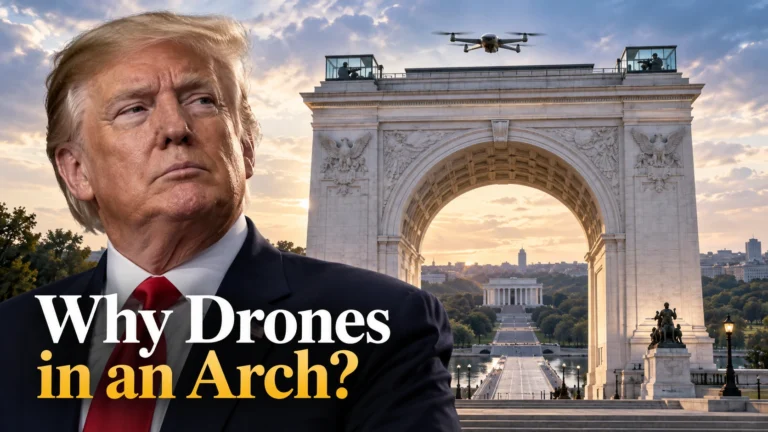
You are watching an NFL game, a cable-news program, or even Saturday Night Live. A 30-second commercial comes on showing President Donald Trump walking through a dark hallway while his voice warns of a “final battle.”
Then, at the end, an unusual line appears:
“Paid for by the U.S. Government.”
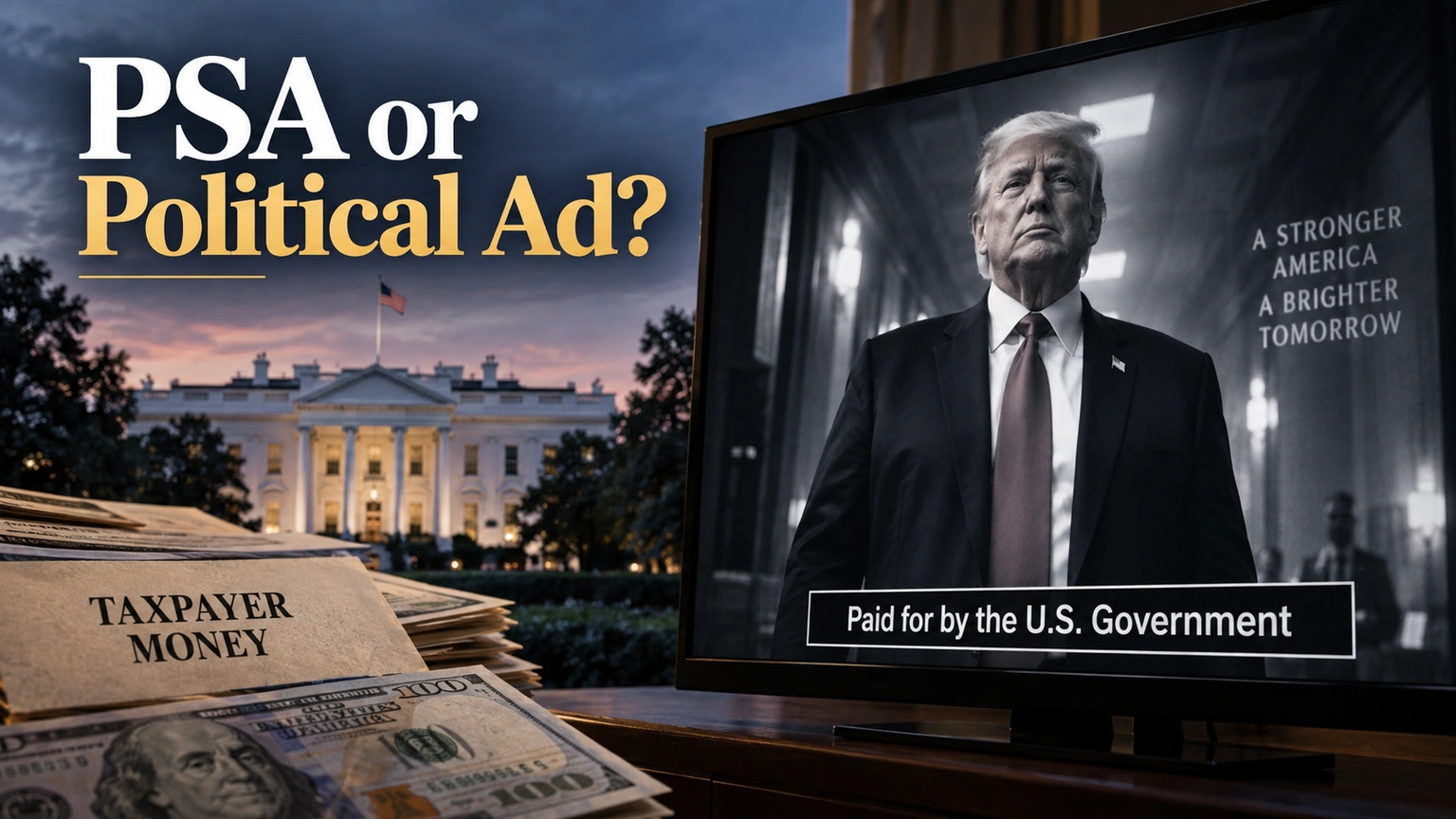
Wait. Can the White House actually spend taxpayer money on television advertising centered on the president?
And if the video closely resembles something Trump used while running for president in 2024, does calling it a “public service announcement” change anything?
The basic answer is more complicated than either “the government can never advertise” or “the president can advertise anything he wants.”
Federal agencies routinely spend public money informing Americans about programs, laws, health campaigns, and government policies. But federal appropriations law also restricts the use of taxpayer money for unauthorized “publicity or propaganda,” and Government Accountability Office decisions have developed tests for when official communications can cross that line. (GAO)
That is why the most important question is not simply whether Trump appears in the ad.
It is what the government is paying to communicate, why it is communicating it, and whether that message remains connected to a legitimate government function rather than a partisan political purpose.
What Changed With the “Final Battle” Ad?
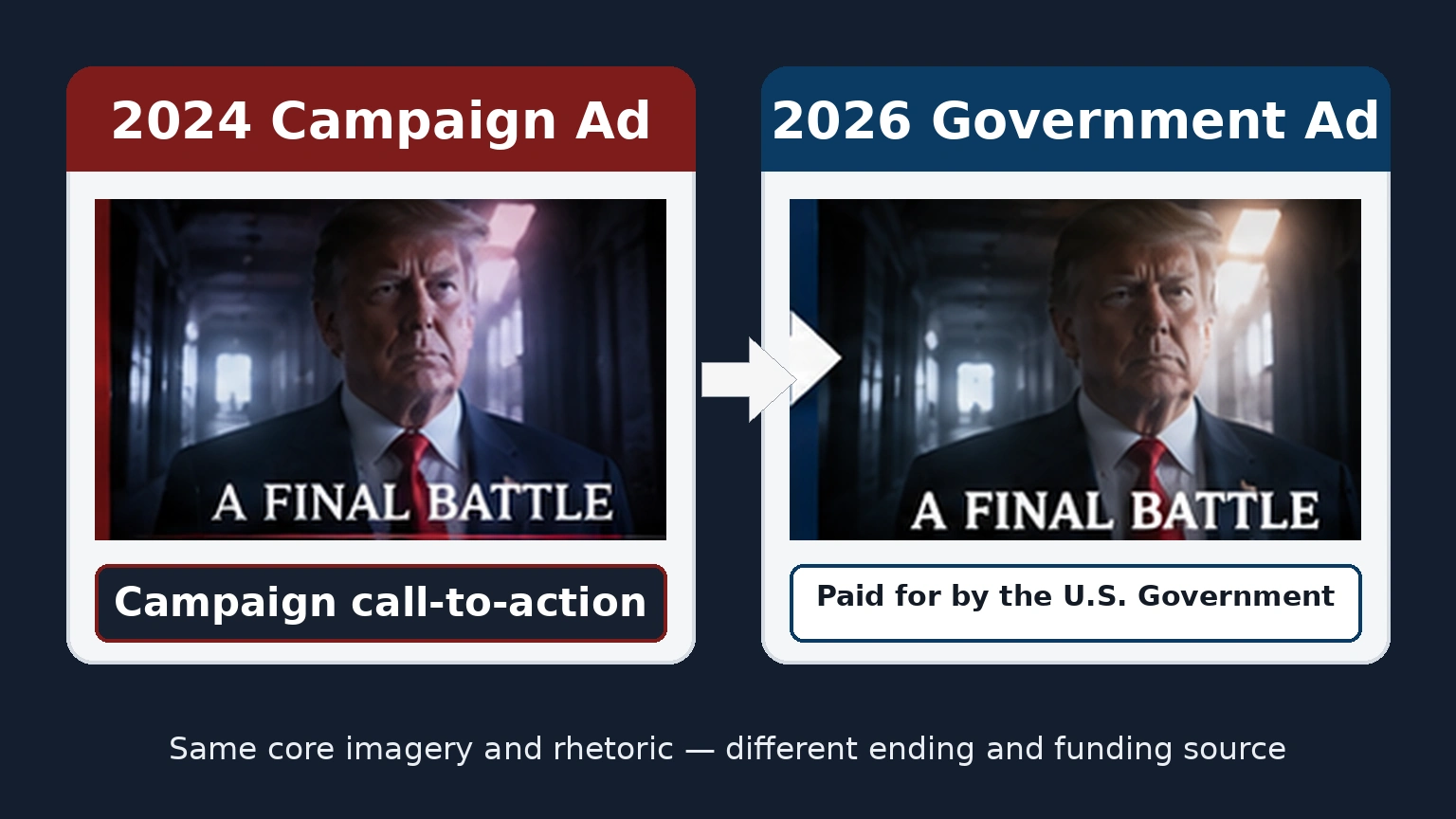
The September 27 development was different from an ordinary presidential policy commercial because the White House aired a video that closely tracked a spot from Trump’s own 2024 campaign.
The 30-second “Final Battle” version shows Trump walking through a hallway while describing a fight against groups he calls the “deep state,” “warmongers,” “globalists,” and other political enemies. The government version ends with the disclosure that it was paid for by the U.S. government. (AP)
The earlier campaign version used closely matching central imagery and rhetoric but ended with a call for viewers to join Trump’s political effort. That campaign call-to-action was removed from the government-funded version. (AP)
The new ad became the third television spot in a series the White House has described as public service announcements. It aired during programs including Fox News Sunday, sporting events, and Saturday Night Live. Ad-tracking data cited by news organizations showed more than $300,000 had already been spent airing the latest spot by Sunday. (Washington Post · AP)
That history matters because the legal question is not being raised in a vacuum.
Critics are asking whether taxpayers are now financing material that grew directly out of presidential campaign messaging.
The White House says something different: the campaign call-to-action is gone, Trump himself is not on the 2026 ballot, and the government message should therefore be understood as an official public-service communication rather than an election advertisement. (White House)
| Version | Who paid? | Main difference at the end |
|---|---|---|
| 2024 version | Trump campaign | Political call-to-action |
| 2026 version | U.S. government | “Paid for by the U.S. Government” disclosure |
The similarity does not by itself answer whether the 2026 version is legal.
But it explains why the dispute became much larger than a routine argument about White House communications.
Why Does “Paid for by the U.S. Government” Matter So Much?
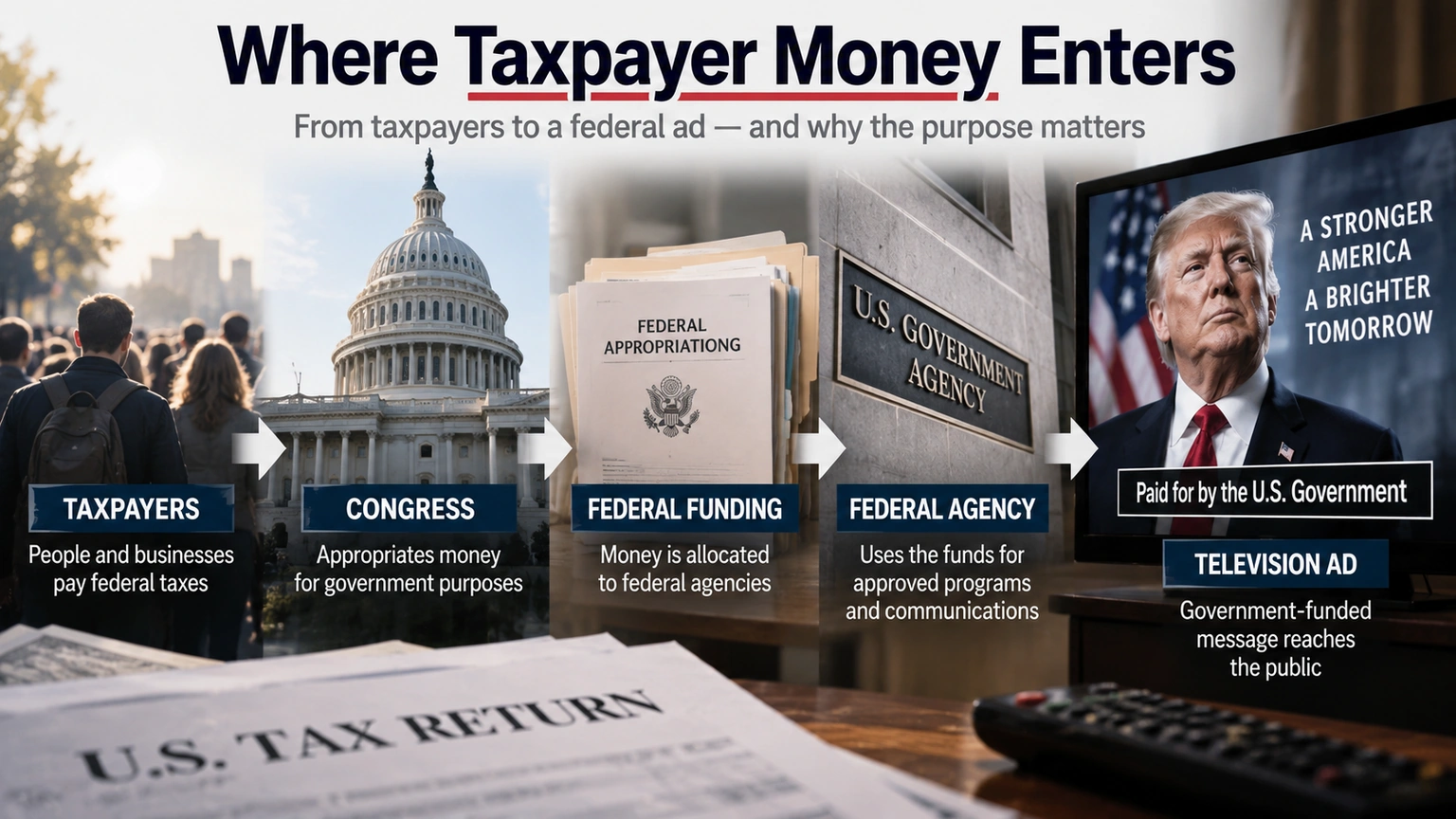
Because public money comes with legal limits that campaign money does not.
A campaign can spend campaign funds promoting its candidate, subject to election and campaign-finance rules.
A federal agency, by contrast, receives money from Congress for governmental purposes. Under the federal “purpose statute,” appropriated money generally must be used for the purposes for which Congress made it available. GAO has repeatedly applied that principle when reviewing government communications. (GAO)
Congress also imposes specific restrictions on unauthorized publicity or propaganda. Democratic congressional appropriators challenging the Trump advertisements cited Section 718 of Division E of the Consolidated Appropriations Act, 2026, which they said bars federal funds from being used for unauthorized publicity or propaganda inside the United States. Their letter states the statutory language and asks the White House to disclose the source and amount of the spending. (U.S. Senate)
There is another unresolved practical question: which federal account actually paid for the advertising?
Reporting on September 27 said it was not clear which government agency was responsible for making and paying for the ads. (Washington Post)
That matters because an appropriations-law review does not look only at the video.
It also asks what money was used and whether that money was legally available for that purpose.
What Does Federal Law Mean by “Publicity or Propaganda”?
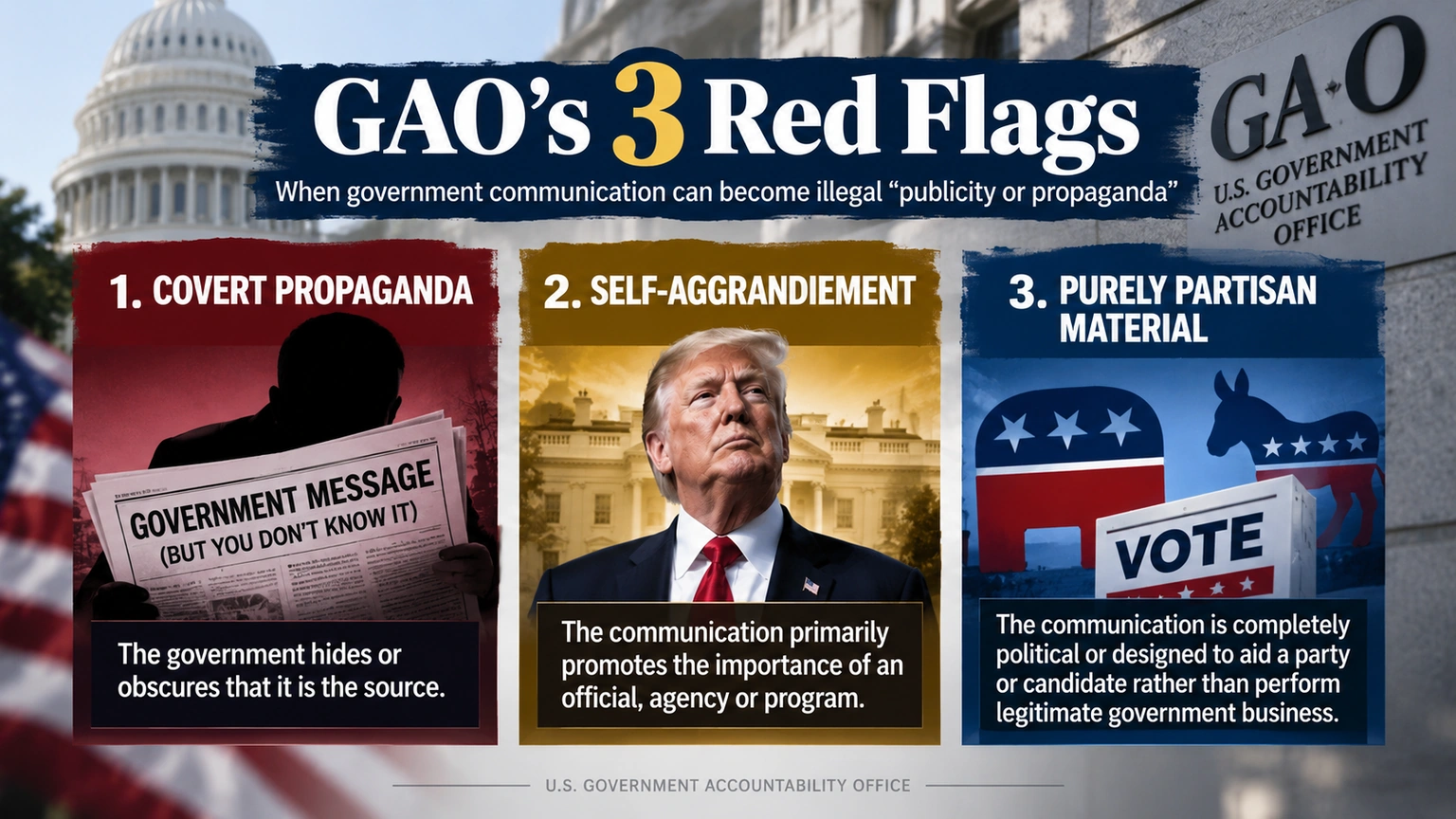
Congress did not write one detailed statutory definition explaining exactly when government communication becomes propaganda.
Much of the practical framework comes from decades of GAO decisions.
GAO generally identifies three problematic categories:
| Category | What GAO looks for |
|---|---|
| Covert propaganda | The government hides or obscures that it is the source |
| Self-aggrandizement | The communication primarily promotes the importance of an official, agency, or program |
| Purely partisan material | The communication has no connection to official duties and is completely political in nature |
(GAO)
The first category is comparatively easy to understand.
If the government secretly creates material and makes the public think it came from an independent source, that can be covert propaganda.
That does not appear to be the central issue with these television ads because the spots explicitly disclose that the U.S. government paid for them.
The more difficult questions involve self-promotion and partisanship.
GAO has repeatedly recognized that presidents and executive agencies are allowed to explain and defend their policies.
An administration does not lose its ability to communicate just because its policies are politically controversial. Government communication can support or defend administration policy without automatically becoming unlawful partisan propaganda. (GAO)
That creates a difficult line:
Explaining why the administration believes a policy is good is one thing. Using government money primarily to promote an officeholder or political movement is a different legal question.
The current dispute is about where these advertisements fall between those points.
Does Reusing a Campaign Ad Automatically Make the Government Version Illegal?
No. The campaign origin is important evidence about the character of the message, but federal appropriations law does not create a simple rule saying that any image or phrase ever used in a campaign becomes permanently off-limits to the government.
GAO’s approach has generally focused on purpose and connection to official governmental duties. (GAO)
That distinction helps explain why the two sides are talking past each other.
| White House position | Critics’ position | Legal question underneath |
|---|---|---|
| Trump is not on the 2026 ballot | Congressional candidates are on the ballot | Is the message designed to affect partisan political success? |
| There is no request to vote | The language closely mirrors campaign messaging | Does removing a call-to-action change the communication’s purpose? |
| Presidents have long appeared in government PSAs | The ads focus heavily on Trump rather than one clearly defined public program | Is the message connected closely enough to an official government function? |
| The government is clearly identified as the sponsor | Disclosure mainly answers the source-identification question | Could the ad still be self-aggrandizing or purely partisan? |
The White House argues that the advertisements are patriotic PSAs intended to communicate the administration’s direction and values.
In its September 25 response, it emphasized that Trump is not a candidate in the November 2026 election and that the ads contain no electoral call-to-action. (White House)
Critics point to something else: the timing before the midterms, the campaign-style rhetoric, and the reuse of material created for Trump’s presidential campaign.
Several Democratic appropriators formally demanded that the ads be removed and requested an accounting of the federal money used. Republican Sen. John Kennedy also publicly questioned the use of public money for advertisements promoting officeholders, while saying the White House viewed the issue differently. (U.S. Senate · Washington Post)
That last distinction is important.
A lawmaker calling an advertisement inappropriate or illegal is a political or legal position.
It is not the same thing as a GAO, OSC, or court determination that the law was violated.
What Does the Hatch Act Have to Do With This?
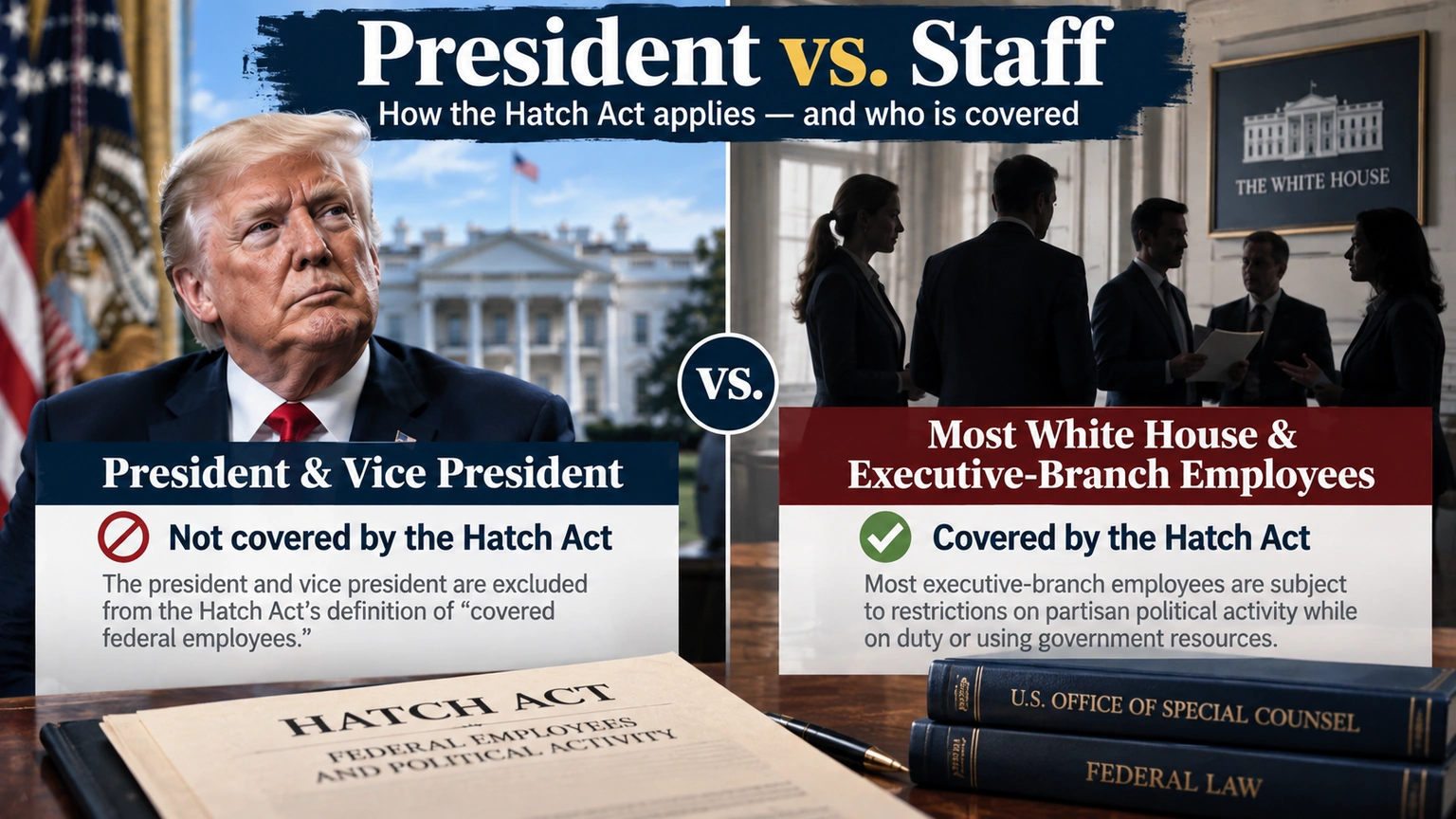
The Hatch Act is a separate issue from the appropriations-law restriction.
It generally limits partisan political activity by federal employees, including using official authority to interfere with or affect an election and engaging in certain political activity while on duty or using government resources.
But there is an important exception many headlines can obscure:
The president and vice president themselves are expressly excluded from the Hatch Act definition of covered federal employees. Most federal civilian executive-branch employees, including White House staff, are covered. (U.S. Office of Special Counsel)
That means a Hatch Act inquiry would focus less on the fact that Trump appears in the video and more on questions such as:
Who created it?
Who approved the media purchase?
Which federal employees worked on it?
Was their work official government communication, or was it political activity directed toward the success or failure of a political party or candidates?
Public Citizen filed a complaint with the GAO and the Office of Special Counsel on September 25 arguing that White House staff involved in the ads crossed that line. That is an allegation submitted for review, not an official finding that a violation occurred. (Public Citizen)
So there are really two legal tracks:
appropriations law asks whether public money was properly used,
while the Hatch Act can ask whether covered federal employees engaged in prohibited partisan political activity.
Haven’t Previous Presidents Used Taxpayer-Funded Television Ads?
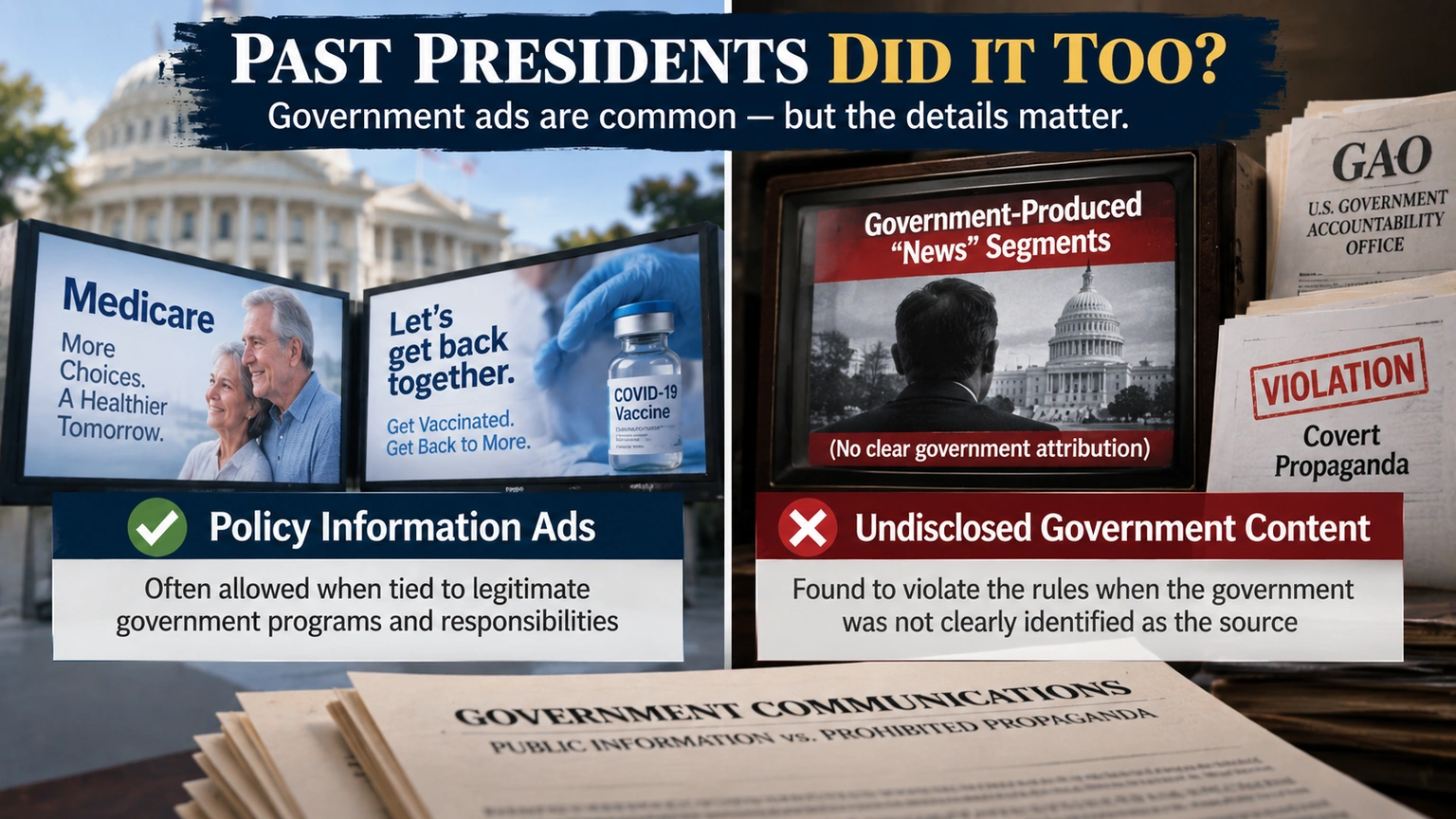
Yes—and this is one reason the legal question is not as simple as it first appears.
The White House has pointed to taxpayer-funded communications under previous Republican and Democratic administrations, including Medicare education under President George W. Bush and COVID-19 vaccination campaigns under President Joe Biden. (White House)
Those examples show that government-paid advertising itself is normal.
What matters is what the government is advertising and how the communication is structured.
A particularly useful example comes from the Bush administration’s Medicare campaign because GAO reached different conclusions about different communications connected to the same policy.
In March 2004, GAO reviewed HHS flyers, print ads, and television advertisements explaining the new Medicare prescription-drug law. GAO concluded the materials did not violate the publicity-or-propaganda restriction because HHS had authority to inform Medicare beneficiaries about the changes, even though GAO noted weaknesses in the materials. (GAO)
Two months later, GAO reached a different conclusion about government-produced “video news releases” on Medicare.
Those segments were presented like independent television news reports without clearly telling viewers that the federal government had produced them. GAO found that lack of attribution made them covert propaganda. (GAO)
Put those decisions together and the rule becomes easier to see:
Government communication is not prohibited merely because it supports the administration.
But how the material is presented, what it is promoting, whether the government identifies itself, and whether the communication is tied to an official public purpose can change the legal outcome.
That history is more useful than simply saying that “other presidents ran PSAs too.”
Who Actually Decides Whether These Ads Cross the Line?
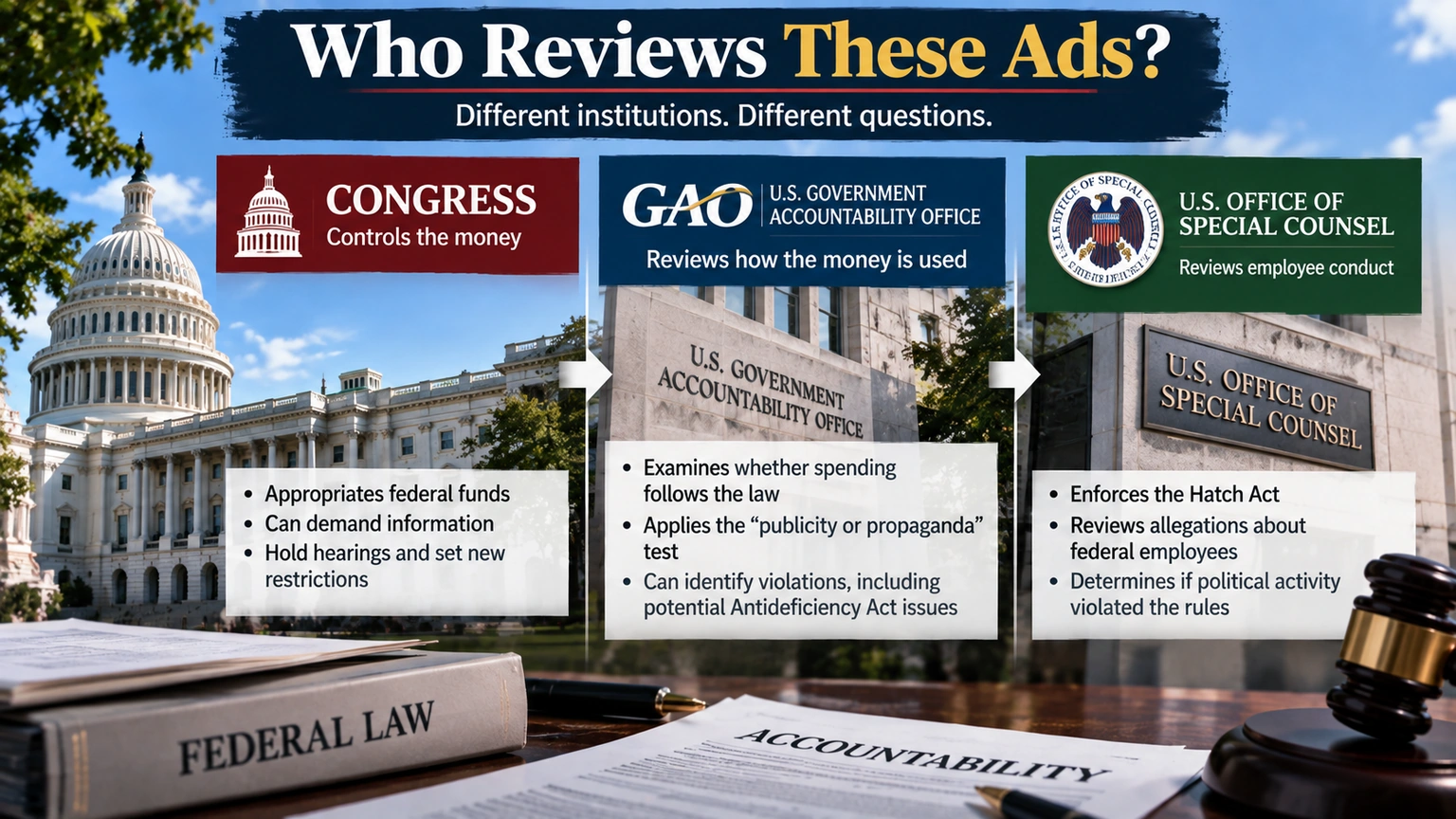
There is no single “government advertising court” that automatically reviews every federal commercial before it airs.
Different institutions handle different parts of the problem.
Congress controls appropriations and can demand information about which funds were used, hold hearings, impose new restrictions, or ask GAO for a legal opinion.
GAO, Congress’s nonpartisan investigative arm, can examine whether appropriated money was legally available for a communication and whether a publicity-or-propaganda restriction was violated.
In past cases, improper use of appropriated money has sometimes led GAO to conclude that an agency also incurred obligations in violation of the Antideficiency Act, which carries reporting requirements. That occurred in the 2004 Medicare video-news-release case. (GAO)
The Office of Special Counsel handles Hatch Act matters involving covered federal employees. (U.S. Office of Special Counsel)
That means public accusations, congressional letters, and watchdog complaints are only the beginning of the legal process.
The decisive questions require evidence about the advertisements’ purpose, production, funding source, and the federal employees involved.
What Should You Watch Next?
The first thing to watch is the money trail.
If the administration identifies the federal account used to pay for the advertisements, that will make it easier to determine what legal authority supported the spending and whether Congress appropriated that money for a purpose reasonably connected to the ads.
The second is whether GAO or the Office of Special Counsel formally reviews the complaints and what legal test each applies.
The third is whether the White House changes the content of future advertisements.
An ad explaining a specific tax law, Medicare change, emergency warning, or government benefit has an obvious connection to a government program.
An advertisement focused primarily on the president, campaign-style themes, or partisan opponents creates a harder legal question because the connection to a specific government program may be less clear.
The fourth is scale.
This did not remain a one-off commercial. The administration expanded the campaign across multiple television programs and sporting events, and the latest spot itself accumulated more than $300,000 in tracked spending within days. By September 29, AP reported that total taxpayer-funded spending across the three advertising campaigns had reached nearly $1.5 million. (AP · Washington Post)
That makes the unanswered funding and legal questions more consequential than they would be for a single government video posted online.
Bottom Line: What This Story Really Means
The federal government can spend taxpayer money on public information and on communications defending an administration’s policies.
There is no rule saying a president may never appear in a government advertisement.
But public money cannot simply be treated like campaign money.
Federal appropriations restrictions and GAO precedent draw legal lines around covert propaganda, self-aggrandizing communications, and material that is purely partisan rather than connected to legitimate official duties.
The controversy over Trump’s 2026 advertisements is unusually sharp because one of the government-funded spots closely resembles a video created for his 2024 presidential campaign, while the campaign call-to-action was removed and a U.S. government payment disclosure was added. The White House says that makes the spot a lawful public service announcement; critics say the campaign-style message remains political.
So the key fact is not that anyone has already proved the ads illegal.
The key fact is that the ads raise a concrete legal boundary question about when official government communication becomes taxpayer-funded partisan promotion.
Where that boundary falls will depend on the funding source, the ads’ purpose, and any formal review by the institutions responsible for applying those rules.
Trump Taxpayer-Funded Ads: Key Questions Explained
Q. Is it illegal for the federal government to pay for television advertisements?
No. Federal agencies routinely use appropriated money for public education, program information, safety messages, and explanations of government policy.
Q. Is it illegal for the president to appear in a taxpayer-funded advertisement?
Not automatically. The legal question depends on the purpose and content of the communication and whether the expenditure is connected to legitimate government business.
Q. Why is the September 27 Trump ad especially controversial?
Because its central video and rhetoric closely resemble a spot from Trump’s 2024 presidential campaign, while the new version was paid for by the U.S. government.
Q. Does the “Paid for by the U.S. Government” disclosure make the ad legal?
No single disclosure settles the entire issue. It makes the government’s sponsorship clear, which is important for the covert-propaganda analysis, but separate questions about self-aggrandizement or purely partisan purpose can remain.
Q. What does GAO consider prohibited government propaganda?
GAO has generally identified three categories: covert propaganda, self-aggrandizing communications, and material that is purely partisan rather than legitimately connected to official government duties.
Q. Does it matter that Trump is not on the 2026 ballot?
It is part of the White House’s defense, but it does not by itself resolve every appropriations-law or Hatch Act question. Critics argue that government messaging can still affect partisan interests even when the president is not personally running.
Q. Does the Hatch Act apply directly to President Trump?
No. The president and vice president are expressly excluded from the Hatch Act definition of covered federal employees. Most White House and executive-branch employees are covered.
Q. Have previous administrations paid for government advertising?
Yes. Presidents of both parties have used federal money for public-information campaigns involving issues such as Medicare, public health, and vaccination.
Q. Did GAO approve every previous presidential PSA?
No. GAO has upheld some policy-information campaigns while finding other government communications unlawful. The message, purpose, attribution, and connection to official duties matter.
Q. Who can review the Trump advertisements?
Congress can conduct oversight and request information, GAO can review appropriations-law questions, and the Office of Special Counsel can examine potential Hatch Act violations involving covered federal employees.
Did this help make the story clearer? 🙂
WIN keeps unpacking the “why” behind the news—clearly and simply!
Sources
The Ads and the White House’s Position
AP — Trump administration begins airing 2024 Trump campaign ad in latest taxpayer-funded messaging
AP — Taxpayers have funded nearly $1.5 million in pro-Trump ads as criticism mounts
The Washington Post — White House expands taxpayer-paid ad campaign boosting Trump
The White House — Presidential Public Service Announcements Are Nothing New
Federal Appropriations and Government-Communication Rules
U.S. GAO — Application of Anti-Lobbying and Publicity or Propaganda Provisions
U.S. GAO — Medicare Prescription Drug Act Advertising Decision
U.S. GAO — Medicare Video News Releases Decision
Congressional and Hatch Act Oversight
U.S. Senate — Appropriators’ Letter on the Taxpayer-Funded White House Ads
U.S. Office of Special Counsel — Federal Employee Hatch Act Rules
Public Citizen — Complaint Filed With GAO and OSC
Keep Reading
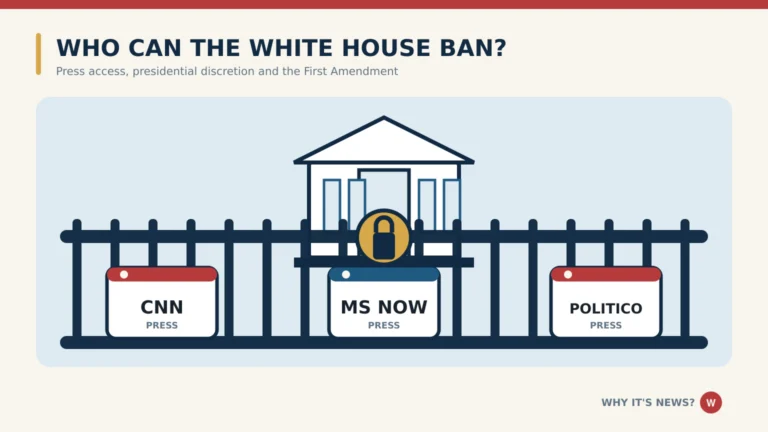
How Far Can the White House Go When It Uses Government Power Against News Organizations?
This ad dispute asks where official government communication ends and partisan political activity may begin. A separate White House fight examines another boundary on presidential power: when the government can restrict established press access because of disputes over news coverage.
Can the White House Ban Entire News Organizations—and What Happens If They Sue?