Did Two Oil Tankers Hit Mines in the Strait of Hormuz—and Why Does It Matter?

Two enormous oil tankers reportedly struck naval mines and caught fire in one of the world’s most important shipping lanes.
That sounds like a major escalation. But there’s an important detail: the account came from Iran’s Revolutionary Guards, and the reported mine strikes have not been independently confirmed.
On October 17, 2026, Iranian authorities said two tankers carrying roughly 2 million barrels of crude oil each had encountered mines while trying to pass through the Strait of Hormuz. Iranian state media also alleged that the vessels had used routes not authorized by Tehran. (Reuters · Anadolu Agency)
The immediate question is whether the reported incidents happened as described.
But there’s another question that reaches far beyond those two vessels: How can one narrow stretch of water give Iran so much influence over global energy markets—even when the United States disputes its control?
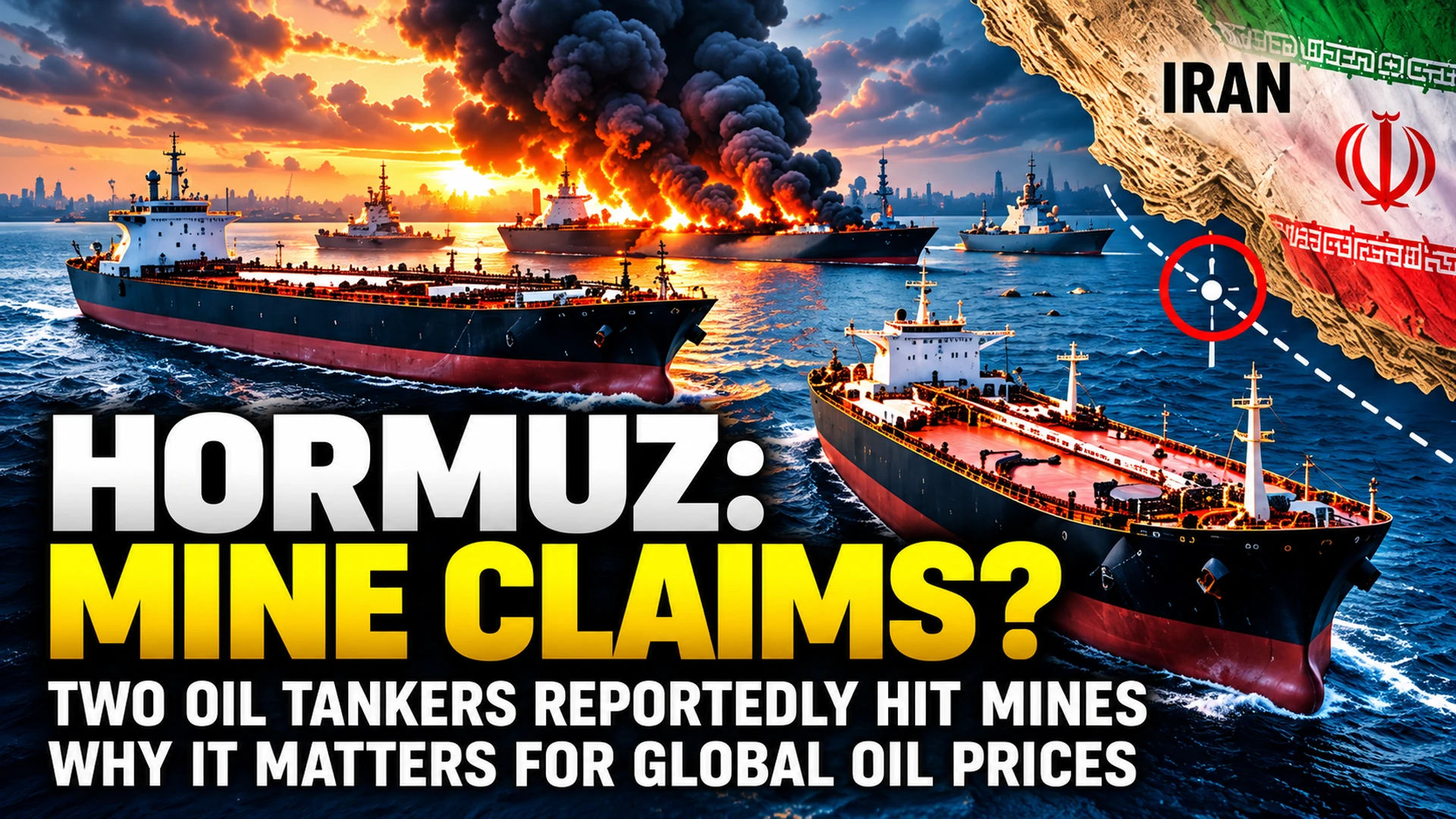
※ Images in this article are AI-generated illustrations created to help explain the story. They are not actual photographs, and depictions of people, places, or events may differ slightly from reality.
The answer involves three things that are often confused: what Iran claims happened, who can safely move through the strait, and why shipping risks can affect oil prices even without a confirmed loss of supply.
What Do We Actually Know About the Two Tanker Reports?
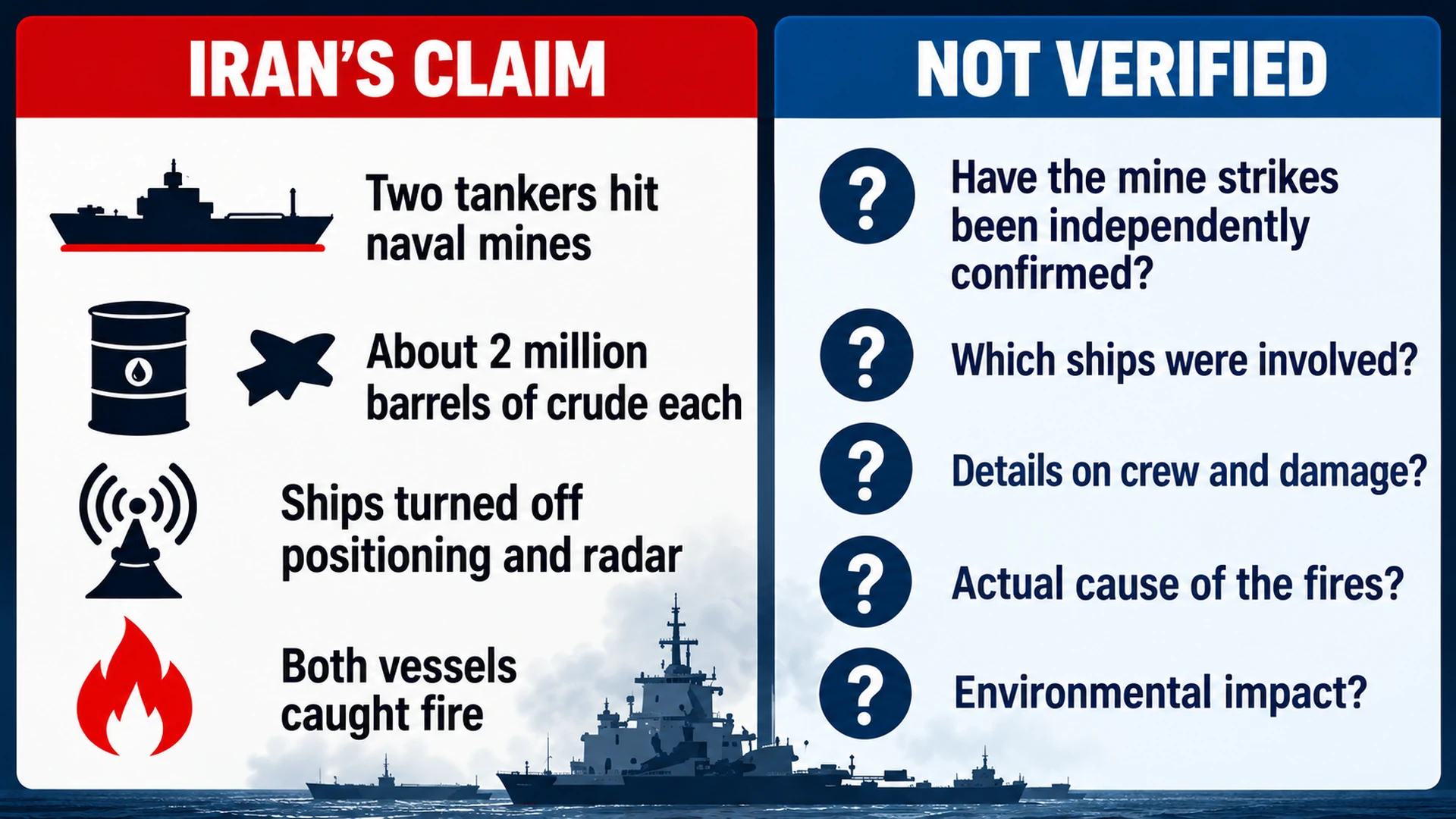
What is confirmed is that Iran’s Revolutionary Guards made the announcement. What remains unverified is whether the two vessels actually struck mines as described.
According to the Iranian account, both ships were carrying approximately 2 million barrels of crude oil. The Guards alleged that the vessels had turned off positioning and radar systems and attempted to use unauthorized routes.
The second tanker was reportedly left unable to move after an explosion. Iranian reporting did not establish the identities of the vessels or provide independently verifiable details about their crews and possible environmental damage. (Reuters · Anadolu Agency)
Here’s the distinction:
| Reported detail | What can be established |
|---|---|
| Two tankers struck naval mines | Iranian official claim; not independently confirmed |
| Both ships were carrying roughly 2 million barrels each | Iranian media account; cargo details not independently confirmed |
| Ships turned off positioning and radar equipment | Iranian allegation |
| Both vessels caught fire | Iranian claim; independent confirmation unavailable |
| Ship identities, casualties, and pollution | Not established by the available reporting |
A video circulated by Iranian media appeared to show a vessel on fire. But footage alone does not establish a ship’s identity, when or where the images were recorded, or what caused a fire. (Euronews)
There is also an important difference between a reported cargo volume and a confirmed oil spill. A vessel carrying 2 million barrels does not mean 2 million barrels have been destroyed or released into the sea.
So the October 17 account should be understood as a serious allegation amid a dangerous shipping crisis—not yet as a fully documented maritime disaster.
Why Is the Strait of Hormuz So Important to the World’s Oil Supply?
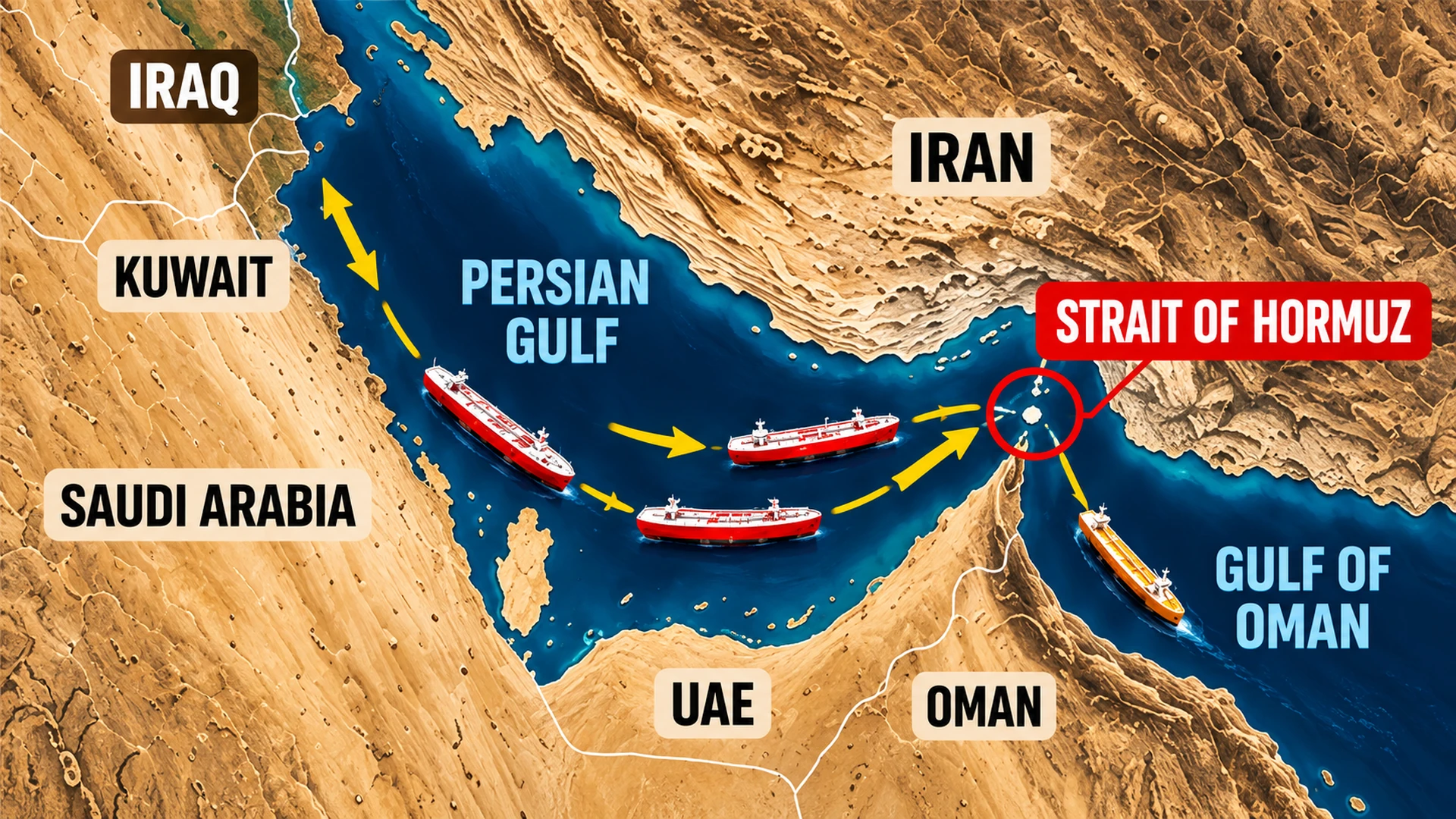
The Strait of Hormuz is a narrow maritime passage connecting the Persian Gulf with the Gulf of Oman and, beyond it, the Arabian Sea. Oil-producing countries around the Persian Gulf depend on it to reach customers around the world.
Iran lies along its northern side, while Oman borders the southern side. The United Arab Emirates is nearby, and much of the oil exported from Saudi Arabia, Iraq, Kuwait, and other Gulf producers has historically passed through the strait.
Think of it as a doorway serving several of the world’s most important oil exporters.
The United States might produce a great deal of its own oil, but that does not make American consumers immune to problems at this doorway. Oil is traded in an interconnected global market.
Before the 2026 conflict severely disrupted shipping, the volume moving through Hormuz was enormous.
The U.S. Energy Information Administration estimated that 21.6 million barrels of oil and petroleum liquids per day traveled through the strait in the fourth quarter of 2025. Historically, Hormuz handled volumes equivalent to roughly one-fifth of global petroleum consumption. These are pre-conflict benchmarks, not estimates of traffic on October 17, 2026. (U.S. EIA · U.S. EIA)
And oil is not the only concern.
Liquefied natural gas, or LNG, also travels through the strait, making disruptions important for electricity and heating costs in countries that depend on imported gas.
The geography explains why shipping companies are concerned. There is no equally convenient sea passage that allows every Persian Gulf exporter to bypass Hormuz.
Saudi Arabia and the UAE have pipeline routes that can move some oil around the strait. But those alternatives cannot replace all the shipping capacity normally available through it.
When this narrow passage becomes dangerous, the problem affects an entire international supply network—not just ships traveling near Iran.
What Exactly Is a Naval Mine, and Why Is It So Dangerous?
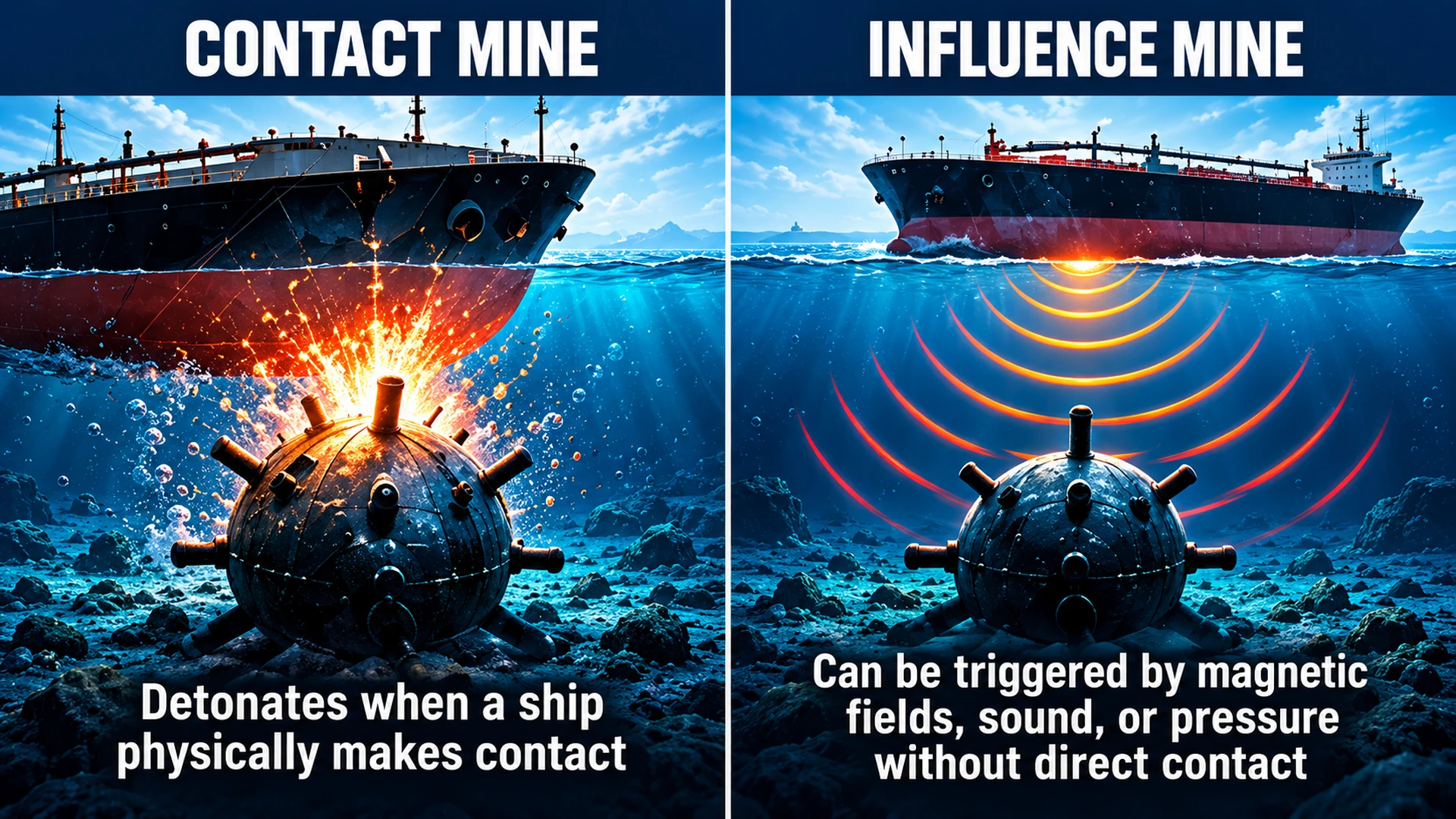
A naval mine is an explosive device placed in water to threaten or prevent the passage of vessels.
Unlike a missile, which is launched toward a target, a mine can remain in position until a vessel triggers it.
There are different mechanisms:
| Type | Basic operation |
|---|---|
| Contact mine | Detonates when a vessel physically makes contact |
| Magnetic influence mine | Reacts to changes in magnetic fields caused by a vessel |
| Acoustic influence mine | Responds to certain underwater sounds |
| Pressure influence mine | Responds to changes in water pressure associated with a passing vessel |
These are general categories described in U.S. Navy materials, not confirmed descriptions of the devices involved in Iran’s October 17 claims. (U.S. Naval History and Heritage Command)
The most troubling feature is that a naval mine does not necessarily have to be visible from a ship’s bridge.
Some mines can be located below the surface, and some can be activated without physical contact.
That creates a difficult problem for civilian shipping.
A tanker operator may not be able to determine from ordinary navigation information whether a particular area is safe. Specialized surveys and mine-countermeasure operations may be needed to establish a safer route.
Mines also produce a wider economic effect.
Even if relatively few ships are physically damaged, the suspected presence of mines can cause other operators to delay departures, demand greater protection, or avoid particular waters.
That uncertainty can be enough to disrupt transportation.
But there is still no publicly established evidence identifying the devices allegedly involved in the October 17 tanker reports. Their reported cause must not be confused with a verified technical finding.
Why Is Iran Trying to Control Which Routes Ships Use?
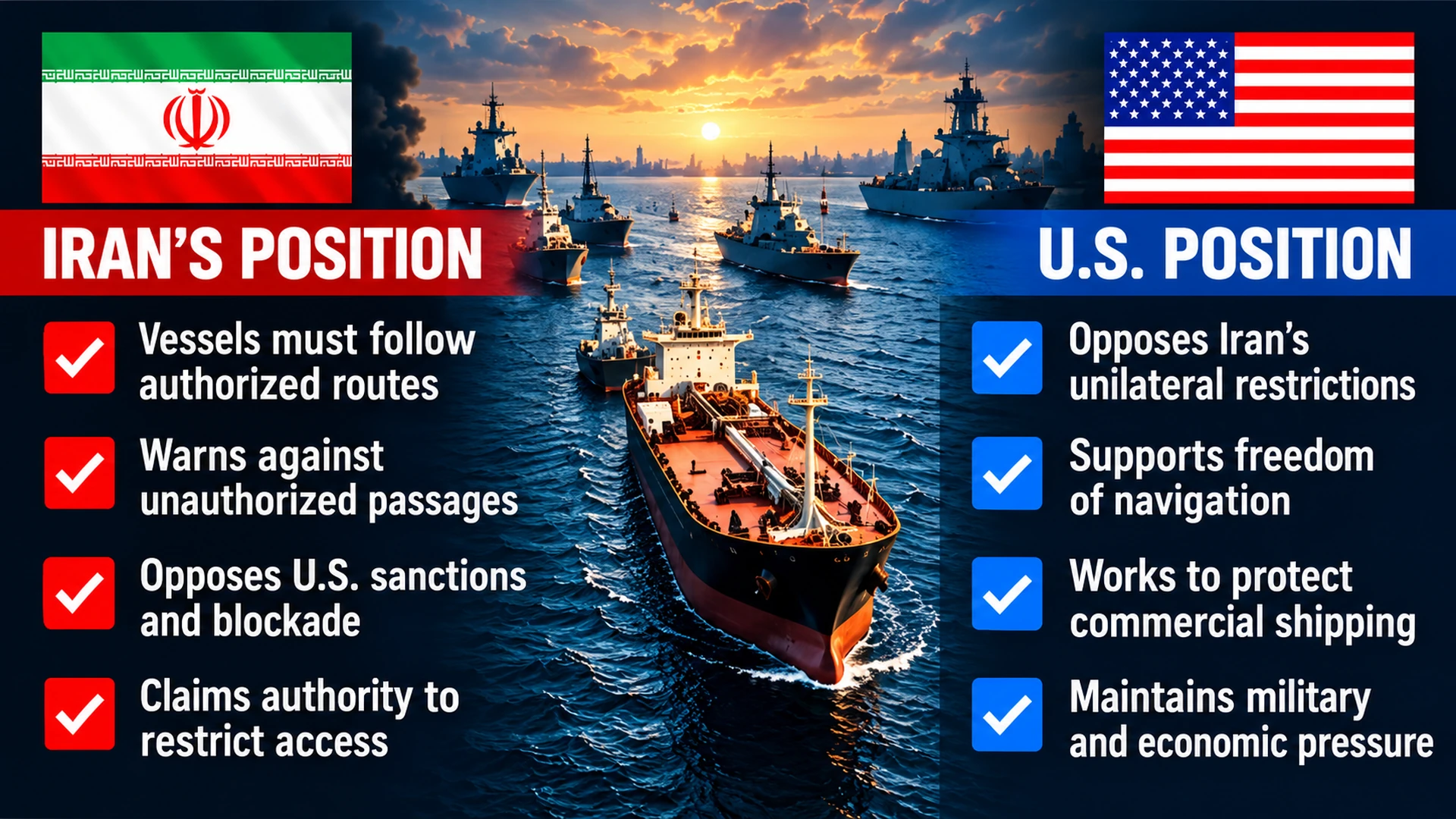
Iran is using restrictions on shipping routes as part of its broader confrontation with the United States. By warning vessels against routes it has not authorized, Tehran seeks to influence how ships use a waterway central to international trade.
But Iran’s position is sharply contested.
The latest tanker reports came amid a conflict involving Iran, the United States, and Israel, along with intensified American economic pressure on Iran.
Iran’s Revolutionary Guards have declared the strait closed to traffic that does not comply with their restrictions. The United States, meanwhile, has maintained that commercial ships should be able to navigate the waterway and has rejected Tehran’s claim to control it. (Euronews)
The distinction becomes clearer when their positions are placed side by side.
| Issue | Iran’s position | U.S. position |
|---|---|---|
| Shipping access | Iran insists vessels follow routes it authorizes | Washington opposes Iran’s unilateral restrictions |
| Maritime security | Tehran warns against attempting unauthorized passages | U.S. forces say they are working to protect commercial navigation |
| Military and economic pressure | Iran opposes the U.S. blockade and sanctions | Washington uses military and economic pressure against Iran |
| Control of Hormuz | Iran claims authority to restrict access | U.S. officials dispute Iran’s claimed control |
The U.S. military announced its support for a maritime security operation called Project Freedom in May 2026, intended to help restore commercial navigation while maintaining pressure on Iran. (U.S. Central Command)
This leads to a question that can sound contradictory.
If the United States says the strait is open, why are ships still coming under attack?
Because the legal and political position that a waterway should remain open is not the same as a guarantee that every voyage is safe.
A shipping route can remain physically passable while still presenting serious risks from missiles, drones, mines, or other attacks.
That is why statements about who controls the strait need to be distinguished from what ship operators experience on the water.
How Did the Situation Become So Dangerous?
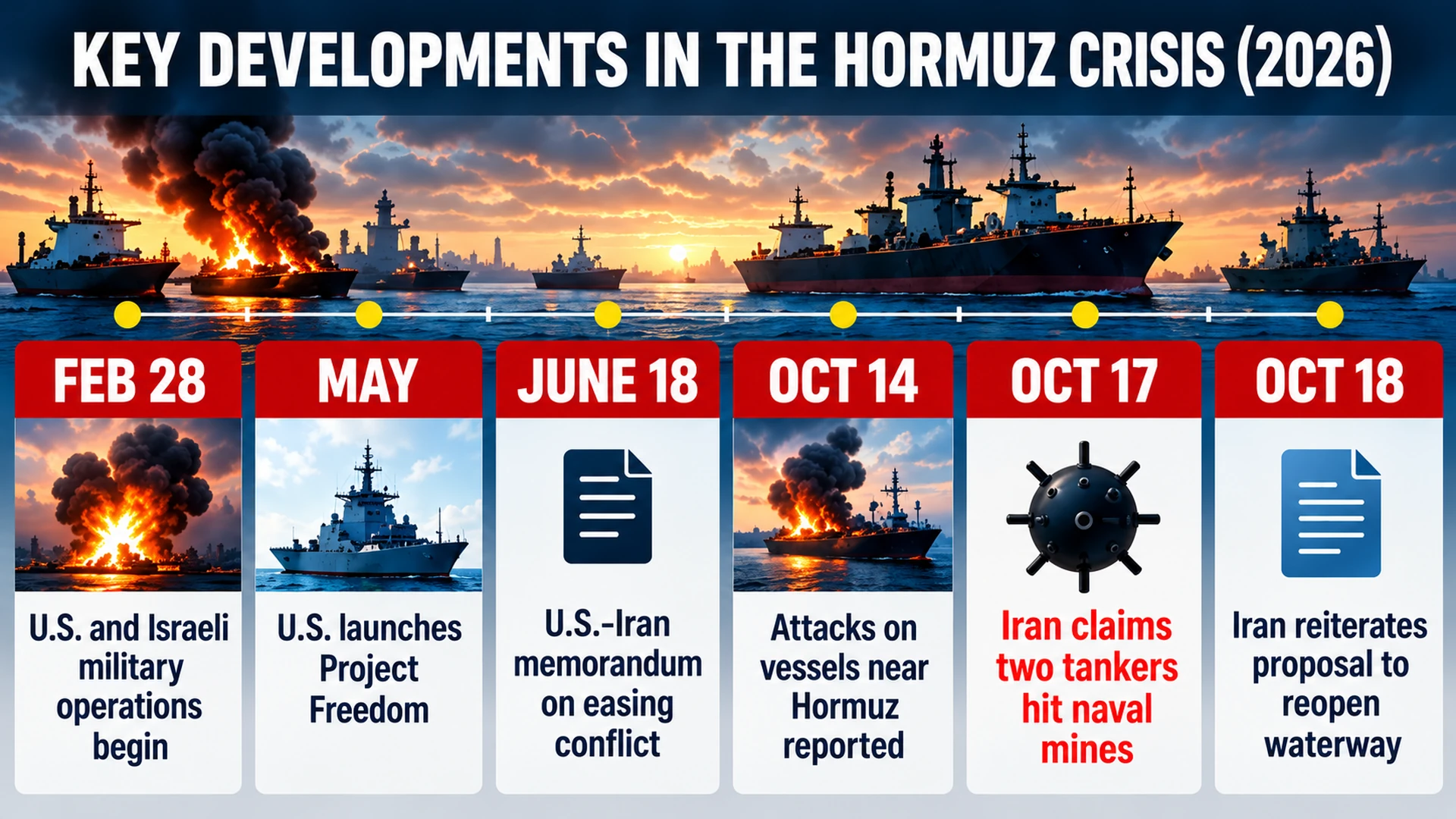
The October 17 tanker claims did not emerge from a previously peaceful shipping route.
They followed months of military confrontation, temporary diplomatic efforts, renewed attacks, and repeated disputes over access to the strait.
Here’s how the principal developments connect:
| Date | Development |
|---|---|
| February 28, 2026 | U.S. and Israeli military operations against Iran begin the current conflict |
| May 2026 | U.S. Central Command announces support for Project Freedom to protect commercial navigation |
| June 17, 2026 | The United States and Iran announce an interim memorandum of understanding aimed at easing the war and reopening shipping |
| September–October 2026 | Renewed American pressure and intensified attacks on vessels increase shipping risks |
| October 14, 2026 | Reports of separate attacks near Hormuz include a container ship and a bulk carrier that sank |
| October 17, 2026 | Iran’s Revolutionary Guards claim two oil tankers struck naval mines |
| October 18, 2026 | Iran reiterates a conditional proposal for reopening the strait |
These developments are documented across American military statements and subsequent reporting. (U.S. Central Command · Reuters · Reuters · Reuters)
The distinction between the October 14 and October 17 incidents matters.
The earlier reports involved vessels struck by projectiles, with information obtained from maritime sources and national shipping authorities. The later Iranian account specifically alleged naval mine strikes.
Those are not interchangeable descriptions.
A projectile attack does not establish the presence of naval mines, and an Iranian statement that a ship hit a mine does not independently establish that a mine caused the damage.
The broader situation is dangerous regardless of whether the latest mine claims are eventually confirmed. Commercial ships have faced repeated threats, and the risk has extended beyond oil tankers to other cargo vessels.
The October 17 reports therefore fit into a prolonged maritime security crisis rather than an isolated event.
How Much Has Oil Shipping Through Hormuz Already Changed?
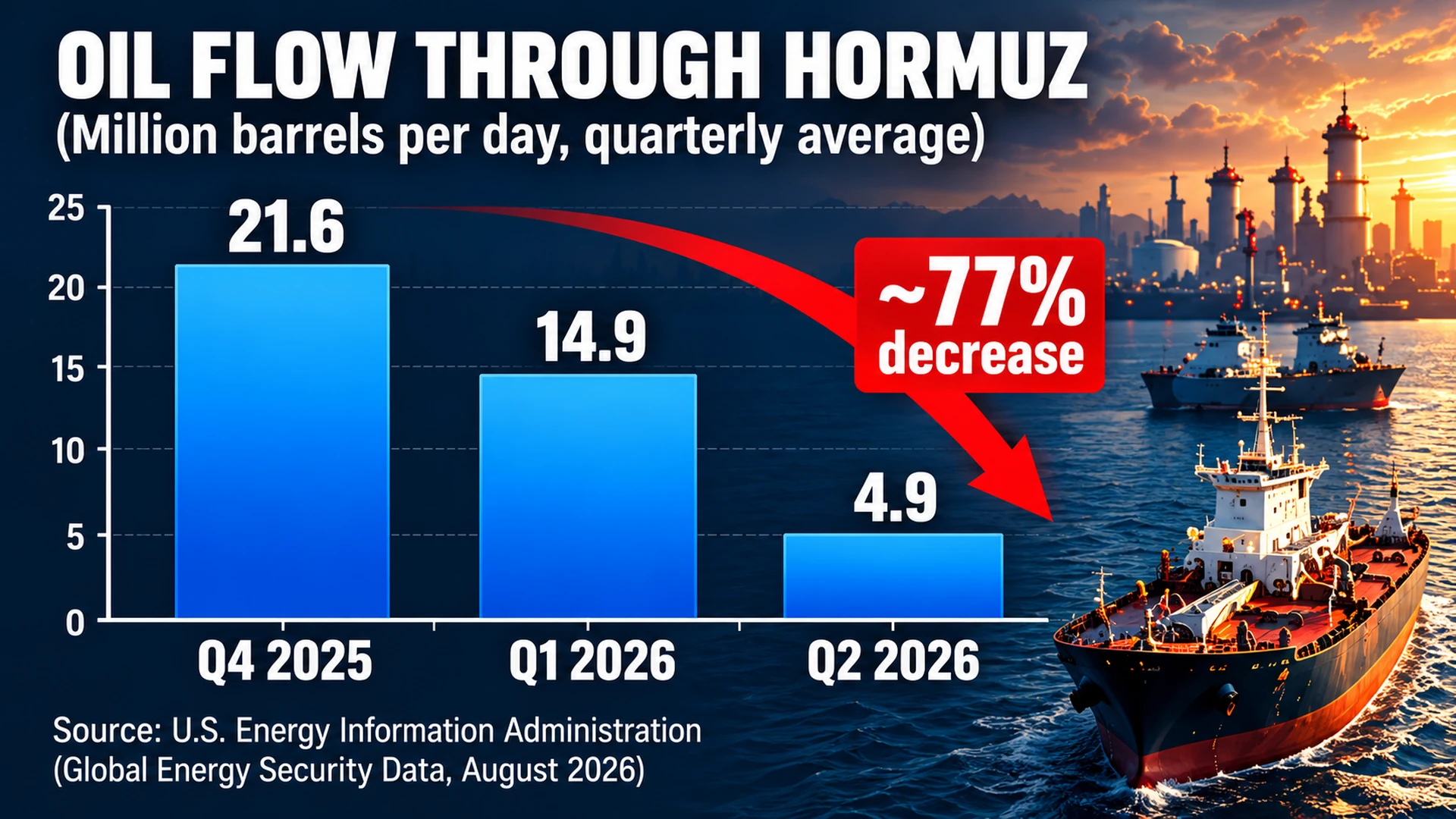
The shipping disruption has already been substantial.
The U.S. Energy Information Administration’s August 2026 global energy security data showed that oil and petroleum liquids moving through Hormuz had fallen sharply from their prewar level.
| Period | Average oil flow through Hormuz |
|---|---|
| Q4 2025 | 21.6 million barrels per day |
| Q1 2026 | 14.9 million barrels per day |
| Q2 2026 | 4.9 million barrels per day |
Source: U.S. Energy Information Administration, August 2026 Global Energy Security Data; historical figures also reported by S&P Global.
The second-quarter estimate was approximately 77% lower than the final quarter of 2025.
That does not mean 77% of the world’s oil disappeared.
It means the estimated volume moving through that particular waterway fell by roughly that proportion between those periods. Some shipments used alternative routes, while other production or transportation was disrupted.
The EIA has also cautioned that vessel-tracking information became especially unreliable during the conflict, making its estimates subject to revision.
And because these figures represent historical quarterly averages, they should not be mistaken for a measurement of traffic on October 17.
Still, the comparison demonstrates something important: the economic consequences of the Hormuz crisis were already substantial before the latest tanker claims.
An uncertain security environment can keep ships away even when a route is technically open.
That can leave oil producers searching for other export paths and buyers paying more to secure deliveries.
Could the Tanker Mine Reports Make Gasoline More Expensive in the United States?
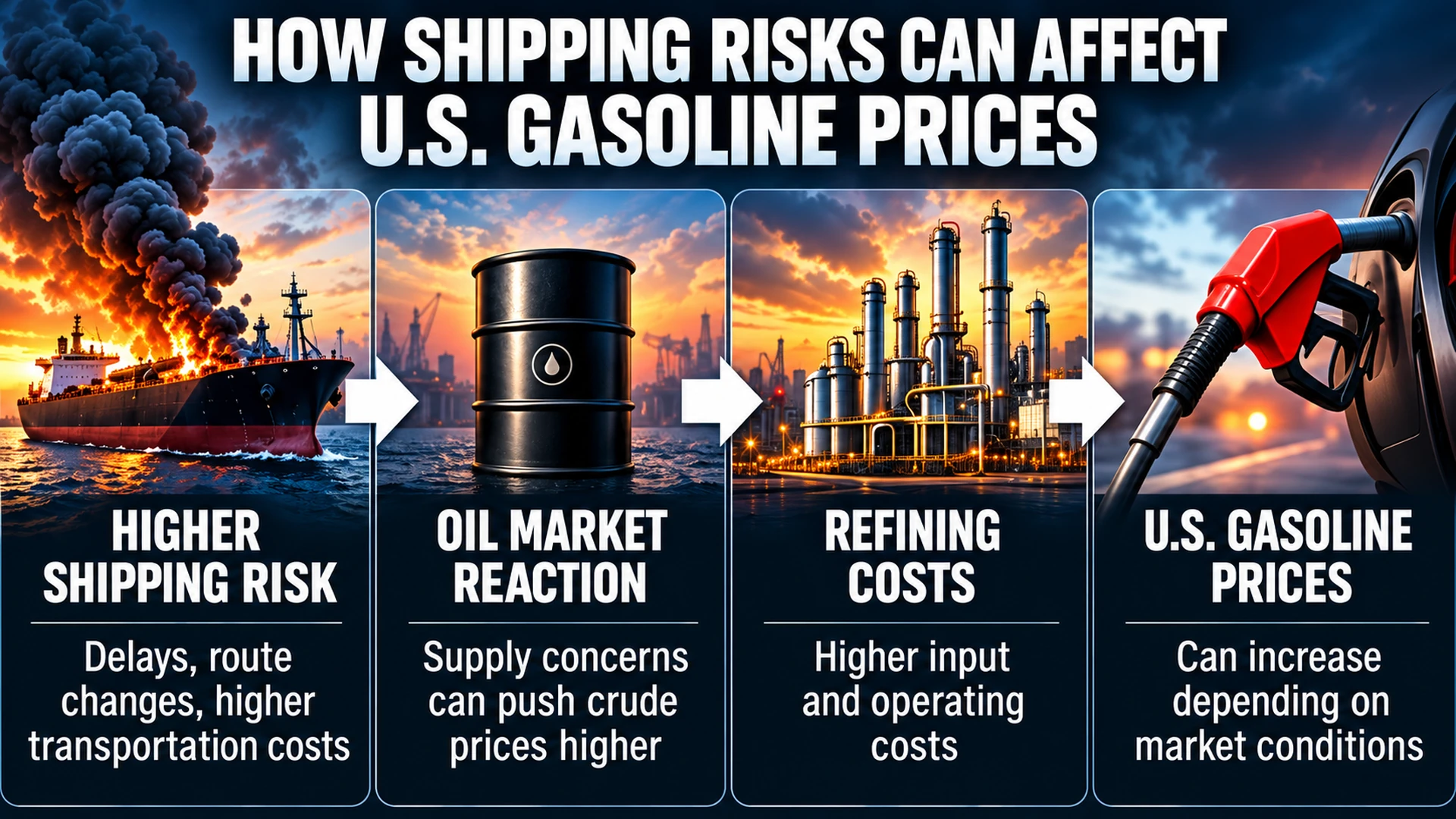
Yes, prolonged shipping disruption can put upward pressure on American gasoline prices. But the October 17 claims alone do not establish how much, or how quickly, prices might change.
That is because the price of gasoline depends on more than the supply of oil produced inside the United States.
American refineries and fuel markets are connected to international crude oil prices, especially the global Brent benchmark.
The U.S. Energy Information Administration explains that retail gasoline prices respond to crude oil prices, refinery costs, distribution and marketing expenses, and taxes. (U.S. EIA)
The possible chain reaction works like this:
- Shipping companies perceive greater danger in the Strait of Hormuz.
- Some voyages face delays, additional costs, or route changes.
- Oil buyers become more concerned about future deliveries.
- Higher transportation costs and supply uncertainty can put upward pressure on international crude prices.
- Sustained changes in crude and refining costs can eventually influence American gasoline and diesel prices.
Not every warning or reported incident produces a measurable increase at the pump.
Inventories, demand, production elsewhere, alternative shipping routes, and the market’s expectations all influence the result.
The United States also does not need to import a particular barrel through Hormuz for American consumers to feel the effects of tighter international oil markets.
A useful comparison is the price of wheat. A shortage in one major producing region can influence international prices even in another country that grows its own wheat.
Oil markets operate through similarly interconnected pricing and trade relationships.
The 2026 conflict has already demonstrated that disruption in the Middle East can affect U.S. fuel markets. EIA analysis of the second quarter found that disrupted regional oil flows contributed to higher and more volatile crude prices, while also increasing U.S. refining activity and exports as international buyers sought alternative supplies. (U.S. EIA)
The question now is whether shipping conditions deteriorate further or improve through security and diplomatic measures.
What Happens Next—and What Would Actually Make Hormuz Safer?
No single announcement will necessarily restore confidence in shipping through the Strait of Hormuz.
The next developments that matter fall into three connected areas.
1. Independent Verification of the Tanker Reports
The first step is establishing what happened on October 17.
Ship identities, operator statements, reliable location information, damage assessments, and independent maritime investigations could help determine whether the reports are accurate.
If mines are confirmed, investigators would still need to establish what type of devices were involved and what evidence exists concerning responsibility.
Confirmation of a mine strike would not, by itself, prove who placed the mine.
2. Actual Conditions for Commercial Shipping
Military and political statements matter, but shipping operators must decide whether they can safely complete voyages.
The important indicators are whether attacks continue, whether vessels can use predictable routes, and whether operators become more willing to transit the area.
A route described as open may remain economically disruptive if ships face serious danger.
3. Negotiations Between Washington and Tehran
There is also a diplomatic development.
On October 18, Iran reiterated an offer to reopen the Strait of Hormuz within a short period if the United States accepted specified conditions.
The proposal involved disputes over American restrictions on Iranian shipping and oil exports, along with broader hostilities. Washington and Tehran remained divided over those terms and Iran’s nuclear program. (Reuters)
An offer is not an agreement, and reopening a waterway on paper would not automatically eliminate the danger of attacks.
For shipping to recover sustainably, vessel operators would need a credible reason to believe that traffic can move without recurring disruptions.
That would require not only diplomatic progress but also demonstrably safer conditions at sea.
Bottom Line: What This Story Really Means
Iran’s Revolutionary Guards said two large oil tankers struck naval mines and caught fire in the Strait of Hormuz on October 17, 2026.
The crucial qualification is that those specific mine strikes have not been independently confirmed.
But the wider shipping crisis is real.
The Strait of Hormuz connects major Persian Gulf energy exporters to international markets. Its strategic importance comes from the amount of oil and gas that normally moves through it and the limited alternatives available when shipping becomes dangerous.
Iran wants to impose restrictions on how vessels use the waterway. The United States disputes those restrictions and says commercial navigation must be protected.
Meanwhile, ship operators face the practical question of whether their vessels can safely complete the journey.
For American consumers, the most relevant consequence is not simply whether the latest claims prove accurate. It is whether continued maritime insecurity keeps energy transportation expensive and unreliable.
The difference between a waterway being declared open and ships being willing to use it safely is central to understanding the Hormuz crisis.
Strait of Hormuz Tanker Mines: Key Questions Explained
Q. Have the two reported tanker mine strikes been independently confirmed?
No. As of October 18, 2026, the available reporting established Iran’s announcement but did not independently verify that both vessels struck naval mines.
Q. Did Iran identify the two oil tankers?
The initial accounts did not establish the vessels’ identities or provide independently confirmed details about their operators, crews, and damage.
Q. Did the reported incidents destroy 4 million barrels of oil?
There is no verified basis for that conclusion. Iranian accounts described the two tankers as carrying approximately 2 million barrels each, but carrying oil is not the same as losing or spilling it.
Q. Can a naval mine explode without a ship touching it?
Yes. Contact mines require physical contact, but influence mines can respond to magnetic changes, underwater sounds, or pressure effects associated with a passing vessel.
Q. Is the Strait of Hormuz completely closed?
Not in the sense that every vessel is physically unable to pass. Iran claims the right to restrict routes, while the United States disputes those restrictions. Commercial traffic has continued under dangerous and disrupted conditions.
Q. Why does Iran object to ships using unauthorized routes?
Iran is seeking to enforce restrictions on maritime movement amid its confrontation with the United States. Washington rejects Tehran’s unilateral control claims and supports commercial navigation.
Q. Does a reduction in Hormuz oil shipments mean the same amount of oil production has disappeared?
No. Reduced traffic through the strait measures a disruption in that transportation route, not an identical reduction in worldwide production. Alternative routes, inventories, and changes in production all matter.
Q. Can the Hormuz conflict affect U.S. gasoline prices even though America produces oil?
Yes. The United States participates in international oil markets, so higher global crude prices and transportation costs can affect American fuel prices even when the oil is produced domestically.
Q. Is Iran proposing to reopen the waterway?
Yes. Iran reiterated a conditional reopening proposal on October 18. But its terms remained disputed, and no completed agreement guaranteeing safe navigation had been established.
Q. What should readers watch to know whether the crisis is improving?
Independent verification of shipping incidents, the frequency of new attacks, the willingness of commercial vessels to transit, and concrete U.S.-Iran security agreements are more informative than political declarations alone.
Did this help make the story clearer? 🙂
WIN keeps unpacking the “why” behind the news—clearly and simply!
Sources
October 17 Tanker Claims and Verification
Reuters — Iran’s Guards Say Two Tankers Hit Mines in Strait of Hormuz, October 17, 2026
Euronews — Supertanker Ablaze After Striking Mine in Strait of Hormuz, IRGC Says, October 17, 2026
Anadolu Agency — Iran’s IRGC Says Second Supertanker Hits Naval Mine, October 17, 2026
Maritime Security, Military Operations, and Diplomacy
Reuters — Two Ships Sink Near Hormuz After Projectile Attacks, October 14, 2026
Reuters — U.S. and Iran Presidents Sign Ceasefire Agreement, June 17, 2026
Reuters — Iran Urges U.S. to Accept Proposal to Reopen Strait of Hormuz, October 18, 2026
Oil Shipping, Fuel Prices, and Naval Mine Technology
U.S. Energy Information Administration — Global Energy Security Data, August 2026
U.S. Energy Information Administration — World Oil Transit Chokepoints
U.S. Energy Information Administration — Why Gasoline Prices Fluctuate
U.S. Naval History and Heritage Command — Naval Mine Warfare
Keep Reading
If Hormuz Is Dangerous, Can’t Saudi Arabia Just Ship Oil Another Way?
Saudi Arabia has a pipeline that bypasses Hormuz, but the alternative route has its own vulnerabilities. The previous story explains why an escape route cannot eliminate the broader threat to energy shipments.
Saudi Arabia Built a Pipeline to Bypass Hormuz—So Why Is Its Oil Route Still at Risk?