Jensen Huang’s $399 Robot Duck Learned to Walk in a Virtual World. How Does That Work?

When Nvidia CEO Jensen Huang told four tiny robot ducks to take a nap, three promptly toppled over. The fourth kept walking for a moment, seemingly unwilling to cooperate.
It was a funny scene at Nvidia’s GTC conference in Berlin on October 21, 2026. But the important part wasn’t how cute the robots looked—or even the fact that one didn’t follow along.
These little machines had learned movement skills in a computer simulation before those skills were transferred to physical robots. That raises a more interesting question: Can a robot practice falling, balancing, and walking thousands of times without a real machine taking the punishment?
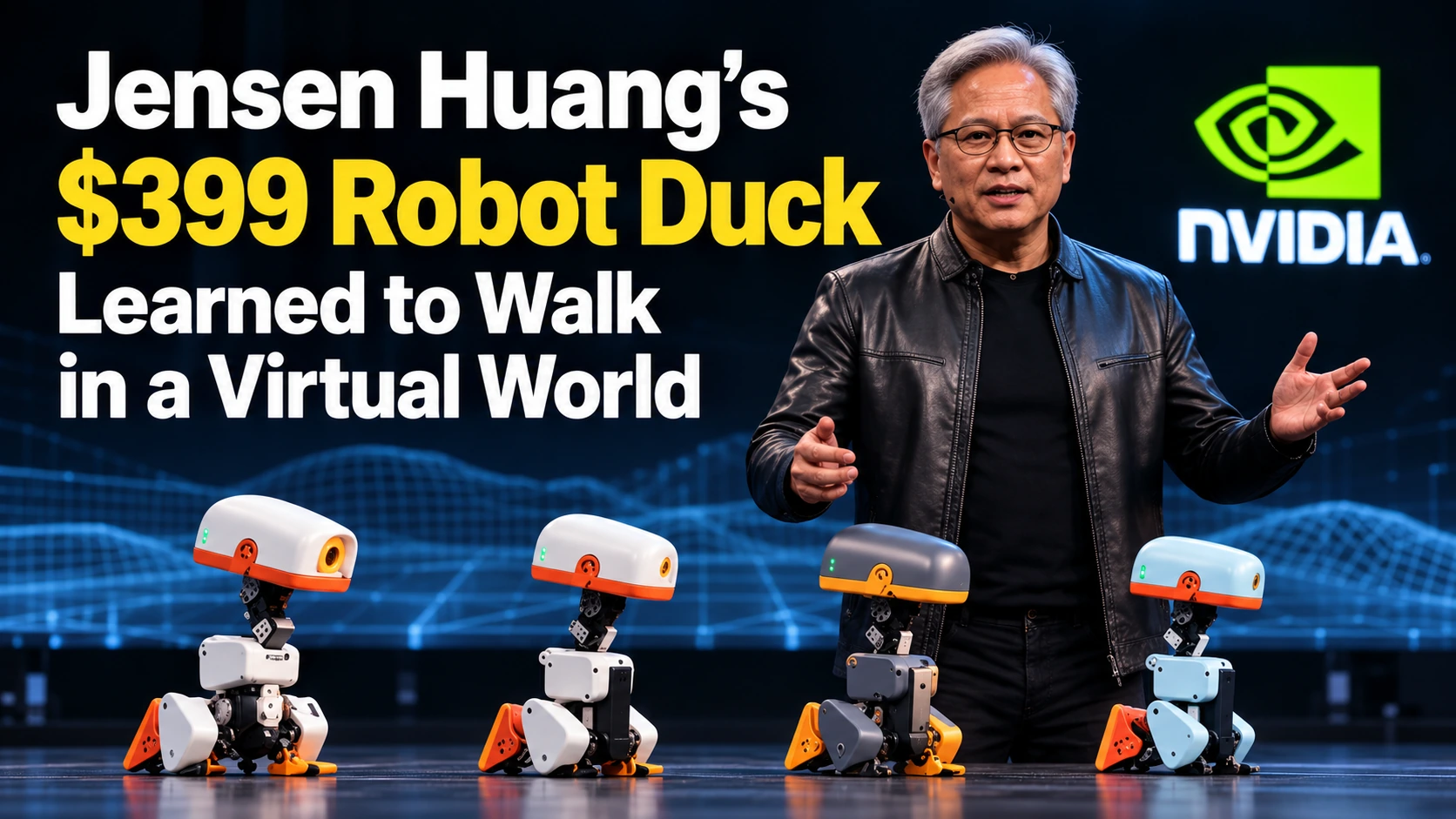
※ Images in this article are AI-generated illustrations created to help explain the story. They are not actual photographs, and depictions of people, places, or events may differ slightly from reality.
That’s the technology Nvidia wanted people to notice. And it also explains why a small, imperfect robot might say more about the future of AI than a polished animation ever could.
What Actually Happened During Jensen Huang’s Robot Duck Demo?
Four duck-shaped robots called Microduck joined Huang near the end of his October 21 keynote in Berlin. They demonstrated simple physical behaviors, including sitting, standing, and lying down.
The presentation was not perfectly synchronized. Reuters reported that three robots quickly lay down when Huang asked them to nap, while the fourth was slow to follow. One also faced the wrong direction near the end. (Reuters)
That awkward moment was useful in its own way. Software can show an ideal result on a screen. A physical robot has motors, weight, friction, and timing differences that make the same movement harder to reproduce.
Nvidia used the demonstration to spotlight its robotics development tools, not to announce that it had invented a duck-shaped household assistant. Its October 21 materials describe how Microduck can be trained using Isaac Lab, an Nvidia framework for teaching robot behaviors in simulated environments. (Nvidia · Hugging Face)
Who Built Microduck—and Is It Actually an Nvidia Robot?
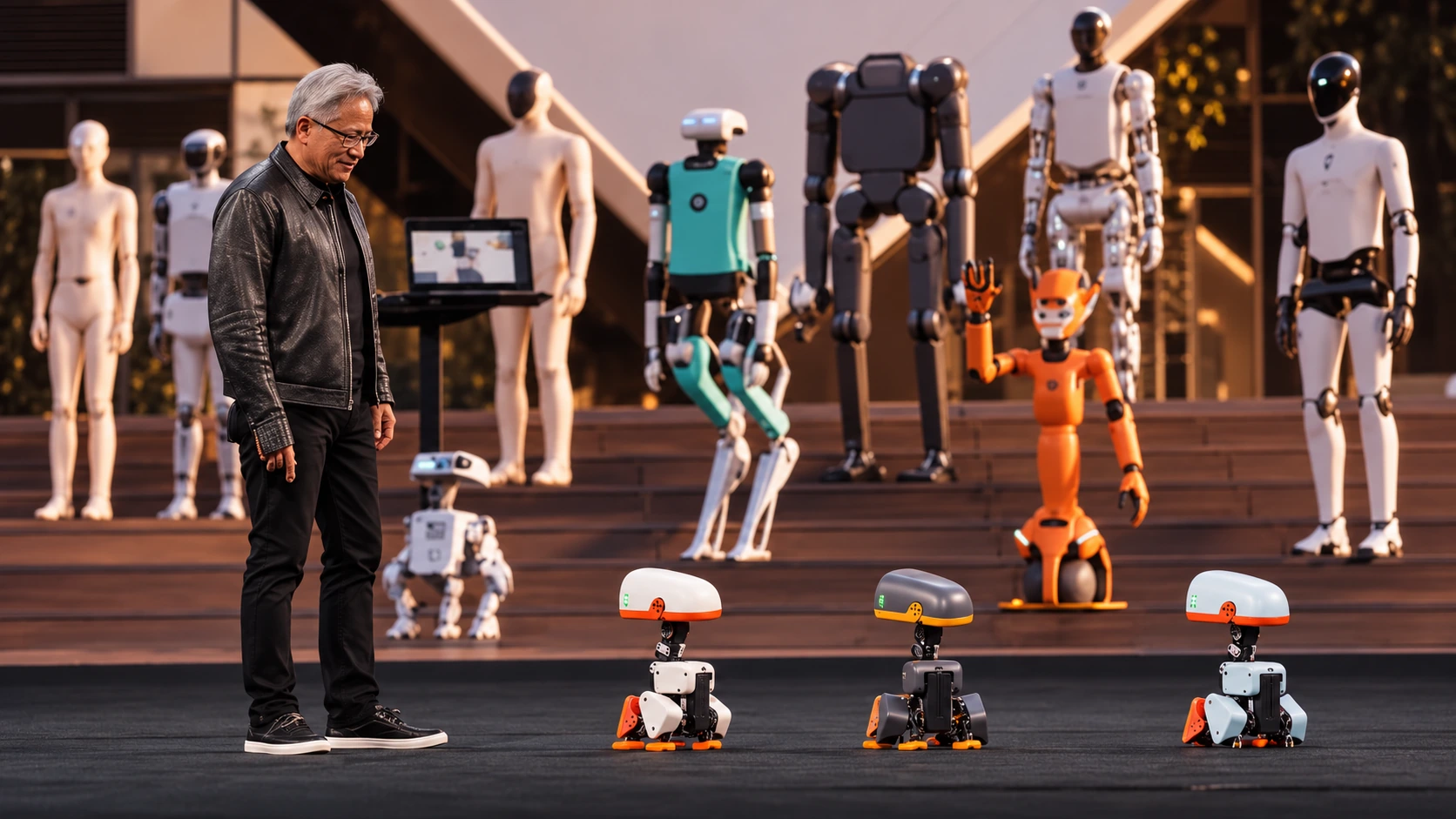
No. Microduck is made by Pollen Robotics, a French robotics company that became part of Hugging Face in 2025. Nvidia supplies tools that can help developers train and test the robot’s movement skills. (Hugging Face)
Hugging Face is widely known for hosting AI models and software that developers can inspect, share, and modify. Pollen Robotics brings the physical hardware. Together, they are trying to make hands-on robotics more accessible than expensive research-only machines.
The distinction matters because the demonstration brought together three different pieces of the robotics business:
| Who | What it contributes |
|---|---|
| Pollen Robotics | Designs and sells the Microduck hardware |
| Hugging Face | Provides the broader open AI and robotics community |
| Nvidia | Develops computing and simulation tools used to train robot behaviors |
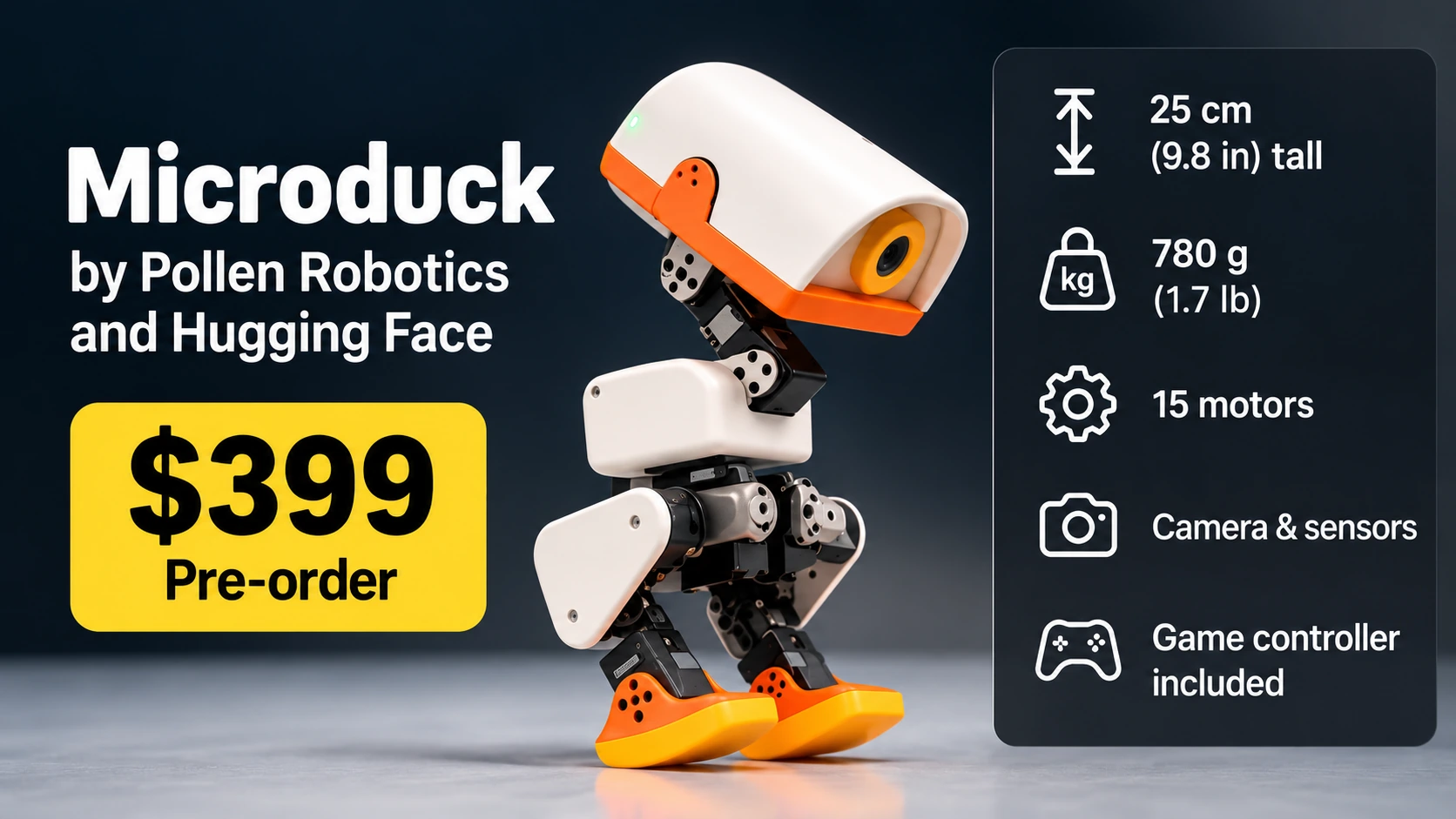
Microduck also predates the Berlin keynote. Pollen introduced it on August 27, 2026, with an introductory $399 pre-order price. The October event brought new attention to a product that had already been announced. (Pollen Robotics)
The next question is how its movements are created in the first place.
How Can a Robot Learn to Walk Inside a Computer?
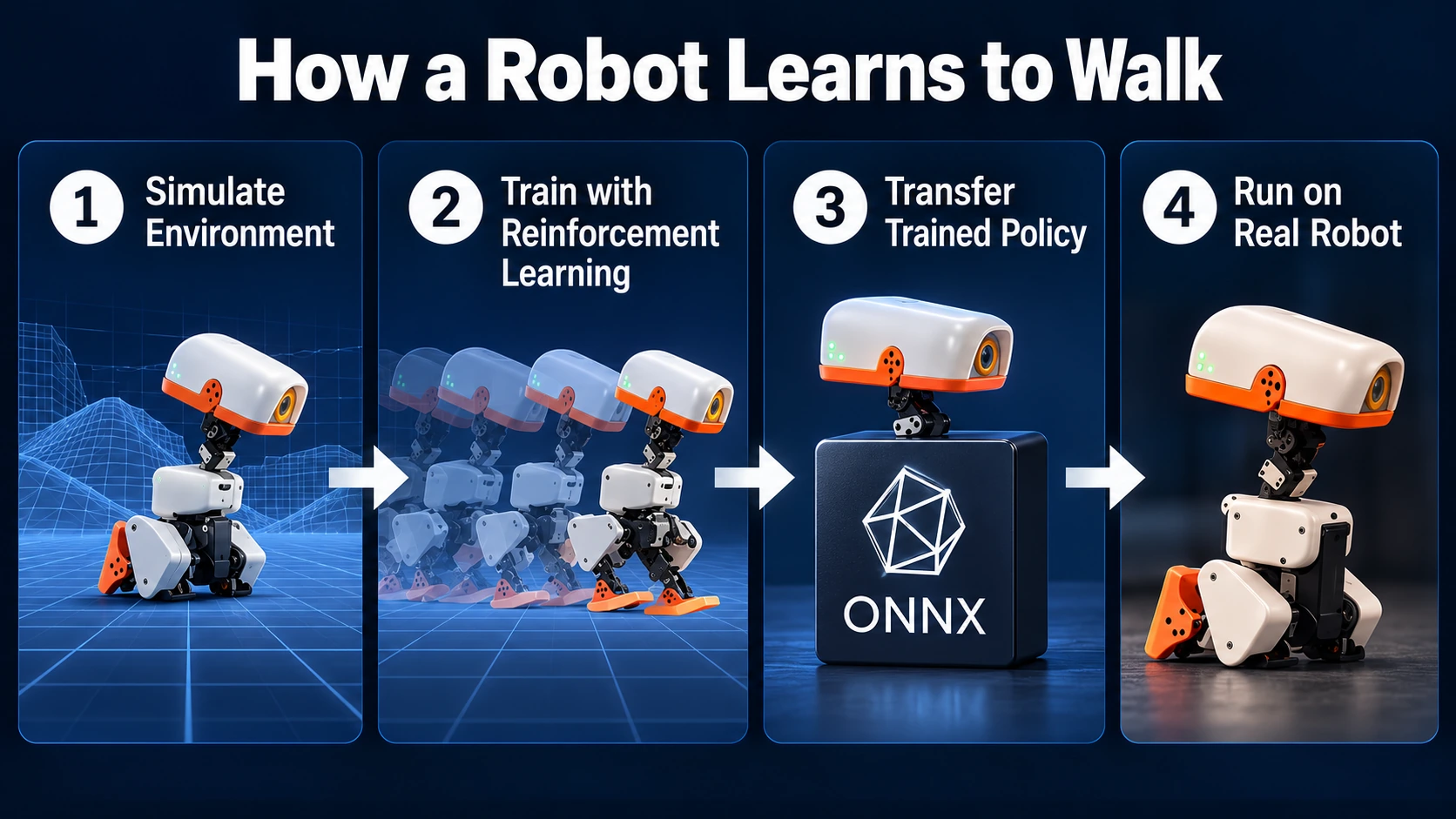
Developers build a virtual version of the robot, let it practice movements repeatedly, and transfer the resulting control software to the real machine. Engineers call this sim-to-real training.
Imagine learning to ride a bicycle in a simulator where falling costs nothing. You can try again and again, changing your balance and steering until you improve. A real bicycle would still feel different, but much of the practice could happen before you take it onto the road.
A robot’s version is more mathematical. Its simulated body has joints, mass, motors, and contact with the ground. The training system gives it an objective—such as moving forward without falling—and evaluates its attempts.
That method is called reinforcement learning. Instead of having engineers write out every tiny motor movement, a learning system adjusts a control strategy through repeated trials, rewarding behavior that better achieves the task.
Nvidia’s Isaac Lab can run many virtual robot environments in parallel using GPUs. Its Microduck tutorial describes training a walking controller, exporting it as an ONNX model, and loading that model onto a physical Microduck. ONNX is a common file format for transferring trained AI models between compatible systems. (Hugging Face and Nvidia technical tutorial)
In this workflow, the program transferred to the robot is called a policy: a compact set of learned rules that turns information about the robot’s state into commands for its joints.
It is not a recording of an animated duck. It is software that continually reacts to the robot’s position and movement.
Why Is the Real World Harder Than the Virtual One?
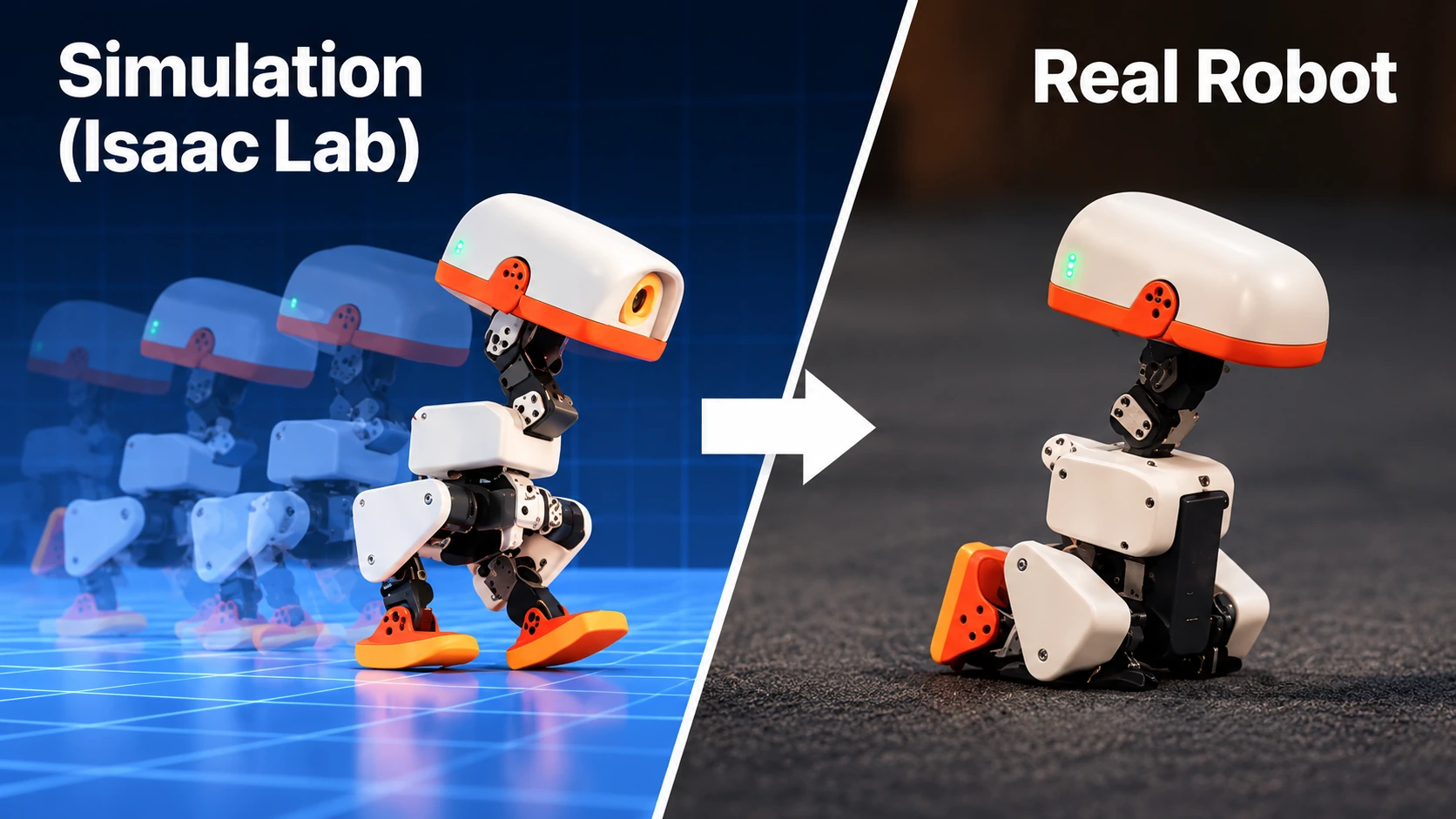
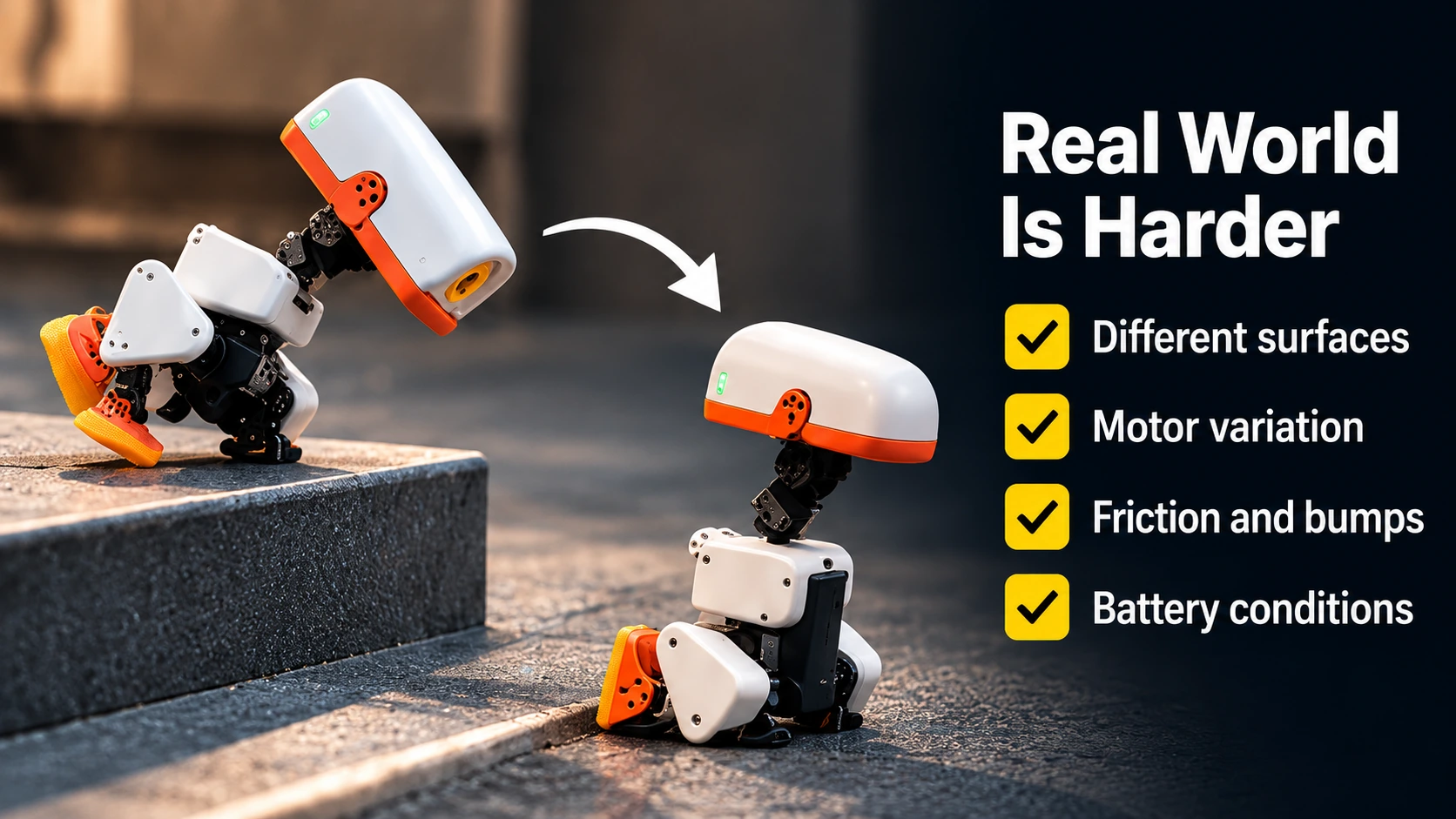
Because a simulation is only an approximation. Even a sophisticated model cannot perfectly reproduce every real motor, battery, floor surface, or unexpected bump.
One robot may have slightly different joint friction from another. The battery voltage may change. A floor may be more slippery than expected. A tiny delay between a command and a motor’s response can matter when the machine is trying not to fall.
Developers try to narrow that gap through domain randomization—deliberately changing things such as simulated friction, robot mass, motor behavior, and command delays during training. The idea is to prevent a robot from learning a trick that works only under one perfectly controlled set of conditions. (Hugging Face and Nvidia)
| In simulation | On a real robot |
|---|---|
| Millions of practice steps can be run without damaging hardware | Falls can strain parts and interrupt testing |
| Conditions can be adjusted precisely | Friction, wear, and battery conditions vary |
| Many copies can train in parallel | Physical experiments need actual hardware and time |
| A movement may look successful in the model | The controller must still work on real motors and surfaces |
None of this proves exactly why the fourth duck hesitated onstage. The public demonstration alone does not identify the cause. What it illustrates is a broader limitation: a successful virtual training session is not a guarantee of flawless physical performance.
What Can the $399 Microduck Actually Do?
Microduck is a small programmable robot built for movement experiments, not a full-service robot assistant.
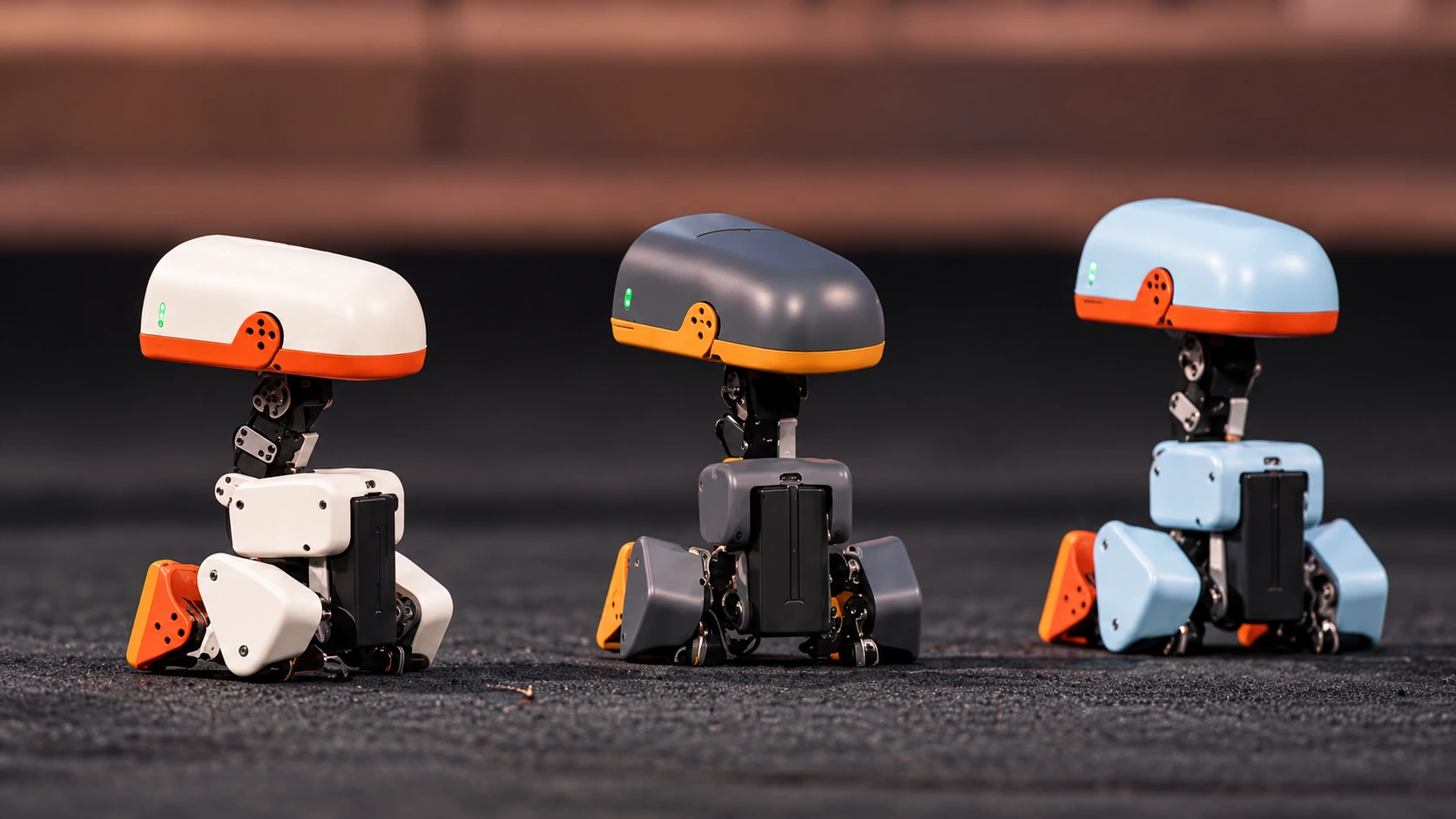
The hardware stands about 9.8 inches (25 centimeters) tall, weighs roughly 1.7 pounds (780 grams), and uses 15 motors. It has a camera, a small depth-sensing system, and motion sensors that help detect changes in its orientation. (Pollen Robotics product specifications)
Its documented behaviors include walking, crouching, sitting, recovering from many common falls, and picking up certain small objects with its beak. With appropriate attachments, it can also move on small rollers. A game controller is included, and developers can work with the published software to train additional behavior policies. (Pollen Robotics · Microduck open-source software)
But there is an important dividing line between a robot that can perform trained movements and one that understands the world in a broad, humanlike way.
| What Microduck demonstrates | What the demonstration does not establish |
|---|---|
| Learned control of walking and balance | Human-level intelligence or judgment |
| Specific programmed or trained behaviors | The ability to perform any task on request |
| A path for developers to retrain skills | Guaranteed success in unfamiliar environments |
| Open software and hardware experimentation | Fully autonomous household assistance |
The stage appearance does not, by itself, prove that the ducks understood spoken English in the way a person would. A public demo can show a robot executing movements without establishing precisely how each high-level instruction reached its controller.
That distinction makes the accomplishment easier to appreciate rather than less impressive: keeping a two-legged machine balanced is already a difficult problem.
Can You Buy Microduck in the U.S. for $399?
U.S. customers are included in the planned launch markets, but $399 is the advertised pre-order price—not proof that a robot is ready for immediate shipment. Taxes and shipping cost extra.
Pollen Robotics lists four color choices and includes the robot, a battery, a USB-C cable, a game controller, and access to its open-source software tools. The company is targeting first deliveries before Christmas 2026, although that is a delivery goal rather than a guarantee for every order. (Pollen Robotics official store)
| Buying question | Current information |
|---|---|
| Advertised U.S. price | $399 before taxes and shipping |
| Order status | Pre-order |
| Size | About 9.8 inches tall |
| Included controls | Game controller and built-in behaviors |
| First delivery target | Before Christmas 2026 |
| Intended audience | Developers, educators, hobbyists, and people curious about programmable robots |
The $399 figure may sound surprisingly low next to industrial robots costing many thousands of dollars. But the comparison can be misleading: Microduck is tiny, has a narrow set of built-in physical abilities, and is designed as an open experimentation platform.
Anyone considering an order should check the seller’s current terms and shipping updates rather than treating a keynote demonstration as evidence of immediate availability.
Why Is Nvidia So Interested in a Robot That Looks Like a Toy?
Because Nvidia is trying to make its computing and software platforms central to physical AI—AI systems that sense, decide, and act in the physical world.
A chatbot can produce a convincing answer while remaining entirely on a screen. A robot must turn its decisions into motion, deal with real objects, and stay within the limits of its hardware.
That creates demand for more than just an AI model. Developers need physics simulations, training software, sensors, real-time controls, and reliable ways to test what happens when a learned behavior meets reality.
On October 21, Nvidia announced a broader expansion of its Isaac robotics platform, including Isaac Lab 3.0 and tools intended to connect simulation with physical machines. The company is courting makers of industrial robots and humanoids as well as researchers experimenting with smaller devices. (Nvidia Newsroom)
Microduck makes that development process visible at a scale that fits on a desk. Its open-source approach also allows developers to inspect and share movement controllers rather than relying entirely on a closed system. (Pollen Robotics open-source project)
Still, there is a long distance between a duck recovering from a fall and a robot reliably working beside people in a factory or home. Larger machines face different forces, safety requirements, and tasks. Training in simulation helps, but real-world testing remains indispensable.
The question to watch is not whether next year’s robots will all look like ducks. It is whether the same basic train-test-transfer approach can make useful robot skills less expensive and easier to improve.
Bottom Line: What This Story Really Means
Jensen Huang’s four robot ducks attracted attention because they were amusing—and because one of them didn’t behave quite as expected.
The technology behind them is more consequential. Microduck shows how developers can train a movement controller in a simulated world, transfer it to a physical machine, and learn from the gap between the two. That is a practical example of sim-to-real robotics.
Microduck is a $399 pre-order product from Pollen Robotics and Hugging Face, not a robot manufactured by Nvidia. Its current abilities are specific and limited; the Berlin demo did not establish humanlike intelligence.
For Nvidia, the ducks helped demonstrate a much bigger commercial ambition: providing the tools that others use to develop the next generation of robots. How reliably those learned skills work outside controlled demonstrations will matter far more than a perfectly coordinated stage performance.
Microduck Robot: Key Questions Explained
Q. Who makes the Microduck robot?
Pollen Robotics makes Microduck and is part of Hugging Face. Nvidia provides robotics training and simulation tools featured in the Berlin demonstration.
Q. How much does Microduck cost in the United States?
The advertised pre-order price is $399, excluding taxes and shipping. It should not be confused with an immediate-shipment retail offer.
Q. When is Microduck supposed to ship?
Pollen Robotics is targeting first deliveries before Christmas 2026. Individual delivery dates are not guaranteed by that target.
Q. What does sim-to-real mean in robotics?
It means training or testing behavior in a computer simulation and transferring the resulting controller to a physical robot, where it must still be evaluated under real conditions.
Q. Did Nvidia invent the Microduck robot?
No. Microduck is a Pollen Robotics and Hugging Face product. Nvidia highlighted its own software and computing role in training robot behavior.
Q. Can Microduck get up after falling over?
Yes. Its published movement capabilities include recovering from many common falls. That does not mean it can recover from every position or surface.
Q. Does Microduck understand everything Jensen Huang says?
There is no basis in the stage demonstration for that claim. The event showcased trained physical behaviors, not verified, open-ended language understanding.
Q. Why train robots in simulation instead of only using real machines?
Virtual training can run many trials without physically wearing down a robot and can expose a controller to varied conditions. Real-world testing is still necessary because simulated physics is imperfect.
Did this help make the story clearer? 🙂 WIN keeps unpacking the “why” behind the news—clearly and simply!
Sources
The Berlin Demonstration and Nvidia’s Robotics Strategy
Nvidia — GTC Berlin Announcement on the Isaac Robotics Platform
Nvidia — How RTX Spark and Isaac Lab Were Used With Microduck
Reuters — Nvidia’s Huang Hails Europe’s AI Potential, Flanked by Robot Ducks
Microduck’s Maker, Features, and Pre-Orders
Pollen Robotics — Meet Microduck
Pollen Robotics — Official Microduck Product Listing
Hugging Face — Pollen Robotics Acquisition
Simulation-to-Real Training and Open Software
Hugging Face and Nvidia — Train in Simulation, Deploy on a Real Robot
Pollen Robotics — Microduck Control Software
Pollen Robotics — Microduck Reinforcement Learning Framework