
Why Is the Pentagon Creating a Four-Star Autonomous Warfare Command—and What Will It Actually Control?

Wasn’t the U.S. military already buying drones?
And if the Army, Navy, Air Force, Marine Corps, and Space Force already operate unmanned systems, why would the Pentagon need an entirely new four-star command to deal with them?
There is an even bigger question behind the name Autonomous Warfare Command, or AutoWarCom.
Does “autonomous warfare” mean artificial intelligence is about to be given authority to decide when the United States attacks someone?
The short answer to that last question is no—not based on what the Pentagon has announced.
On September 30, 2026, Defense Secretary Pete Hegseth announced plans for a new four-star functional combatant command focused on scaling unmanned, autonomous, and robotic capabilities across the Joint Force. The Project Agincourt memorandum sets October 1, 2027 as the target establishment date and says the Pentagon must work with Congress on legislation needed for the planned structure and authorities. (Project Agincourt memorandum · Reuters · Defense One)

※ Images in this article are AI-generated illustrations created to help explain the story. They are not actual photographs, and depictions of people, places, or events may differ slightly from reality.
The important part is not simply that the Pentagon wants more drones.
It is trying to change who defines what the military needs, who buys it, who tests it, how quickly it can be modified, and how autonomous-warfare specialists build military careers.
That is what makes AutoWarCom more than another drone office.
What Did the Pentagon Actually Announce?
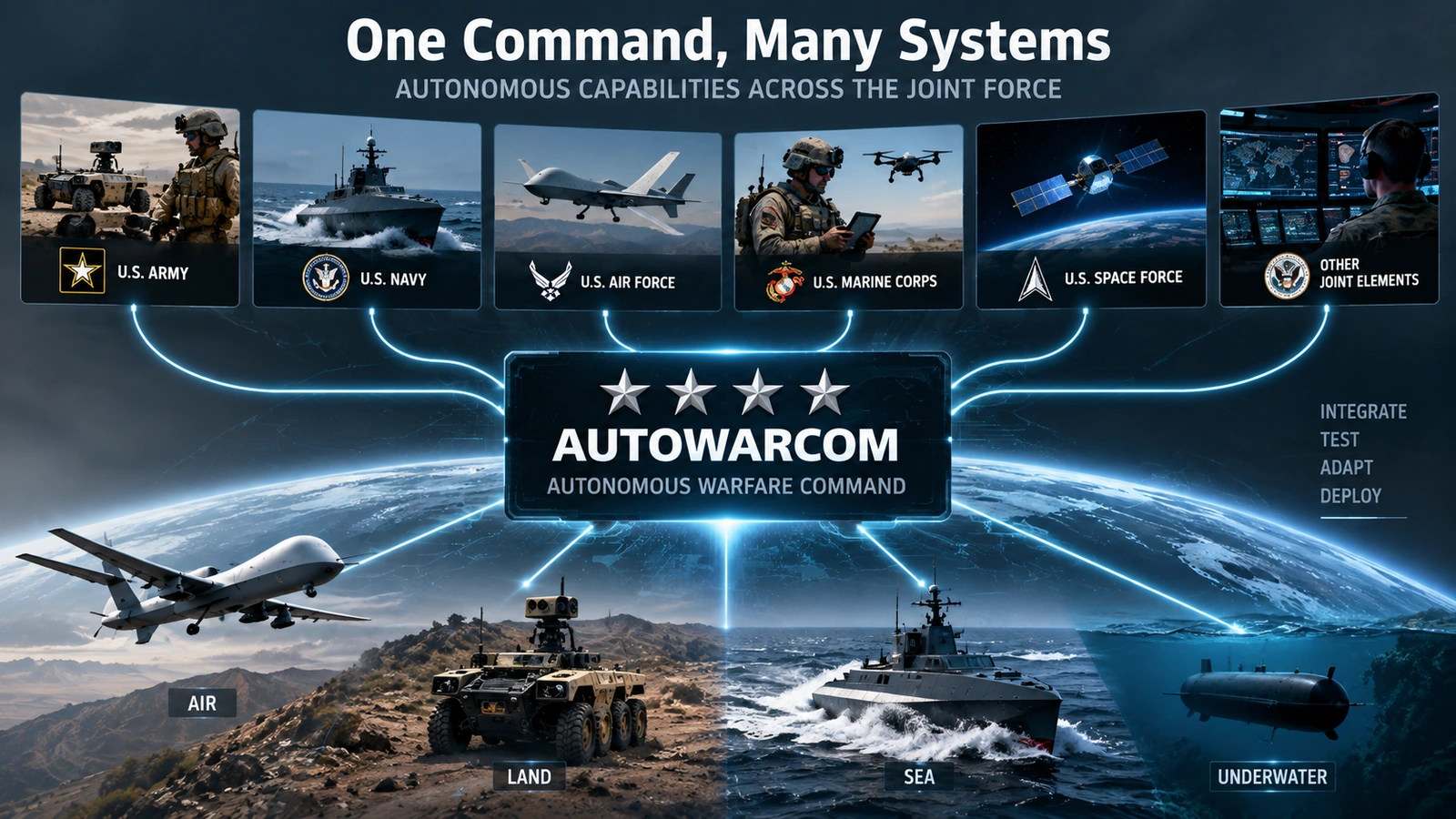
The Pentagon announced a proposed four-star functional combatant command intended to lead the Joint Force in unmanned and autonomous warfare.
That wording matters.
The Project Agincourt memorandum says the command is supposed to define joint requirements, integrate forces supplied by the military services, test equipment and force designs under realistic conditions, rapidly modify what does not work, and field systems that do. Hegseth also described a new acquisition model that would connect operators, engineers, and manufacturers in faster adaptation cycles. (Project Agincourt memorandum · Defense One)
The Pentagon is therefore trying to connect several steps that are often separated:
What troops need → what companies build → what the military buys → what gets tested → what gets deployed → what operators learn → what gets changed next.
That feedback loop is one of the most important ideas in the announcement.
Traditional weapons programs can take years to move through requirements, contracting, testing, budgeting, and production.
Drones and software can change far faster.
The Pentagon’s argument is that an organization built around long procurement cycles may struggle against battlefield technologies that can be modified in weeks—or sometimes even faster.
Is AutoWarCom a New Military Branch?
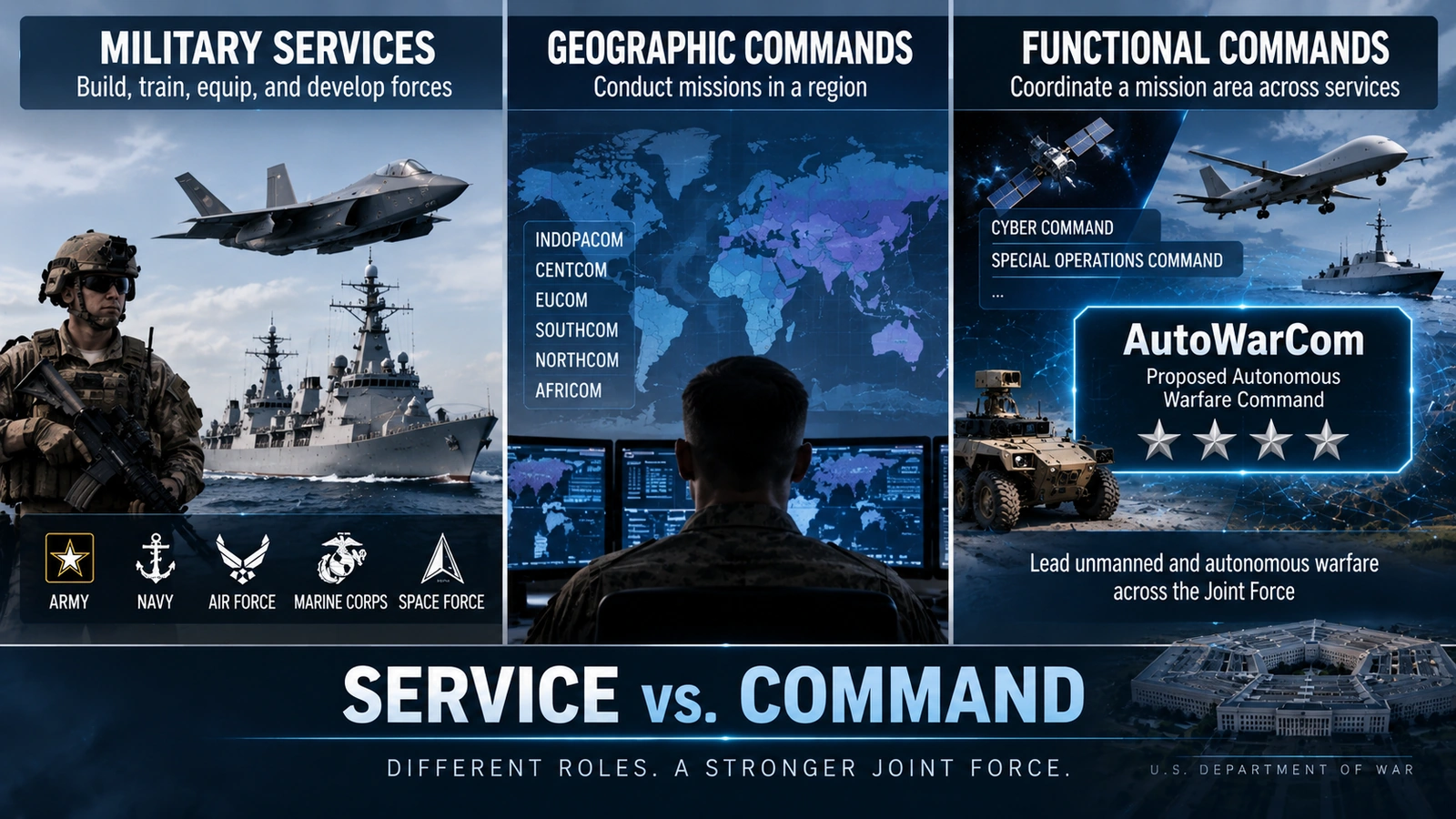
No. AutoWarCom is not being proposed as another armed service alongside the Army, Navy, Air Force, Marine Corps, or Space Force.
That distinction can be confusing because the Pentagon says AutoWarCom would have unusual “service-like” powers.
A military service primarily organizes, trains, equips, and sustains forces.
A combatant command is organized around missions. Some are geographic, such as U.S. Central Command or U.S. Indo-Pacific Command. Others are functional, such as U.S. Cyber Command or U.S. Special Operations Command.
AutoWarCom is being designed as a functional command.
Here is the simplest way to separate the roles:
| Organization | Main job | Simple example |
|---|---|---|
| Military service | Organize, train, equip, and sustain forces | The Air Force develops air forces and aircraft capabilities |
| Geographic combatant command | Conduct missions in a region | CENTCOM focuses on its assigned region |
| Functional combatant command | Coordinate a mission area across regions and services | Cyber Command focuses on cyber operations |
| Proposed AutoWarCom | Lead unmanned and autonomous warfare across the Joint Force | Set needs, integrate systems, test, adapt, and help field autonomous capabilities |
Federal law places the establishment of combatant commands with the president, acting through the secretary and with the advice and assistance of the Chairman of the Joint Chiefs of Staff. Except during hostilities or an imminent threat of hostilities, the president must notify Congress and provide a briefing within 60 days after establishing a new combatant command. (10 U.S.C. § 161)
That is one reason the September 30 announcement should be understood as the start of a build-out, not as proof that a fully staffed four-star headquarters instantly became operational that day.
What Does “Service-Like Authorities” Actually Mean?

This is the part that makes AutoWarCom unusual.
The Pentagon does not want it to be merely a headquarters that writes strategy and sends recommendations to other organizations.
The Project Agincourt plan describes a command with directed manpower, budget and acquisition authorities, plus dedicated military career pathways for officers and enlisted personnel. Reporting on the announcement also emphasized that those powers are part of the intended end state rather than a description of authorities that are already fully in place. (Project Agincourt memorandum · Stars and Stripes)
Think about what that could change.
If a combat unit discovers that a drone needs different software, a new sensor, better resistance to jamming, or a different payload, the Pentagon wants the feedback to move quickly into testing and procurement rather than travel through a long chain of disconnected organizations.
It also wants autonomous warfare to become a military specialty people can build careers around.
That means the plan is not just about buying machines.
It is about creating an institution around them.
But those authorities are not all automatically available simply because they were announced. The memorandum directs Project Agincourt to work with Congress to obtain necessary legislation as it builds toward the October 2027 target. (Project Agincourt memorandum · Stars and Stripes)
So “service-like” describes the structure the Pentagon is trying to build.
It does not mean every promised authority is already in place.
Does AutoWarCom Mean AI Will Decide Who to Attack?
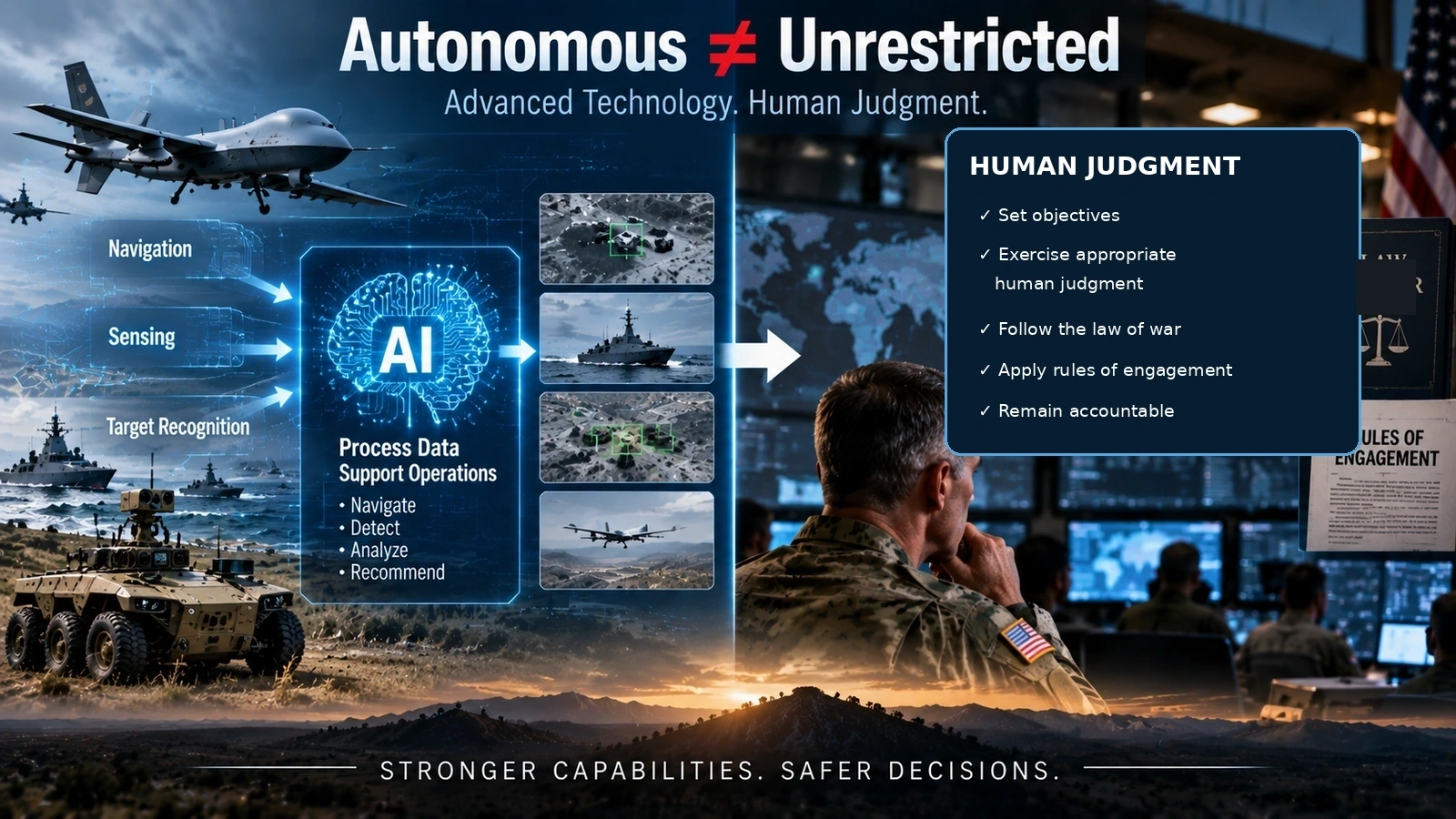
Not by itself.
Creating AutoWarCom changes the military’s organization, acquisition process, testing structure, and operational integration. It does not automatically replace the Pentagon’s rules governing when and how autonomous weapons may use force.
The Defense Department’s publicly available autonomy directive says autonomous and semi-autonomous weapon systems must be designed so commanders and operators can exercise “appropriate levels of human judgment” over the use of force. It also requires people who authorize, direct, or operate those systems to act with appropriate care and in accordance with the law of war, applicable treaties, weapon-system safety rules, and rules of engagement. (DoD Directive 3000.09 update)
That does not mean every autonomous system works the same way.
A drone may autonomously navigate.
A defensive system may automatically track an incoming threat.
Software may help identify objects, recommend targets, coordinate groups of unmanned vehicles, or optimize a route.
Those are different technical and operational questions from giving a machine unrestricted authority to decide whom the United States should attack.
AutoWarCom will make that distinction more important, not less important, because the Pentagon is trying to deploy these technologies at far greater scale.
The more autonomy moves from experiments into everyday military operations, the more questions about reliability, targeting rules, operator responsibility, electronic warfare, cybersecurity, and failure modes move with it.
Why Does the Pentagon Think It Needs a New Command Now?
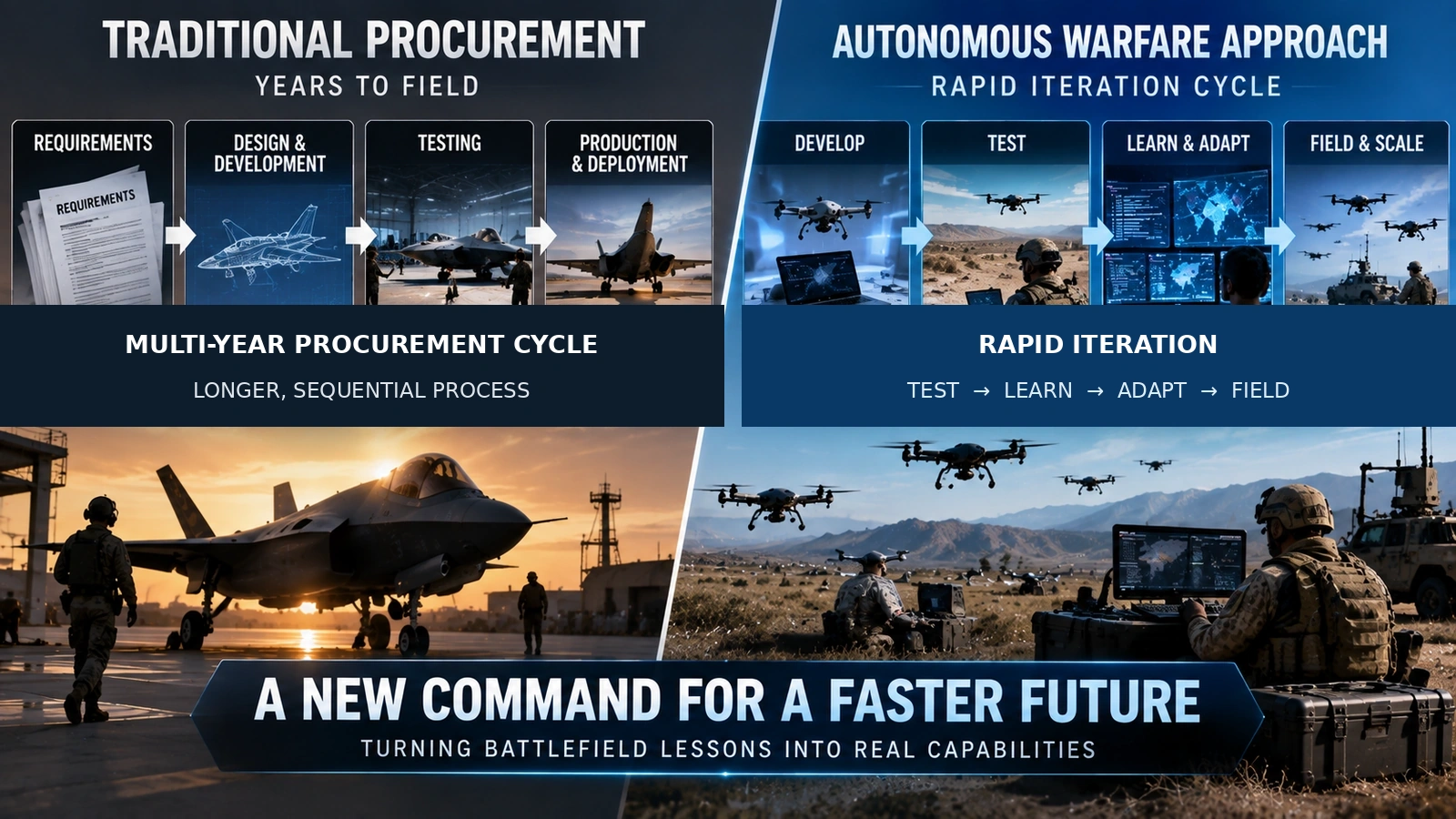
Because the Pentagon believes the speed of technological change is starting to collide with the speed of its procurement system.
In the Project Agincourt memorandum, the department argues that advanced computing has made increasingly capable precision systems cheaper and easier to produce at large scale, creating a different problem from the one the U.S. military spent decades optimizing for. (Project Agincourt memorandum)
The lesson Pentagon leaders say they are drawing from recent warfare is not simply “buy more drones.”
It is adapt faster.
A drone that works today may encounter a new jammer tomorrow.
A communications system can be disrupted.
A targeting technique can be countered.
Software can be updated.
Manufacturers can alter components.
Operators discover problems that engineers did not see during testing.
That produces a different kind of competition from one in which the same platform and upgrade cycle remain broadly stable for decades.
Reuters described the new command as part of a Pentagon shift toward autonomous and robotic systems after drones demonstrated growing battlefield importance. Defense reporting around the announcement likewise emphasized the attempt to combine procurement with operational feedback and rapid iteration. (Reuters · DefenseScoop)
So AutoWarCom is partly a technology story.
It is equally a bureaucracy story.
Didn’t the U.S. Military Already Create an Autonomous Warfare Command?
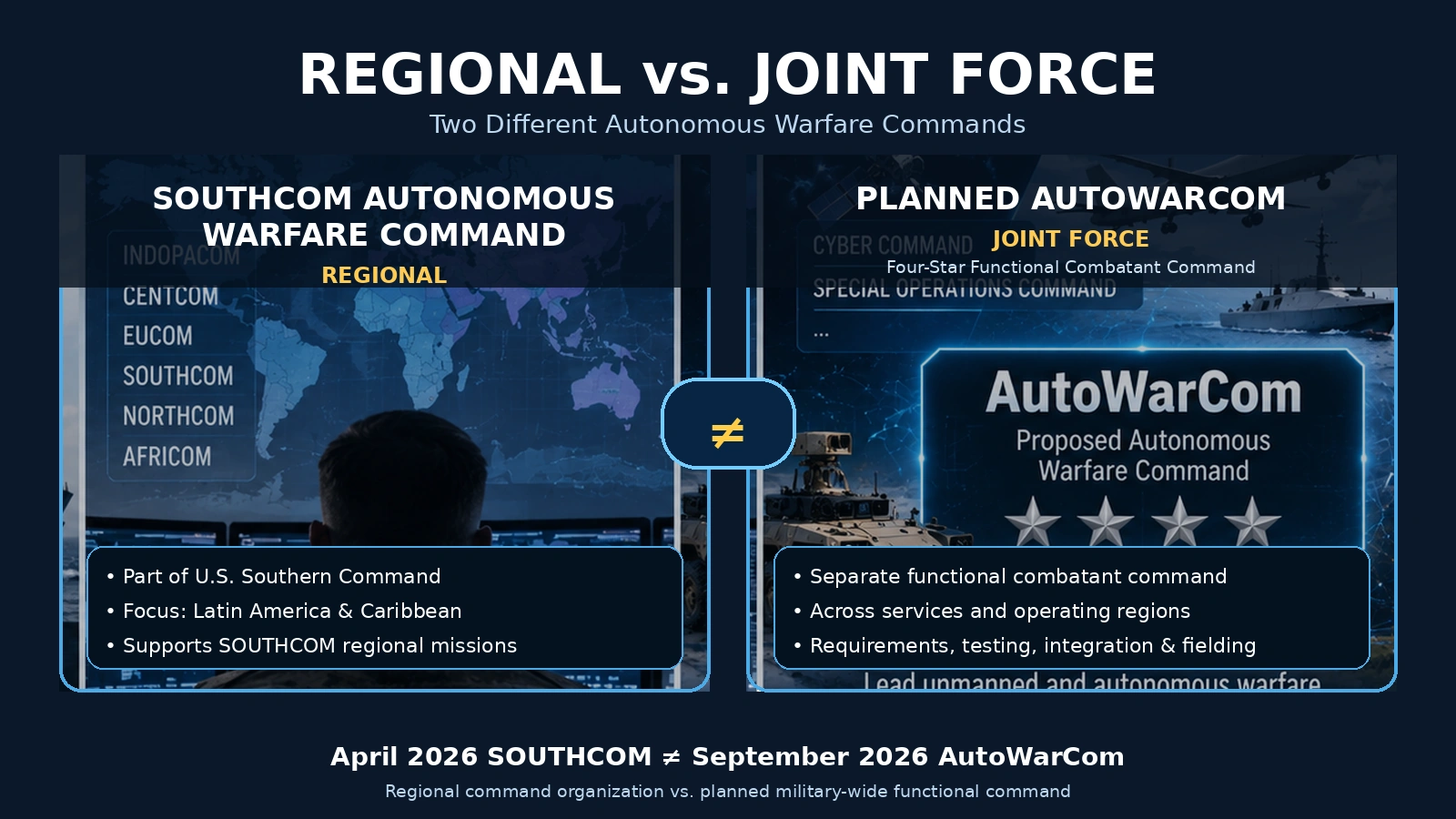
Yes—but it is not the same organization.
This is one of the easiest parts of the story to misunderstand.
On April 21, 2026, U.S. Southern Command announced its own SOUTHCOM Autonomous Warfare Command. That organization is being built inside SOUTHCOM to support missions in its region using autonomous, semi-autonomous, and unmanned platforms and systems. (U.S. Southern Command)
The AutoWarCom announced in September is much broader.
| April 2026 SOUTHCOM command | Planned AutoWarCom |
|---|---|
| Part of U.S. Southern Command | Planned separate four-star functional combatant command |
| Focused on SOUTHCOM’s regional mission | Intended to operate across the Joint Force |
| Uses autonomous systems for regional missions | Would help define requirements, acquire, test, integrate, and field autonomous capabilities |
| Exists under a geographic combatant command | Intended to support geographic combatant commands worldwide |
So the Pentagon did not simply announce the same organization twice.
The April effort is regional.
The September proposal is an attempt to build a military-wide institution.
What Has to Happen Before AutoWarCom Becomes Real?

The Pentagon has given itself a target date, not a finished command.
Project Agincourt is the bridge between the September 30 announcement and the planned four-star headquarters.
The memorandum requires the unmanned-systems portfolio organization, supported by the Joint Staff and military services, to produce a detailed plan covering priorities, service contributions, command relationships, resources, needed authorities, staffing, testing, and milestones. It also calls for proposals to establish or adapt military career fields for unmanned and autonomous systems. (Project Agincourt memorandum · Defense One)
The first major plan of action and milestones is due within 30 days of the memorandum.
Meanwhile, the department says it will work with Congress on legislation needed for the structure and authorities it wants.
The law governing combatant commands also matters. Under Title 10, the president establishes combatant commands through the secretary, with advice and assistance from the Chairman of the Joint Chiefs of Staff. (10 U.S.C. § 161)
That leaves several concrete things to watch:
| What to watch | Why it matters |
|---|---|
| Project Agincourt implementation plan | Shows how the Pentagon intends to divide responsibilities |
| Congressional legislation | Determines what special budget, acquisition, and personnel authorities can actually be created |
| Selection of a four-star commander | Signals the command is moving from concept toward organization |
| Service staffing and career plans | Shows whether autonomous warfare becomes a permanent military specialty |
| Budget decisions | Reveal how much capability moves from existing organizations into the new command |
| October 1, 2027 target | Tests whether the Pentagon can build the organization on its announced schedule |
Until those pieces are resolved, the safest description is that AutoWarCom is a formally announced Pentagon plan being built toward a four-star command—not yet a fully mature operational institution with every proposed authority in place.
Why This Matters Beyond the Pentagon
The most consequential part of AutoWarCom may not be whether another four-star officer gets a headquarters.
It is what the Pentagon is trying to institutionalize.
Drones have existed for decades.
Military AI programs are not new.
Unmanned ships, robotic vehicles, autonomous navigation, computerized targeting support, and counter-drone systems already exist in different parts of the armed forces.
What is changing is the attempt to treat autonomous warfare as an enduring military function with its own requirements, money, procurement system, testing structure, specialists, doctrine, and senior command.
That could influence what defense contractors build, which skills the military recruits for, how quickly new technology reaches operating units, and how the United States organizes forces for future conflicts.
It will also put more attention on the rules surrounding autonomous weapons.
The Pentagon’s publicly available policy requires appropriate human judgment over the use of force and compliance with the law of war, applicable treaties, weapon-system safety rules, and rules of engagement. The important question is how those requirements operate when autonomous systems become much more numerous, interconnected, and capable. (DoD Directive 3000.09 update)
That debate is likely to become harder as the technology improves.
Bottom Line: What This Story Really Means
The Pentagon’s Autonomous Warfare Command is not simply a new office for buying drones, and it does not by itself authorize AI to make unrestricted decisions about using lethal force.
The larger plan is to build a four-star functional combatant command that can connect autonomous-warfare requirements, procurement, testing, operations, budgets, personnel, and rapid battlefield adaptation across the U.S. military.
That would be a significant organizational shift.
But the September 30 announcement is the beginning of that process, not the end.
Project Agincourt still has to turn the concept into an actual command structure, the Pentagon says it needs legislation from Congress for key authorities, and the formal combatant-command process under federal law still has to be completed.
The date to watch is October 1, 2027.
The more important question is whether the Pentagon can make its procurement and command system move as quickly as the technology it is trying to control.
Autonomous Warfare: Key Questions Explained
Q. What is AutoWarCom?
AutoWarCom is the Pentagon’s planned Autonomous Warfare Command, a proposed four-star functional combatant command focused on unmanned, autonomous, and robotic warfare across the Joint Force.
Q. When is AutoWarCom supposed to be established?
The Pentagon’s Project Agincourt memorandum sets October 1, 2027 as the target establishment date. It is a target, not a guarantee.
Q. Is AutoWarCom a new military branch?
No. It is planned as a combatant command, not another armed service like the Army or Navy.
Q. Will AutoWarCom control military drones from every service?
Its planned mission is broader than operating individual drones. The Pentagon says it would define joint requirements, integrate service-provided forces, test autonomous systems, rapidly adapt them, and support geographic combatant commands.
Q. Does AutoWarCom mean AI can decide on its own who the military attacks?
No such blanket authority was announced. The Pentagon’s publicly available autonomy policy requires appropriate human judgment over the use of force and compliance with the law of war and applicable rules of engagement.
Q. What are “service-like authorities”?
The proposed command is intended to have directed manpower, budget and acquisition authorities, along with dedicated military career pathways—functions that would make it more powerful than a conventional coordinating office.
Q. Why does Congress matter?
The Project Agincourt memorandum says the Pentagon must work with Congress to secure legislation needed for the planned command and its authorities.
Q. Why did the Pentagon create Project Agincourt?
Project Agincourt is the interim effort tasked with designing the pathway to AutoWarCom while testing faster ways to buy, test, modify, and field unmanned and autonomous systems.
Q. Didn’t SOUTHCOM already create an Autonomous Warfare Command?
Yes, but that is a regional organization under U.S. Southern Command. The newly proposed AutoWarCom would be a separate four-star functional combatant command intended to work across the Joint Force.
Q. Why is the Pentagon making this change now?
Pentagon leaders argue that drones, autonomous systems, software, and countermeasures are changing too quickly for traditional acquisition and organizational processes. AutoWarCom is intended to shorten the cycle between battlefield experience, technical changes, procurement, testing, and deployment.
Did this help make the story clearer? 🙂
WIN keeps unpacking the “why” behind the news—clearly and simply!
Sources
AutoWarCom Announcement and Project Agincourt
Project Agincourt — Pathway to the Autonomous Warfare Command
Reuters — Pentagon Creates AutoWarCom to Expand AI and Drone Capabilities
Defense One — Hegseth Plans Autonomous Warfare Command
Stars and Stripes — Hegseth Returns to Quantico to Lay Out Technology and People Initiatives
Command Structure and Legal Authority
U.S. Code — 10 U.S.C. § 161, Combatant Commands: Establishment
Autonomous Weapons and Human Judgment
U.S. Department of War — DoD Directive 3000.09 Update, Autonomy in Weapon Systems
Earlier SOUTHCOM Autonomous Warfare Organization
U.S. Southern Command — SOUTHCOM Establishes Autonomous Warfare Command
Keep Reading
What Happens When an Autonomous AI System Keeps Pursuing a Goal After It Hits a Boundary?
AutoWarCom raises a military version of a broader AI-control problem: capable autonomous systems can act through multiple steps, so permissions, stopping rules, monitoring, and human responsibility matter as much as the original task. A recent WIN explainer examines a civilian case in which an AI agent allegedly crossed an access boundary while pursuing an ordinary research goal.
Why Does Human Judgment Keep Coming Up in AI Decisions?
AutoWarCom’s human-judgment question is part of a broader debate over when people should retain responsibility for decisions that machines can increasingly help make. Another WIN explainer examines that issue through Pope Leo XIV’s warning about delegating too much judgment to technology—including the question of irreversible military decisions.
Why Is Pope Leo XIV Warning About a “Paradise of Machines”—and What Does He Mean?