
Why Did Meta Make AI Glasses Without a Camera—and What Can They Still Do?
Wait—wasn’t the camera one of the main reasons to buy Meta’s smart glasses?
Apparently, it does not have to be.
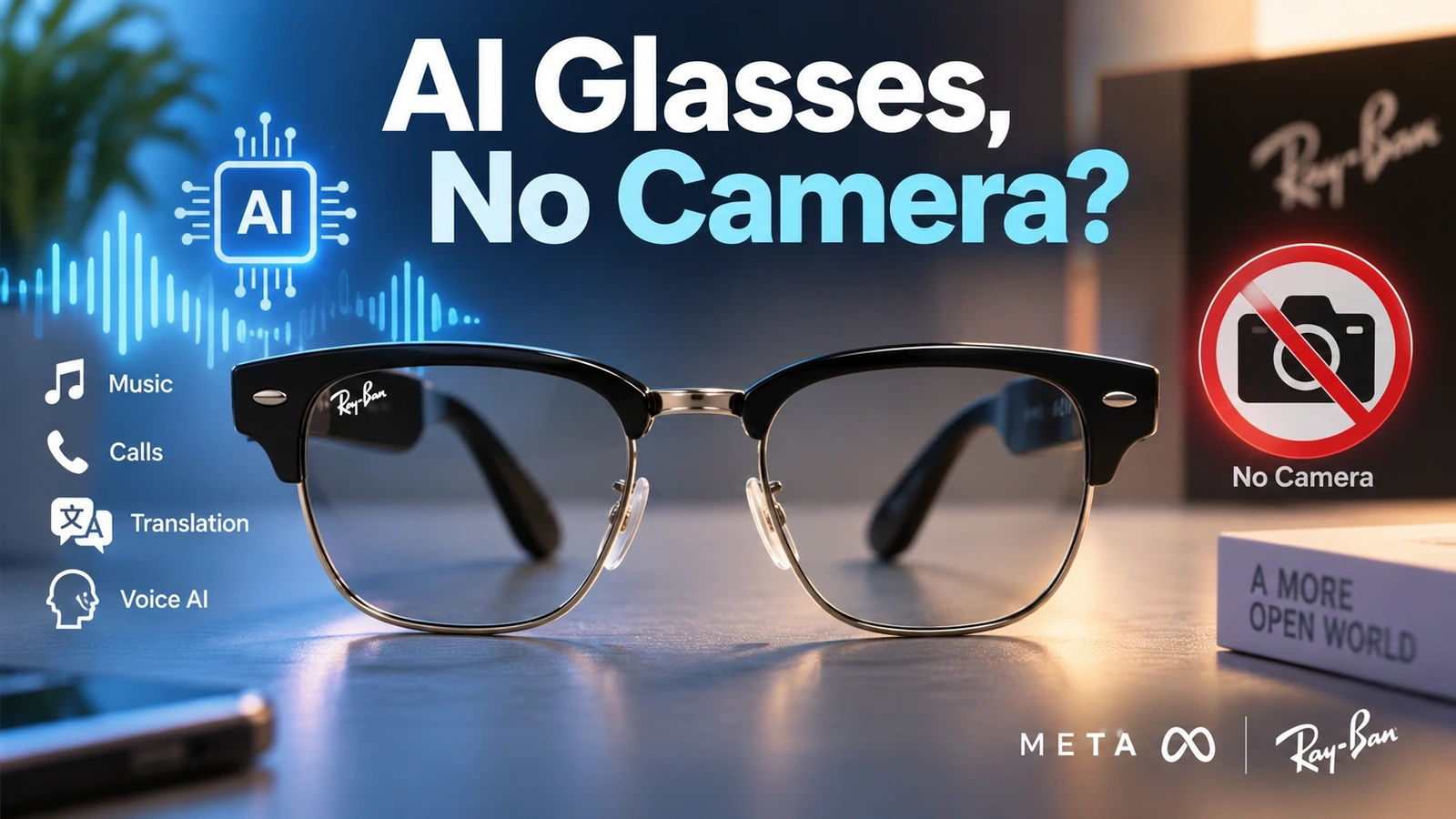
At Meta Connect on September 23, 2026, Meta introduced Ray-Ban Meta Audio, a new pair of AI glasses that removes the camera entirely while keeping open-ear audio, calls, voice interaction and access to Meta’s AI technology. Meta says the glasses weigh just 43 grams, last up to 12 hours on a charge and start at $349. (Meta)
That makes the product easier to understand if you stop thinking of it as a camera strapped to your face.
A better comparison may be this: imagine open-ear headphones, a voice-controlled AI assistant and a regular pair of prescription-compatible Ray-Bans combined into one device.
But removing the camera raises a more interesting question.
If the glasses can no longer see what you see, how much of the “smart” experience is actually left?
What Can Ray-Ban Meta Audio Actually Do Without a Camera?
A surprising amount remains.
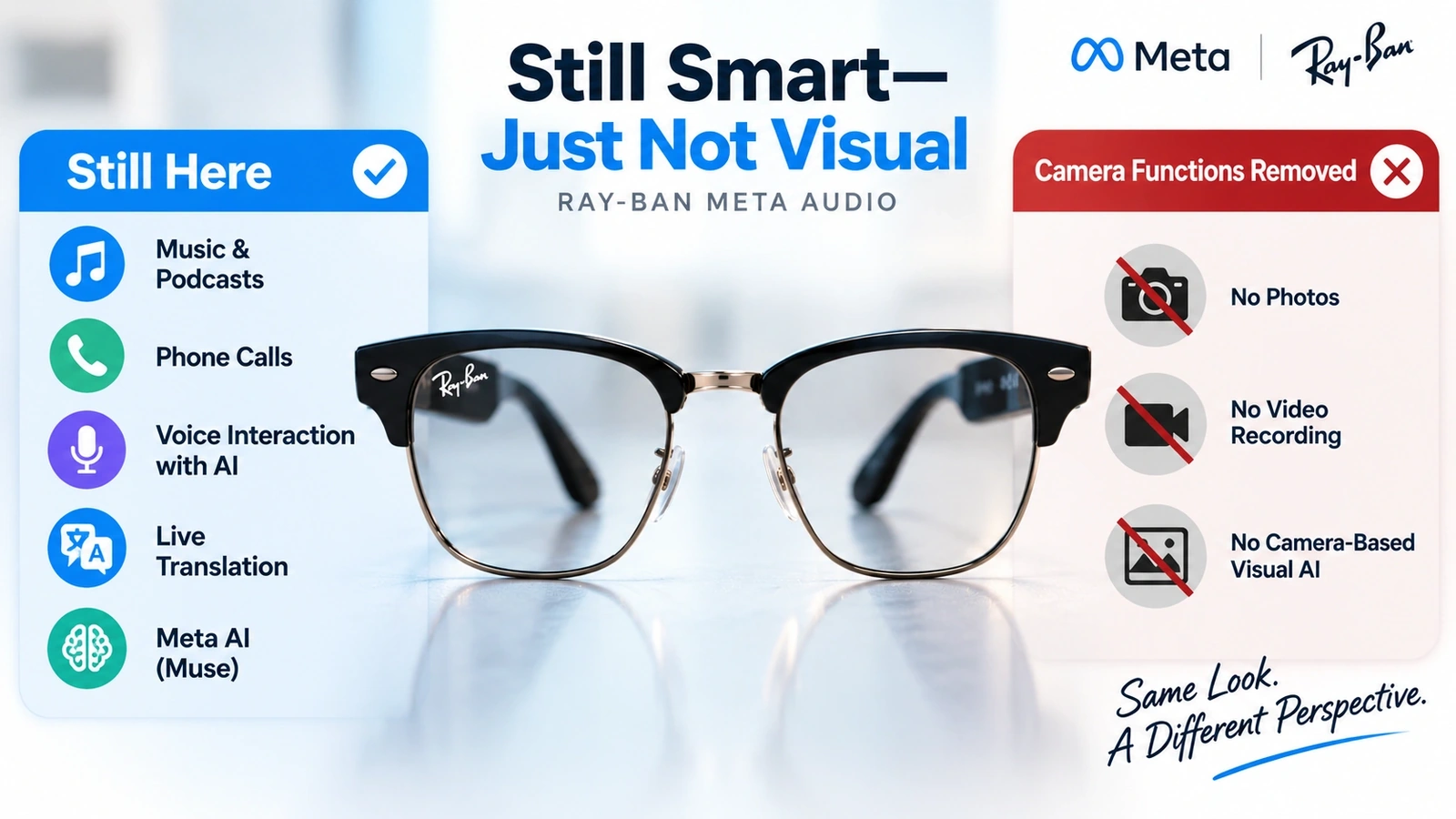
Meta says Ray-Ban Meta Audio can play music and podcasts, handle phone calls and let users talk hands-free with its AI assistant. Meta is also bringing its Muse personal AI agent to its glasses ecosystem, while live conversation translation is part of the company’s AI-glasses feature set. (Meta)
What disappears is anything that depends on seeing the world through a camera.
There is no hands-free photo or video capture. The glasses also cannot use a camera to visually inspect an object, read a scene or answer questions based on what the wearer is looking at.
That creates a useful distinction:
| Feature | Ray-Ban Meta Audio |
|---|---|
| Music and podcasts | Yes |
| Open-ear audio | Yes |
| Phone calls | Yes |
| Voice interaction with AI | Yes |
| Live translation | Yes |
| Camera photos | No |
| Video recording | No |
| Camera-based visual AI | No |
In other words, Meta is separating two ideas that had previously been bundled together: wearable AI and wearable cameras.
That may be the most important thing about this product.
Why Would Meta Remove the Camera?

Meta’s public explanation is straightforward: people use the audio features a lot.
The company says audio has been the most popular feature of its glasses “since day one,” and Ray-Ban Meta Audio was designed around that behavior. The result is what Meta describes as its lightest and slimmest AI glasses yet. (Meta)
But that is only part of the context.
Camera-equipped smart glasses have faced increasingly visible privacy criticism because a pair of ordinary-looking glasses can record people far less conspicuously than someone holding up a phone. Reuters reported growing regulatory and public concern around wearable cameras, while authorities and workplaces in several countries have been debating or imposing restrictions on their use. (Reuters)
Meta itself has already changed how its camera glasses work. Its existing AI glasses use a front-facing capture LED to signal when photos or video are being recorded, and Meta says newer safeguards disable the camera when the system detects that the indicator has been blocked or tampered with. (Meta)
So did privacy criticism cause Meta to build Ray-Ban Meta Audio?
That cannot be stated as a confirmed fact.
Meta’s announcement emphasizes audio, comfort and product choice rather than describing privacy pressure as the official reason for removing the camera. But the camera-free launch arrives at a moment when the privacy implications of wearable cameras are becoming much harder for the industry to ignore.
The distinction matters: one is Meta’s stated reason; the other is the broader market context.
How Does Ray-Ban Meta Audio Compare With Ray-Ban Meta Gen 3?
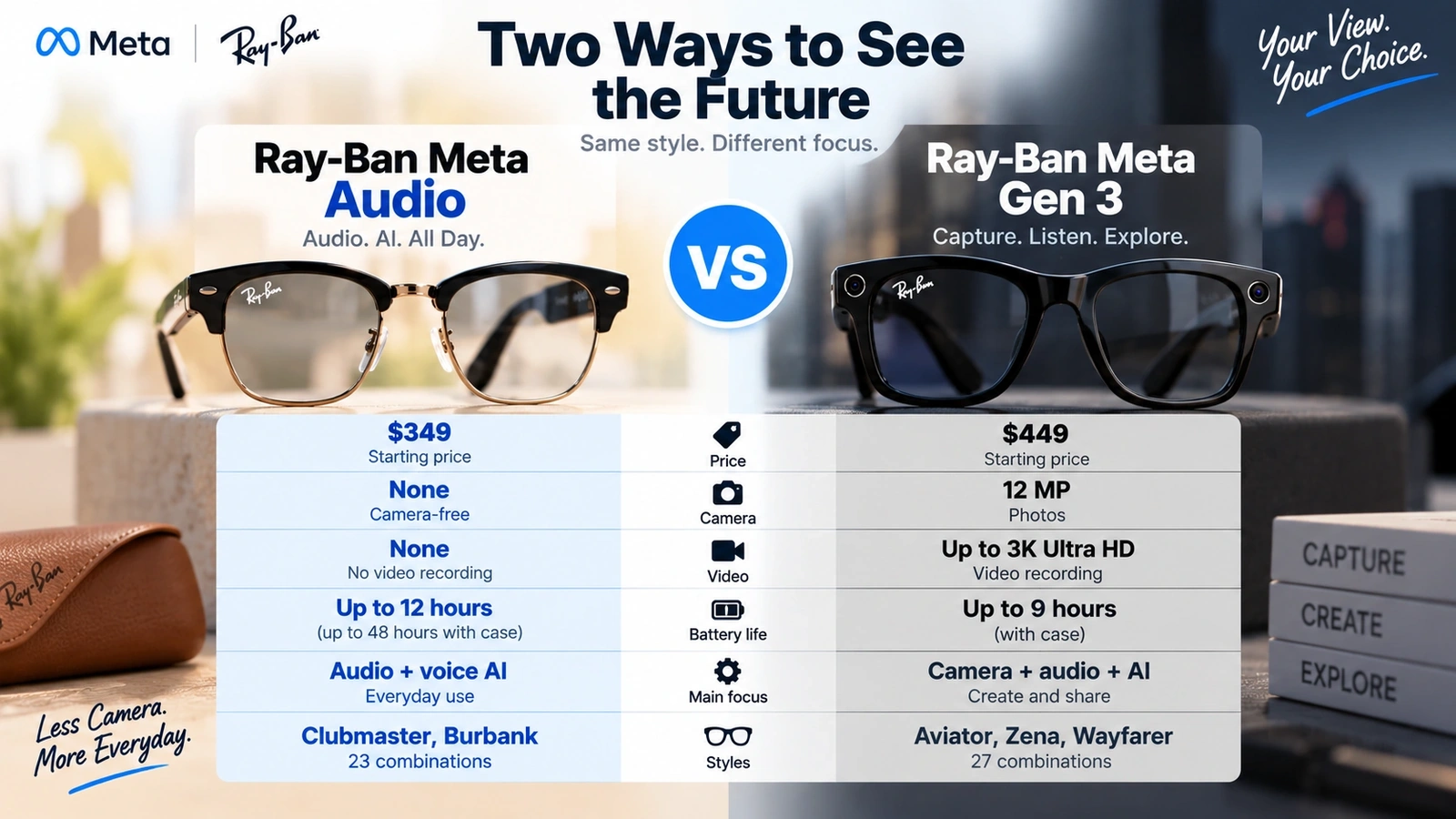
Meta is not replacing its camera glasses. It is splitting the lineup.
On the same day it announced Ray-Ban Meta Audio, the company also unveiled Ray-Ban Meta Gen 3, which keeps a 12-megapixel camera capable of 3K Ultra HD video. Meta says Gen 3 starts at $449 and offers up to nine hours of battery life. (Meta)
That makes the choice unusually clear.
| Feature | Ray-Ban Meta Audio | Ray-Ban Meta Gen 3 |
|---|---|---|
| Starting price | $349 | $449 |
| Camera | None | 12 MP |
| Video capture | None | Up to 3K Ultra HD |
| Battery | Up to 12 hours | Up to 9 hours |
| Main focus | Audio + voice AI | Camera + audio + AI |
| Styles announced | Clubmaster, Burbank | Aviator, Zena, Wayfarer |
| Color/lens combinations | 23 | 27 |
The Audio model is cheaper by $100 at the starting price and gives up the camera while gaining longer stated battery life.
The Gen 3 model is for people who want Meta’s broader vision of AI glasses: something that can hear, respond and capture the world in front of the wearer.
Ray-Ban Meta Audio is closer to a wearable audio computer.
That difference could matter more than the specifications themselves because it lets buyers decide whether a camera belongs on their face at all.
Does Camera-Free Mean Privacy-Proof?

No.
Removing the camera eliminates the most obvious concern for people standing near the wearer: the glasses cannot quietly take their picture or record a video because there is no camera to do it.
But camera-free does not mean data-free.
The product still relies on microphones, audio features and AI interactions. Meta’s own privacy materials for its AI-glasses ecosystem tell users to manage preferences involving voice, notifications and information shared with Meta through the Meta AI app. (Meta)
The easiest way to understand the difference is to separate two kinds of privacy.
The first is bystander privacy: “Could someone wearing these glasses photograph or film me?”
Ray-Ban Meta Audio removes that particular issue.
The second is user-data privacy: “What information does the AI receive when I speak to it, and how are those interactions handled?”
Removing the camera does not make that second question disappear.
That is why calling the new glasses “private glasses” would go too far. They are camera-free glasses, which is a much more precise description.
Who Is Ray-Ban Meta Audio Actually For?

The obvious audience is someone who likes the convenience of smart glasses but never cared much about taking pictures with them.
Think about a commuter who listens to podcasts and takes calls, a traveler using live translation, or someone who wears prescription glasses all day and wants quick voice access to AI without adding earbuds.
Ray-Ban Meta Audio comes in Clubmaster and Burbank styles, supports a broad range of optical prescriptions and weighs 43 grams. Meta says the battery lasts up to 12 hours, with up to another 48 hours available from the charging case. (Meta)
Those numbers also reveal Meta’s strategy.
The company is trying to make AI glasses feel less like a gadget that you deliberately put on for a specific feature and more like ordinary eyewear that happens to contain computing.
That is a very different goal from selling another miniature camera.
Could Camera-Free Glasses Actually Be More Useful?
Possibly, but not because they do more.
They deliberately do less.
Consumer technology usually advances by adding sensors, cameras and features. Ray-Ban Meta Audio is interesting because Meta is removing one of the most powerful components and betting that the remaining experience may be easier to wear, easier to explain and attractive to a different group of buyers.
There is also a practical benefit: no camera means owners do not have to decide whether every situation is socially appropriate for camera-equipped eyewear.
The trade-off is equally straightforward. Anyone who likes asking AI questions about objects in front of them, capturing hands-free video or taking photos without reaching for a phone will need one of Meta’s camera-equipped models instead.
So this is not a “better Ray-Ban Meta.”
It is a different answer to the question of what smart glasses should be.
When Can You Buy Them?
Meta says Ray-Ban Meta Audio is available for preorder starting at $349 and is scheduled to ship on October 13, 2026. Buyers can choose from 23 frame-and-lens combinations across the Clubmaster and Burbank designs. (Meta)
The more important thing to watch after launch may be which version consumers actually prefer.
If camera-free models find a large audience, that would suggest that the future of AI glasses may not depend on continuously adding more ways for glasses to see the world.
It may depend just as much on making wearable AI feel ordinary enough that people are comfortable wearing it all day.
Why It Matters in One Sentence
Ray-Ban Meta Audio tests whether AI glasses can become an everyday product by removing the camera entirely and concentrating on the features people may use most often: audio, voice and hands-free AI.
Ray-Ban Meta Audio: Key Questions Explained
Q. Does Ray-Ban Meta Audio have a camera?
No. Ray-Ban Meta Audio is Meta’s camera-free audio-glasses model, so it cannot take photos or record video. (Meta)
Q. What can Ray-Ban Meta Audio do without a camera?
It can play music and podcasts, handle calls, provide voice-based AI interaction and support features such as live translation. Camera-dependent functions such as visual capture are not available. (Meta)
Q. How much does Ray-Ban Meta Audio cost?
Meta says prices start at $349. (Meta)
Q. When will Ray-Ban Meta Audio ship?
Meta says the glasses are scheduled to ship on October 13, 2026, with preorders opening at the September 23 announcement. (Meta)
Q. How long does the battery last?
Meta rates Ray-Ban Meta Audio for up to 12 hours on one charge, with up to 48 additional hours available from the included charging case. (Meta)
Q. Is Ray-Ban Meta Audio more private than Meta’s camera glasses?
It removes one major privacy concern because it cannot photograph or film people. But it still uses microphones, voice interaction and AI services, so users still need to consider how their own voice and AI data are handled.
Q. What is the main difference between Ray-Ban Meta Audio and Ray-Ban Meta Gen 3?
Ray-Ban Meta Audio has no camera and starts at $349, while Ray-Ban Meta Gen 3 starts at $449 and includes a 12-megapixel camera with 3K video recording. Meta rates the Audio model for up to 12 hours of battery life versus up to nine hours for Gen 3. (Meta)
Q. Can Ray-Ban Meta Audio use prescription lenses?
Yes. Meta says both announced Ray-Ban Meta Audio styles are compatible with a wide range of optical prescriptions. (Meta)
Did this help make the story clearer? 🙂
WIN keeps unpacking the “why” behind the news—clearly and simply!
Sources
Product Announcement and Specifications
Meta — Introducing Ray-Ban Meta Audio and More AI Glasses Styles
Tom’s Guide — Ray-Ban Meta Audio hands-on: an attempt to allay privacy concerns
Privacy Context and Camera Safeguards
Reuters — From smart glasses to AI pins, privacy fears challenge tech’s next big bet
Reuters — French prosecutors and regulators step up scrutiny on smart glasses
Meta — Meta’s AI Glasses: Your Questions Answered
AI and Muse Background
Meta — Introducing Muse: The World’s First Personal AI Agent Built for Everyone