
Project Star: Why Does a 5-GW Texas AI Campus Need 6.47 GW of Gas Power—and Why Is South Korea Involved?

Five gigawatts—for one data-center campus?
And if the computing campus can reach 5 GW, why is the power project next door being designed for 6.472 GW?
Then there is another question: why is South Korea involved in a giant power project in a small South Texas community?
Those questions are all connected.
On September 30, 2026, the U.S. Department of Commerce and the Republic of Korea selected Related Companies and NextEra Energy Resources, working with Lewis Energy Group, to develop Project Star in Encinal, Texas. The planned energy campus carries a stated total project cost of $22.3 billion and 6,472 MW of generation capacity. (NextEra Energy · Korea.net · Reuters)
One distinction matters immediately: $22.3 billion is the stated total cost of Project Star. The public announcements do not say South Korea alone will contribute that entire amount.
The adjacent 5 GW data-center campus is also described separately as privately funded.
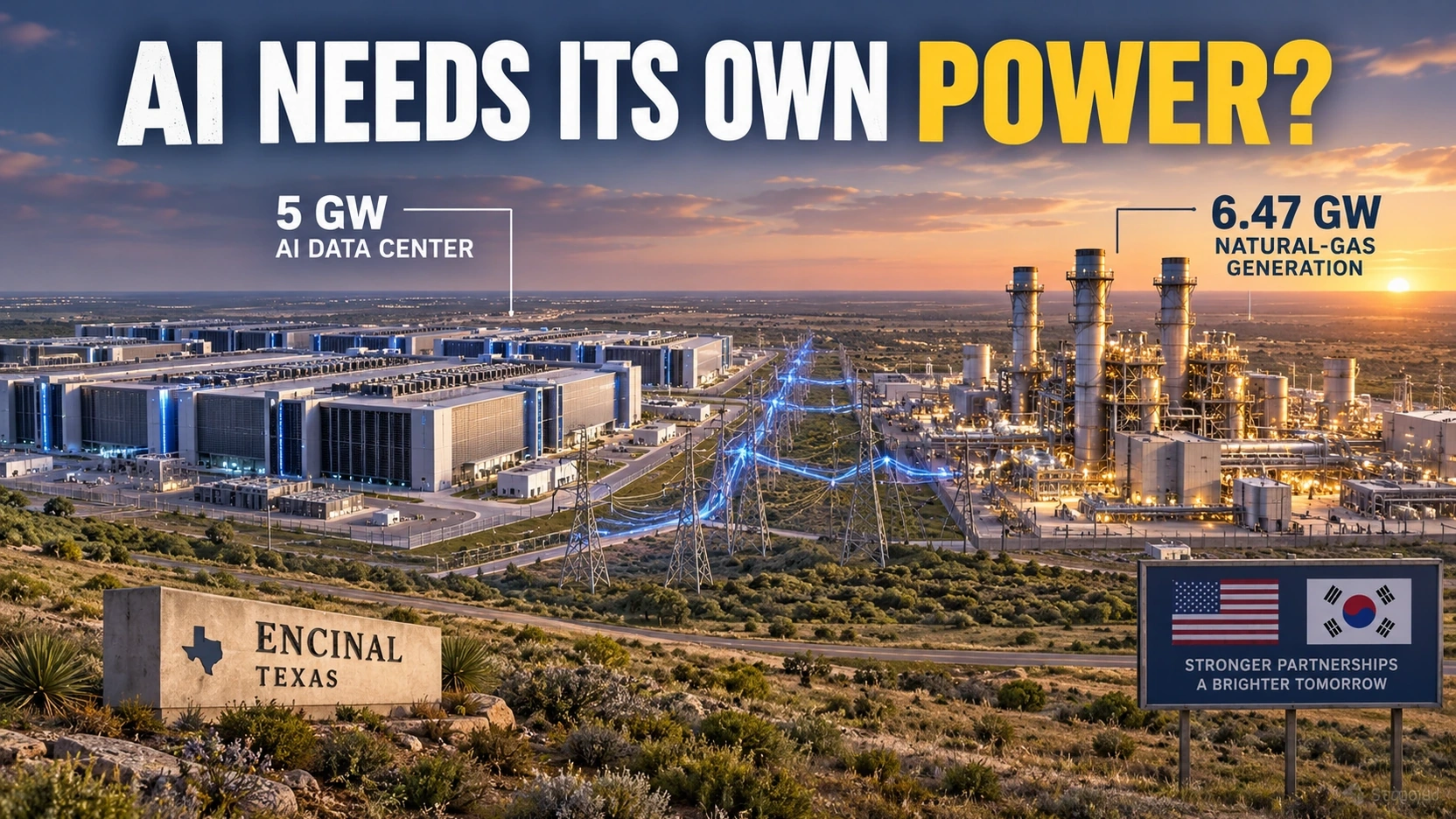
※ Images in this article are AI-generated illustrations created to help explain the story. They are not actual photographs, and depictions of people, places, or events may differ slightly from reality.
The project is easiest to understand as two enormous pieces being developed side by side: computing infrastructure that needs extraordinary amounts of electricity, and a new power system designed primarily to serve it.
What Did the U.S. and South Korea Actually Announce?
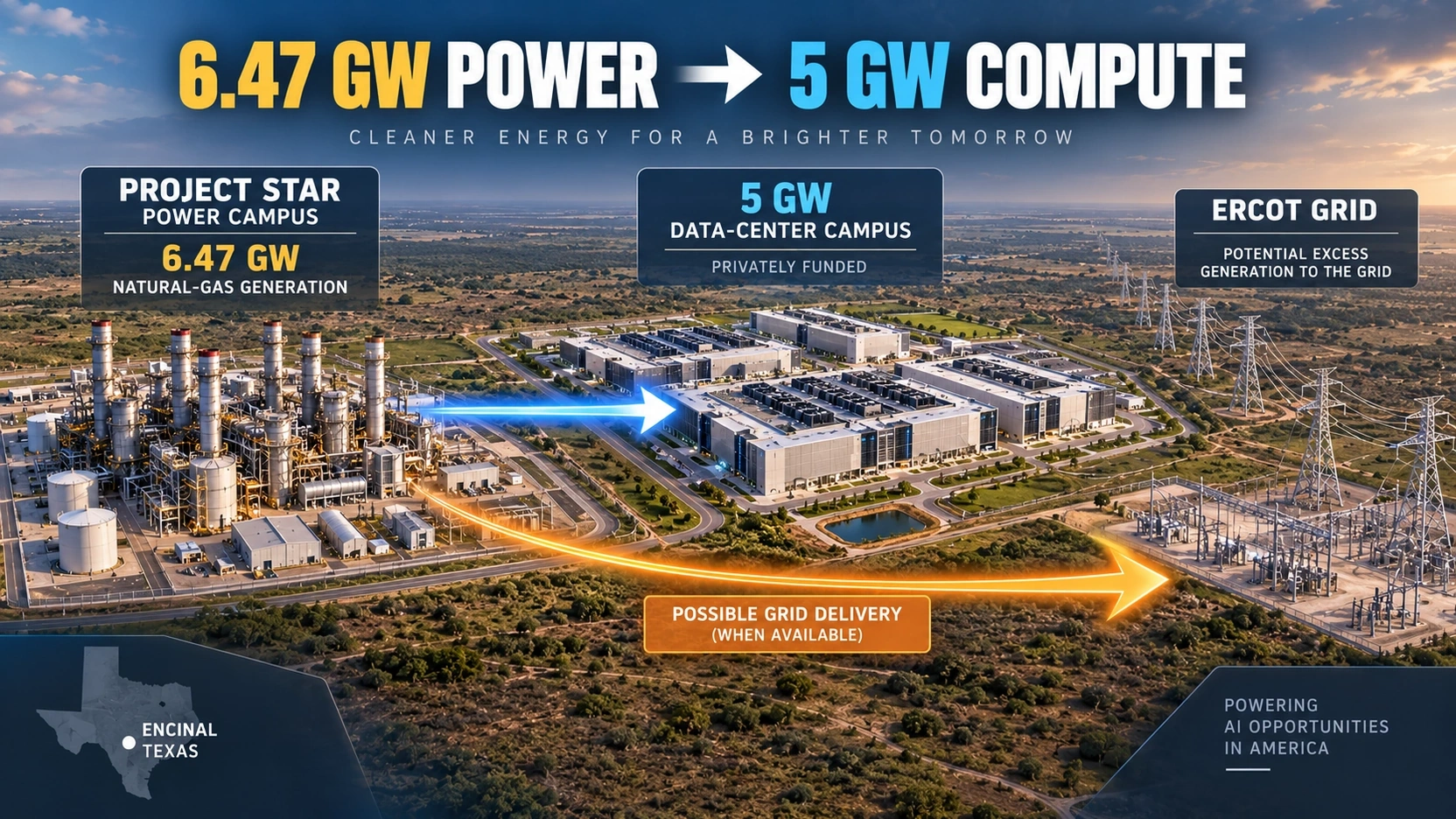
Project Star is a proposed natural-gas-fired combined-cycle power campus in Encinal, in La Salle County. Its planned generating capacity is 6,472 MW, or 6.472 GW.
Next door, Related Digital plans a privately funded digital-infrastructure campus that can reach 5 GW at full scale. Project Star is intended to supply that campus directly while also being designed to deliver excess generation to the wider grid. (NextEra Energy)
The basic structure looks like this:
| Part of the project | Planned scale | Role |
|---|---|---|
| Project Star power campus | 6,472 MW | Generate electricity primarily for the nearby computing campus |
| Related Digital data-center campus | 5,000 MW at full scale | Run AI and other large-scale digital infrastructure |
| ERCOT grid connection | Variable | Receive generation when Project Star has power available beyond campus needs |
Related Companies and NextEra Energy Resources are expected to develop, build and operate the power project. Lewis Energy Group is providing the site and associated infrastructure, including natural-gas supply, land and produced water. (NextEra Energy)
The developers estimate about 8,400 jobs at peak construction and roughly 170 permanent jobs at the power campus once it is operating. Those are project estimates, not completed-job counts. The Korean government says the first phase is targeted for commercial operation in 2029, with full operation planned for 2032. (NextEra Energy · Korea.net)
Why Does a 5-Gigawatt Data Center Need 6.47 Gigawatts of Generation?
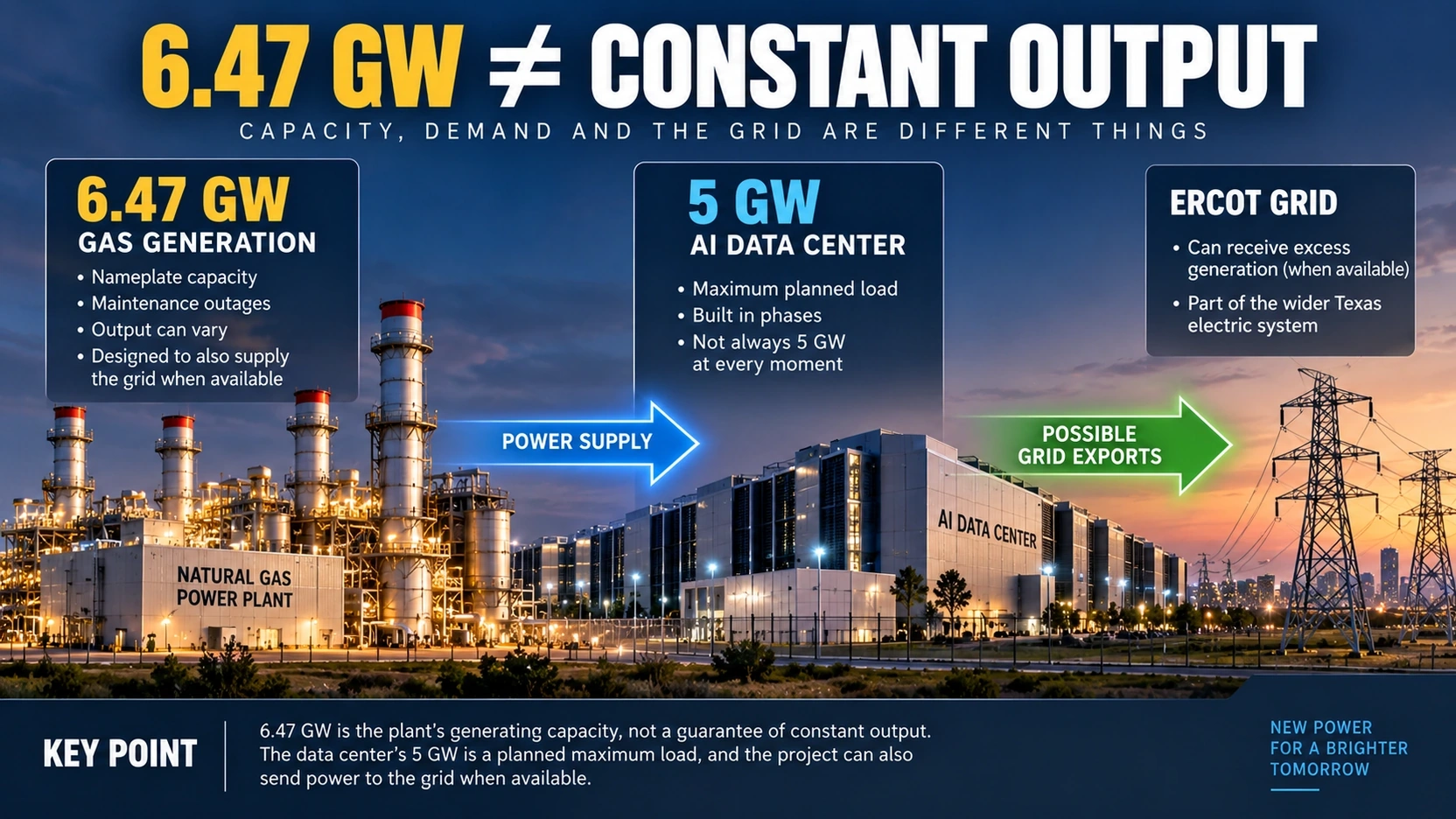
There is no single public document that explains the exact engineering margin between 6.472 GW of generation and a 5 GW data-center campus.
What the announcements do make clear is that 6.472 GW is generating capacity, not a promise that the plant will produce exactly 6.472 GW every second. Power plants require maintenance, units can be unavailable, actual output can vary, and the data-center campus itself is expected to be developed in stages. The project is also designed to deliver excess generation to the grid when available.
So simply subtracting 5 GW from 6.472 GW and calling the remaining 1.472 GW a permanent surplus would be misleading.
The scale is still remarkable. ERCOT lists its current 2026 all-time peak-demand record at 91,089 MW, set on July 22, 2026. A 5,000 MW computing campus is roughly 5.5% of that statewide peak figure, while 6,472 MW of generating capacity is about 7.1%. (ERCOT)
That comparison is only meant to show scale. It does not mean the finished campus will continuously consume 5 GW, and it does not mean Texas demand will still be 91 GW when the full project is completed.
It does explain why this is not being treated like an ordinary commercial building asking a utility for a larger connection. At full scale, the project is closer to adding an industrial-scale electricity system of its own.
Why Build the Power Plant Right Next to the Data Center?
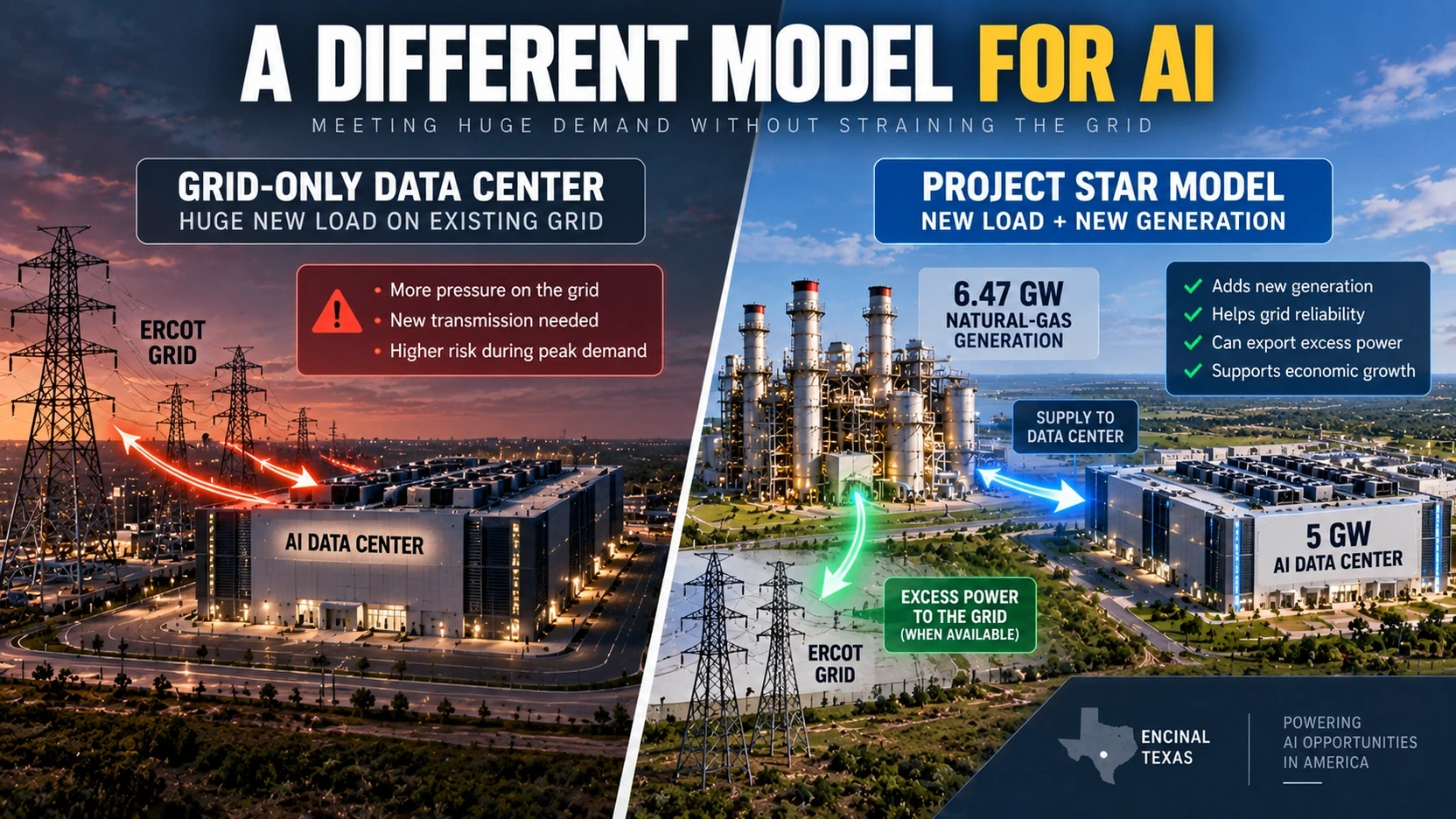
Because the biggest challenge created by giant AI data centers is not simply how much electricity they use. It is how quickly an enormous block of demand can appear in one location—and who pays for the generation, substations and transmission infrastructure needed to serve it.
ERCOT has been tracking a surge in large-load interconnection requests. In an April 2026 presentation, it reported about 410 GW of large loads seeking interconnection through 2030, with roughly 87.6% associated with data centers. ERCOT also stresses that connection requests and preliminary forecasts are not predictions that every proposed project will actually be built. (ERCOT · ERCOT)
Texas law also puts more responsibility on very large electricity users. Senate Bill 6 directs regulators to make large-load customers contribute to interconnection costs, establishes financial-commitment requirements, and creates mechanisms for certain large loads to curtail demand during emergency conditions. (Texas Legislature)
Then, on September 21, 2026, Gov. Greg Abbott directed the Texas Commission on Environmental Quality to halt permits sought by data centers until state agencies complete audits of their power and water demands. The directive says data centers should pay their own way and not compromise grid reliability or water resources. (Texas Governor’s Office)
Project Star starts from a different premise than a data center that simply asks the existing grid for another 5 GW: it pairs the new computing load with a massive block of new generation.
The developers say that structure can protect reliability and ratepayers while also making generation available to the grid when the campus does not need all of it. That is the developers’ stated case for the project; the actual effects will depend on final interconnection, operating and cost-allocation arrangements. (NextEra Energy)
Why Is South Korea Involved in a Texas Gas Plant?
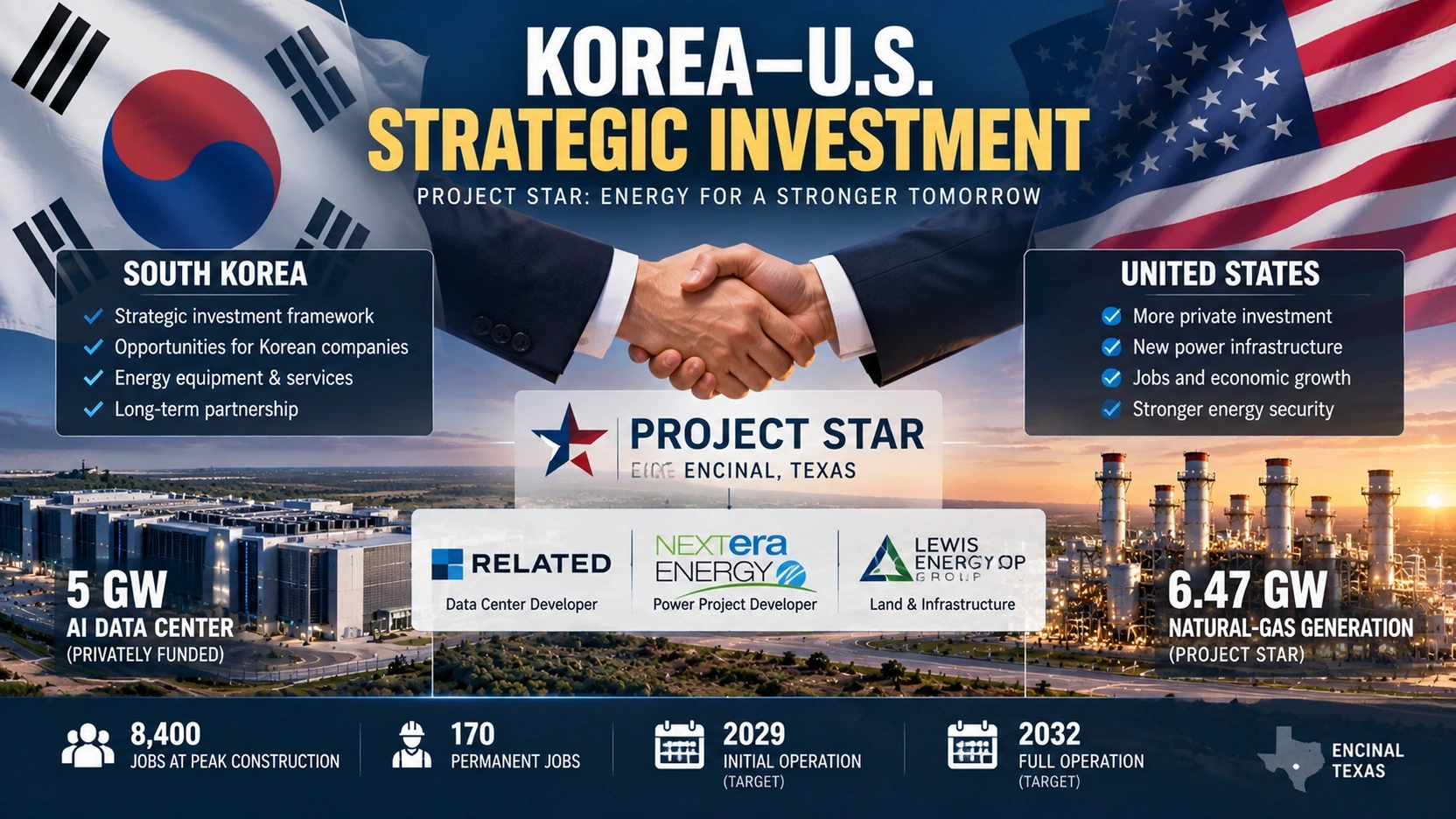
Because Project Star is not just a Texas utility project. It is the first project being advanced under a broader Korea-U.S. strategic investment framework that followed the two countries’ 2025 trade agreement and strategic investment memorandum. (Korea.net · Reuters)
The headline number needs careful wording:
| What the announcement says | What it does not say |
|---|---|
| $22.3 billion is the stated total Project Star cost | It does not say South Korea alone will provide the full $22.3 billion |
| Project Star is the first Korea-U.S. strategic investment project | That does not mean the Korean government itself will construct or operate the plant |
| The NextEra release says the energy campus will be jointly owned under the bilateral trade structure | The public announcements do not provide a simple Korea-only dollar contribution for the entire project |
| Korean companies are expected to have opportunities to compete for equipment and services | Specific contracts should not be assumed until they are actually awarded |
NextEra’s announcement says the energy campus will be jointly owned by the Republic of Korea and the United States under the bilateral trade structure, while the Related/NextEra team is expected to build and operate the generation facilities. Lewis Energy Group is providing the site and related resources. (NextEra Energy)
South Korea’s government also says it negotiated opportunities for competitive Korean companies to participate in generating equipment, engineering, construction, and long-term operations and maintenance. It says the U.S. side expressed an intention to provide opportunities for Korean-made equipment, including turbines, in Project Star and potentially similar future projects. (Republic of Korea Policy Briefing)
That means South Korea’s interest is broader than one power plant. The project could also create a path for Korean energy-equipment and engineering companies into the expanding U.S. AI-infrastructure market—but actual supplier awards will depend on future procurement decisions.
Why Natural Gas—and What Does “Combined Cycle” Mean?
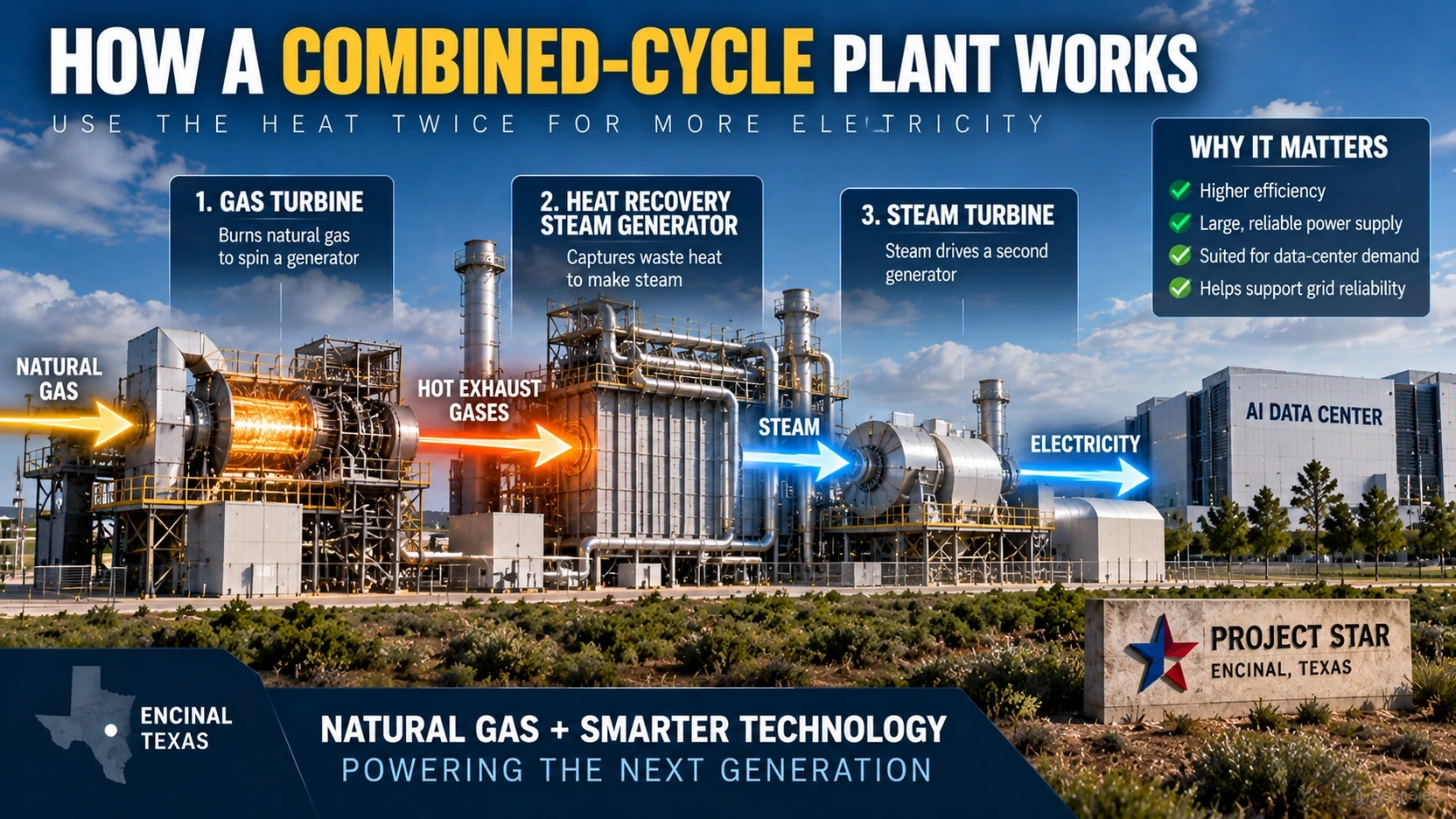
A combined-cycle plant gets more electricity from natural gas by using the fuel’s heat in two stages instead of one.
First, natural gas burns in a combustion turbine that drives a generator. Instead of simply discarding the hot exhaust, a combined-cycle system routes that heat through a heat-recovery steam generator. The steam then drives another turbine to produce additional electricity. EIA says this process increases generating efficiency compared with a simple-cycle gas turbine. (U.S. Energy Information Administration)
Why does that fit a huge data-center campus?
The companies have not publicly reduced the fuel choice to one single reason. But combined-cycle natural-gas plants can supply large amounts of dispatchable electricity and generally operate more heavily than simple-cycle gas turbines, which are used more often for short periods of peak demand. (U.S. Energy Information Administration)
That matters because large AI data centers can require electricity around the clock. Natural gas therefore offers a way to add a very large block of controllable generation close to the computing load.
The trade-off is just as clear: this is still fossil-fuel generation. Project Star may address the problem of supplying dependable electricity to AI infrastructure, but it is not a zero-emissions power solution.
Is Project Star Already Approved and Ready to Build?
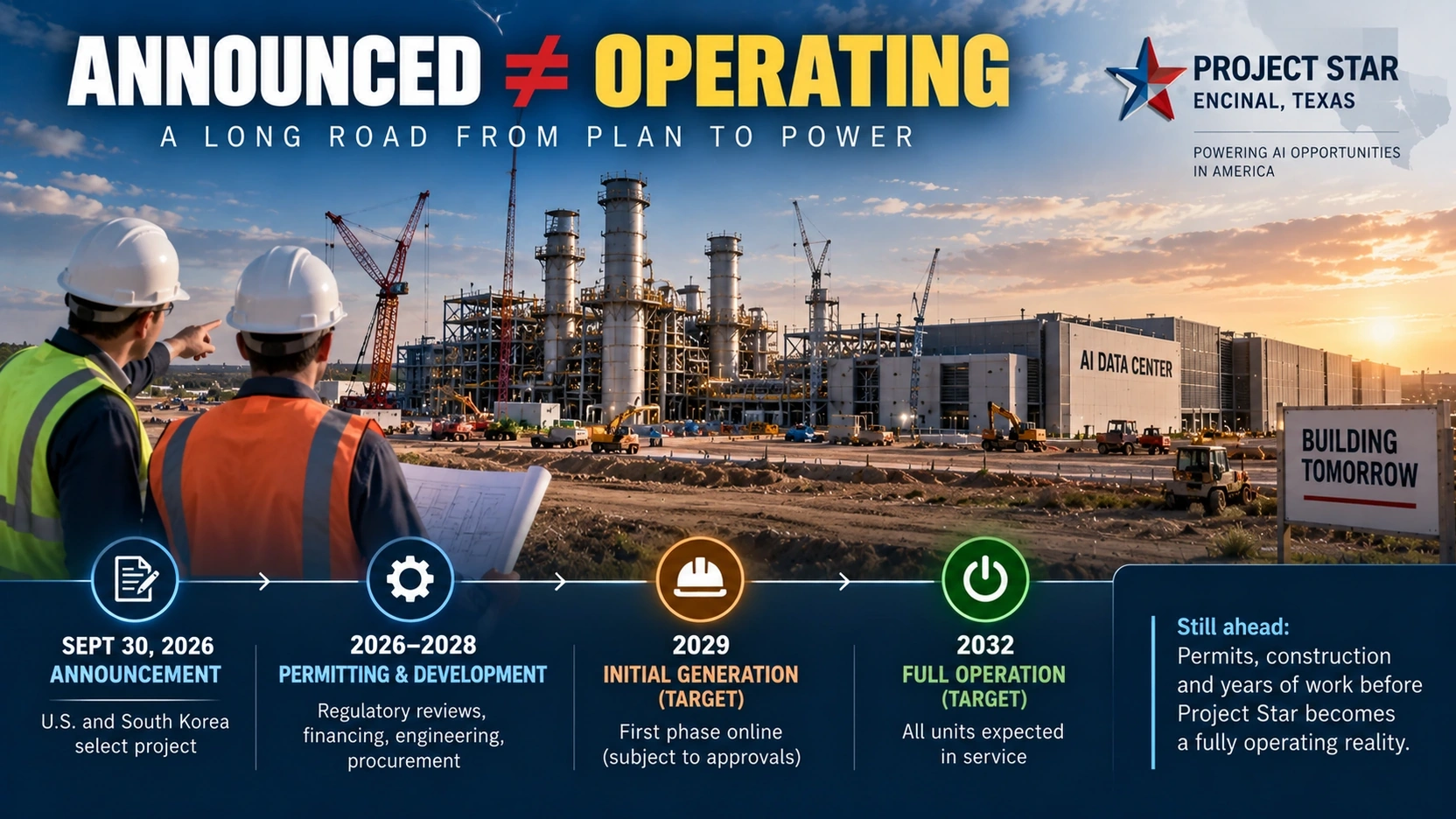
No. The announcement moves Project Star forward, but it does not mean a finished 6.47 GW plant has received every required permit and is ready to switch on.
NextEra says the project will be developed in phases, with initial generating resources anticipated to come online as early as 2029, subject to required permitting and approvals. South Korea’s government lists 2032 as the target for full operation. (NextEra Energy · Korea.net)
That qualification matters because Texas is scrutinizing data-center projects closely. Abbott’s September 21 directive paused state permits sought by data centers until the relevant power and water audits are completed. Project Star’s dedicated-generation structure addresses one of the state’s central concerns, but the announcement does not say the project is exempt from required regulatory reviews. (Texas Governor’s Office)
The development sequence is better understood this way:
| Stage | Status |
|---|---|
| U.S.–Korea project selection | Announced |
| Developers and project structure | Announced |
| 6.472 GW generation target | Announced |
| 5 GW adjacent data-center scale | Announced |
| Required permits and approvals | Still part of the development process |
| Initial generation | Targeted as early as 2029 |
| Full operation | Targeted for 2032 |
A project of this scale still has to move through engineering, financing, equipment procurement, permitting, grid arrangements and years of construction before the headline numbers become operating infrastructure.
What Could Project Star Mean for Texas Electricity Customers?
The central promise is that the new computing load would arrive with major new generation rather than depending entirely on power plants that already serve the ERCOT system.
The developers say Project Star can send excess generation to the grid and help support reliability and affordability. (NextEra Energy)
That is the intended design, not yet a demonstrated outcome.
Whether ordinary Texas customers ultimately benefit will depend on less dramatic details: who pays for transmission and interconnection upgrades, how much electricity the data center actually draws, how much generation is available to ERCOT during tight conditions, and how contracts divide financial risk if the computing campus is delayed or built at a smaller scale.
Texas Senate Bill 6 was written partly around that broader problem—making very large electricity users contribute to interconnection costs and giving the system tools to manage large loads during emergency conditions. (Texas Legislature)
Project Star could therefore become a test of a new model for AI infrastructure: if a developer wants to add a city-scale block of computing demand, it may also need to bring city-scale power infrastructure with it.
Bottom Line: What This Story Really Means
Project Star is a $22.3 billion plan to build 6.472 GW of natural-gas generation beside a separately funded 5 GW digital-infrastructure campus in Encinal, Texas.
The difference between those two numbers should not be treated as a guaranteed 1.472 GW surplus. Generating capacity, actual output and data-center demand are different measurements, and both sides of the campus are expected to be developed in phases.
South Korea is involved because Project Star is the first specific project advanced through the Korea-U.S. strategic investment framework. The public announcements describe a bilateral ownership structure and opportunities for Korean suppliers, but they do not say South Korea alone is paying the entire $22.3 billion project cost.
The larger story is what AI is doing to the electricity business. A data center can now be so large that finding a site and building servers are only part of the project. Building the power system may be just as important.
Project Star: Key Questions Explained
Q. What is Project Star?
Project Star is a planned $22.3 billion natural-gas power campus in Encinal, Texas, designed to provide 6,472 MW of generating capacity primarily for an adjacent large-scale digital-infrastructure campus.
Q. Is the $22.3 billion the cost of the AI data center?
No. The $22.3 billion figure refers to Project Star’s energy infrastructure. Related Digital describes the adjacent 5 GW data-center campus as privately funded.
Q. Is South Korea investing the entire $22.3 billion?
The public announcements do not say that. They identify $22.3 billion as the total project cost and place Project Star within the broader Korea-U.S. strategic investment structure.
Q. Why is the power plant larger than the 5 GW data-center campus?
The announcements do not provide one single engineering explanation for the difference. The 6.472 GW figure is generating capacity rather than guaranteed constant output, the data center is planned in phases, and the project is designed to deliver excess generation to the grid when available.
Q. How large is a 5 GW data center compared with the Texas grid?
For scale, 5 GW is roughly 5.5% of ERCOT’s current 2026 all-time peak-demand record of 91,089 MW. That does not mean the campus will continuously draw 5 GW.
Q. Why is Project Star using natural gas?
The developers have not publicly identified one single reason. Combined-cycle natural-gas plants can provide large amounts of dispatchable electricity and are commonly used for sustained power production, characteristics that fit a very large computing load.
Q. What does “combined cycle” mean?
It means the plant produces electricity with a gas turbine and then captures hot exhaust to make steam for another turbine. Reusing that heat increases efficiency.
Q. When will Project Star start operating?
Initial generating resources are anticipated to come online as early as 2029, subject to required permitting and approvals. South Korea’s government says full operation is targeted for 2032.
Q. Is Project Star fully permitted?
The public announcement does not say that. NextEra explicitly states that initial generation is subject to required permitting and approvals, and Texas is currently subjecting data-center projects to heightened power and water reviews.
Did this help make the story clearer? 🙂
WIN keeps unpacking the “why” behind the news—clearly and simply!
Sources
Project Star Announcement and Korea-U.S. Investment Structure
NextEra Energy — Project Star Strategic Investment Announcement
Korea.net — Project Star: Texas Gas-Fired Combined-Cycle Power Generation Project
Republic of Korea Policy Briefing — Korea-U.S. Strategic Investment Project Star Details
Reuters — South Korea Unveils Major Energy Investment Plans in the U.S.
Texas Grid Demand and Large-Load Rules
ERCOT — 2026 Yearly Peak Demand Records
ERCOT — Preliminary Long-Term Load Forecast for 2026–2032
Texas Legislature — Senate Bill 6 Enrolled Text
Texas Governor’s Office — Governor Abbott Directs TCEQ to Halt Data Center Permits
Combined-Cycle Power Technology
U.S. Energy Information Administration — How Combined-Cycle Power Plants Use Exhaust Heat
U.S. Energy Information Administration — How Natural-Gas Generation Technologies Are Used
Keep Reading
Why Is Texas Making Data Centers Prove Who Will Pay for New Power Infrastructure?
Project Star’s dedicated generation makes more sense once the wider Texas debate over grid costs, water use and massive new computing loads is clear. This earlier WIN article explains why Texas paused permits and why regulators are focusing on who pays for the infrastructure these projects require.
Why Are Texas and California Putting New Limits on Data Centers—and Who Pays for the Power?