Trump Says the U.S. and Cuba Can Make a Deal—So What Would Actually Have to Change?
Didn’t Trump just say Cuba was going to fall?
So why is he now predicting a deal?
On September 26, President Donald Trump told reporters at the White House that he expected the United States and Cuba to reach an agreement and said he did not think military action would be necessary. Four days earlier at the United Nations, he had called Cuba a failed state, said it was under extraordinary pressure and declared that “freedom will be coming” to the island. (Reuters · Reuters)
That can sound like a reversal. It is not that simple.
Trump did not announce a negotiated agreement, a sanctions rollback or a formal diplomatic framework. What changed was his public emphasis: he described a negotiated outcome as likely while playing down the need for military force.
Later on September 26, Cuban Foreign Minister Bruno Rodríguez told the U.N. General Assembly that Havana remained open to dialogue with Washington and to commercial relationships with U.S. companies. He also said talks would have to respect Cuban sovereignty and proceed without interference in internal affairs or preconditions. (EFE)
Both governments were therefore publicly leaving a door open to talks—but they were not describing the same terms for walking through it.

What Actually Changed on September 26?
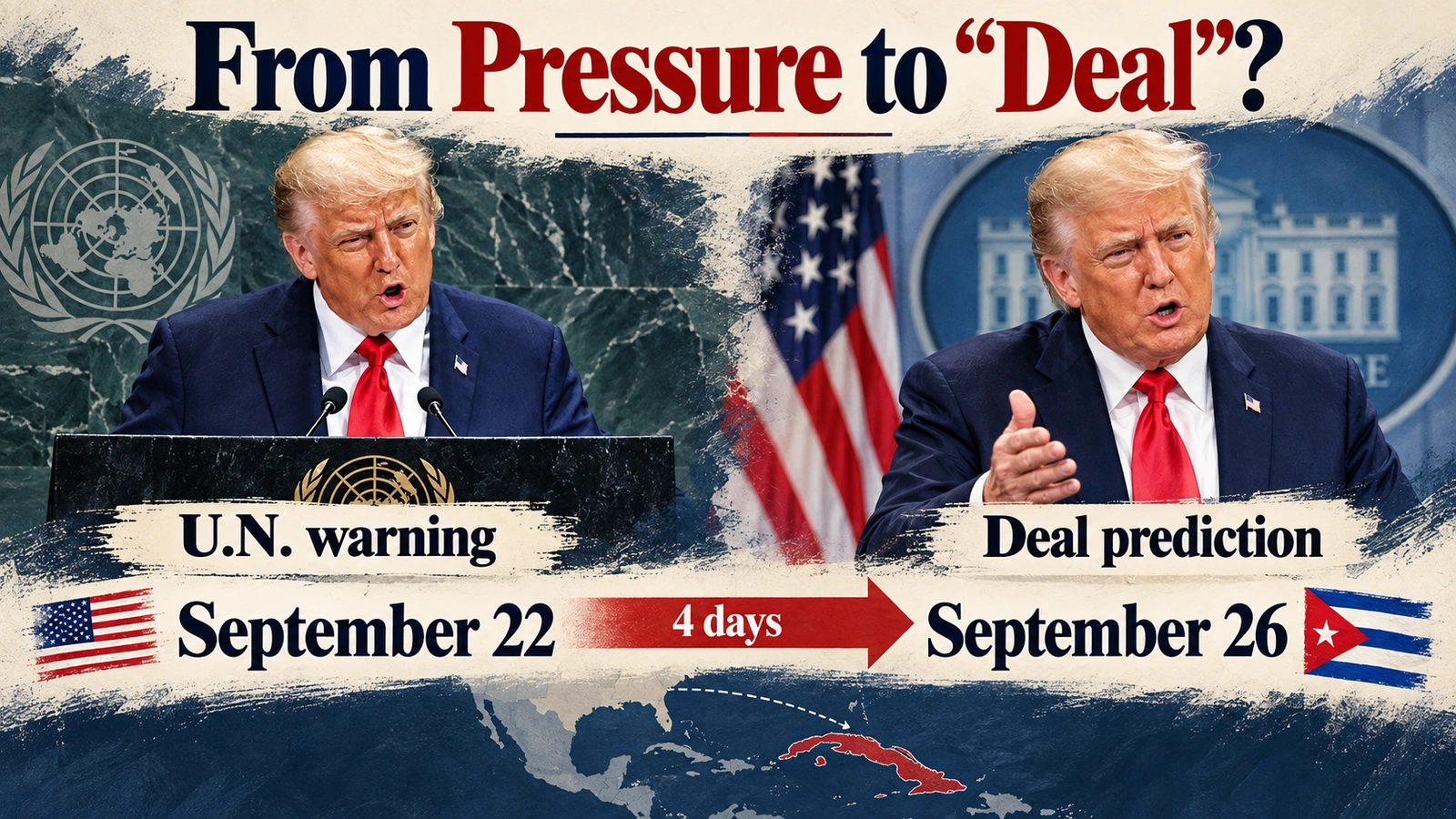
The clearest change was in Trump’s public description of what might happen next, not in an announced change to U.S. sanctions policy.
On September 22, Trump used his U.N. address to call for “fundamental” change in Cuba, said the island was under the greatest pressure it had faced and said Secretary of State Marco Rubio was handling negotiations. (Reuters)
On September 26, Trump told reporters, “Cuba and us will make a deal,” and added that he did not think the military would be needed. He also said the United States wanted to help Cuba and “open Cuba up to our people.” (Reuters)
Rodríguez then gave Havana’s position at the U.N. General Assembly. Cuba, he said, remained willing to discuss bilateral disputes and was open to business relationships with U.S. companies, but he rejected interference in Cuba’s internal affairs and talks conditioned on preconditions. (EFE)
| Question | What changed? |
|---|---|
| Did the U.S. and Cuba sign an agreement? | No |
| Did Trump announce an end to sanctions? | No |
| Did Trump say he expected a deal? | Yes |
| Did Trump say military action was likely? | No. He said he did not think it would be needed |
| Did Cuba reject talks? | No. Cuba publicly said it remained open to dialogue |
| Are the conditions for a deal agreed? | No public agreement on terms was announced |
That last point is the most important one.
How Can Pressure and Negotiation Happen at the Same Time?
The Trump administration has paired intensified economic measures with public statements that negotiations are taking place.
That combination is visible in the administration’s own actions. In January, Trump declared a national emergency regarding Cuba and created a tariff mechanism that can be used against goods from countries that directly or indirectly provide oil to Cuba. In May, he signed another executive order expanding sanctions authorities related to Cuba. (White House · U.S. Treasury)
At the same time, Trump said on September 22 that Rubio was handling negotiations with Cuba, and four days later he predicted a deal. (Reuters · Reuters)
Cuba describes the U.S. pressure very differently. Rodríguez called it coercive and argued at the U.N. that Washington was using economic pressure to force political change. (EFE)
So both sides can say they favor dialogue while disagreeing over the basic setting for that dialogue. Washington has continued pressure while talking. Havana says talks should occur without that kind of pressure determining Cuba’s internal choices.
Why Is Oil at the Center of the U.S.-Cuba Standoff?
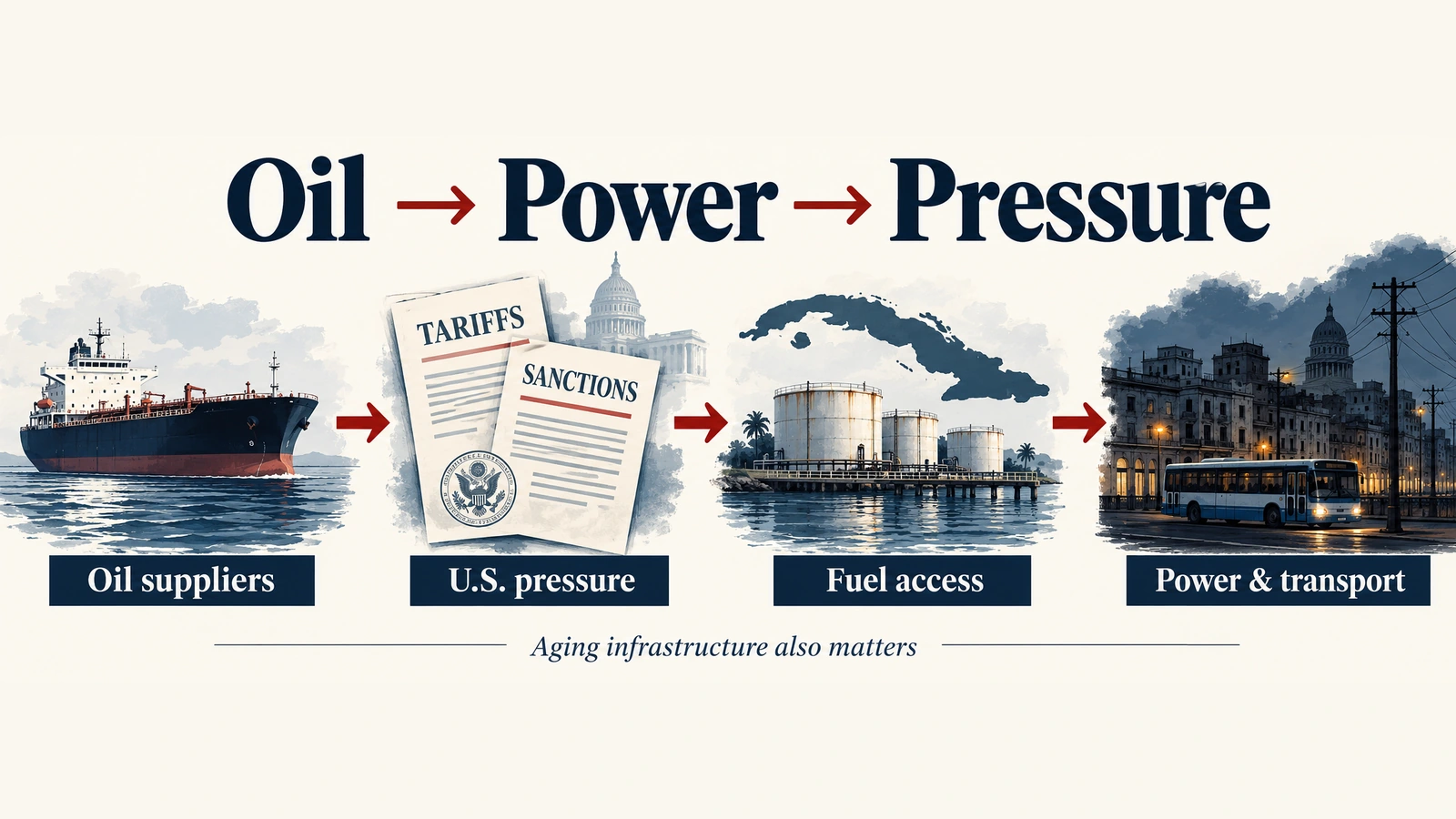
Oil matters because Cuba’s electrical system, transportation network and broader economy depend heavily on imported fuel.
Trump’s January 29 executive order established a system under which additional U.S. tariffs may be imposed on goods from countries that directly or indirectly sell or provide oil to Cuba. The order itself describes a tariff mechanism; it does not order a U.S. naval blockade. (White House)
News reports and Cuban officials have nevertheless used the phrase “oil blockade” to describe the practical pressure created by the policy. Reuters reported that the measures have put Cuba under severe strain as it deals with fuel shortages and blackouts, while Rodríguez compared the U.S. pressure to a naval blockade in his U.N. speech. (Reuters · EFE)
On May 1, Trump signed Executive Order 14404, adding sanctions authorities aimed at people and entities the administration says are responsible for repression in Cuba or threats to U.S. national security and foreign policy. (U.S. Treasury)
Cuba’s energy crisis also has important domestic causes. AP has reported on aging infrastructure, shortages and deep structural economic problems alongside the impact of tighter U.S. pressure. Reuters reported in September that the Cuban peso had fallen roughly tenfold against the dollar since 2021 and that official prices had risen at least 25% in 2026 by that point. (AP · Reuters)
So the fuel problem is not a one-cause story: U.S. pressure matters, and so do Cuba’s infrastructure and broader economic weaknesses.
What Has Washington Publicly Said It Wants From Cuba?
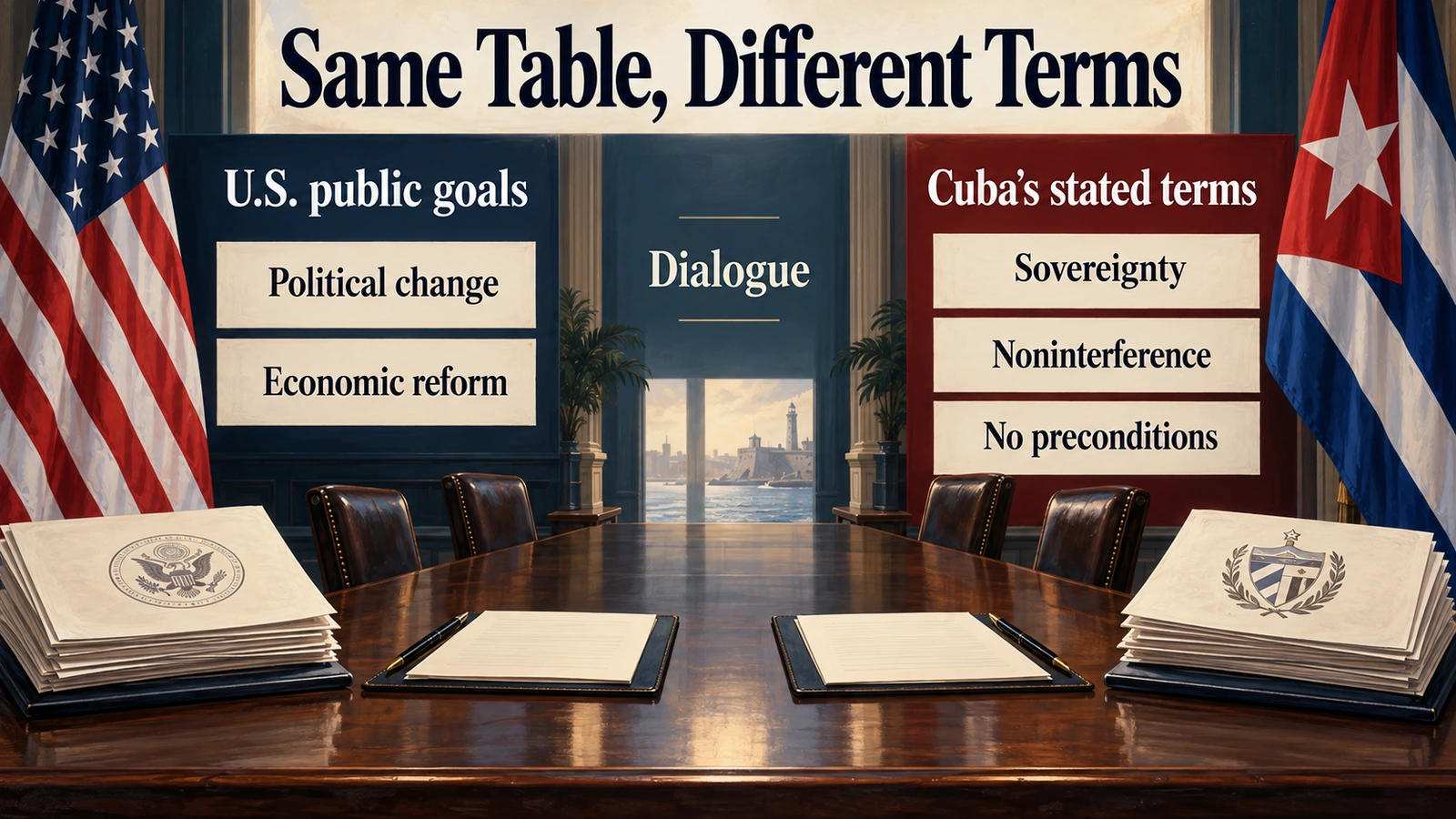
Washington has publicly called for major political and economic change in Cuba, but the sources reviewed for this article do not provide a complete U.S. negotiating blueprint.
Trump’s September 22 U.N. speech called for “fundamental” change and predicted that Cuba’s current system would not endure. He also said Rubio was handling negotiations. (Reuters)
The administration has also tightened economic pressure through the January tariff mechanism and the May sanctions order. (White House · U.S. Treasury)
What has not been publicly spelled out is a comprehensive list of concessions Washington would require for a September 26-style “deal,” or the exact sequence in which U.S. restrictions and Cuban policy changes would be addressed.
That distinction prevents two different things from being confused: the administration’s broad policy goals and the terms of a specific negotiated agreement are not necessarily identical.
What Is Cuba Willing to Discuss—and What Won’t It Accept?
Cuba’s public position also contains both an opening and a limit.
The opening is economic. Rodríguez said September 26 that Cuba was open to commercial and business relationships with U.S. companies. He linked that possibility to the country’s ongoing package of 176 economic reforms. (EFE)
The limit is political conditionality. Rodríguez said talks should take place with respect for sovereign equality, international law and noninterference in internal affairs, and without preconditions. (EFE)
| U.S. public position | Cuba’s stated position |
|---|---|
| Washington has intensified sanctions and oil-related economic pressure | Havana wants U.S. economic pressure lifted or reduced |
| Trump has publicly called for fundamental political change | Cuban officials reject outside interference in the country’s political system |
| Trump says negotiations are taking place and predicts a deal | Cuba says it remains open to dialogue |
| The U.S. has emphasized political and economic reform | Cuba says its economic reforms are sovereign decisions |
| Trump says he does not think military force will be needed | Cuba says it would regard U.S. military action as unlawful aggression |
The clearest overlap is that both sides are publicly talking about negotiations and economic relations. The clearest disagreement is over the conditions surrounding those talks.
Could Trump End the Cuba Embargo With a Deal?
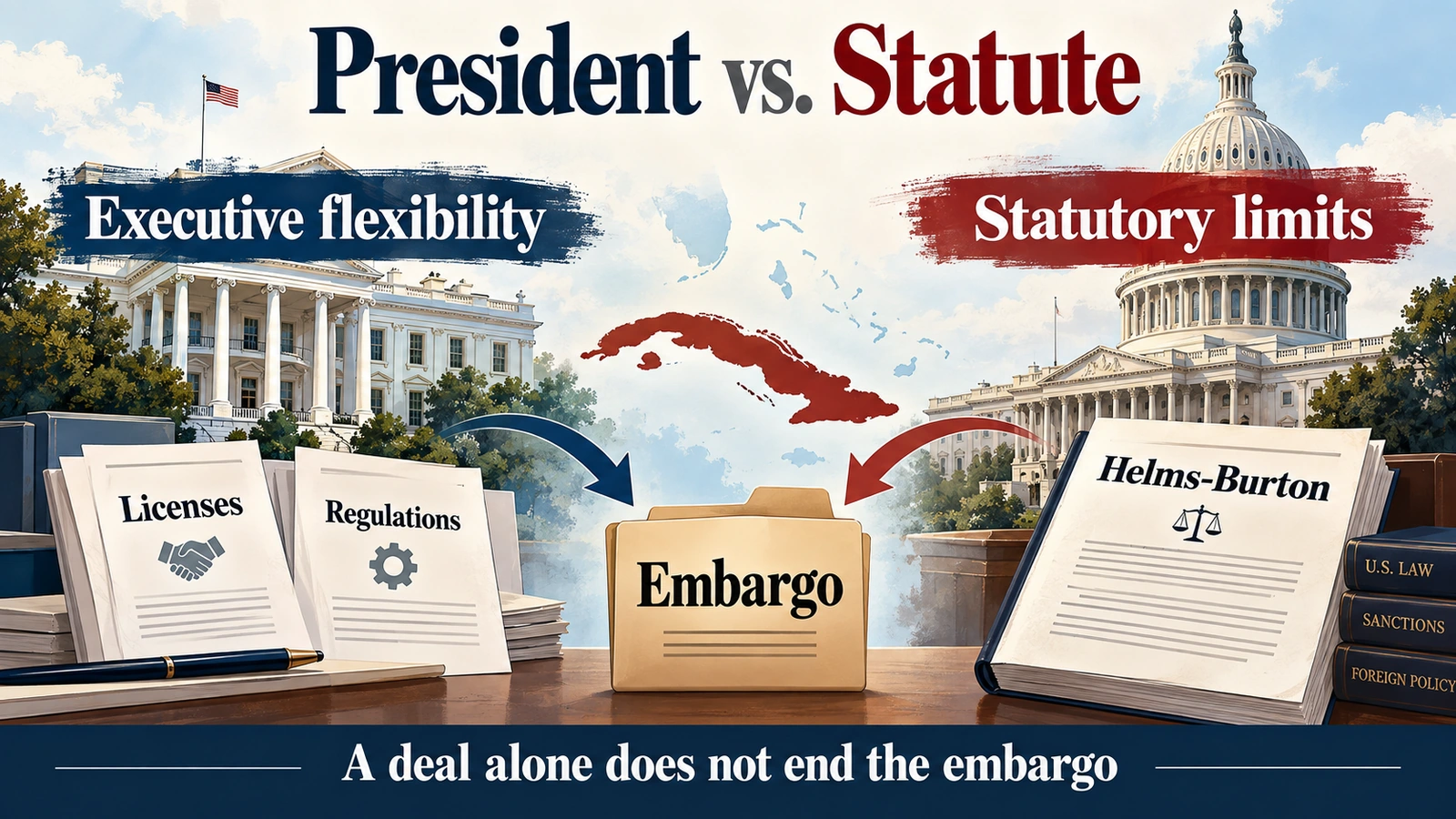
Not simply by announcing an agreement.
Major parts of the Cuba embargo were codified by Congress, especially through the 1996 Cuban Liberty and Democratic Solidarity Act, commonly called the Helms-Burton Act.
Section 204 of that law, now codified at 22 U.S.C. §6064, authorizes a president to take steps to suspend the embargo after determining that a qualifying transition government is in power in Cuba. It directs termination of the embargo after a determination that a democratically elected government meeting the statute’s conditions is in power. (U.S. Code)
At the same time, presidents retain meaningful regulatory and licensing authority over parts of Cuba policy. That is why administrations have been able to loosen or tighten travel, remittance, banking and other restrictions without Congress repealing the entire statutory framework.
The Obama administration illustrated that distinction. The United States and Cuba restored diplomatic relations in July 2015 and reopened embassies, but the embargo remained in place. The State Department explicitly said at the time that legislative action was required to lift it. (U.S. Department of State)
So a future U.S.-Cuba agreement could change important parts of the relationship without immediately eliminating every embargo restriction.
Why Do Cuba’s 176 Economic Reforms Matter?

Because Cuba is already changing parts of its economic model while keeping its one-party political system.
In June, Cuban lawmakers approved a package of 176 economic measures that AP described as the country’s most sweeping market-oriented changes since the revolution. The package expands space for private businesses, allows more direct importing and exporting, permits private hiring and banking, and opens additional channels for investment by Cubans living abroad. (AP)
Cuban leaders have not presented the changes as an abandonment of socialism. Rodríguez said at the U.N. that the reforms were intended to help Cuba continue building socialism, while AP reported that Cuban officials have pointed to China and Vietnam as reference points for combining market mechanisms with a one-party system. (EFE · AP)
That matters for negotiations because Washington has publicly demanded substantial change while Havana is already making economic changes on its own terms.
The unresolved question is whether those reforms overlap enough with U.S. demands to become part of an agreement—and, if they do, what each side would be expected to do first.
Does “We Won’t Need the Military” Mean Military Planning Is Over?
No.
Trump’s September 26 statement is significant because he publicly said he did not think military force would be necessary. But it was not a formal announcement ending military contingency planning.
CBS News reported the same day that the U.S. Army Reserve was examining whether it could provide Southern Command with police forces, medical personnel and other support units within the next four months. The internal message reviewed by CBS did not mention Cuba, but U.S. officials told the network the request was connected to continued planning related to Cuba. CBS also reported that there was no indication any units had received deployment orders. (CBS News)
Military planning and a political decision to use force are not the same thing.
So Trump’s statement is evidence of his public preference at that moment, not proof that every military option or planning process had been formally canceled.
What Would a Real U.S.-Cuba Deal Actually Require?
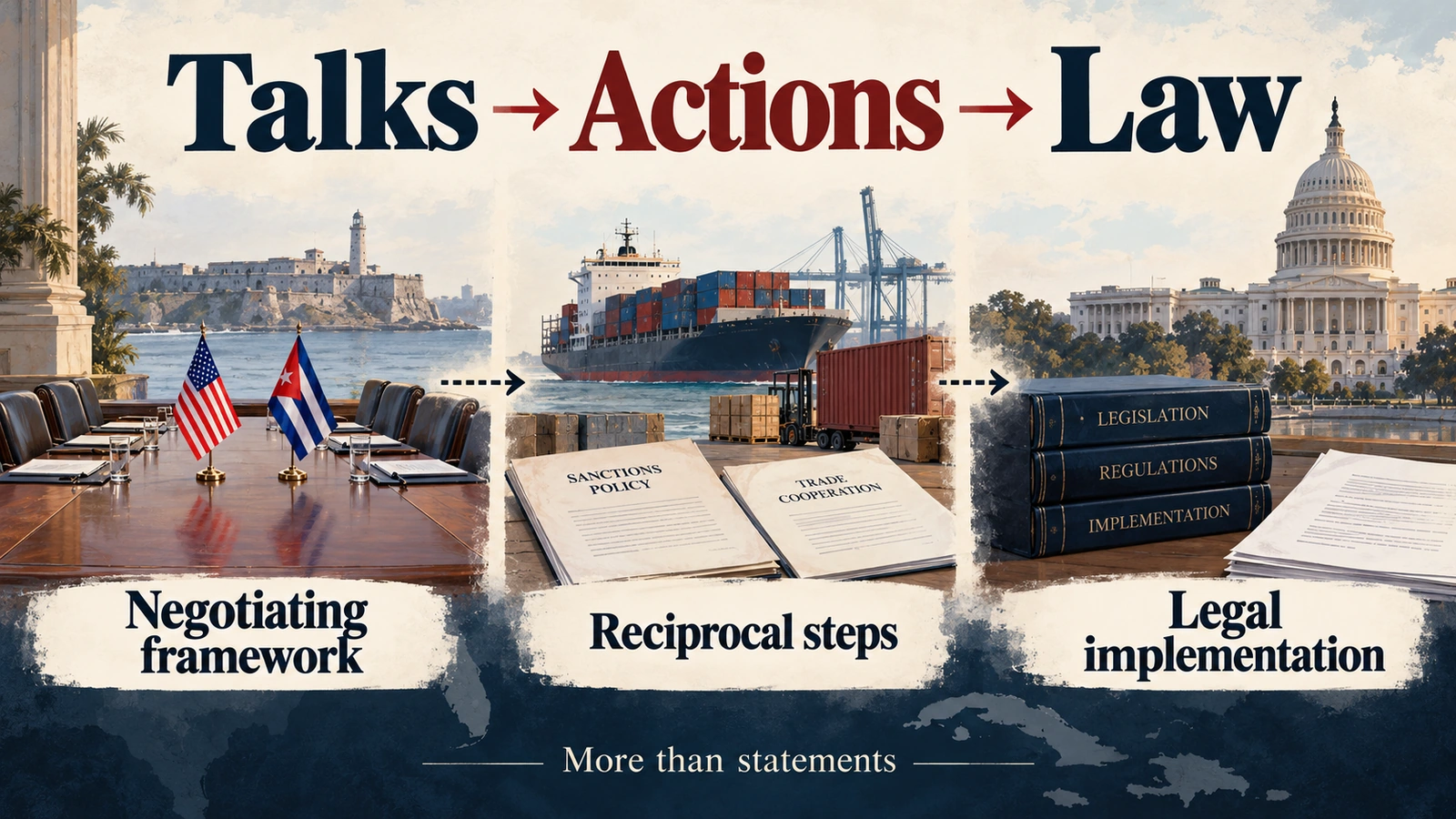
No public document reviewed for this article lays out a complete U.S.-Cuba deal. That means it is important to separate what is known from what is still undefined.
First, there would have to be an agreed negotiating framework.
Trump says negotiations are taking place and predicts an agreement. Cuba says it is prepared for dialogue. The public record does not yet identify a complete agenda, sequence or list of agreed conditions. (Reuters · EFE)
Second, the two sides would need concrete reciprocal steps.
Those steps could involve areas already affected by current policy—such as sanctions administration, commercial activity, energy-related measures or Cuban economic policy—but the September 26 remarks did not announce a specific package.
Third, the U.S. side would have to distinguish between changes the executive branch can make and restrictions embedded in federal law.
That is why “a deal with Cuba” can describe several very different outcomes.
| Possible outcome | What it would mean |
|---|---|
| Limited bilateral agreement | Cooperation on a specific issue without broad normalization |
| Economic arrangement | Selected changes involving trade, licenses, investment or other commercial activity |
| Broader political agreement | Reciprocal commitments tied to wider policy changes |
| Diplomatic normalization package | A substantial expansion of government-to-government and commercial relations |
| Full end of the embargo | The most legally complicated outcome because major restrictions are codified in federal law |
Trump has not publicly defined which version he has in mind.
What Should Readers Watch Next?
The most meaningful sign of progress would be specific action, not another general statement that a deal is possible.
Watch for formal meetings, identification of the officials conducting negotiations, changes to Treasury or Commerce rules, new commercial arrangements, changes in oil-related measures, or a public description of what each government expects from the other.
The military side also matters. CBS’s September 26 report shows that contingency planning can continue even while the president publicly emphasizes diplomacy. (CBS News)
And the legal side matters if talks expand beyond a narrow agreement. A president can change important parts of Cuba policy through executive and regulatory authority, but full removal of the embargo is constrained by federal statutes. (U.S. Code · U.S. Department of State)
Those are the developments that would show whether Trump’s September 26 prediction is turning into an actual negotiating process with defined terms.
Bottom Line: What This Story Really Means
Trump’s September 26 statement does not mean the United States and Cuba have reached an agreement, and it does not mean the long-standing U.S. embargo has disappeared.
What changed is the public direction of the conversation. After intensified economic pressure and renewed discussion of possible military action, Trump said he expected a deal and did not think the military would be needed. Cuba, meanwhile, said it remained willing to talk and was open to business with U.S. companies.
That creates a diplomatic opening, but the basic disagreement remains clear: Washington has publicly demanded major change in Cuba, while Havana says negotiations must respect Cuban sovereignty and proceed without outside interference or preconditions.
Even if the two governments bridge part of that gap, a limited executive agreement and a complete end to the statutory embargo would still be very different things.
Cuba Deal: Key Questions Explained
Q. Did Trump announce a deal with Cuba?
No. Trump predicted on September 26 that the United States and Cuba would reach a deal, but no negotiated agreement was announced in his remarks. (Reuters)
Q. Did Trump permanently rule out military action against Cuba?
No. He said he did not think military action would be necessary. CBS reported the same day that military planning related to Cuba was continuing, while noting there was no indication units had received deployment orders. (CBS News)
Q. Is Cuba willing to negotiate with the United States?
Yes. Foreign Minister Bruno Rodríguez said Cuba remained willing to seek solutions to bilateral disagreements through dialogue, while insisting on sovereign equality, noninterference and no preconditions. (EFE)
Q. Is Cuba willing to do business with American companies?
Rodríguez said Cuba was open to commercial and business relationships with U.S. companies. U.S. sanctions and licensing rules would still determine which transactions are legally possible for American firms. (EFE)
Q. Why is oil such a major issue in the U.S.-Cuba dispute?
Cuba depends heavily on imported fuel, and Trump’s January executive order created a tariff mechanism aimed at countries that provide oil to the island. The policy has added pressure to an energy system already weakened by aging infrastructure and economic problems. (White House · AP)
Q. Can Trump end the entire Cuba embargo by himself?
Not simply by signing a bilateral agreement. Major parts of the embargo are codified in federal law, although the executive branch retains significant authority over licenses, regulations and some sanctions administration. (U.S. Code · U.S. Department of State)
Q. Haven’t the United States and Cuba normalized relations before?
They restored diplomatic relations in July 2015 and reopened embassies, but the statutory embargo remained in place. The State Department said legislative action was required to lift it. (U.S. Department of State)
Q. Is Cuba becoming a capitalist economy?
No. Cuba has adopted major market-oriented reforms, including wider space for private business, trade and investment, but its leaders say the country is retaining its socialist political and economic framework. (AP · EFE)
Q. What would show that a real Cuba deal is getting closer?
Concrete steps would matter most: formal negotiations, clearly defined reciprocal actions, changes to sanctions or licenses, new commercial arrangements, or a public statement describing agreed terms.
Did this help make the story clearer? 🙂
WIN keeps unpacking the “why” behind the news—clearly and simply!
Sources
September 26 Deal Statements and U.N. Diplomacy
Reuters — Trump Predicts Cuba and U.S. Will Make a Deal
EFE — Cuba Says It Is Open to Dialogue and Business With U.S. Companies
Reuters — Trump’s September 22 U.N. Remarks on Cuba
U.S. Sanctions, Oil Policy and Military Planning
White House — Addressing Threats to the United States by the Government of Cuba
U.S. Treasury — Executive Order 14404 Cuba Sanctions Action
CBS News — U.S. Military Lays Groundwork for Potential Action Around Cuba
Cuba’s Economic Changes and Current Crisis
Associated Press — Cuba’s 176 Economic Reform Measures
Reuters — Cuba’s Economic Crisis and Market-Oriented Changes
Embargo Law and Earlier U.S.-Cuba Normalization
U.S. Code — 22 U.S.C. §6064, Termination of Economic Embargo of Cuba
U.S. Department of State — Re-Establishment of Diplomatic Relations With Cuba
Keep Reading
What Else Did Trump Say About U.S. Power at the U.N.?
Trump’s Cuba warning was part of a broader U.N. speech about U.S. power, Iran and the Western Hemisphere. This earlier WIN explainer separates what Trump, Emmanuel Macron and Luiz Inácio Lula da Silva actually said from the way their speeches were sometimes framed online.
Did Trump Threaten Macron and Lula? What Their U.N. Speeches Actually Said