Why Are Parts of Paris Under Curfew After Protests Over Schools and Living Costs?

How does a protest about missing teachers end with police restricting access to parts of central Paris after dark?
At first, that connection seems strange. French teenagers were demanding better classrooms, enough teachers, and a fairer education system. Those concerns have little to do with tourists walking through Paris or shoppers visiting the city center.
But the demonstrations did not stay focused on schools.
They drew in people angry about expensive fuel, strained household budgets, and the government’s handling of public services. Over the weekend, some of the largest gatherings were accompanied by serious violence, including fires, damaged public buildings, and looted stores.
On October 19, 2026, Paris police responded with overnight restrictions in two specific areas of the capital. The order did not place the entire city under curfew. (AP)
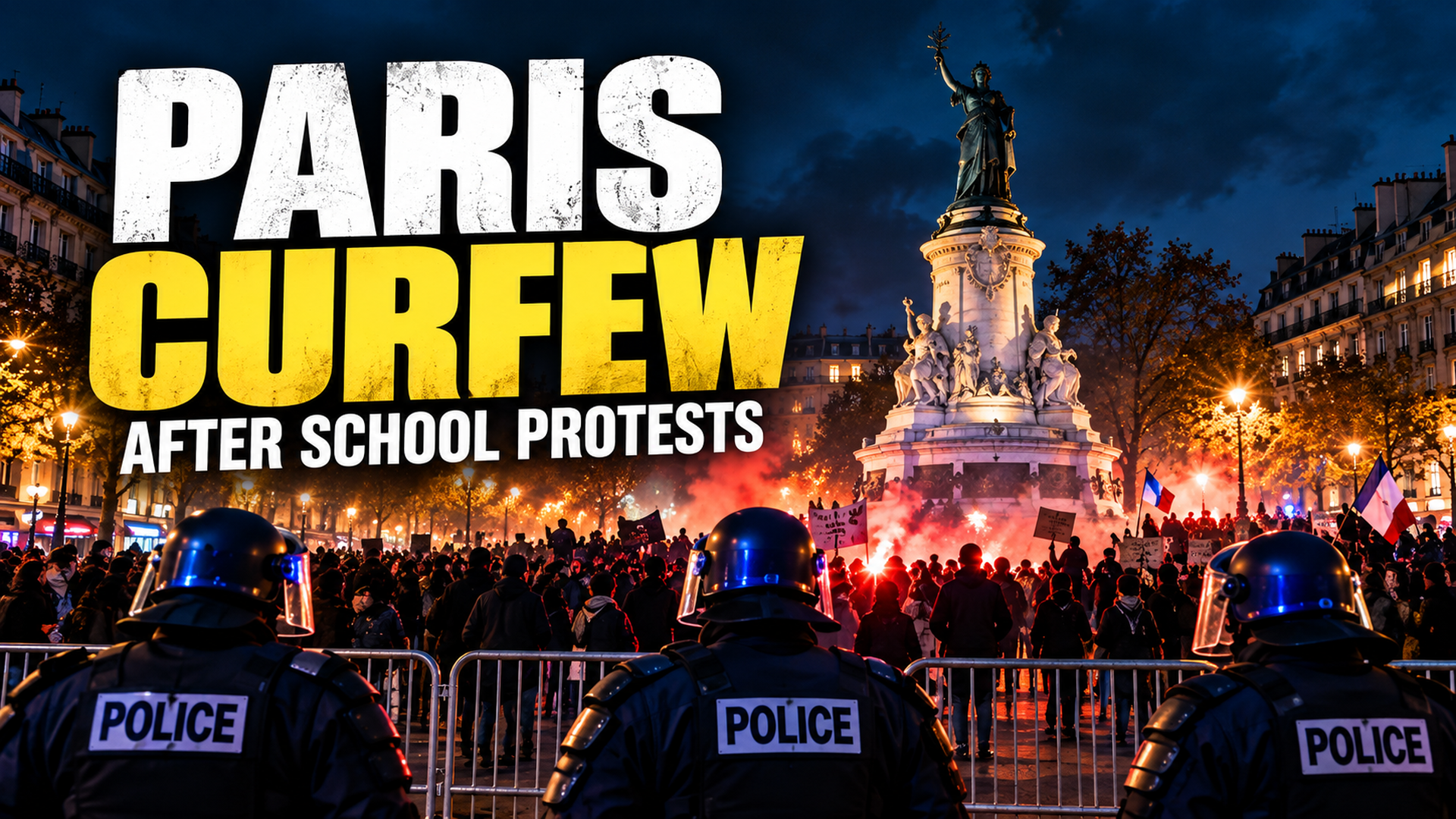
※ Images in this article are AI-generated illustrations created to help explain the story. They are not actual photographs, and depictions of people, places, or events may differ slightly from reality.
The immediate reason for the restrictions was the violence and looting. Understanding why the protests became so large, however, requires looking at the problems that brought different groups onto France’s streets in the first place.
Where Exactly Did Paris Impose a Curfew—and What Does It Restrict?
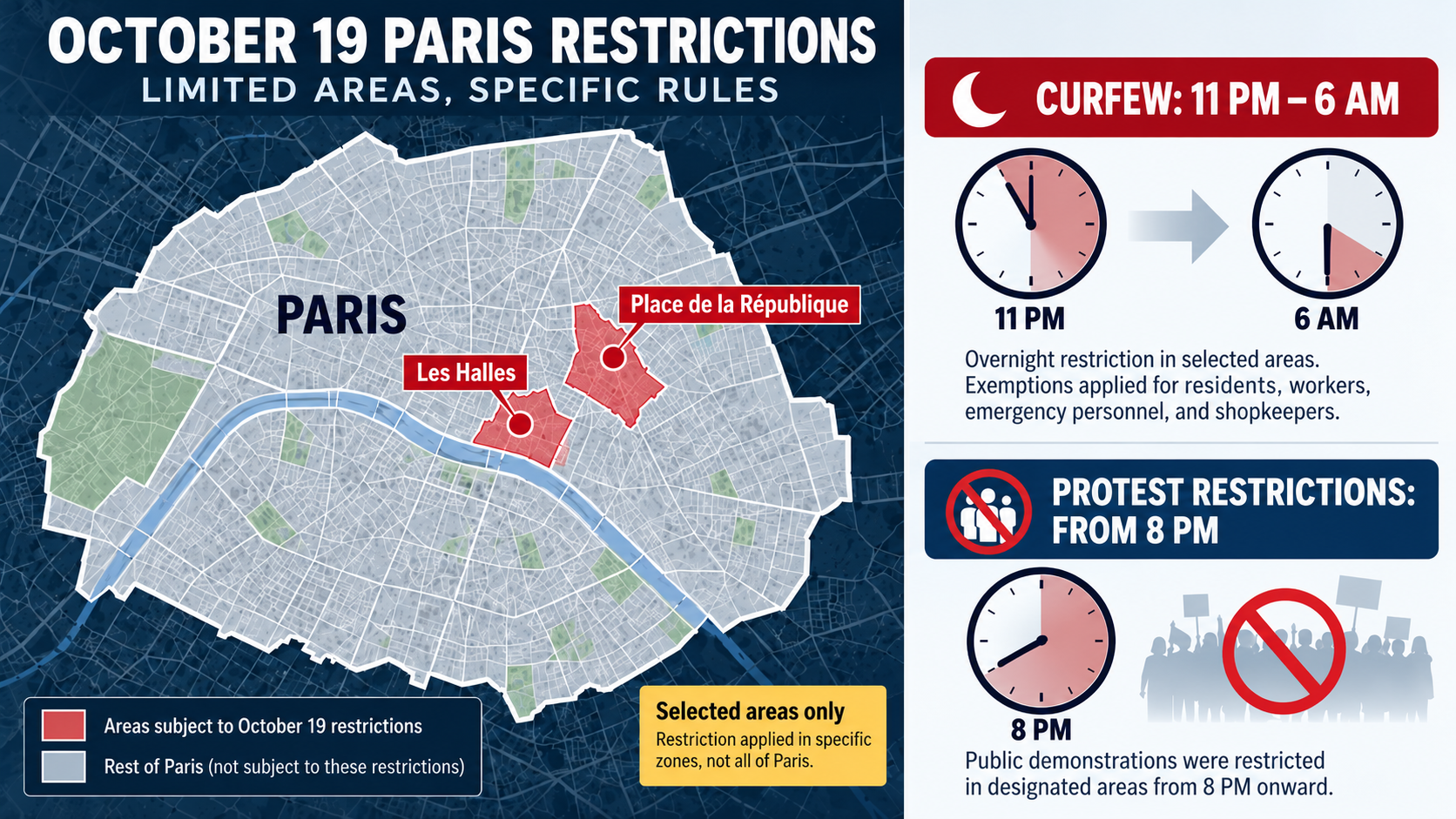
The Paris curfew announced on October 19 covered designated areas around Place de la République and Les Halles, not the whole city.
The police order set an overnight restriction from 11 p.m. Monday, October 19, until 6 a.m. Tuesday, October 20, local time.
Place de la République is a major public square and gathering point in Paris. Les Halles is a busy central shopping and transportation district. Both had been affected by unrest, with clashes around République and looting near Les Halles. (AP)
The actual restricted area was narrower than those familiar neighborhood names might suggest.
At République, the measure focused on the central square. Around Les Halles, it covered designated streets and approaches, including parts of Rue Berger and Boulevard Sébastopol.
The order also contained exemptions for residents who could establish that they lived in the affected area, people required to work there, emergency-service personnel, and shopkeepers. (RTL)
A separate set of restrictions prohibited certain public demonstrations and gatherings in additional designated areas beginning at 8 p.m.
These measures are easy to confuse, but they were not identical.
| Measure | October 19 restrictions |
|---|---|
| Overnight curfew | 11 p.m.–6 a.m. in designated areas around République and Les Halles |
| Demonstration restrictions | From 8 p.m. in additional designated parts of Paris |
| Residents and essential access | Specified exemptions, including qualifying residents, workers, emergency personnel, and shopkeepers |
| Entire city of Paris | No citywide curfew announced |
The distinction matters for ordinary residents and visitors.
A ban on demonstrations in a particular area does not necessarily mean everyone is forbidden from walking through it. A curfew, by contrast, can restrict ordinary presence within its specified perimeter unless an exemption applies.
The orders were a response to a specific period of unrest. They should not be mistaken for an indefinite ban on nighttime activity throughout Paris.
How Did a Protest About French Schools Become a Nationwide Movement?
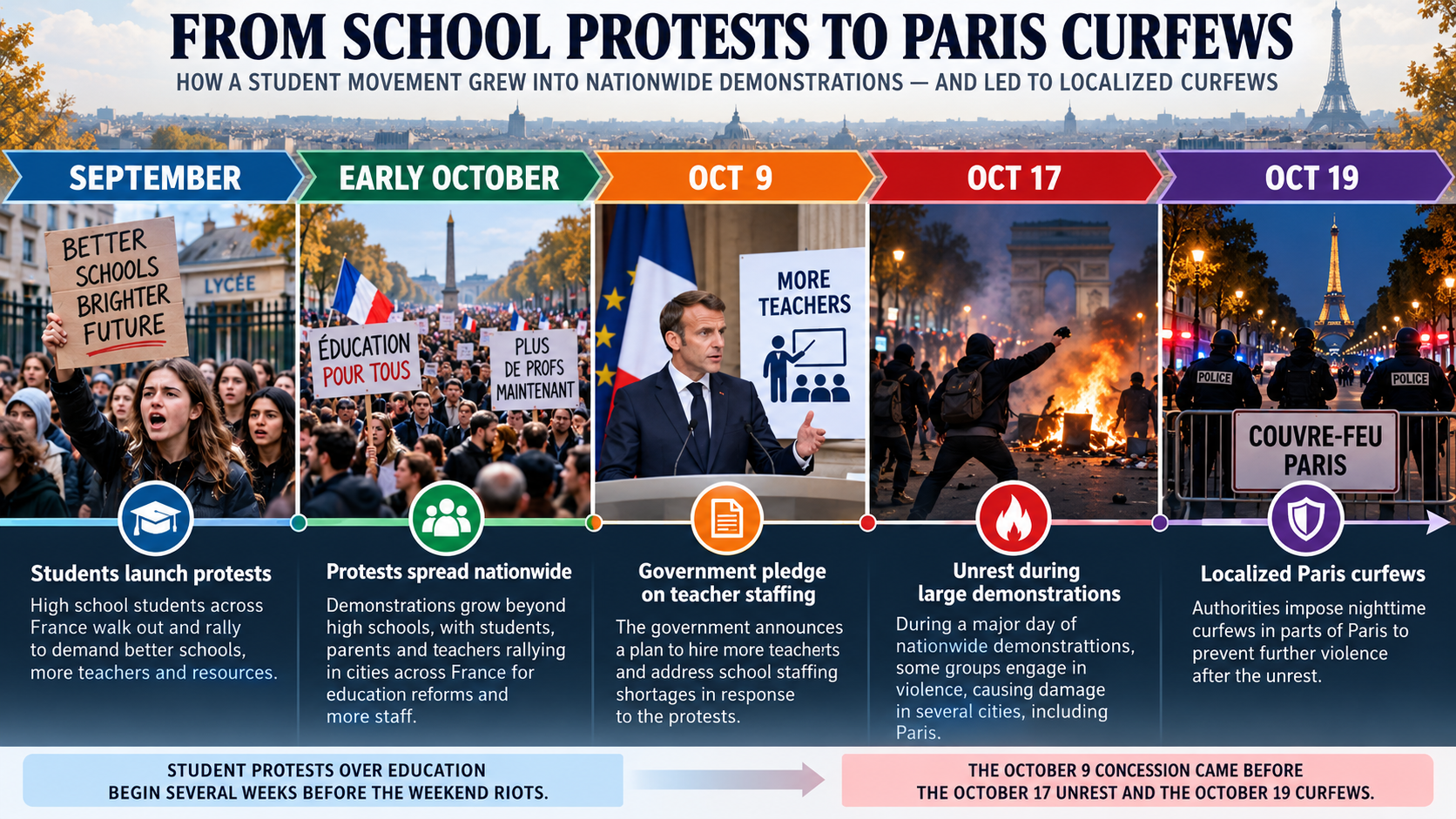
The protests began with concerns that many French students could not rely on basic conditions for learning.
During September, high school students in the Paris region began organizing demonstrations over missing teachers, deteriorating facilities, overcrowded classrooms, and unequal educational opportunities.
Some students described classes continuing for weeks without qualified replacements for absent teachers. Others complained about damaged buildings, inadequate equipment, and classrooms that became unbearably hot during warmer months.
This was not simply a dispute about making school easier.
It was a demand for a functioning education system, especially in lower-income communities where families had fewer alternatives to public schools. (The Guardian)
The movement expanded as students from other schools recognized similar problems.
Teachers, parents, and university students also became involved. By early October, demonstrations and school blockades had spread across France.
The government acknowledged some of the concerns and announced an emergency plan to bring 3,000 qualified teachers into schools facing staffing shortages.
That announcement was a concession, not proof that the underlying problems had been solved. Student organizations argued that schools still needed longer-term investment and broader changes. (Reuters)
How the Crisis Developed
| Period | Development |
|---|---|
| Mid-September 2026 | Student demonstrations begin over teacher shortages and school conditions in the Paris region |
| Early October | Protests and school blockades spread across France |
| October 9 | The government announces plans to deploy 3,000 qualified teachers to address shortages |
| October 17–18 | Large demonstrations over schools and living costs are accompanied by extensive violence and looting |
| October 19 | Authorities announce localized curfews and additional demonstration restrictions |
The timeline shows why the unrest cannot be explained as one weekend of disorder.
The original education movement had been developing for weeks. The weekend violence was a later escalation in a broader social crisis.
Why Did Rising Living Costs Become Part of the School Protests?
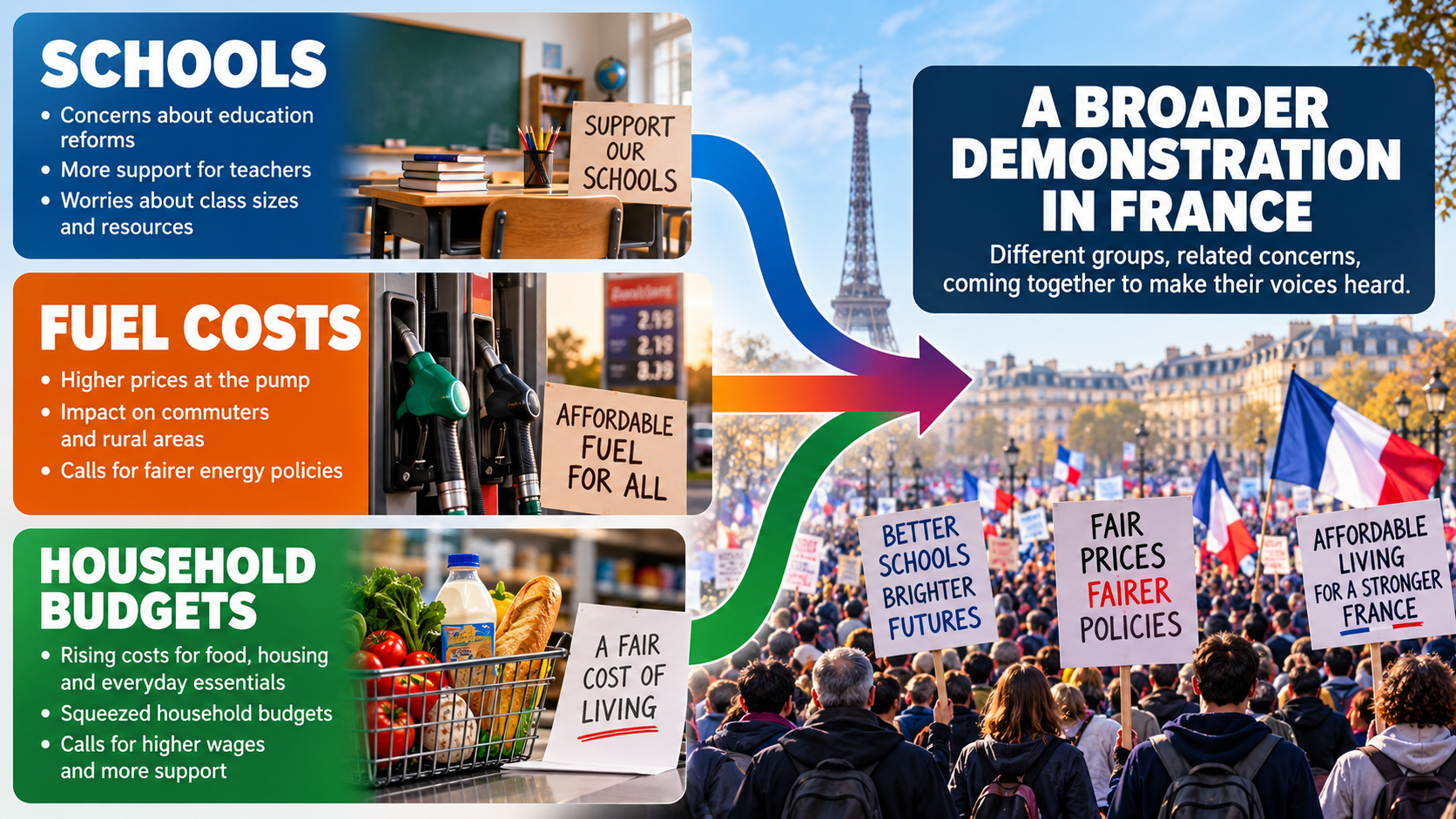
The school protests grew because other groups saw their own frustrations reflected in the students’ complaints.
For students, the immediate problem was education.
For many workers and families, it was the increasing cost of everyday life.
France has been dealing with pressure from high fuel prices, public spending constraints, and concern about the quality of government services.
Labor unions and activists associated with the country’s earlier yellow vest movement joined the demonstrations, linking education grievances to demands involving wages, pensions, and living costs. (Reuters)
The common concern was not necessarily one particular law or one shared political program.
It was whether the government was providing enough support for ordinary people while household expenses remained difficult to manage.
Why Does Fuel Matter So Much?
Fuel costs affect far more than the price displayed at a gas station.
They influence commuting expenses, transportation costs for businesses, and the cost of moving goods. Those pressures can add to household financial stress, even when the relationship between fuel prices and grocery bills is not immediate or uniform.
France’s latest cost-of-living concerns have also been intensified by disruptions to global energy supplies linked to the conflict involving Iran and instability around the Strait of Hormuz. (Euronews)
For a household already struggling with rent, food, and other bills, another sustained increase in transportation costs can feel especially burdensome.
That is why a school protest could become a gathering point for people whose most pressing concern was not education.
Why Are People Comparing This With the Yellow Vest Protests?
The comparison comes from France’s 2018 yellow vest movement, named after the high-visibility safety vests worn by demonstrators.
Those protests began with anger over fuel taxes but expanded into a much broader debate about living standards, economic fairness, and whether the government understood ordinary households’ problems.
The original movement brought together people from different regions and economic backgrounds who did not necessarily share the same political views.
It showed how a specific complaint about fuel prices could turn into a wider challenge to government policy. (Reuters via Euronews)
There is a recognizable pattern in 2026.
The current protests started with school conditions, then attracted groups concerned about purchasing power and broader social inequality.
That does not make the two movements identical. Their initial grievances, participants, and political circumstances are different.
But both demonstrate how dissatisfaction over everyday living conditions can unite people who might otherwise protest separately.
What Happened Over the Weekend That Led to the Curfew?
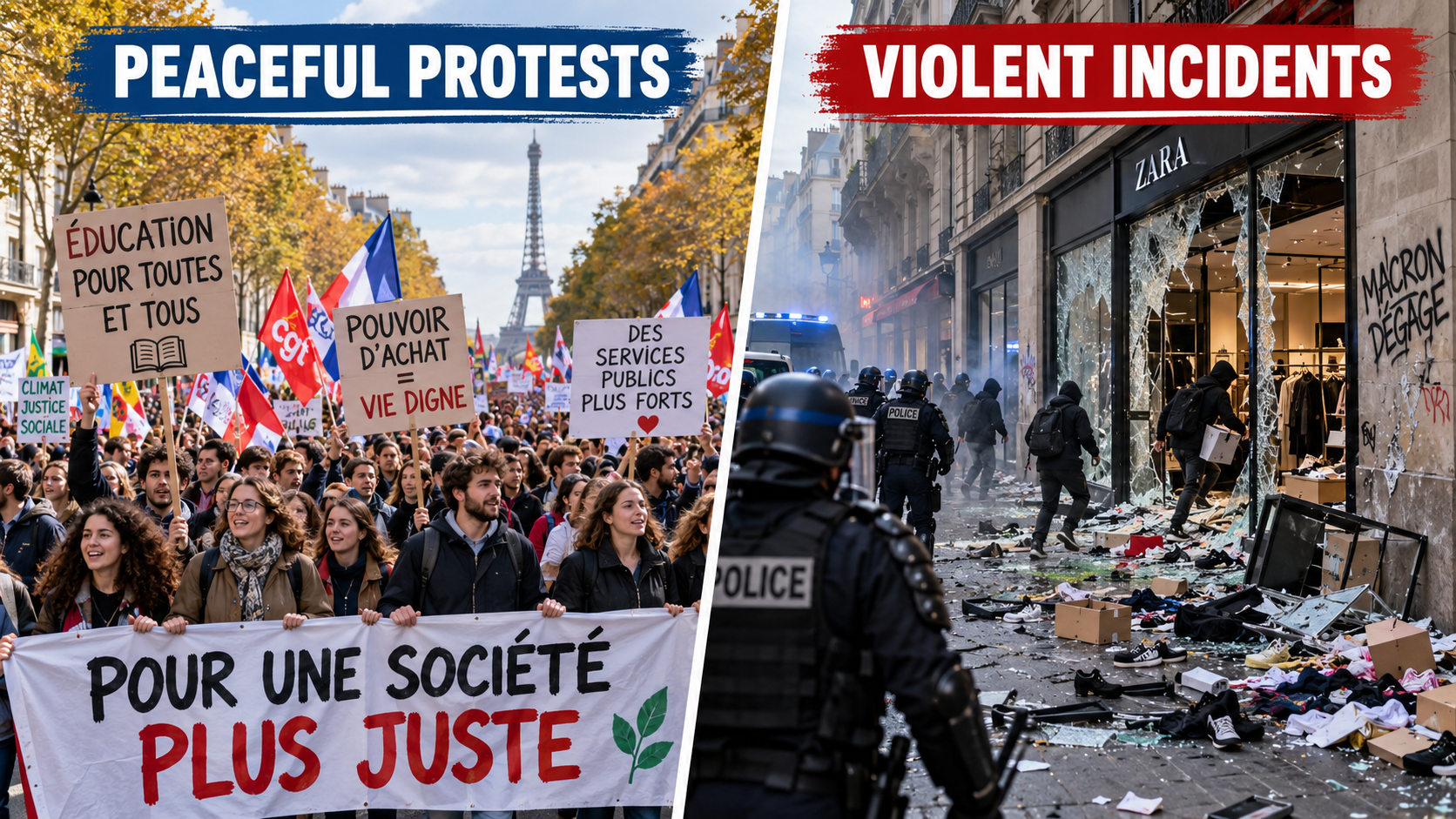
The turning point came when large demonstrations on October 17 were accompanied by widespread violence that continued to strain security forces over the weekend.
Across France, hundreds of thousands of people joined protests over education and the cost of living.
Police and organizers reported different crowd estimates. Authorities put the October 17 turnout at about 550,000 nationwide, while organizers estimated roughly 800,000.
The scale of the demonstrations was substantial, but participating in a protest was not the same as taking part in violence. Many marches were peaceful. (AP)
Separate groups clashed with police, damaged businesses, and set fires in several cities.
In Paris, Place de la République became a focus of confrontations. Other areas, including the commercial district around Les Halles, experienced looting and vandalism.
The violence was not limited to the capital.
A major fire damaged the historic city hall in Limoges, while other cities saw attacks on shops, public buildings, and police officers.
By October 19, AP reported that about 2,400 people had been arrested amid the nationwide disorder. The arrests were part of the developing police response and should not be interpreted as convictions or proof that all those detained committed the same offenses. (AP)
Were the People Protesting About Schools Responsible for the Riots?
The available reporting does not support treating everyone involved as one organized group.
The demonstrations drew students, parents, workers, union members, political activists, and other citizens with different grievances.
French government officials blamed much of the serious disorder on radical far-left groups and people engaged in criminal activity.
That was the government’s explanation for the violence, not a finding that every participant or organization associated with the protests was responsible.
The distinction matters because peaceful assembly, disorderly conduct, and criminal acts such as arson and looting involve different behavior and different legal consequences.
Some people were demanding better schools or lower living costs. Others were involved in violence and destruction.
The existence of the second group does not erase the grievances of the first.
Who Ordered the Restrictions—and Is France Under a National State of Emergency?
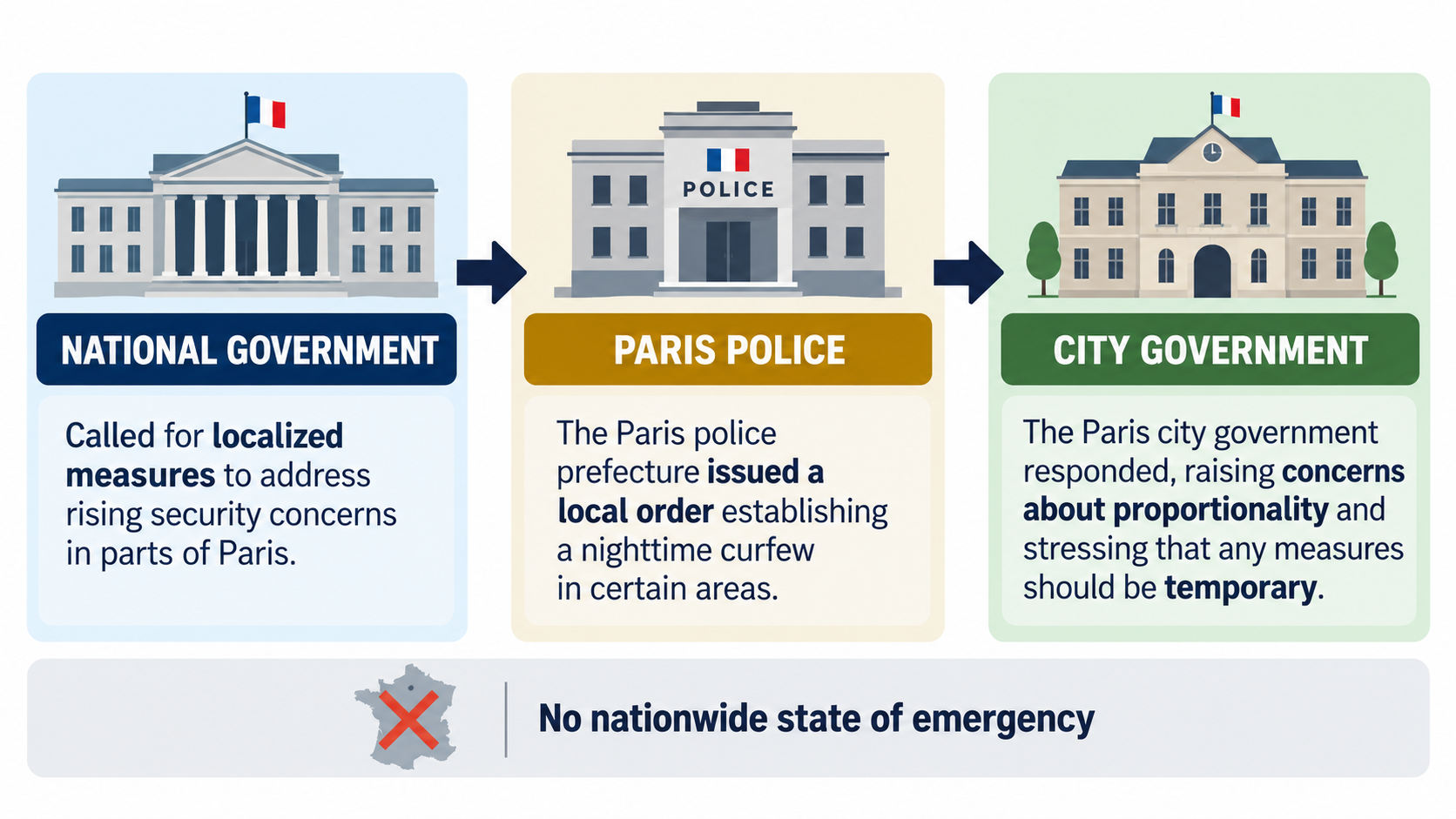
France had not declared a nationwide state of emergency as part of the October 19 curfew decision. The government chose targeted restrictions in areas affected by serious disorder.
Prime Minister Sébastien Lecornu called for limited, localized curfews rather than a blanket measure covering Paris.
Local authorities then issued restrictions tailored to particular cities and areas. In Paris, the police prefecture was responsible for the curfew order. (Reuters)
That division of responsibility matters.
France’s national government sets broad security priorities, but specific local public-order restrictions can be imposed through the relevant policing authorities.
Paris Mayor Emmanuel Grégoire acknowledged the decision and the damage suffered by residents and businesses. But he also warned that the measure should remain exceptional and temporary, rather than becoming a lasting restriction on freedom of movement.
His official statement emphasized that restoring order was necessary but would not, by itself, resolve the underlying political and social grievances. (City of Paris)
Why Is the Government Facing Criticism From Several Directions?
The government faces two problems that can pull its response in different directions.
Residents and business owners affected by vandalism want effective protection and accountability for those responsible.
Meanwhile, students, civil liberties advocates, and some political opponents have questioned whether policing tactics have been excessive or have worsened tensions.
Interior Minister Laurent Nuñez acknowledged shortcomings in how police handled the disorder and offered his resignation. President Emmanuel Macron declined to accept it, leaving Nuñez responsible for improving the security response. (Reuters)
There have also been reports of serious injuries to demonstrators and allegations involving police use of riot-control weapons.
Those allegations require investigation and should not be treated as established findings about every police operation. The authorities have maintained that force was necessary in responding to violent incidents, while critics have questioned the proportionality of particular tactics. (The Guardian)
This creates a difficult situation for the government.
If it fails to stop looting, it risks losing public confidence in its ability to protect people.
If it responds too broadly or disproportionately, it risks worsening resentment among peaceful protesters.
A local curfew can help prevent another night of disorder in a vulnerable location, but it cannot settle the disputes over education funding, household finances, and policing.
What Does the Paris Curfew Mean for Tourists, Residents, and Businesses?
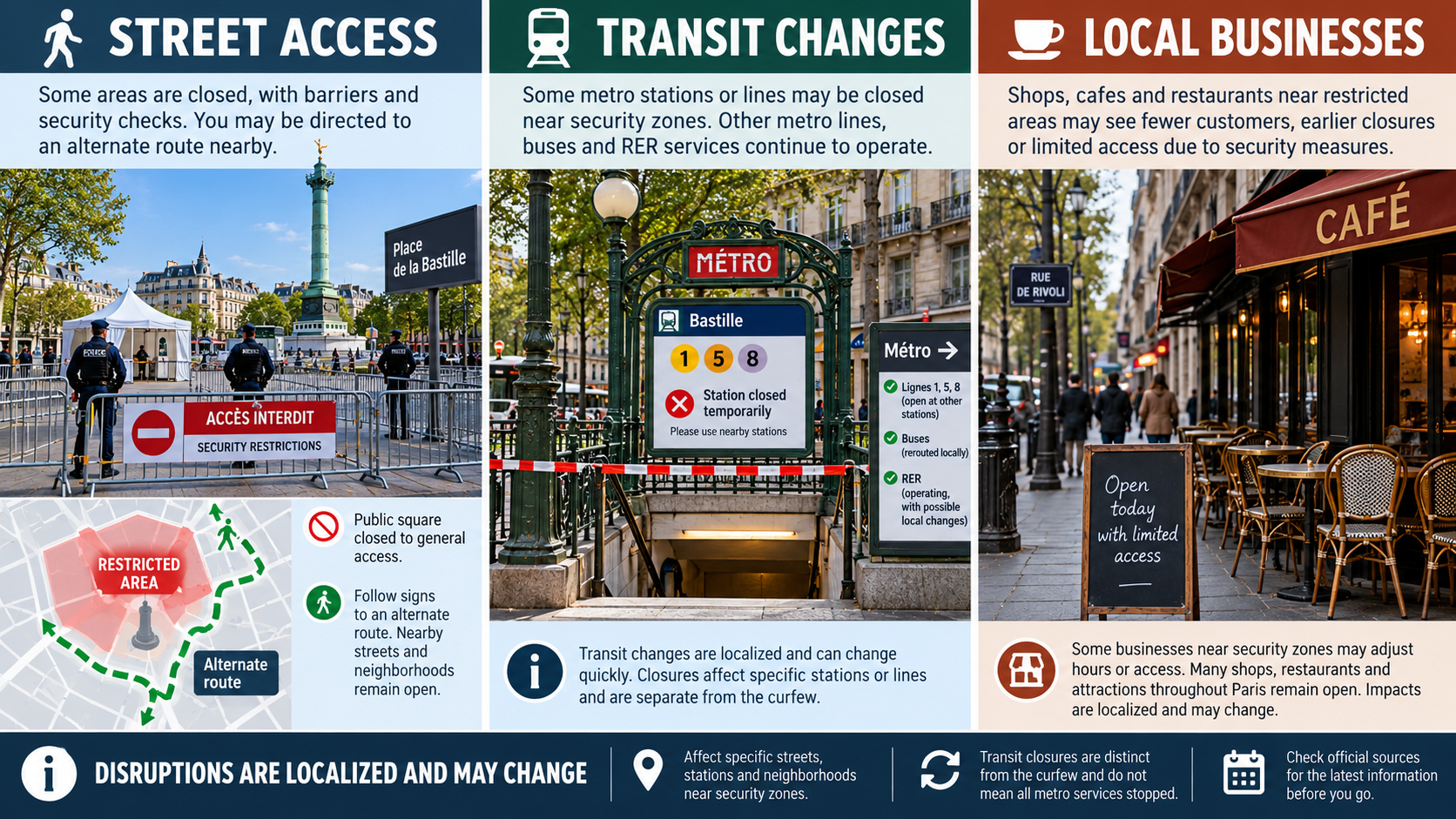
For people in Paris, the immediate effects are concentrated in the affected streets, squares, and transportation connections.
The curfew does not mean every restaurant, hotel, shop, or attraction in Paris must close.
But it can make it harder to move through particular central areas, especially when police close streets or transportation stations as a precaution.
On October 19, Paris transit operator RATP announced security-related closures beginning at 10 p.m. at République, Châtelet, Châtelet–Les Halles, and Les Halles stations. Trains could continue through without stopping, and some transfers were unavailable. (RATP)
Those station closures were operational security measures, distinct from the curfew’s 11 p.m. start.
For someone returning to a hotel or apartment, that difference could matter.
A person may be allowed to reach a residence under an exemption but still encounter a closed station or blocked access route.
For visitors planning activities in central Paris, it is important to check the current restrictions rather than assuming a previously announced timetable remains unchanged.
Business owners face a separate challenge.
Even establishments outside the restricted perimeter can experience fewer customers if people avoid an area because of security concerns.
Businesses directly damaged by looting may also face repair costs, disrupted operations, and uncertainty about when normal trading can resume.
These consequences show why public-order measures affect more than demonstrators.
They also influence ordinary people who have no involvement in the protests.
Can Curfews Stop the Violence Without Resolving the Protests?
Curfews may help authorities reduce opportunities for further violence in particular areas, but they do not address the underlying demands that brought so many people into the streets.
That distinction is central to understanding what happens next.
The immediate security question is whether police can prevent more looting and destruction without relying on restrictions broader than necessary.
The longer-term political question is whether the government can persuade students, workers, and families that their concerns are being addressed.
The challenge is made harder by France’s financial situation.
The government is under pressure to control spending and public debt, while demonstrators are demanding better-funded public services and relief from living costs.
Those objectives can conflict. Improving schools or expanding financial support requires resources at a time when policymakers are being urged to restrain spending. (Reuters)
Three developments are particularly worth watching.
Will the School Staffing Plan Produce Results?
The government has promised 3,000 teachers to help address staffing shortages.
The important test is whether students actually receive more consistent teaching, not simply whether an emergency plan has been announced.
Broader demands involving school facilities, classroom conditions, and inequality will also remain relevant.
Will Labor Unions and Other Groups Continue Demonstrating?
The movement now includes grievances extending far beyond education.
Even if the authorities restore order in the streets, workers and other protesters may continue demanding action on wages, pensions, fuel prices, and living costs.
Further peaceful marches, strikes, and negotiations could shape the next phase of the dispute.
Will Security Measures Stay Localized?
Authorities could lift restrictions if the immediate threat subsides, issue new time-limited orders, or consider additional measures if serious unrest continues.
The October 19 decision alone did not establish a permanent curfew or a nationwide emergency.
Future restrictions would need to be evaluated according to their actual scope, legal basis, duration, and practical effects.
France’s larger challenge is to separate the need to prosecute violent crimes from the obligation to respond to legitimate public concerns.
A government may regain control of a public square without restoring public trust.
Bottom Line: What This Story Really Means
Paris introduced a limited overnight curfew on October 19, 2026, after widespread protests over education and living costs were accompanied by serious violence, looting, and damage across France.
The restriction was not a lockdown of the entire French capital.
It targeted specific areas around Place de la République and Les Halles, with separate rules governing demonstrations in other designated locations.
The protests themselves began weeks earlier with students demanding better conditions in public schools. They expanded as workers, unions, and other groups joined demonstrations over household expenses and broader dissatisfaction with government policy.
The unrest has two connected but distinct dimensions: legitimate social grievances and acts of violence that require a public-safety response.
French authorities must address both without treating peaceful protesters and people committing criminal offenses as interchangeable.
For residents and visitors, the immediate concern is whether localized restrictions and transportation disruptions affect their plans.
For France, the larger question is whether its government can restore public order while making credible progress on the problems that brought people into the streets.
A temporary curfew may prevent further damage in a particular area. Whether it can help calm the wider crisis depends on what happens after the barriers are removed.
Paris Curfew: Key Questions Explained
Q. Is all of Paris under curfew?
No. The October 19 order covered designated areas around Place de la République and Les Halles, not the entire city.
Q. What time did the Paris curfew begin?
The announced overnight curfew ran from 11 p.m. on Monday, October 19, to 6 a.m. on Tuesday, October 20, 2026, local time. Separate demonstration restrictions began earlier in certain areas.
Q. Can residents enter their homes during the curfew?
Yes, the order provided exemptions for qualifying residents, along with certain workers, emergency personnel, and shopkeepers. Residents may need to establish that they live inside the affected perimeter.
Q. Why did French students begin protesting?
Students complained about missing teachers, overcrowded classrooms, deteriorating school facilities, and inequalities in the education system.
Q. Why did the protests expand beyond schools?
Labor unions, workers, and other demonstrators joined over the high cost of living, fuel prices, wages, pensions, and broader concerns about public services.
Q. How many people participated in the October 17 protests?
French authorities estimated about 550,000 demonstrators nationwide, while organizers estimated roughly 800,000. These were competing turnout estimates, not independently established exact counts.
Q. Were all French protesters involved in riots?
No. Many people participated peacefully. The looting, arson, and serious clashes involved particular individuals and groups and should not be attributed to all demonstrators.
Q. Has France declared a nationwide state of emergency?
No nationwide state of emergency was declared as part of the October 19 curfew decision. Authorities instead adopted localized restrictions in selected areas.
Q. Were Paris metro stations closed because of the unrest?
Yes. On October 19, RATP reported precautionary closures at several central stations, including République and Châtelet–Les Halles, beginning at 10 p.m. Travelers should consult updated service information because restrictions can change.
Q. What could happen next in France?
The immediate questions involve public safety, further demonstrations, and whether localized restrictions will continue. Longer-term developments depend on government responses to education problems, household costs, and concerns about police conduct.
Did this help make the story clearer? 🙂
WIN keeps unpacking the “why” behind the news—clearly and simply!
Sources
Paris Curfew Orders and Official Responses
Associated Press — Paris Police Issue Overnight Curfew in Two Areas of the Capital, October 19, 2026
RTL — Scope and Exemptions for Localized Curfews, October 19, 2026
Le Parisien — Curfew Areas, Hours, and Exemptions, October 19, 2026
City of Paris — Mayor’s Official Statement on the Localized Curfew, October 19, 2026
Reuters — French Prime Minister Calls for Partial Curfews After Weekend Riots, October 19, 2026
Student Protests and the Cost-of-Living Movement
The Guardian — School Protesters in a Paris Suburb Describe Their Grievances, October 10, 2026
Reuters — French Student Protesters Continue After Government Teacher Pledge, October 9, 2026
Reuters — Students, Trade Unions and Yellow Vests Protest Across France, October 17, 2026
Reuters via Euronews — Explaining France’s Earlier Yellow Vest Movement, January 18, 2019
Weekend Violence and Government Accountability
Associated Press — Clashes, Fires and Looting During Nationwide Demonstrations, October 17, 2026
Associated Press — How France’s Unrest Escalated and How Authorities Responded, October 19, 2026
Reuters — Macron Rejects Interior Minister’s Offer to Resign, October 19, 2026
The Guardian — Police Tactics and Injuries During French School Protests, October 6, 2026
Reuters — France’s Unrest Deepens Pressure on Macron’s Government, October 19, 2026
Transportation and Local Disruptions
RATP — Paris Public Transportation Security Closures on October 19, 2026
Keep Reading
Why Can Trouble in the Middle East Make Fuel More Expensive Far Away?
Rising fuel costs helped draw more people into France’s protests. A related question is how disruptions to a narrow shipping route in the Middle East can affect energy prices in countries far beyond the conflict.
Did Two Oil Tankers Hit Mines in the Strait of Hormuz—and Why Does It Matter?