
Boeing’s 737 MAX Has a Software Glitch Under FAA Review—What Does It Actually Do?
Another Boeing 737 MAX software problem sounds alarming before you even know what the software does.
Is this another version of the MCAS problem that preceded the two fatal MAX crashes?
Does the airplane suddenly lose its ability to fly automatically?
And if Boeing says the issue is not an immediate safety risk, why are the FAA and major airlines taking it seriously?
The answer starts with a distinction that is easy to miss: this is not the old MCAS problem.
The newly disclosed issue involves software in the 737 MAX flight management computer. Under a narrow set of circumstances during a missed approach, or go-around, the airplane’s vertical navigation function—known as VNAV—can disengage after pilots change the programmed flight path. The airplane does not simply become uncontrollable; the automated guidance drops to a less sophisticated level of pitch control, and pilots have procedures for managing the situation.
The issue became public on September 26, 2026, after news reports described the software condition and Boeing confirmed that it had notified 737 operators in August. The FAA said it was aware of the potential issue and would convene a Corrective Action Review Board. (Reuters · CBS News)
Several major U.S. airlines have also told Boeing they do not want newly delivered aircraft carrying the affected software versions. (CBS News)
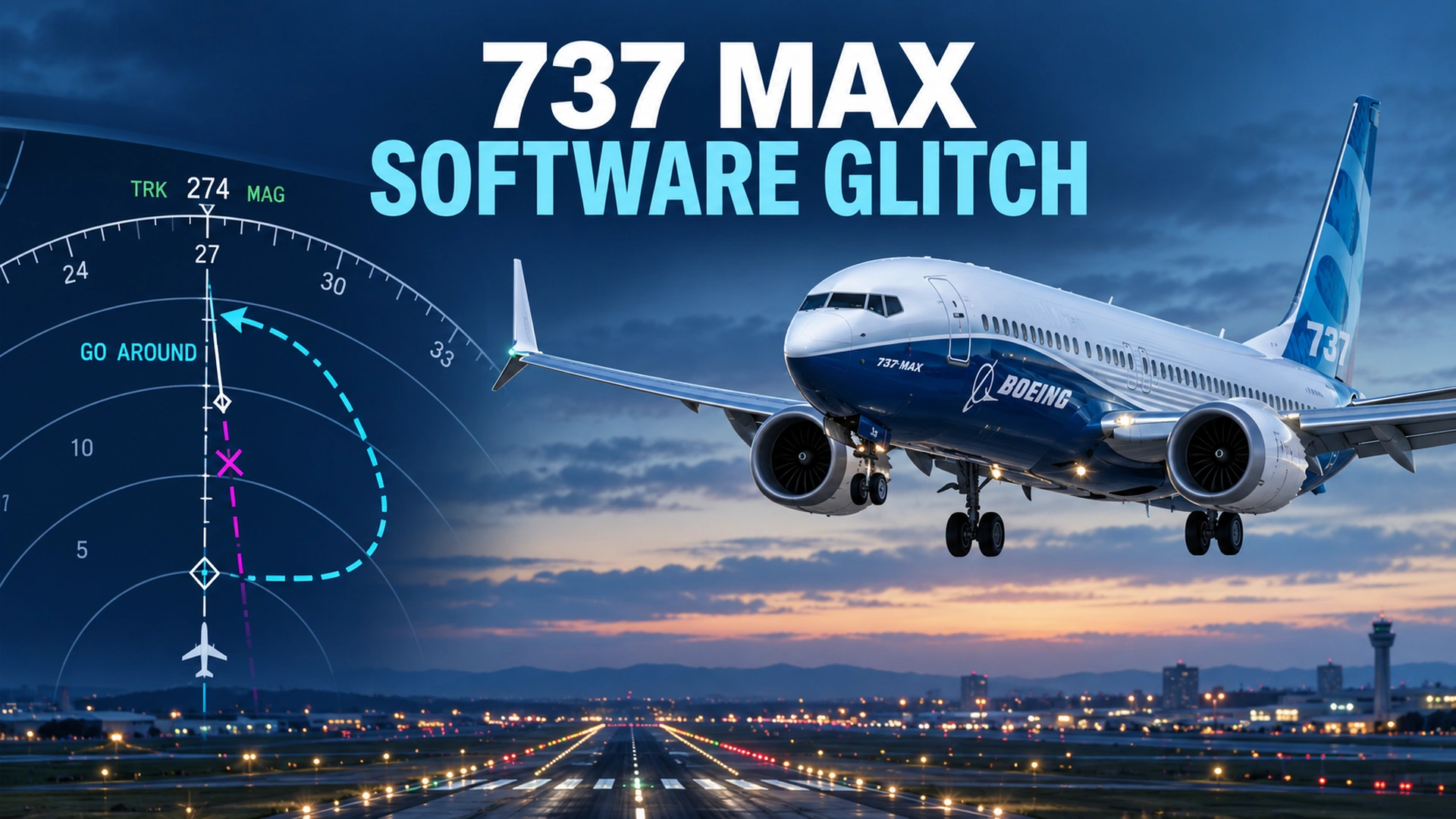
The more interesting question is why a problem that sounds so specific matters enough to involve regulators, aircraft deliveries and potentially the certification schedule of Boeing’s newest MAX variants.
What Exactly Is Going Wrong With the 737 MAX Software?
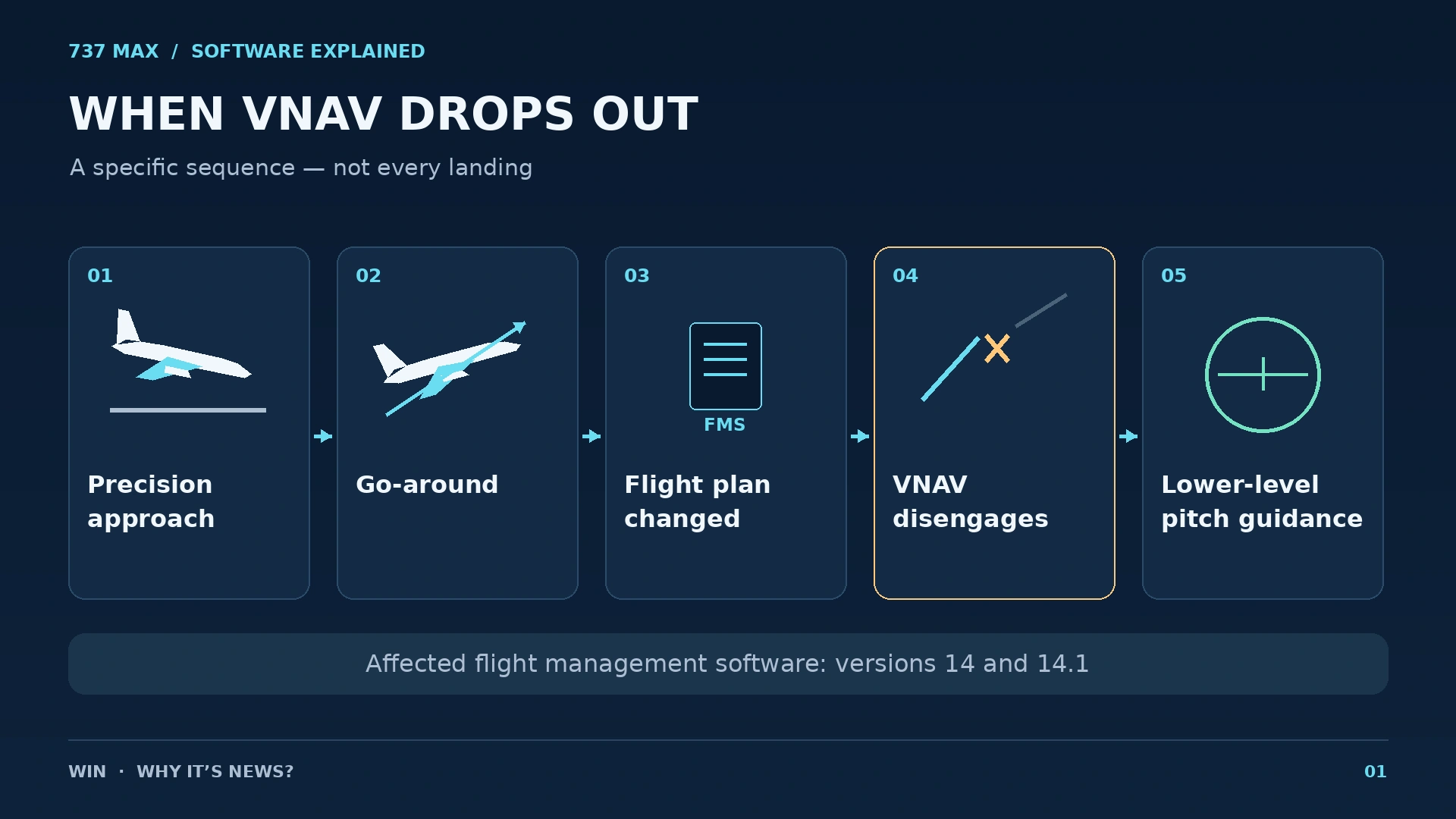
The reported problem occurs only under a particular combination of events.
According to CBS News, a pilot must be conducting a precision approach with the autopilot engaged, discontinue that landing attempt, and then make changes to the programmed flight plan. Under those circumstances, a problem in the flight management computer can cause VNAV to disengage. (CBS News)
The issue has been identified in software versions 14 and 14.1 used by the MAX flight management computer. (CBS News)
Here is the sequence in simpler terms:
| Step | What Happens |
|---|---|
| 1 | The aircraft is flying an automated approach toward the runway. |
| 2 | The crew decides or is instructed to go around instead of landing. |
| 3 | The airplane climbs away and prepares for another approach or route. |
| 4 | The crew changes the programmed flight path. |
| 5 | Under the affected software, VNAV can disengage and automation shifts to a less sophisticated pitch-control mode. |
That final step is the software problem.
It is important to understand what that does not mean. The report does not say that engines shut down, flight controls stop responding or pilots lose the ability to fly the airplane.
The problem is that one useful layer of automated guidance may no longer be available at a moment when the crew is already managing a change in plans.
What Is a Go-Around—and Why Would Pilots Do One?

A go-around is not automatically a sign that something has gone wrong with an airplane.
The FAA describes it as a safe, routine maneuver in which a pilot—or sometimes air traffic control—discontinues a landing approach and the aircraft climbs away so it can make another approach or follow different instructions. (FAA)
Pilots may go around because another aircraft has not cleared the runway, weather changes, the approach becomes unstable or the crew simply decides the safest option is not to land yet.
That matters here because the MAX glitch does not appear during an ordinary cruise flight or every routine landing.
It appears in a more specific situation after the landing attempt has already been abandoned and the crew is reconfiguring the airplane’s planned path.
VNAV helps the aircraft calculate and follow a vertical profile—essentially how the airplane should climb or descend along a programmed path. The FAA defines VNAV as a navigation function that calculates, displays and provides vertical guidance to a flight profile. (FAA)
So a useful way to picture the problem is this:
The airplane still has a pilot and other flight-control capabilities. What can disappear is one layer of automation that helps manage the vertical path.
Does the Glitch Mean Pilots Lose Control of the Airplane?

No. Loss of VNAV is not the same thing as losing control of the airplane.
CBS reported that the affected system can transition from VNAV to a less sophisticated automated pitch-control mode. Boeing has also told operators that crews can manage the situation using existing procedures while the company develops a permanent software correction.
That distinction matters because modern airline cockpits use multiple layers of automation.
Automation can reduce workload by calculating paths, maintaining targets and helping crews manage complicated procedures. But commercial pilots are trained to recognize when automation is not doing what they expect and to change modes or fly manually when necessary.
The concern is therefore less dramatic—but still important.
A go-around already requires pilots to manage power, climb, aircraft configuration, navigation instructions and communications. Losing a higher level of automated guidance at that point can add work at exactly the time when the crew may have several tasks to handle.
Boeing has classified the condition as not presenting an immediate safety risk. The FAA has not made Boeing’s assessment its own final safety determination; it is conducting its own review. (CBS News)
Why Is the FAA Reviewing It If Boeing Says It Is Not an Immediate Safety Risk?
The FAA has a formal process for deciding whether an aircraft defect rises to the level of an unsafe condition requiring mandatory corrective action.
For this issue, the agency says it will convene a Corrective Action Review Board, usually shortened to CARB. (CBS News)
FAA guidance says a Corrective Action Review Board is the agency’s safety-review process for determining whether an unsafe condition exists. If the FAA determines that an unsafe condition must be corrected, it can move toward an Airworthiness Directive requiring specific action. (FAA)
So there are several possible outcomes.
| FAA Finding | What It Could Mean |
|---|---|
| Existing procedures are adequate | Operations could continue while Boeing completes a permanent fix. |
| Additional procedures are needed | Airlines could receive revised operating instructions or training requirements. |
| Software must be replaced or modified | FAA could require corrective action on affected aircraft. |
| Certification impact is identified | Approval or delivery timing for newer MAX variants could be affected. |
The FAA has not yet publicly announced which outcome it will choose.
Its current position is that it is aware of the potential issue, is working with Boeing and airlines, and will take immediate action if its review identifies a safety concern. (CBS News)
Why Are Some Airlines Refusing New MAX Jets With the Affected Software?
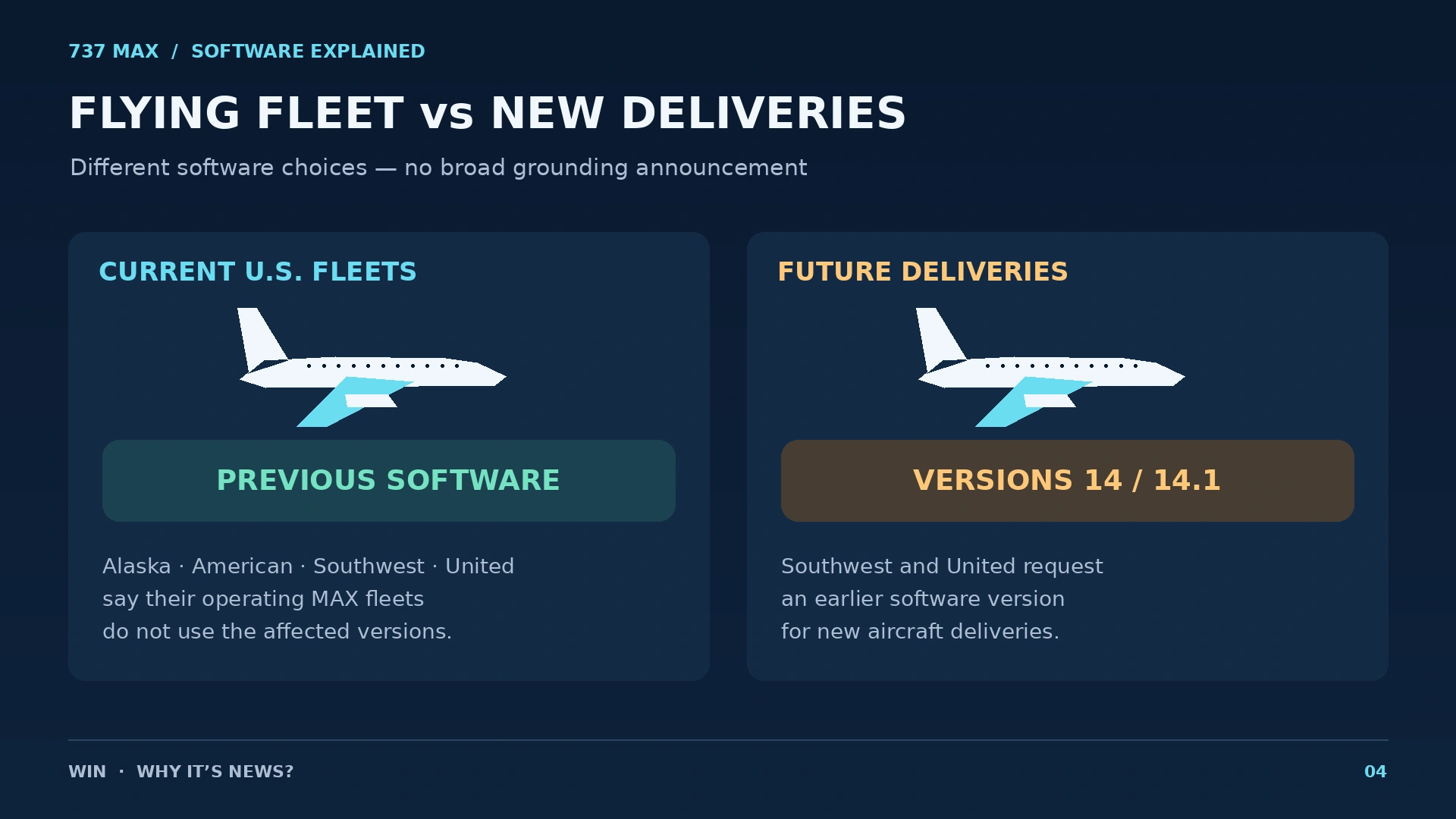
This is where the story becomes less intuitive.
Southwest and United have told Boeing they do not want new aircraft delivered with the affected software and have requested an earlier version instead. (CBS News)
At the same time, Alaska Airlines, American Airlines, Southwest and United told CBS News that none of their currently operating 737 MAX fleets use the software versions in question. (CBS News)
So refusing the new software does not mean those airlines are grounding the MAX aircraft they already fly.
It means airlines can take a cautious approach to future deliveries while the software issue is investigated.
The number of aircraft around the world currently using versions 14 or 14.1 has not been publicly established. Boeing, airlines and regulators are still determining the scope of the affected fleet. (Reuters)
That uncertainty is one reason the investigation matters.
Is This the Same Problem as MCAS?

No. They involve different systems and different circumstances.
The two MAX crashes in 2018 and 2019 focused attention on the Maneuvering Characteristics Augmentation System, or MCAS. That system was part of the aircraft’s flight-control logic and could command stabilizer movement based on angle-of-attack information.
After the crashes, the FAA required major changes, including new flight-control computer software that compares information from both angle-of-attack sensors rather than allowing MCAS to depend on one sensor. (FAA)
The newly disclosed issue is different.
| Earlier MCAS Issue | Newly Disclosed Issue | |
|---|---|---|
| Main system | Flight-control system / MCAS | Flight management computer / VNAV |
| Trigger | Erroneous angle-of-attack information in the crash scenarios | Specific go-around and flight-plan-change sequence |
| Effect | Could command unwanted stabilizer movement | VNAV may disengage and automation drops to a lower pitch-control mode |
| Current status | Redesigned before MAX return to service | Under FAA review |
| Same defect? | — | No |
That does not make the new issue irrelevant.
It does mean that headlines describing another “737 MAX software problem” can create a misleading impression unless readers know which software is actually involved.
If Boeing Knew About the Issue Earlier, Why Is It Becoming News Now?

This may be the most important timeline in the story.
CBS News reported that Boeing was first notified about the issue by an airline in November 2024. The company reviewed it and concluded in February 2025 that it did not represent a safety issue. (CBS News)
Then the situation changed.
CBS reported that Boeing received additional information from operators in 2026, leading the company to open a formal safety review. Boeing sent the findings of that review to the FAA in September. (CBS News)
The sequence looks like this:
| Date | Development |
|---|---|
| November 2024 | An airline reports the issue to Boeing. |
| February 2025 | Boeing concludes its review and determines it is not a safety issue. |
| 2026 | Additional information from operators prompts another formal Boeing safety review. |
| Late August 2026 | Boeing issues a bulletin to 737 operators describing the software condition and procedures. |
| September 2026 | Boeing sends review findings to the FAA; the FAA prepares a CARB review. |
| September 26, 2026 | The issue becomes public through major news reports; Boeing and the FAA provide statements. |
Boeing’s initial operator bulletin indicated that a permanent software correction might not be available until 2028, with updated pilot guidance planned sooner. CBS reported that Boeing is now trying to accelerate both efforts. (CBS News)
The open question is therefore not simply, “Why wasn’t the airplane grounded immediately?”
It is how the risk assessment changed as Boeing received additional operational information—and whether the FAA agrees with Boeing’s earlier conclusion.
Could This Affect the MAX 7 and MAX 10?
Potentially, although the extent is not yet clear.
This matters because Boeing is in the middle of an important certification and delivery cycle for the two newest MAX variants.
The FAA certified the 737 MAX 7 on August 3, 2026, after a lengthy review that included flight controls, human factors, crew alerting and other safety-critical systems. (FAA)
CBS reported that the MAX 7 was certified using software version 14—the version now associated with the newly disclosed condition. (CBS News)
The 737 MAX 10, meanwhile, had been using version 14.1 during certification testing. CBS said the FAA review could affect its certification schedule. (CBS News)
Only days before the software story emerged, Boeing CEO Kelly Ortberg said MAX 10 certification was expected “very soon” and that flight testing had been completed, leaving documentation and regulatory review as the main remaining work. (Boeing)
No official FAA announcement has yet said the MAX 10 certification will be delayed because of this issue.
But the timing explains why the software review has consequences beyond aircraft already in service.
Should Passengers Expect MAX Flights to Be Grounded?
There has been no broad grounding announcement tied to this software issue.
That is an important distinction.
The FAA is still evaluating the condition, and Boeing says existing procedures allow crews to manage the scenario safely. Major U.S. carriers also say the MAX airplanes they currently operate do not use the affected software versions. (CBS News)
For passengers, the next meaningful developments are regulatory rather than operational speculation.
Watch for:
- whether the FAA determines the condition is an unsafe condition,
- whether it requires an Airworthiness Directive,
- whether Boeing accelerates a permanent software update,
- whether affected software must be removed from newly delivered aircraft,
- whether MAX 7 deliveries are altered,
- and whether the MAX 10 certification schedule changes.
Until those decisions are made, saying either “there is no problem” or “the MAX is unsafe again” goes beyond what regulators have established.
The more accurate description is: a narrowly triggered automation problem has been identified, Boeing has proposed procedures and a software fix, airlines have become cautious about accepting the affected version, and the FAA is now deciding what level of corrective action is appropriate.
Bottom Line: What This Story Really Means
The latest Boeing 737 MAX software issue is not a repeat of MCAS and does not mean pilots suddenly lose control during landing.
It involves the flight management computer and a specific sequence during a go-around: after a missed approach, changing the programmed flight path can cause VNAV—automated vertical guidance—to disengage and fall back to a lower level of automation.
That sounds narrow, but aviation safety is built around examining exactly these low-frequency combinations before they become larger problems.
The bigger reason this story matters is timing. Boeing first received a report about the condition in 2024, later received additional operator information, and is now facing an FAA review just as the MAX 7 begins moving toward deliveries and the MAX 10 approaches certification.
So the key question is no longer simply whether Boeing has found another software bug.
It is what the FAA concludes the bug requires Boeing and airlines to do about it.
737 MAX Software Glitch: Key Questions Explained
Q. What is the new Boeing 737 MAX software glitch?
It is a problem in certain flight management computer software versions that can cause VNAV, the airplane’s automated vertical navigation function, to disengage during a specific sequence involving a go-around and a change to the programmed flight path. (CBS News)
Q. Does the glitch happen during every 737 MAX landing?
No. The reported condition requires a particular combination of circumstances and is not described as something that occurs during ordinary MAX landings.
Q. What does VNAV do?
VNAV calculates and provides vertical guidance along a programmed flight profile, helping manage how an aircraft climbs or descends. (FAA)
Q. Is a go-around an emergency?
Not necessarily. The FAA describes a go-around as a safe, routine maneuver used when a landing approach is discontinued. (FAA)
Q. Do pilots lose control if VNAV disengages?
No. The reported problem involves a loss of one level of automated vertical guidance, not loss of basic aircraft control. The system can transition to a lower level of automated pitch control, and Boeing has provided procedures for crews. (CBS News)
Q. Is this the same software problem as MCAS?
No. MCAS is part of a different flight-control function. The new issue involves flight management software and VNAV during a specific go-around scenario. (FAA)
Q. Are U.S. airlines currently flying MAX jets with the affected software?
Alaska Airlines, American Airlines, Southwest and United told CBS News that their in-service MAX fleets do not use the affected software versions. (CBS News)
Q. Why are Southwest and United refusing some new deliveries?
They have told Boeing they do not want new aircraft delivered with the affected software and prefer an earlier version while the issue is being reviewed. (CBS News)
Q. Could the software issue delay the 737 MAX 10?
It could affect the certification process, but the FAA has not announced a confirmed delay. The MAX 10 had been using software version 14.1 during certification testing, according to CBS News. (CBS News)
Q. What happens next?
The FAA plans to convene a Corrective Action Review Board to assess the issue. Depending on its findings, regulators could accept existing procedures, require additional mitigation or mandate corrective action. (FAA)
Did this help make the story clearer? 🙂
WIN keeps unpacking the “why” behind the news—clearly and simply!
Sources
Software Issue, Airline Response and Timeline
Reuters — Boeing flags 737 MAX software glitch affecting landing navigation feature
FAA Guidance on Go-Arounds, VNAV and Corrective Action
Federal Aviation Administration — Go-Arounds Explained
Federal Aviation Administration — Pilot/Controller Glossary definition of Vertical Navigation
737 MAX Certification and Software Background
Federal Aviation Administration — Certification of the Boeing 737 MAX 7
Boeing — 737 MAX flight-control software update and MCAS changes
Boeing — 737-10 certification progress and completion of planned certification flight testing