Why Is Mamdani Reviewing NYPD Use-of-Force Rules—and What Could Change?

When a police officer is accused of excessive force, what happens if that officer retires before a disciplinary hearing?
Does retirement put an end to the case?
Those questions have become central to a new debate over policing in New York City. Mayor Zohran Mamdani has ordered the New York Police Department to conduct its first comprehensive use-of-force policy review in a decade. The announcement followed renewed anger over the fatal 2024 police shooting of 19-year-old Win Rozario—and the discovery that an officer involved had retired before facing a disciplinary trial.
But there’s a distinction that matters right away: the city has announced new accountability measures, not a completed rewrite of the NYPD’s use-of-force rules. (NYC Mayor’s Office)
※ Images in this article are AI-generated illustrations created to help explain the story. They are not actual photographs, and depictions of people, places, or events may differ slightly from reality.
This story is about several related—but different—decisions: when officers may use force, who investigates alleged misconduct, who imposes discipline, and what happens when an officer leaves before that process is finished.
What Changed on October 12—and What Didn’t?
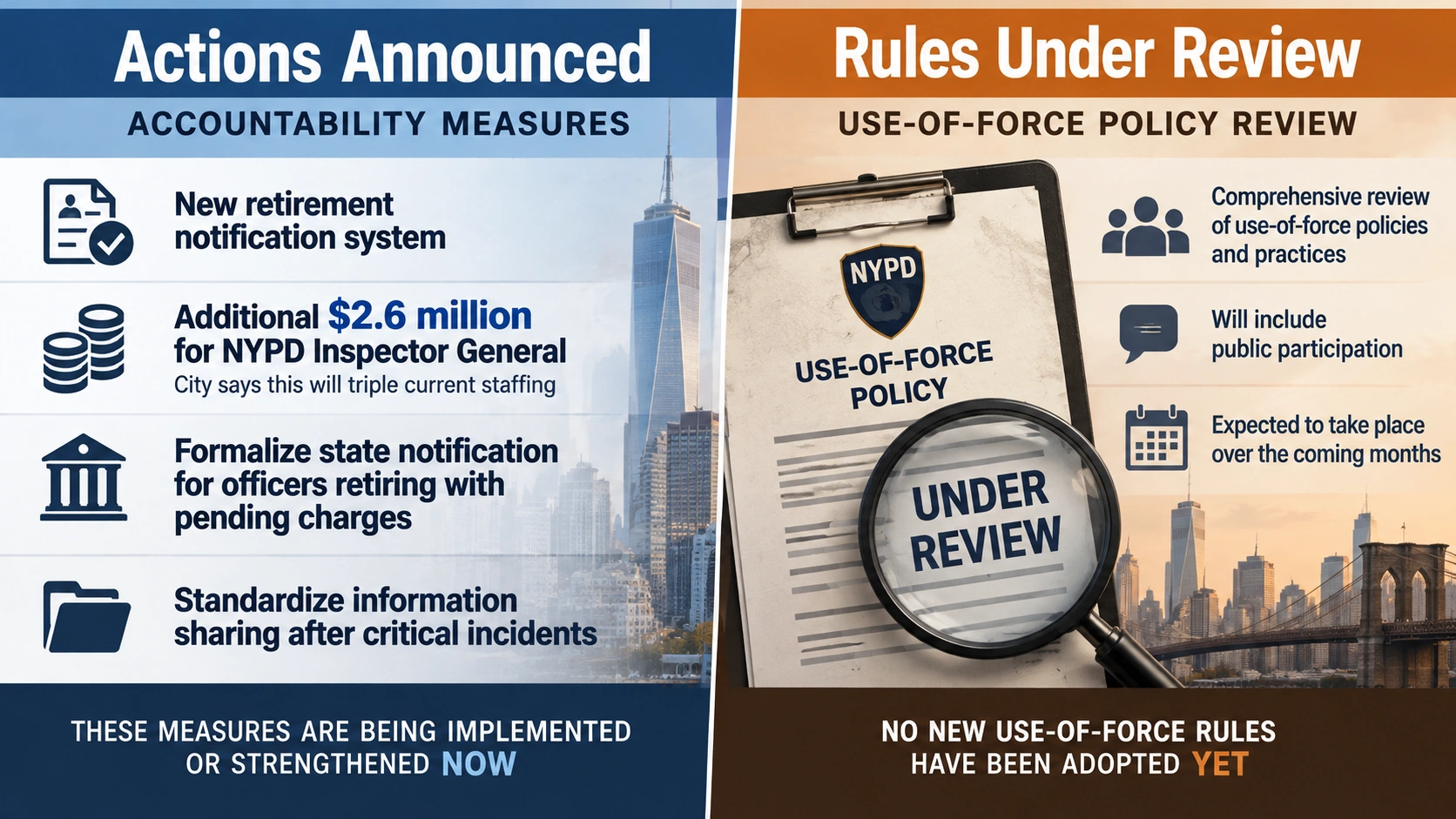
On October 12, 2026, Mamdani directed the NYPD to review its use-of-force policies and practices over the coming months, with community input. City Hall described it as the department’s first comprehensive review in a decade. (NYC Mayor’s Office)
The administration also unveiled several narrower accountability measures. Those are not the same as the results of the future policy review.
| Measure | Status as of October 12 |
|---|---|
| Comprehensive use-of-force policy review | Ordered; findings and revisions still pending |
| Retirement notification system | NYPD says a new system has been implemented |
| Independent oversight funding | Additional $2.6 million announced |
| State notification when officers retire with pending charges | Existing practice to be formalized |
| Critical-incident information sharing | More standardized procedures announced |
| Reporting police-involved deaths to the state | Continued compliance with an existing legal obligation |
| Comprehensive replacement use-of-force rules | Not announced or adopted through this review |
The new funding will go to the Office of the Inspector General for the NYPD, which examines systemic problems in department policies and practices. City Hall says the extra $2.6 million will triple that office’s current staffing. (NYC Mayor’s Office)
Some safeguards have therefore been introduced, while others have been announced for formalization. The broader question—whether and how the city will rewrite rules governing officers’ use of force—remains open.
Why Did One Officer’s Retirement Set Off a New Controversy?
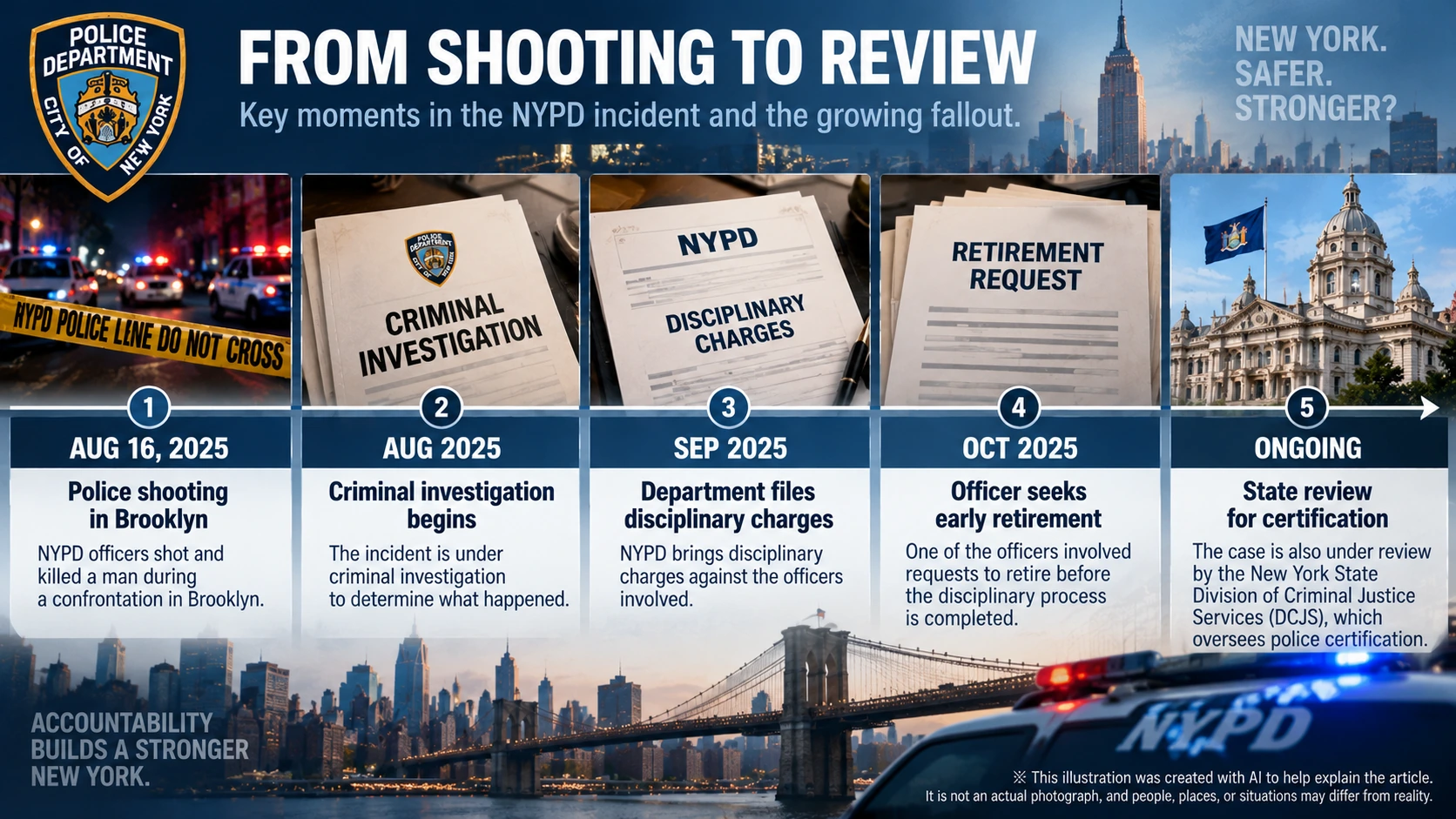
The controversy centers on what happened to a disciplinary case after one of the officers involved in Win Rozario’s death retired.
On March 27, 2024, Rozario called 911 while experiencing a mental health crisis at his family’s Queens home. According to the New York Attorney General’s Office, two responding officers encountered him holding scissors. They used Tasers during the confrontation, and both ultimately fired their guns. Rozario was struck five times and died at a hospital. (New York Attorney General)
The encounter prompted two distinct forms of scrutiny: a criminal investigation and separate departmental disciplinary proceedings.
One of the officers, Salvatore Alongi, retired in May 2026 with a disability pension, before a departmental disciplinary trial. The retirement came under public scrutiny on October 8, when Rozario’s family and advocates called attention to it. This was not a retirement that first occurred in October. (CBS New York)
| Date | Event |
|---|---|
| March 27, 2024 | Win Rozario is fatally shot during an NYPD response in Queens |
| September 2025 | Departmental misconduct charges move forward against the two officers |
| December 4, 2025 | New York’s attorney general announces that criminal charges will not be pursued |
| May 2026 | Officer Salvatore Alongi retires before a disciplinary trial |
| October 8, 2026 | The retirement becomes the focus of renewed public criticism |
| October 12, 2026 | Mamdani orders a policy review and announces accountability measures |
The sequence matters because the October 12 announcement was a response to an older shooting and a retirement that had already occurred—not a newly reported shooting or a retirement taking place that day. (CBS New York · NYC Mayor’s Office)
So why were disciplinary charges still an issue if the attorney general had already decided not to bring criminal charges?
How Can There Be No Criminal Charges but Still Be a Disciplinary Case?
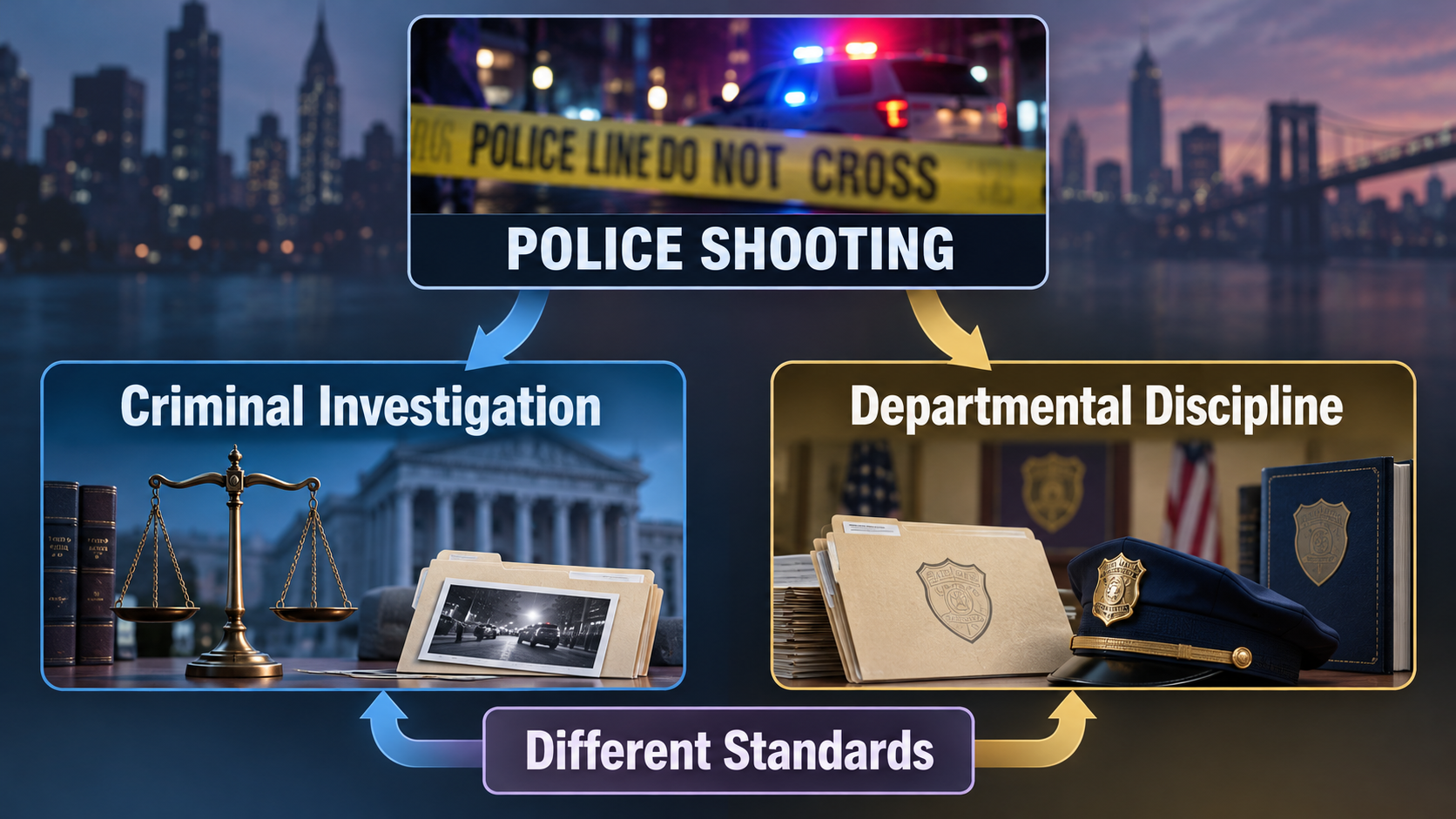
Criminal law and NYPD employment rules answer different questions. Conduct that prosecutors cannot prove is a crime can still be examined for violations of departmental policy.
On December 4, 2025, New York Attorney General Letitia James’ Office of Special Investigation announced it would not pursue criminal charges against the officers involved in Rozario’s death. Investigators concluded that prosecutors could not disprove beyond a reasonable doubt that the officers’ use of deadly force was justified under New York law. (New York Attorney General)
That was a decision not to prosecute, not a criminal trial ending in an acquittal. Nor did it resolve every question about the officers’ compliance with NYPD rules.
The Civilian Complaint Review Board (CCRB), an independent city agency, separately pursued departmental disciplinary charges. Its role is to examine certain allegations of police misconduct and, in serious cases, prosecute charges in an administrative process. The police commissioner ultimately makes the department’s final disciplinary determination. (CCRB · New York Attorney General)
| Criminal review | NYPD disciplinary process |
|---|---|
| Asks whether conduct violates criminal law | Asks whether conduct violates department standards |
| A conviction requires proof beyond a reasonable doubt | Administrative findings use a lower evidentiary standard |
| May result in criminal charges and a court trial | May result in internal charges, a hearing and discipline |
| Attorney general declined prosecution in this case | CCRB pursued disciplinary charges involving the officers |
An everyday comparison helps: an employee can avoid criminal charges and still face consequences for breaking workplace rules. Police powers, legal protections and disciplinary procedures are much more specialized, but the distinction between a crime and a workplace-rule violation remains.
The practical problem in Rozario’s case was that one officer left the department before the disciplinary trial could take place.
Can Officers Retire Before NYPD Disciplinary Cases Are Finished?
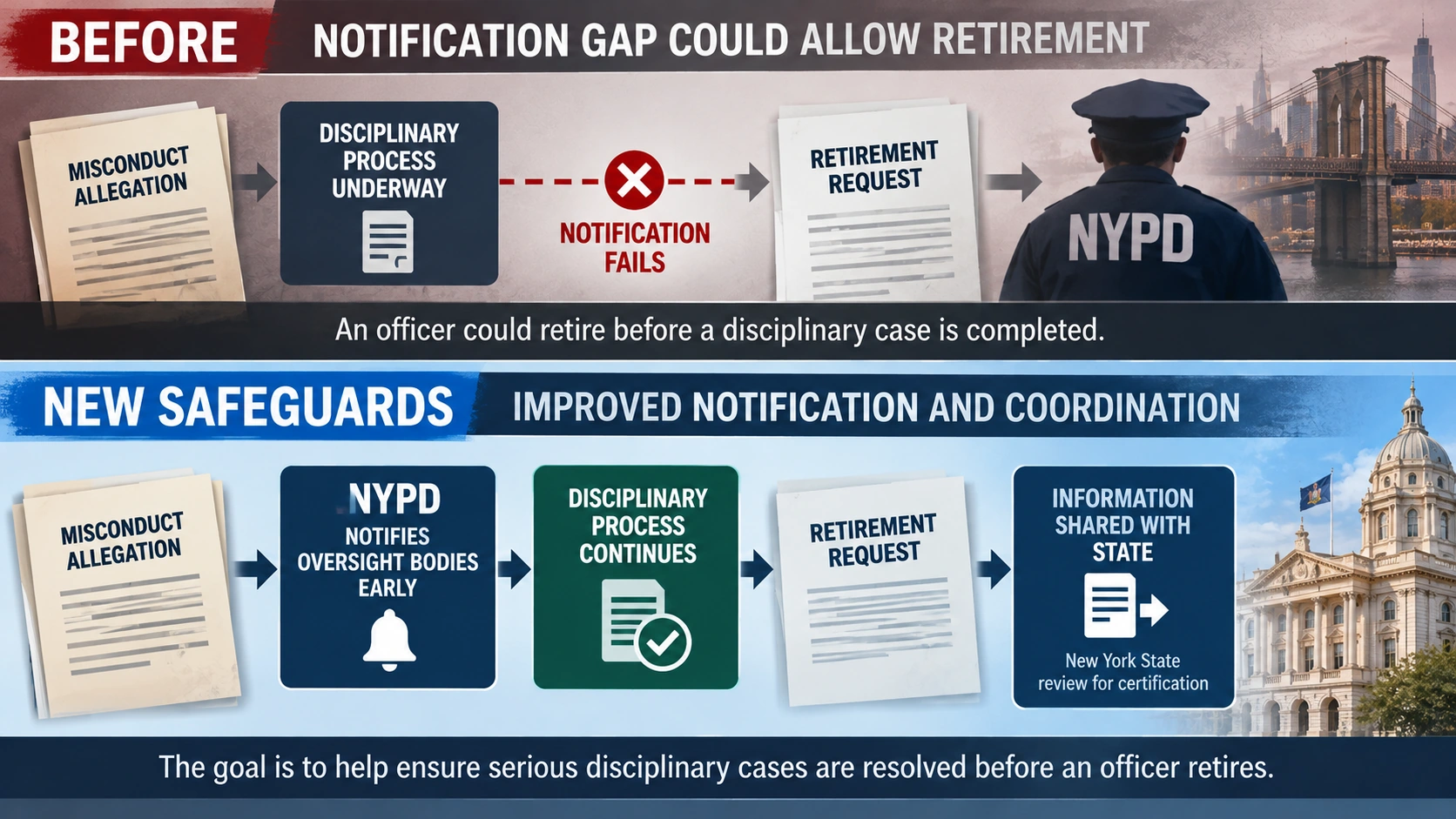
The Rozario case showed that an officer could retire while a disciplinary case remained unresolved—and that a missed notification could prevent a timely hearing.
CBS New York reported that the NYPD acknowledged an internal failure to notify the appropriate oversight body about Alongi’s pending retirement. The department said a civilian employee should have made that notification, which could have allowed the disciplinary process to proceed before retirement. (CBS New York)
Mamdani’s announcement addresses that gap in two ways.
First, the NYPD says it has implemented a new retirement notification system intended to facilitate completion of disciplinary proceedings before an officer retires.
Second, the department says it will formalize an existing practice of notifying the New York State Division of Criminal Justice Services and submitting relevant information for possible decertification when an officer with pending charges retires. (NYC Mayor’s Office)
Decertification concerns whether an officer remains eligible to serve in law enforcement under state rules. It is distinct from criminal prosecution and from the NYPD’s employment-based discipline.
A notification safeguard is not an automatic ban on retirement. Likewise, referring information to the state does not mean the officer’s certification has already been revoked.
The real test will be whether the revised process reliably identifies unresolved serious charges before an officer’s departure—and whether state authorities receive the information they need afterward.
Who Actually Controls Police Accountability in New York City?
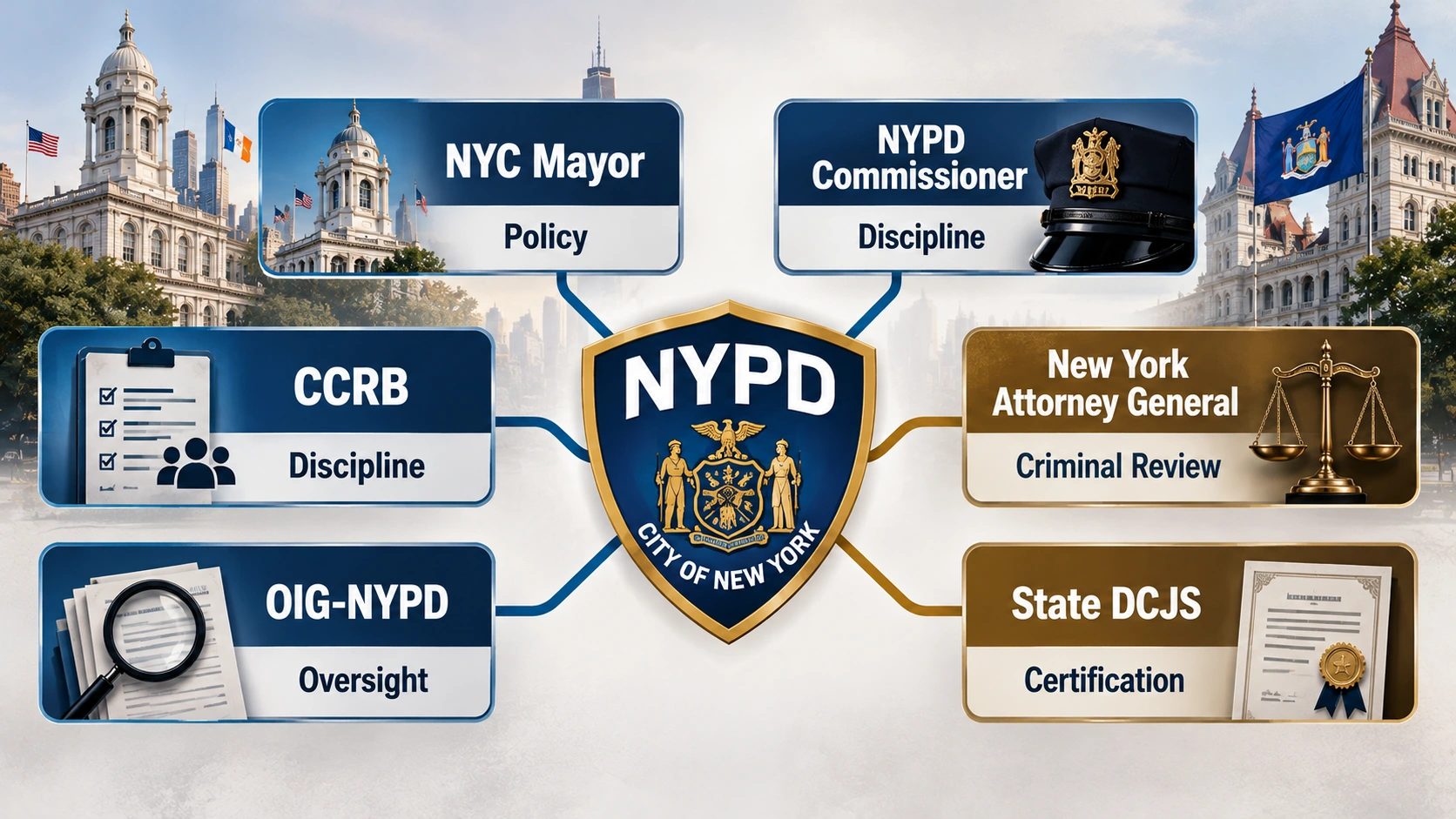
The mayor can direct policy reviews and set administration priorities. The mayor cannot personally decide every criminal prosecution, disciplinary case or state certification outcome.
New York City and New York State divide those responsibilities among several institutions.
| Institution | Main role |
|---|---|
| NYC mayor | Sets city administration priorities and directs policy reviews |
| NYPD commissioner | Leads the department and makes final NYPD disciplinary determinations |
| Civilian Complaint Review Board | Investigates specified misconduct complaints and prosecutes certain disciplinary cases |
| NYPD inspector general | Independently examines systemic NYPD policies and practices |
| New York attorney general | Investigates qualifying police-caused deaths and evaluates criminal charges |
| State Division of Criminal Justice Services | Oversees relevant statewide law-enforcement certification processes |
The state attorney general’s criminal investigation into Rozario’s death was separate from the CCRB’s departmental case. The CCRB could pursue misconduct charges even after the attorney general declined prosecution. (New York Attorney General · CCRB)
The inspector general has another assignment: examining patterns and systems rather than determining the penalty in one officer’s disciplinary trial. That is why City Hall’s additional $2.6 million in oversight funding is relevant to the broader reform effort. (NYC Mayor’s Office)
There is also disagreement over the political meaning of the reforms. Police Benevolent Association president Patrick Hendry argued that the CCRB should itself be reviewed and criticized the mayor’s approach. Supporters of stronger police oversight see the changes as needed safeguards against unresolved misconduct. These are competing positions, not findings that either side’s broader claims have been proved. (CBS New York · AP)
Police reform therefore involves more than one official changing one rule. It requires coordination among institutions whose responsibilities do not always overlap.
Could the Review Change Responses to Mental Health Emergencies?

Possibly. But the October 12 announcement did not establish a new citywide mental health emergency-response rule.
Rozario’s death raised questions not only about when officers fired their weapons, but also about whether different resources might have been available before the encounter escalated.
In its December 2025 report, the New York Attorney General’s Office examined B-HEARD, the city’s Behavioral Health Emergency Assistance Response Division, which uses paramedics and mental health professionals in certain emergencies.
Investigators found that B-HEARD was not operating in Rozario’s precinct at the time. Even if it had been, his call would not have qualified under the program’s then-existing rules because the original 911 report mentioned suspected drug use. (New York Attorney General)
The attorney general recommended expanding coverage, broadening eligibility for substance-related crises and improving procedures for coordinating mental health and police responses when safe.
Those recommendations are relevant background, not reforms that the October 12 announcement itself put into effect.
Some emergencies involve an immediate threat and may require police intervention. In other cases, qualified mental health professionals may be able to play a greater role. The unresolved policy question is how New York should decide which response is appropriate, and how responders should coordinate once they arrive.
What Should New Yorkers Watch Next?
Three things will show whether this announcement produces meaningful change.
First, the city will need to publish the actual results of its use-of-force review. City Hall says that process will take place over the coming months with community engagement, but it did not release comprehensive replacement rules on October 12. (NYC Mayor’s Office)
Second, the new retirement notification system will need to work in practice. When an officer with pending serious allegations applies to retire, do the relevant oversight bodies receive timely notice? Can required proceedings move forward before the officer leaves?
Third, the city has promised clearer information sharing following critical incidents. City Hall said it would formalize the release of final Force Investigation Division reports to affected families or their representatives who request them. Whether families receive those reports consistently will be a practical accountability test. (NYC Mayor’s Office)
The larger challenge is to provide officers with workable guidance while ensuring that alleged misconduct is reviewed fairly, thoroughly and transparently. Neither goal can be measured by the announcement alone.
Bottom Line: What This Story Really Means
Mayor Zohran Mamdani’s October 12 announcement began a comprehensive review of NYPD use-of-force policies and introduced or promised procedural changes intended to strengthen police accountability.
A central trigger was the revelation that Officer Salvatore Alongi had retired in May 2026, before a disciplinary trial related to the March 2024 fatal shooting of Win Rozario. The October controversy brought renewed attention to shortcomings in how pending disciplinary cases and retirement applications were communicated.
The case also illustrates a distinction that reaches beyond New York: declining to bring criminal charges does not automatically settle whether an officer complied with department rules.
The policy review is still pending. Its significance will depend on the rules eventually adopted and on whether the new accountability procedures work when tested by real cases.
NYPD Use-of-Force Review: Key Questions Explained
Q. Did Mamdani change all NYPD use-of-force rules on October 12, 2026?
No. The mayor ordered a comprehensive review; he did not announce a completed replacement set of rules. The administration also described separate accountability safeguards.
Q. Who was Win Rozario?
Win Rozario was a 19-year-old New Yorker who died after NYPD officers shot him during a mental health crisis in his family’s Queens home on March 27, 2024.
Q. When did Officer Salvatore Alongi retire?
Alongi retired in May 2026 with a disability pension, before a departmental disciplinary trial. His retirement became the focus of renewed public controversy in October 2026.
Q. Why did the attorney general decline to charge the officers criminally?
In December 2025, the attorney general’s office concluded that prosecutors could not disprove beyond a reasonable doubt that the officers’ deadly force was justified under New York law. The office therefore declined criminal prosecution.
Q. How could there still be an NYPD disciplinary case?
Criminal charges and departmental discipline apply different legal standards. The CCRB pursued alleged violations of NYPD rules separately from the attorney general’s criminal investigation.
Q. Will an officer’s retirement automatically stop a disciplinary case?
Not every case follows the same path. The Rozario controversy showed that retirement and missed notifications can interfere with completing a departmental trial. The NYPD says it has implemented a new notification system to address that risk.
Q. Does retirement with pending misconduct charges automatically revoke police certification?
No. Submitting information to New York State for possible decertification is not the same as an automatic revocation of certification.
Q. How much additional funding was announced for NYPD oversight?
City Hall announced an additional $2.6 million for the Office of the Inspector General for the NYPD and said the funding would triple its current staffing.
Q. Did the city announce that mental health professionals will replace police on emergency calls?
No. The October 12 announcement did not create such a citywide rule. An earlier attorney general report recommended expanding and improving mental health crisis-response options.
Q. When will the comprehensive NYPD policy review be finished?
The administration said the review would unfold over the coming months. It did not announce a final set of revised rules or a specific effective date on October 12.
Did this help make the story clearer? 🙂 WIN keeps unpacking the “why” behind the news—clearly and simply!
Sources
October 12 Announcement and Policy Measures
NYC Mayor’s Office — First Comprehensive NYPD Use-of-Force Review and Accountability Reforms
Associated Press — Mamdani Orders a Review of NYPD’s Use-of-Force Policies
NY1 — Mamdani Orders NYPD to Review Use-of-Force Policies After Teen’s Death
Win Rozario Investigation and Retirement Timeline
New York Attorney General — December 4, 2025 Investigation Announcement
CBS New York — October 8 Report on Officer’s May 2026 Retirement
CBS New York — October 12 Reporting on NYPD Reforms and Reactions
Accountability Rules and Police Oversight
NYC Civilian Complaint Review Board — Case Outcomes and Findings