Why Was Ilhan Omar’s Home Searched Weeks Before the Midterms—and What’s Actually Known?

Can federal agents really search the home of a sitting member of Congress?
Yes. Holding elected office does not place someone beyond the reach of a criminal investigation.
But the search of Rep. Ilhan Omar’s Washington, D.C., home raises a more complicated question.
Why would federal investigators take such a public step against a candidate just weeks before an election?
On October 12, 2026, federal agents searched the Minnesota Democrat’s residence under a judicially authorized warrant. The Justice Department confirmed the search but did not publicly explain the specific allegations behind it. (AP · Reuters)
That leaves two separate issues: whether investigators have evidence supporting a legitimate criminal inquiry, and whether the decision to search Omar’s home so close to Election Day complied with the safeguards meant to keep law enforcement independent of politics.
Neither question can be settled simply by looking at photographs of agents outside her home.

※ Images in this article are AI-generated illustrations created to help explain the story. They are not actual photographs, and depictions of people, places, or events may differ slightly from reality.
The most important distinction is that a court-approved search establishes authority to look for evidence. It does not establish that the person whose home was searched committed a crime.
Understanding how that works makes the political controversy much easier to evaluate.
What Actually Happened at Ilhan Omar’s Home?
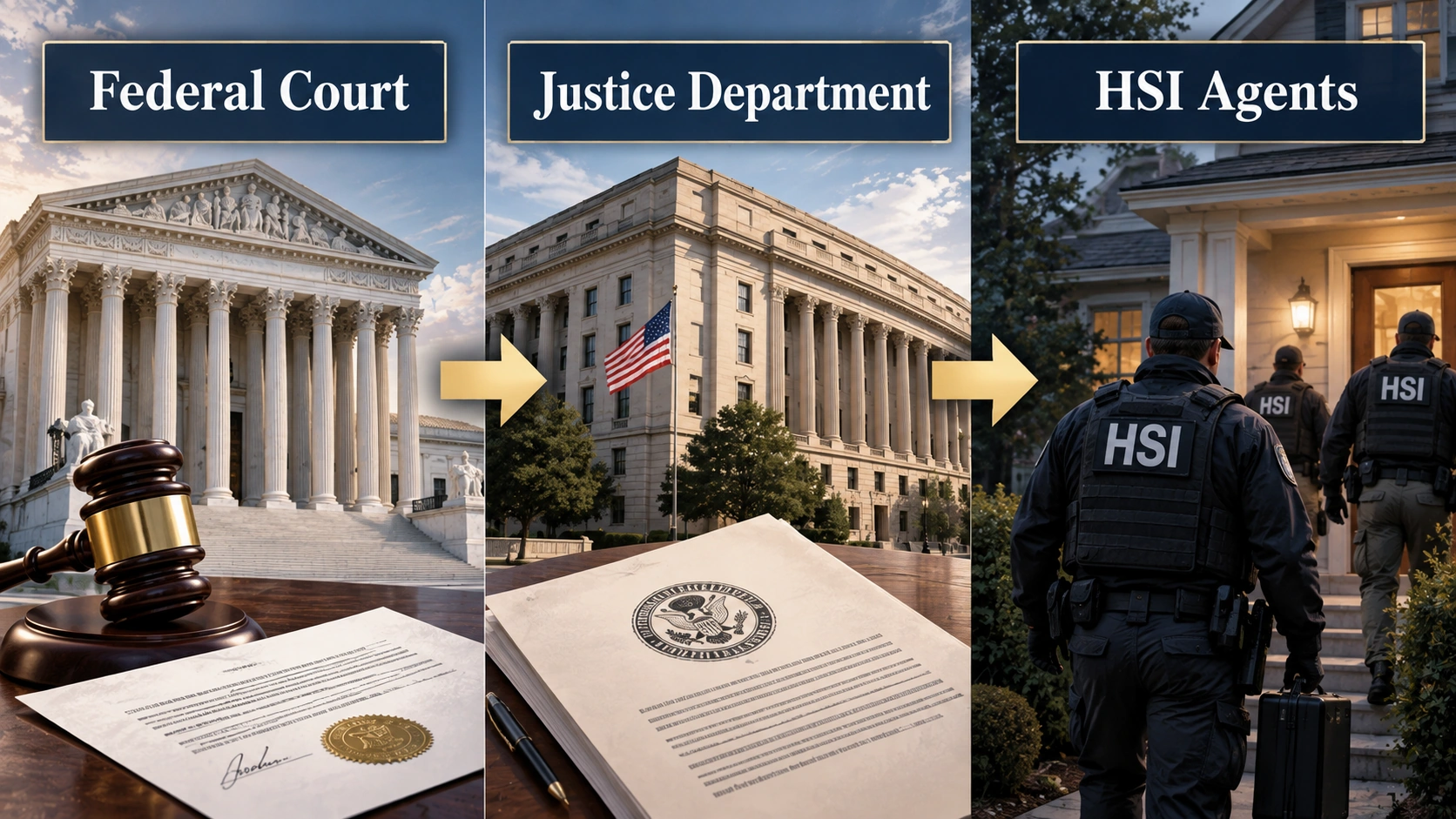
Federal agents with Homeland Security Investigations, or HSI, searched Omar’s Washington residence on Monday morning, October 12. The Justice Department confirmed that it had secured a warrant authorized by a court as part of an ongoing federal criminal investigation. (CBS News · NPR)
That establishes that a criminal investigation exists and that a judge authorized a search. It does not publicly establish the precise offense being investigated, the evidence agents expected to find, or whether Omar will face charges.
Why was Homeland Security involved instead of the FBI?
The Department of Homeland Security does more than operate immigration enforcement at the border.
HSI is the criminal investigative arm of U.S. Immigration and Customs Enforcement, commonly known as ICE. It investigates immigration-document offenses as well as financial crimes, trafficking, smuggling, cybercrime, and other federal violations. (ICE)
ICE’s Enforcement and Removal Operations division, which handles many immigration arrests and removals, is distinct from HSI.
So when news reports say immigration agents searched Omar’s home, that should not automatically be interpreted as a deportation operation. In this case, the publicly confirmed action was the execution of a federal criminal search warrant.
The Justice Department’s role also matters. Prosecutors and investigators may seek judicial authorization, but a judge must approve a search warrant based on the applicable legal requirements. That is a safeguard against searches conducted solely at the government’s discretion.
What Is the Immigration Investigation Reportedly About?
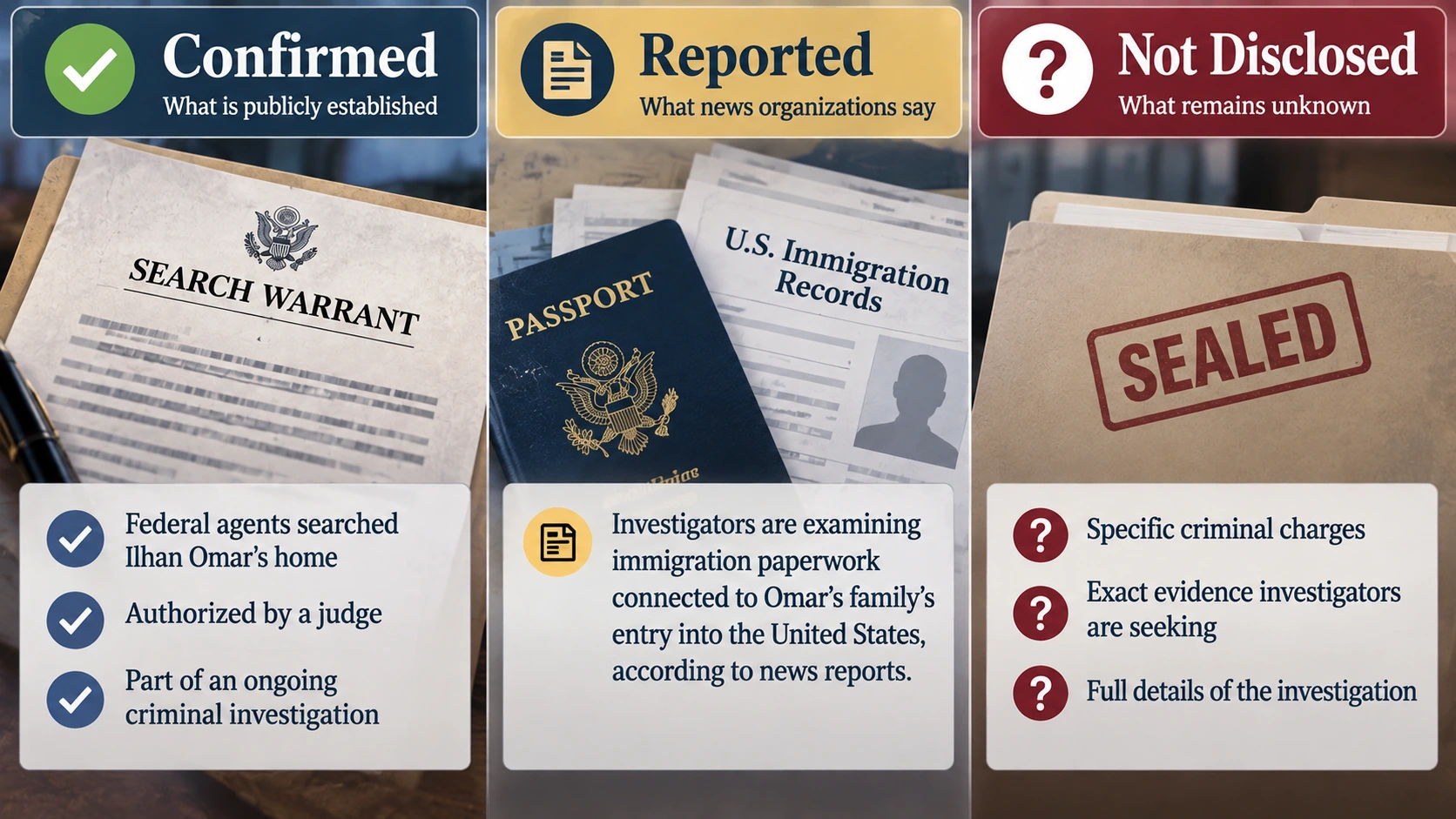
News organizations report that investigators are examining immigration paperwork connected to Omar’s family’s entry into the United States. However, the Justice Department has not publicly disclosed a detailed allegation or announced criminal charges against Omar in connection with the search.
CBS News, citing sources familiar with the investigation, reported that the documents under scrutiny date to Omar’s childhood and involve paperwork completed by her late father. (CBS News)
Omar was born in Somalia, immigrated to the United States as a child, and became a U.S. citizen in 2000. She was first elected to Congress in 2018. (AP)
For years, Republican figures have raised allegations about her immigration history, including disputed claims involving her family relationships and past marriage. Omar has consistently denied committing immigration fraud.
The existence of those allegations does not establish their truth.
What is confirmed, and what remains unproven?
| Question | Current public record |
|---|---|
| Did federal agents search Omar’s home? | Yes. Confirmed by the Justice Department and multiple news organizations. |
| Was the search authorized by a judge? | Yes, according to the Justice Department. |
| Does a federal criminal investigation exist? | Yes. |
| Does the investigation reportedly involve immigration records? | Yes, according to news organizations citing sources. |
| Has the DOJ publicly detailed a specific criminal charge? | No criminal charge was announced in the reviewed reports. |
| Has Omar been convicted of immigration fraud in this investigation? | No. A search warrant is not a conviction. |
| Was political retaliation the reason for the search? | Omar alleges political intimidation; that motivation has not been independently established. |
A report about what investigators are examining is not the same as publicly disclosed evidence proving that an offense occurred. Nor does a longstanding political accusation necessarily explain why a judge authorized a particular warrant.
The warrant application and supporting affidavit, if disclosed, could eventually provide a clearer picture of the government’s legal and factual basis.
Does a Search Warrant Mean Investigators Have Proven a Crime?
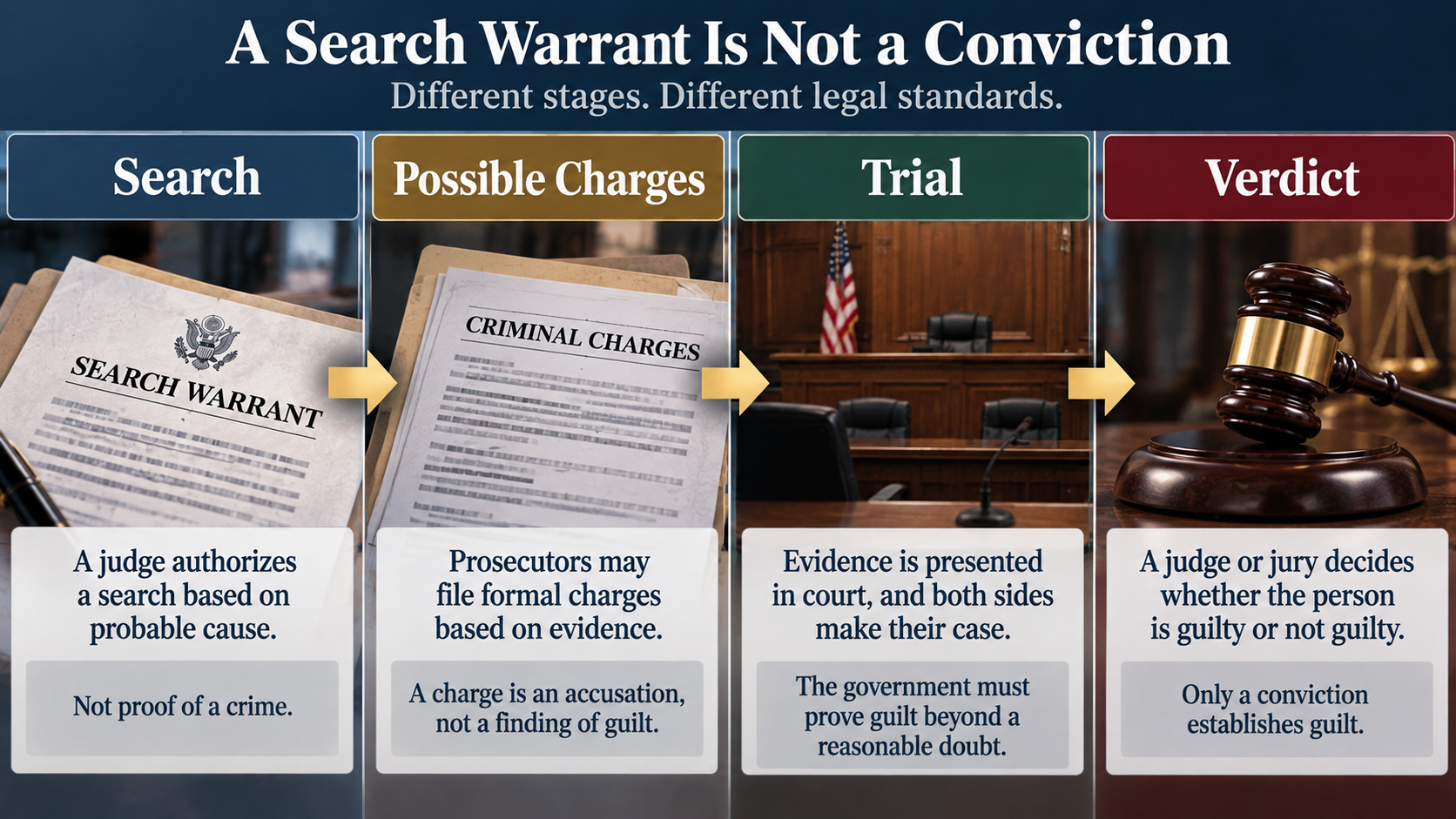
No. A search warrant means a judge found sufficient legal grounds to authorize a search of a particular location or property. It does not mean investigators proved that an identified person committed a crime.
Under the Fourth Amendment, warrants are generally based on probable cause. In the search-warrant context, that involves a sufficient factual basis to believe evidence or items connected to a crime may be found in the place being searched.
It is different from proving guilt beyond a reasonable doubt, the standard used for criminal convictions. The Justice Department’s own prosecution guidance distinguishes the existence of probable cause from the separate decision to bring criminal charges. (DOJ Justice Manual)
Consider a hypothetical situation: Investigators believe documents relevant to a suspected financial crime are stored in someone’s house. A judge may authorize a search for those documents.
But several outcomes are possible. The documents may support a charge, contradict the original suspicion, implicate another person, or provide little useful information. The search itself does not settle which result is correct.
The four legal stages people often confuse
| Legal stage | What it means | What it does not mean |
|---|---|---|
| Investigation | Authorities examine possible criminal conduct. | A crime has been proven. |
| Search warrant | A judge authorizes a specific search based on probable cause. | The person searched is guilty. |
| Criminal charges | Prosecutors formally accuse someone of an offense. | The accusation has been proven. |
| Conviction | Guilt is established through a guilty plea or court verdict. | Every investigative allegation was necessarily true. |
A criminal case does not have to move through every one of these stages. Investigators can search a location and decide not to charge anyone. Charges can also be dismissed or result in an acquittal.
For Omar, the publicly reported search is an investigative development, not a criminal judgment.
Can Federal Agents Legally Search a Sitting Member of Congress?

Yes. Members of Congress can be investigated, searched, and prosecuted for crimes. Their elected positions do not provide general immunity from federal criminal law.
However, the Constitution gives lawmakers special protection for legitimate legislative activities.
Article I’s Speech or Debate Clause protects legislative work from certain forms of executive and judicial interference. Depending on the circumstances, committee work, legislative deliberations, and associated records can be protected.
The Congressional Research Service explains that these safeguards exist to preserve the independence of Congress, not to shield lawmakers from accountability for unrelated criminal conduct. (Congressional Research Service)
Why does the location of a search matter?
A member’s private home is not automatically beyond the reach of a search warrant. But if investigators encounter documents protected by the Speech or Debate Clause, constitutional questions can arise over how those materials are reviewed or disclosed.
An important example came from the federal investigation of former Rep. William Jefferson. In 2006, FBI agents searched his congressional office. A federal appeals court later found that the procedures used to examine legislative materials violated constitutional protections. The court did not establish that lawmakers’ offices are categorically immune from search warrants. (DOJ — Rayburn House Office Building Case)
That distinction also matters here. Omar’s home was searched, not a congressional office, according to the reporting. The constitutional protection of legislative materials cannot be reduced to a simple rule based only on where documents are located.
Whether agents encountered protected legislative materials, and whether special procedures were used, has not been established by the publicly disclosed information reviewed for this article.
Are there additional safeguards for investigating members of Congress?
Yes. The Justice Department’s Justice Manual specifically addresses investigations involving lawmakers.
Section 9-85.110 requires consultation with the department’s Public Integrity Section in investigations involving a member of Congress or congressional staff. It also sets approval requirements before certain warrants involving a lawmaker’s records or property, or places where legislative materials are likely to be found. (DOJ Justice Manual)
These are additional departmental safeguards beyond the requirement that a court authorize a search. The public record surrounding Omar’s search does not establish which internal consultations or approvals occurred. Nor does it demonstrate that the required procedures were bypassed.
A fair assessment requires distinguishing what the written rules require from what the government has publicly revealed about compliance with them.
Why Does the Midterm Election Make This Search So Controversial?
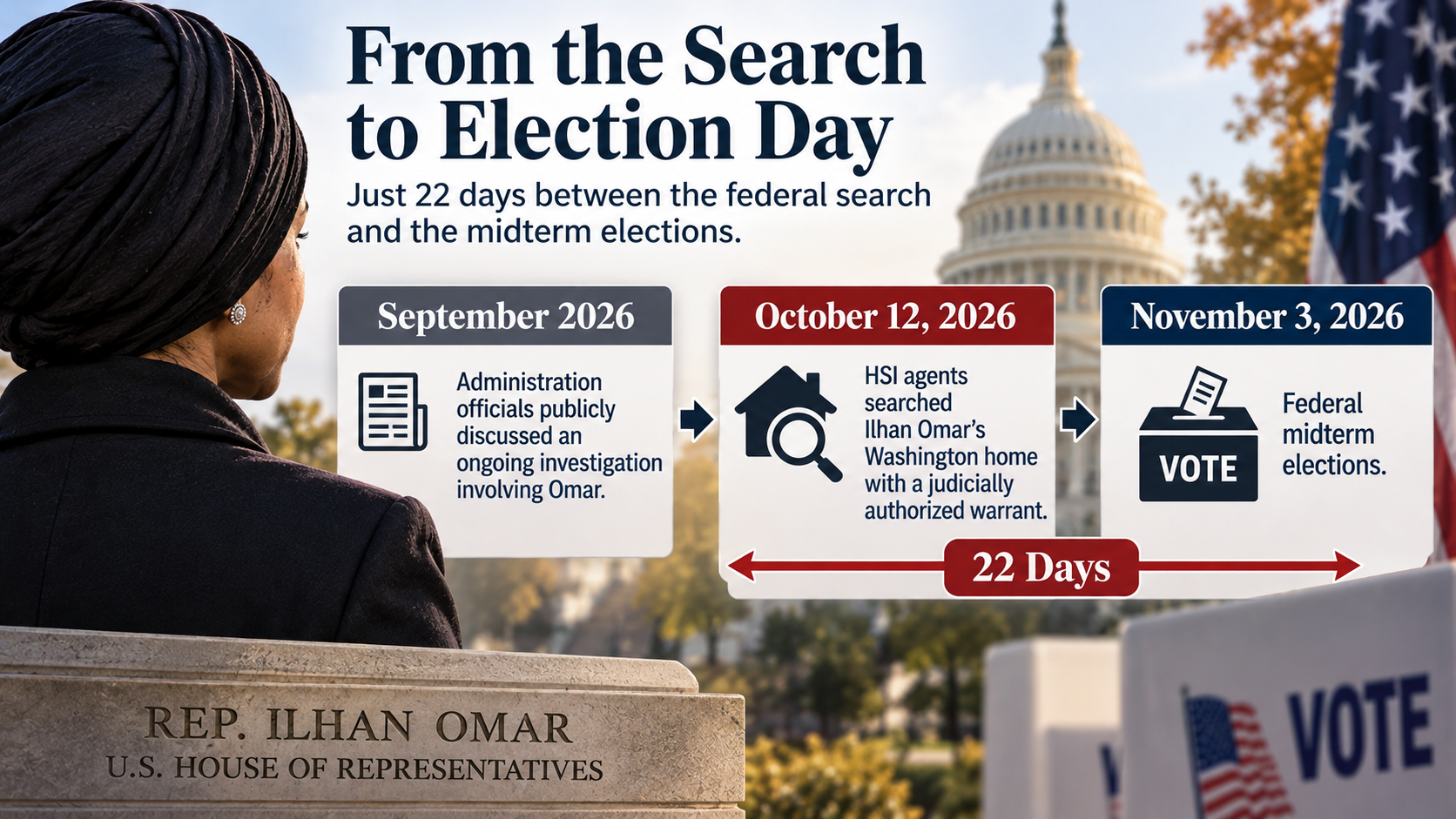
The timing is controversial because the search occurred just 22 days before the November 3, 2026, midterm elections, when Omar is seeking another term in Congress. A law enforcement action involving a candidate can influence public perceptions even if no criminal charges are eventually filed.
Omar represents Minnesota’s 5th Congressional District, which includes Minneapolis. She has become nationally known as a progressive Democrat and an outspoken critic of President Donald Trump.
The timeline behind the controversy
| Date | Development |
|---|---|
| Before 2026 | Republican figures repeatedly raised disputed allegations about Omar’s immigration history. |
| September 2026 | Administration officials publicly discussed an ongoing investigation involving Omar. |
| October 12, 2026 | HSI agents searched Omar’s Washington home using a judicially authorized warrant. |
| November 3, 2026 | The scheduled federal midterm elections take place. |
Sources: (AP · CBS News · Federal Election Commission)
House Democratic leader Hakeem Jeffries and other Democrats criticized the search and raised concerns about the use of federal investigative power against political opponents. Omar called it part of a campaign of intimidation and denied wrongdoing. (Reuters)
Those concerns are politically significant, but they remain allegations about the government’s motivations. A search near Election Day does not automatically demonstrate election interference.
An investigation can have a legitimate evidentiary reason for proceeding urgently. Conversely, a search warrant’s judicial authorization does not, by itself, establish that every decision about timing and publicity was free of political considerations.
The difficult question is whether the timing was driven by legitimate investigative needs or an improper effort to influence an election. The publicly available evidence does not yet settle that issue.
Does the Justice Department Have a Rule Against Investigations Before Elections?
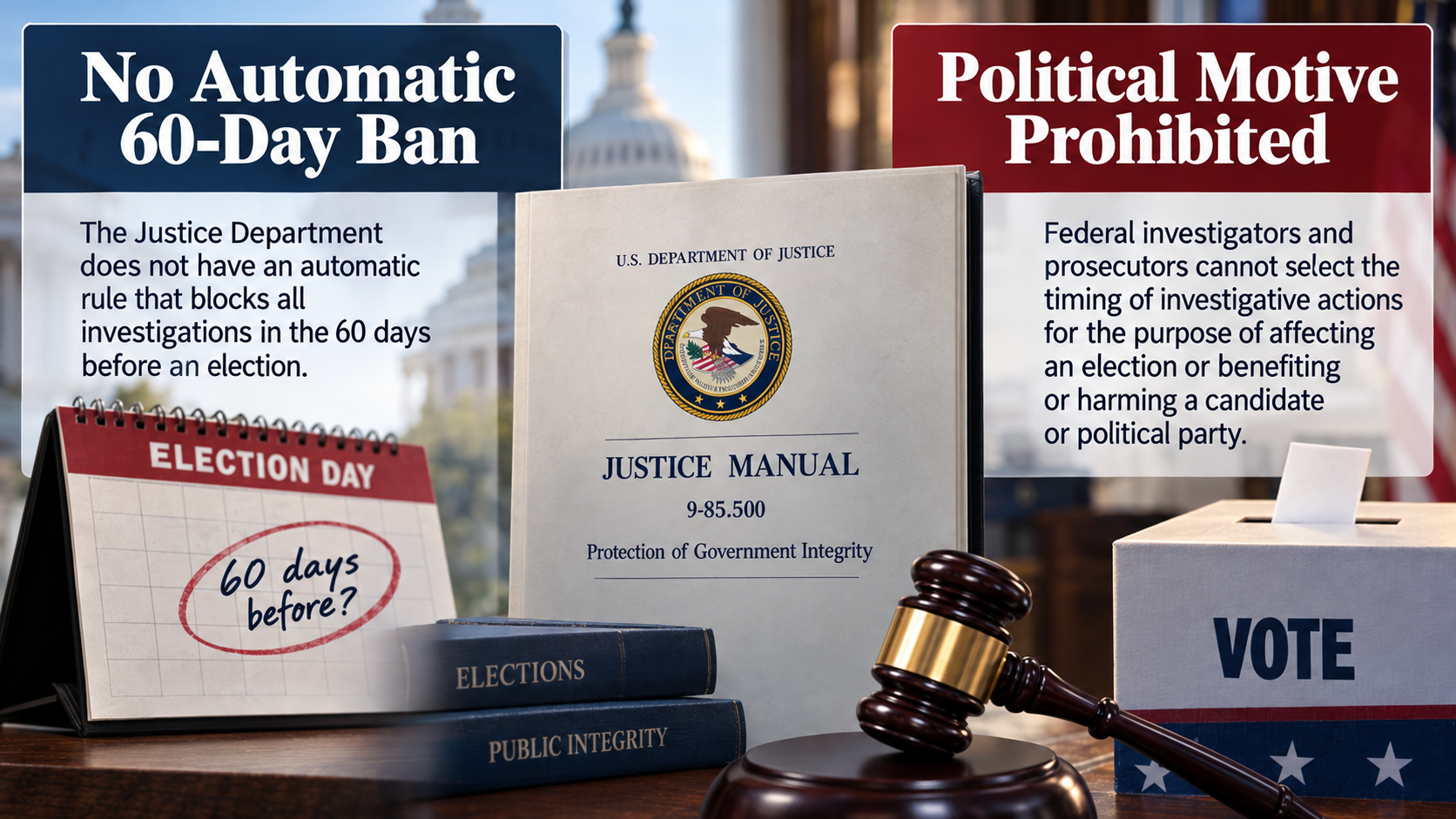
The Justice Department has rules designed to prevent investigators and prosecutors from using their authority to influence elections. But there is no universal law that automatically prohibits every federal search or criminal investigation during the final 60 days of a campaign.
The phrase “60-day rule” is sometimes treated as an absolute legal blackout. The department’s written policies are more nuanced.
What does the written DOJ policy actually say?
Section 9-85.500 of the Justice Manual prohibits federal prosecutors and agents from selecting the timing of investigative steps, charges, or public statements for the purpose of affecting an election or benefiting or harming a candidate or political party.
It requires consultation with the Public Integrity Section for actions likely to create an issue or perception of improper electoral influence, and further consultation may be required. (DOJ — Protection of Government Integrity)
That is a rule about the purpose and handling of government action, not an automatic ban triggered by a particular date.
A separate Justice Department inspector general report examining investigations during the 2016 election described a general principle against interfering in elections, rather than a single fixed 60- or 90-day prohibition applicable to all cases. (DOJ Office of Inspector General)
Why is this distinction important?
Imagine two hypothetical situations.
In the first, investigators have a legitimate reason to act quickly because they believe important evidence could disappear. The proximity of an election does not necessarily mean the action must be postponed.
In the second, officials deliberately schedule an otherwise unnecessary search to damage a candidate politically. That would raise serious problems under departmental rules even if a judge had authorized the search.
The critical issue is not simply how many days remain before an election. It is whether investigators followed the law and applicable safeguards, and whether timing was chosen for a legitimate investigative reason rather than political advantage.
For Omar’s case, the public would need considerably more information to determine whether those standards were met.
What Are Omar and Federal Officials Actually Disputing?
Omar says the search was politically motivated and that she has done nothing wrong. The Justice Department has confirmed the investigation and warrant but has not publicly provided the detailed evidence or legal theory behind the search.
Those are different kinds of statements. Omar is disputing the legitimacy and motivation of the action. The Justice Department’s public confirmation addresses the existence and judicial authorization of the investigative step, without resolving the wider dispute.
| Party | Public position or reported action |
|---|---|
| Justice Department | Confirms a judicially authorized search connected to an ongoing criminal investigation, without detailing its scope. |
| Ilhan Omar | Denies wrongdoing and characterizes the search as political intimidation. |
| Democratic congressional leaders | Raise concerns about potential abuse of federal investigative power and timing near an election. |
| Trump administration figures | Have previously promoted scrutiny of Omar’s immigration history and discussed an investigation. |
The government does not have to make every detail of an ongoing criminal investigation public immediately. Premature disclosure can affect witnesses, evidence, investigative strategy, and the rights of individuals involved.
But secrecy can create a different problem when the person being investigated is a prominent political opponent of the administration. The public may see an aggressive law enforcement action without knowing the facts a judge reviewed when authorizing it.
That is why two principles must operate together: investigators need the ability to pursue legitimate criminal inquiries, and citizens need confidence that the government is not using that power to punish political opposition.
Neither principle requires assuming Omar is guilty or assuming investigators acted improperly.
Could the Search Affect Omar’s Reelection or Her Seat in Congress?
The search could influence political debate, but it does not automatically prevent Omar from running, remove her from Congress, or establish a legal disqualification.
The November 3 elections will determine all 435 House seats and roughly one-third of Senate seats. Every House member faces an election every two years. (USAGov)
For Omar, the immediate political risk is separate from the criminal process. Voters may form opinions about an investigation before any judge or jury resolves its substance.
That is one reason election-related law enforcement policies emphasize avoiding the improper use of investigative authority for political advantage.
Even if prosecutors later file charges, criminal accusations alone do not automatically remove a sitting representative from office. The Constitution establishes qualifications for House membership, while Congress has its own disciplinary powers. A search warrant is not equivalent to any of those processes.
There is another distinction. Naturalized U.S. citizens can serve in the House of Representatives if they meet the Constitution’s age, residency, and citizenship-duration requirements. Becoming a citizen through naturalization does not itself make someone less eligible than a U.S.-born citizen for the House.
Any possible criminal or immigration-related proceeding would involve separate legal questions and procedures, not an automatic consequence of the October 12 search.
What Happens Next in the Ilhan Omar Investigation?
The next significant development could be an official disclosure about the investigation, a court proceeding involving the search, or a formal charging decision. At present, the public record leaves several questions unanswered.
Will the warrant become public?
Possibly, but not necessarily immediately.
Search-warrant materials can contain affidavits describing the government’s evidence and the items investigators sought. Some records may remain sealed to protect an ongoing investigation.
If relevant documents become public, they could clarify what investigators were looking for and why they believed the search was justified. A court filing could also reveal whether Omar or another affected party is challenging the legality or execution of the search.
Will Omar be charged?
That has not been established. Investigators may continue reviewing evidence, seek additional records, refer findings to prosecutors, or close an investigation without filing charges.
If charges are brought, the government would have to identify specific offenses and support its allegations through the criminal justice process. Omar would retain the legal rights available to defendants, including the presumption of innocence.
What should readers watch most closely?
- Whether prosecutors identify a particular alleged offense and publish supporting court documents.
- Whether evidence emerges connecting Omar personally to any alleged wrongdoing.
- Whether the search or handling of materials becomes the subject of a legal challenge.
- Whether the Justice Department provides additional information about compliance with congressional and election-sensitive safeguards.
- Whether the investigation advances to formal charges or ends without prosecution.
Until then, the most accurate description remains an ongoing federal investigation accompanied by a political dispute over its timing and purpose.
Bottom Line: What This Story Really Means
Federal agents searched Rep. Ilhan Omar’s Washington home on October 12, 2026, with a warrant authorized by a judge.
The Justice Department confirmed the action but did not publicly explain its full basis. News reports connected the investigation to immigration paperwork, while Omar denied wrongdoing and accused the administration of political intimidation.
The search is real. The reported allegations have not been established as proven facts. And the accusation of political retaliation has not been independently established either.
What makes this case especially important is its timing. The search occurred 22 days before a federal election in which Omar is a candidate.
Justice Department policy prohibits selecting the timing of investigative actions to affect elections, and investigations involving members of Congress are subject to additional safeguards. But proximity to an election does not automatically invalidate a court-authorized search.
Did investigators have a legitimate evidentiary basis for the search? Were applicable safeguards followed? Was the timing chosen for investigative reasons rather than political advantage?
Answers may come from future court filings or official disclosures. For now, a search warrant, a criminal accusation, and a finding of guilt are different things—and none should be confused with proof of political motivation.
Ilhan Omar Home Search: Key Questions Explained
Q. Why did federal agents search Ilhan Omar’s home?
Federal agents searched Omar’s Washington home on October 12, 2026, under a judicially authorized warrant as part of an ongoing criminal investigation. News organizations reported an inquiry into immigration paperwork, but the Justice Department did not publicly disclose its full basis.
Q. What is Ilhan Omar accused of?
Republican figures have previously raised disputed allegations about Omar’s immigration history. News reports say investigators are examining immigration records, but the precise scope of any criminal allegation has not been publicly detailed in the reviewed official statements. Omar denies wrongdoing.
Q. Was Ilhan Omar arrested or charged?
The publicly reported October 12 action was a home search. The reviewed reports did not establish that Omar had been arrested or formally charged in connection with it.
Q. Does a federal search warrant mean someone is guilty?
No. A search warrant authorizes a search based on probable cause. It does not constitute a criminal charge or a determination of guilt.
Q. Can Homeland Security investigate a member of Congress?
Yes. Federal lawmakers are subject to criminal investigation and prosecution. However, constitutional protections for legislative activities and additional Justice Department procedures can apply.
Q. What is Homeland Security Investigations?
Homeland Security Investigations, or HSI, is ICE’s criminal investigative arm. It investigates immigration-document offenses, trafficking, financial crimes, and numerous other federal violations.
Q. Why is the date of Omar’s home search controversial?
The search took place October 12, just 22 days before the November 3, 2026, midterm elections. Democrats questioned whether the timing reflected political intimidation, an allegation that requires evidence beyond timing alone.
Q. Is the Justice Department prohibited from investigating candidates within 60 days of an election?
No. There is no automatic, universal 60-day legal prohibition. Justice Department policy instead forbids choosing investigative timing to influence an election and requires consultation in sensitive circumstances.
Q. Could the investigation prevent Ilhan Omar from serving in Congress?
A home search does not automatically remove a representative from office or disqualify a candidate. Criminal proceedings, congressional discipline, and constitutional qualifications are separate legal matters.
Q. What could happen next?
Investigators could review additional evidence, seek more information, or refer the matter for a charging decision. Court filings or official disclosures could clarify the scope and basis of the investigation. No particular outcome should be assumed.
Did this help make the story clearer? 🙂 WIN keeps unpacking the “why” behind the news—clearly and simply!
Sources
Federal Search and Public Statements
Associated Press — Agents Search Rep. Omar’s Washington Home in Criminal Investigation
Reuters — U.S. Immigration Authorities Raid Democratic Congresswoman Ilhan Omar’s Home
CBS News — Rep. Ilhan Omar’s D.C. Home Searched by Homeland Security Investigators
NPR — Federal Agents Search Rep. Ilhan Omar’s D.C. Home
Legal Standards and Congressional Protections
U.S. Department of Justice — Principles of Federal Prosecution
U.S. Department of Justice — Protection of Government Integrity
Congressional Research Service — Understanding the Speech or Debate Clause
U.S. Department of Justice — Rayburn House Office Building Case
Election Timing and Federal Election Procedures
DOJ Office of Inspector General — Review of FBI and DOJ Actions in Advance of the 2016 Election
Federal Election Commission — Election Dates and Voting Information
USAGov — Congressional Elections and Midterm Elections
Keep Reading
How Can Citizenship-Verification Records Affect an Election?
Omar’s case involves reported scrutiny of immigration records, not a challenge to a voter database. But a separate dispute over the federal SAVE system shows why citizenship records, data accuracy, and the rights of naturalized Americans can become especially contentious during election season.
What Is the SAVE Voter Database—and What Did the Supreme Court Actually Allow?