Could Trump Move White House Reporters Out—and Who Controls Press Access?

Can a president simply tell the reporters who cover him every day to pack up and work somewhere else?
That question suddenly feels less hypothetical after President Donald Trump said he might relocate journalists who work at the White House.
But the detail that made the story particularly strange was a swimming pool.
For days, reports had circulated that Trump was interested in replacing the familiar White House press briefing room with an indoor pool. On October 24, 2026, he publicly rejected that idea while leaving open the possibility of moving the reporters themselves. (Reuters)
So the pool proposal and the press relocation are not the same thing. Trump denied the first without ruling out the second.
※ Images in this article are AI-generated illustrations created to help explain the story. They are not actual photographs, and depictions of people, places, or events may differ slightly from reality.
There is also a distinction that is easy to miss: Moving the press briefing room is not necessarily the same as banning journalists from the White House.
The administration has considerable authority over how White House facilities operate. But the Constitution also limits the government’s ability to discriminate against journalists because of what they publish.
And because Trump has already fought several battles over journalists’ access to his administration, even a seemingly straightforward change of workspace carries implications well beyond office furniture.
What Did Trump Actually Say About Moving White House Reporters?
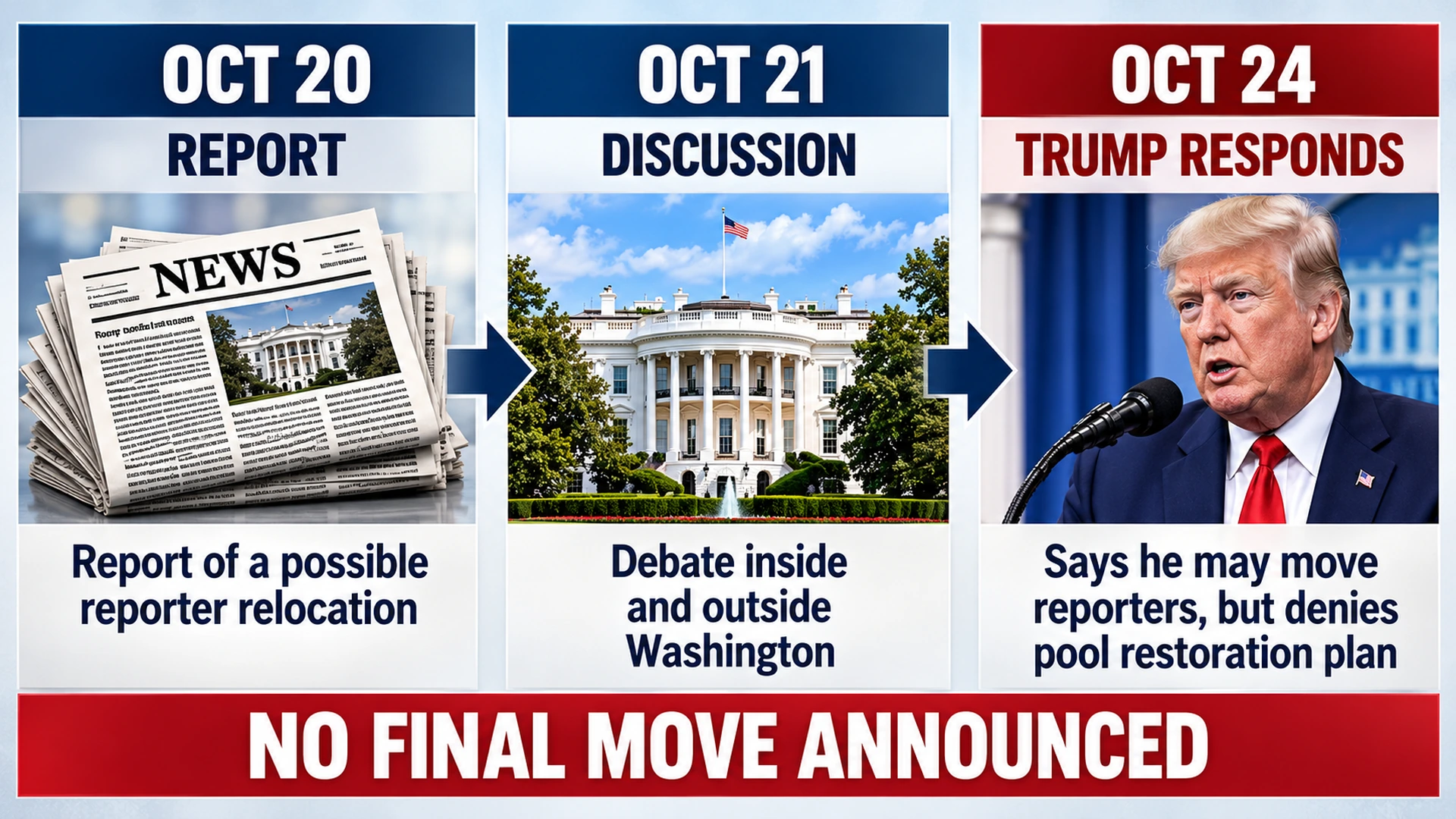
On October 24, Trump acknowledged that he might move journalists to another location. He did not announce an order, specify a destination, or provide an implementation date.
His statement appeared on Truth Social in response to reporting about the James S. Brady Press Briefing Room.
Trump denied wanting to restore the old indoor pool and wrote:
“I may move the Fake News to a less obnoxious location.”
The statement was important because it was a direct public acknowledgment from the president that relocation remained a possibility. (Mediaite · Reuters)
How did the story develop?
| Date | Development | What it established |
|---|---|---|
| October 20 | The New York Times reported discussions about moving reporters and restoring an indoor pool. | A proposal had reportedly been discussed. |
| October 21 | CBS News reported that Trump had considered moving the press corps to another building. | People familiar with the discussions said no final decision had been made. |
| October 24 | Trump rejected the pool-restoration story but said he might move journalists. | Relocation remained possible, not confirmed. |
The October 20 reporting described discussions that reportedly occurred months earlier, including an August conversation involving then-press secretary Karoline Leavitt. CBS subsequently reported that people close to Trump had discussed possible relocation, including suggestions from allies outside the administration. (CBS News)
In response to the earlier reporting, White House communications director Steven Cheung defended the administration’s criticism of the media and said the White House had not ruled out its options.
That response was not an implementation announcement.
As of October 24, the confirmed development was Trump’s statement—not an actual relocation.
Which raises an unusual question: Why was a presidential swimming pool involved in the first place?
Why Is a Swimming Pool Beneath the White House Press Briefing Room?
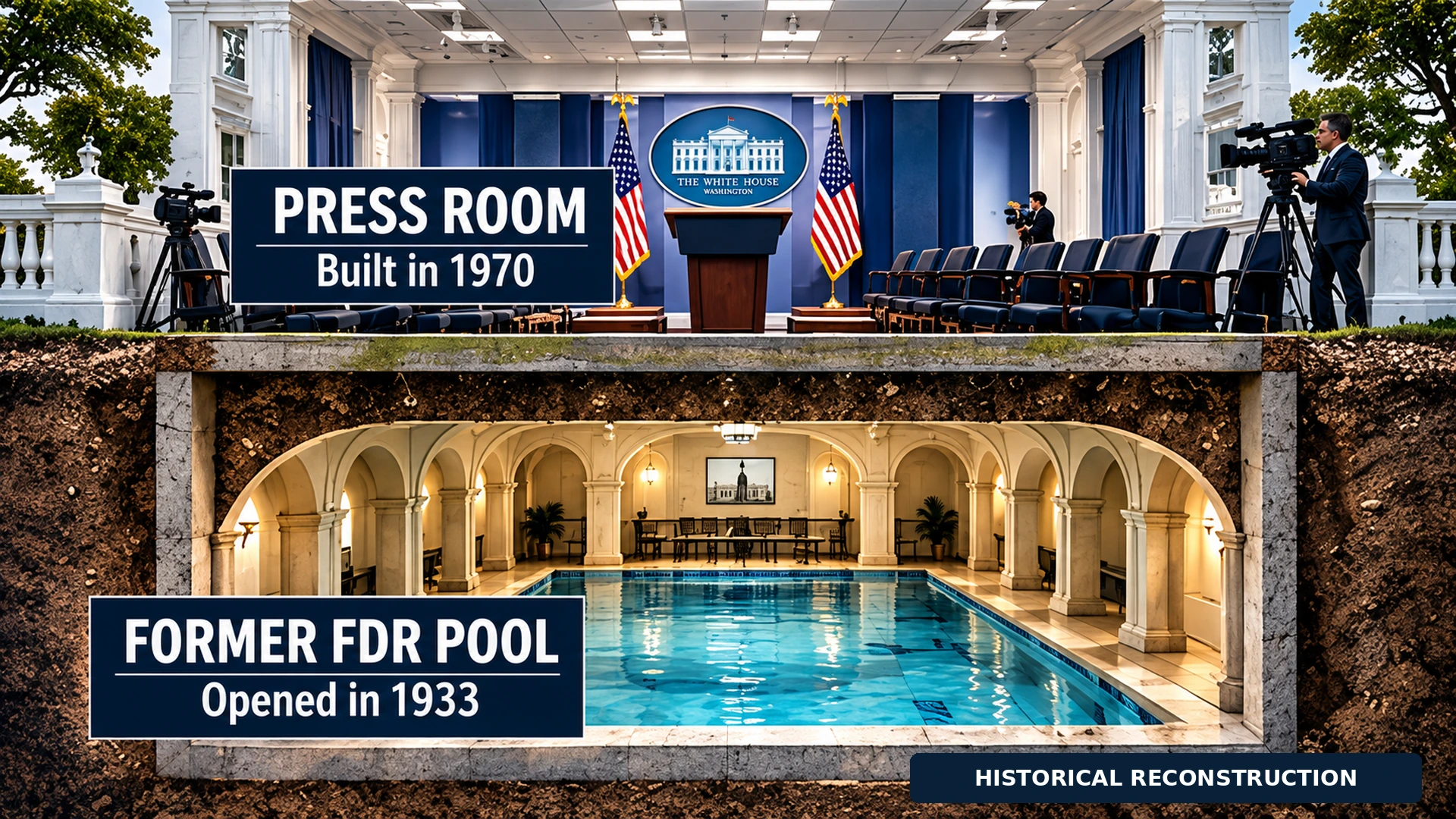
There really is a former swimming pool beneath the White House press briefing room. It was built in 1933 for President Franklin D. Roosevelt, who used swimming as therapy for the effects of polio.
This is not a story invented for the current political controversy.
The pool opened in June 1933 after a fundraising campaign organized by the New York Daily News. It occupied space near the West Wing and served several presidents after Roosevelt.
By the late 1960s, however, television news had changed the relationship between presidents and reporters.
The growing White House press corps needed a permanent space equipped for increasingly frequent briefings and broadcast coverage.
President Richard Nixon arranged for a press briefing room to be constructed over the pool in 1970. The pool was covered rather than completely destroyed, leaving the original structure underneath. (White House Historical Association)
A room with two different histories
| Period | Primary use |
|---|---|
| 1933–1969 | Indoor presidential swimming pool |
| 1970 onward | Press briefing room built above the former pool |
| 2000 | Briefing room named in honor of James S. Brady |
| October 2026 | Renewed controversy over whether reporters might be moved elsewhere |
James Brady served as White House press secretary under Ronald Reagan. He was seriously wounded in the 1981 assassination attempt against Reagan, and the room was subsequently named in his honor. (George W. Bush White House Archives)
The site therefore connects three different eras of the presidency: Roosevelt’s personal health needs, Nixon’s accommodation of television journalism, and today’s disputes over media access.
But Trump has expressly denied planning to restore the swimming pool.
The historical location helps explain why the rumor attracted attention. It does not establish that the room is about to be converted back into a pool.
And the president could consider moving reporters without making any changes to the old swimming pool.
Who Actually Controls the White House Press Room and Reporters’ Access?
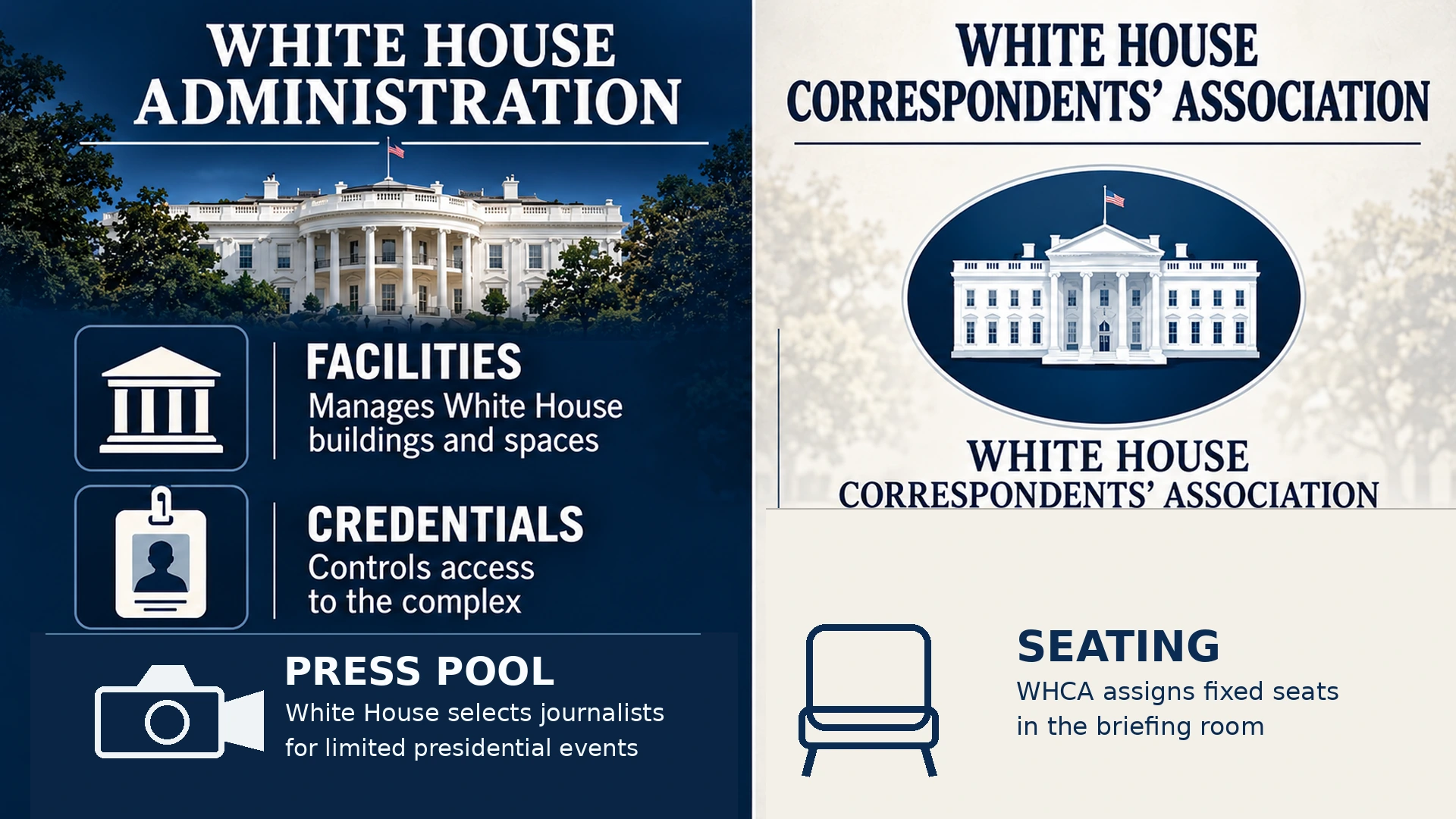
There is no single organization that independently controls every aspect of White House journalism.
The administration manages government facilities and access, while the White House Correspondents’ Association has traditionally organized important parts of the journalists’ working arrangements.
The distinction becomes clearer when the responsibilities are separated.
| Responsibility | Who plays the principal role? |
|---|---|
| White House facilities | White House administration |
| Regular press credentials | White House Press Office, with Secret Service security screening |
| Assigned briefing room seats | White House Correspondents’ Association |
| Selection of reporters for limited presidential events | White House, under its revised press pool arrangements |
The White House Correspondents’ Association, commonly called the WHCA, represents journalists who regularly cover the presidency.
Its responsibilities have included assigning seats in the James S. Brady Press Briefing Room, advocating for access, and coordinating aspects of the press corps’ working arrangements.
The briefing room has 49 fixed seats, although substantially more journalists cover the White House than can sit there. A reporter does not necessarily need an assigned seat to attend a briefing. (WHCA)
The White House Press Office, meanwhile, issues press credentials, and the Secret Service conducts security screening.
A credential allowing regular access to the White House complex is not the same thing as an unrestricted right to enter the Oval Office, board Air Force One, or personally question the president whenever a reporter chooses.
What is a White House press pool?
A press pool is a smaller group of journalists selected to cover events where space is limited.
For example, if the president meets a foreign leader inside the Oval Office, not every White House reporter can enter. A limited group attends and shares reporting, photographs, video, and other material with the broader press corps.
This process matters because smaller news organizations may depend on that shared reporting even when they do not have representatives physically present.
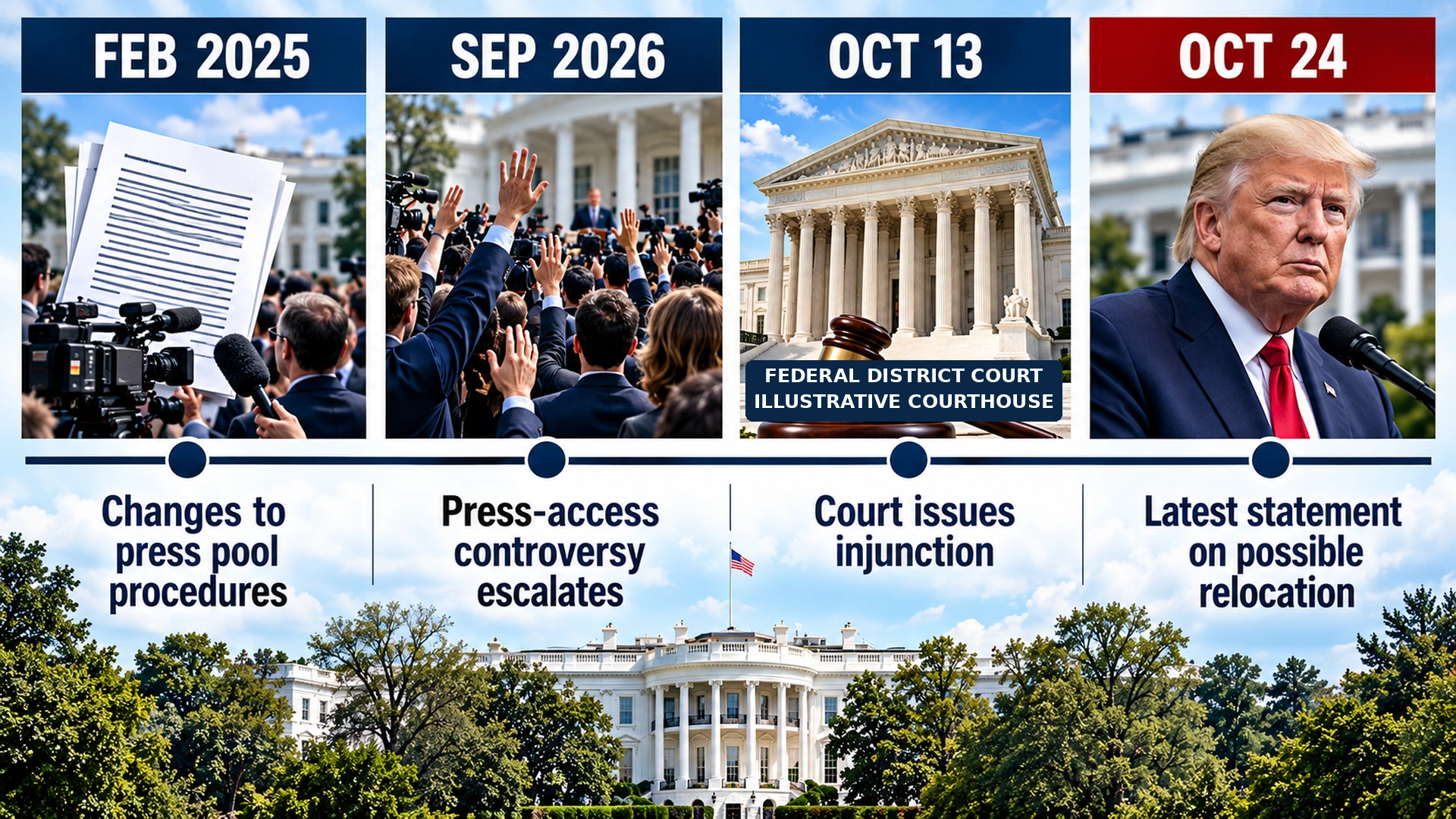
In February 2025, the Trump administration announced that the White House would take control of selecting participating news organizations for presidential press pools, replacing a long-standing system coordinated by the WHCA. The administration said its approach would allow a wider range of media outlets to participate. The WHCA argued that giving the government control over which journalists cover the president threatened independent reporting. (Reuters · WHCA)
This is an important distinction in the current controversy.
Who receives a permanent seat, who gets a White House credential, who joins a presidential press pool, and where journalists physically work are related questions—but they are not interchangeable.
Can Trump Legally Relocate White House Reporters?
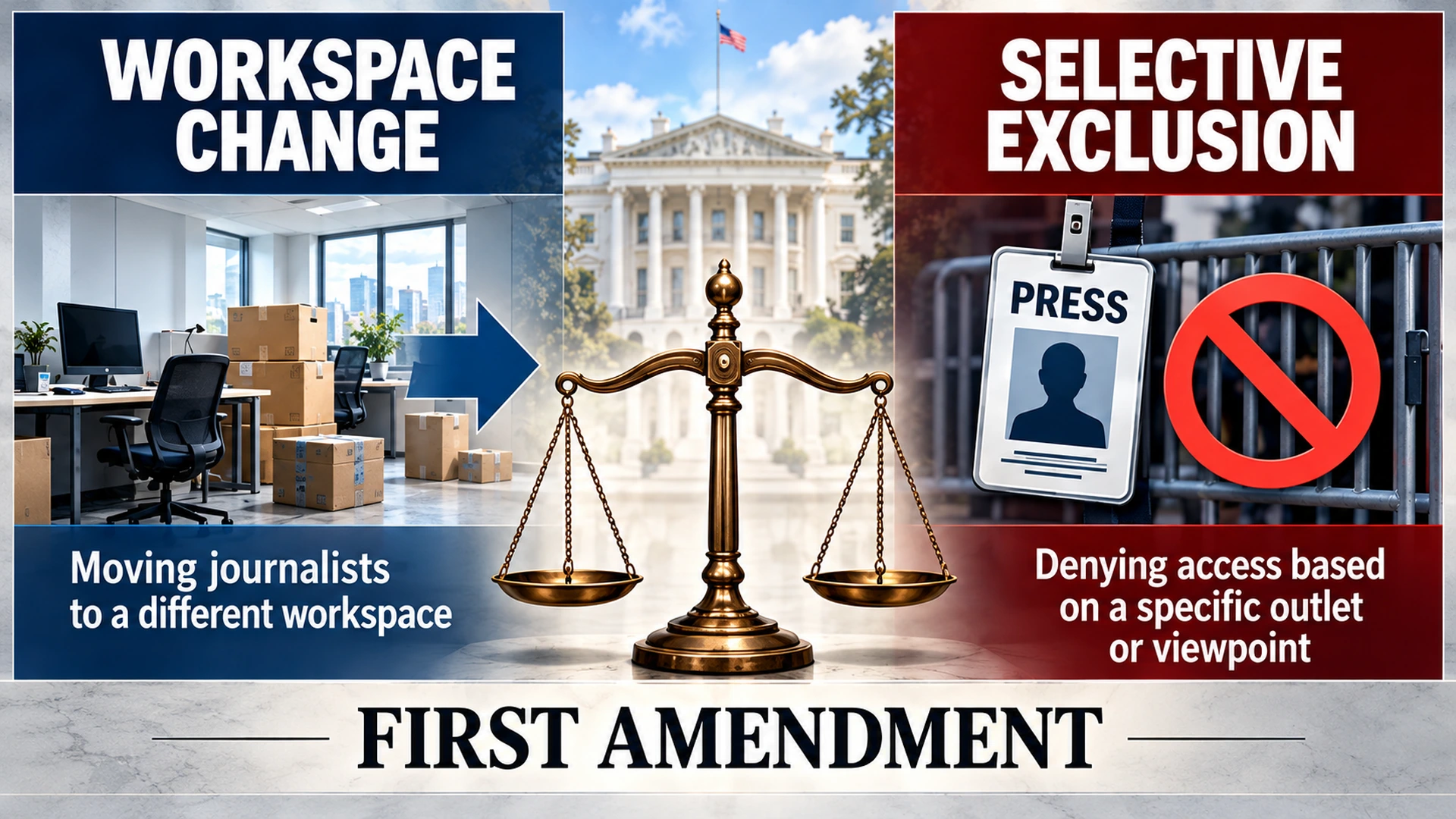
A president generally has significant administrative discretion over how the White House operates, including how its working spaces are organized.
That means relocating a briefing room is not automatically unconstitutional.
But the government’s authority over its facilities does not give it unlimited power to punish journalists for unfavorable reporting.
The First Amendment protects freedom of the press. The Fifth Amendment also provides due process protections relevant to certain government decisions affecting access.
The legal distinction is easier to understand through three scenarios.
| Possible action | Main legal consideration |
|---|---|
| Relocate all reporters to another suitable workspace | Primarily facilities management, with access and other legal questions depending on implementation |
| Revoke an established reporter’s credential | May trigger constitutional requirements concerning justification and due process |
| Exclude reporters because of critical coverage | Raises serious First Amendment concerns about viewpoint-based retaliation |
What have courts said about White House press passes?
One important precedent is Sherrill v. Knight, a 1977 decision by the U.S. Court of Appeals for the D.C. Circuit.
The case involved a journalist who was denied a White House press credential because of a security determination.
The court recognized that denying a bona fide journalist such access implicated constitutional protections. It required procedural safeguards, including notice of the reasons for denial and an opportunity to respond, along with an appropriate written decision. (U.S. Court of Appeals decision)
But Sherrill did not establish that journalists own a particular room or can demand access to every presidential event.
It dealt with press credentials, not a comprehensive relocation of the press corps.
That distinction limits how directly the decision answers the current question.
A policy moving all credentialed reporters to another functioning workspace would present different factual and legal issues from a decision stripping selected outlets of their credentials because officials disliked their journalism.
Courts would examine what actually changed, why the government acted, and whether journalists continued receiving meaningful access.
The legal question is not simply where reporters sit. It is whether a change in location unlawfully restricts independent newsgathering.
Why Are Reporters Worried After Trump’s Earlier Press Restrictions?
The concern is not based solely on the possibility of moving desks.
Trump’s administration has already taken actions restricting which journalists can access certain White House spaces and presidential events, and those decisions have produced constitutional litigation.
One major dispute began in September 2026.
Trump announced restrictions targeting CNN, MS NOW, and Politico, accusing the outlets of unfair and inaccurate coverage. Journalists from the organizations subsequently lost access to the White House grounds.
The organizations challenged the move in federal court, arguing that it constituted retaliation against protected journalism and violated procedural rights.
On September 24, U.S. District Judge Timothy Kelly ordered the administration to temporarily restore access.
Then, on October 13, he issued a preliminary injunction continuing that protection while the lawsuit proceeded. The judge concluded that the news organizations were likely to succeed on important constitutional claims. (Reuters · CBS News)
A preliminary injunction is not a final judgment on every issue in a lawsuit. It preserves legal protection while the court considers the underlying dispute.
The administration has continued to contest the litigation, and questions about access to specific presidential events have remained separate from general access to White House grounds.
Why does that history matter now?
Because a relocation proposal can be understood differently depending on the circumstances.
The administration could argue that it is reorganizing White House facilities and adjusting working arrangements.
Journalists could respond that moving them farther from key officials or reducing their access would make independent coverage more difficult—particularly in the context of previous restrictions.
Neither argument alone establishes whether a future relocation would be lawful.
The real policy would have to be evaluated, including its stated purpose, its practical effects, and whether it applies fairly.
And that leads to another question: Why does physical proximity matter so much when journalists can publish news from almost anywhere?
Why Would Moving White House Reporters Matter to Ordinary Americans?
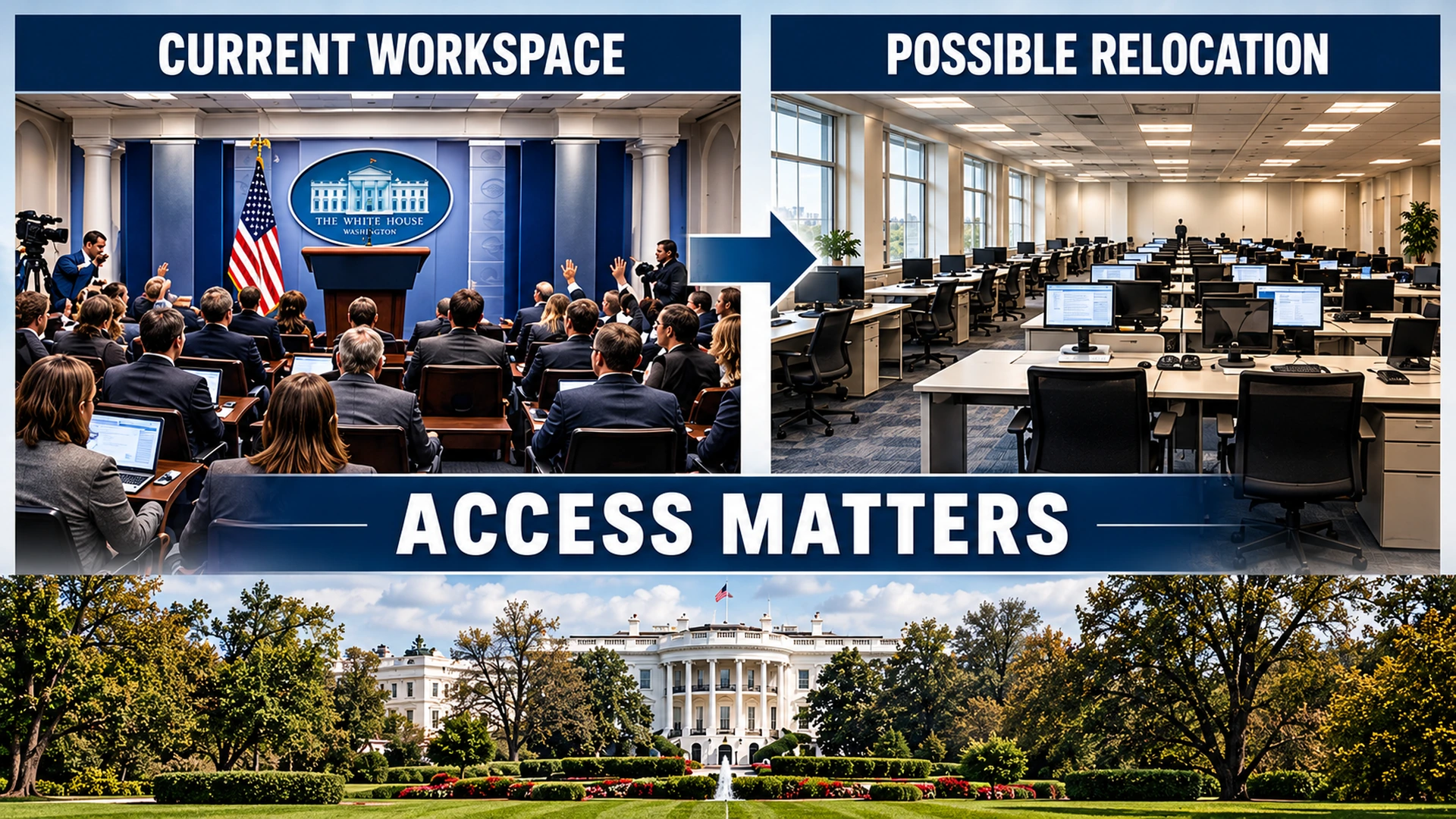
White House reporters do more than attend formal news conferences.
They spend long hours observing presidential activities, questioning officials, speaking with aides, and documenting events as they unfold.
Proximity to the West Wing can make it easier to respond when the president unexpectedly takes questions or an administration official offers new information.
That is one reason journalists have maintained working facilities near the center of White House operations for generations. The White House Historical Association describes the briefing room’s location as an important part of how the presidency and the press have interacted over time. (White House Historical Association)
A reporter based in a separate building could still cover the president through scheduled briefings, electronic communications, interviews, official releases, and other sources.
But the quality of that access would depend on the practical arrangements.
For example, if reporters were moved to another building but retained reliable entry to presidential events and comparable opportunities to ask questions, the impact might be limited.
If relocation instead reduced spontaneous access or gave the administration more discretion to exclude particular journalists, the consequences could be much greater.
Why should someone outside Washington care?
Consider what happens when a president makes an unexpected statement about tariffs, military action, or a national emergency.
A journalist who is present can ask an immediate follow-up question.
What exactly does the president mean? When would the policy take effect? Is this a formal decision or an idea still under discussion?
A spokesperson’s prepared statement may not answer those questions.
The ability of reporters to challenge, clarify, and independently verify government claims helps the public make sense of decisions that can affect markets, national security, public spending, and everyday life.
That does not mean every White House reporter needs permanent physical access to every room.
It means a functioning independent press requires more than permission to publish whatever information the administration chooses to release.
What Happens Next With Trump’s White House Press Room Proposal?
The immediate issue is whether Trump’s remarks turn into a specific administrative plan.
As of October 24, 2026, no completed relocation or final publicly announced destination had been established in the sources reviewed.
Possible relocation to another building in the White House complex, including the Eisenhower Executive Office Building, has appeared in reporting and historical discussions. But that should not be confused with a confirmed new location. (CBS News)
There are several different developments worth watching.
1. Will the White House announce an actual relocation?
The first meaningful change would be a specific announcement identifying where reporters would work, when the move would happen, and whether the existing briefing room would remain operational.
Without those details, a suggestion remains a suggestion.
2. Would reporters keep comparable access?
A move could affect office space, equipment, briefing arrangements, security procedures, and access to presidential events in different ways.
The critical question would be whether journalists retain practical opportunities to gather news independently.
3. Would the press corps challenge the decision?
The WHCA could publicly object or negotiate over working arrangements.
If a relocation involved credential restrictions, unequal treatment, or alleged retaliation based on coverage, affected journalists or organizations might consider litigation. But a lawsuit would not be automatic simply because the administration moved a room.
4. How will the courts handle existing access disputes?
The ongoing litigation involving CNN, MS NOW, and Politico will continue to shape the debate over the legal limits of White House media restrictions.
Those decisions will not necessarily determine the outcome of a separate dispute over office location. However, they provide important context for assessing claims of retaliation and unequal access.
Until a definite relocation plan appears, the most important distinction remains between presidential rhetoric, a proposed administrative change, and a policy that has actually taken effect.
Bottom Line: What This Story Really Means
Donald Trump has said he may move White House reporters to another location, but he has not announced a final relocation plan. He has also denied reports that he intends to restore Franklin D. Roosevelt’s former swimming pool beneath the press briefing room.
The president has substantial authority over White House facilities. That does not make every decision affecting journalists automatically lawful.
A general change in workspace and a selective effort to punish news organizations for unfavorable coverage are different actions with different legal implications.
The controversy matters because journalists’ access to the presidency affects more than their professional convenience. It influences how quickly and independently the public can learn what the nation’s most powerful officials are doing.
The central question is whether a future relocation would simply change where reporters work—or materially change their ability to question and scrutinize the government.
For now, that question remains unanswered because the details of any relocation have not been established.
Trump White House Press Room: Key Questions Explained
Q. Has Trump officially ordered White House reporters to move?
No. On October 24, 2026, Trump said he might relocate reporters, but the available reporting did not establish a finalized relocation order, destination, or schedule.
Q. Is Trump replacing the White House press room with a swimming pool?
Trump publicly denied intending to restore the historic indoor swimming pool. Although earlier reporting described discussions about that possibility, no confirmed restoration plan was announced.
Q. Is there really a swimming pool underneath the White House press room?
Yes. An indoor therapy pool was built for Franklin D. Roosevelt in 1933. President Richard Nixon had a press briefing room constructed over it in 1970, leaving the former pool structure underneath.
Q. Can the president legally change the location of White House press briefings?
Generally, the administration has considerable discretion over White House facilities and briefing arrangements. A relocation is not automatically unconstitutional, but its purpose and effect could create legal issues if it unlawfully discriminated against journalists or restricted protected newsgathering.
Q. Does the First Amendment guarantee reporters a specific room in the White House?
No. The First Amendment protects press freedom, but it does not grant every journalist a permanent right to a particular workspace or unrestricted access to the president.
Q. Who issues permanent White House press credentials?
The White House Press Office issues regular press credentials, with security screening conducted by the Secret Service. The White House Correspondents’ Association does not issue those credentials.
Q. Who decides where reporters sit during White House briefings?
The White House Correspondents’ Association assigns the fixed seats in the James S. Brady Press Briefing Room. The White House Press Office controls admission and the press secretary determines which journalists are called on during briefings.
Q. Why were CNN, MS NOW, and Politico involved in a White House access lawsuit?
Their journalists were barred from White House grounds in September 2026 after Trump criticized the organizations’ coverage. The outlets challenged the restrictions, and a federal judge ordered their general access restored while litigation continued.
Q. What is the difference between a press credential and a presidential press pool assignment?
A press credential allows a qualifying journalist regular access to the White House complex. A presidential press pool assignment allows selected journalists to cover particular events in spaces too small for the full press corps.
Q. What would be the most important sign that Trump’s proposal is becoming reality?
A formal announcement specifying the new workspace, implementation date, and access rules would establish that the administration had moved beyond public discussion toward an actual policy.
Did this help make the story clearer? 🙂
WIN keeps unpacking the “why” behind the news—clearly and simply!
Sources
October 2026 Relocation Statements and Reporting
Reuters — Trump Says He May Move White House Press Corps, October 24, 2026
Mediaite — Trump Claims He May Move Press to a Less Obnoxious Location, October 24, 2026
CBS News — Trump Weighs Moving White House Press Corps Out of Building, October 21, 2026
White House Press Room History and Access Procedures
White House Historical Association — A Pool for the President
White House Historical Association — The President, the Press, and Proximity
White House Correspondents’ Association — Covering the White House
Reuters — White House Takes Control of the Press Pool Covering Trump, February 25, 2025
First Amendment Law and Recent Media Access Litigation
U.S. Court of Appeals — Sherrill v. Knight, 569 F.2d 124 (1977)
Reuters — Judge Extends White House Access for CNN, MS NOW, and Politico, October 14, 2026
Keep Reading
Can a President Ban News Organizations Rather Than Just Move Their Workspace?
The current relocation discussion comes after a separate conflict over press credentials. That earlier dispute helps explain why changing office space and removing journalists’ access raise different legal questions.
Can the White House Ban Entire News Organizations—and What Happens If They Sue?