
Why Did Resident Evil Just Have Its Biggest Opening Ever?
Why is Resident Evil suddenly setting records now?
Hasn’t Hollywood been making these movies since 2002?
And didn’t the last theatrical reboot, Resident Evil: Welcome to Raccoon City, open to only about $5.3 million in North America?
That is what makes the latest result so striking. Zach Cregger’s new Resident Evil opened to roughly $60 million in the U.S. and Canada over the September 18–20 weekend. It was the biggest opening weekend in the movie franchise’s history and more than double the previous record. Its worldwide launch came to roughly $108 million. (AP)
But the interesting part is not simply that an old franchise came back.
Resident Evil never really disappeared. The games remained enormous, horror is having an unusually strong year at theaters, and the new movie was designed less like another chapter in an aging film series and more like a reset built around the experience of playing the games.
That combination helps explain why a 24-year-old movie franchise suddenly produced its biggest opening.

What Exactly Did Resident Evil Break?

The record is specifically an opening-weekend record.
The new Resident Evil earned about $60 million in North America during its first weekend. The previous franchise high belonged to 2010’s Resident Evil: Afterlife, which opened with about $26.7 million. The 2021 reboot, Welcome to Raccoon City, opened with only about $5.3 million. (The Numbers)
| Movie | North American opening | North American total |
|---|---|---|
| Resident Evil (2002) | $17.7M | $40.1M |
| Resident Evil: Afterlife (2010) | $26.7M | $60.1M |
| Resident Evil: Welcome to Raccoon City (2021) | $5.3M | $17.0M |
| Resident Evil (2026) | $60.0M | About $60.2M to date |
The comparison is even more dramatic when you look at lifetime totals.
The new movie made in one opening weekend roughly what Afterlife made during its entire North American theatrical run. It also made more in that weekend than most previous Resident Evil movies ever earned domestically. (The Numbers)
Box Office Mojo and The Numbers both list the opening weekend at $60.0 million. The Numbers currently shows about $60.2 million in total domestic gross after the opening weekend, so that extra $0.2 million should not be treated as part of the weekend record. (Box Office Mojo · The Numbers)
There is also an important distinction: this does not yet make the 2026 movie the highest-grossing Resident Evil movie ever.
That title still depends on the movie’s full theatrical run.
Why Does This Resident Evil Feel Different From the Earlier Movies?
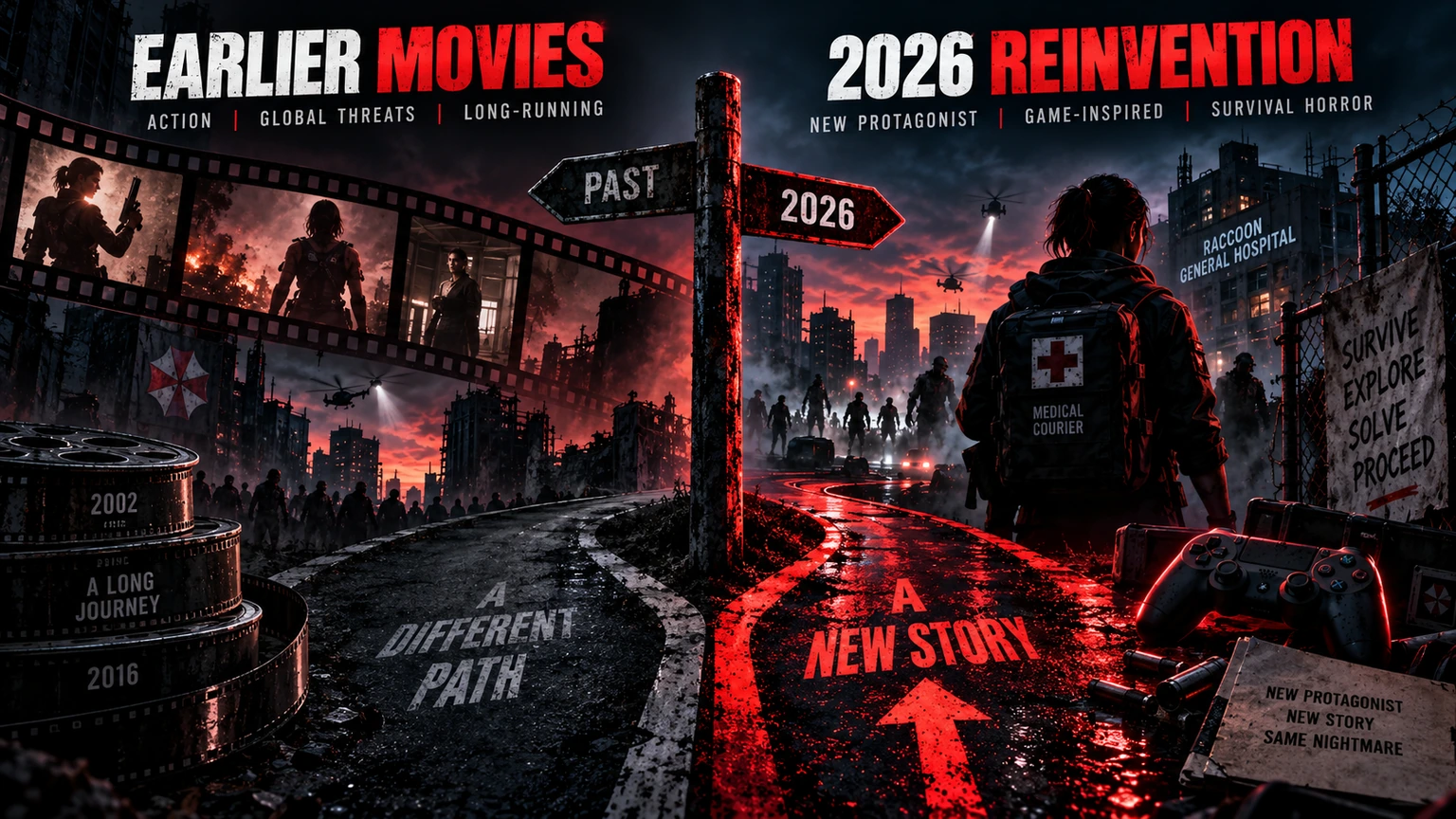
Sony describes the 2026 film as a “reinvention” built around an all-new story.
Instead of bringing back the central movie storyline associated with Milla Jovovich’s Alice, the film follows Bryan, a medical courier played by Austin Abrams who gets caught in a catastrophic outbreak. Sony lists Zach Cregger as director and co-writer with Shay Hatten. (Sony Pictures)
That matters because a long-running franchise can create a problem: new viewers may feel they need to understand years of previous movies before buying a ticket.
This film offers a much simpler entry point.
Cregger told The Guardian that although he was a longtime fan of the Resident Evil games, he had never watched the previous movies. His approach was to create an original story that still felt unmistakably like Resident Evil. He designed Bryan’s journey to resemble the rhythm of playing a survival-horror game: moving into a new environment, figuring out what is dangerous, finding resources and trying to survive long enough to reach the next area. (The Guardian)
That makes the 2026 movie unusual.
It can sell familiarity to existing fans without demanding that casual moviegoers remember what happened across seven previous live-action films.
How Much Did Zach Cregger Matter?
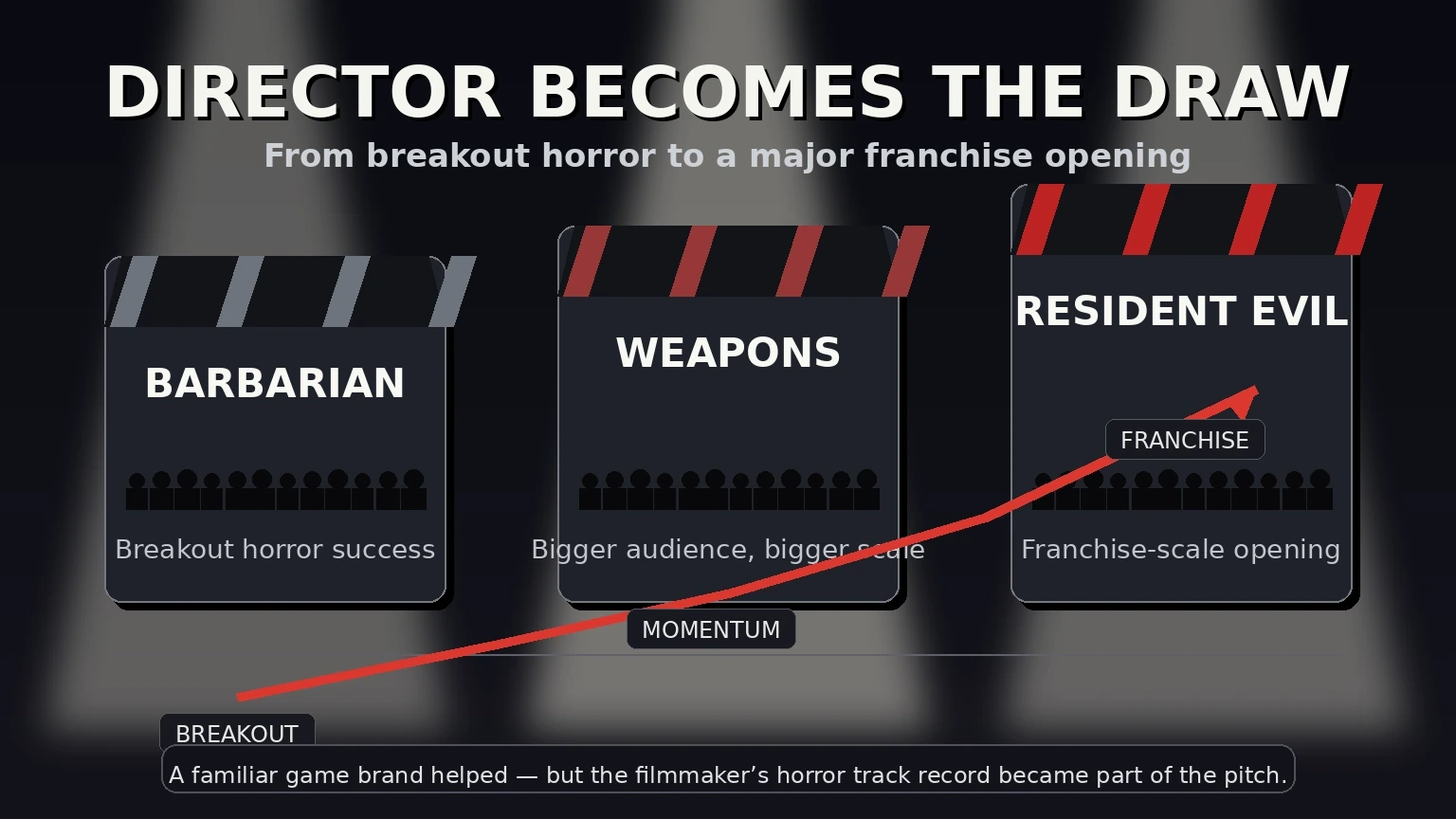
A familiar brand helped, but the director had become part of the brand too.
Before Resident Evil, Cregger directed Barbarian and Weapons. AP reported that Barbarian grossed more than $46 million on a production budget below $5 million, while Weapons reached about $270 million worldwide on a reported $38 million budget. (AP)
By the time Resident Evil arrived, moviegoers were not being asked to see only “another Resident Evil movie.”
They were also being sold “the new horror movie from the director of Barbarian and Weapons.”
That distinction is difficult to measure precisely, but it was visible enough for box-office analysts interviewed by AP to describe Cregger himself as a meaningful part of the movie’s draw. (AP)
The early response also gave the opening momentum. Rotten Tomatoes listed the film at a 95% critics score and a 91% verified audience score when checked on September 22. Those percentages can move as more reviews arrive, but they show that the movie entered its first week with unusually strong reception for this franchise. (Rotten Tomatoes)
Was Resident Evil Really a Dormant Franchise?

No. That is one of the easiest ways to misread the box-office story.
The film series had gone through a weak period, but Resident Evil as a game brand remained enormous.
Capcom says the Resident Evil game series had surpassed 213 million cumulative unit sales worldwide as of June 30, 2026. The first game debuted in 1996, meaning the movie arrived during the franchise’s 30th-anniversary year. (Capcom)
Capcom also released Resident Evil Requiem in February 2026. The company announced in March that the game had already exceeded six million copies worldwide, the fastest Resident Evil title to reach that milestone at the time. (Capcom)
So the movie was not trying to revive a forgotten name.
A better way to describe it is that Hollywood was trying to reconnect with an audience that had remained active in games even while the movie side of the franchise struggled.
That distinction helps explain why comparing only the 2021 movie with the 2026 movie can be misleading. The brand underneath both films was much stronger than the 2021 box-office number alone would suggest.
Why Did the Timing Help?
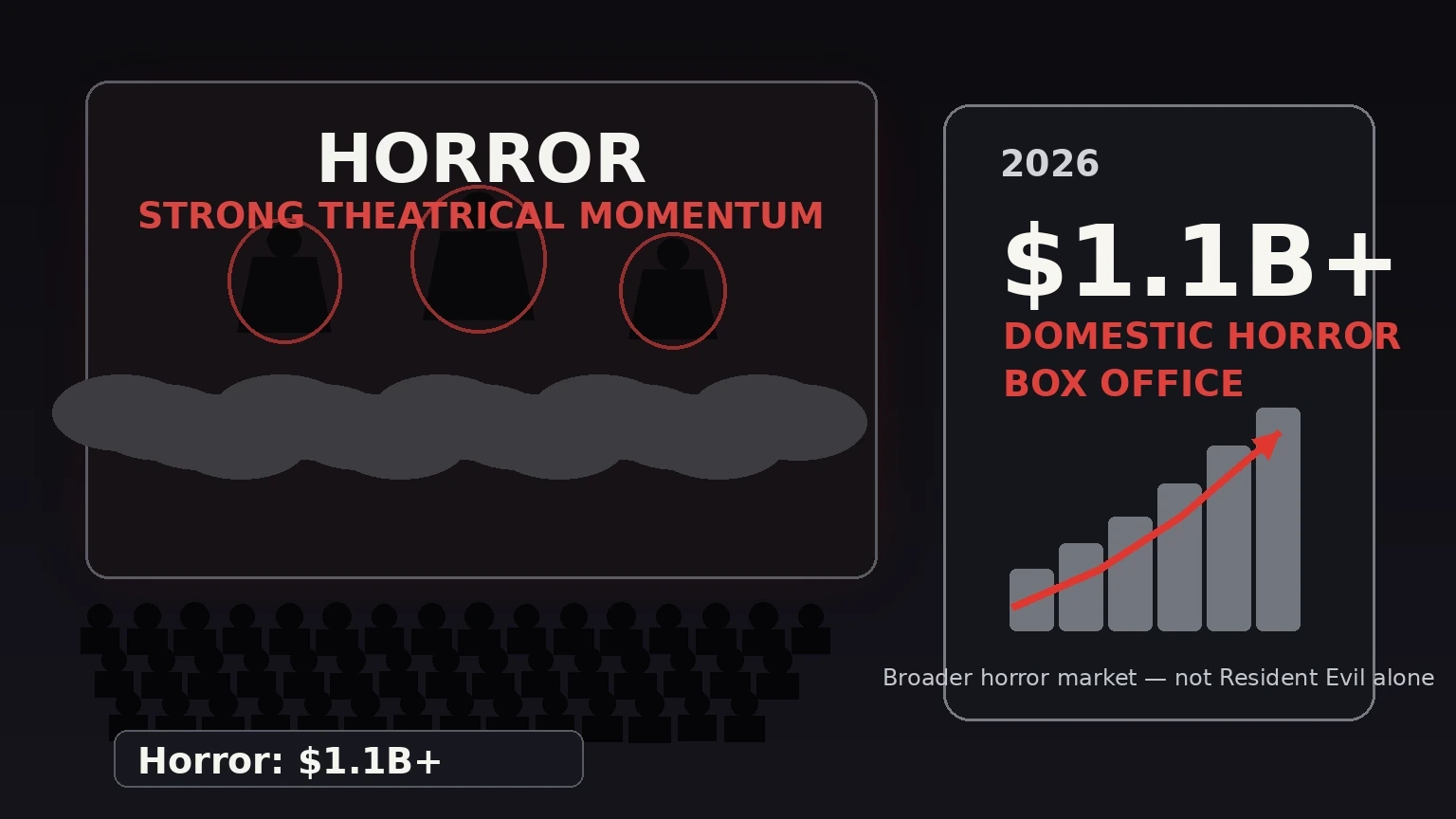
Resident Evil also opened into a market that is unusually receptive to horror.
According to Rentrak figures cited by AP, horror movies had already generated more than $1.1 billion at the domestic box office in 2026 by the weekend Resident Evil opened. (AP)
That does not prove people bought Resident Evil tickets simply because horror was popular.
It does show that the movie was not fighting against a weak genre. Audiences were already showing a willingness to leave home and pay for horror experiences in theaters.
Resident Evil then combined that broader demand with something many horror releases do not have: a globally recognized game franchise and a director who had recently established his own horror following.
Here is how the pieces fit together:
| Signal | What is verified | Why it may have helped |
|---|---|---|
| Creative reset | Sony marketed an all-new story with a new protagonist | New viewers did not need years of movie continuity |
| Director recognition | Cregger followed Barbarian and Weapons | Horror fans had a separate reason to pay attention |
| Large game audience | Resident Evil games passed 213M cumulative sales | The underlying brand remained globally familiar |
| Strong horror market | 2026 horror passed $1.1B domestically | The genre already had strong theatrical demand |
| Strong early reception | Critics and verified audiences rated the film highly | Positive reaction could strengthen opening-weekend interest |
None of those factors alone proves why a particular person bought a ticket.
Together, though, they explain why this release entered theaters under very different conditions from a routine eighth installment in an old movie series.
Did Video Game Movies Finally Stop Being a Bad Bet?
The old stereotype was simple: popular game, disappointing movie.
That assumption is much harder for Hollywood to make now.
Resident Evil is especially revealing because the property has already lived through multiple adaptation strategies. The original movie series leaned heavily into its own action-oriented mythology. The 2021 reboot tried another approach. Cregger’s version instead focuses on recreating the feeling of survival-horror gameplay while using a new lead character.
The result does not prove that adapting a famous game automatically works.
If anything, it suggests the opposite.
Recognition can get people to notice a movie, but filmmakers still have to decide which part of the game experience should survive the transition to film. In this case, Cregger emphasized vulnerability, exploration, limited resources and the feeling of stumbling into one dangerous environment after another. (The Guardian)
That may be more important than reproducing every familiar character or plot point.
The 2026 opening therefore looks less like evidence that audiences will watch anything carrying a game logo and more like evidence that old IP can still expand when filmmakers give viewers a new reason to care.
Does a $60 Million Opening Mean Resident Evil Is Already Profitable?
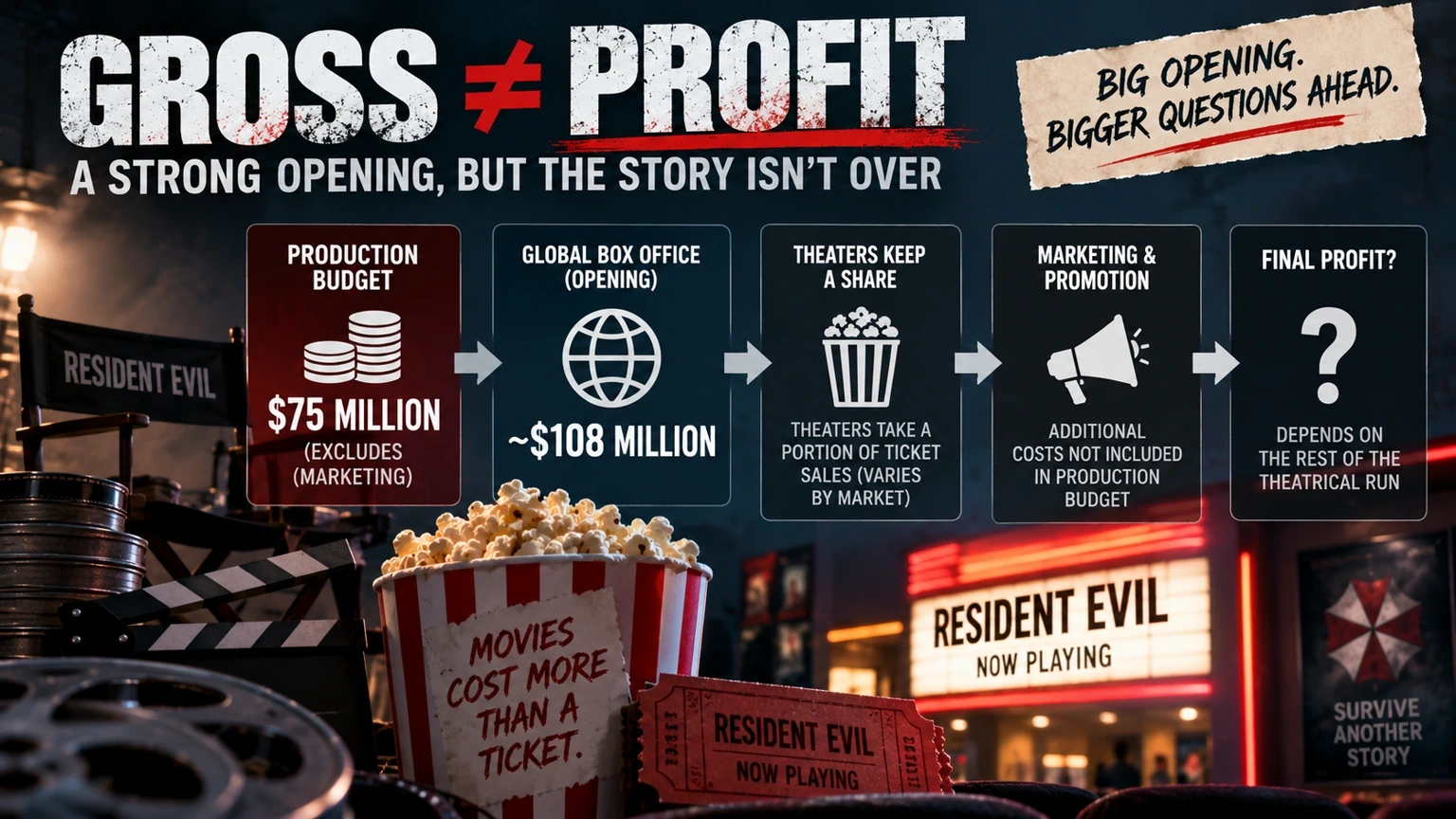
Not yet.
AP reported a production budget of about $75 million, excluding marketing and promotion. The movie launched with roughly $108 million worldwide. (AP)
Those two numbers cannot simply be subtracted from each other.
A worldwide box-office gross is total ticket revenue. Movie theaters keep a portion of those ticket sales, and the percentage returned to a studio varies by market and agreement. Marketing and distribution expenses are also separate from the reported production budget.
So a $108 million global opening on a $75 million production budget is a very strong start, but it is not the same thing as saying the studio already earned a $33 million profit.
The next few weekends matter.
Horror movies can sometimes fall sharply after opening weekend, and AP specifically noted that Cregger’s earlier movies performed unusually well by horror standards after their debuts. Whether Resident Evil can do the same will help determine how large this success ultimately becomes. (AP)
There is another useful benchmark.
Resident Evil: The Final Chapter earned more than $314 million worldwide in its full theatrical run, according to The Numbers. The 2026 movie owns the franchise opening record, but it still has a long way to go before it can claim the franchise’s worldwide-gross record. (The Numbers)
What Should We Watch Next?
The first number to watch is the second weekend.
If the movie holds reasonably well, the opening starts to look less like a burst of franchise nostalgia and more like the beginning of a sustained theatrical run.
The second is international performance. Resident Evil has historically been a franchise with significant overseas appeal, so North America alone will not determine where the new film ultimately ranks.
The third is the larger Hollywood reaction.
If a filmmaker-led, game-inspired reset can turn a $5 million opening from the previous movie into roughly $60 million five years later, studios will pay attention—not simply to the Resident Evil name, but to the way familiar intellectual property is being rebuilt.
The opening weekend has already answered one question.
People were still interested in Resident Evil.
What Hollywood does not know yet is how long that interest will last.
Why It Matters in One Sentence
Resident Evil did not suddenly become popular again after disappearing; a still-powerful game franchise, a fresh creative reset, Zach Cregger’s rising horror reputation and an unusually strong horror market came together at the same time—and produced the biggest opening weekend in the movie series’ history.
Resident Evil Box Office: Key Questions Explained
Q. How much did Resident Evil make in its 2026 opening weekend?
The movie opened to an estimated $60.0 million in the U.S. and Canada over September 18–20, 2026. Both Box Office Mojo and The Numbers list the opening weekend at $60.0 million, well above the franchise’s previous opening record. (Box Office Mojo · The Numbers)
Q. What was the previous Resident Evil opening-weekend record?
Resident Evil: Afterlife held the previous record with about $26.7 million in 2010. The new film opened at more than twice that level. (The Numbers)
Q. How did the 2026 movie compare with Welcome to Raccoon City?
Resident Evil: Welcome to Raccoon City opened to about $5.3 million in 2021 and finished with about $17 million domestically. The 2026 Resident Evil made roughly $60 million during its opening weekend alone. (The Numbers)
Q. Is the 2026 Resident Evil already the highest-grossing movie in the franchise?
No. It has the biggest opening weekend, but its theatrical run has only begun. Resident Evil: The Final Chapter remains ahead in worldwide lifetime gross with more than $314 million according to The Numbers. (The Numbers)
Q. Is the new Resident Evil a continuation of the old movie series?
Sony presents the film as a reinvention with an all-new story. It follows Bryan, a medical courier played by Austin Abrams, rather than continuing the central storyline of the earlier films. (Sony Pictures)
Q. Who directed the 2026 Resident Evil movie?
Zach Cregger directed the film and co-wrote it with Shay Hatten. Cregger previously directed Barbarian and Weapons. (Sony Pictures)
Q. How popular are the Resident Evil games in 2026?
Capcom reported more than 213 million cumulative Resident Evil game sales worldwide as of June 30, 2026. That means the underlying game franchise remained extremely large even after the movie series slowed down. (Capcom)
Q. Is horror doing unusually well at the box office in 2026?
Yes. Rentrak data cited by AP showed horror movies had already generated more than $1.1 billion domestically in 2026 by the weekend Resident Evil opened. (AP)
Q. Does a $60 million opening mean the studio has already made a profit?
No. Box-office gross is not the same as studio profit. Theaters retain part of ticket revenue, and AP reported that the movie’s roughly $75 million production budget did not include marketing and promotion expenses. (AP)
Did this help make the story clearer? 🙂
WIN keeps unpacking the “why” behind the news—clearly and simply!
Sources
Opening Weekend and Franchise Box Office History
Associated Press — “Resident Evil” tops the box office with a franchise-best debut
The Numbers — Resident Evil franchise box-office history
Box Office Mojo — September 18–20, 2026 domestic weekend chart
Film Concept and Creative Direction
Sony Pictures — Resident Evil official movie page
The Guardian — Zach Cregger on reinventing Resident Evil
Rotten Tomatoes — Resident Evil (2026) current ratings and consensus
Resident Evil Game Franchise and Audience Base
Capcom — Game Series Sales, including Resident Evil cumulative sales