
Why Is the G7 Releasing 100 Million Barrels of Oil and Diesel—and Will It Lower U.S. Fuel Prices?

One hundred million barrels sounds enormous.
So does that mean American drivers should expect the numbers on gas-station signs to start falling almost immediately?
Not necessarily.
The G7 announced on October 2 that it would coordinate the release of 100 million barrels from emergency oil stocks over four months, including a substantial diesel release during the first 20 days. The goal is to add supply to a stressed market quickly—not to guarantee a particular price at the pump. (G7 Évian 2026 · Reuters)
And there is another part of the announcement that can easily get lost in the headline.
Diesel, not just crude oil, is one of the immediate problems the G7 is trying to solve.
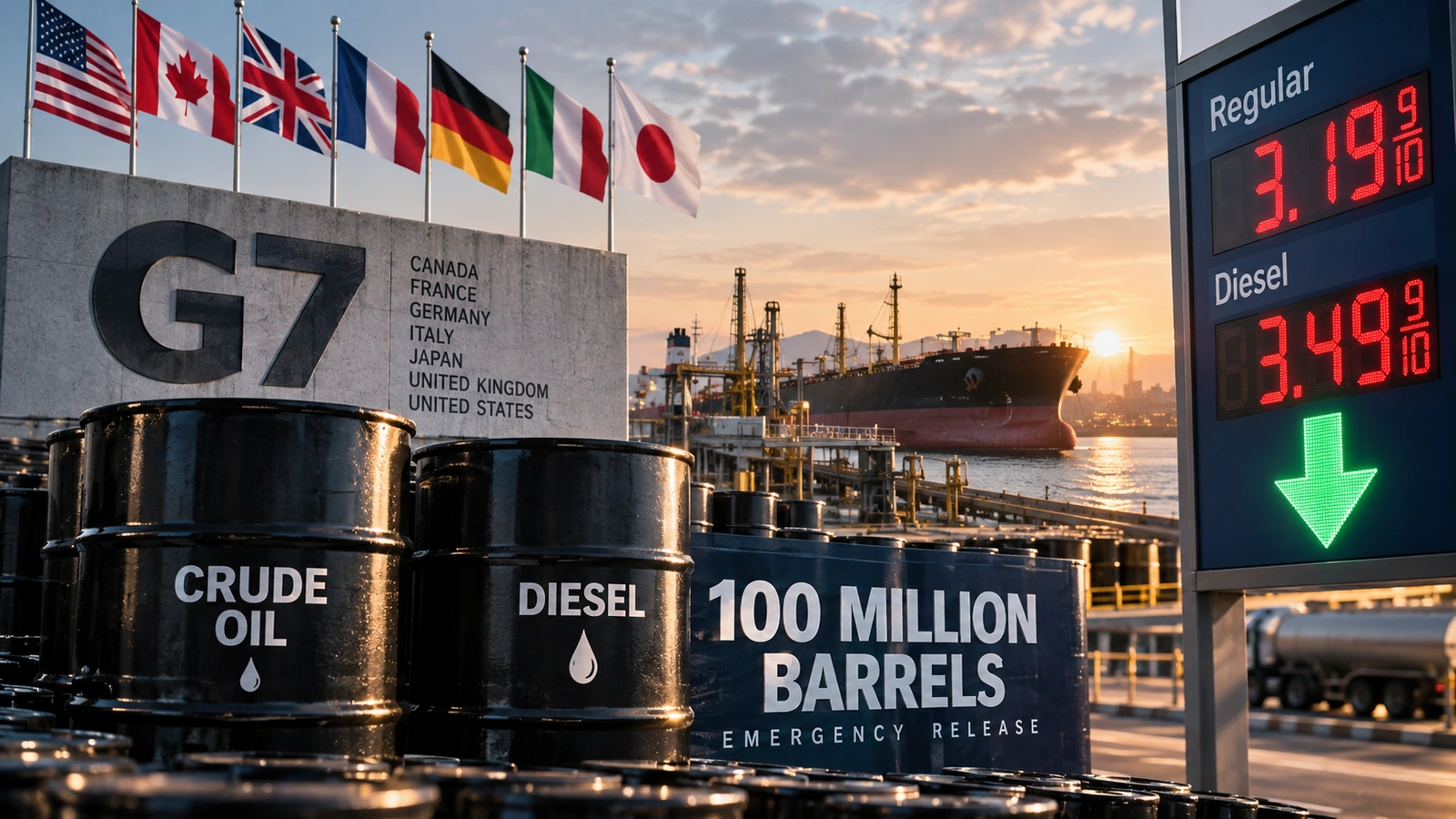
※ Images in this article are AI-generated illustrations created to help explain the story. They are not actual photographs, and depictions of people, places, or events may differ slightly from reality.
That distinction helps explain both why governments are acting now and why the effect on U.S. gasoline and diesel prices may be different from what the phrase “100 million barrels” suggests.
What Did the G7 Actually Agree to Do?
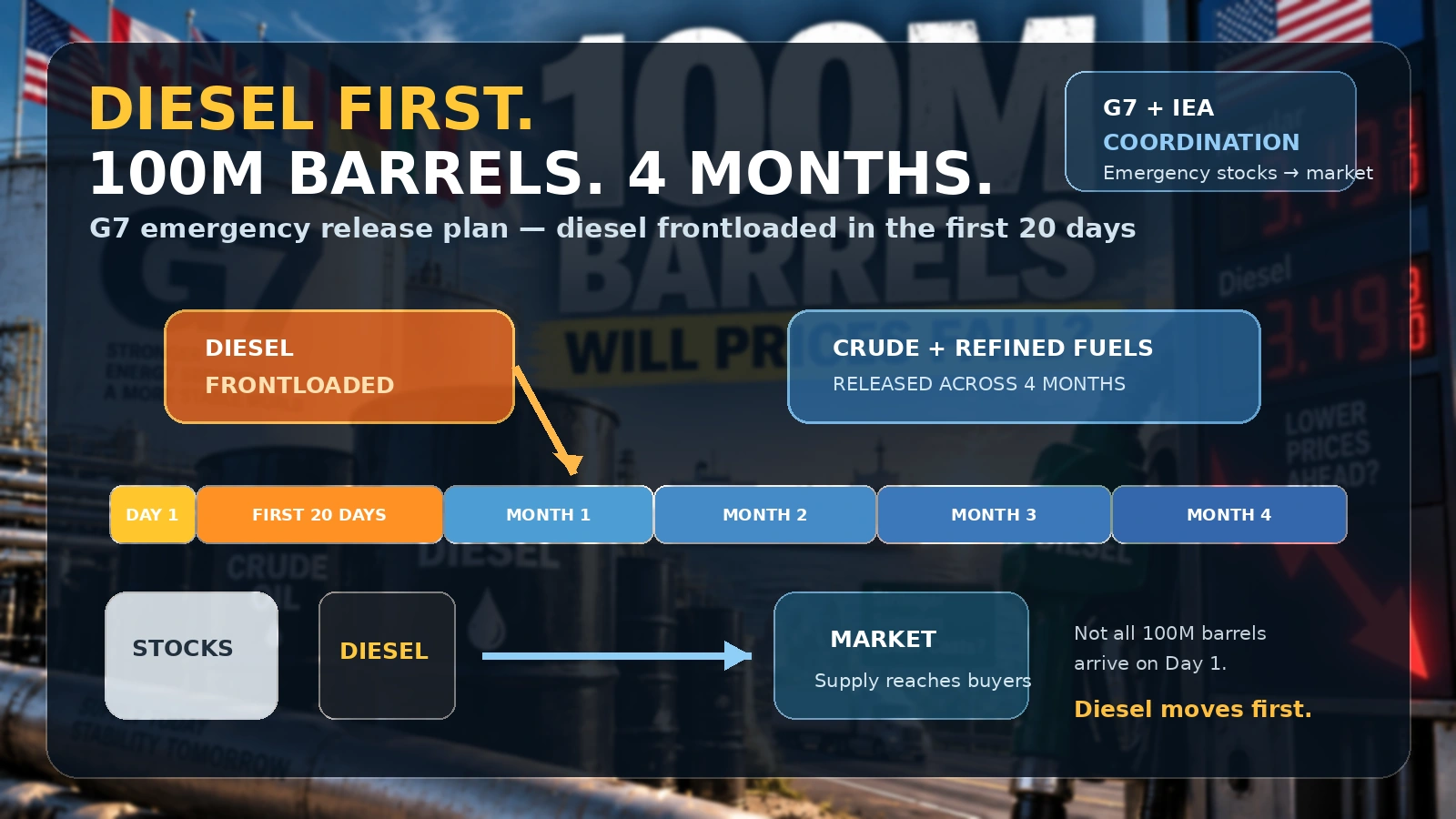
The agreement is broader than simply opening a valve on a giant crude-oil reserve.
The G7 said it would coordinate through the International Energy Agency, or IEA, with the 100 million-barrel release beginning immediately and extending over four months. A substantial diesel release is supposed to be frontloaded during the first 20 days. Leaders also agreed to coordinate refinery maintenance, encourage higher production of refined fuels where possible, and avoid export restrictions among G7 countries. (G7 Évian 2026)
Here is the announcement in simpler terms:
| G7 action | What it is meant to do |
|---|---|
| Release 100 million barrels over four months | Add emergency supply to the market |
| Frontload diesel during the first 20 days | Attack the tightest part of the fuel market sooner |
| Coordinate refinery maintenance | Avoid taking too much refining capacity offline at the same time |
| Encourage more refined-fuel production | Increase diesel and other finished products, not just crude supply |
| Avoid export restrictions within the G7 | Keep fuel moving across borders instead of trapping it in individual countries |
| Consider more diesel releases | Give governments another option if the shortage remains severe |
There is an important caveat.
The G7 statement explicitly links the new four-month plan to implementation of the 400 million-barrel emergency action that IEA members agreed to in March 2026, saying commitments already fulfilled should be taken into account. So it would be misleading to mechanically add 100 million barrels to the earlier 400 million-barrel headline and call the total a completely separate 500 million-barrel release. (IEA · G7 Évian 2026)
The clearest way to describe the October decision is this: the G7 has set a coordinated 100 million-barrel implementation plan, with diesel pushed forward urgently, while continuing the broader emergency response that began in March.
Why Is Diesel Being Released First?
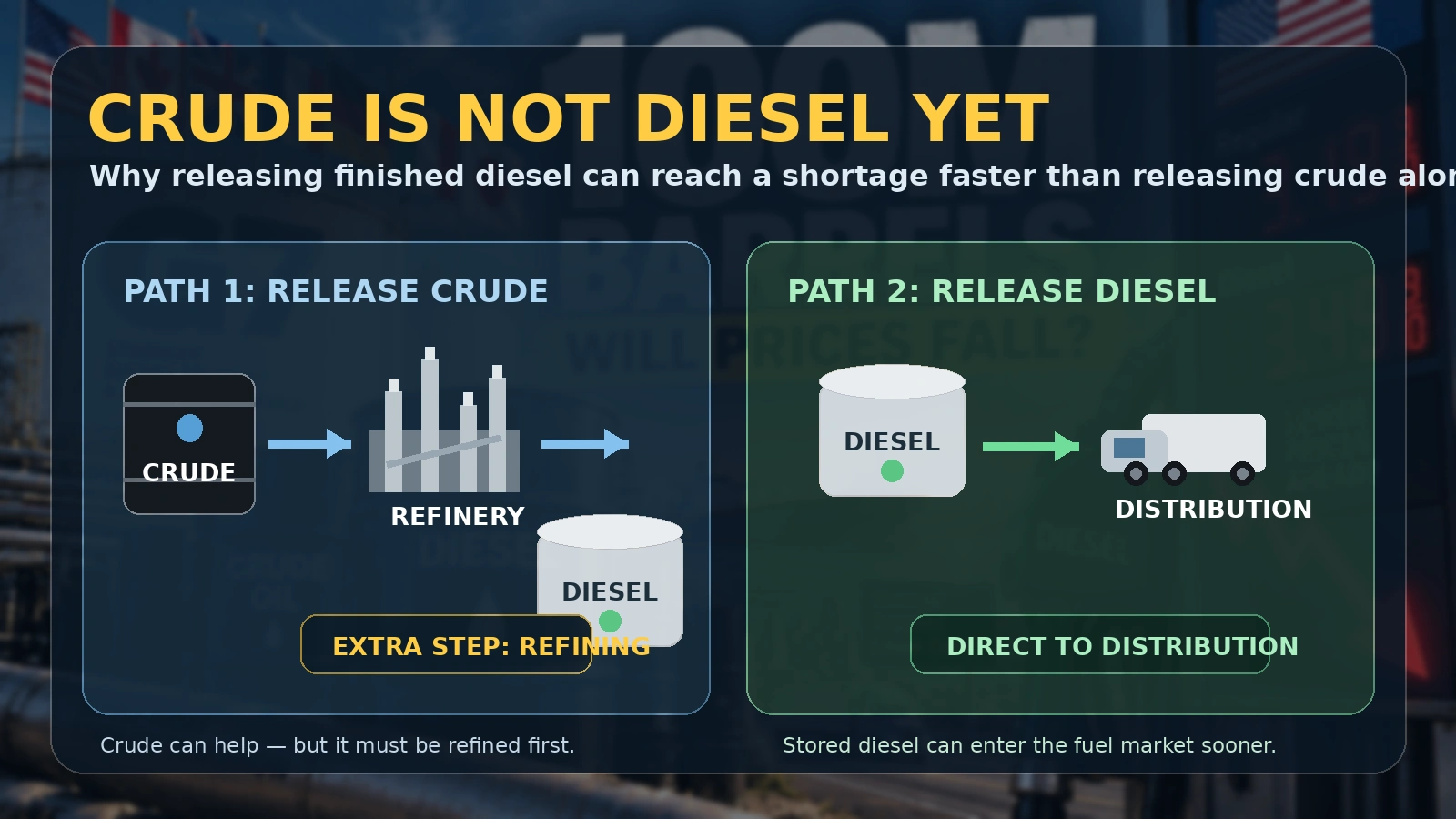
Because the market does not simply have an “oil” problem. It also has a refined-fuel problem, and diesel has been especially tight.
Diesel is produced from crude oil at refineries. Releasing more crude can help only after refiners turn that crude into the products the market needs. Releasing already refined diesel can reach the shortage more directly.
That matters because U.S. distillate inventories—the category that includes diesel and heating oil—have been unusually low. In its September outlook, the U.S. Energy Information Administration forecast inventories to drop below 100 million barrels and remain below the recent five-year range for an extended period. The same outlook said tight global supplies were encouraging U.S. distillate exports and keeping diesel prices high. (EIA)
The easiest way to picture the difference is a bakery running short of bread.
Having extra wheat in a warehouse helps, but only after the wheat can be milled, turned into dough and baked. A truckload of finished bread can solve the immediate shortage faster.
In this comparison, crude oil is the wheat. Diesel is the bread already ready to ship.
Why Did the Diesel Market Become So Tight?
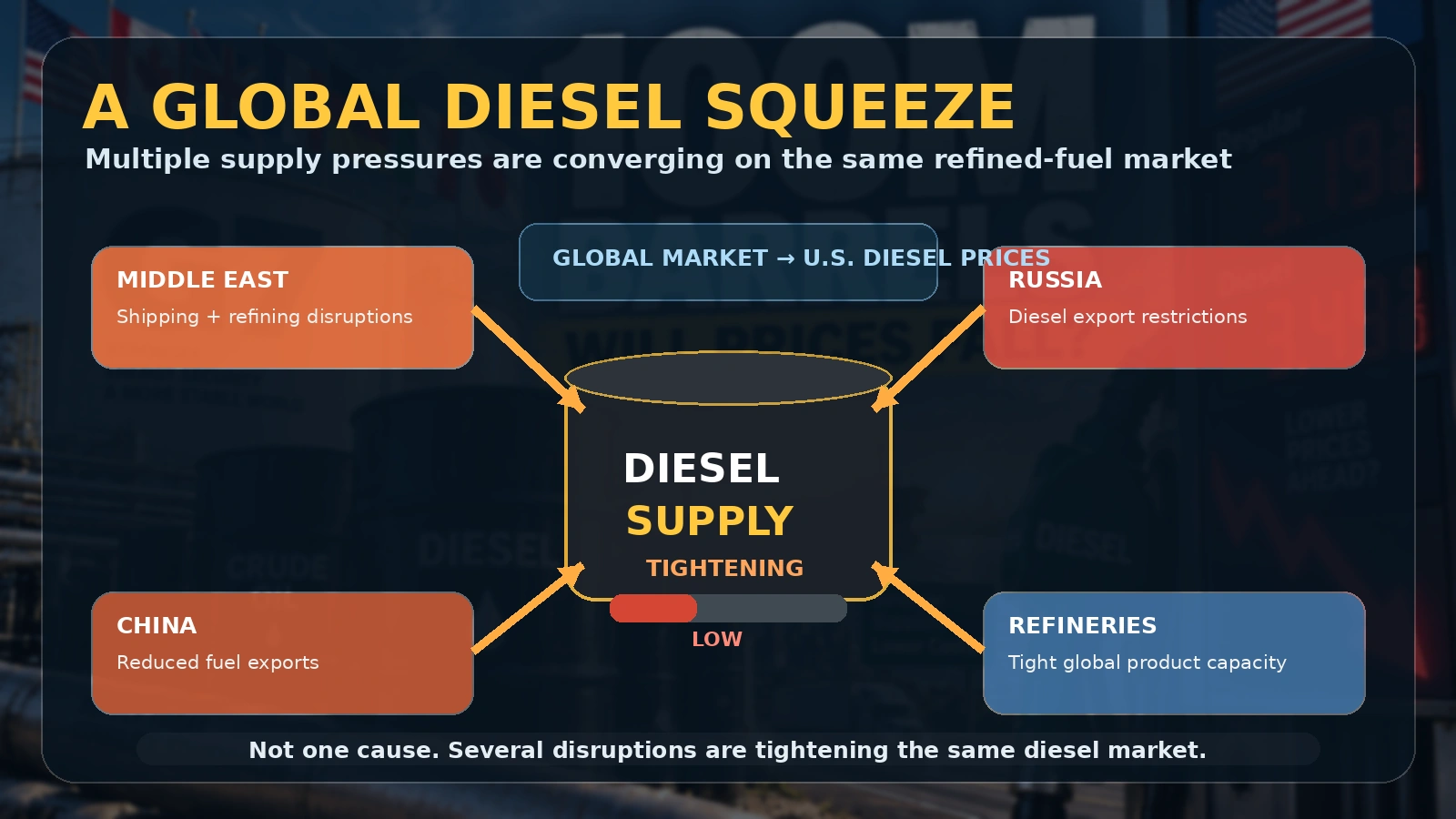
Several pressures have stacked on top of one another.
The Middle East conflict has disrupted energy trade and refining. Russia has restricted diesel exports. China has also periodically restricted or halted fuel exports as governments try to protect domestic supply. The EIA says U.S. distillate inventories have been pulled lower in part by high exports after the loss of substantial international supply from the Middle East, Russia and China. (EIA · Reuters)
That helps explain an otherwise strange situation.
The United States is a major oil producer and refiner. Yet U.S. diesel prices can still rise sharply when overseas buyers are competing for the same limited pool of refined fuel.
Fuel markets are global.
The latest EIA weekly retail data before the G7 announcement showed U.S. on-highway diesel averaging $6.382 per gallon on September 28, compared with $4.465 for regular gasoline. (EIA)
That unusually large gap helps explain why policymakers are focusing so heavily on diesel.
Where Do 100 Million Barrels of Emergency Fuel Actually Come From?
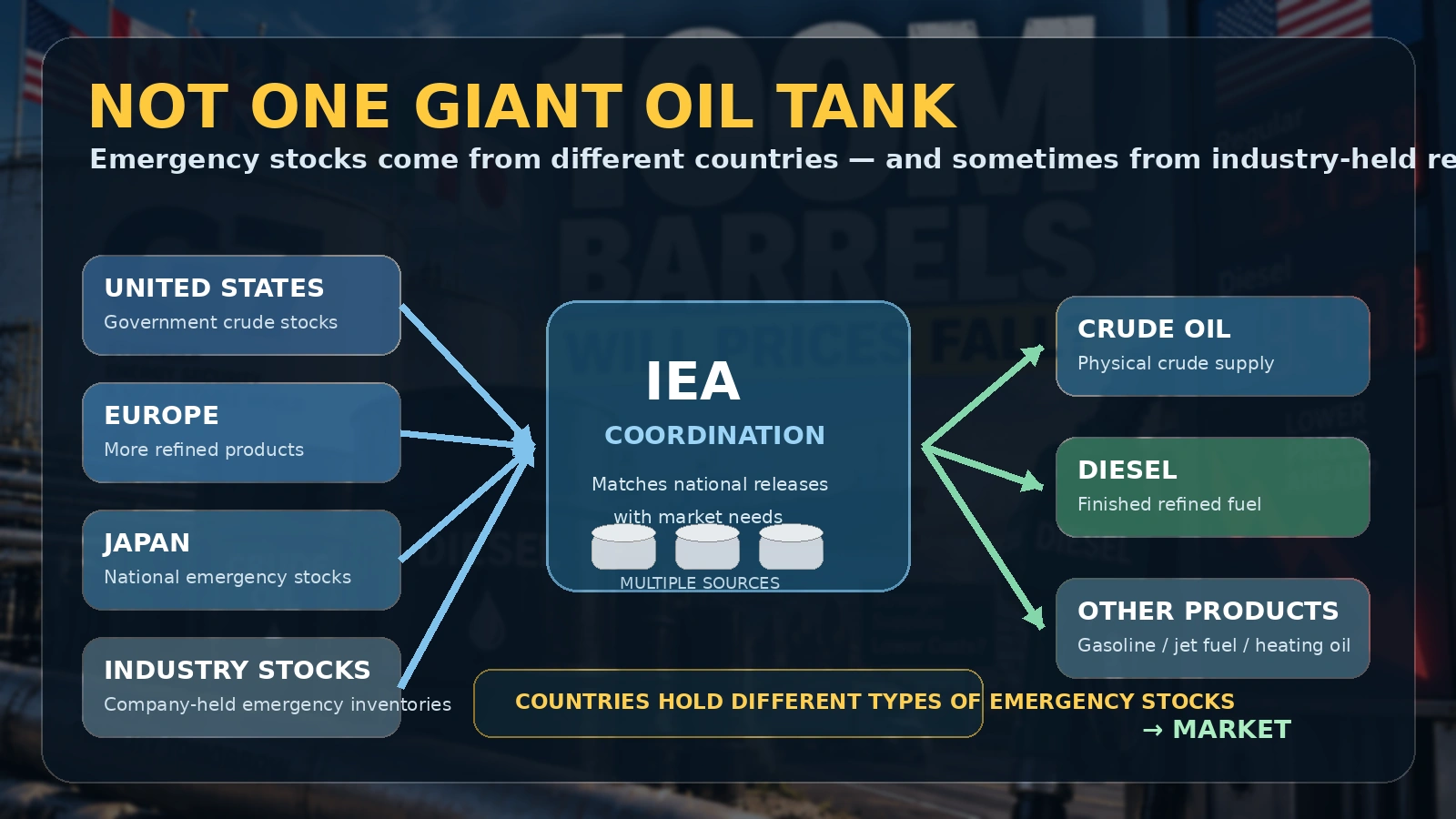
There is no giant “G7 oil reserve” sitting in one location.
IEA members hold emergency stocks in different ways. Some barrels are government-owned, while some countries require companies to maintain minimum inventories that can be made available during a crisis.
The March IEA action illustrated the difference clearly. The Americas’ contribution was primarily crude oil, while European contributions were much more heavily weighted toward refined petroleum products. (IEA)
That distinction also matters for the United States.
The U.S. Strategic Petroleum Reserve, or SPR, is a crude-oil reserve. According to the latest EIA weekly data available before this article was prepared, it held 283.767 million barrels on September 25, 2026. (EIA)
The United States separately maintains the Northeast Home Heating Oil Reserve, which the Department of Energy describes as roughly 1 million barrels of ultra-low-sulfur distillate, a diesel-type fuel intended to protect the Northeast from supply disruptions. (U.S. Department of Energy)
But the October 2 G7 statement did not specify exactly how many barrels each country will contribute.
That means it would be premature to assume a particular volume will come from the U.S. SPR, the Northeast reserve or any other single national stockpile.
Will Releasing 100 Million Barrels Actually Lower U.S. Gas and Diesel Prices?
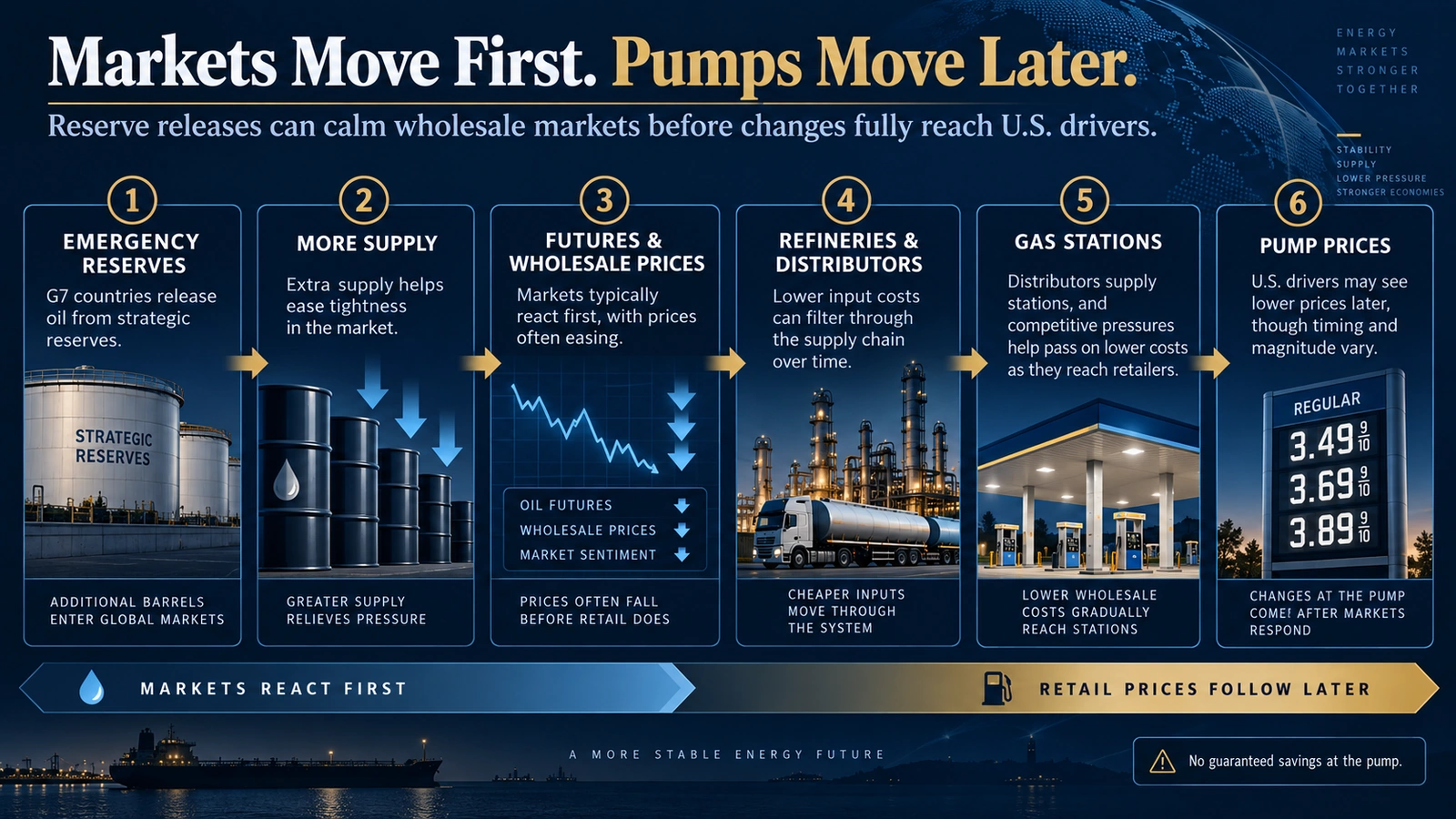
It can put downward pressure on prices, but it cannot guarantee that U.S. pump prices will fall by a specific amount.
Oil and fuel prices usually react first in wholesale and futures markets. After the G7 decision, IEA Executive Director Fatih Birol said oil prices had started falling, while diesel futures also moved lower after the announcement. (Reuters)
Retail prices come later and depend on more than the cost of crude oil.
The chain looks roughly like this:
Emergency reserves released → physical supply becomes easier to obtain → futures and wholesale prices may fall → refiners and distributors may pay less → some of that decline can reach gas stations.
But several other factors can interrupt that chain.
U.S. gasoline and diesel prices also reflect refinery availability, inventories, transportation costs, taxes, regional supply conditions and demand. The EIA describes inventories as a physical buffer between short-term supply and demand imbalances, which is why adding emergency stocks can calm markets even before every barrel has physically reached a buyer. (EIA)
So the realistic expectation is not:
100 million barrels released = an immediate, predictable drop at every U.S. gas station.
It is:
More emergency supply can reduce part of the shortage premium built into oil and diesel prices, especially if traders believe additional fuel will continue arriving.
Is 100 Million Barrels Really a Lot?
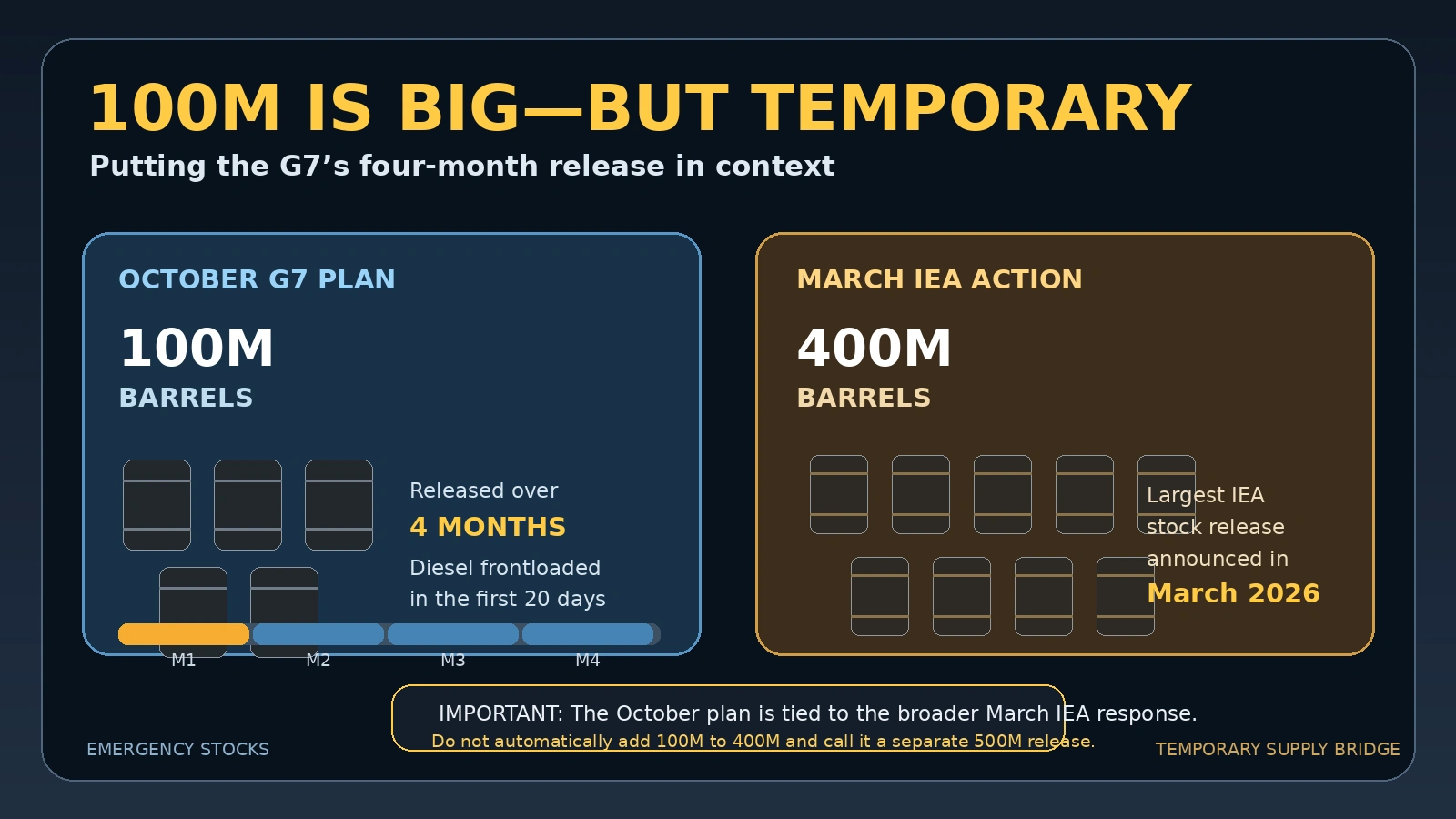
It is large enough to influence the market. It is not large enough to permanently replace disrupted production and refining.
If 100 million barrels were spread evenly across roughly four months, the average flow would be on the order of 0.8 million barrels per day. The actual pattern will not be even because diesel is being frontloaded.
It also helps to compare the new plan with the broader response earlier this year.
| Emergency action | Announced volume | Main purpose |
|---|---|---|
| IEA action announced March 11, 2026 | 400 million barrels | Respond to the major Middle East oil-supply disruption |
| G7 implementation plan announced October 2 | 100 million barrels over four months | Reinforce supply, with an urgent early focus on diesel |
The March action was the largest emergency stock release in IEA history. (IEA)
That history makes another point clear: emergency reserves are designed to bridge a disruption, not permanently replace normal production, refining and shipping.
Once reserves are drawn down, governments also have to consider how and when to rebuild them. The G7 asked the IEA to report on implementation and make recommendations that include future stock replenishment. (G7 Évian 2026)
Why Should You Care About Diesel If Your Car Uses Gasoline?
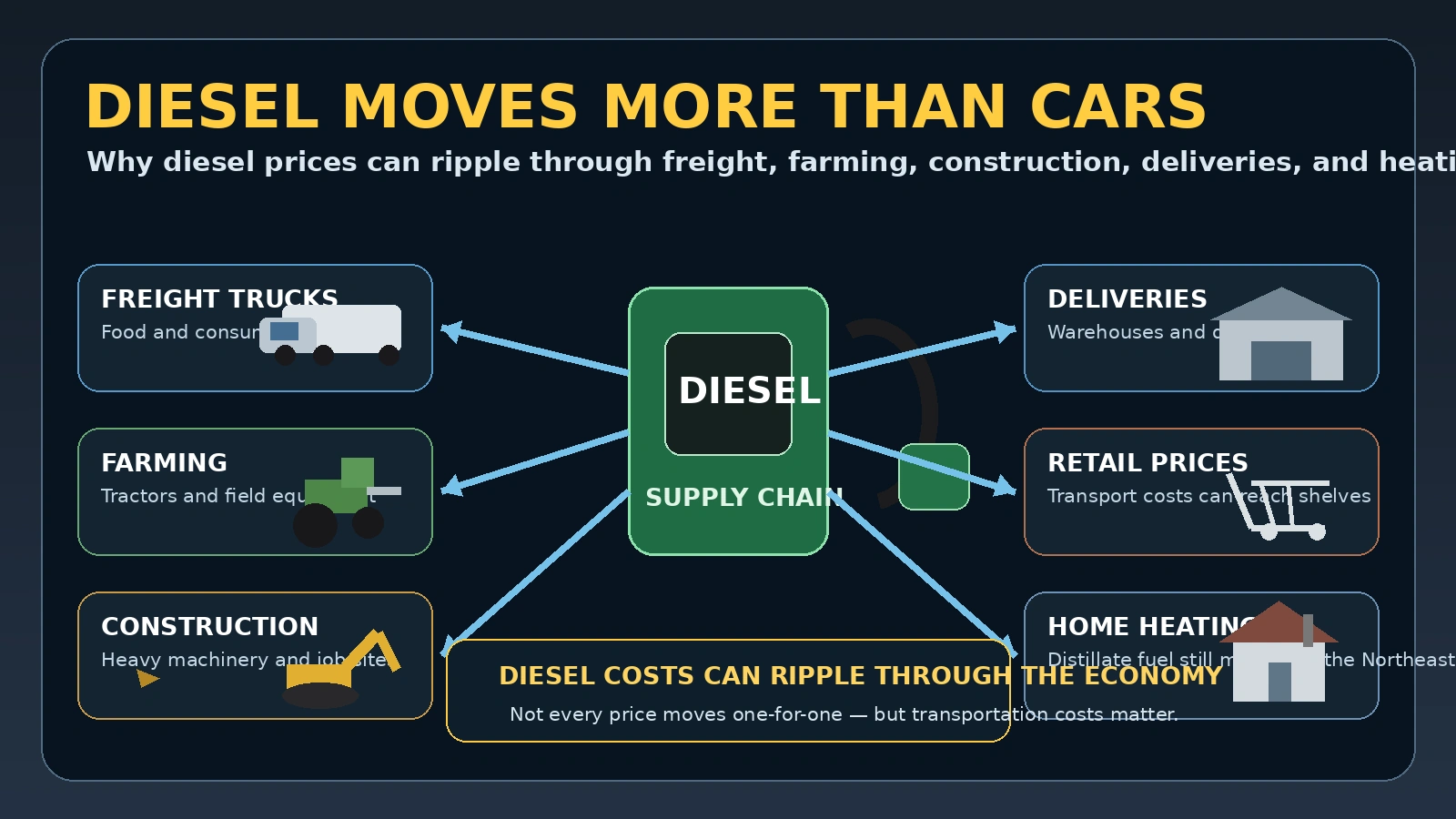
Because diesel moves much more than passenger vehicles.
Heavy trucks use it to move food and consumer goods. Farmers use it in agricultural equipment. Construction equipment relies on it. Heating oil remains important in parts of the Northeast.
When diesel becomes unusually expensive, transportation and operating costs can rise across the economy.
That does not mean a 10-cent increase in diesel automatically makes everything at the grocery store 10 cents more expensive. Businesses absorb, negotiate and pass through costs differently.
But sustained high diesel prices can become part of the inflation story because so many supply chains depend on the fuel.
What Could Stop the G7 Plan From Working?
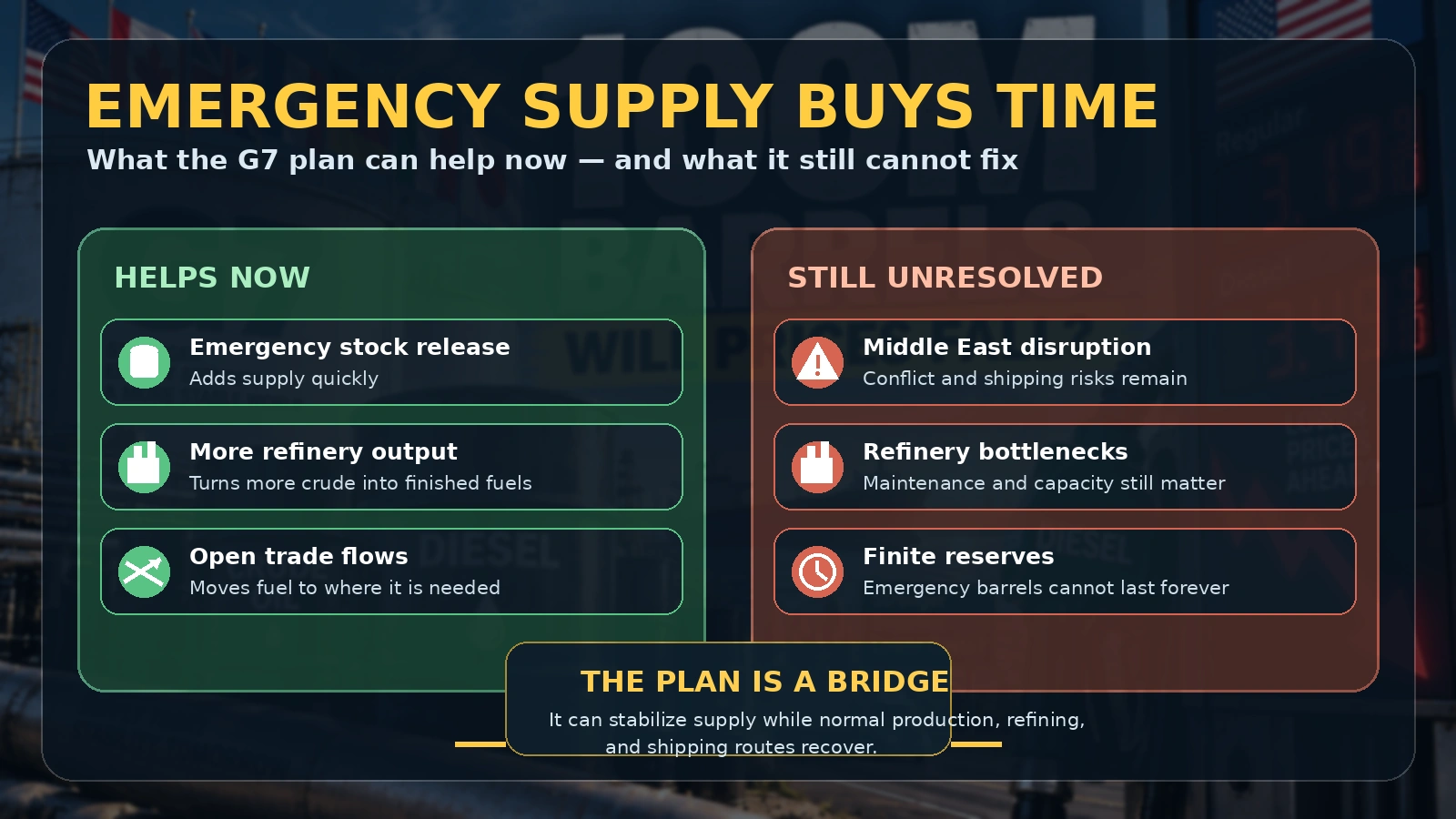
Emergency reserves are powerful because they are fast.
They are also finite.
The broader energy problem will depend on whether normal production, refining and international shipping recover. The G7 specifically called for restoration of navigation through the Strait of Hormuz and said it would continue watching refinery output and refined-fuel markets. (G7 Évian 2026)
A useful way to separate the tools is this:
| Tool | What it can do | What it cannot do |
|---|---|---|
| Emergency stock release | Add supply quickly | Create permanent new production |
| Frontloaded diesel release | Relieve a refined-fuel shortage | Fix every refinery bottleneck |
| Higher refinery utilization | Produce more finished fuel | Run indefinitely without maintenance |
| Keeping trade open | Move fuel to where it is needed | Produce additional barrels by itself |
| Restoring normal shipping | Address a major underlying disruption | Happen solely because reserves were released |
That is why emergency reserves are best understood as a bridge.
They can give the market time.
Whether prices stay lower depends on what happens before that bridge runs out.
What Should U.S. Drivers Watch Next?
There are four signals worth watching.
First is diesel, not just crude oil. If wholesale diesel prices keep falling as emergency barrels arrive, that would suggest the release is easing the most acute shortage.
Second is U.S. fuel inventories. A sustained rebuilding of distillate inventories would be more reassuring than a short-lived decline in futures prices.
Third is refinery output. More crude does little good if refineries cannot turn enough of it into diesel, gasoline and jet fuel.
And fourth is the underlying Middle East supply disruption. Emergency stocks can soften the impact of interrupted trade, but restoring normal production and shipping would change the market more fundamentally.
The G7 asked the IEA for a follow-up report within 20 days, which should provide an early indication of how quickly the plan is being implemented and whether further measures are needed. (G7 Évian 2026)
Bottom Line: What This Story Really Means
The G7’s 100 million-barrel plan matters because governments are trying to attack the fuel shortage at its most stressed point.
That is why diesel is being pushed out early instead of relying only on crude-oil reserves.
The release can increase supply, calm wholesale markets and reduce some of the pressure that has pushed U.S. gasoline and diesel prices higher. But it cannot guarantee a specific drop at the pump, and it does not permanently solve the supply disruptions that caused the problem.
Emergency reserves can buy the market time. They cannot manufacture a permanent replacement for normal oil production, refining and shipping.
Whether American drivers see lasting relief will depend on what happens during that extra time.
G7 Oil Reserves: Key Questions Explained
Q. How many barrels are the G7 countries releasing?
The October 2 plan calls for a coordinated 100 million-barrel release over four months, with a substantial diesel release frontloaded during the first 20 days.
Q. Is the entire 100 million barrels crude oil?
No. The plan involves emergency oil stocks and explicitly includes a frontloaded release of diesel, a refined petroleum product.
Q. Why is diesel being released before more crude oil?
Because the immediate shortage is partly a shortage of finished diesel, not simply crude. Stored diesel can enter distribution more directly, while crude first has to pass through a refinery.
Q. Will the G7 release immediately lower U.S. gasoline prices?
Not necessarily. Wholesale markets can react quickly, but retail prices also depend on refining, inventories, transportation, taxes, regional conditions and demand.
Q. Why are U.S. diesel prices so much higher than gasoline prices?
Global distillate supplies have been unusually tight. The latest EIA data before the announcement showed U.S. on-highway diesel averaging $6.382 per gallon versus $4.465 for regular gasoline on September 28.
Q. Is the U.S. Strategic Petroleum Reserve filled with diesel?
No. The main U.S. Strategic Petroleum Reserve holds crude oil. The United States separately maintains the much smaller Northeast Home Heating Oil Reserve, which contains about 1 million barrels of ultra-low-sulfur distillate.
Q. Is the 100 million-barrel release separate from the 400 million barrels announced in March?
The G7 statement ties the October plan to implementation of the March IEA commitments and says commitments already fulfilled should be taken into account. It should therefore not automatically be described as 100 million completely additional barrels on top of the entire March announcement.
Q. What matters most after the emergency release begins?
Watch diesel prices, U.S. distillate inventories, refinery output and whether disrupted international oil and fuel flows return toward normal. Those factors will help determine whether any price relief lasts.
Did this help make the story clearer? 🙂 WIN keeps unpacking the “why” behind the news—clearly and simply!
Sources
G7 Decision and Immediate Market Response
G7 Leaders’ Statement on Global Energy Security and Market Stability — G7 Évian 2026
Reuters — G7 Countries Agree on Release of Diesel and Oil Stocks
Reuters — IEA Says Oil Prices Started Falling After Reserve-Release Decision
IEA Emergency Stock Response
IEA — Member Countries Announce 400 Million-Barrel Emergency Release
IEA — Breakdown of Member-Country Contributions to the March Collective Action
U.S. Fuel Prices, Inventories and Reserves
EIA — Gasoline and Diesel Fuel Update
EIA — September 2026 Short-Term Energy Outlook: U.S. Petroleum Products
EIA — Weekly U.S. Petroleum Stocks Including the Strategic Petroleum Reserve
U.S. Department of Energy — Northeast Home Heating Oil Reserve
Keep Reading
Why can an oil crisis continue even when Saudi Arabia has a route around the Strait of Hormuz?
Emergency reserves can ease a shortage, but the underlying problem is still whether oil can move reliably through vulnerable pipelines and shipping routes. Saudi Arabia’s East-West Pipeline shows why bypassing one chokepoint does not remove every supply risk.
Saudi Arabia Built a Pipeline to Bypass Hormuz—So Why Is Its Oil Route Still at Risk?