How Can the NFL Suspend 49ers Owner Jed York—and What Does a Six-Game Ban Actually Mean?

Wait—the owner owns the team. So who exactly gets to suspend him? And if Jed York is not a player, what does a “six-game suspension” actually stop him from doing?
The NFL answered the first part on October 2, when it suspended the San Francisco 49ers’ principal owner for six regular-season games and fined him $500,000 for violating the league’s Personal Conduct Policy. York had already stayed away from the 49ers’ first three games and from league meetings while the NFL reviewed the matter, so those absences count toward the six-game penalty. He is eligible to return on October 20, after San Francisco’s Week 6 game against Washington. (NFL.com · Reuters)
That still leaves the more interesting question: how can a sports league discipline someone who owns one of its franchises? The answer is that owning an NFL team does not place an owner outside the NFL’s rules. It puts the owner inside a private league structure that comes with its own governance, conduct standards and disciplinary authority.
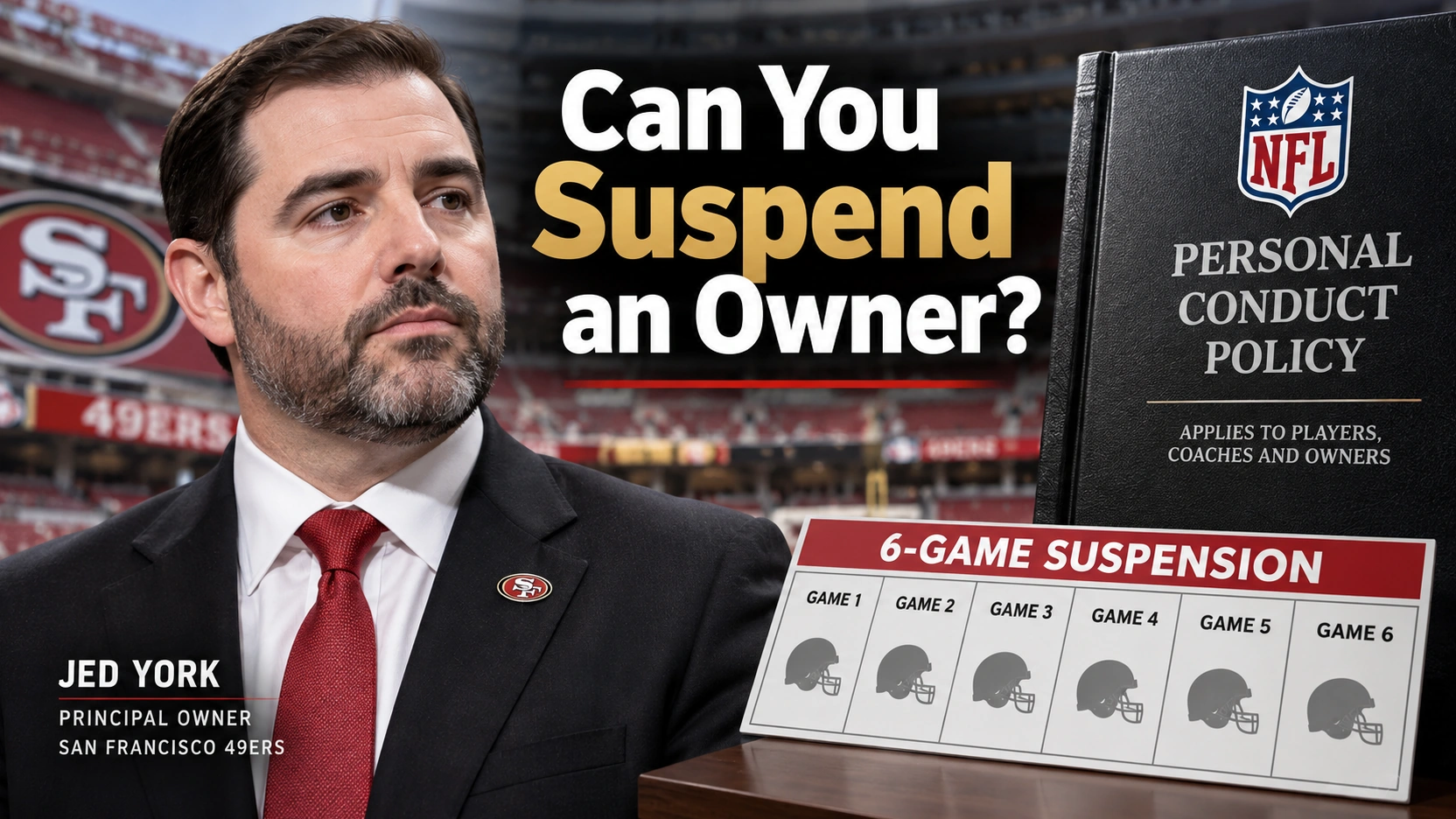
※ Images in this article are AI-generated illustrations created to help explain the story. They are not actual photographs, and depictions of people, places, or events may differ slightly from reality.
Why Can the NFL Punish Someone Who Owns an NFL Team?
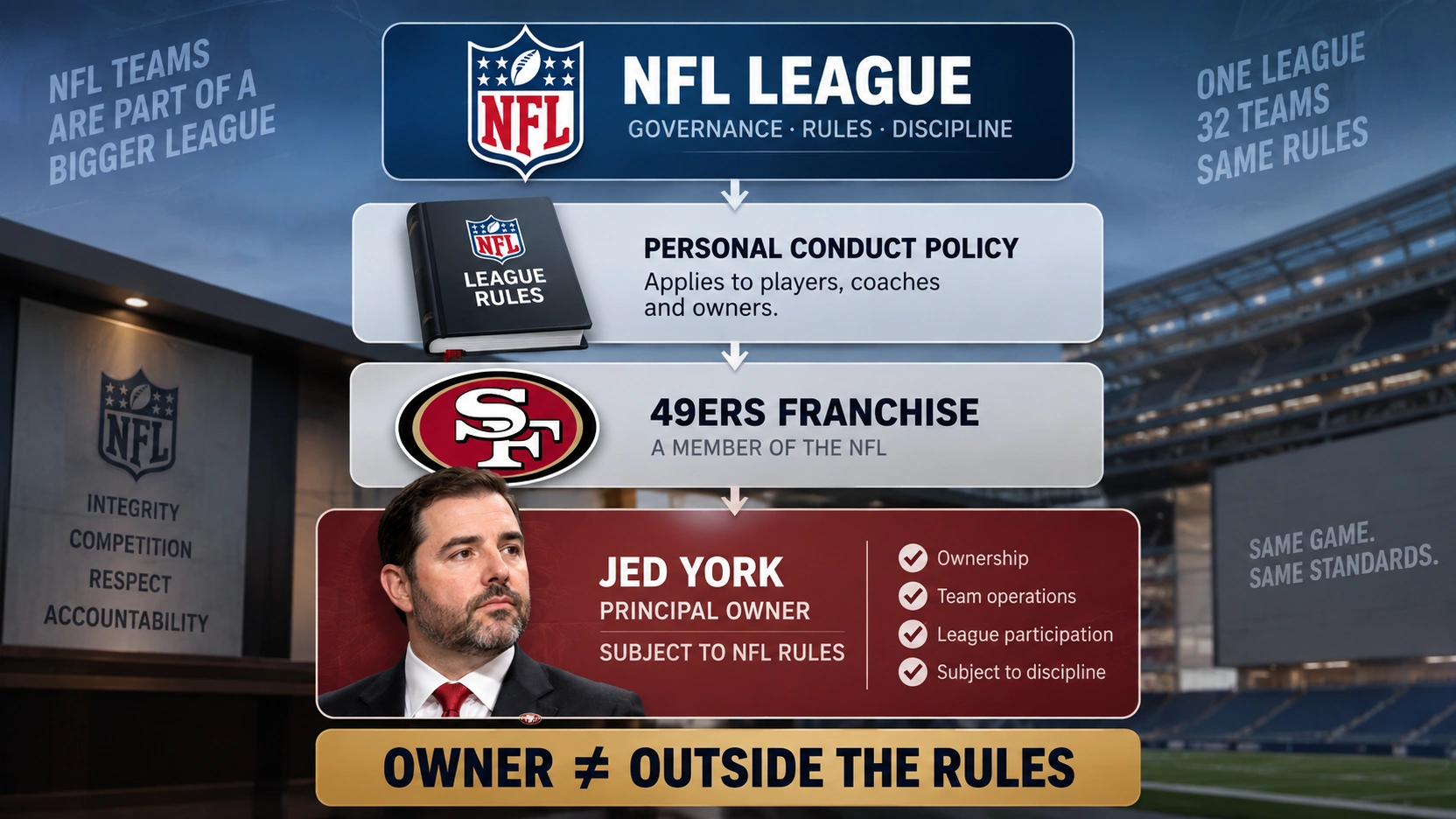
Because an NFL franchise is not an independent island. An NFL-published version of the Personal Conduct Policy explicitly says the standards apply to owners as well as coaches, players and other league or club personnel. The same policy says ownership and club or league management have traditionally been held to a higher standard and can face more significant discipline when violations occur. (NFL Personal Conduct Policy)
The policy also explains why the league process does not simply copy the criminal-court result. It says league discipline may still be imposed even when conduct does not result in a criminal conviction, because the NFL applies its own conduct standards and investigation process. (NFL Personal Conduct Policy)
Here is the easiest way to picture it: York owns an interest in the 49ers, but the 49ers participate in the NFL under league rules. Ownership gives him control inside the franchise; it does not give him immunity from the league that the franchise belongs to.
The October 2 punishment did not announce any transfer or reduction of York’s ownership stake. The 49ers still list him as principal owner. A suspension is a restriction on participation in team and league activities, not an automatic confiscation of the owner’s shares. (49ers)
So What Does a Six-Game Owner Suspension Actually Do?
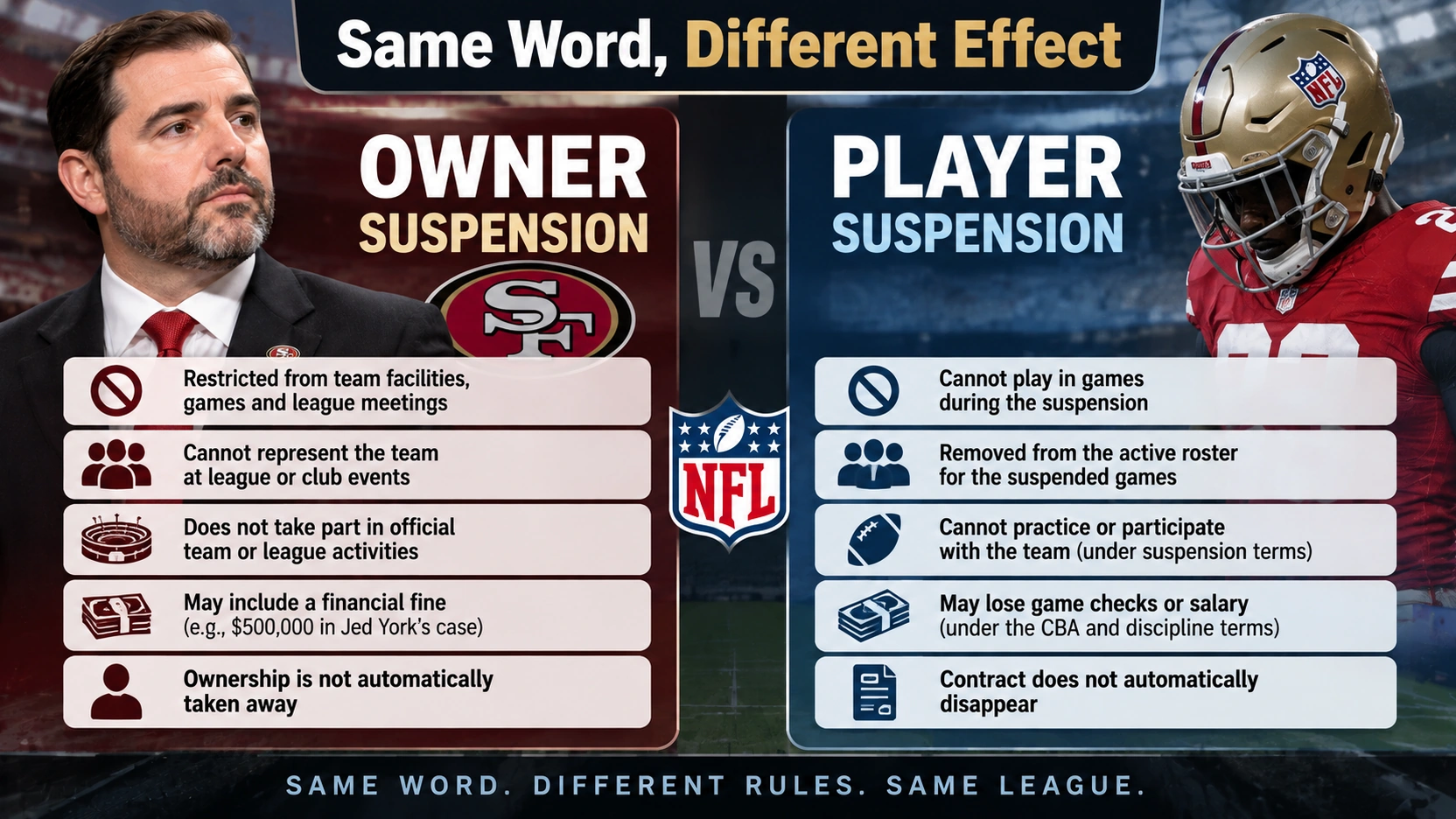
For a player, “six games” has an obvious meaning: the player cannot play in those games. For an owner, the penalty is about access, representation and official participation, because an owner does not take snaps on Sunday.
The NFL’s public announcement on York specifically confirms two things: he stayed away from the first three 49ers games and from NFL league meetings, and those absences are being credited toward the suspension. The announcement does not publicly spell out every day-to-day restriction in the same level of detail the league has used in some earlier owner cases. (NFL.com)
Past owner suspensions show what that kind of separation can look like. When the NFL suspended Indianapolis Colts owner Jim Irsay for six games in 2014, it barred him from the team facility and from practices and games. The league also restricted him from representing the club at league or committee meetings and other team or league events. (NFL.com)
Miami Dolphins owner Stephen Ross faced a different kind of case in 2022, involving tampering and league-integrity rules rather than the Personal Conduct Policy. His punishment also restricted his presence at the team facility and his ability to represent the club at events, and it included separate limits on league meetings and committee participation. (NFL.com)
So the word “suspended” is the same, but the practical effect depends on the person’s role.
| Question | Owner suspension | Player suspension |
|---|---|---|
| What is mainly restricted? | Official access, representation and league/team participation | Playing in games and participating under the terms of the suspension |
| Does the underlying status automatically disappear? | No; the ownership stake is not automatically transferred | No; the player remains under contract unless a separate roster or contract action occurs |
| Is there a financial consequence? | A separate fine may be imposed | Suspended games can carry pay consequences under the CBA and discipline terms |
| Who keeps the organization functioning? | Club executives and football leadership continue operating the team | Coaches and the roster use other available players |
That is why an owner suspension can sound stranger than it is. The league is not pretending the owner is a player. It is temporarily cutting the owner off from the official privileges that come with representing an NFL club.
Why Did Three Games Count Before the NFL Announced the Penalty?
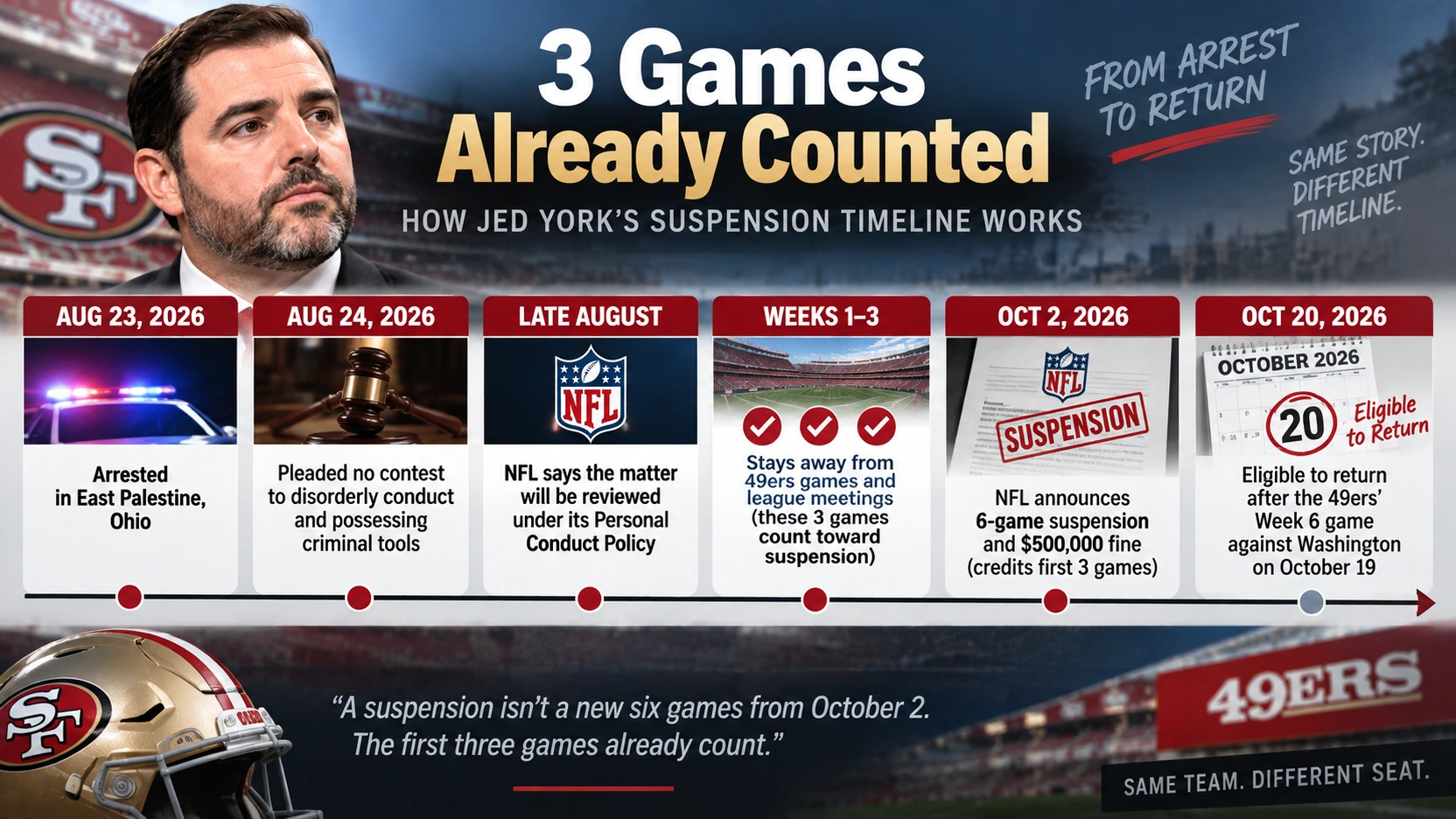
Because York had already removed himself from games and league meetings while the investigation was underway. The NFL decided those first three regular-season games would count as time served, which means the October 2 announcement did not start a fresh six-game clock. (NFL.com · Reuters)
The sequence matters because the legal case and the NFL process were separate tracks. The August arrest and plea are supported by AP and Reuters reporting based on court and police records; the suspension and return timing come from the NFL’s October 2 announcement. (AP · Reuters · NFL.com)
| Date | What happened |
|---|---|
| August 23 | York was arrested in East Palestine, Ohio, during an undercover prostitution investigation. |
| August 24 | He pleaded no contest to misdemeanor disorderly conduct and possessing criminal tools after the original prostitution charge was amended. |
| Late August | The NFL said the matter would be reviewed under its Personal Conduct Policy. |
| Weeks 1–3 | York stayed away from 49ers games and league meetings while the review continued. |
| October 2 | The NFL announced a six-game suspension and a $500,000 fine, crediting the first three games. |
| October 20 | York becomes eligible to return after the 49ers’ Week 6 game against Washington on October 19. |
Court records and Associated Press reporting show that the “criminal tools” charge involved the phone York used to respond to the undercover advertisement. The original engaging-in-prostitution charge was amended to disorderly conduct before his no-contest plea. (AP)
The result is easy to miss in the headline: six games of discipline does not mean six future games from October 2. Half of the suspension had already been credited before the league announced it.
Did the NFL Suspend York Because of the Original Prostitution Charge?
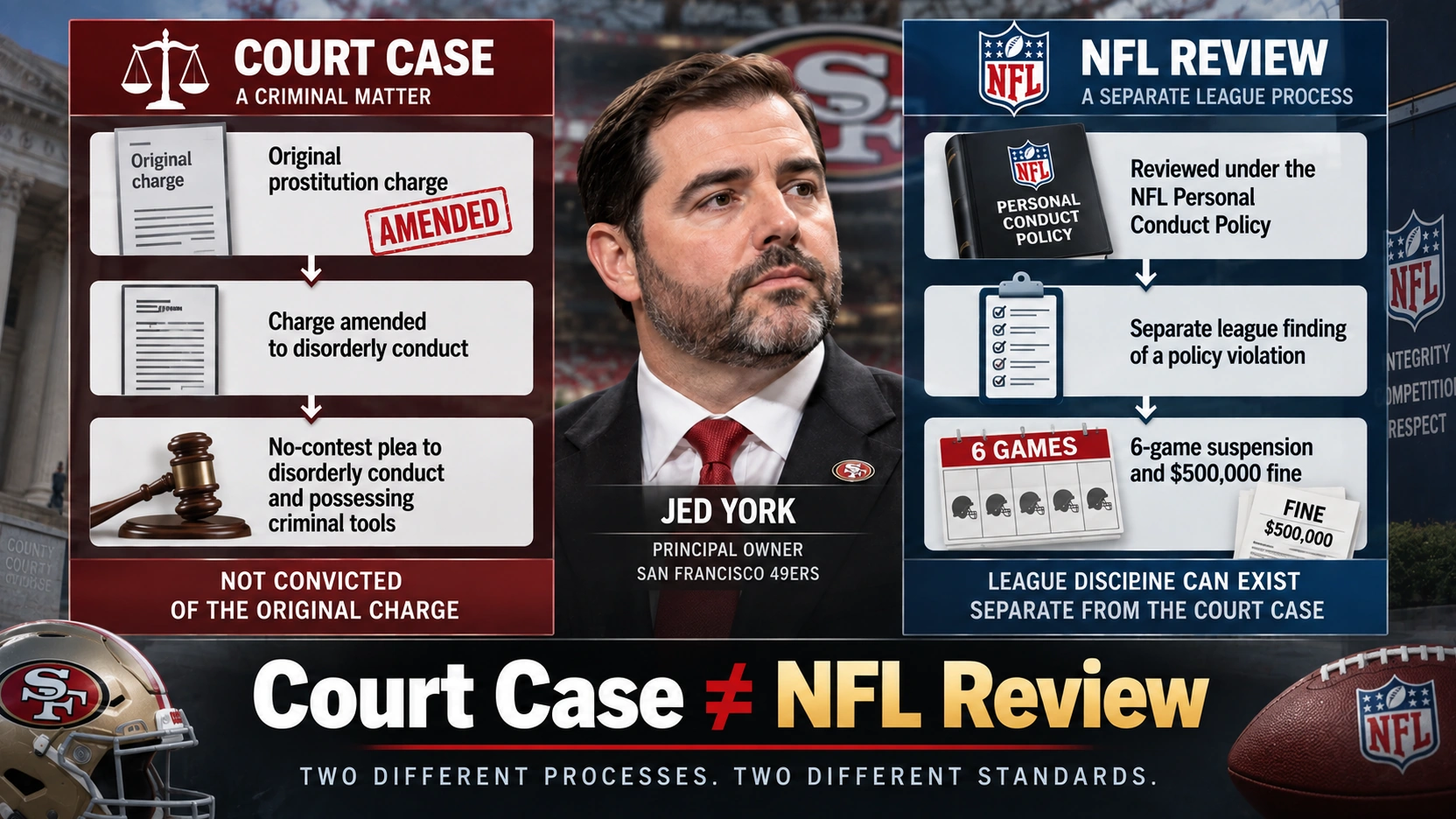
Not exactly. The NFL said York violated its Personal Conduct Policy, but its October 2 announcement did not say that he was being punished for a criminal conviction on the original prostitution charge.
That distinction matters because York was not convicted of the original engaging-in-prostitution charge. Prosecutors amended that count to disorderly conduct, and York pleaded no contest to disorderly conduct and possessing criminal tools. The court case therefore ended differently from the way the first arrest headline sounded. (AP)
The NFL, however, does not have to copy the criminal court’s labels. Its Personal Conduct Policy is a separate league process focused on conduct that the NFL believes can damage the integrity of or public confidence in the league. Earlier official versions of the policy explicitly state that league discipline can be imposed even when conduct does not result in a criminal conviction. (NFL Personal Conduct Policy)
So there were two different questions. The court asked what criminal charges would be resolved and how. The NFL asked whether York’s conduct violated league standards for someone who represents an NFL franchise.
Once those two tracks are separated, the story becomes much easier to follow.
Who Runs the 49ers While the Owner Is Suspended?
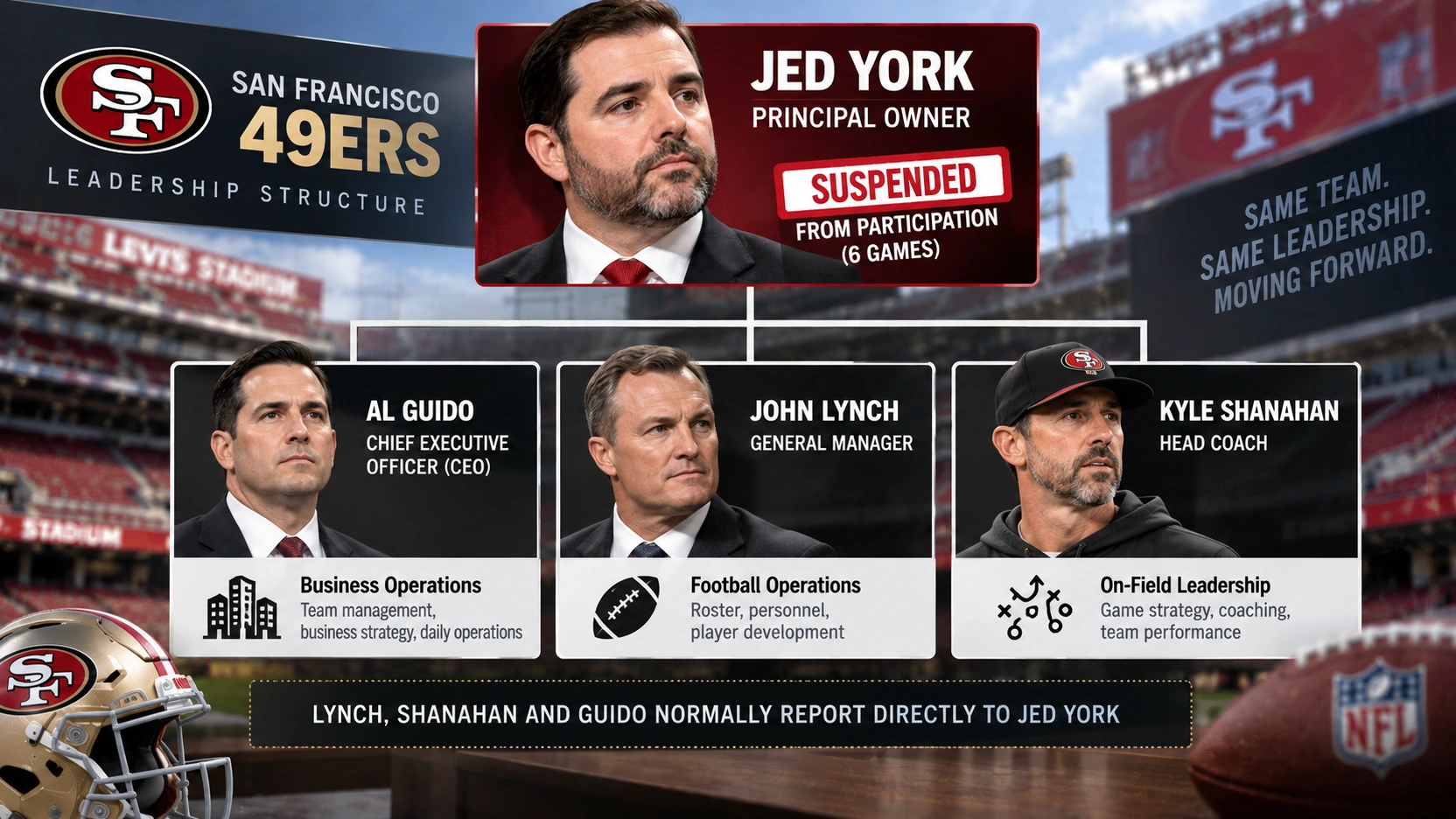
The 49ers do not stop operating because their principal owner is suspended. The club already has executives and football leaders whose jobs continue regardless of whether York is attending games or league meetings.
In February 2026, the 49ers promoted Al Guido from president to chief executive officer. The team said at the time that York would remain principal owner, while football operations would continue to be led by John Lynch and Kyle Shanahan, with Lynch, Shanahan and Guido normally reporting directly to York. (49ers)
That distinction helps explain why an owner suspension may be much more visible in governance than on the field. York does not call offensive plays, set the defensive front or decide which receiver runs which route. The immediate football work is already handled by the coaching and football-operations structure.
The suspension can still matter. A principal owner is involved in major organizational decisions, long-term strategy and league-level representation. But the 49ers do not need to invent an entire replacement football operation for six games just because York is temporarily separated from his usual role.
Have NFL Owners Been Suspended Before?
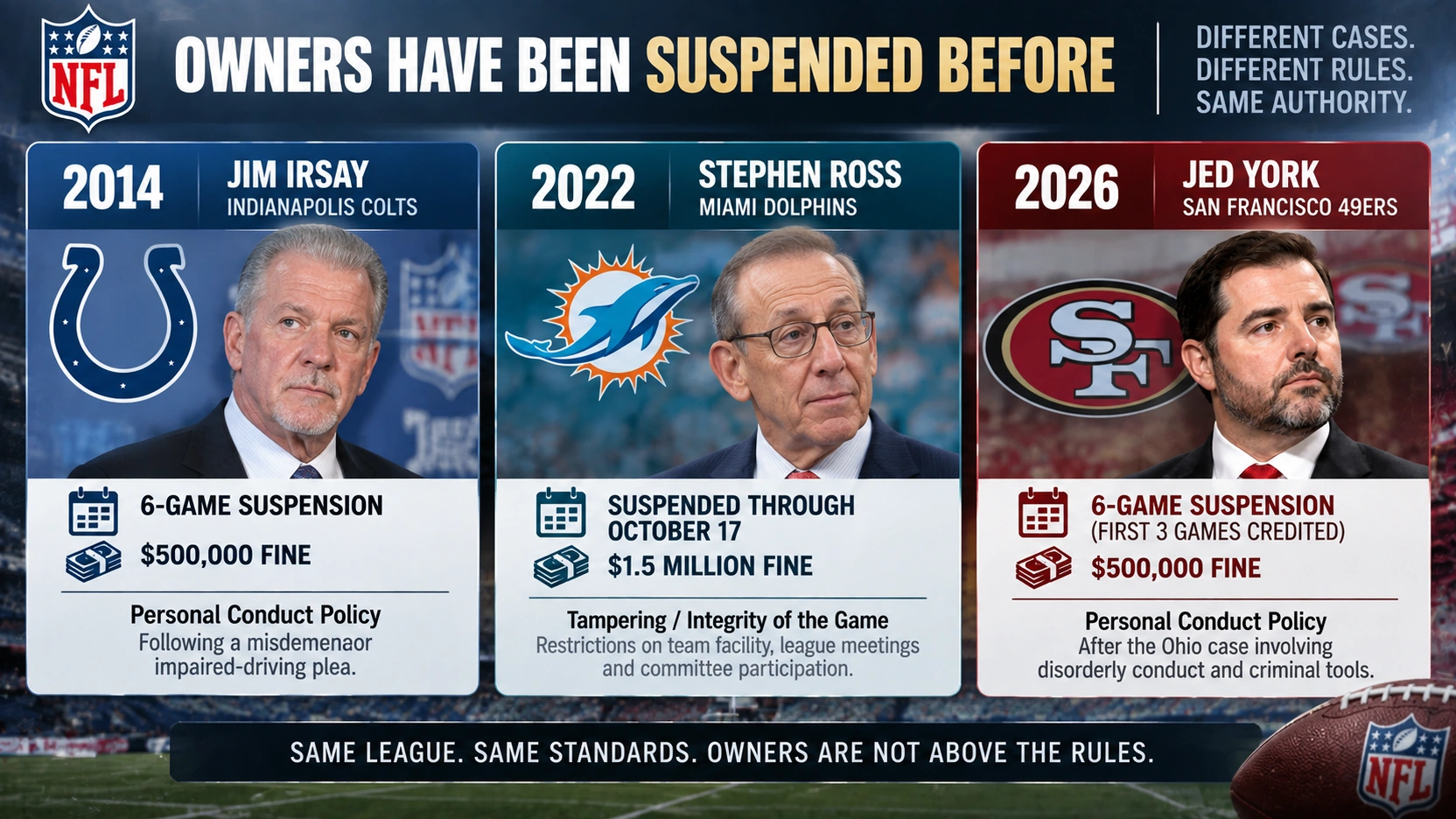
Yes. York’s case is unusual because owner suspensions are rare, but the basic mechanism has clear precedents.
| Owner | Year | What the case involved | NFL discipline highlighted here |
|---|---|---|---|
| Jim Irsay, Colts | 2014 | Personal Conduct Policy after a misdemeanor impaired-driving plea | Six games, $500,000 fine and restrictions on facility, games and league representation |
| Stephen Ross, Dolphins | 2022 | Tampering and integrity-of-the-game investigation | Suspended through October 17, $1.5 million fine, league-meeting and committee restrictions |
| Jed York, 49ers | 2026 | Personal Conduct Policy after the Ohio case | Six games, $500,000 fine, with the first three missed games credited |
The comparison needs one important warning: these are not three versions of the same offense. Ross’s case centered on league tampering and competitive-integrity rules, while Irsay and York were disciplined under personal-conduct standards. The precedents are useful for understanding what the NFL can do to an owner, not for creating a simple punishment chart. (NFL on Irsay · NFL on Ross)
What they do show is that “owner” is not the top of every hierarchy. Inside a franchise, the owner may be the highest authority. Inside the NFL, that owner still represents one member club in a league with collective rules.
Does the Suspension Change Who Owns the 49ers?
No. Nothing in the NFL’s October 2 announcement says York’s ownership stake was transferred, reduced or placed under someone else’s control. He remains listed by the 49ers as the club’s principal owner. (49ers)
That is the easiest misconception to clear up. A suspension limits York’s participation; it does not, by itself, erase his ownership. The same distinction explains why the 49ers can keep operating under their existing executives while York serves the rest of the league-imposed penalty.
The next date to watch is October 20. That is when the NFL says York is eligible to return after the 49ers finish Week 6 against the Washington Commanders on October 19. The league schedule lists that matchup for Monday night at Levi’s Stadium. (NFL.com · NFL Schedule)
What comes after that is less about a roster move and more about governance. York said in his statement that he accepted the NFL’s decision and that trust would have to be earned back over time. The league’s formal six-game penalty has a clear end date; the broader reputational consequences do not come with the same kind of calendar. (NFL.com · Reuters)
Bottom Line: What This Story Really Means
The strange-sounding part of this story is also the part that makes it worth explaining: yes, the NFL can suspend a team owner because owners are subject to league rules, too. Jed York still owns his stake in the 49ers, but the NFL can restrict his ability to participate in team and league activities and can impose a financial penalty when it finds a conduct-policy violation.
The six-game number is also less straightforward than the headline suggests. York had already stayed away for the first three regular-season games, so those games count toward the suspension. He has three more games to serve and is eligible to return on October 20.
So this is not the NFL “benching” an owner the way it benches a player. It is the league temporarily removing the privileges that come with officially representing one of its franchises.
Jed York: Key Questions Explained
Q. Can the NFL really suspend a team owner?
Yes. NFL conduct rules apply to owners as well as players, coaches and other league or club personnel, and the league can impose discipline when it determines that an owner violated those standards.
Q. Did Jed York lose ownership of the 49ers?
No. The suspension does not transfer or cancel York’s ownership interest. The 49ers continue to list him as principal owner.
Q. How long is Jed York suspended?
The NFL imposed a six-regular-season-game suspension. Because the first three games York already missed are being credited, he is eligible to return on October 20 after San Francisco’s Week 6 game.
Q. Why do the first three games count toward the suspension?
York had already stayed away from 49ers games and NFL league meetings while the league was reviewing the matter. The NFL decided those absences would count as the first half of the six-game penalty.
Q. Was Jed York convicted of engaging in prostitution?
No. He was initially charged with engaging in prostitution, but prosecutors amended that charge to disorderly conduct. York pleaded no contest to disorderly conduct and possessing criminal tools.
Q. Does the 49ers organization stop operating while York is suspended?
No. The club has an established management structure. Al Guido is CEO, while John Lynch and Kyle Shanahan lead football operations.
Q. Is an owner suspension the same as a player suspension?
No. A player suspension primarily removes the player from competition under the applicable discipline terms. An owner suspension focuses on access, representation and participation in club and league activities, while ownership itself does not automatically disappear.
Q. Have other NFL owners been suspended before?
Yes. The NFL suspended Colts owner Jim Irsay for six games in 2014 and suspended Dolphins owner Stephen Ross in 2022 in a separate tampering and integrity case. The underlying violations were different, but both cases show that owners can be restricted and fined by the league.
Did this help make the story clearer? 🙂 WIN keeps unpacking the “why” behind the news—clearly and simply!
Sources
NFL Discipline and Return Date
NFL.com — Niners owner Jed York suspended six games, fined $500K
NFL — 2026 San Francisco 49ers schedule
Reuters — 49ers owner Jed York suspended 6 games, fined $500K by NFL
Court Case and Personal Conduct Policy
Associated Press — 49ers owner Jed York pleads no contest to two misdemeanor charges in Ohio
NFL Personal Conduct Policy — official policy document
49ers Leadership and Owner-Suspension Precedents
San Francisco 49ers — Al Guido named Chief Executive Officer
NFL.com — Colts owner Jim Irsay suspended six games, fined $500K
NFL.com — Dolphins owner Stephen Ross suspended following league investigation