
Why Did Tom Kim’s Asian Games Gold Change His Military Service—and His PGA Tour Future?

A gold medal usually changes a golfer’s résumé.
For Tom Kim, one changed something much bigger: the way he can fulfill South Korea’s mandatory military-service obligation.
On October 3, 2026, the 24-year-old PGA Tour player—whose Korean name is Kim Joo-hyung—shot a final-round 64 to win the men’s individual golf title at the Asian Games in Japan. He finished at 18-under 262, three strokes clear of the three players tied behind him. (AP · Reuters)
That is why so many headlines used the phrase “military exemption.”
But that phrase can give American readers the wrong idea.
Kim did not simply win a medal and erase every military obligation. Under South Korea’s current rules, an athlete who finishes first at the Asian Games can qualify for arts and sports personnel status, a special form of service that allows qualifying athletes to continue in their designated field instead of performing ordinary active-duty military service. (National Law Information Center · Military Manpower Administration)
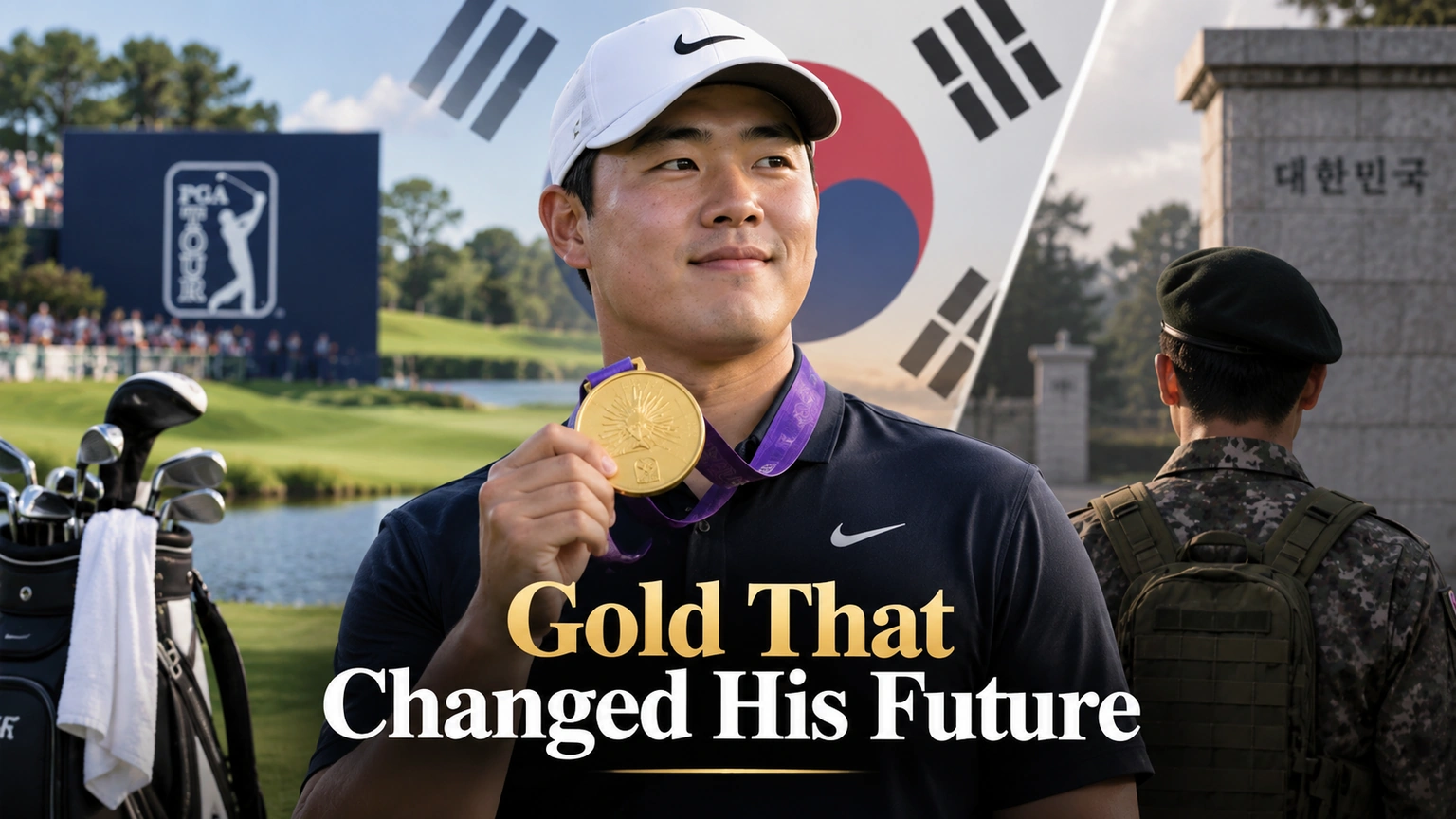
※ Images in this article are AI-generated illustrations created to help explain the story. They are not actual photographs, and depictions of people, places, or events may differ slightly from reality.
For a professional golfer who competes around the world, that distinction is enormous.
It means Kim no longer faces the same prospect of stepping away from top-level golf for roughly 18 to 21 months of conventional military service, depending on branch. (PGA Tour)
It does not mean he has no service requirements at all.
What Did Tom Kim Actually Win in Japan?
Kim won the Asian Games men’s individual golf gold medal at Kasugai Country Club in Japan.
He entered the final round with a one-stroke lead and shot 6-under 64, finishing the four-round event at 18-under par. Japan’s Kazuki Higa won silver and Thailand’s Sadom Kaewkanjana took bronze after a playoff involving the three players who finished three shots behind Kim. (AP · PGA Tour)
The result had two very different consequences.
The first was obvious: Kim became an Asian Games champion representing South Korea.
The second was unusually important to his professional future: Asian Games gold is one of the specific athletic achievements recognized under South Korea’s military-service rules for arts and sports personnel.
South Korea did not win the men’s team event. China took team gold and South Korea finished with silver. That mattered because the qualifying threshold at the Asian Games is first place—not simply winning any medal. (AP · National Law Information Center)
Why Does Asian Games Gold Change Military Service?
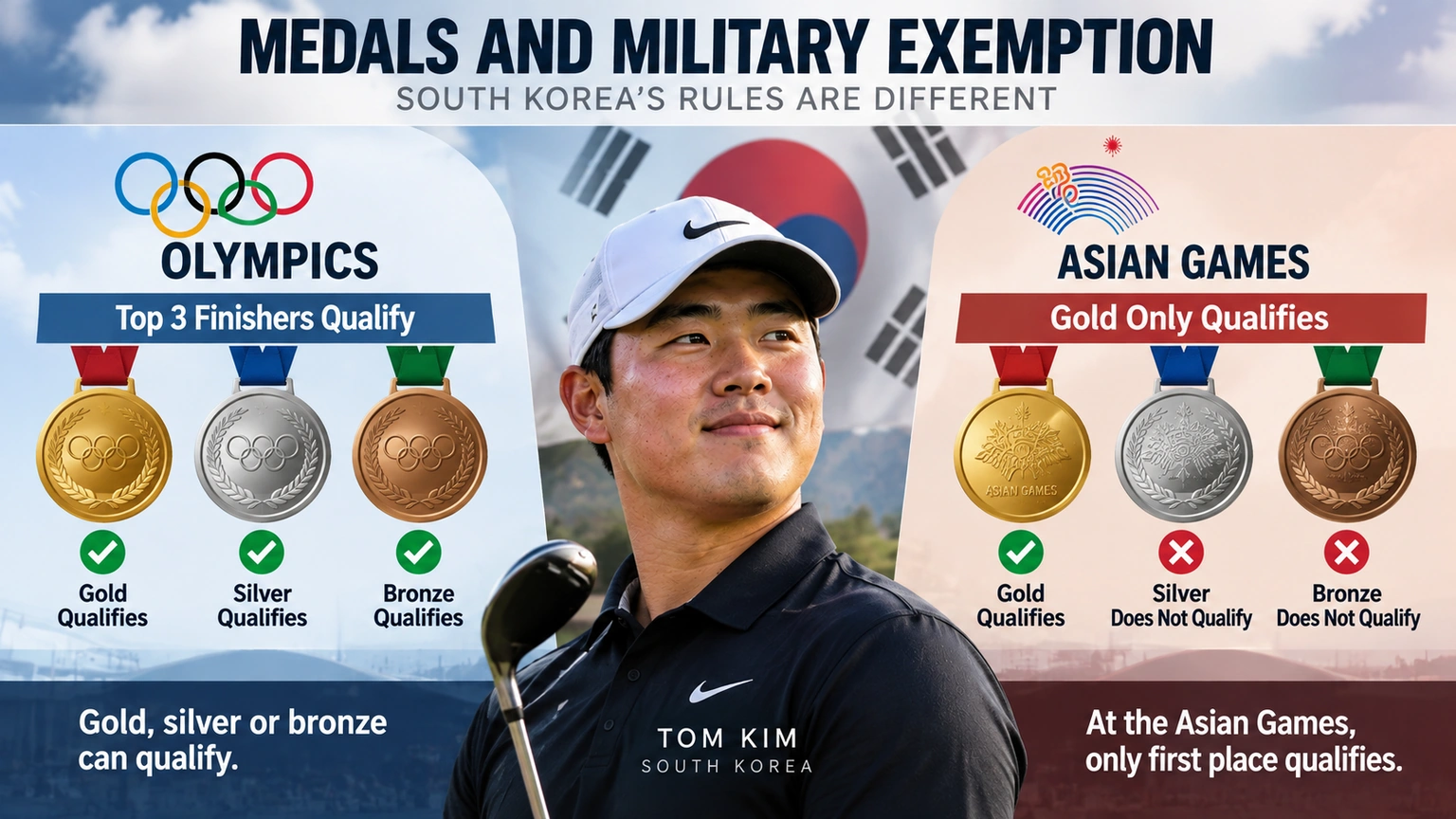
Because South Korean law names very specific competitions and finishing positions.
Under Article 68-11 of the Enforcement Decree of the Military Service Act, qualifying athletes include those who finish third or better at the Olympics and those who finish first at the Asian Games. (National Law Information Center)
That creates a rule that can look strange if you are used to thinking of medals simply as gold, silver and bronze versions of the same achievement.
| Result | Does it meet the athletic qualification? |
|---|---|
| Olympic gold | Yes |
| Olympic silver | Yes |
| Olympic bronze | Yes |
| Asian Games gold | Yes |
| Asian Games silver | No |
| Asian Games bronze | No |
| PGA Tour victory | Not by itself |
So an Olympic bronze medal can satisfy the sporting threshold.
An Asian Games silver medal cannot.
And winning a major professional tournament—even one far more lucrative or prestigious in global golf—does not replace those statutory requirements.
That helps explain why Kim’s Asian Games appearance carried stakes that had little to do with prize money or world-ranking points.
Does “Military Exemption” Mean Tom Kim Has No Military Obligations?
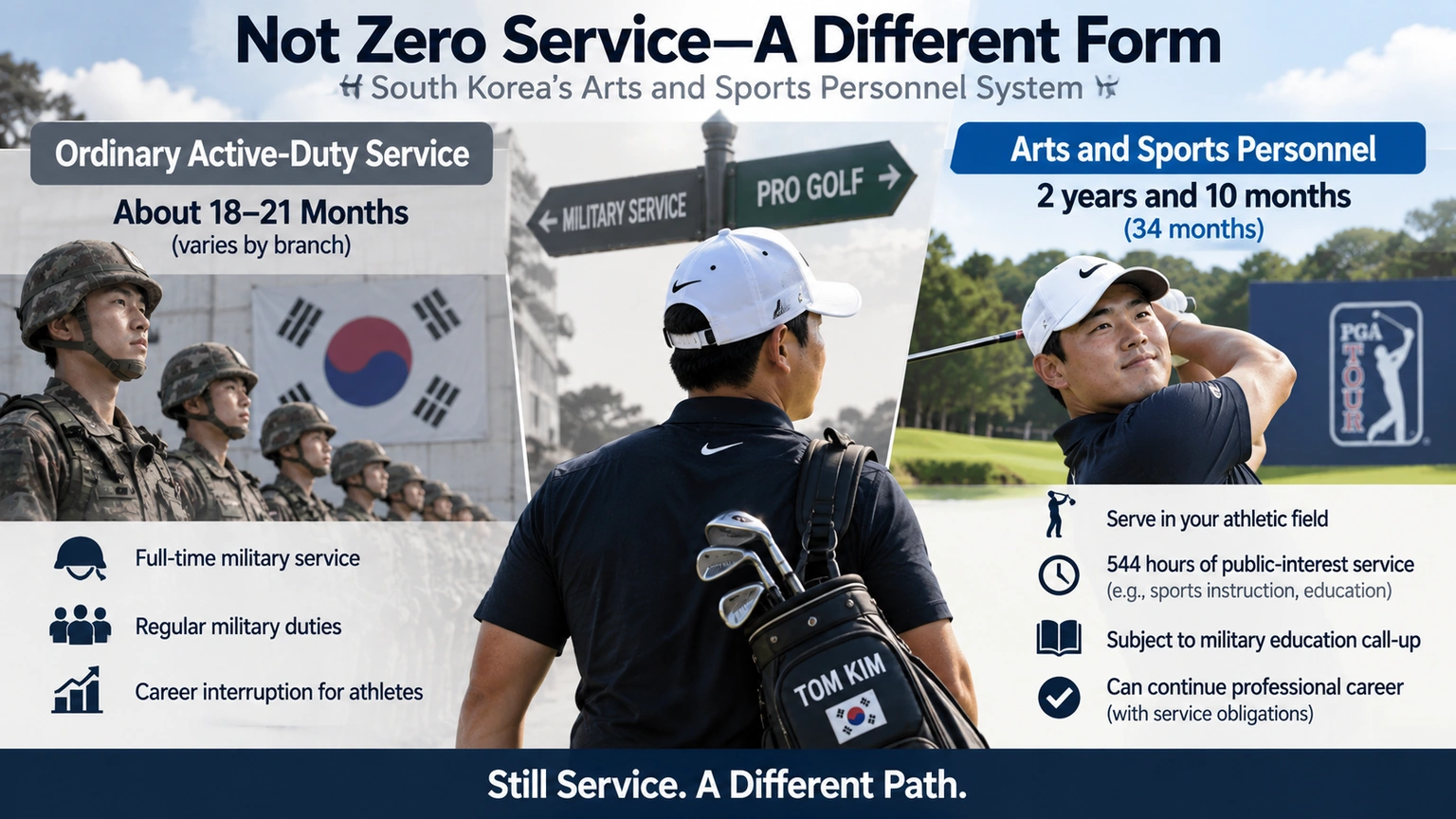
No. “Exemption” is useful shorthand, but legally it is more accurate to say Kim qualifies for a different form of service.
South Korea’s Military Manpower Administration describes arts and sports personnel as people who serve in their specialized artistic or athletic fields rather than performing conventional military duty. The service period is 34 months. (Military Manpower Administration)
During that period, arts and sports personnel must complete 544 hours of public-interest service using their professional skills. The agency lists activities such as instruction, education and public-interest campaigns among the qualifying forms of service. (Military Manpower Administration)
Arts and sports personnel are also subject to a military education call-up under the Military Service Act and its enforcement rules. The enforcement decree states that, unless an applicable exception applies, the call-up for arts and sports personnel is carried out within one year after their assignment. (National Law Information Center)
A simple comparison makes the distinction clearer:
| Ordinary active-duty route | Arts and sports personnel route |
|---|---|
| Extended service in the armed forces | Service primarily through the athlete’s designated field |
| Professional career can face a lengthy interruption | Athlete can continue activity in the qualifying sport, subject to service rules |
| Regular military duties | Specialized service plus required public-interest work |
| No athlete-specific 544-hour public-interest requirement | 544 hours of public-interest service during the service period |
So when golf coverage says Kim “avoided military service,” what it really means is that he avoided ordinary full-time active-duty service.
His military obligations did not disappear.
They changed form.
Why Was This Such a Big Deal for a PGA Tour Player?
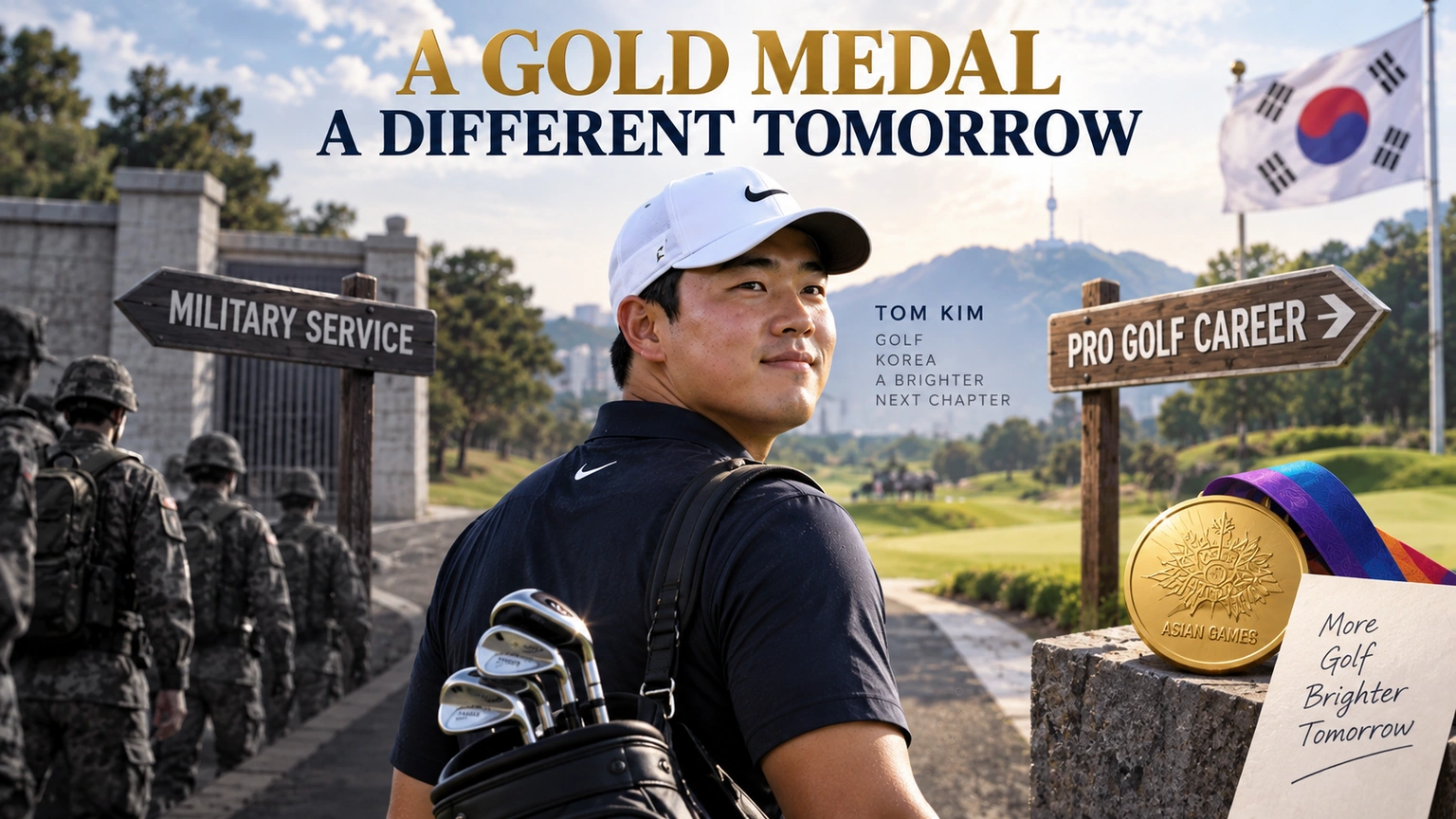
Because an elite golf career is unusually difficult to put on hold.
Tom Kim is already a four-time PGA Tour winner competing internationally at age 24. His career depends on tournament eligibility, competitive rhythm, rankings, sponsorships and maintaining performance against players who continue competing week after week. (PGA Tour)
A long interruption does not automatically end a golfer’s career.
But it can force an athlete to rebuild tournament form and professional momentum after being away from top-level competition.
The PGA Tour pointed to Seung-yul Noh and Sangmoon Bae as examples of Korean players who had already won on Tour before serving their military obligations and then faced the challenge of returning afterward. (PGA Tour)
That is what made Kim’s situation different from a normal question about whether an athlete would miss one tournament or one season.
The issue was whether one of the prime stretches of a young golfer’s career might eventually be interrupted by a national obligation that exists independently of his success on the PGA Tour.
The Asian Games gold removed that particular active-duty uncertainty.
Why Didn’t South Korea’s Team Silver Do the Same Thing?
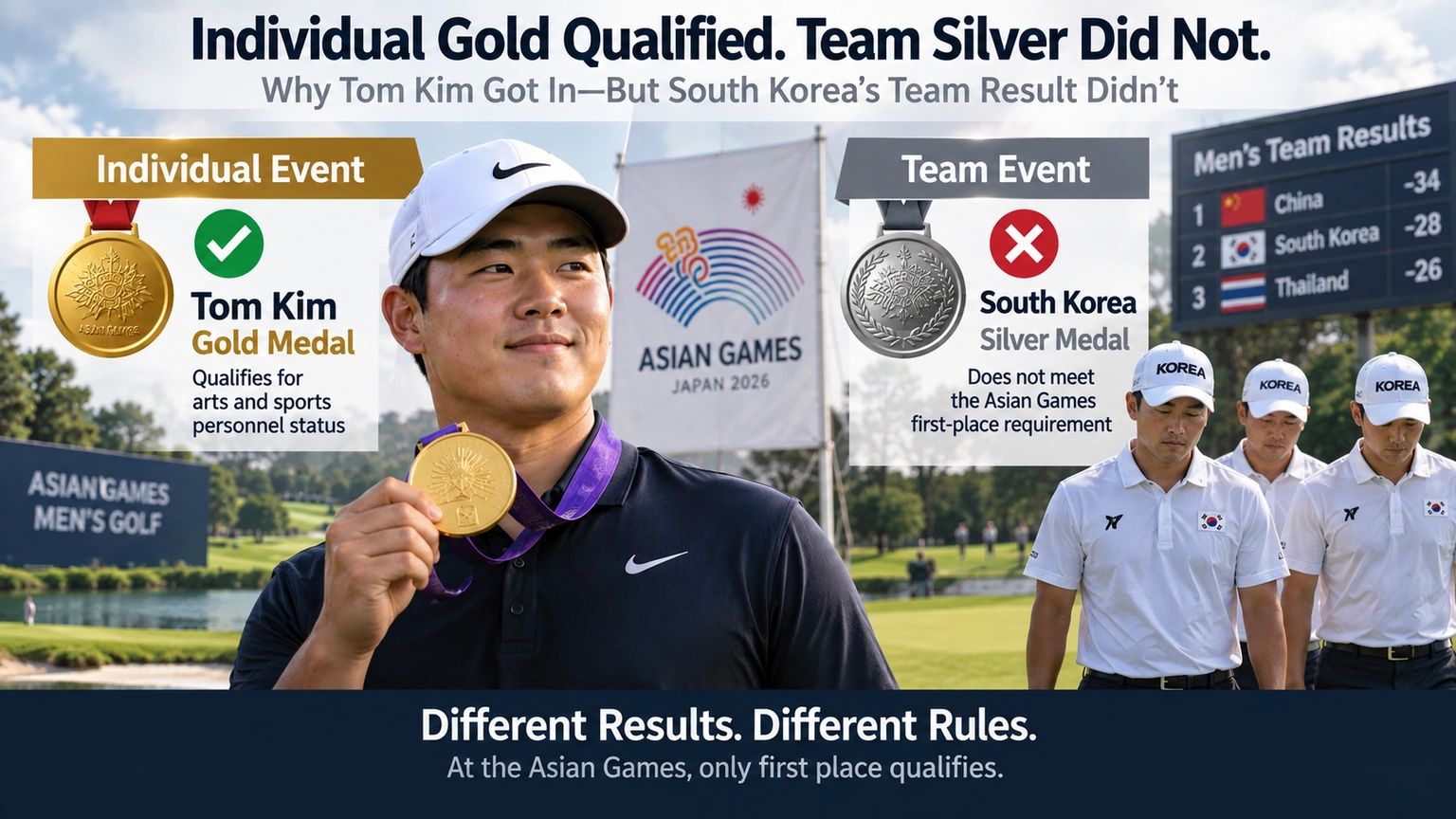
Because South Korea’s rule is tied to a result that actually meets the qualifying standard.
Kim won the individual event, so his individual gold provided a qualifying result.
South Korea finished second to China in the men’s team competition. That team silver did not meet the Asian Games first-place requirement. (AP · National Law Information Center)
This mattered especially for teammate S.H. Kim, or Kim Seong-hyeon.
Had South Korea won team gold, eligible players who actually participated could have had another qualifying path under the rule for team events. Instead, Tom Kim’s individual victory secured his own qualifying result while the team finished with silver. Teammate Mun Do-yeob had already completed military service. (AP)
The golf format made the situation even more unusual.
Three golfers represented each team, with the two best scores each day counting toward the team total. Tom Kim was therefore competing in two overlapping contests at once: one for the individual title and one for Korea’s team score. (PGA Tour)
Only one of those paths ultimately produced gold.
For Kim, one was enough.
Why Is the Olympic Rule Different?
The difference is written directly into the eligibility rules rather than being decided separately for each athlete.
South Korea recognizes an Olympic finish of third place or higher, which means gold, silver or bronze can qualify.
At the Asian Games, the athlete must finish first. (National Law Information Center)
That is why Kim’s eighth-place finish at the 2024 Paris Olympics did not resolve the issue. He finished at 13-under 271, four shots behind the bronze medal position. (Yonhap)
The system can therefore create very different stakes across competitions.
A bronze medal at the Olympics can change a Korean athlete’s military-service path.
A silver medal at the Asian Games cannot.
For American golf fans, that is probably the most important rule to understand when a Korean golfer treats a regional multi-sport event as one of the highest-pressure tournaments of his career.
What Happens Next for Tom Kim?
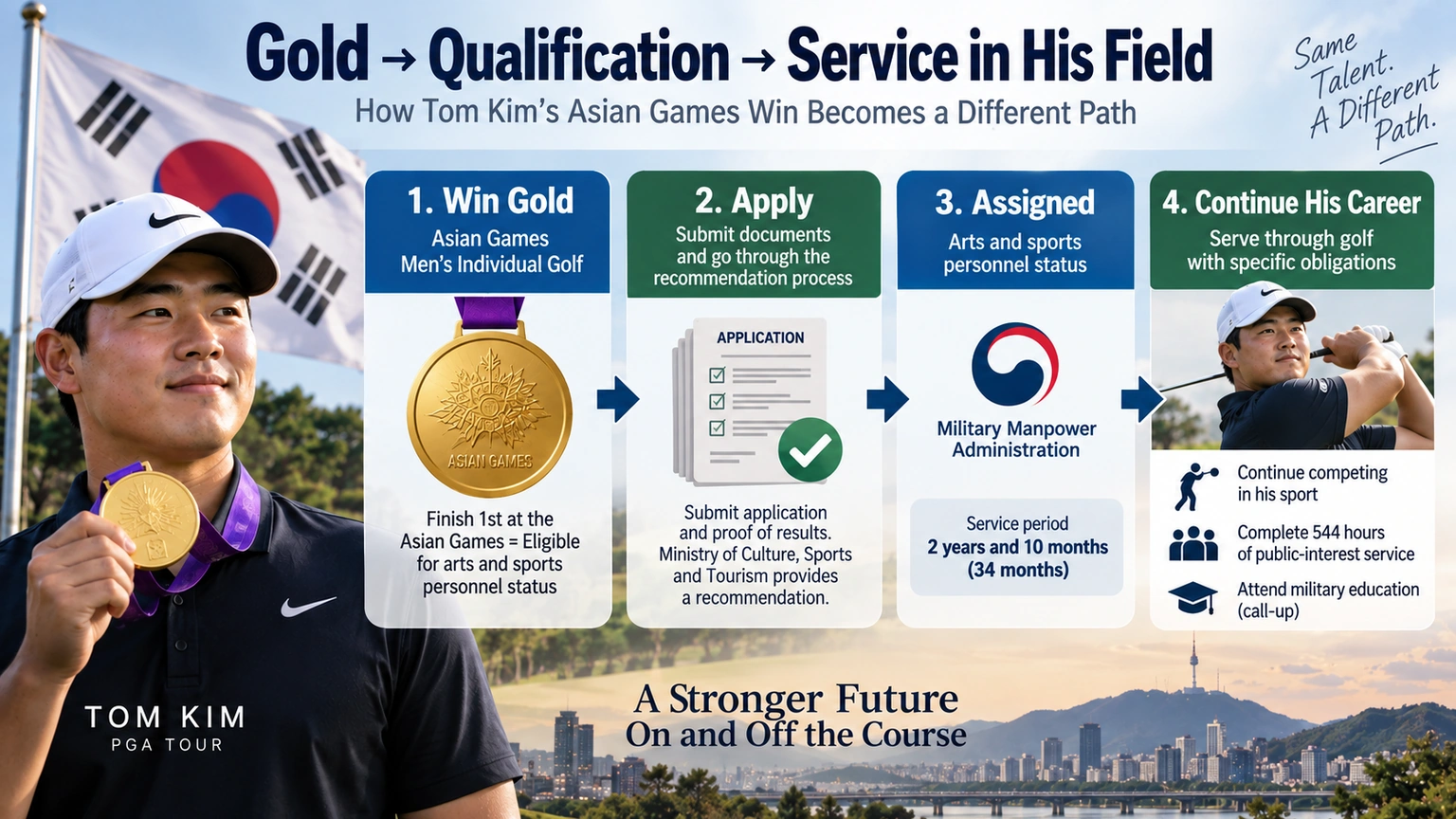
The medal gives Kim the qualifying achievement, but the legal structure still includes an administrative process.
Under the current enforcement decree, a qualifying athlete who wants to serve as arts and sports personnel submits an application and supporting documents to the Ministry of Culture, Sports and Tourism. The ministry then has 14 days after receiving the application to send its recommendation list to the head of the Military Manpower Administration. (National Law Information Center)
Once assigned, the athlete serves in the designated sports field under the rules administered by the Military Manpower Administration. The agency’s guidance specifically lists continued activity as a registered athlete among the permitted sports-service fields. (Military Manpower Administration)
That is why the most accurate way to describe the result is not:
Tom Kim no longer has any military obligation.
It is:
Tom Kim’s Asian Games gold gives him a path to avoid the long active-duty interruption that could have taken him away from the PGA Tour, while fulfilling South Korea’s military obligation through the arts and sports personnel system instead.
For his career, that distinction is enormous.
Bottom Line: What This Story Really Means
Tom Kim’s Asian Games victory was about far more than adding another gold medal to his career.
By winning the men’s individual golf title, he met one of South Korea’s specific legal thresholds for arts and sports personnel status: Asian Games gold.
That gives him a path to avoid the extended interruption of ordinary active-duty military service and continue his professional golf career while fulfilling a different set of service obligations.
But “military exemption” should not be read as “no service at all.”
The arts and sports personnel system carries a 34-month service period in the designated field, a military education call-up and 544 hours of public-interest service. (Military Manpower Administration · National Law Information Center)
For PGA Tour fans, the simplest way to understand the news is this:
The gold medal did not erase Tom Kim’s military obligation. It changed the kind of service he can perform—and removed the biggest threat of a long active-duty interruption to his golf career.
Tom Kim Military Exemption: Key Questions Explained
Q. Did Tom Kim receive a complete exemption from South Korean military service?
Not exactly. Tom Kim’s Asian Games gold gives him the qualifying result needed to apply for arts and sports personnel status instead of ordinary active-duty military service. That system still carries military and public-service obligations.
Q. Why did Tom Kim need gold at the Asian Games?
Because South Korea’s current rules recognize first place at the Asian Games as the athletic qualification. Silver and bronze do not meet that threshold.
Q. Would an Olympic bronze medal have been enough?
Yes. South Korea’s rules recognize athletes who finish third or better at the Olympics, so Olympic gold, silver or bronze can qualify.
Q. How long do arts and sports personnel serve?
The service period is 34 months, but qualifying athletes serve primarily through their designated athletic field rather than ordinary full-time active duty.
Q. Does Tom Kim still have to undergo military education?
Yes. Arts and sports personnel are subject to a military education call-up under South Korea’s Military Service Act and its enforcement rules, subject to applicable exceptions.
Q. How much public-interest service is required?
Arts and sports personnel are required to complete 544 hours of public-interest service using their specialized skills during the service period.
Q. Can Tom Kim continue playing professional golf?
The arts and sports personnel system allows qualifying athletes to serve in their designated sport, subject to the program’s rules and other obligations. That is what makes the result so important to the continuity of Kim’s PGA Tour career.
Q. Why didn’t South Korea’s team silver give the same benefit?
Because Asian Games eligibility requires first place. South Korea won silver in the men’s team competition, while Tom Kim separately won individual gold and therefore had his own qualifying result.
Did this help make the story clearer? 🙂 WIN keeps unpacking the “why” behind the news—clearly and simply!
Sources
Asian Games Result and PGA Tour Stakes
Reuters — South Korean golfer Kim wins Asian Games gold and military exemption
PGA Tour — Tom Kim delivers gold for South Korea at Asian Games
South Korea’s Arts and Sports Personnel Rules
National Law Information Center — Enforcement Decree of the Military Service Act, Article 68-11
Military Manpower Administration — Arts and Sports Personnel: Service Management and Fields