
Can the White House Ban Entire News Organizations—and What Happens If They Sue?
Can the White House simply ban an entire news organization because the president dislikes its coverage?
And is that the same legal question as deciding which reporters get into the Oval Office?
Those questions moved from theory to reality after President Donald Trump announced on September 18, 2026, that CNN, MS NOW and Politico would be barred from the White House. The next morning, journalists from all three organizations were denied entry, and some had their press credentials deactivated or confiscated. (Reuters · CBS News)
Trump said the outlets had been reporting what he called “fake news.” The White House did not publicly identify a security incident involving the affected reporters, while CNN, Politico and MS NOW said they would defend their First Amendment rights. (AP · CBS News)
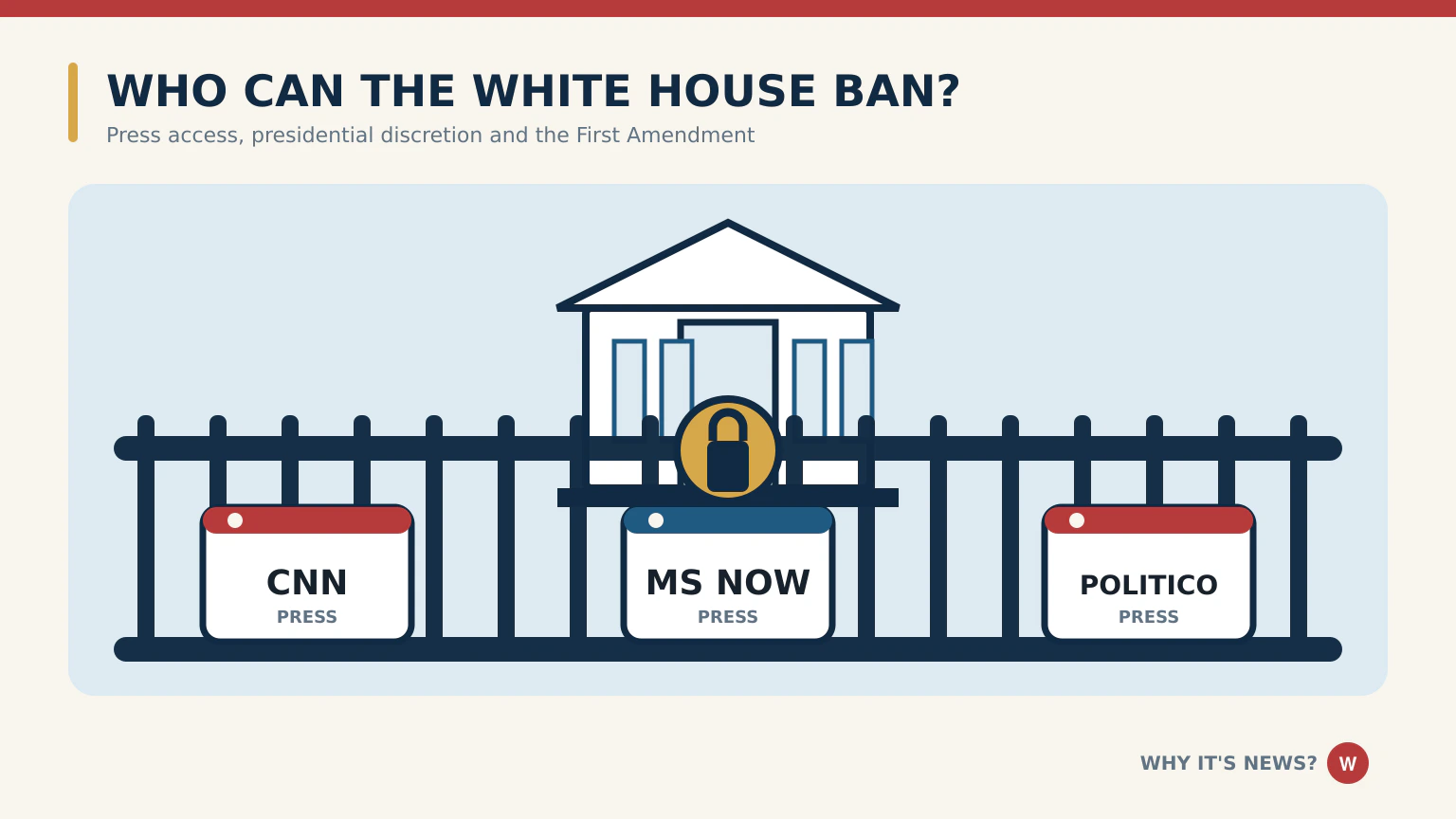
The complicated part is that “press access to the White House” is not one single legal right. A credential that lets a reporter work from the general White House press area is not necessarily treated the same way as an invitation to a small Oval Office event or a one-on-one interview with the president.
That distinction could become central if the dispute reaches federal court.
What Did the White House Actually Do?
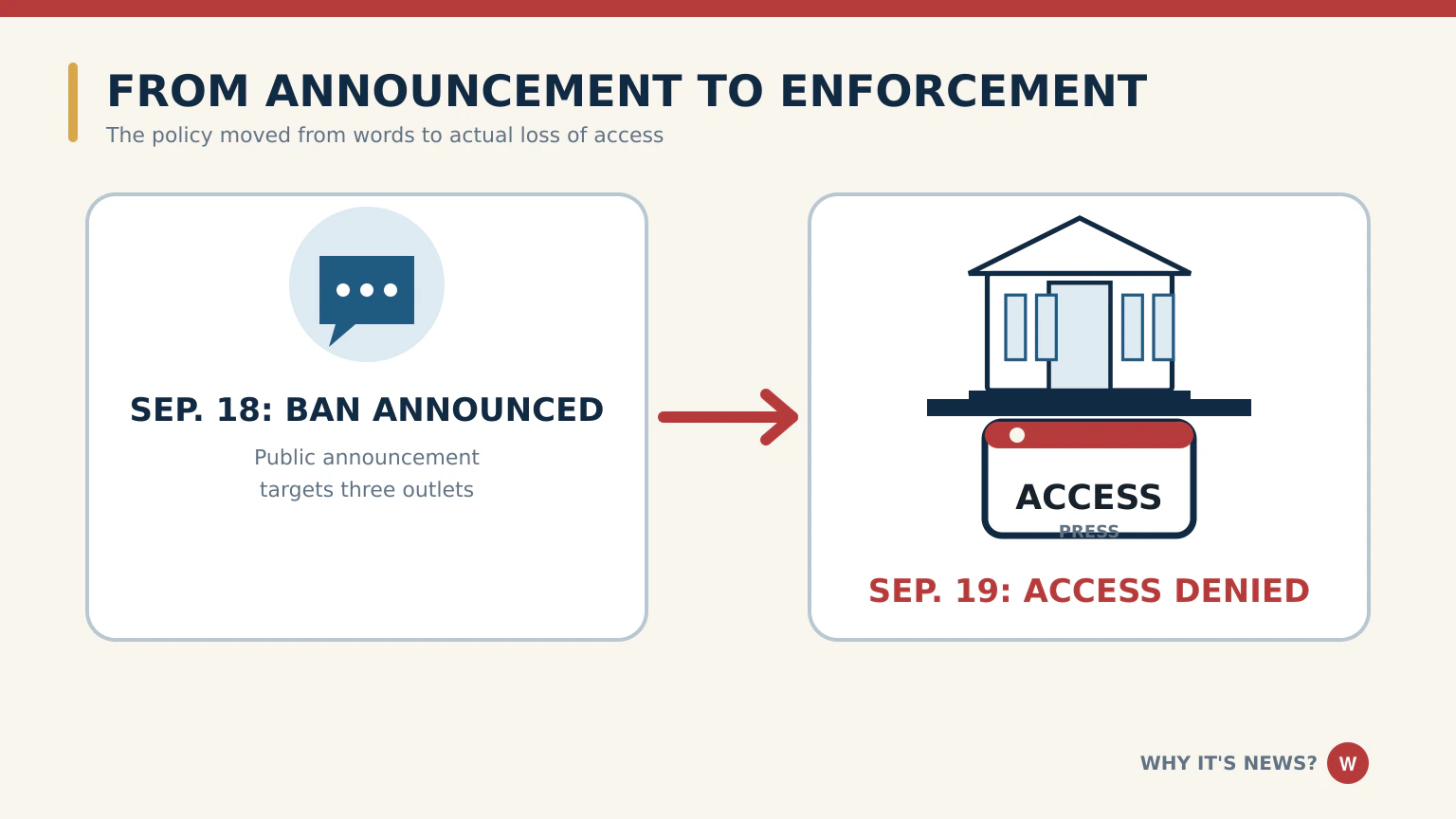
This was not merely a threat to exclude the outlets from one press conference.
Trump announced that CNN, MS NOW and Politico were being banned from the White House. On September 19, CNN senior White House reporter Betsy Klein, MS NOW correspondent Akayla Gardner and Politico reporter Cheyenne Haslett were among the journalists who were turned away when they attempted to enter. CBS News reported that passes were disabled or confiscated. (Reuters · CBS News)
That detail matters.
A president has broad practical control over whom to call on, whom to interview and how many reporters can fit into restricted presidential spaces. Revoking the credentials that reporters use to enter the broader White House press area presents a different question.
Does the First Amendment Guarantee Reporters Access to the White House?
No. The First Amendment does not mean every journalist has an automatic constitutional right to enter every government building, attend every presidential meeting or receive an interview.
But courts have drawn an important distinction once the government creates press facilities and an established credentialing system that is generally available to qualified journalists.
D.C. Circuit precedent has treated the general White House press area as a type of nonpublic forum. In that setting, access rules can exist, but courts have said they must be reasonable and may not be based on the journalist’s viewpoint. The government has more discretion when the president is deciding whom to admit to much smaller, restricted spaces or whom to speak with personally.
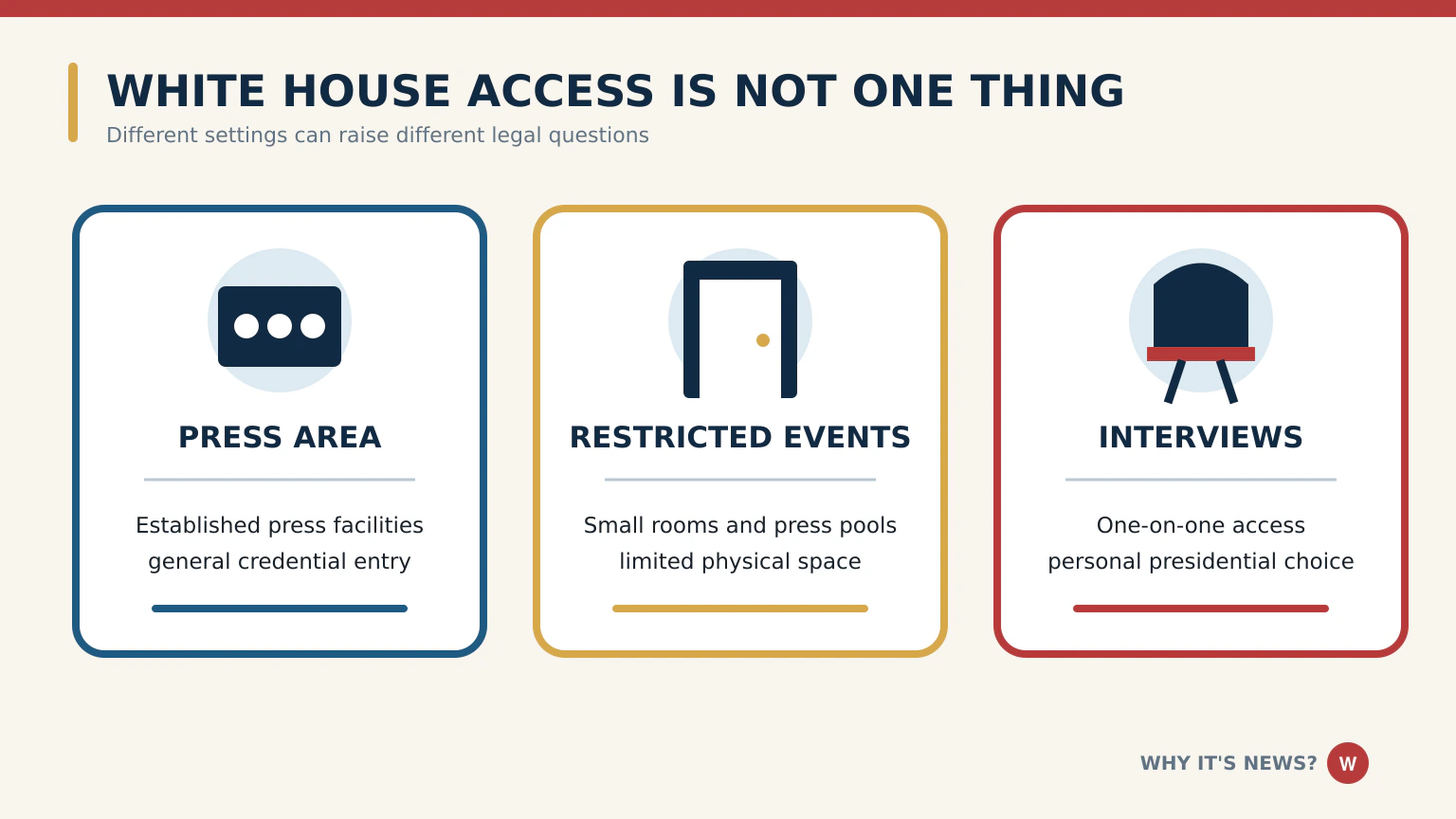
A simple way to see the difference is this:
| Type of access | Example | Why the distinction matters |
|---|---|---|
| General press access | White House press facilities and ordinary credentialed entry | Courts have imposed stronger limits on arbitrary or viewpoint-based exclusion |
| Restricted presidential access | Small Oval Office events and limited press pools | The president and White House have greater discretion over limited space |
| Individual access | Interviews or direct conversations with the president | The president is generally free to choose whom to speak with |
The new controversy is especially significant because reporters said their credentials were disabled or confiscated at the White House entrance rather than simply being left off the list for one small event. (CBS News)
Why Does “Viewpoint Discrimination” Keep Coming Up?
Because the publicly stated reason for the ban focused on the outlets’ journalism.
Trump described CNN, MS NOW and Politico as purveyors of “fake news” and said he was tired of what he viewed as dishonest coverage. He did not publicly point to a security violation by the reporters who were denied entry. (AP · CBS News)
In First Amendment law, viewpoint discrimination generally means the government treats a speaker differently because it approves or disapproves of the speaker’s position or message.
That is why the affected outlets and press-freedom groups are framing this as more than an ordinary credential dispute.
Their likely argument is straightforward: if other credentialed news organizations may enter but these three were excluded because the president objects to their reporting, the government is conditioning access on editorial viewpoint.
The White House, if litigation follows, could argue that the president has substantial authority to control access to presidential workspaces and events. The strength of either argument would depend in part on exactly which spaces and privileges the ban covers.
That last point is important because recent litigation has shown that courts do not necessarily treat the briefing room, the East Room, the Oval Office and other limited spaces as legally identical.
Haven’t Courts Already Decided This Kind of Fight?
They have decided parts of it, but not one rule that answers every possible White House press-access dispute.
During Trump’s first term, the White House revoked CNN correspondent Jim Acosta’s credential after a contentious November 2018 press conference. CNN sued, and a federal judge ordered the credential temporarily restored. The dispute centered heavily on whether Acosta had received adequate procedural protections before losing the pass. The White House later restored it. (CBS News)
A more recent fight involved the Associated Press.
In 2025, the White House restricted AP access after the organization continued using “Gulf of Mexico” in its style guidance rather than adopting Trump’s preferred “Gulf of America.” A federal district judge issued a preliminary injunction requiring the government not to exclude the AP because of its viewpoint. An appeals court later paused much of that order as it applied to smaller restricted presidential spaces while allowing part of it to remain in effect for the East Room. (CBS News)
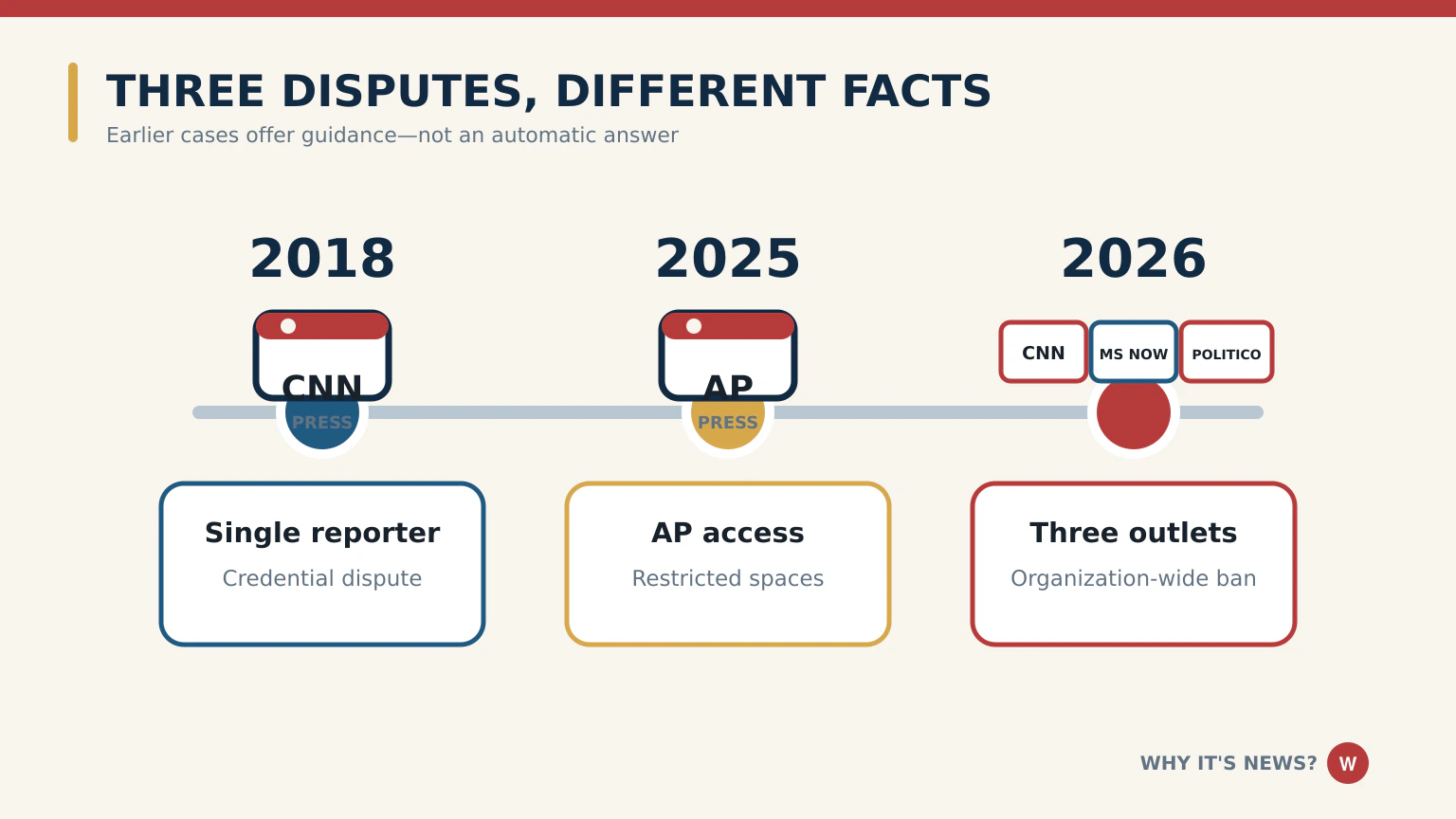
The lesson from those earlier disputes is not simply “the press always wins” or “the president controls everything.”
It is that courts look closely at what kind of access was taken away, why it was taken away and what process was used.
Is Banning an Entire News Organization Different From Suspending One Reporter?
It is broader in practical effect, but that does not automatically determine the legal result.
When one reporter loses a credential because of alleged conduct, a court can examine what that individual did, what rule applied and whether the reporter had notice and an opportunity to respond.
An outlet-wide ban raises a different factual problem. Reporters, photographers, producers and other employees can lose access even if they were not personally accused of misconduct.
That makes the government’s stated reason especially important.
If the restriction is tied to the organization’s editorial coverage rather than specific behavior by individual credential holders, the affected outlets could argue that the government is punishing the newsroom’s speech rather than enforcing a neutral access rule.
But the physical location still matters. Excluding an organization from the general White House press facilities would present a different legal question from declining to include that organization in one very small presidential event.
What Happens If CNN, MS NOW or Politico Sue?
A lawsuit would probably begin with a request for fast court action rather than waiting months or years for a final judgment.
The organizations could seek a temporary restraining order or preliminary injunction asking a federal judge to restore access while the case proceeds. Similar emergency requests have been used in earlier press-credential disputes.
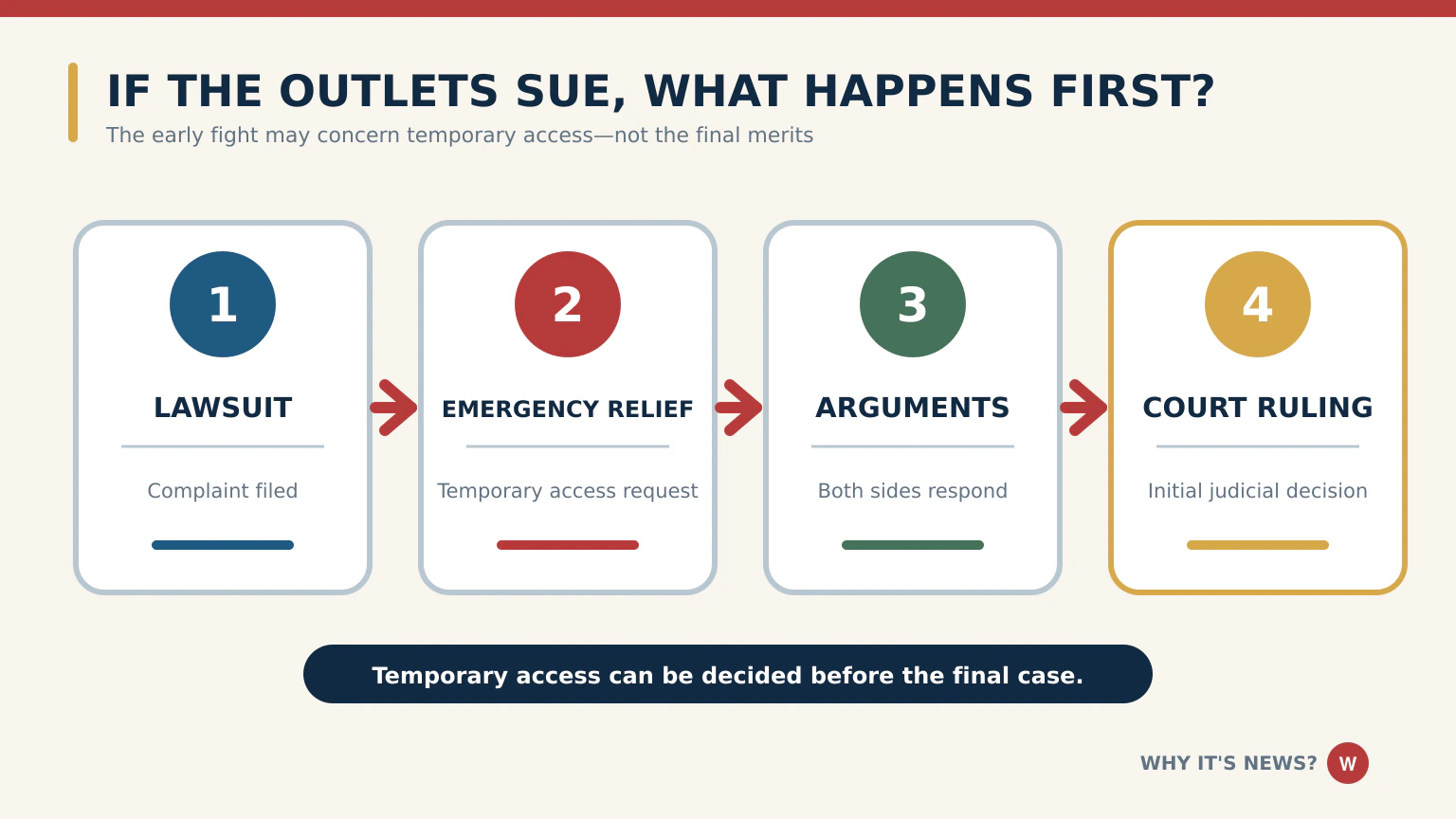
A judge would likely need to sort through several separate questions:
- Were the outlets barred from the general White House press area, only from limited presidential spaces, or both?
- What official reason did the administration give for revoking the credentials?
- Were comparable news organizations still allowed access?
- Were the affected reporters given any formal notice, standards or opportunity to challenge the loss of their passes?
- Does the restriction operate against specific reporters or against the news organizations as a whole?
The news organizations would be expected to emphasize the First Amendment and, depending on the credential process, procedural protections associated with losing an established press pass.
The administration could emphasize the president’s authority over physical access, security and the operation of restricted presidential spaces.
A court would then have to decide which line of precedent best fits the actual scope of this ban. That is why the details of how the policy is being enforced could matter as much as Trump’s announcement itself.
Why Does White House Access Matter If the Outlets Can Still Report From Outside?
Because banning reporters from a building does not stop a news organization from publishing—but it can change how reporters gather information.
White House reporters use physical access to attend briefings, observe presidential events, ask officials questions, speak with aides and participate in press pools. Losing that access can make firsthand newsgathering more difficult.
At the same time, CNN, MS NOW and Politico can continue covering the administration through public events, official feeds, interviews, sources, court records and reporting from outside the White House. CNN said its coverage of the government would continue despite the restriction. (CBS News)
So this is not literally a ban on those organizations publishing news about the president.
The legal fight is narrower: whether the government can selectively remove physical access that it continues to provide to other members of the press, and on what grounds.
What Should Readers Watch Next?
The first thing to watch is whether the three outlets formally challenge the ban in federal court.
The second is the precise scope of the restriction. If reporters remain excluded from the entire White House press area rather than only selected presidential events, that distinction could become important in any legal filings.
Another question is whether the White House issues written criteria explaining when an entire news organization may lose its credentials.
Trump has also suggested that other outlets could face similar restrictions, which means the dispute may expand beyond CNN, MS NOW and Politico. (Reuters · AP)
The most important legal development will not simply be whether someone files a lawsuit. It will be how a court defines the access at issue: general press credentials, restricted presidential spaces, or both.
Why It Matters in One Sentence
The dispute is not simply about whether a president must invite every reporter everywhere; it is about whether the government can revoke broad White House press access because it objects to a news organization’s coverage.
White House Media Ban: Key Questions Explained
Q. Did the White House actually bar CNN, MS NOW and Politico reporters?
Yes. Journalists from the three organizations were denied access on September 19, 2026, after Trump announced the ban the previous day, and reporters said credentials were deactivated or confiscated. (Reuters · CBS News)
Q. Does the First Amendment give every reporter a right to enter the White House?
No. The First Amendment does not guarantee every journalist access to every room, event or presidential interview. Courts have drawn stronger protections around established press facilities that the government has opened to credentialed journalists.
Q. What is viewpoint discrimination?
It is government treatment that turns on the position or message expressed by a speaker. In this dispute, the affected outlets could argue that they lost access because the president objected to their coverage.
Q. Can the president decide who enters the Oval Office?
The president has substantially more discretion over small, restricted presidential spaces than over established general press facilities. Recent AP litigation illustrates why courts may treat those settings differently.
Q. Why could due process matter in a press-pass case?
Courts have previously examined whether reporters were given clear standards, notice and an opportunity to respond before established credentials were suspended or revoked.
Q. Does losing White House access prevent an outlet from covering the president?
No. The organizations can continue publishing and reporting through other sources and locations, but losing direct physical access can limit firsthand observation and opportunities to question officials.
Q. What could the outlets ask a court to do first?
They could seek emergency relief restoring access while the broader constitutional case is litigated. A preliminary ruling on access would not necessarily be the final decision on the merits.
Q. What is the biggest unresolved question?
The key issue is how broadly the ban operates. A court could view exclusion from general White House press facilities differently from exclusion from a small, invitation-only presidential event.
Did this help make the story clearer? 🙂
WIN keeps unpacking the “why” behind the news—clearly and simply!
Sources
September 18–19 Ban and Enforcement
Reuters — White House Turns Away CNN, MS NOW, Politico Reporters After Trump’s Ban
CBS News — CNN, MS NOW and Politico Staffers Turned Away From White House
First Amendment Questions and Earlier Press Access Disputes
AP — CNN, MS NOW and Politico Reporters Denied White House Access
CBS News — White House Media Ban and Earlier CNN/AP Credential Cases