Why Is Adidas Making a Comeback While Nike Is Still Struggling?

For decades, Nike seemed to have the upper hand in the global sneaker business. Adidas was its biggest traditional rival, but Nike often set the pace in American sports culture, athlete endorsements, and sneaker hype.
Now the two companies seem to be moving in different directions.
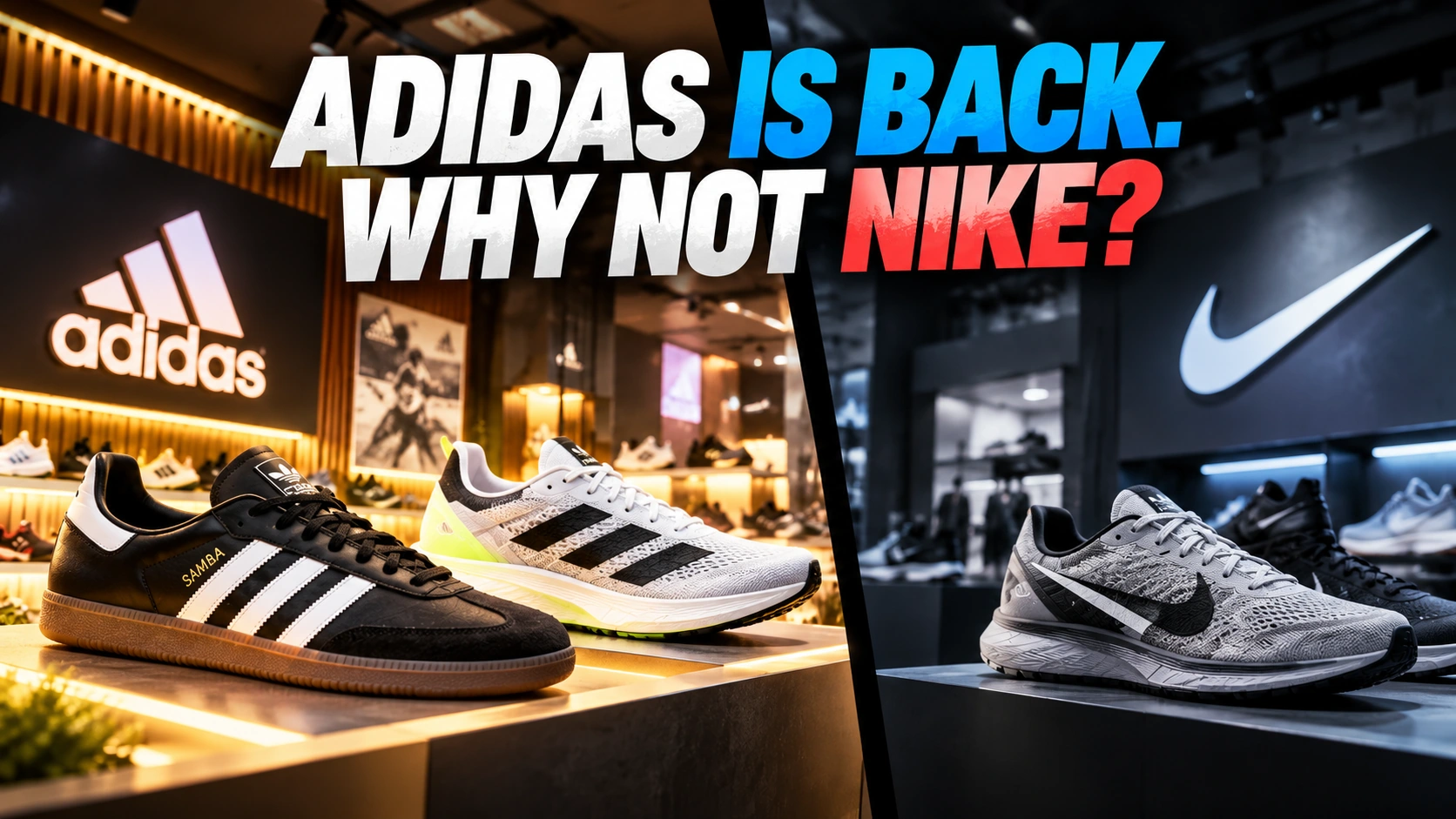
Adidas has returned to record sales, with its classic sneakers back on city streets and its running shoes winning major marathons. Nike, meanwhile, is still working through a difficult turnaround, with sales pressure in China and weakness in parts of its lifestyle business.
So what happened? Didn’t both companies face many of the same problems?
They did. Both confronted shifting consumer tastes, stronger competitors, trouble in China, and questions about how they sold their products.
The difference is that Adidas managed to turn several of those challenges into opportunities—and its comeback went much deeper than one popular sneaker.
※ Images in this article are AI-generated illustrations created to help explain the story. They are not actual photographs, and depictions of people, places, or events may differ slightly from reality.
In 2025, Adidas reported record annual revenue of €24.8 billion. Its operating profit climbed 54% from the previous year.
The recovery continued into 2026. Adidas generated a record €13.3 billion in revenue during the first six months, while operating profit rose 11%.
Nike’s latest reported quarter told a less encouraging story: revenue fell 4%, and sales in Greater China declined sharply.
These figures cover different reporting periods, so they are not a direct head-to-head growth comparison. They do, however, illustrate why the two companies’ recent fortunes have attracted so much attention. (Adidas · Nike)
To understand why Adidas recovered, it helps to go back to the moment when the company appeared to be losing its way.
How Bad Did Adidas’ Crisis Actually Get?
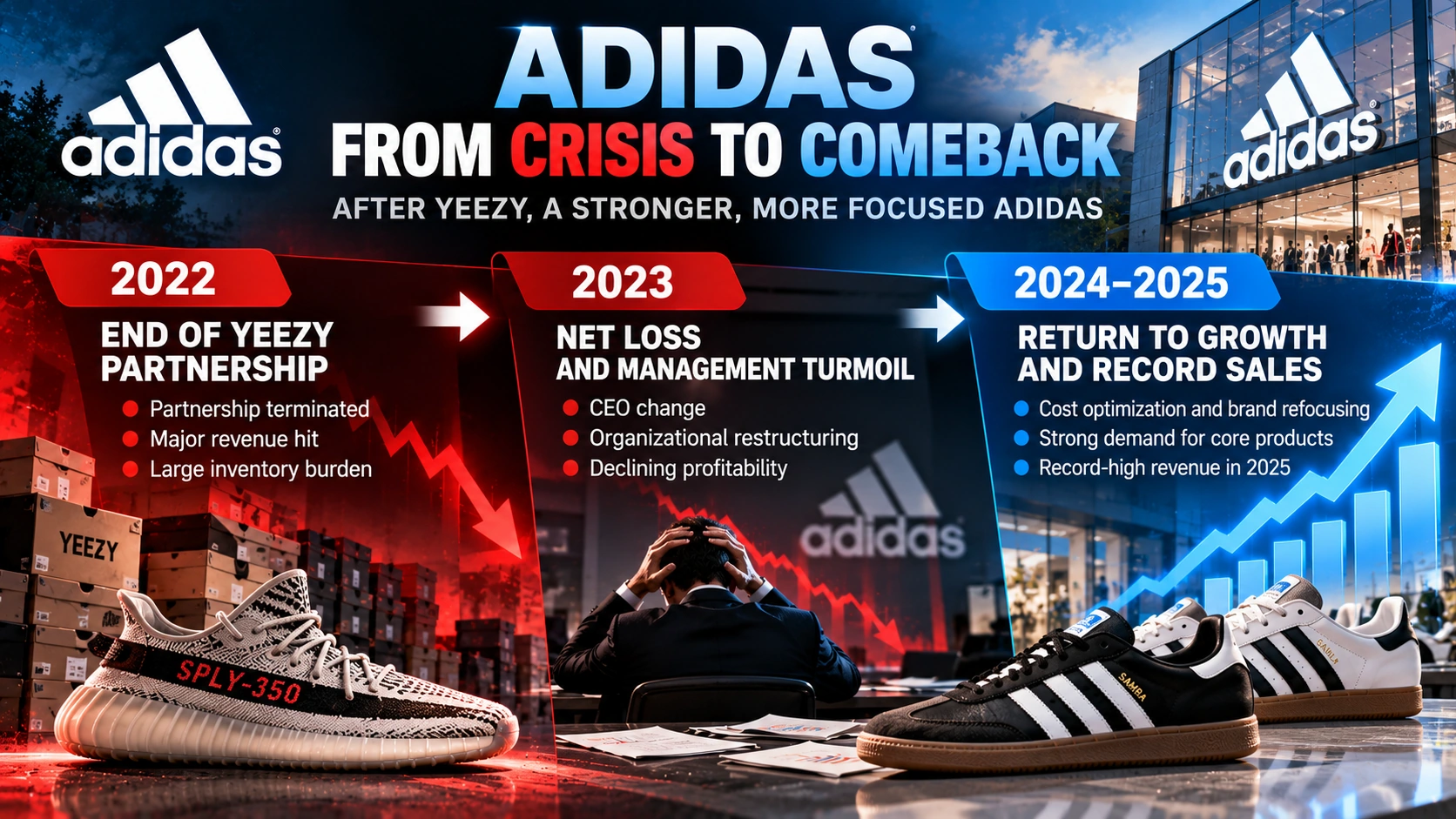
Adidas entered 2023 with several problems colliding at once. Its lucrative Yeezy partnership had collapsed, its Chinese business was under pressure, and the wider sneaker market was becoming more competitive.
The Yeezy breakup was especially painful.
For years, Adidas had collaborated with Ye, formerly known as Kanye West, on sneakers that attracted huge consumer interest and commanded remarkable resale prices.
The partnership helped give Adidas a stronger position in sneaker culture, particularly in the United States.
But the business also depended heavily on the public behavior of one celebrity.
On October 25, 2022, Adidas terminated the partnership after Ye made antisemitic statements. The company said the remarks violated its values and announced an immediate end to the Yeezy business. (Adidas)
The decision created a difficult financial problem.
Adidas could stop working with Ye, but it still had existing Yeezy inventory. Simply disposing of those products would destroy their remaining commercial value, while continuing sales required navigating the controversy surrounding the partnership.
The company eventually sold much of the remaining inventory, with associated donations and provisions for donations to organizations addressing discrimination and related harms.
Its 2023 results showed just how difficult the transition had become.
| Financial measure | 2023 | 2025 |
|---|---|---|
| Annual revenue | €21.43 billion | €24.81 billion |
| Operating profit | €268 million | €2.06 billion |
| Net income from continuing operations | –€58 million | €1.38 billion |
| Operating margin | 1.3% | 8.3% |
Figures: Adidas 2023 financial highlights and 2025 financial highlights.
One distinction matters here: Adidas recorded a net loss in 2023, but it did not record a full-year operating loss. Its operating business remained profitable, although earnings had fallen dramatically.
This was more than a temporary setback. Adidas had lost an important source of revenue and cultural relevance at a time when its traditional competitors were facing difficulties of their own.
And the Yeezy problem was only one part of the story.
Why Did China Become Such a Difficult Market for Both Brands?
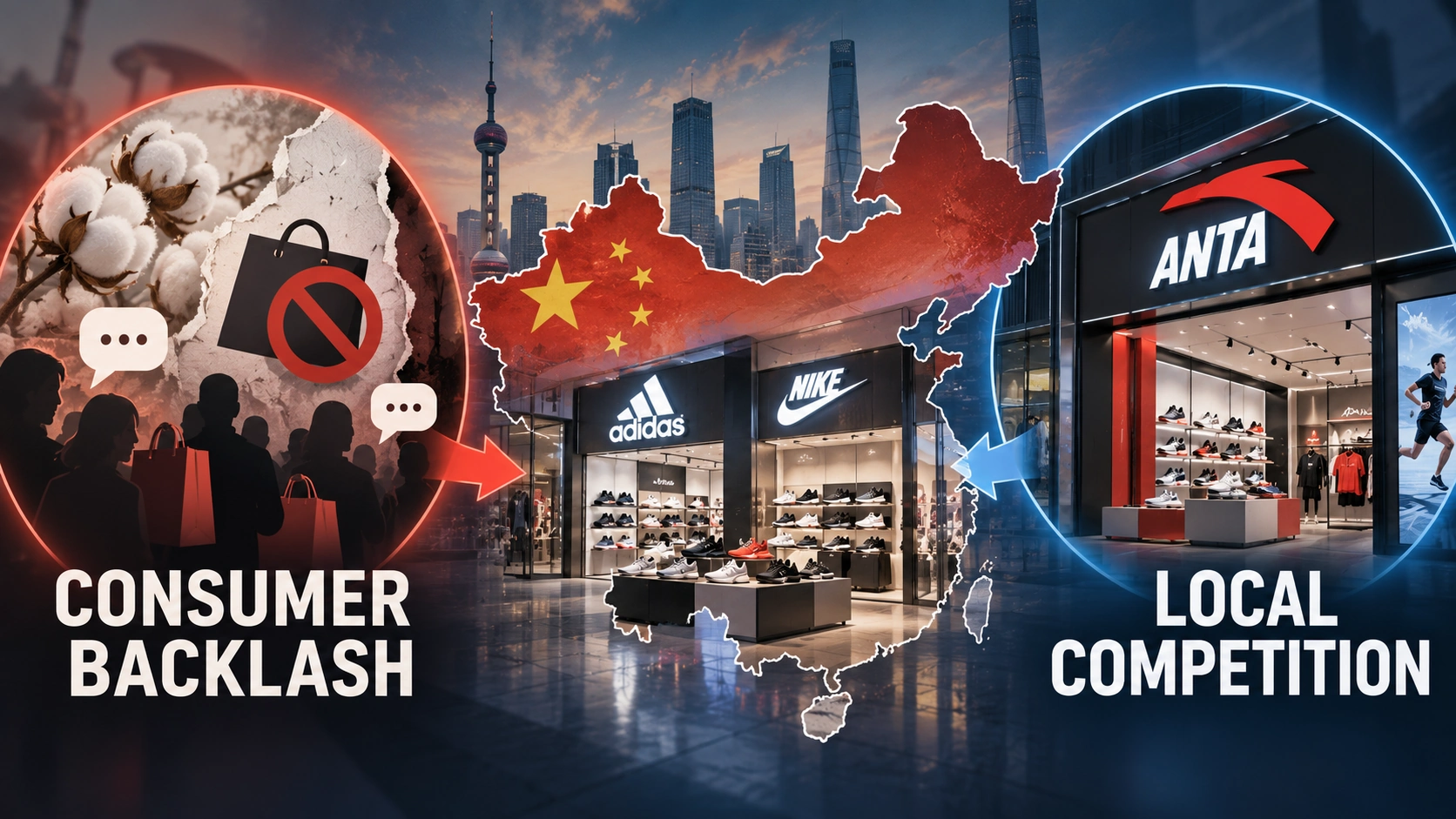
China had long been a major growth market for Nike and Adidas. But the companies faced a combination of political controversy, pandemic disruptions, and increasingly successful local competitors.
The most politically sensitive issue centered on cotton from China’s Xinjiang region.
Western governments and human rights organizations raised concerns about forced labor involving Uyghurs and other predominantly Muslim minority groups. Beijing rejected accusations of widespread abuses.
International apparel companies came under pressure to address the risks in their supply chains.
In 2021, statements by brands including Nike and Adidas about Xinjiang cotton became the focus of criticism in China. Chinese state media and online campaigns encouraged consumers to reject several foreign brands. (Associated Press)
The controversy exposed a difficult reality for global companies: they could face pressure in Western markets over human rights concerns while also facing commercial retaliation or consumer backlash in China.
COVID-era restrictions added another complication, disrupting stores, shopping patterns, and normal business operations.
But the deeper competitive problem was not limited to boycotts.
Chinese sportswear companies were becoming much stronger.
Anta, for example, expanded through multiple brands and price segments, building a business that combined affordable sportswear with higher-end athletic and outdoor products.
By 2025, Anta had become China’s leading sportswear group by market share, according to its annual results. (Anta Sports)
That made the challenge harder for Nike and Adidas. Recovering from a political controversy would not automatically bring back customers who had discovered competitive alternatives.
So how did Adidas begin recovering in China?
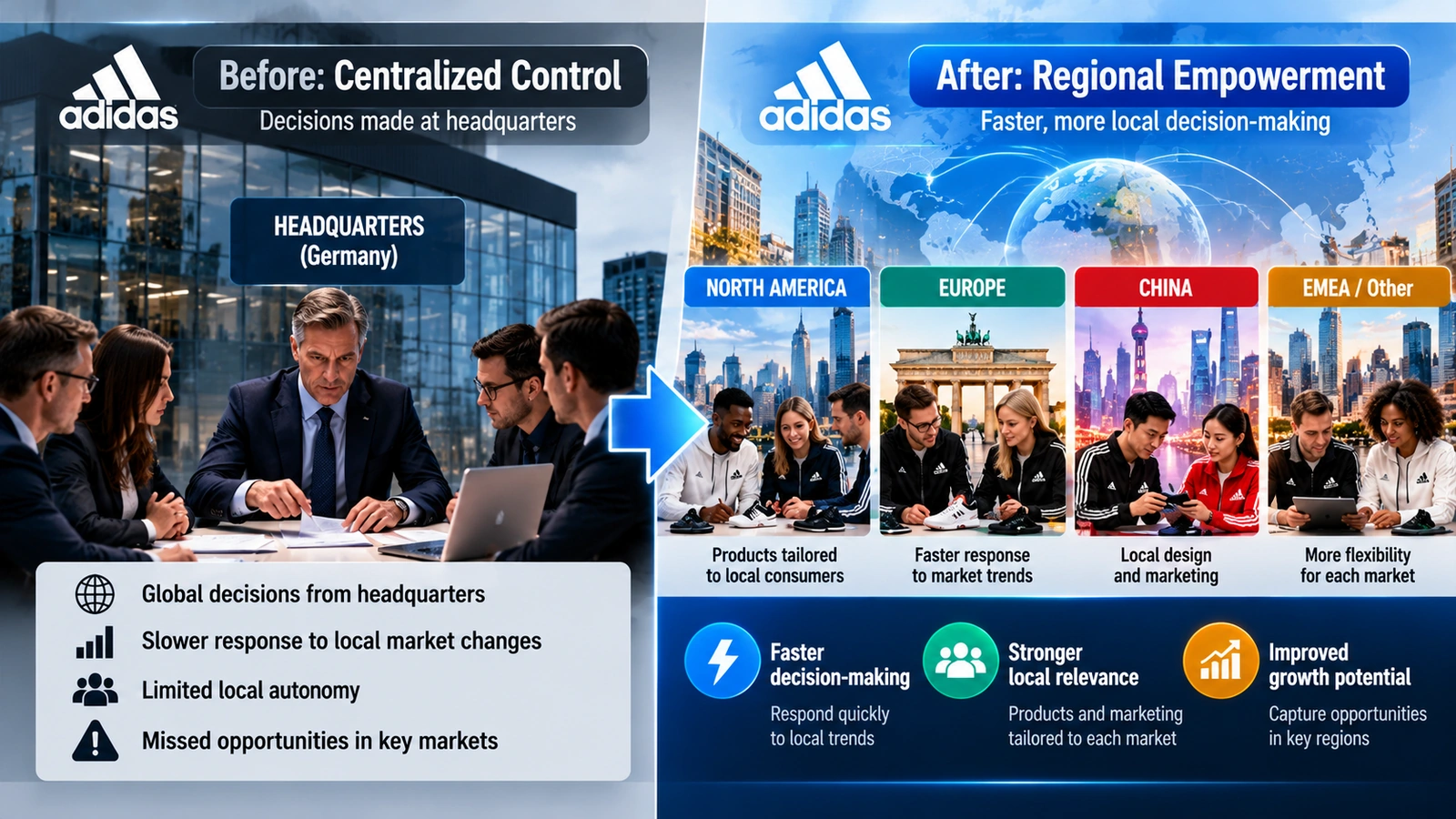
Rather than depending entirely on products planned at its German headquarters, Adidas gave its Chinese operations more authority to make decisions about local products, partnerships, and marketing.
That change mattered because Chinese fashion trends and consumer preferences do not always match those in Europe or the United States.
Adidas could design more products for local tastes and work with nearby manufacturers to respond more quickly.
The results have improved.
In the first half of 2026, Adidas reported 16% currency-neutral sales growth in Greater China, while Greater China represented approximately 15% of its global sales in 2025.
Nike’s Greater China revenue, by contrast, declined 26% on a currency-neutral basis in its fiscal 2027 first quarter, which ended August 31, 2026. The periods differ, but the contrast is notable. (Adidas · Nike)
This leads to a more interesting question: what changed inside Adidas that allowed the company to respond so much faster?
What Did Adidas’ New CEO Change?
One of the most important parts of Adidas’ turnaround happened behind the scenes.
Bjørn Gulden became Adidas CEO in January 2023, after leading rival sportswear company Puma.
He arrived at a moment when the business needed more than a new marketing campaign. It needed to rethink how products were developed, distributed, and sold.
A central problem was speed.
In a traditional global-company structure, major decisions can be made at headquarters and then passed down to regional offices.
That approach helps maintain consistency. But it can also become a disadvantage in fashion, where a shoe can suddenly become popular in one country while consumers elsewhere are moving toward something completely different.
Gulden pushed Adidas toward a more locally responsive operating model.
Instead of requiring every market to follow the same product strategy, regional teams gained greater freedom to adapt assortments, create products, choose partners, and organize marketing.
The change also brought product creation and decision-making closer to retailers and consumers.
In his discussion of the company’s strategy, Gulden specifically highlighted China as an example of how local creative teams and nearby manufacturing could shorten the time between product development and delivery. (Adidas Annual Report)
Consider what that means in practice.
If a particular sneaker style suddenly becomes popular in Los Angeles, a regional team can respond to the demand with suitable colors, products, and partnerships.
If consumers in Shanghai prefer a different silhouette or culturally specific design, local teams can respond to that market rather than waiting for one global assortment to fit everyone.
Adidas was not simply changing what it sold. It was changing how quickly it could recognize what people wanted.
That became especially valuable when an unexpected fashion trend created one of the company’s biggest opportunities.
How Did Samba and Gazelle Become Comeback Hits?

Adidas found a major opportunity in products that were already decades old.
The Samba, Gazelle, and Handball Spezial were not originally designed as modern fashion statements. They came from Adidas’ long history in sports footwear.
Yet their low-profile shapes became increasingly attractive as fashion preferences shifted away from some of the bulkier sneaker styles that had dominated earlier years.
What made the trend powerful was its versatility.
A pair of Sambas could work with jeans, trousers, casual office wear, or streetwear. The shoes were recognizable without requiring an oversized design or an entirely new technology.
Celebrity appearances, collaborations, and fashion coverage helped reinforce the trend.
Adidas also supported the revival through its Originals campaigns, connecting classic models with contemporary music, sport, and street culture.
Its 2023 Originals campaign featured the Samba, Gazelle, and Superstar while highlighting their place across different generations and communities. (Adidas Originals)
But selling more shoes was only part of the challenge.
A fashion hit can become a problem if a company supplies so many units that consumers begin seeing the product as overexposed.
That is why Adidas paid closer attention to product assortment, full-price sales, and how much inventory retailers were receiving.
Rather than relying forever on the same Samba or Gazelle, Adidas expanded into related styles, new materials, different colors, collaborations, and other footwear franchises.
The company also revived the Superstar and developed newer lifestyle models to broaden consumer interest. (Adidas Annual Report)
The distinction is important.
A fashion trend can help restore a brand’s reputation, but a durable recovery requires turning that attention into demand for a wider range of products.
And there was another part of the business Adidas needed to repair: its relationships with the stores selling those shoes.
Why Did Adidas Strengthen Relationships With Outside Retailers?
During the rise of online shopping, many major brands became increasingly interested in selling directly to consumers.
The idea seemed financially attractive.
If a company sells shoes through its own website or stores, it can keep more control over pricing, customer data, and the shopping experience. It also avoids sharing as much of the retail margin with an outside seller.
This approach is called direct-to-consumer, or DTC.
Nike made a major strategic push in this direction, reducing its reliance on some outside retail relationships before later rebuilding parts of its wholesale business.
But there was a catch.
When a brand reduces its presence in major shoe stores, consumers may encounter its products less often.
Imagine walking into a multi-brand footwear store.
If one company’s shoes dominate the shelves while another company’s products are difficult to find, the first company gains both a sales opportunity and valuable consumer attention.
A store shelf is not just a place to complete a purchase. It is also a place where shoppers discover products and compare brands.
Competitors can take advantage of any space a major brand leaves behind.
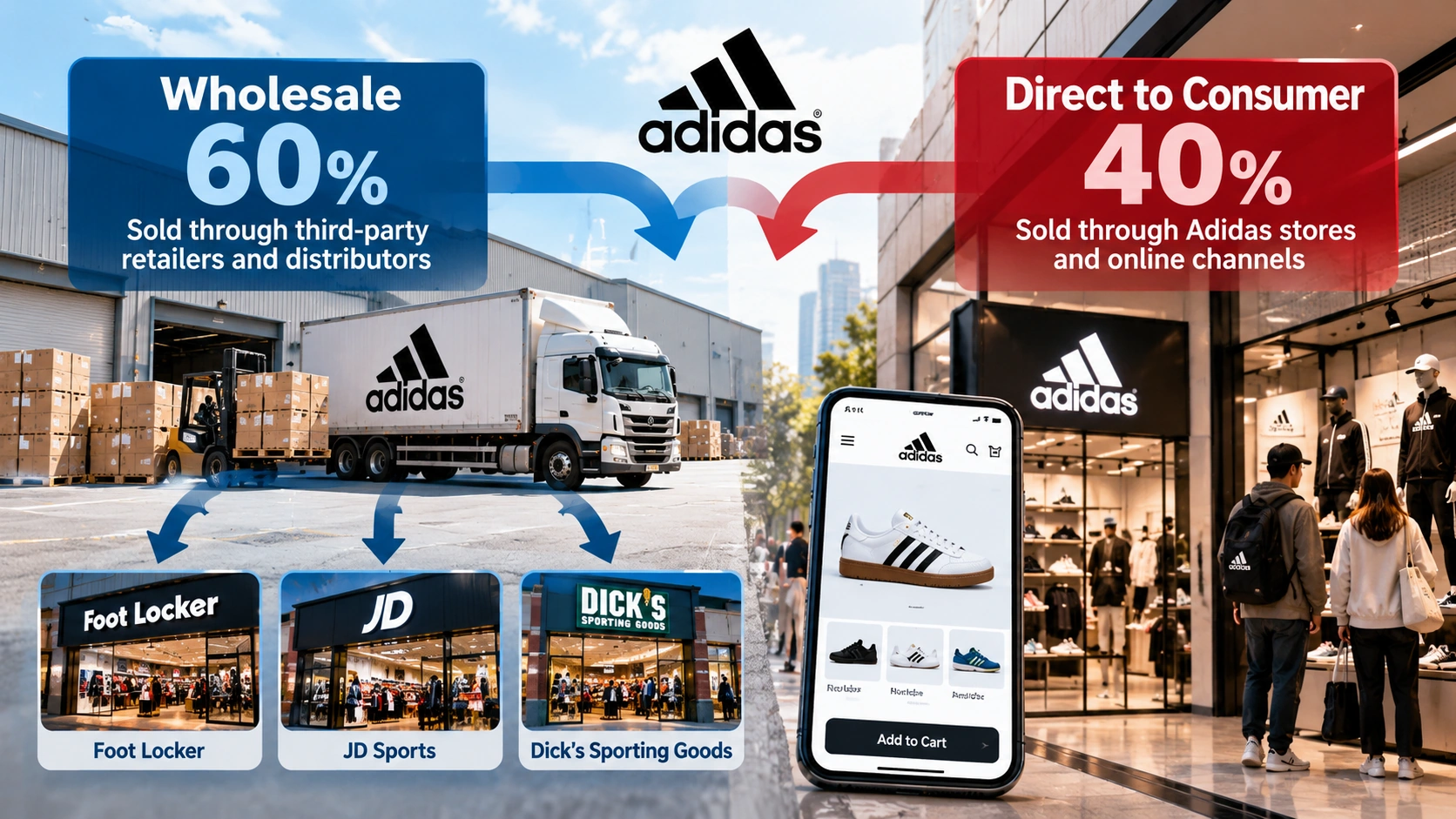
Adidas maintained a substantial wholesale presence and worked to improve those relationships.
According to the company’s 2025 annual report, wholesale accounted for 60% of Adidas’ total sales, while direct-to-consumer channels made up the remaining 40%.
Its strategy included working closely with retailers on product selection, merchandising, and market-specific collections. (Adidas Annual Report)
Nike has also acknowledged the need to reinvest in wholesale distribution and improve the presentation of its products in physical stores. Those priorities appear in its fiscal 2026 annual filing. (Nike Form 10-K)
This does not mean direct selling is inherently a mistake. Both companies still operate significant online and company-owned retail businesses.
The lesson is that a successful sportswear brand needs to be visible wherever its customers prefer to shop.
For Adidas, rebuilding retailer relationships helped make the recovery broader than its own website and flagship stores.
Still, greater shelf space would not have been enough without products that consumers genuinely wanted.
Why Are Running Shoes Becoming So Important to Adidas?
For years, Nike and Adidas were the obvious names consumers encountered when shopping for athletic shoes.
That market has become more fragmented.
Specialist brands such as Hoka and On have attracted runners looking for particular cushioning, comfort, or performance characteristics. Established companies such as ASICS and New Balance have also competed strongly across different running categories.
A brand no longer wins every customer simply by being famous.
Someone shopping for serious marathon shoes may make a very different decision from someone shopping for casual sneakers.
Adidas has responded by investing heavily in performance running.
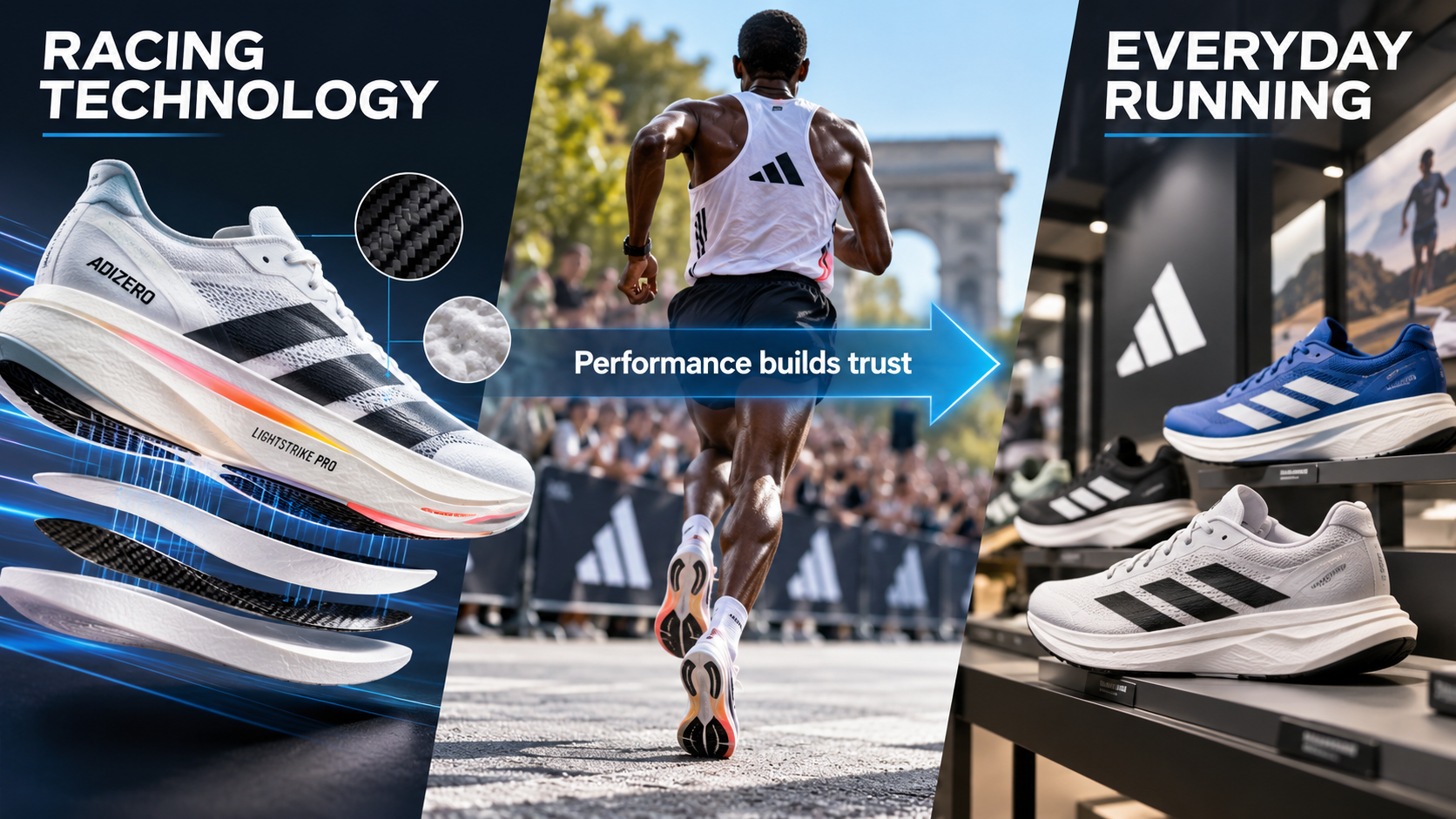
Its Adizero family includes specialized racing shoes as well as models designed for a much broader range of runners.
The logic is straightforward.
Elite racing shoes demonstrate what a brand can do at the technological frontier. More accessible running shoes allow a larger number of consumers to benefit from the brand’s performance reputation.
This is often called a halo effect: success or prestige at the top of a product range helps generate interest in other products from the same brand.
The strategy has produced measurable results.
Adidas reported that its running business grew more than 30% in 2025. In the second quarter of 2026, it reported approximately 30% growth in running, supported by continued demand for the Adizero range.
The company also identified the Evo SL as an important model bringing Adizero’s performance identity to everyday runners. (Adidas)
An especially visible example came on October 11, 2026.
At the Chicago Marathon, Kenya’s Amos Kipruto won the men’s race, while Ethiopia’s Hawi Feysa won the women’s race.
Both wore Adidas Adizero Adios Pro Evo 3 shoes, according to post-race footwear reporting. (Reuters · The Running Channel)
That kind of result does not prove Adidas makes the best running shoe for every runner. Elite athletes have different needs from most consumers, and sponsorships are also part of professional sport.
But it gives Adidas something a retro sneaker alone cannot provide: a visible reason for consumers to associate the brand with high-level athletic performance.
That matters because fashion trends can disappear quickly, while a credible performance business provides another reason for people to keep buying the brand.
How Did the 2026 World Cup Give Adidas Another Boost?
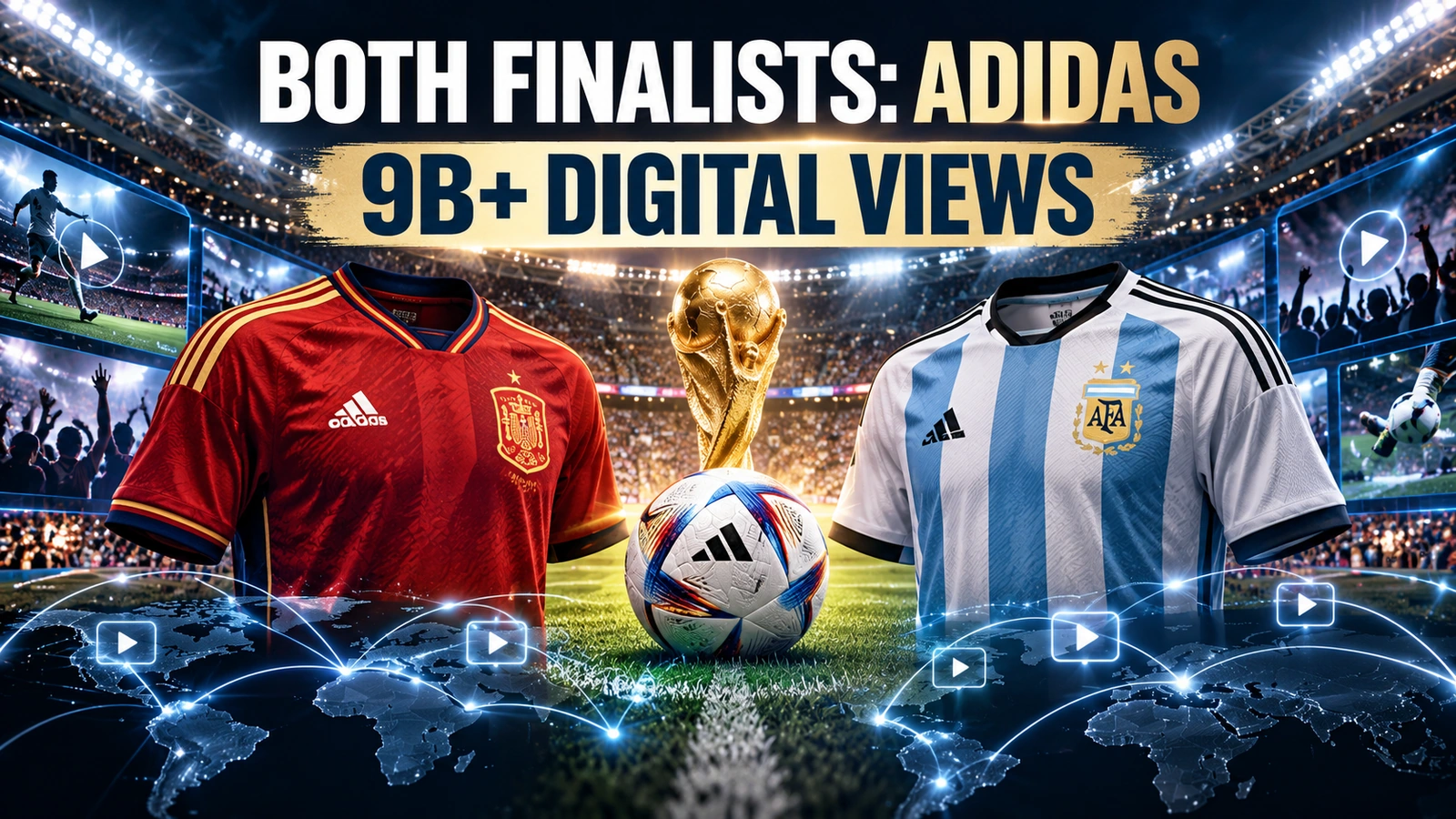
The 2026 FIFA World Cup provided Adidas with an unusually valuable global marketing opportunity.
Both teams in the final—Spain and Argentina—wore Adidas kits.
Nike sponsored 12 national teams at the tournament, while Adidas sponsored 14. But when the tournament reached its biggest match, both finalists represented Adidas on the field.
Spain ultimately defeated Argentina 1–0 after extra time in the final on July 19, 2026. (FIFA · Reuters)
That gave Adidas enormous global visibility.
The company’s marketing campaign featured major athletes and cultural figures, including Lionel Messi, Lamine Yamal, Jude Bellingham, Trinity Rodman, and Bad Bunny.
Adidas reported more than 9 billion digital views and over 400 million engagements across its World Cup marketing ecosystem.
Importantly, 9 billion views does not mean 9 billion different people watched the advertisements. The same person can generate multiple views.
Still, the campaign showed the scale of attention Adidas could command.
The tournament also helped the company sell more than jerseys.
Football apparel, retro-inspired collections, footwear, and products connecting soccer culture to everyday fashion all benefited from the broader marketing effort.
In the second quarter of 2026, Adidas reported 35% currency-neutral growth in apparel revenue and 39% growth in its overall Performance business. (Adidas)
But the marketing success created a financial question.
How much did Adidas have to spend to achieve it?
And was the resulting profit strong enough to satisfy investors?
If Adidas Is Recovering, Why Did Its Stock Fall?
This is one of the most revealing parts of the Adidas comeback.
A company can sell more products, report record revenue, and still disappoint investors.
That is exactly what happened in July 2026.
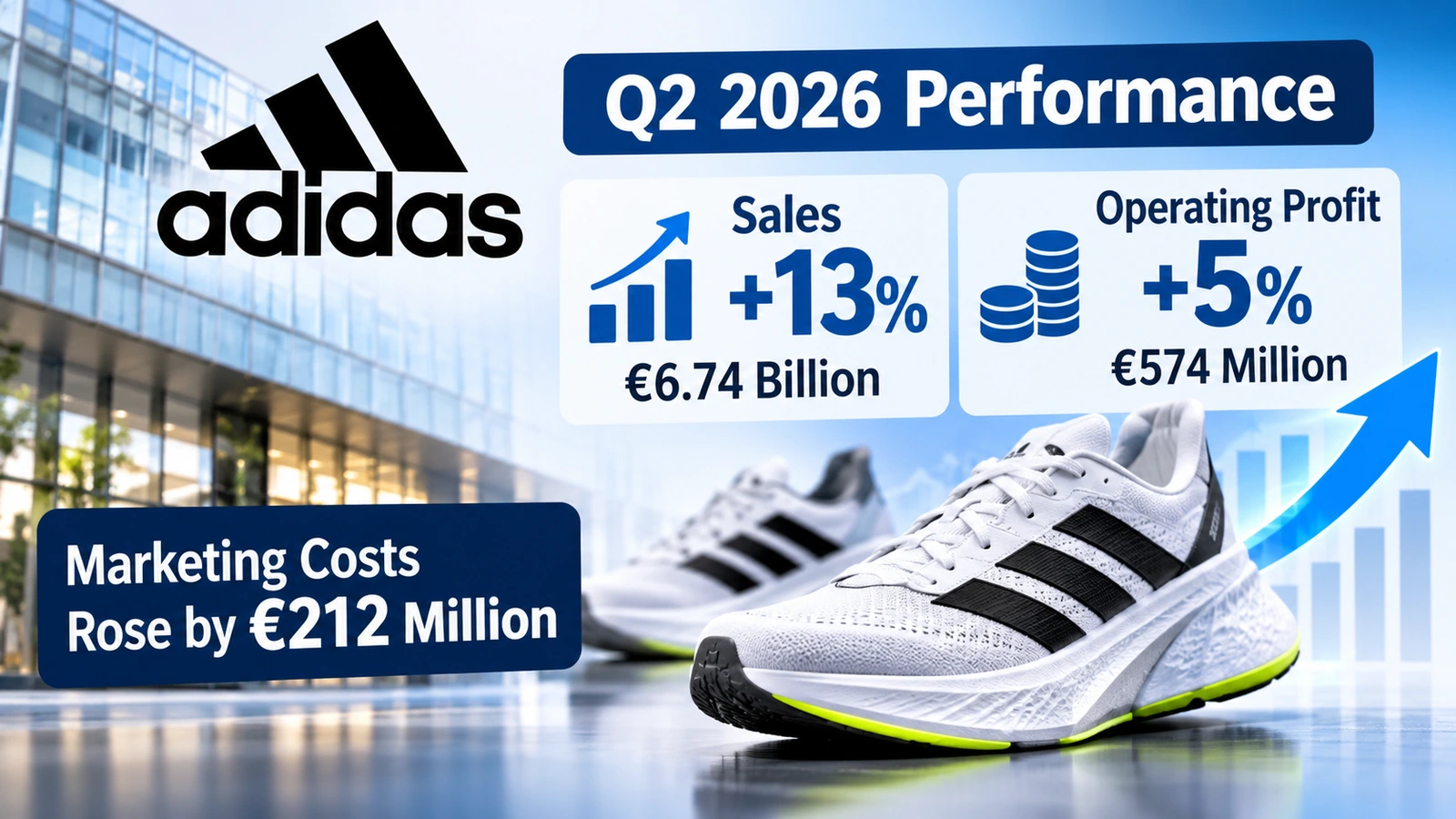
Adidas announced its highest quarterly revenue on record, reaching €6.74 billion in the second quarter.
But operating profit grew only 5%, reaching €574 million.
Why such a large difference?
The company’s marketing and point-of-sale expenses had increased 30% from a year earlier, rising by €212 million to €924 million.
Adidas had invested heavily in World Cup advertising, sponsorships, events, and brand promotion.
Those activities helped fuel sales, but they also reduced how much of the additional revenue translated into operating profit.
The company’s second-quarter operating margin declined from 9.2% in the prior-year period to 8.5%. (Adidas)
Why did investors react so negatively?
Investors had already been expecting a strong Adidas recovery.
When expectations are high, good results may not be good enough.
Analysts surveyed by Visible Alpha had expected approximately €623 million in quarterly operating profit, according to Reuters. The actual result was €574 million.
Adidas shares fell roughly 19% on July 30 after the results, despite the company’s improved revenue outlook. (Reuters)
There are also external pressures.
Adidas earns revenue in currencies around the world. When the euro strengthens against those currencies, international revenue can translate into fewer euros in the company’s financial statements.
Higher U.S. import tariffs can also affect the cost of supplying the American market.
Adidas said currency movements and tariffs were significant headwinds in 2026.
So the stock market was not necessarily rejecting the comeback itself.
It was questioning how much future growth Adidas could deliver, how profitable that growth would be, and whether investors had already priced in too much optimism.
That is an important difference between a company recovering operationally and its stock delivering attractive returns.
Is Adidas Actually Doing Better Than Nike?
Adidas has clearly delivered stronger recent momentum across several important areas, but that does not mean Nike has lost its overall position as a major global sportswear business.
The companies’ latest financial reports tell different stories.
| Area | Adidas | Nike |
|---|---|---|
| Recent reported results | Record Q2 2026 revenue, up 13% in euros | Fiscal Q1 2027 revenue down 4% |
| Greater China | H1 2026 currency-neutral sales up 16% | Fiscal Q1 2027 currency-neutral sales down 26% |
| Retail distribution | Strong wholesale partnerships alongside growing DTC sales | Reinvesting in wholesale while resetting its digital business |
| Major opportunity | Running, football, lifestyle products, regional localization | Rebuilding sports innovation, product demand, and marketplace health |
| Main challenge | Sustaining growth while improving profitability | Restoring consistent sales growth across weaker businesses |
The reporting periods, accounting measures, and geographic mixes are different. These figures describe each company’s recent direction, not a directly comparable market-share ranking.
Reporting periods: Adidas H1 2026 results and Nike fiscal Q1 2027 results.
Nike is not standing still.
Under CEO Elliott Hill, the company is working to strengthen its sports-focused product portfolio, improve relationships with wholesale partners, reduce excess inventory in weaker categories, and rebuild its presence in important markets.
Nike has also reported progress in selected areas, including improved gross margin in its latest quarter and growth in North America.
But the recovery remains uneven.
Nike’s own October 2026 earnings statement acknowledged that Nike Sportswear, Jordan Brand, and Greater China still required substantial work. (Nike)
This makes it misleading to describe the competition as a permanent Adidas victory.
Both companies are still trying to adapt to an athletic footwear market where consumer preferences change quickly and smaller competitors can win substantial attention.
What differs is their stage of recovery.
Adidas has already demonstrated that its improved strategy can produce strong revenue and earnings growth.
Nike is still working to achieve a similarly broad and sustained improvement.
What Happens When the Samba Trend and World Cup Boost Fade?
This may be the biggest question facing Adidas now.
Its comeback has benefited from several favorable developments: renewed demand for classic sneakers, stronger relationships with retailers, regional product strategies, greater running-shoe credibility, and the enormous visibility of the World Cup.
But some of those tailwinds may not last.
Fashion trends are unpredictable. A product that seems essential one year can become less desirable as consumers move toward new styles.
A World Cup marketing campaign also cannot be repeated every quarter.
And although performance running has become a stronger business for Adidas, competition remains intense.
The company now has to prove that its operating model can keep generating successful products without depending on one viral sneaker, one celebrity collaboration, or one global sporting event.
There are reasons for optimism.
Adidas’ 2025 growth was broad-based, covering both Performance and Lifestyle, multiple geographic markets, and both wholesale and direct-to-consumer sales.
In the first half of 2026, the Performance division grew 34% on a currency-neutral basis, while the Lifestyle business grew a more modest 4%. That difference suggests Adidas is increasingly relying on genuine sporting performance, not only retro fashion.
Yet inventories rose 13% year over year to nearly €6 billion at June 30, 2026, partly because Adidas prioritized product availability during the World Cup.
That is worth monitoring. Excess inventory can eventually lead to discounts, although the company said current and future-season products accounted for the vast majority of its stock. (Adidas)
The next financial test
As of October 17, 2026, Adidas’ latest published full-year guidance called for currency-neutral revenue growth of 9% to 10% in 2026 and operating profit of approximately €2.3 billion.
Those are company projections, not completed results.
Adidas is scheduled to publish its nine-month 2026 results on October 29, 2026. (Adidas Financial Calendar)
That report should offer another look at whether sales momentum is continuing after the World Cup, whether product demand remains healthy, and whether the company is making progress on profitability.
Investors will also be watching how performance running develops, whether China continues its recovery, and whether higher marketing and operating costs can be managed without weakening demand.
The real test is no longer whether Adidas can recover from its past mistakes.
It is whether the company can build a business that continues to grow after the excitement surrounding its comeback fades.
Bottom Line: What This Story Really Means
Adidas’ comeback was not simply the result of the Samba becoming fashionable again.
The company recovered by addressing several problems at once.
It moved beyond its dependence on Yeezy, gave regional teams more decision-making authority, strengthened its relationships with retailers, managed its product portfolio more carefully, and rebuilt credibility in performance sports.
Those changes helped Adidas achieve record revenue and a sharp improvement in profitability.
Nike, meanwhile, has been working through some related challenges, especially its retail strategy, lifestyle product portfolio, and difficult Chinese market.
But the story should not be reduced to Adidas winning and Nike losing.
Nike remains a powerful global competitor, while Adidas still faces questions about the sustainability and profitability of its growth.
Adidas has shown that it can escape a crisis. What it has not yet fully proved is how far that recovery can carry the company.
That is what makes the next chapter of the Adidas–Nike rivalry worth watching.
Adidas Comeback: Key Questions Explained
Q. Why is Adidas making a comeback?
Adidas has benefited from popular retro sneakers, stronger performance running products, improved retailer partnerships, and a more flexible regional management strategy. Those changes helped restore revenue growth and profitability following its difficult 2023 transition.
Q. Why did Adidas struggle financially in 2023?
The company faced pressure from the Yeezy breakup, challenges in China, and a difficult retail environment. It recorded a €58 million net loss from continuing operations in 2023 but maintained a positive operating profit of €268 million.
Q. How much did Adidas earn in 2025?
Adidas reported record annual revenue of €24.81 billion and operating profit of €2.06 billion in 2025. Operating profit increased 54% compared with 2024.
Q. Why did Adidas end its partnership with Kanye West?
Adidas terminated its Yeezy partnership with Ye in October 2022 following his antisemitic statements and actions. The decision created financial disruption and left the company managing unsold Yeezy inventory.
Q. Are Samba and Gazelle the main reasons Adidas recovered?
They played an important role by restoring consumer interest in Adidas’ lifestyle products, but the recovery became broader. Running, football, apparel, regional product development, and stronger retail distribution also contributed to growth.
Q. Why is Nike struggling while Adidas is growing?
Nike has faced weak demand in parts of its lifestyle business, challenges in China, and the costs of restructuring its retail and product strategies. Adidas has made faster recent progress in several of those areas, although their financial reporting periods differ.
Q. Is Adidas gaining ground in running shoes?
Yes. Adidas reported strong growth in its running business during 2025 and 2026. The Adizero range has also gained visibility through elite marathon performances, including wins in both the men’s and women’s races at the 2026 Chicago Marathon.
Q. Why did Adidas shares fall after strong 2026 sales?
Investors were disappointed by operating profit that fell short of expectations despite record quarterly revenue. Higher marketing spending associated with the World Cup contributed to weaker-than-expected profitability.
Q. Did Adidas beat Nike at the 2026 World Cup?
Adidas enjoyed a major sponsorship advantage in the final because both Spain and Argentina wore its kits. That provided valuable global visibility, but sponsorship success alone does not determine which company will lead the sportswear industry.
Q. What should investors watch next?
Adidas’ October 29, 2026 results will provide another indication of whether sales growth remains strong after the World Cup and whether profit margins are improving. Running-shoe demand, China, inventories, and marketing expenses are also important indicators.
Did this help make the story clearer? 🙂
WIN keeps unpacking the “why” behind the news—clearly and simply!
Sources
Adidas Financial Crisis and Recovery
Adidas 2023 Financial Highlights
Adidas 2025 Financial Highlights
Adidas Full-Year 2025 Results and Recovery
Adidas First-Half 2026 Financial Results and Outlook
Yeezy, China, and Corporate Strategy
Adidas Official Statement Terminating the Ye Partnership
Associated Press — Chinese Consumer Backlash Against Western Brands
Anta Sports — 2025 Annual Results and Chinese Market Position
Adidas Annual Report — Interview With CEO Bjørn Gulden
Adidas Annual Report — Markets and Sales Channels
Nike Competition and Athletic Performance
Nike Fiscal 2027 First-Quarter Financial Results
Nike Fiscal 2026 Annual Filing and Marketplace Strategy
The Running Channel — 2026 Chicago Marathon Footwear Results
Reuters — Nike and Adidas Sponsorships at the 2026 World Cup Final
World Cup Marketing, Investor Reaction, and Next Results
FIFA — Spain vs. Argentina, 2026 World Cup Final
Reuters — Adidas Shares Fall After World Cup-Driven Earnings