Why Is Coca-Cola Stock Surging When Americans Are Drinking Less Soda?

Americans have been moving away from sugary drinks for years. Water has gained ground, concerns about added sugar have grown, and weight-loss medications have raised new questions about what people will want to eat and drink.
So why is Coca-Cola—a company whose most famous product is sugary soda—having such a remarkable year on Wall Street?
On October 16, 2026, Coca-Cola shares closed at $93.90, roughly 34% above their price at the end of 2025, excluding dividends. Meanwhile, the company has reported rising beverage volumes and earnings, and KFC has announced plans to replace Pepsi products with Coca-Cola beverages at its U.S. restaurants. (Stock Analysis · Yahoo Finance · Coca-Cola)
The apparent contradiction has an explanation. Coca-Cola does not need Americans to drink ever more regular Coke to keep growing. It can gain customers from competitors, sell more zero-sugar drinks, expand internationally, and earn more revenue through changes in pricing and product mix.
※ Images in this article are AI-generated illustrations created to help explain the story. They are not actual photographs, and depictions of people, places, or events may differ slightly from reality.
And there is another remarkable part of this story: Warren Buffett’s company now stands to receive hundreds of millions of dollars a year in dividends from Coca-Cola shares bought decades ago.
Why Is Coca-Cola Stock Rising So Sharply in 2026?
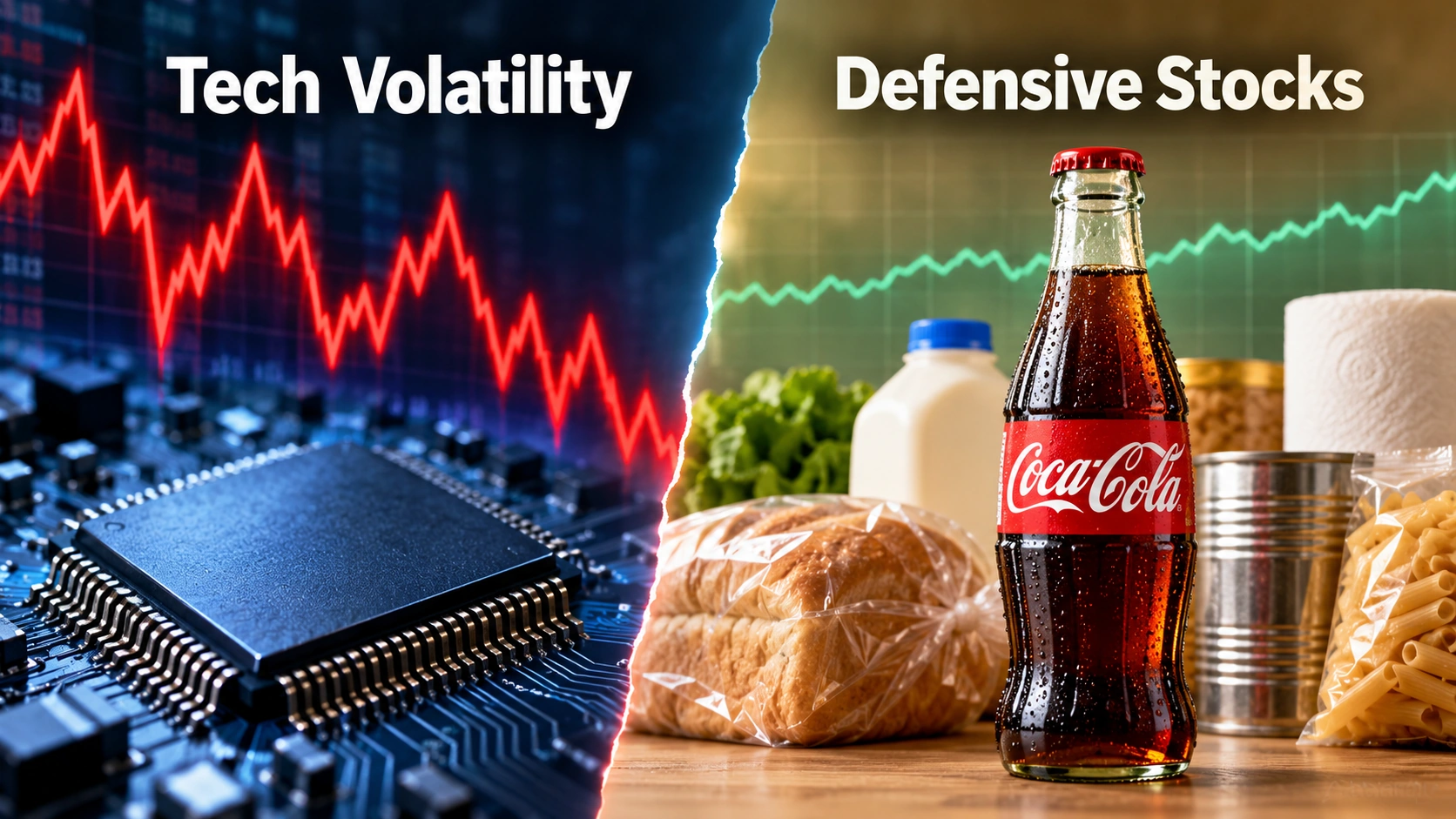
There are two overlapping reasons: Coca-Cola’s business has been performing well, and investors have recently shown more interest in established companies outside the technology sector.
The company’s July earnings report showed second-quarter revenue growth of 7%, worldwide unit case volume growth of 5%, and operating income growth of 9%. It also raised its full-year earnings outlook. Those are measurable business improvements, not just enthusiasm for a familiar logo. (Coca-Cola)
The market backdrop matters too. During October, worries about expensive AI and semiconductor stocks helped drive attention toward other parts of the market, including established consumer businesses. Coca-Cola appeared among the old-economy names reaching new highs. That is one explanation offered by market observers—not proof that every dollar of Coca-Cola’s gain came from investors leaving tech. (Barron’s)
Coca-Cola is commonly called a consumer-staples stock. This means it sells products that customers tend to keep buying even when household budgets tighten. It does not make the shares immune to losses, but it helps explain why predictable sales and dividends can become especially appealing when investors are nervous about faster-growing companies.
Are Americans Really Drinking Less Soda?
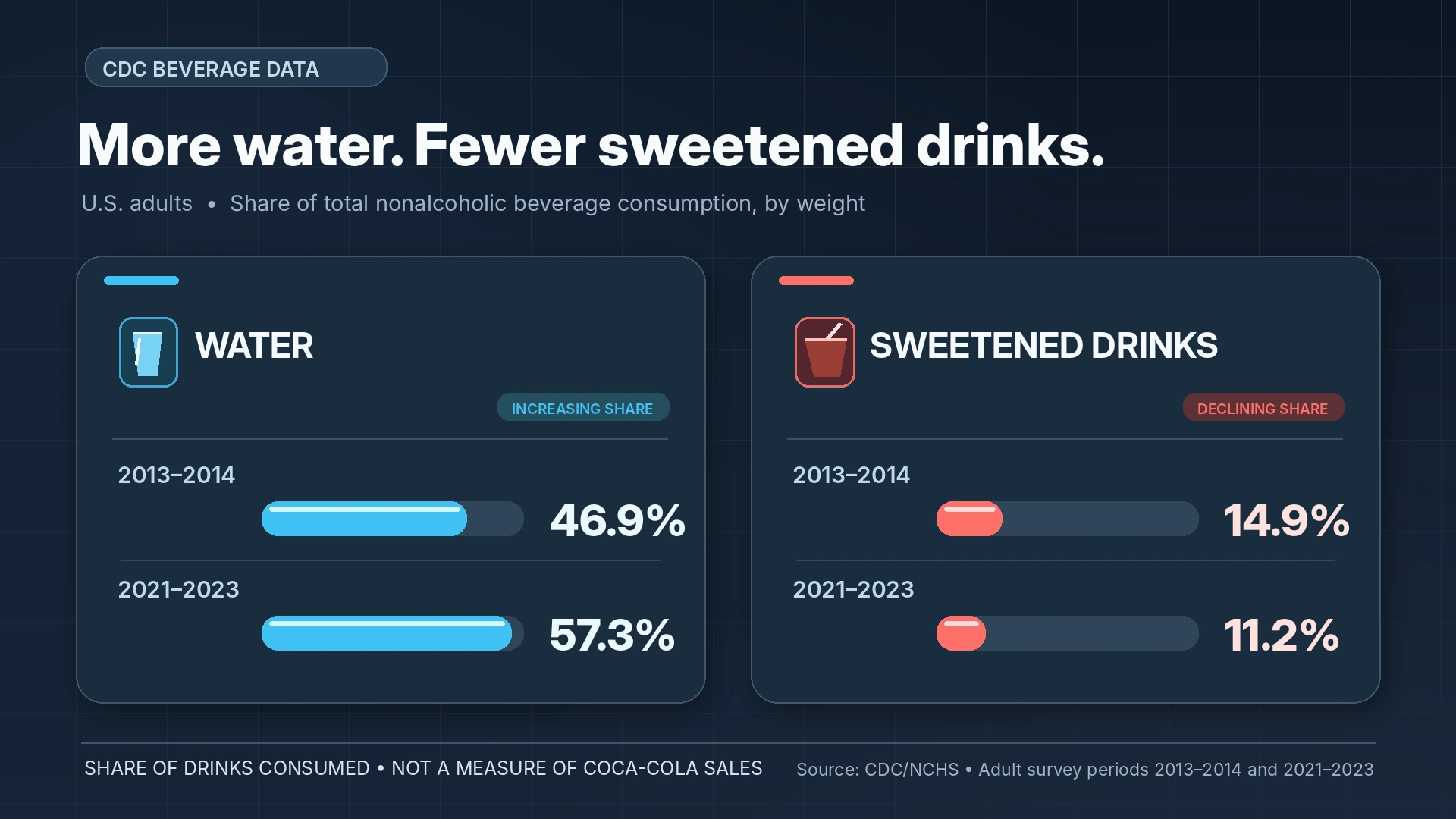
Yes, the longer-term shift away from sweetened drinks is real. But declining demand for a category does not mean every company—or every product within it—is shrinking.
A September 2026 report from the Centers for Disease Control and Prevention examined U.S. beverage consumption. Among adults, sweetened drinks fell from 14.9% of total nonalcoholic beverage consumption in 2013–2014 to 11.2% in 2021–2023. Water’s share rose from 46.9% to 57.3%. These are shares of beverage consumption by weight, not figures showing that Coca-Cola’s U.S. sales fell by the same percentages. (CDC)
Now compare that trend with Coca-Cola’s own latest results. In the second quarter of 2026, the company reported 3% unit case volume growth in North America. Globally, Coca-Cola Zero Sugar grew 16%, while the broader Coca-Cola trademark family grew 5%. (Coca-Cola)
Those figures measure different things, but that distinction is exactly what makes the story interesting. Someone who stops drinking regular Coke might switch to Coke Zero. Someone who buys fewer sugary soft drinks could purchase bottled water, tea, or a sports drink—categories in which Coca-Cola also competes.
The company sells much more than its original cola. Its portfolio includes Sprite, Fanta, smartwater, Powerade, BODYARMOR, fairlife, and other beverages. The relevant investment question is not simply whether traditional soda is declining. It is whether Coca-Cola can continue capturing consumer spending as drinking habits change. (Coca-Cola 2025 Annual Report)
How Can Coca-Cola Earn More Without Selling Much More Soda?
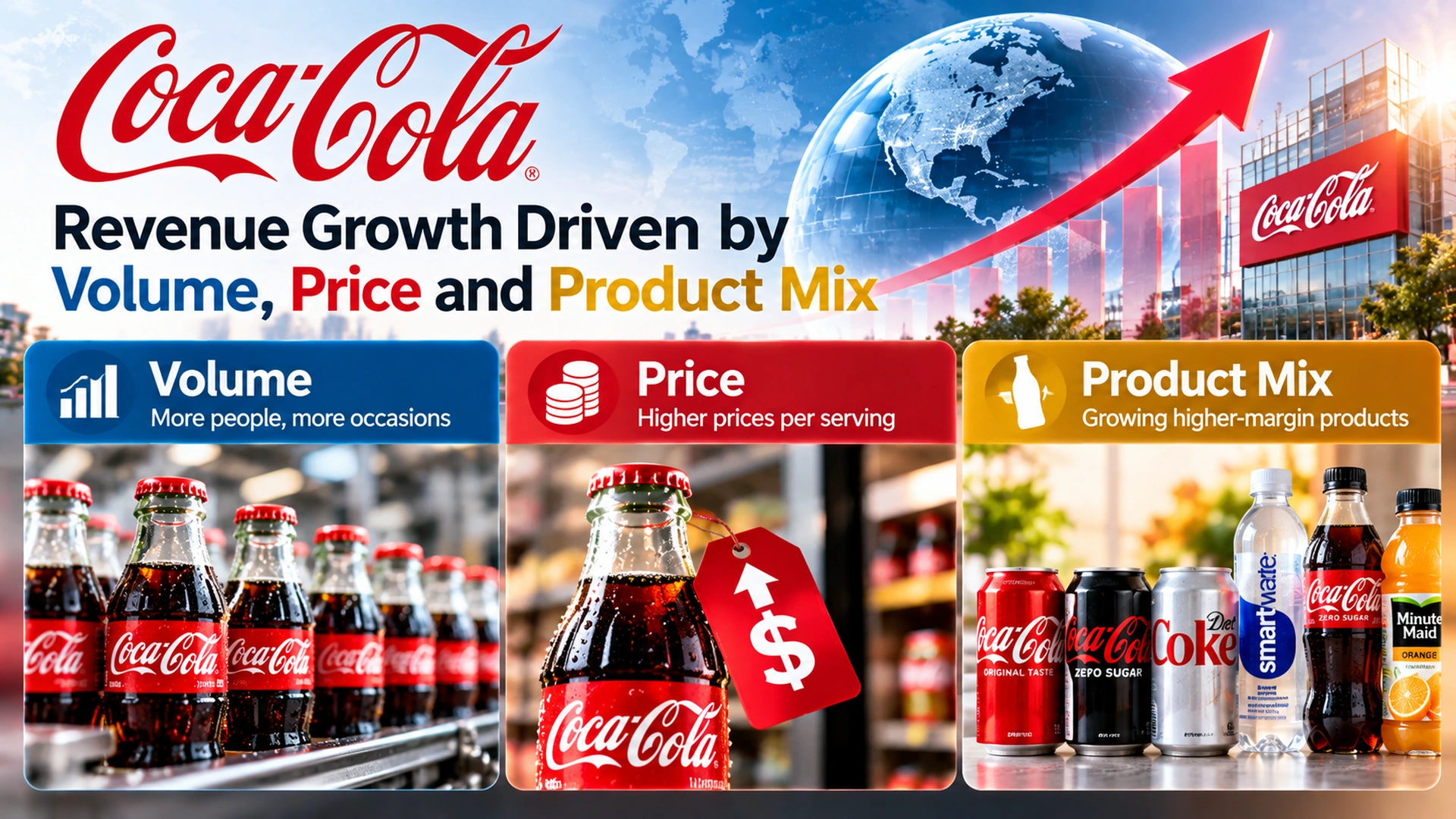
A beverage company has more than one path to growth. It can sell more drinks, charge more for certain products, or change which products customers buy.
Coca-Cola calls the combined effect of pricing changes and shifts in what customers purchase price/mix. For instance, a smaller package can cost less at the register while still carrying a higher price per ounce. Premium beverages can also bring in more revenue than basic products. Neither outcome is automatic; customers have to keep finding value in what the company offers.
Coca-Cola’s second-quarter 2026 results show why investors monitor several numbers rather than just soda consumption:
| Measure | Q2 2026 change | What it tells us |
|---|---|---|
| Global unit case volume | +5% | More beverage volume sold across the system |
| Price/mix | +2% | Changes in pricing and the products or packages sold |
| Net revenue | +7% | Growth in Coca-Cola’s reported company revenue |
| Operating income | +9% | Higher operating profit than a year earlier |
These numbers come from Coca-Cola’s earnings release. The price/mix and volume figures are not a simple equation for revenue because concentrate sales timing, currency, and business changes also affect reported results. (Coca-Cola)
There is a limit to this strategy: repeated price increases can eventually encourage consumers to trade down, switch brands, or buy fewer drinks. That is why volume growth matters alongside revenue growth. A company selling fewer items at increasingly high prices may face a different future from one that is winning customers as well.
Where Can Coca-Cola Still Find New Customers?
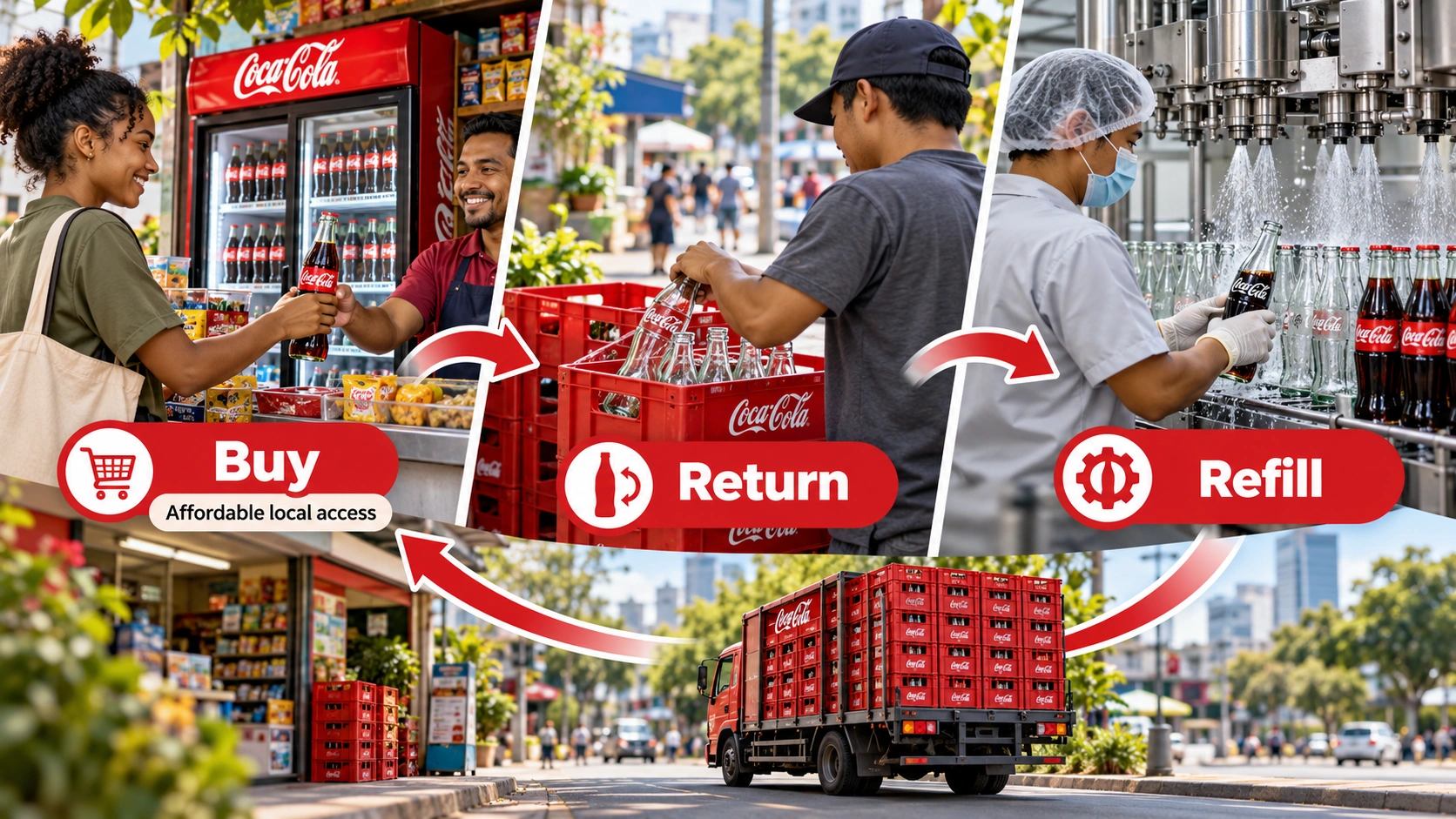
Some mature markets are harder to expand in, but Coca-Cola’s international business gives it many different opportunities. The company’s beverages are sold in more than 200 countries and territories. Its second-quarter 2026 case volume increased 8% in Asia Pacific and 3% in Latin America. (Coca-Cola)
Selling more drinks is not just a matter of running more advertisements. A beverage must be affordable, cold when customers want it, and available in stores and restaurants close to where people live. Distribution networks, local bottlers, and package sizes help determine whether those conditions are met.
One surprisingly old-fashioned tool remains useful: the refillable bottle. Unlike a single-use container, a returnable glass or plastic bottle can be collected, cleaned, and used again. Where collection infrastructure works well, repeat use can reduce the need to make a new container for every drink and support affordable purchasing options.
Coca-Cola said in a July 2026 company update that it and its bottling partners were expanding refillable glass and plastic packaging in multiple markets. The system requires collection infrastructure and investment; it is not a free shortcut or a model that works equally well everywhere. (Coca-Cola)
This is part of the answer to a puzzle: an iconic American product can find growth far beyond the U.S., even when some American consumers are drinking less of its traditional version.
Who Actually Makes and Delivers All That Coca-Cola?
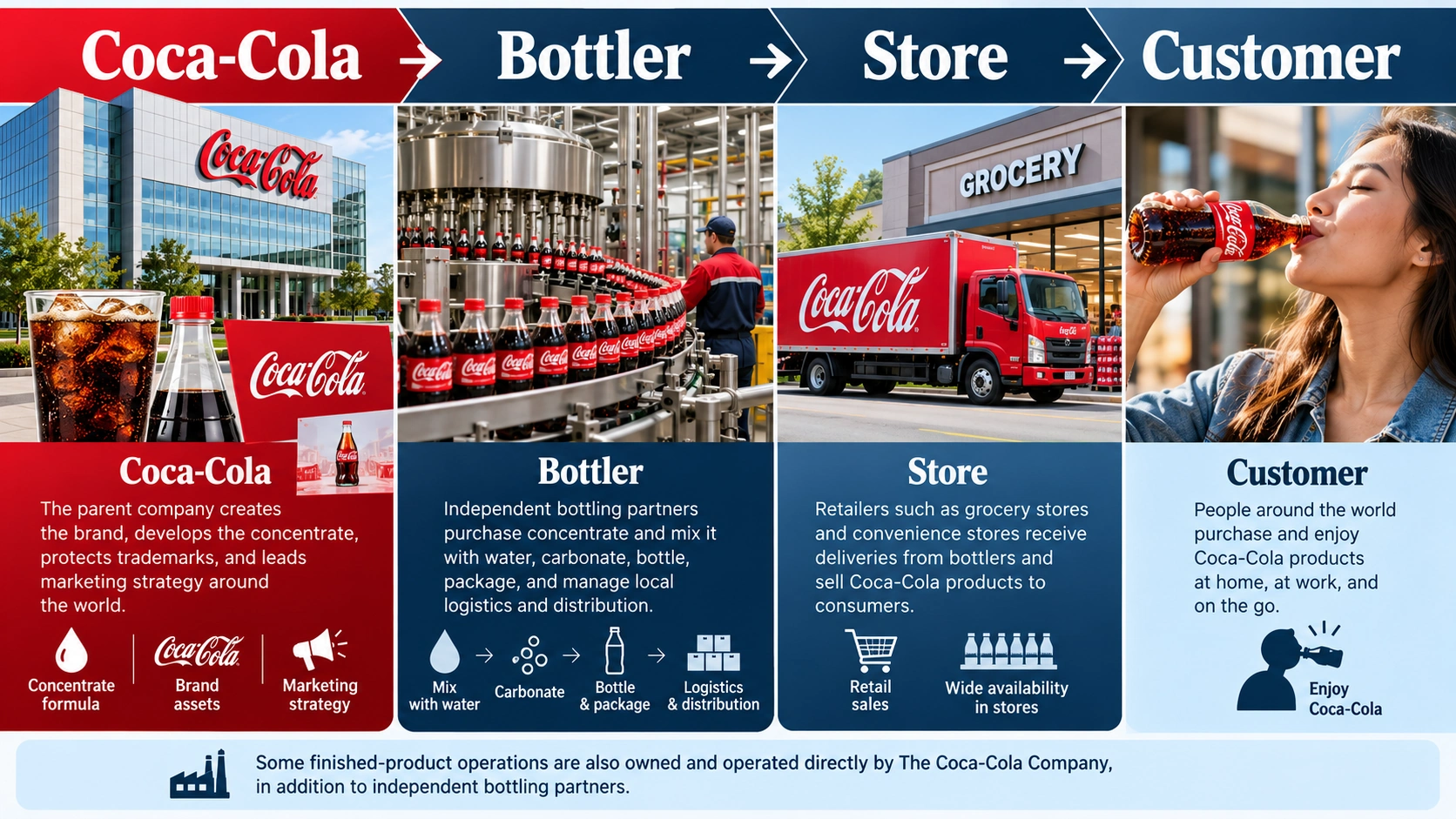
Coca-Cola often earns money from the brand and beverage concentrate, while bottling partners handle much of the physical work of turning that concentrate into drinks, packaging them, and moving them to customers.
Think about the cost of running a bottling plant: equipment, labor, packaging, warehousing, delivery trucks, and a network of retail customers. Those activities can generate substantial sales, but they also require substantial spending. Concentrate operations generally have higher gross margins than finished-product operations, according to Coca-Cola’s annual report. (Coca-Cola 2025 Annual Report)
That does not mean Coca-Cola has stopped making finished beverages itself. Its 2025 filing provides a useful comparison:
| Coca-Cola business type | Share of 2025 company revenue | Share of 2025 system unit case volume |
|---|---|---|
| Concentrate operations | 59% | 85% |
| Finished-product operations | 41% | 15% |
These percentages describe different measures: company revenue versus beverage volume across the Coca-Cola system. Concentrate operations represent a much larger share of system volume than of reported revenue. Finished-product operations generate more revenue per unit of system volume but generally have lower gross margins. (Coca-Cola 2025 Annual Report)
This business model can help the parent company concentrate capital on brands, marketing, innovation, and new opportunities. It also depends on bottling partners being able to manage costs, invest in equipment, and deliver products reliably.
Why Is KFC Dropping Pepsi for Coca-Cola in the U.S.?
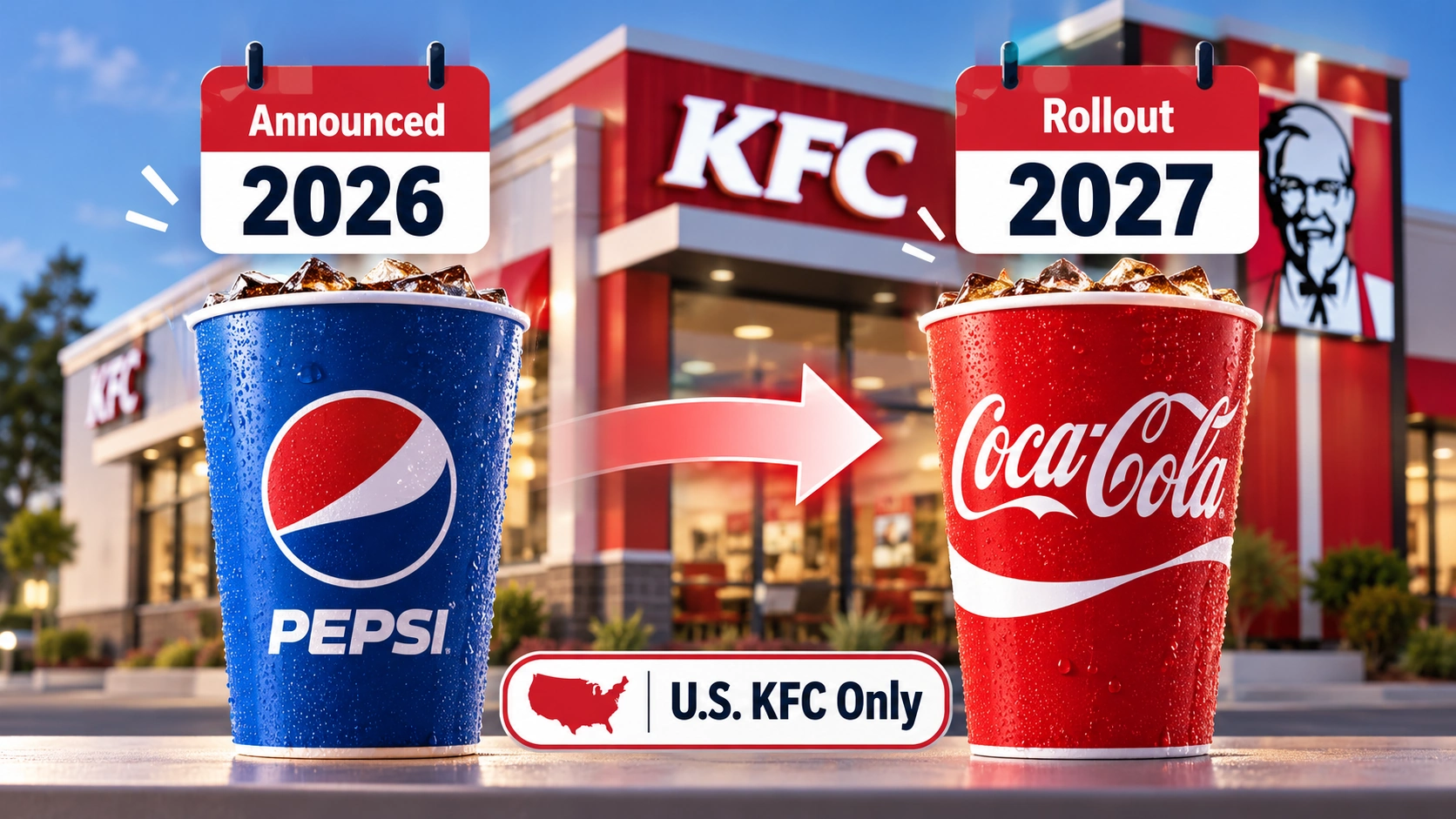
KFC’s decision is a visible victory for Coca-Cola in the long-running battle for restaurant beverage customers. On October 15, 2026, the companies announced that Coca-Cola drinks would begin appearing in U.S. KFC restaurants in January 2027, with the transition expected to reach all U.S. locations by spring. The announcement describes approximately 3,600 restaurants. (Coca-Cola and KFC)
This matters because KFC had maintained a longstanding beverage relationship with PepsiCo. A restaurant contract creates recurring demand and puts a brand in front of customers who may not have chosen that drink in a supermarket.
But there are two important limits to the story. First, the change concerns U.S. KFC restaurants, not every KFC worldwide. PepsiCo continues to have other food-service partnerships. Second, analysts expect the direct earnings impact on PepsiCo to be relatively modest. The symbolic significance may be greater than the immediate financial effect. (Reuters)
Nor does one restaurant deal establish that Coca-Cola will win every future competition with Pepsi. PepsiCo operates a substantial snack business as well as beverages, so comparisons between the two parent companies require care. The KFC announcement is best understood as fresh evidence that Coca-Cola’s distribution reach and brand relationships still have competitive value.
How Did Buffett’s $1.3 Billion Coca-Cola Investment Become So Valuable?
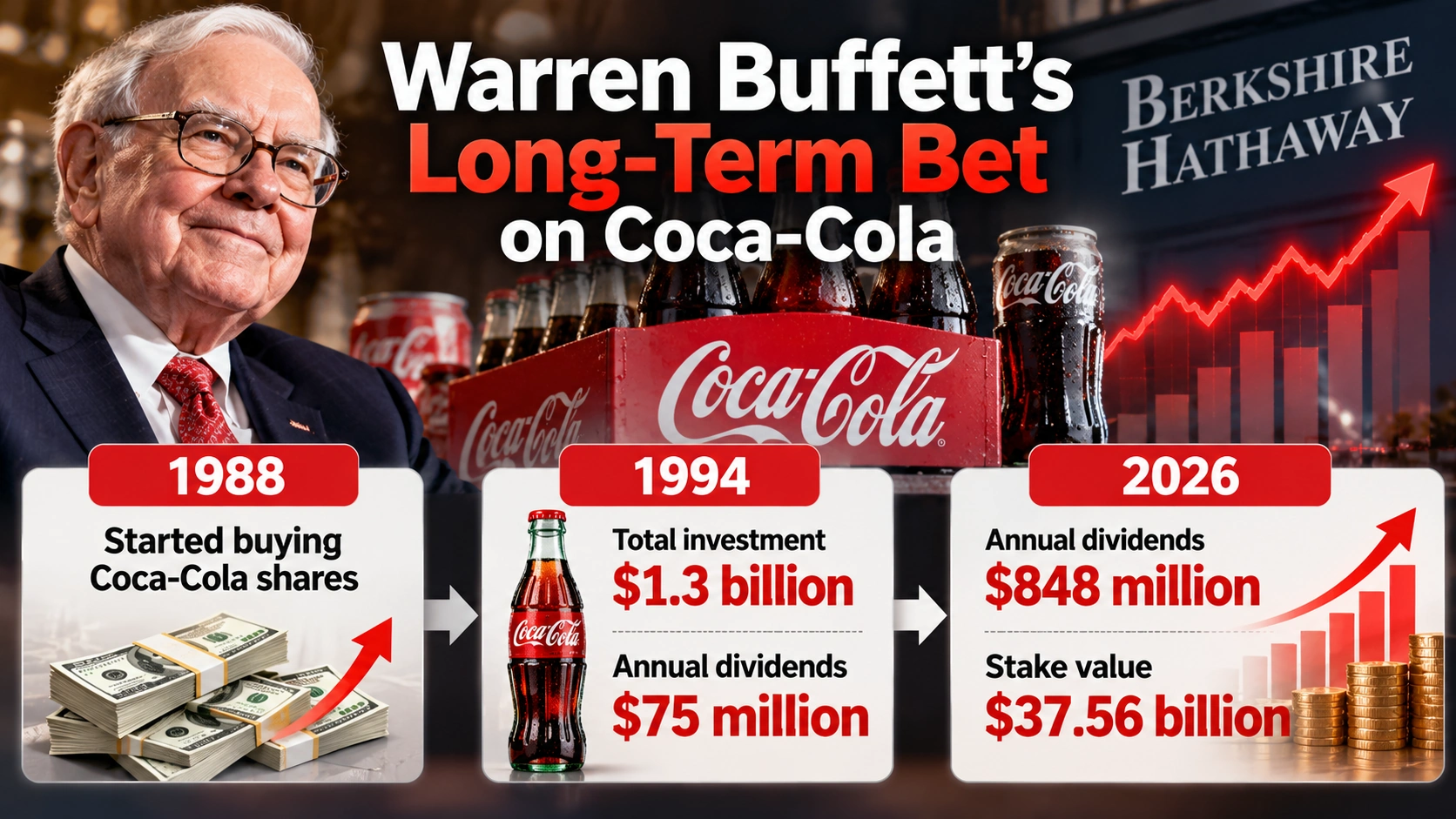
Warren Buffett’s investment company, Berkshire Hathaway, began buying Coca-Cola stock in 1988 and completed the purchase program in 1994. Berkshire paid approximately $1.3 billion for the stake that now totals 400 million shares after stock splits. (Berkshire Hathaway’s 1988 Letter · Berkshire Hathaway’s 2022 Annual Report)
Coca-Cola’s 2026 proxy statement lists Berkshire as its largest shareholder, with 400 million shares, equivalent to 9.29% of outstanding shares as reported from year-end 2025 ownership data. Using Coca-Cola’s October 16, 2026 closing price of $93.90, that holding would be worth about $37.56 billion on paper. It is a market valuation, not cash Berkshire has collected by selling the stock. (Coca-Cola Proxy Statement · Stock Analysis)
The dividend story may be even more revealing. In his 2022 shareholder letter, Buffett reported that Berkshire collected $75 million in Coke dividends in 1994 and $704 million in 2022. In February 2026, Coca-Cola approved its 64th consecutive annual dividend increase, setting its quarterly payout at 53 cents per share, or $2.12 annually. (Berkshire Hathaway · Coca-Cola)
At that announced annual rate, Berkshire’s 400 million shares would generate $848 million a year, equivalent to about 65% of its original $1.3 billion purchase cost annually. The calculation assumes the share count and payout rate remain unchanged; it is an annualized figure, not a claim that Berkshire has already received all four 2026 payments.
| Berkshire’s Coca-Cola investment | Amount |
|---|---|
| Original aggregate purchase cost | About $1.3 billion |
| Annual dividends received in 1994 | $75 million |
| Annual dividends received in 2022 | $704 million |
| 2026 dividend at the announced annual rate | $848 million |
| Value of 400 million shares at $93.90 | $37.56 billion |
One distinction is easy to miss: this is not an example of Berkshire repeatedly reinvesting Coca-Cola dividends into more Coke shares. The shareholding has remained at 400 million shares for decades. The growing annual dividend reflects increases in Coca-Cola’s payout per share, while the share price appreciation increased the holding’s market value.
It is also Berkshire’s investment, not a personal stock account belonging to Buffett. Warren Buffett became chairman emeritus on September 18, 2026, and remains a director; his son Howard Buffett is now chairman. Greg Abel has been CEO since January 1, 2026. (Berkshire Hathaway · Berkshire Hathaway Proxy Statement)
Could Coca-Cola’s Rally Reverse—and What Happens Next?
Coca-Cola’s resilience does not make the stock risk-free. After such a large price increase, investors may demand stronger evidence that earnings can keep pace with the valuation.
Several pressures remain. More consumers may reduce sugary drinks, competition can intensify, and repeated price increases can reach a limit. The rise of GLP-1 weight-loss medications is another potential change in purchasing habits. A 2026 JAMA Network Open study of consumer purchases in Denmark found shifts in food choices after people began these medications, but it did not establish a specific sales loss for Coca-Cola in the United States. (JAMA Network Open)
Packaging costs, currency movements, marketing expenses, and geopolitical disruptions also matter. Coca-Cola’s own annual filing discusses many of these risks. The company must keep investing in its brands and distribution system rather than simply waiting for customers to buy its products. (Coca-Cola 2025 Annual Report)
There is a useful way to separate the company’s success from the stock’s price:
| What to watch | Why it matters |
|---|---|
| Unit case volume | Shows whether customers are buying more beverages |
| Price/mix | Shows the role of higher prices and product choices |
| Operating margins | Shows whether growth is turning into profit |
| Zero-sugar and broader portfolio sales | Tests whether Coca-Cola is adapting to changing tastes |
| Stock valuation and dividend yield | Tests whether investors are paying too much for that growth |
At $93.90 per share, the announced $2.12 annual dividend represents a current indicated yield of about 2.3%—very different from Berkshire’s 65% annual dividend return measured against what it paid decades ago. Today’s buyer does not get Buffett’s original purchase price.
The next immediate test is October 27, 2026, when Coca-Cola is scheduled to announce third-quarter earnings before the U.S. stock market opens. Investors will be watching volume, pricing, profit margins, and management’s outlook. Until those results are released, they are expectations rather than known outcomes. (Coca-Cola Investor Relations)
Bottom Line: What This Story Really Means
Coca-Cola’s stock rally does not mean Americans have suddenly abandoned health concerns or returned to drinking more sugary soda across the board. It means investors see a company that has found several ways to grow even while consumer preferences change.
Coca-Cola can gain market share, sell zero-sugar and other beverages, adjust prices and packaging, expand through global distribution partners, and defend longstanding customer relationships. The KFC partnership offers a timely example of that competitive strength, while the latest earnings provide stronger evidence of actual operating performance.
Warren Buffett’s decades-old investment shows what sustained earnings and rising dividends can mean for a long-term shareholder. It does not prove that buying Coca-Cola at today’s price will produce the same result.
Coca-Cola Stock: Key Questions Explained
Q. How much has Coca-Cola stock risen in 2026?
The shares closed at $93.90 on October 16, approximately 34% above their December 31, 2025 close of $69.91. That price change excludes dividends.
Q. Is U.S. soda consumption increasing again?
Not necessarily. CDC data show a long-term decline in the share of sweetened beverages in Americans’ overall drink consumption. Coca-Cola can still increase its own sales by gaining share and selling different beverages.
Q. Is Coke Zero actually helping Coca-Cola grow?
Yes. Coca-Cola reported 16% worldwide unit case volume growth for Coca-Cola Zero Sugar in the second quarter of 2026, though that is only one part of the company’s broader business.
Q. Does Berkshire Hathaway own Coca-Cola?
Berkshire owns 400 million Coca-Cola shares, listed as 9.29% of the company in Coca-Cola’s 2026 proxy statement, making it the largest reported shareholder in that filing.
Q. How much does Berkshire Hathaway receive in Coca-Cola dividends?
At Coca-Cola’s announced 2026 annual dividend rate of $2.12 per share, Berkshire’s 400 million shares represent $848 million in annualized dividend income, assuming no change in the share count or payout.
Q. Did Buffett compound the investment by reinvesting Coke dividends?
Not by buying more Coca-Cola shares with those dividends. The holding has remained at 400 million shares for decades; the annual payment grew mainly because Coca-Cola raised its dividend per share.
Q. When will KFC start serving Coca-Cola instead of Pepsi?
The U.S. rollout is scheduled to start in January 2027 and finish by spring 2027. It does not mean that all international KFC restaurants are switching at the same time.
Q. When is Coca-Cola’s next earnings report?
Coca-Cola has scheduled its third-quarter 2026 results for October 27, before the New York Stock Exchange opens. The results should help show whether recent sales and profit growth is continuing.
Did this help make the story clearer? 🙂 WIN keeps unpacking the “why” behind the news—clearly and simply!
Sources
Stock Performance and Market Context
Stock Analysis — Coca-Cola Historical Daily Stock Prices
Yahoo Finance — Coca-Cola Historical Prices
Barron’s — Coca-Cola and Other Stocks Rise as Investors Rotate Out of Chip Stocks
Sales, Operating Model, and Consumer Trends
Coca-Cola — Second Quarter 2026 Results and Updated Guidance
Coca-Cola — 2025 Annual Report on Form 10-K
CDC — Nonalcoholic Beverage Consumption Among U.S. Youth and Adults
Coca-Cola — How the System Is Scaling Refillable Bottles
JAMA Network Open — Consumer Food Purchases After GLP-1 Medication Initiation
Berkshire’s Investment and the Dividend Record
Berkshire Hathaway — 2022 Annual Report and Shareholder Letter
Coca-Cola — 2026 Proxy Statement
Coca-Cola — 64th Consecutive Annual Dividend Increase
Berkshire Hathaway — 2026 Proxy Statement and Leadership
Berkshire Hathaway — September 18, 2026 Chairman Transition Announcement
KFC Partnership and the Next Earnings Release
Coca-Cola and KFC — New U.S. Beverage Partnership Announcement
Reuters — KFC’s Move Puts PepsiCo’s Restaurant Partnerships in Focus
Coca-Cola — Third Quarter 2026 Earnings Release Date
Keep Reading
Who Runs Berkshire Hathaway Now That Warren Buffett Has Stepped Back?
Buffett’s Coca-Cola investment is part of Berkshire’s history, but the company has since divided his former leadership responsibilities among different people. The earlier WIN article explains what Greg Abel, Howard Buffett, and Warren Buffett each do today.
Warren Buffett Stepped Down as Berkshire Chairman—So Who Actually Runs the Company Now?