Will Trump’s New Mortgage Order Actually Lower Your Monthly Housing Payment?

Your mortgage payment may be one of the biggest bills you pay every month. So when the president signs an order promising to reduce housing costs, the first question is obvious:
Does that mean your next mortgage bill will be smaller?
Not necessarily.
President Donald Trump signed an executive order on October 22, 2026, aimed at reducing certain homeownership and mortgage expenses. But the order doesn’t simply lower everyone’s mortgage interest rate or automatically reduce every homeowner’s monthly payment. (Reuters)
Instead, it targets costs that are often overlooked: private mortgage insurance, refinancing-related title expenses, certain federally issued home loans, and barriers to factory-built housing.
For some homeowners, eliminating mortgage insurance could mean meaningful monthly savings. Others might benefit from lower refinancing costs. Many borrowers, however, may see no immediate change.
※ Images in this article are AI-generated illustrations created to help explain the story. They are not actual photographs, and depictions of people, places, or events may differ slightly from reality.
The difference depends on what kind of mortgage you have, how much equity you’ve built, and how federal housing agencies put the new order into practice.
And there’s an important distinction between something the government has ordered agencies to develop and a benefit homeowners can actually claim today.
What Did Trump’s October 22 Mortgage Order Actually Change?
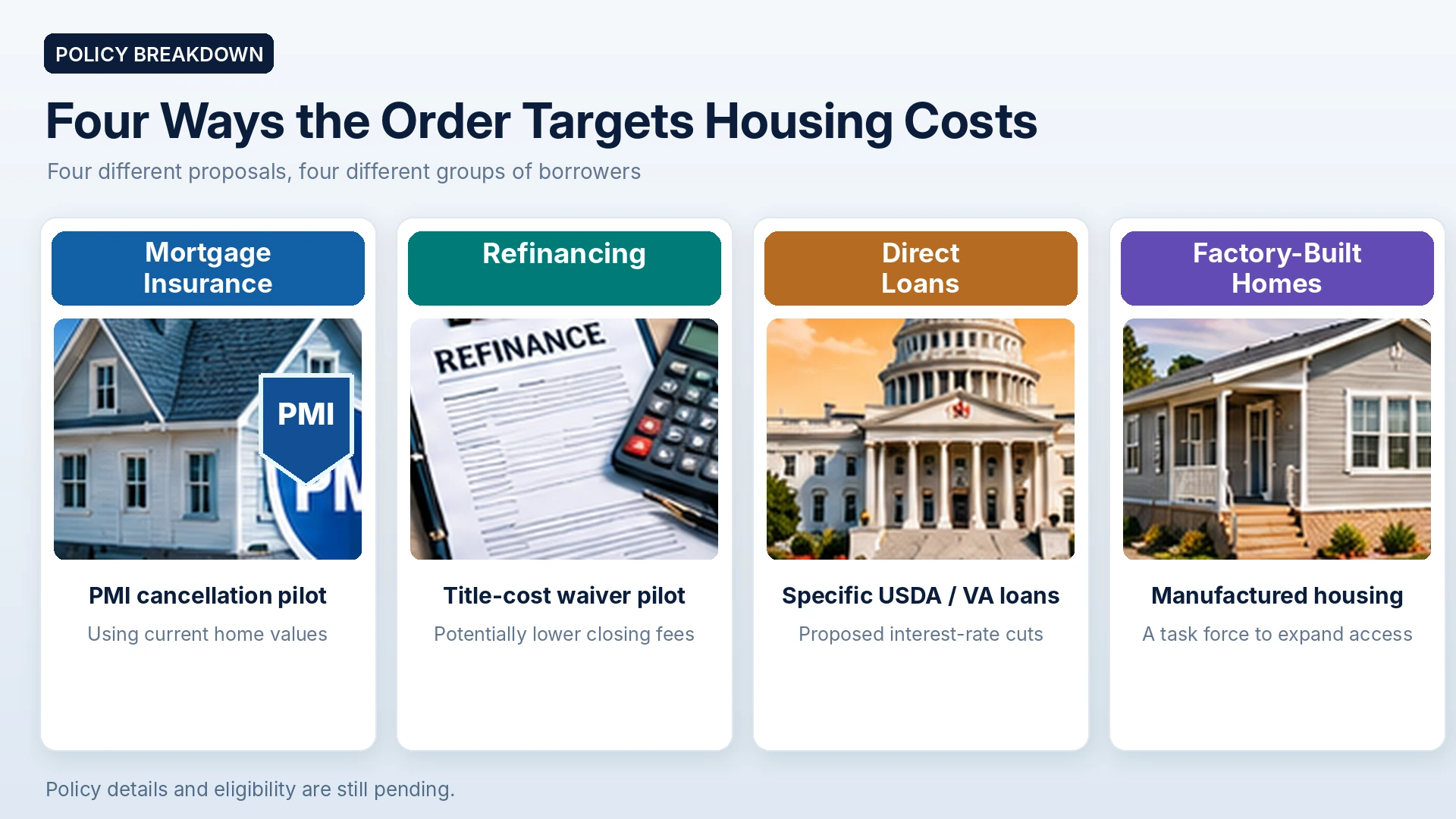
The order directs federal agencies to pursue four different approaches to housing costs. Some could affect existing homeowners fairly directly, while others address particular loan programs or the longer-term supply of homes.
According to the White House announcement and Reuters, the measures include a new mortgage insurance cancellation pilot, an expanded refinancing title-insurance waiver program, a manufactured housing initiative, and interest-rate reductions for certain home loans made directly through federal departments. (Reuters · White House Statement)
| Policy area | What the order directs | Potential beneficiary |
|---|---|---|
| Mortgage insurance | Develop proactive cancellation using current home values | Eligible existing homeowners paying mortgage insurance |
| Refinancing | Make a title-insurance waiver pilot permanent and expand its availability | Eligible homeowners refinancing |
| Federal direct loans | Reduce rates on certain loans issued by USDA and VA | Borrowers in qualifying federal direct-loan programs |
| Manufactured housing | Promote factory-built homes through a federal task force | Potential future buyers and housing providers |
The first two measures are particularly relevant to homeowners who already have mortgages.
But neither means that the government has reduced the interest rate written into an existing fixed-rate mortgage.
That distinction is especially important because a mortgage payment is often made up of several separate expenses.
Why Could Mortgage Insurance Disappear From Some Monthly Payments?
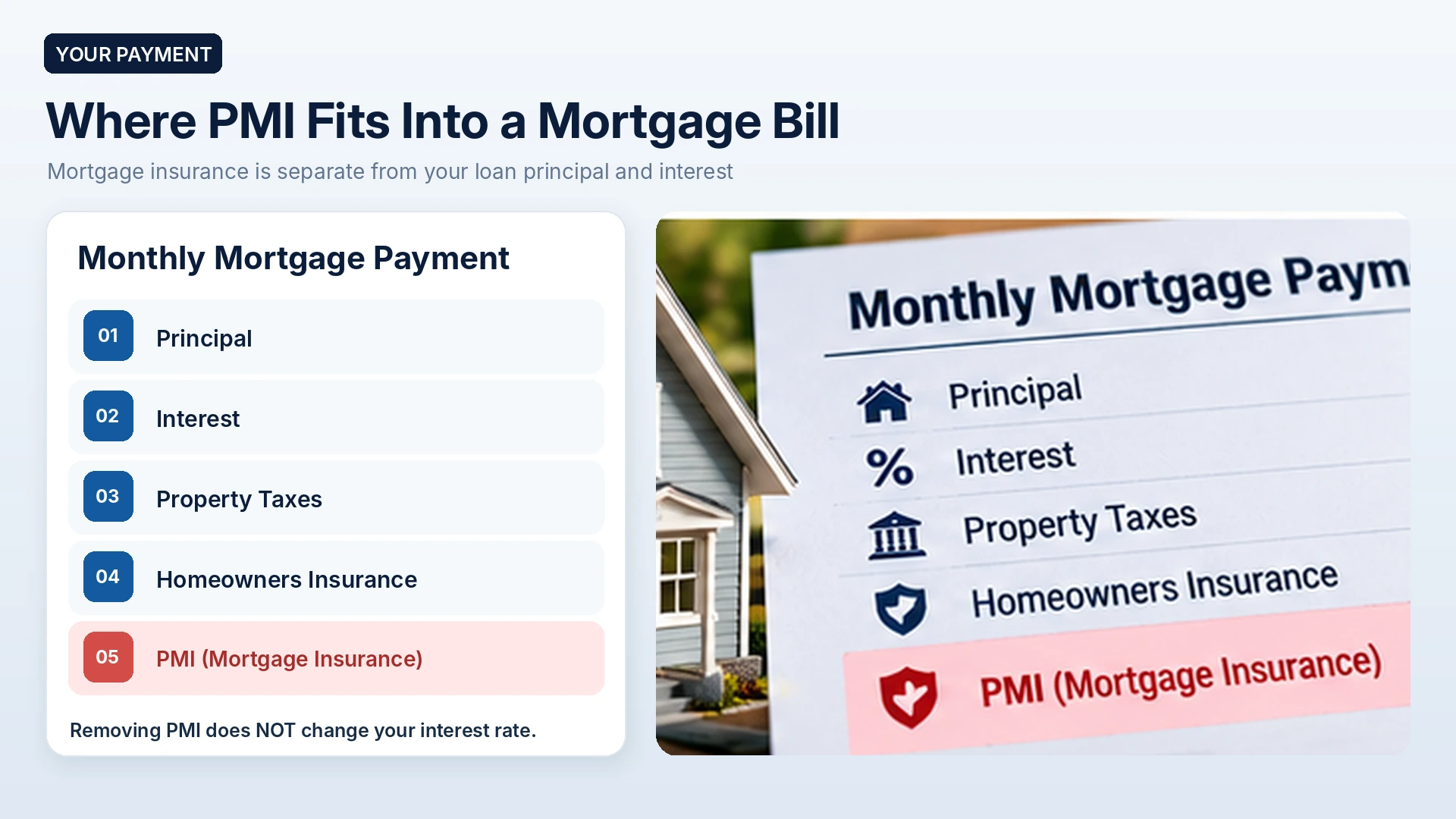
Private mortgage insurance, or PMI, is an additional expense commonly required on conventional mortgages when the borrower makes a down payment of less than 20%.
Although the homeowner pays for it, PMI primarily protects the lender if the borrower defaults.
It isn’t the same thing as homeowners insurance, which protects against covered damage or losses involving the property.
And PMI isn’t meant to last forever.
Under existing federal rules, many borrowers already have the right to request PMI cancellation when the loan balance reaches 80% of the home’s original value, provided they meet other requirements.
Generally, PMI must be automatically terminated when the loan is scheduled to reach 78% of the original value, as long as the borrower is current on payments. Different rules apply to some mortgage programs and loan circumstances. (Consumer Financial Protection Bureau)
So why does Trump’s order matter if homeowners can already remove PMI?
Because the new initiative seeks to make cancellation more proactive and take account of a home’s current market value.
That could make a difference for borrowers whose homes have appreciated significantly since they were purchased.
It could also reduce the need for eligible borrowers to navigate a complicated cancellation process themselves.
But the pilot still needs implementation rules, and its precise eligibility conditions are not yet established in the information publicly available with the October 22 announcement.
Could Rising Home Values Let You Remove PMI Earlier?
Potentially, yes. That’s one of the most important possibilities raised by the order.
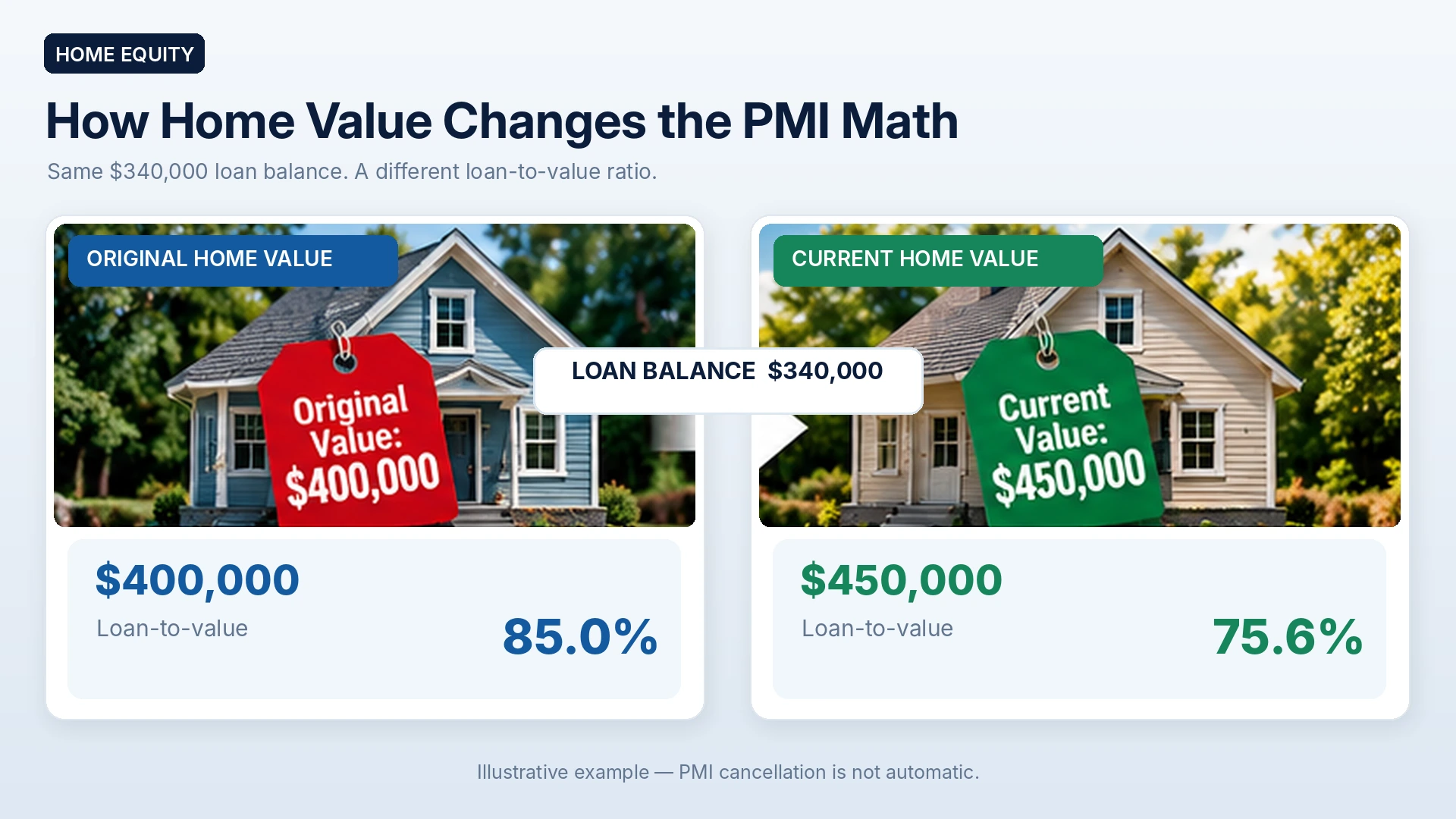
Consider a hypothetical homeowner who bought a house several years ago.
| Mortgage detail | Amount |
|---|---|
| Original home value | $400,000 |
| Remaining mortgage balance | $340,000 |
| Current estimated home value | $450,000 |
| Loan balance relative to original value | 85.0% |
| Loan balance relative to current value | 75.6% |
Under the standard federal cancellation calculation based on original value, the homeowner hasn’t yet reached the usual 80% request threshold.
The balance would need to decline to $320,000 to meet that numerical threshold, assuming the relevant original value is $400,000.
But look at the current estimated home value.
With a $340,000 mortgage balance against a $450,000 property, the homeowner has approximately $110,000 in equity.
That means the mortgage represents roughly 75.6% of the home’s current estimated value.
A program that recognizes current market value could potentially identify additional borrowers who qualify to remove mortgage insurance without waiting for the original-value threshold.
Important: This example illustrates how the calculation works. It does not establish that this borrower will qualify for the new federal pilot.
There is another complication.
Fannie Mae and Freddie Mac already have investor-specific guidelines that can allow earlier PMI cancellation in some circumstances. The Consumer Financial Protection Bureau acknowledges those possibilities. (CFPB)
So the new policy shouldn’t be described as the first time rising home values could ever help remove PMI.
The potential change is a more systematic process for identifying eligible homeowners and reducing administrative obstacles.
That leaves practical questions: Which loans will be eligible? How will current property values be measured? And will borrowers need to take any action?
Those details will matter far more to an individual homeowner than the announcement itself.
Will Refinancing Become Cheaper Even If Mortgage Rates Stay High?
Yes, refinancing could become less expensive for certain borrowers, even without a general reduction in mortgage rates.
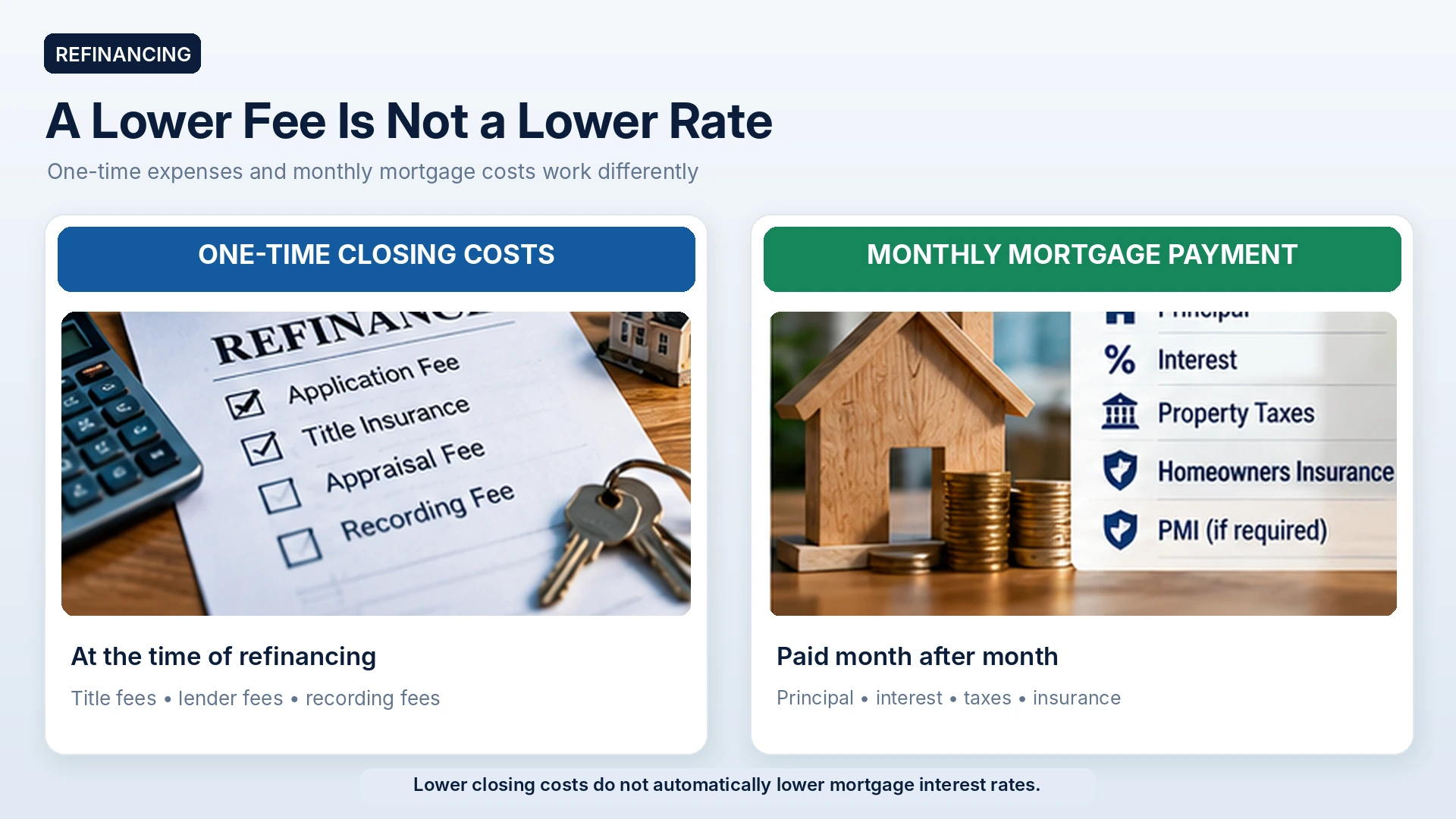
But there’s an important difference between reducing the cost of getting a new loan and lowering what that loan costs every month.
When homeowners refinance, they replace an existing mortgage with a new one.
Even if they already own the property, the refinancing process can involve closing costs such as lender charges, recording fees, and title-related expenses.
One expense can be lender’s title insurance, which protects the lender against certain problems involving ownership claims and liens.
In 2024, the Federal Housing Finance Agency approved a limited Fannie Mae pilot that allows certain low-risk refinancing transactions to proceed without the usual lender’s title insurance policy or attorney opinion letter requirement.
The original pilot applied to qualifying refinances with loan-to-value ratios below 80%, through participating lenders and selected areas. (FHFA Title Acceptance Pilot FAQs)
Trump’s October 22 order directs FHFA to expand that approach into a permanent program.
That could save qualifying borrowers money at closing.
However, the order does not mean all refinances are now exempt from title insurance requirements, nor does it eliminate every refinancing expense.
The savings work differently
Imagine two potential savings scenarios:
| Type of savings | Illustrative benefit |
|---|---|
| PMI cancellation | $125 less per month |
| Lower refinance closing costs | $1,000 less at closing |
Both examples are hypothetical, not announced government savings amounts.
In the first case, the homeowner would save $1,500 over a full year if the $125 monthly PMI payment disappeared.
In the second, the homeowner saves $1,000 on a one-time expense.
Those are different financial benefits.
If closing costs are financed into the new loan rather than paid upfront, reducing them could also reduce the amount borrowed. But that still doesn’t mean the lender has reduced the mortgage interest rate.
And refinancing should be evaluated against the borrower’s existing loan.
For someone holding a 3% fixed mortgage, refinancing into a substantially higher rate could be expensive even if closing fees fall.
The Consumer Financial Protection Bureau recommends comparing actual Loan Estimates, including interest rates, closing costs, and total monthly payments. (CFPB)
Who Could Benefit—and Who Might See No Change?
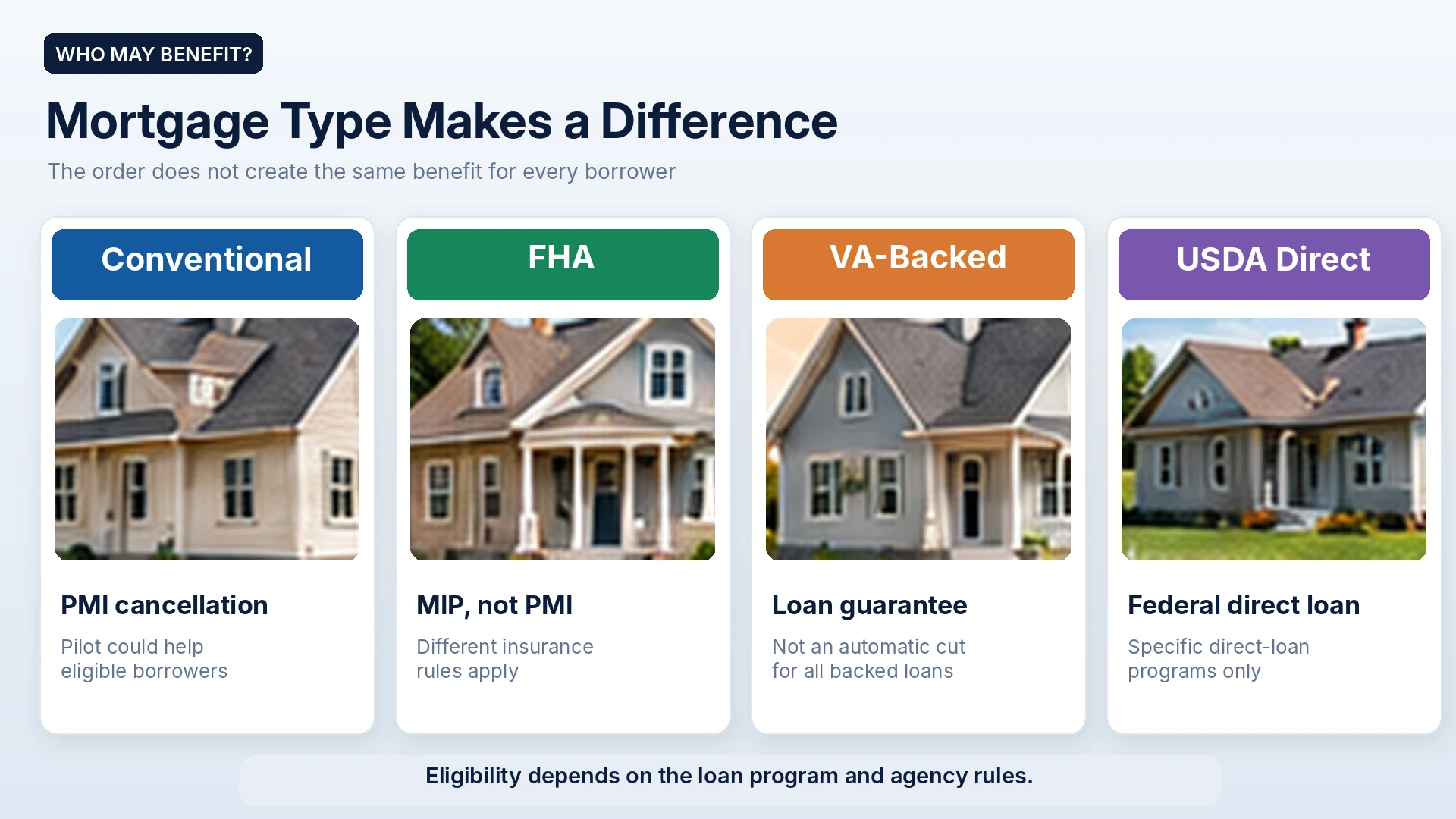
The order isn’t a universal mortgage discount. Eligibility depends heavily on the borrower’s loan type and which part of the order is involved.
For conventional borrowers paying PMI, the new cancellation pilot may eventually provide a route to savings, subject to the program’s final requirements.
Homeowners who refinance may benefit from expanded title-insurance alternatives if their transactions qualify.
But other mortgage programs operate under different rules.
FHA loans are not the same as conventional PMI loans
Mortgages insured by the Federal Housing Administration generally use mortgage insurance premiums, commonly called MIP, rather than conventional private mortgage insurance.
Those premiums follow their own program rules.
A homeowner with an FHA loan therefore should not assume that an FHFA initiative involving conventional mortgage insurance automatically eliminates FHA MIP.
The distinction also matters for borrowers whose loans already have different insurance or guarantee arrangements. (CFPB)
What about veterans and USDA borrowers?
The White House announcement also directs the Departments of Veterans Affairs and Agriculture to reduce rates on certain single-family home loans made directly by those departments. (Reuters)
That doesn’t mean every VA-backed mortgage is receiving a rate reduction.
Most VA-backed home loans are made by private lenders and guaranteed by the VA. The department also has a much narrower direct-lending program for eligible Native American veterans. (Department of Veterans Affairs)
Similarly, USDA operates both direct and guaranteed mortgage programs. Its Section 502 Direct Loan Program serves eligible low- and very-low-income borrowers in rural areas. (USDA Rural Development)
The order’s language about loans made by the departments matters because a federal direct loan is not interchangeable with a privately issued, government-guaranteed mortgage.
A borrower should therefore verify the specific loan program and any announced implementation changes rather than assuming a new interest rate automatically applies.
What about people who don’t own a home yet?
Prospective homebuyers could eventually benefit from changes in mortgage costs or an expanded supply of factory-built housing.
The executive order establishes a task force focused on manufactured housing innovation, including making more factory-built homes eligible for federal housing programs.
But establishing a task force does not immediately produce additional homes, lower local home prices, or guarantee access to a cheaper mortgage.
Any broader affordability impact would depend on later agency actions, program changes, builders, lenders, and local market conditions.
How Much Could a Homeowner Actually Save?
There is no single savings figure that applies to everyone.
The financial benefit could range from no change at all to the elimination of a recurring insurance payment, depending on the borrower’s mortgage and eligibility.
Suppose a homeowner currently pays $150 each month in PMI.
If that entire charge is removed, the arithmetic looks like this:
| Period | Hypothetical PMI savings |
|---|---|
| One month | $150 |
| Six months | $900 |
| One year | $1,800 |
| Two years | $3,600 |
These are illustrative calculations, not a government estimate of average savings or a prediction of when an individual homeowner would qualify.
They also assume the monthly insurance charge would otherwise have remained in place for the entire period.
A homeowner already scheduled to lose PMI soon under existing rules would have a smaller incremental benefit from earlier cancellation.
Someone who doesn’t pay PMI in the first place wouldn’t save anything from removing that particular charge.
For refinancing, the calculation is different. A homeowner would need to compare the total financing costs, any reduction in upfront expenses, and the new interest rate against the mortgage they already have.
The largest potential benefit is not necessarily a lower interest rate. It may be the removal of an expense that sits alongside the mortgage payment.
Why Doesn’t the President’s Order Automatically Lower Mortgage Rates?
Because mortgage interest rates and mortgage-related fees are not the same thing.
The president can direct federal agencies to pursue changes within their legal authority, but an executive order doesn’t automatically rewrite the interest rates in millions of private mortgage contracts.
Market mortgage rates reflect factors such as Treasury yields, inflation expectations, funding costs, and financial-market conditions.
As of October 22, 2026, Freddie Mac’s average 30-year fixed mortgage rate had eased to 7.32%, according to an Associated Press report. That decline was a market-rate observation, not evidence that the newly signed order had already reduced rates. (AP)
This matters because borrowing costs remain a major obstacle to affordability.
A borrower can save money on title fees and still face a high monthly principal-and-interest payment.
Likewise, a borrower may qualify for PMI cancellation without refinancing or changing the loan’s original interest rate.
The administration is targeting some components of housing costs that federal housing agencies may be able to influence more directly.
That is a narrower objective than making all mortgages cheaper overnight.
What Should Homeowners Do Now—and When Will the Changes Start?
Homeowners don’t need to wait for the new pilot to check whether they already qualify for mortgage insurance cancellation.
Existing protections remain relevant, and some borrowers may already be eligible to have PMI removed.
A practical starting point is to review a recent mortgage statement and contact the company that services the loan.
Ask whether the loan carries borrower-paid PMI, whether it is owned by Fannie Mae or Freddie Mac, and what cancellation options are already available under existing law and investor rules.
Homeowners can also request information about whether their current property value can be considered under applicable servicing requirements.
The CFPB explains the existing rules and conditions for removing private mortgage insurance. (CFPB)
For refinancing, a lower title-related expense is useful only in the context of the full loan offer. Compare the new rate, loan term, closing costs, and total amount paid over time.
As for the October 22 executive order, several important questions remain unresolved in the initial public announcement:
- When will the new mortgage insurance pilot begin operating?
- Which loan types and borrowers will qualify?
- What property valuation methods will servicers use?
- How widely will expanded refinancing title waivers be available?
- What specific rate changes will USDA and VA announce for their direct-loan programs?
Until agencies publish operational details, a homeowner cannot reliably calculate a personalized benefit from the executive order alone.
The announcements to watch are those from FHFA, the mortgage enterprises and participating servicers, along with USDA and VA for their respective direct-loan programs.
Bottom Line: What This Story Really Means
Trump’s October 22 mortgage executive order could reduce housing expenses for some Americans, but it does not automatically lower every homeowner’s monthly mortgage payment.
The most immediately relevant possibility for many conventional borrowers is the expansion of mortgage insurance cancellation using current home equity and a more proactive eligibility process.
For homeowners considering refinancing, broader title-insurance waivers could help reduce upfront closing costs.
Other provisions deal with specific federal direct loans and efforts to expand manufactured housing.
But these measures work differently, and the practical results will depend on implementation.
The most useful question for homeowners is not simply whether Trump has ordered lower housing costs.
It’s whether their particular mortgage has an expense that can actually be removed—and whether they already have the right to remove it under existing rules.
Trump Mortgage Executive Order: Key Questions Explained
Q. Did Trump eliminate private mortgage insurance in October 2026?
No. The October 22 executive order directs FHFA to establish a pilot that would proactively cancel mortgage insurance for qualifying borrowers. It does not immediately eliminate PMI for everyone.
Q. Does the new mortgage order reduce interest rates on existing mortgages?
Not generally. The order focuses heavily on insurance and transaction costs. It also addresses rates on certain federal direct-loan programs, but it does not automatically change existing private mortgage interest rates.
Q. Can home appreciation help homeowners remove PMI?
Potentially. Existing investor guidelines may already permit current-value-based cancellation in certain circumstances, and the newly ordered pilot seeks a more proactive approach using current market values.
Q. At what point can conventional mortgage insurance normally be removed?
For many qualifying loans, homeowners may request PMI cancellation when the balance reaches 80% of the property’s original value, subject to conditions. Automatic termination generally occurs when the balance is scheduled to reach 78%, provided the borrower is current.
Q. Do homeowners need to refinance to cancel PMI?
Not necessarily. PMI can often be canceled on an existing qualifying mortgage without refinancing, although eligibility and requirements vary.
Q. Will refinancing become free under Trump’s executive order?
No. Expanded title-insurance waivers may reduce certain closing costs, but lenders and borrowers may still face other refinancing expenses.
Q. Does the mortgage insurance change automatically apply to FHA loans?
No. FHA mortgage insurance follows different rules from conventional private mortgage insurance. Borrowers should check their specific loan program.
Q. Will all veterans with VA-backed mortgages receive lower rates?
No automatic across-the-board reduction was established. The October 22 announcement addresses certain loans made directly by the VA, which are different from the much larger category of privately issued VA-guaranteed loans.
Q. How much could removing $150 in monthly PMI save?
It would save $1,800 over 12 months if the full $150 charge disappeared and otherwise would have continued throughout that period. Actual savings depend on the homeowner’s premium and cancellation timing.
Q. When will Trump’s new mortgage savings programs become available?
The initial October 22 announcement did not establish a universal start date for every borrower. Implementation details and eligibility requirements must be confirmed through subsequent agency and servicing announcements.
Did this help make the story clearer? 🙂
WIN keeps unpacking the “why” behind the news—clearly and simply!
Sources
October 22 Executive Order and Policy Announcement
Reuters — Trump Signs Order Aimed at Reducing Single-Family Housing Costs, October 22, 2026
White House Housing Cost Announcement — Republished by Mirage News, October 22, 2026
Mortgage Insurance Rules and Homeowner Protections
Consumer Financial Protection Bureau — When Can I Remove Private Mortgage Insurance From My Loan?
Refinancing and Title Insurance Policy
Federal Housing Finance Agency — Director’s Statement on the Title Acceptance Pilot, March 7, 2024
Federal Housing Finance Agency — Title Acceptance Pilot Eligibility FAQs
Consumer Financial Protection Bureau — Understanding and Comparing Loan Estimates
Federal Home Loan Programs and Mortgage Market Context
U.S. Department of Veterans Affairs — Direct vs. VA-Backed Home Loans
USDA Rural Development — Single Family Housing Direct Home Loans
Associated Press — Average Long-Term U.S. Mortgage Rate Eases to 7.32%, October 22, 2026
Keep Reading
Why can mortgage rates differ from one website to another?
The new order addresses some costs around a mortgage, but it doesn’t set market interest rates. Understanding why mortgage quotes and national averages differ can help put any potential savings in perspective.
Why Are Mortgage Rates Back Above 7%—and Why Does Every Website Show a Different Number?