Social Security Is Rising 3.6% in 2027—Why Won’t Everyone Get an Extra $75?

An extra $75 a month sounds like straightforward good news. But imagine two retirees opening their Social Security notices this winter. One sees an increase of about $54. The other sees about $108. Neither has been shortchanged.
On October 14, 2026, the Social Security Administration announced a 3.6% cost-of-living adjustment (COLA) for 2027. It said the average monthly retirement benefit would rise by approximately $75. That is an average, not a flat payment added to every check. (Social Security Administration)
And there is another wrinkle: the increase in your benefit is not necessarily the same as the increase in your bank deposit. Medicare premiums and other deductions can change the amount you actually receive.

※ Images in this article are AI-generated illustrations created to help explain the story. They are not actual photographs, and depictions of people, places, or events may differ slightly from reality.
So what should someone expecting a larger check actually calculate?
Why Won’t Every Retiree Get an Extra $75?
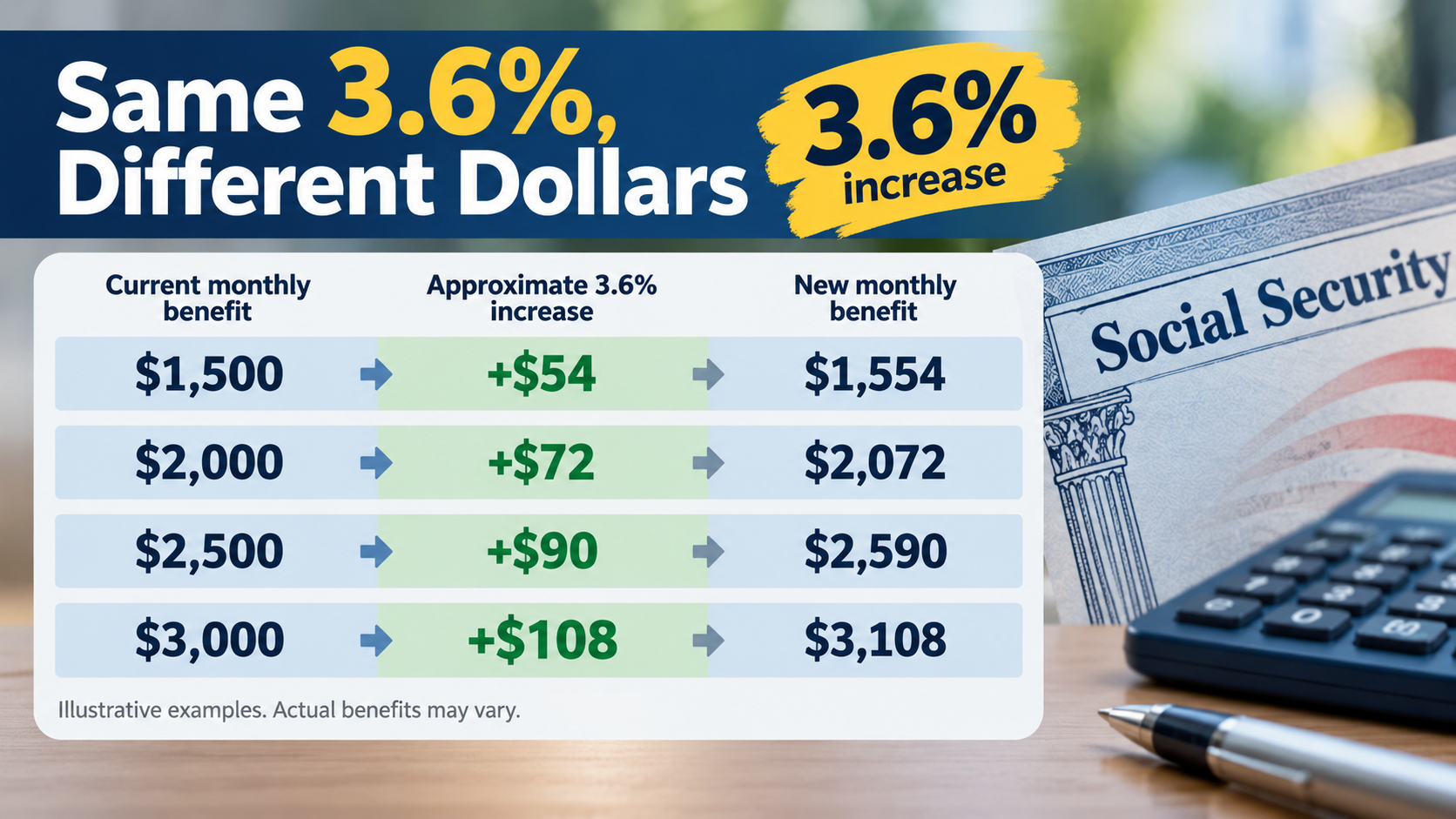
The $75 figure is an average, not a fixed bonus. A 3.6% COLA is applied to each person’s own benefit calculation, so the dollar increase depends largely on the amount before the adjustment.
Here is a simple illustration, using hypothetical monthly benefits before deductions:
| Current monthly benefit | Approximate 3.6% increase | New monthly benefit |
|---|---|---|
| $1,500 | $54 | $1,554 |
| $2,000 | $72 | $2,072 |
| $2,500 | $90 | $2,590 |
| $3,000 | $108 | $3,108 |
These are estimates to explain the math, not personalized SSA payment quotes. Actual benefit calculations include adjustments and rounding that can shift the final figure slightly. (Social Security Administration)
SSA’s official 2027 fact sheet estimates that the average monthly benefit for retired workers will rise from $2,095 to $2,170, a $75 difference. But the starting amount varies with a person’s covered earnings history, when benefits began, and the type of benefit received. (Social Security Administration)
That explains why two people can receive the same COLA rate without receiving the same number of extra dollars.
Why Could Your Bank Deposit Increase by Less Than Your Benefit?
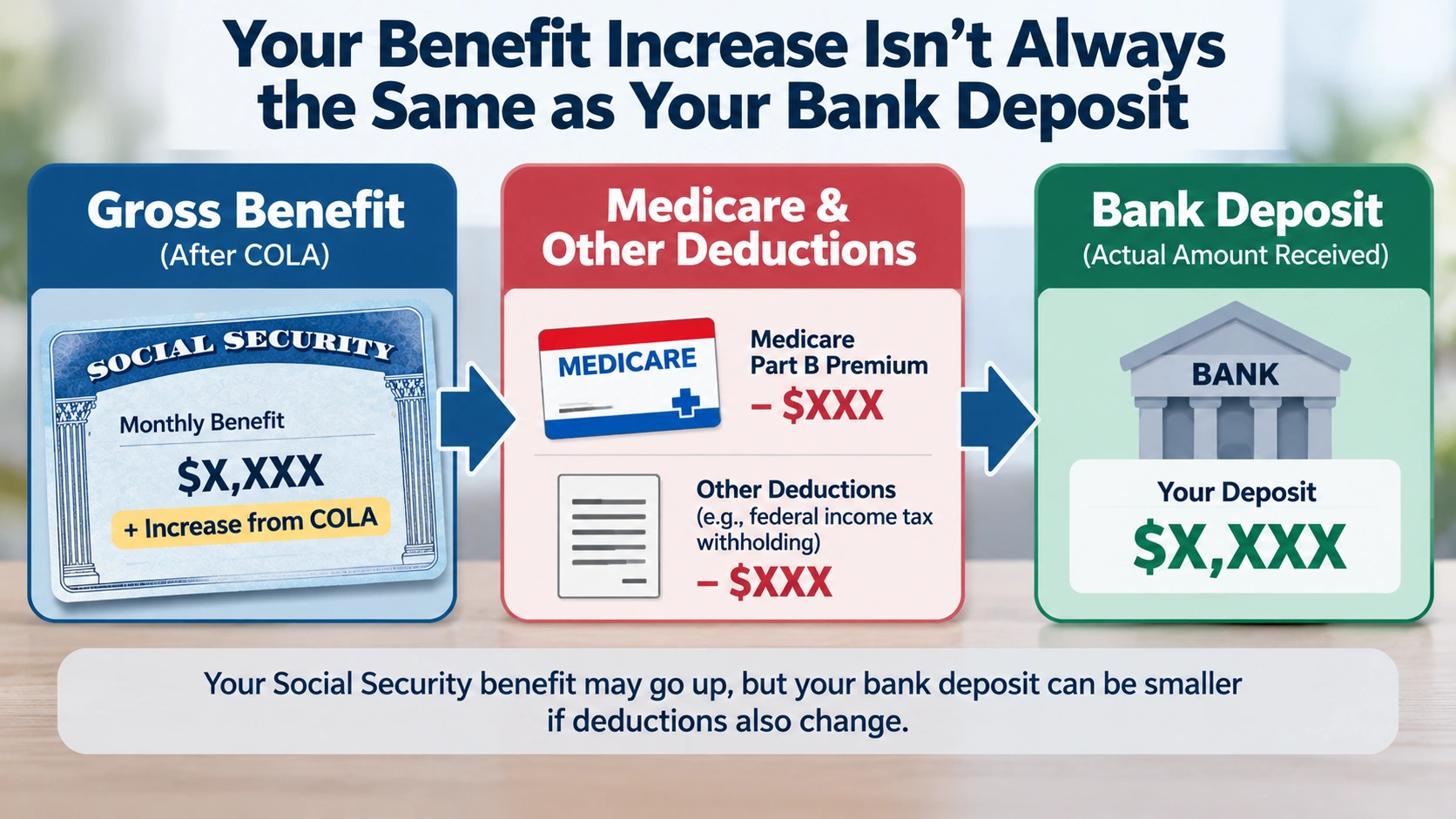
The COLA increases your Social Security benefit calculation. What reaches your bank account also depends on deductions. Most people enrolled in Medicare Part B have its monthly premium taken directly out of their Social Security payment. (Medicare)
The standard Medicare Part B premium is $202.90 a month in 2026. As of October 15, 2026, the official 2027 standard Part B premium has not yet been included in SSA’s COLA announcement; SSA says Medicare information will be available later, with individualized premium details appearing in notices beginning in late November. (Centers for Medicare & Medicaid Services · Social Security Administration)
Consider a hypothetical retiree whose gross benefit rises by $72 a month. If that person’s Medicare deduction also rises by $10, the extra amount deposited could be about $62 a month, assuming everything else stays the same. The $10 is an example, not an announced 2027 premium change.
Other deductions, including voluntary federal income tax withholding, may also affect a payment. Some people have a protection known as the hold-harmless provision, which limits the effect of certain Part B premium increases on eligible Social Security payments. It does not protect everyone, including some new Medicare enrollees and people subject to higher income-related premiums. (Social Security Administration)
The practical distinction is between your gross benefit increase and your net deposit increase. Your personalized COLA notice should help you see both.
Why Is the COLA 3.6% When September Inflation Was 3.7%?
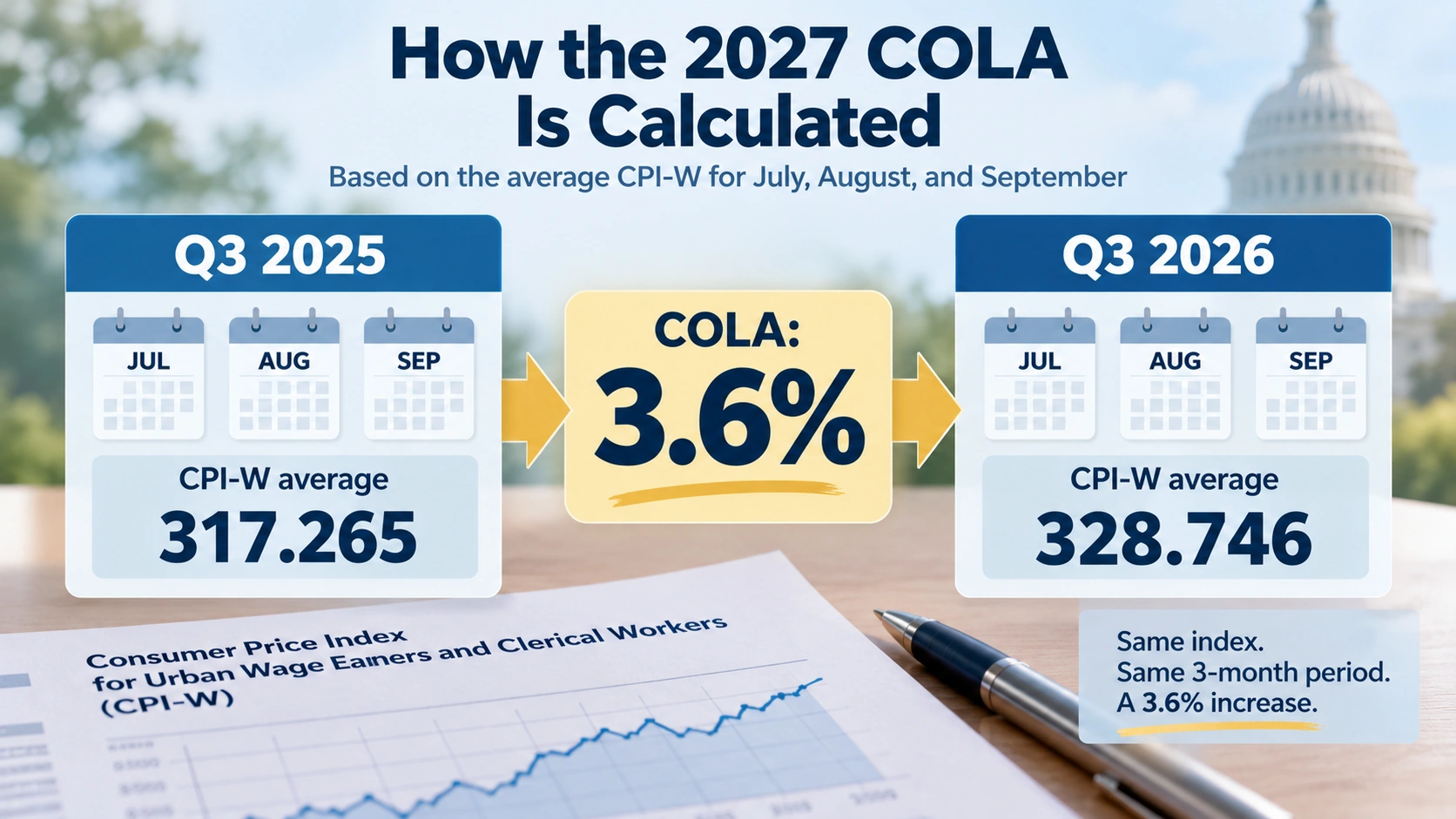
The 3.6% Social Security COLA and 3.7% September inflation rate use different price indexes and comparison periods. Social Security’s annual COLA uses the Consumer Price Index for Urban Wage Earners and Clerical Workers (CPI-W), specifically the average index for July, August, and September compared with the same quarter a year earlier.
For the 2027 adjustment, the CPI-W third-quarter average rose from 317.265 in 2025 to 328.746 in 2026. That works out to a 3.6% increase when rounded according to the statutory rule. (Social Security Administration)
Meanwhile, the widely reported 3.7% September inflation rate describes the 12-month increase in the broader Consumer Price Index for All Urban Consumers (CPI-U). That is a different index and a different comparison. (Bureau of Labor Statistics)
| Figure in the news | What it measures | Comparison period |
|---|---|---|
| 3.6% Social Security COLA | CPI-W average | July–September 2026 vs. July–September 2025 |
| 3.7% headline inflation | CPI-U, all items | September 2026 vs. September 2025 |
The 2027 COLA is higher than the 2.8% adjustment for 2026 and the 2.5% adjustment for 2025. But a larger COLA is largely a response to higher measured prices, not a promise that retirees will suddenly be better off. (Social Security Administration)
Who Gets the Increase, and When Will the Higher Payments Arrive?
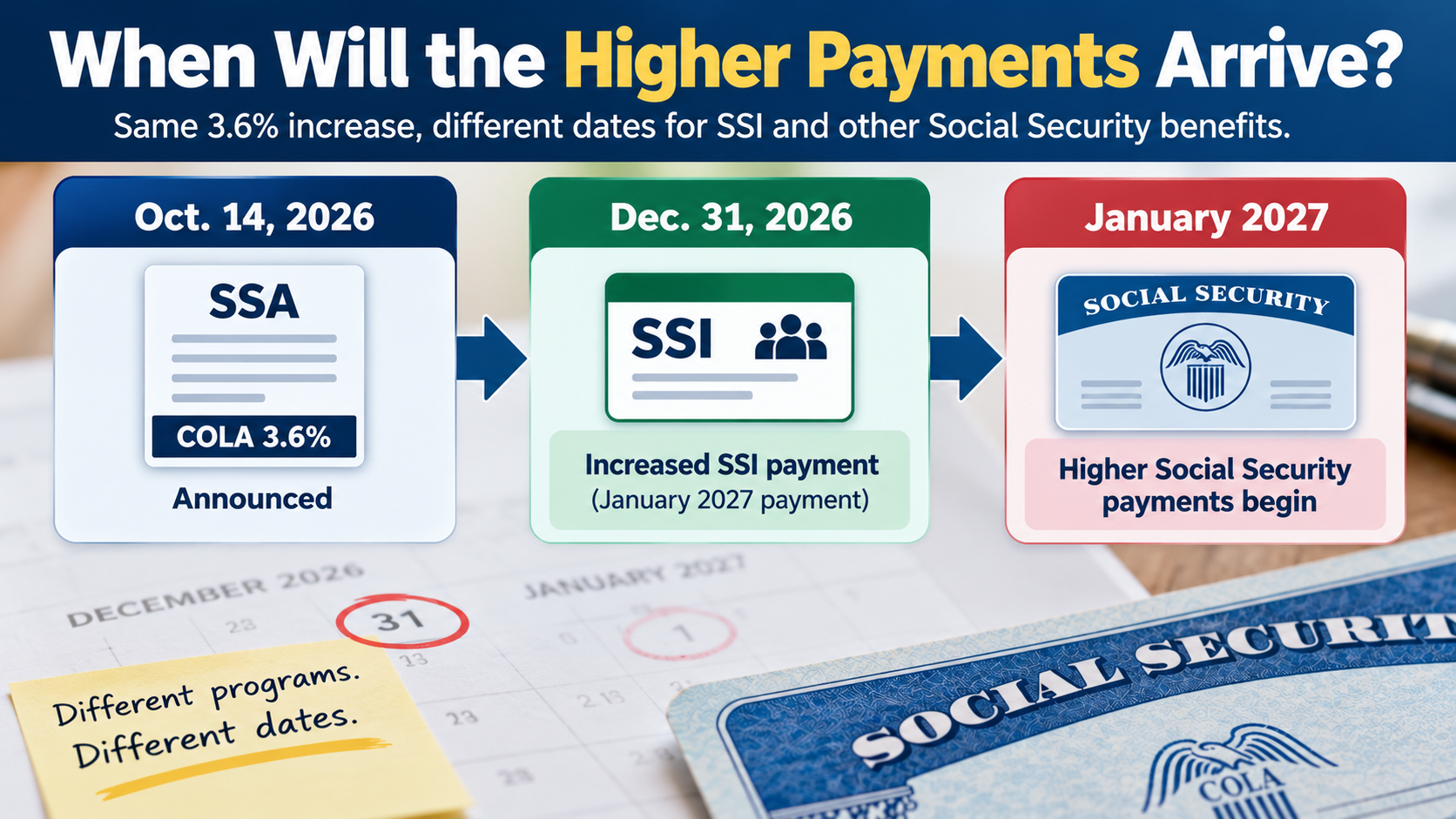
The 3.6% adjustment covers Social Security retirement, survivor, and disability benefits as well as Supplemental Security Income (SSI). But the first payment date is different for SSI recipients. (Social Security Administration)
| Benefit program | When the 2027 increase first appears | What to know |
|---|---|---|
| Social Security retirement, survivor, and disability benefits | Payments received in January 2027 | Automatically adjusted for eligible beneficiaries |
| Supplemental Security Income (SSI) | December 31, 2026 | This is the early payment for January 2027, not an extra December benefit |
SSA says nearly 72 million Social Security beneficiaries and about 7.3 million SSI recipients are affected. The total is approximately 76 million distinct people, not the sum of those two figures, because some people receive both programs. (Social Security Administration)
SSI is a separate, needs-based program. For 2027, its maximum federal monthly payment standard rises from $994 to $1,029 for an eligible individual and from $1,491 to $1,544 for an eligible couple. Actual SSI payments can be lower depending on income, living arrangements, and other applicable rules. (Social Security Administration)
Eligible recipients do not have to submit a special application to receive the annual COLA.
What Else Changes in Social Security for 2027?
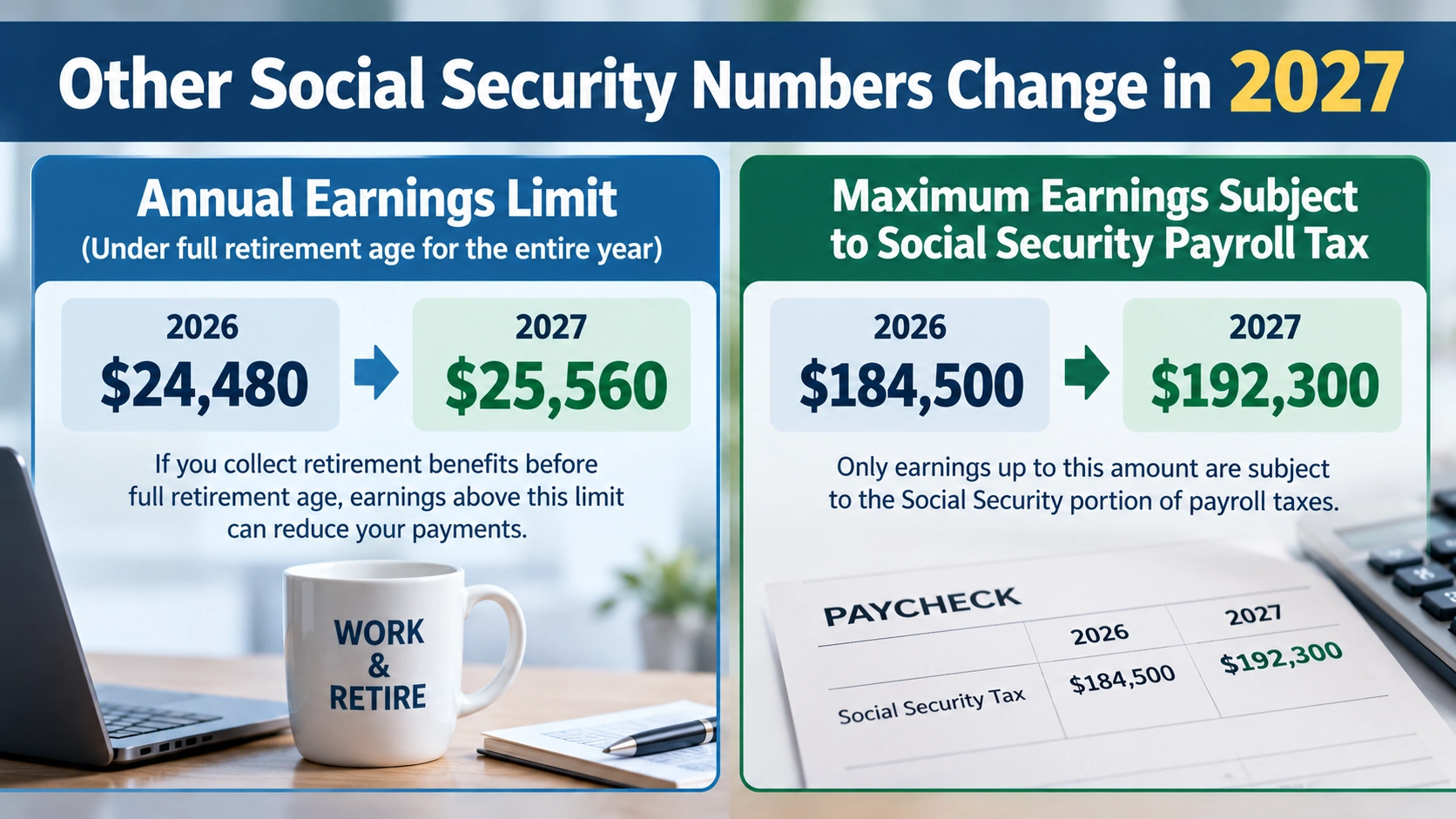
The annual COLA is the headline, but other Social Security figures will change in 2027—particularly for people who work while collecting retirement benefits or earn higher wages.
| Rule or threshold | 2026 | 2027 |
|---|---|---|
| Annual earnings limit, under full retirement age for the entire year | $24,480 | $25,560 |
| Annual earnings limit, in the year full retirement age is reached | $65,160 | $67,920 |
| Maximum earnings subject to Social Security payroll tax | $184,500 | $192,300 |
These are different rules from the 3.6% benefit COLA. The earnings-test amounts and payroll-tax maximum are generally adjusted using wage measures rather than simply applying the COLA percentage. (Social Security Administration)
For someone who claims retirement benefits while younger than full retirement age, earnings above the applicable limit can cause some benefits to be temporarily withheld. In 2027, the general rule is $1 withheld for every $2 above $25,560. In the year a person reaches full retirement age, a different limit and a $1-for-$3 rule apply only to earnings in the months before that age is reached. The earnings test no longer applies beginning with the month full retirement age is reached. (Social Security Administration)
The $192,300 payroll-tax figure, meanwhile, is a ceiling on earnings subject to the Social Security portion of payroll taxes—not a cap on how much someone is allowed to earn.
When Can You Find Your Exact 2027 Monthly Benefit?
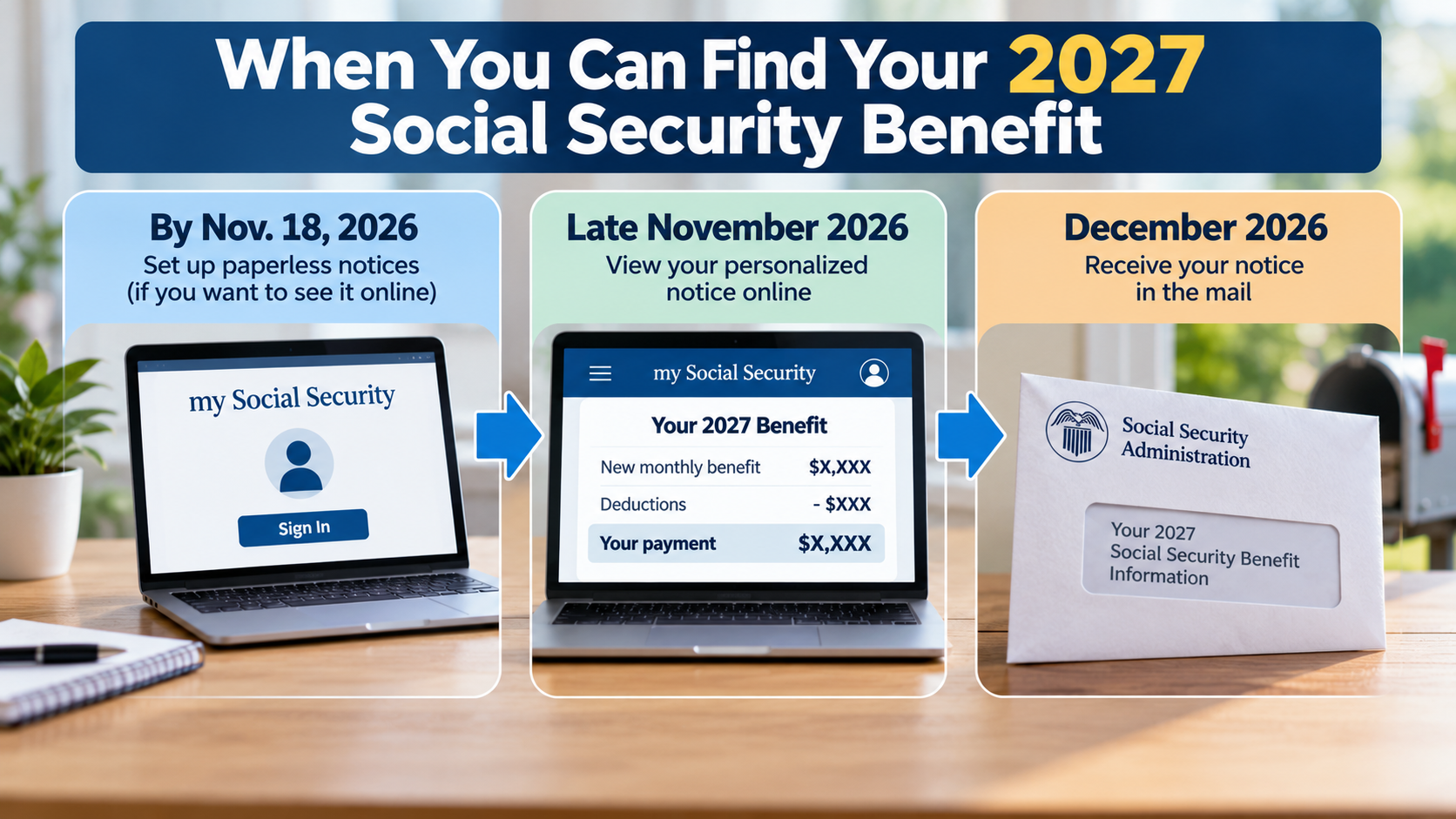
Your personalized 2027 COLA notice should become available online in late November or early December, or by mail during December. It shows your new monthly benefit and any deductions, making it more useful than the $75 average in a headline. (Social Security Administration · SSA FAQ)
SSA’s October 14 announcement gives late November as the online starting point, while its FAQ specifies early December for retirement and disability beneficiaries. The precise availability date can vary; neither should be treated as one guaranteed date for every account.
If you need to create a my Social Security account and enroll in paperless notices, SSA lists November 18, 2026, as the deadline. Otherwise, a paper notice should arrive during December. (Social Security Administration)
For Medicare enrollees, the final picture depends in part on 2027 premium information, which SSA says will be reflected in the personal account’s Message Center beginning in late November.
A useful way to read the notice is to check three things in order: the new gross benefit, each listed deduction, and the resulting payment amount. The last figure is the one most directly tied to your monthly budget.
Will a 3.6% Increase Really Keep Up With Living Costs?
Not necessarily. A COLA is an inflation catch-up mechanism, not an across-the-board increase in purchasing power. The 2027 adjustment reflects a particular national price index measured in 2026. It cannot predict what groceries, rent, utilities, or medical expenses will cost in every household next year.
There is also a mismatch between the measurement and some retirees’ spending patterns. CPI-W tracks expenses for urban wage-earner and clerical-worker households. A retiree who spends a larger share of income on particular costs may experience inflation differently, even if the national formula is applied correctly.
This is why a larger percentage can still feel disappointing. The reported increase can help offset rising prices, while higher deductions or unusually fast-growing expenses can consume part of that relief. (AP)
The most useful question is not just how much Social Security rises on paper, but how much of the increase remains after deductions—and what that remaining amount can actually buy.
Bottom Line: What This Story Really Means
The Social Security Administration has confirmed a 3.6% cost-of-living adjustment for 2027, but it has not promised every retiree an extra $75 a month. That $75 is an estimated average. Your dollar increase depends on your own benefit, while Medicare and other deductions can affect the amount deposited into your bank account.
Most Social Security beneficiaries will first receive the increase in January 2027; SSI recipients will see their January payment issued on December 31, 2026. The decisive document for your household budget will be your personalized COLA notice, which identifies the actual benefit and deductions.
2027 Social Security COLA: Key Questions Explained
Q. Is everyone getting a $75 Social Security raise in 2027?
No. $75 is the estimated average monthly increase for retired workers, not a fixed bonus. The 3.6% adjustment produces different dollar gains for people with different benefit amounts.
Q. How much more would a $2,000 monthly Social Security benefit pay?
About $72 more per month before deductions, for an illustrative total of $2,072. Actual SSA calculations and rounding can change the final amount slightly.
Q. Are disability and survivor benefits included in the 2027 COLA?
Yes. Social Security retirement, disability, and survivor benefits receive the 3.6% adjustment. SSI payments also increase, although SSI follows separate eligibility and payment rules.
Q. When will the 2027 Social Security COLA show up in checks?
The higher Social Security payments arrive beginning in January 2027. The increased January SSI payment is scheduled for December 31, 2026.
Q. Has the 2027 Medicare Part B premium been officially set?
Not as part of the October 14 Social Security COLA announcement. SSA says 2027 Medicare premium information will appear later, including in personalized notices beginning in late November. Forecasts should not be treated as finalized premiums.
Q. Could Medicare take up part of my Social Security increase?
Yes. If your Medicare Part B premium is deducted from Social Security and rises, that can reduce your net increase. Some beneficiaries qualify for a special protection against certain premium increases.
Q. Do I need to apply to get the 3.6% increase?
No. The annual COLA is applied automatically to eligible benefits. You can review your new amount through your personalized SSA notice.
Q. Why doesn’t the COLA match the 3.7% inflation rate reported for September 2026?
The 3.6% COLA compares third-quarter averages of CPI-W for 2025 and 2026. The 3.7% September headline is a 12-month change in the broader CPI-U index.
Q. Can working while receiving retirement benefits affect my 2027 checks?
Yes, if you have not reached full retirement age. In 2027, the general annual earnings-test limit is $25,560, with separate rules for the year you reach full retirement age. The earnings test no longer applies starting with the month you reach that age.
Did this help make the story clearer? 🙂 WIN keeps unpacking the “why” behind the news—clearly and simply!
Sources
Official COLA Announcement and 2027 Benefit Amounts
Social Security Administration — October 14, 2026 COLA Announcement
Social Security Administration — 2027 COLA Fact Sheet
Social Security Administration — 2027 Payment Timing FAQ
Social Security Administration — SSI Federal Payment Amounts for 2027
Inflation Formula and Individual Benefit Calculations
Social Security Administration — Latest COLA and Third-Quarter CPI-W Calculation
Social Security Administration — How COLA Is Applied to Retirement Benefits
Bureau of Labor Statistics — September 2026 Consumer Price Index Report
Associated Press — 2027 COLA and Household Cost Concerns
Medicare Deductions, Earnings Limits, and Notices
Medicare — How Part A and Part B Premiums Are Paid
Centers for Medicare & Medicaid Services — 2026 Part B Premiums
Social Security Administration — The Hold-Harmless Protection
Social Security Administration — 2027 Retirement Earnings-Test Limits
Social Security Administration — Digital COLA Notice Timing
Keep Reading
Could Some Workers Really Claim Full Social Security at 60?
Your monthly retirement benefit depends on more than the annual COLA—when you begin collecting benefits matters, too. A separate bill would let some workers in physically demanding jobs claim unreduced benefits at age 60, but it remains a proposal and has not changed current law.
Could Some Workers Get Full Social Security at 60? How the New Bill Would Decide Who Qualifies