
Why Is the FTC Suing Lens.com—and How Can “Taxes & Fees” Double the Advertised Price?

You search for contact lenses and find a price that looks dramatically cheaper than the competition.
You click. The product page still looks cheap.
Then you get deeper into checkout—and the total jumps.
So what happened to the price?
And if the extra charge says “Taxes & fees,” doesn’t that sound like money the retailer has little choice but to collect?
That is the basic conflict behind a federal lawsuit filed on October 2, 2026. The Federal Trade Commission, the Nevada Bureau of Consumer Protection, and the Utah Division of Consumer Protection allege that Lens.com advertised artificially low contact-lens prices and then added substantial mandatory charges later in the purchase process. The FTC says those charges routinely doubled advertised prices and cost consumers hundreds of millions of dollars. (FTC)
There is an important legal point before going any further: these are allegations, not a court finding. The FTC lists the case as pending, and the lawsuit has only begun. (FTC case page)
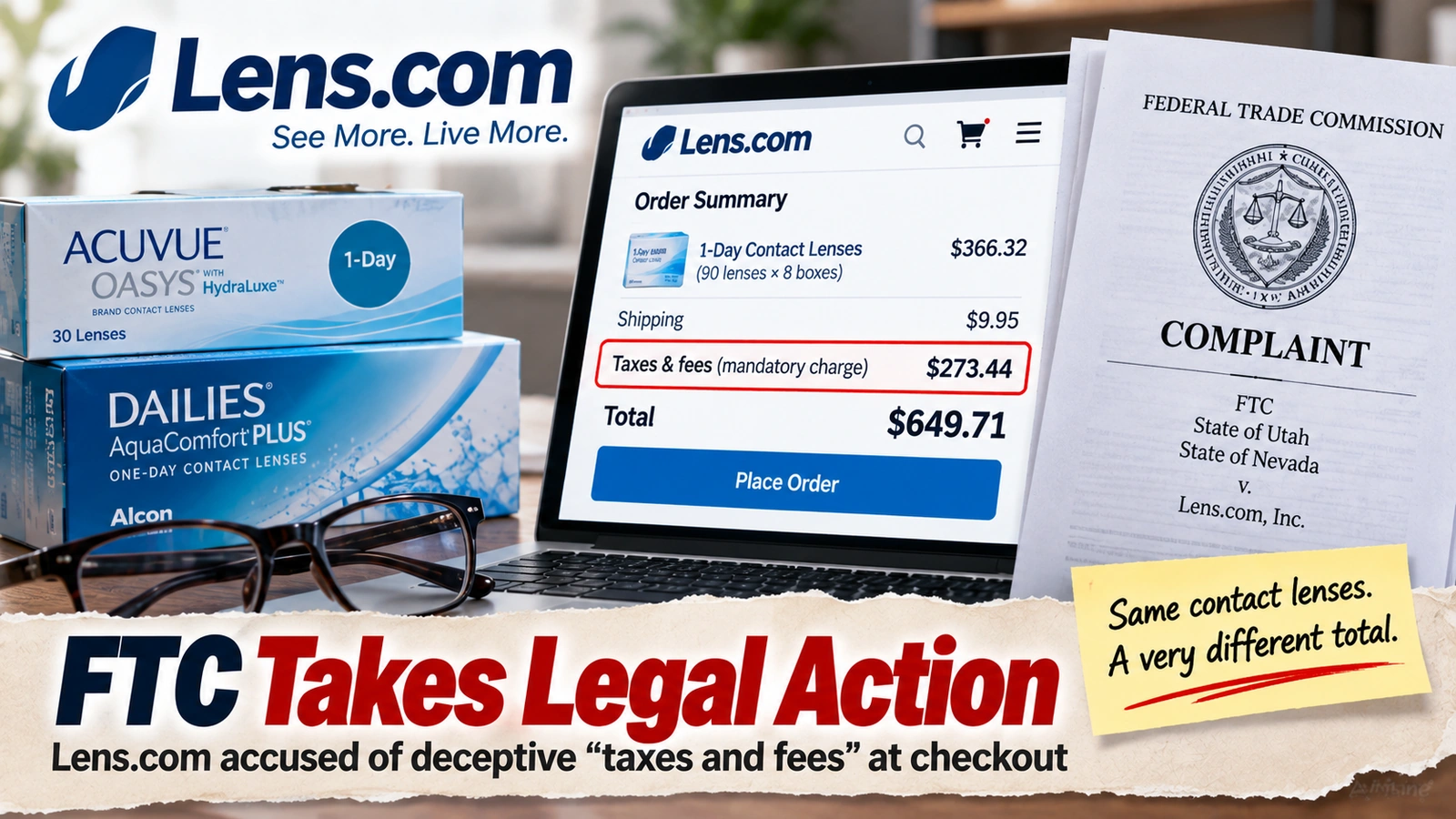
※ Images in this article are AI-generated illustrations created to help explain the story. They are not actual photographs, and depictions of people, places, or events may differ slightly from reality.
The more interesting question is how an online price can look so cheap at the beginning of a purchase while leaving a shopper with a very different number at the end.
What Exactly Is the FTC Alleging?
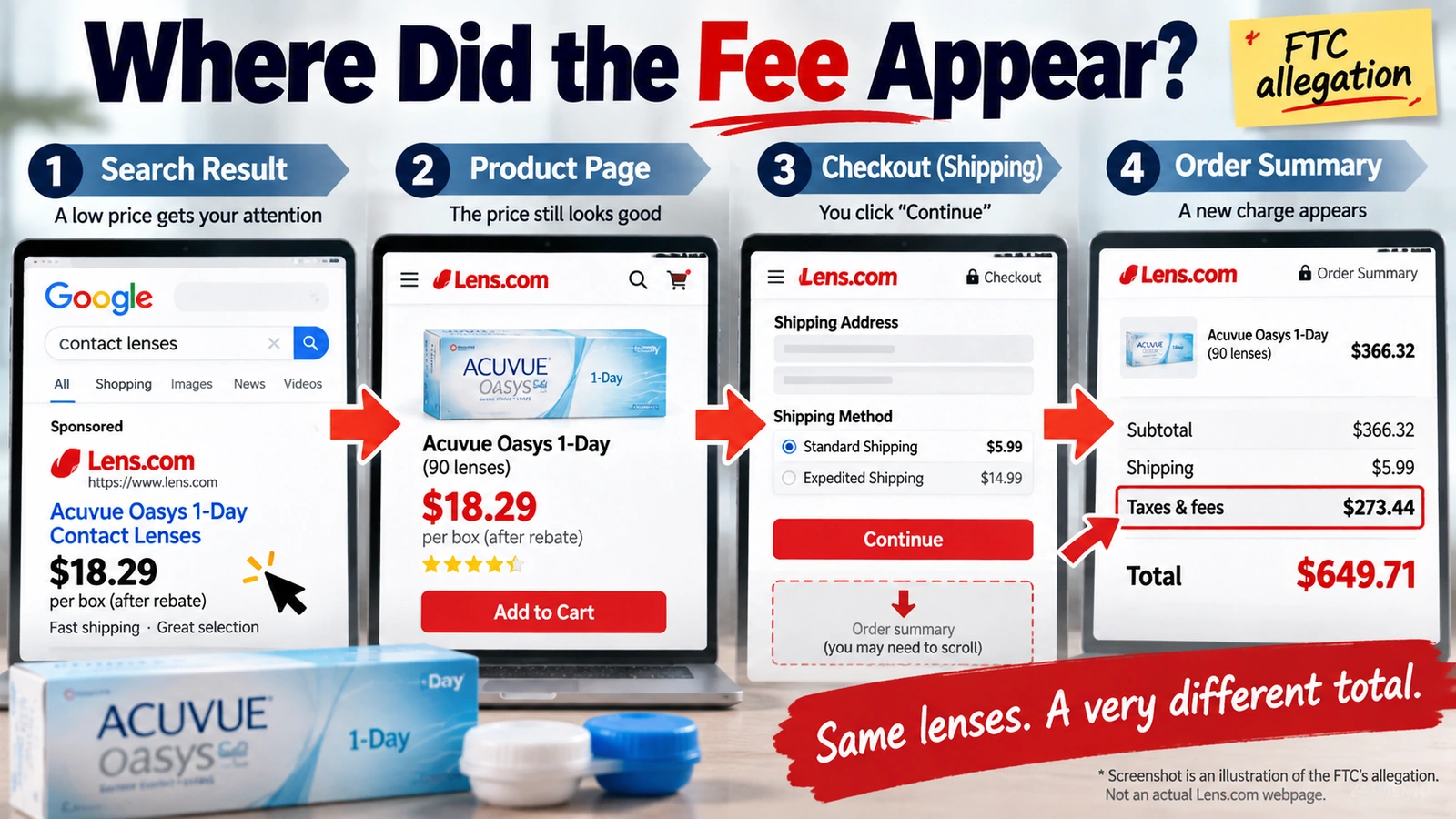
The FTC’s central allegation is not simply that Lens.com charged a fee. It is that shoppers were attracted by one price and could reach a much later stage of checkout before seeing a mandatory charge that substantially changed the real cost.
According to the FTC, Lens.com promoted low prices in sponsored Google results and on its own product pages. But the agency says a mandatory line labeled “Taxes & fees” appeared farther down an interim checkout page—below the portion a shopper might see without scrolling.
The FTC says the same screen encouraged shoppers to press a prominent “Continue” button. A shopper who continued without scrolling could therefore miss the separate fee line entirely, according to the complaint. (FTC)
That pattern is often described as drip pricing: a price starts low, then unavoidable charges are revealed later as the customer moves toward payment.
The practical problem is comparison shopping.
If one retailer appears to sell the same lenses for much less than another retailer, a shopper may spend time entering prescription information and moving through checkout before discovering that the apparent price advantage has shrunk—or disappeared.
That makes the advertised price less useful as a way to compare competing sellers.
How Can an $18.29 Price Turn Into a Much Bigger Bill?
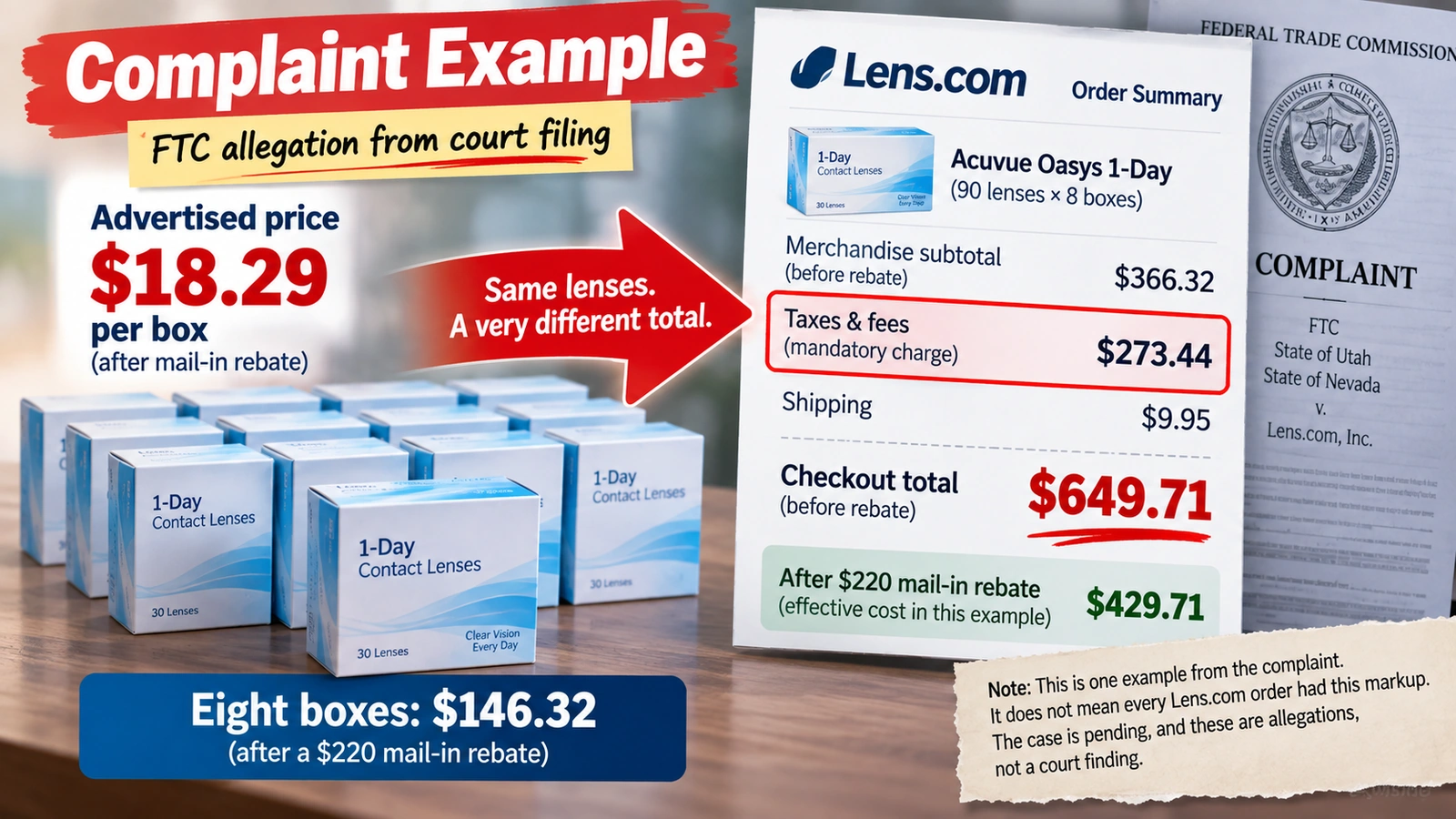
The lawsuit includes a concrete example that shows why the numbers can become confusing.
Nevada news outlet KTNV, citing the court complaint and showing images from the filing, reported that a February 2026 example advertised lenses at $18.29 per box after a mail-in rebate, or $146.32 for eight boxes.
But the order summary described in the complaint looked very different. (KTNV)
| Stage | Amount | What the number represents |
|---|---|---|
| Advertised post-rebate price | $18.29 per box | Price highlighted to the shopper |
| Eight-box advertised total | $146.32 | Effective total after a $220 mail-in rebate |
| Merchandise subtotal before rebate | $366.32 | Eight boxes before rebate |
| “Taxes & fees” | $273.44 | Mandatory additional charge alleged in the complaint |
| Shipping | $9.95 | Additional shipping cost |
| Checkout total before rebate | $649.71 | Amount shown before the mail-in rebate |
Using those figures, even if the shopper later received the full $220 rebate, the effective cost would still be $429.71.
That is nearly three times the $146.32 post-rebate figure that initially made the purchase look inexpensive.
This does not mean every Lens.com customer paid that exact markup. It is one worked example cited in the case.
But it makes the FTC’s broader allegation easier to understand: a low per-box price can be technically connected to the product while still giving a shopper a poor sense of the total amount ultimately required.
Why Does the Label “Taxes & Fees” Matter?
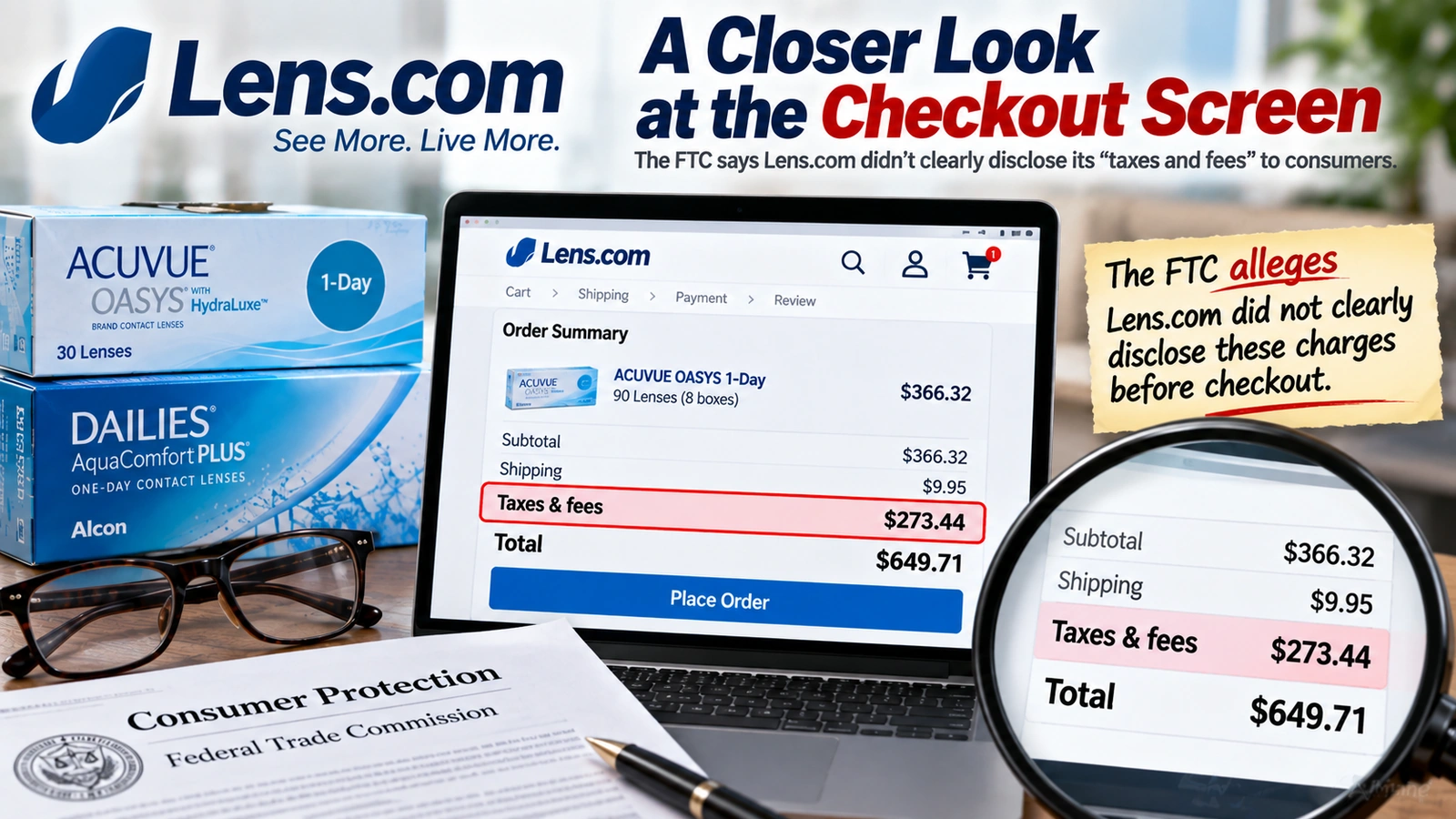
Because people interpret the word tax differently from the word fee.
A tax usually sounds like a government-imposed amount that the retailer must collect. A business fee sounds like part of the seller’s own pricing structure.
Grouping the two together can therefore affect how a shopper understands the charge.
The FTC alleges that the “Taxes & fees” description was misleading because many states exempt contact lenses from sales tax, while some jurisdictions do not impose a general state sales tax. Yet the same combined label was still used, according to the agency. (FTC)
That does not automatically prove the entire charge was improper.
The legal question is more specific: Did the price presentation and description of the charge give consumers a misleading impression about what they would actually have to pay and what the charge represented?
That distinction matters.
A company may have legitimate operating costs. The FTC’s complaint is not based on the idea that every business fee is inherently unlawful.
It is about how the total price and the nature of the fee were presented to consumers.
Is It Illegal to Add Mandatory Fees at Checkout?
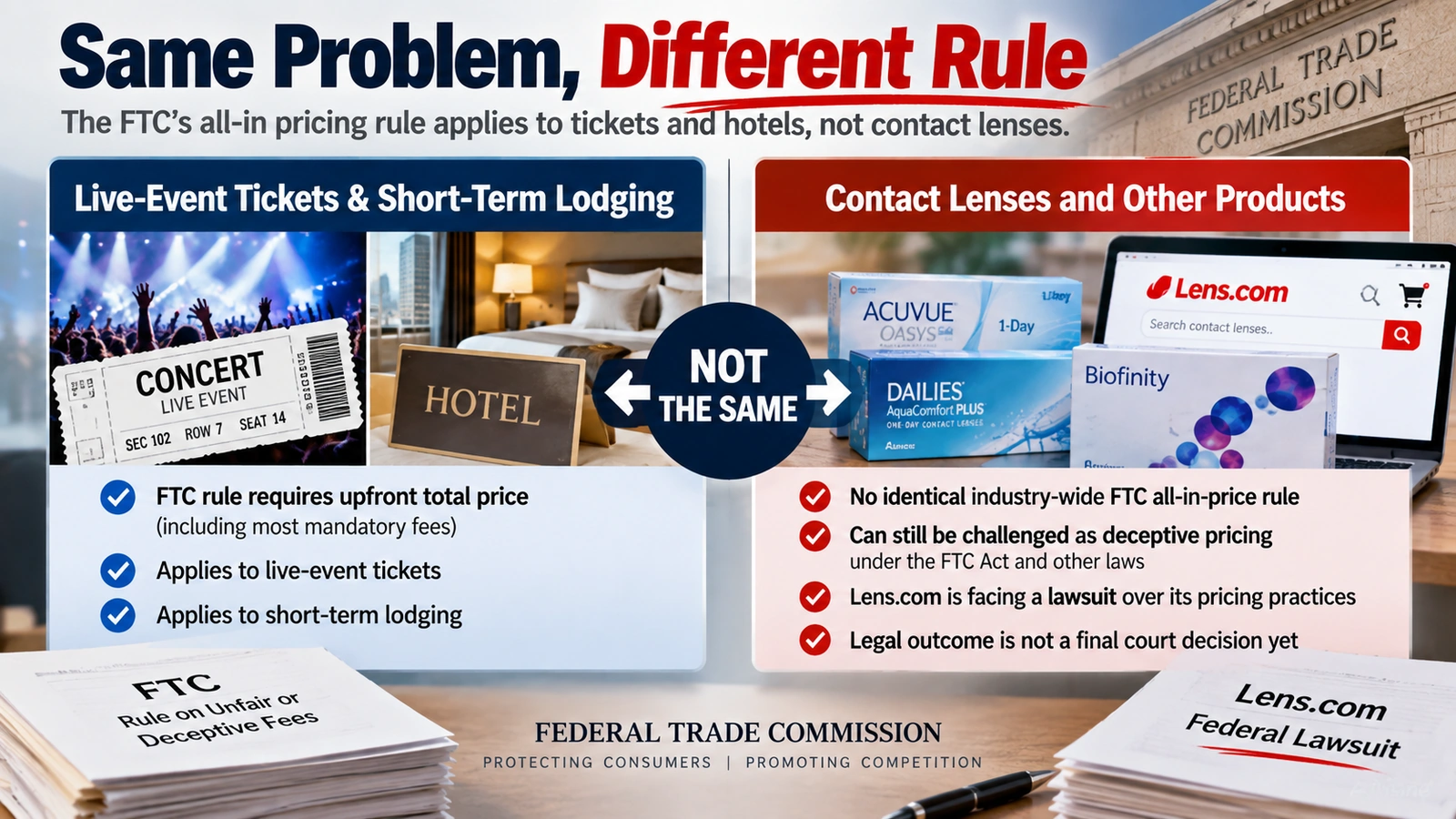
No. A mandatory fee is not automatically illegal merely because it exists.
This is where the Lens.com case can easily be confused with another FTC policy.
Since May 12, 2025, the FTC’s Rule on Unfair or Deceptive Fees has required businesses selling live-event tickets and short-term lodging to display the total price, including most mandatory fees, prominently up front. (FTC Fees Rule FAQ)
But contact lenses are not live-event tickets or hotel rooms.
So the Lens.com lawsuit is not simply an allegation that the company violated that specific ticket-and-lodging all-in pricing rule.
The FTC itself has said that businesses outside those two industries can still face enforcement under longstanding consumer-protection law if their pricing is deceptive. (FTC)
A simple way to separate the two:
| Situation | Legal framework |
|---|---|
| Live-event tickets or short-term lodging | Specific FTC rule requires prominent total-price disclosure |
| Contact lenses and many other products | No identical industry-wide FTC all-in-price rule, but deceptive pricing can still be challenged under existing law |
| Optional charge clearly chosen by the customer | Not the same issue as a mandatory hidden charge |
| Mandatory fee described misleadingly | Can create additional consumer-protection concerns |
The Lens.com complaint relies on the FTC Act, the Restore Online Shoppers’ Confidence Act, and other federal and state consumer-protection laws rather than treating contact lenses as though they fall under the hotel-and-ticket fee rule. (FTC)
So “junk fee” is useful everyday language for understanding the controversy.
It is not, by itself, the legal test the court will apply.
What Does AutoRefill Have to Do With the Lawsuit?
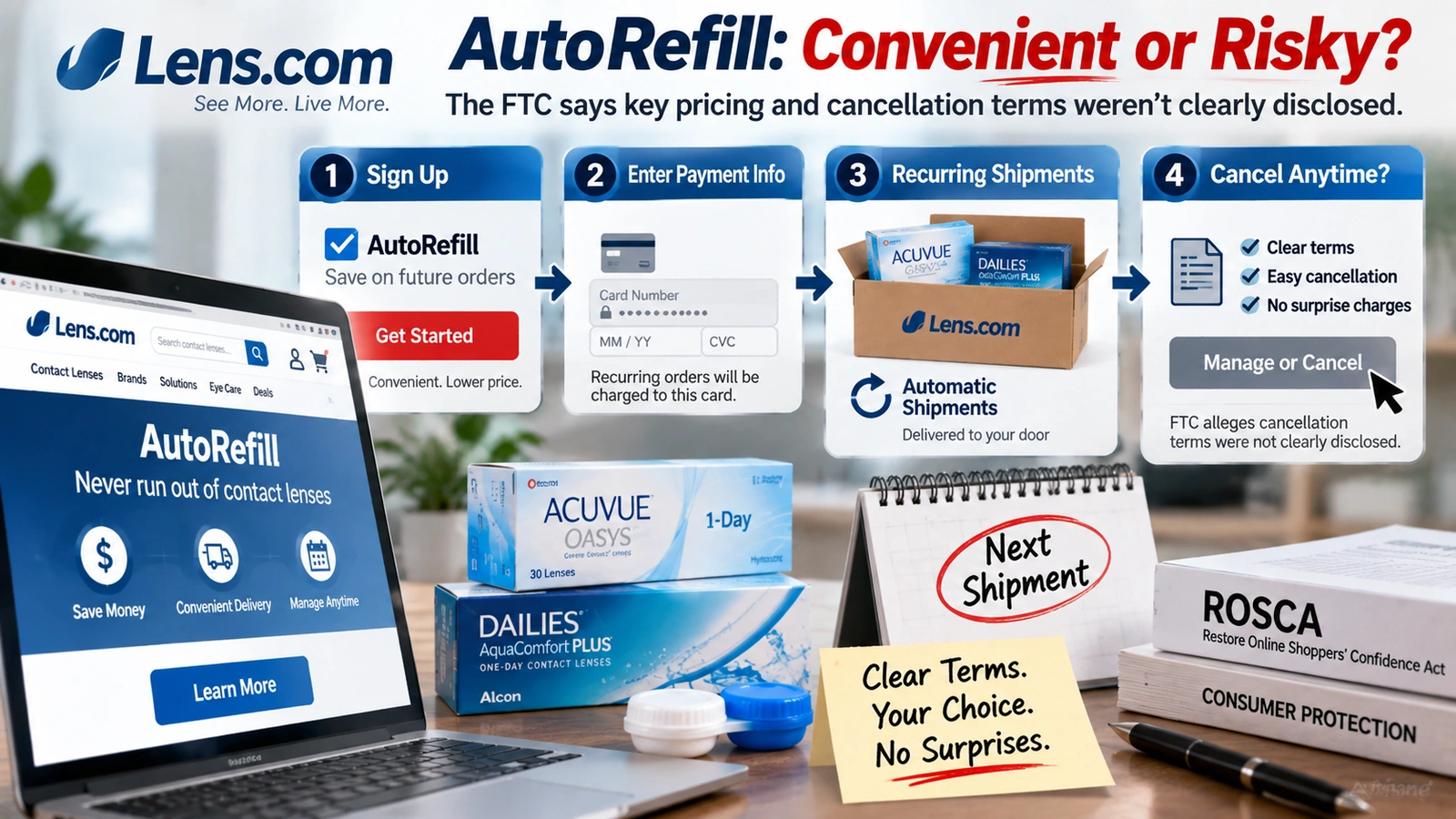
Because recurring orders create another layer of consumer-protection law.
Lens.com offers an AutoRefill program that automatically sends future contact-lens orders. Its current public AutoRefill page says customers receive a discount on future orders and can manage or cancel the subscription through their account. (Lens.com AutoRefill)
The FTC’s allegation is narrower than saying subscription programs themselves are illegal.
It says Lens.com failed to make the disputed “Taxes & fees” charge sufficiently clear before obtaining billing information for AutoRefill and also failed to clearly disclose, within the purchase flow, how consumers could cancel and when they needed to cancel to avoid the next charge. (FTC)
That brings in the Restore Online Shoppers’ Confidence Act, usually called ROSCA.
The relevant part of ROSCA requires an online seller using a negative-option feature—one where charges continue unless the customer takes action to stop them—to clearly disclose material terms before obtaining billing information, obtain express informed consent before charging, and provide a simple way to stop recurring charges. (FTC — ROSCA)
Think about the difference between these two questions:
“Can I eventually find cancellation instructions somewhere on the website?”
and
“Were the important recurring-charge and cancellation terms clearly presented before I agreed and gave the company my billing information?”
They are not the same question.
The second one is much closer to what the FTC is challenging.
Has Lens.com Been Found Liable—and Are Customers Getting Refunds Now?
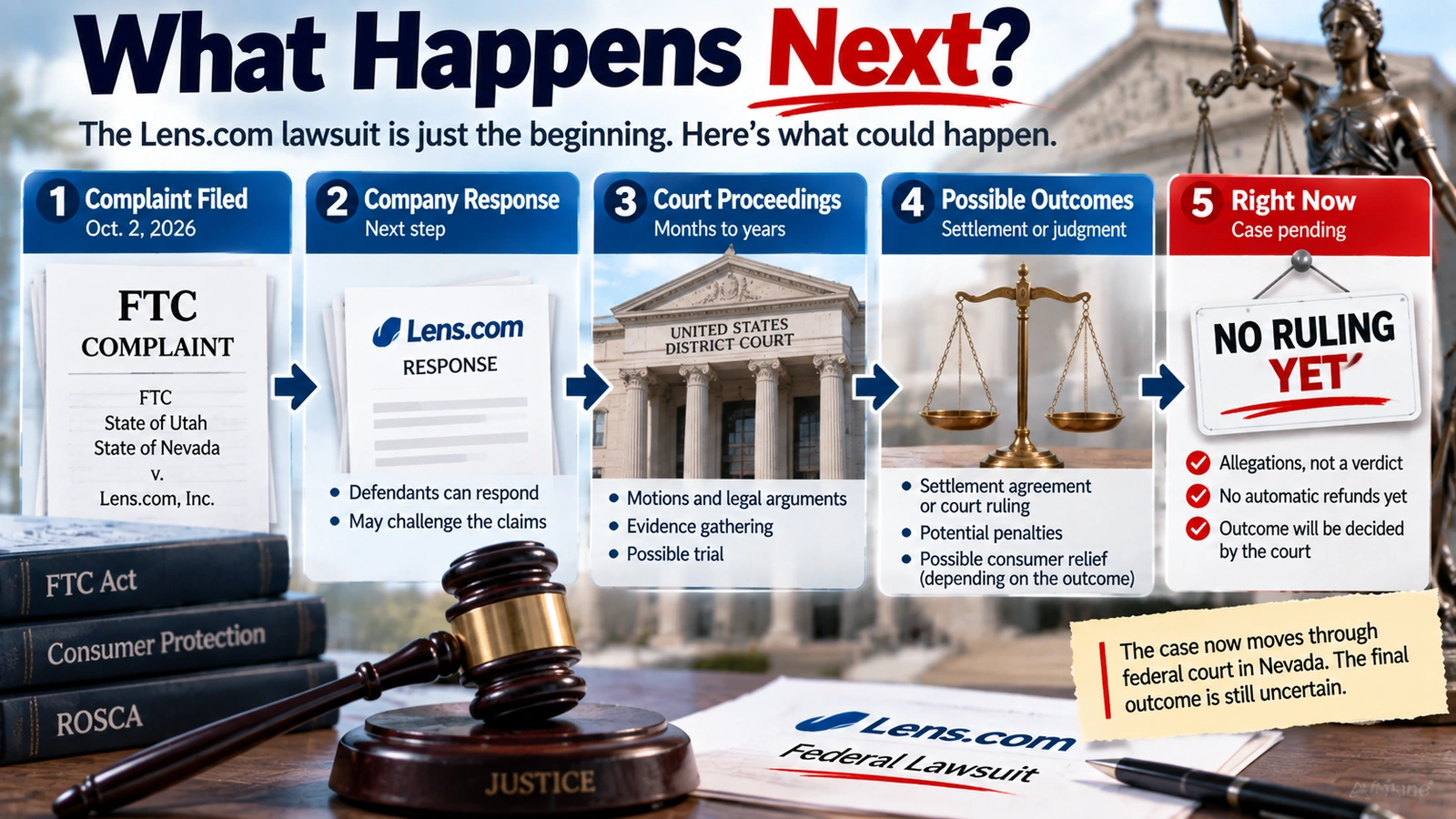
No. Filing a complaint is not the same as winning a case.
The FTC case page lists the Lens.com matter as pending. The agency says it files a complaint when it has reason to believe the law is being violated and believes court proceedings are in the public interest; the court ultimately decides the case. (FTC case page · FTC)
The complaint names Lens.com Inc., affiliated company Speed Commerce LLC, and Lens.com owner Cary Samourkachian as defendants. It seeks court orders stopping the alleged practices as well as monetary relief, penalties, and other remedies available under the laws invoked in the case. (FTC)
But there is currently no court ruling establishing that the defendants violated those laws.
And filing the lawsuit does not automatically create a refund for everyone who previously bought contact lenses from Lens.com.
The FTC’s October 2 case materials do not announce a consumer refund program. That could change only if later developments—such as a settlement or court judgment—provide for consumer payments or another form of monetary relief. (FTC case page)
Why Does This Case Matter Beyond Contact Lenses?
Because the dispute illustrates a weakness in the way people shop online.
Search engines make products look easy to compare because they place prices side by side.
But that only works if the numbers represent roughly the same thing.
Imagine three retailers selling the same product:
| Retailer | Search price | Mandatory fee revealed later | Real comparison price |
|---|---|---|---|
| Store A | $40 | $0 | $40 |
| Store B | $31 | $12 | $43 |
| Store C | $27 | $20 | $47 |
A shopper sorting by the first column would think Store C was cheapest.
A shopper sorting by the final column would choose Store A.
The numbers are hypothetical, but the economic problem is real: late mandatory fees can change which seller appears to offer the best deal.
That is why regulators focus not only on whether a customer eventually sees the final total before pressing the last payment button.
They also care about whether the earlier price presentation caused consumers to spend time or make shopping decisions based on a comparison that was not meaningful.
The FTC says that is what happened at Lens.com. (FTC)
Lens.com and the other defendants will have the opportunity to contest that allegation in court.
What Happens Next?
The case is pending in the U.S. District Court for the District of Nevada. (FTC case page)
The defendants can respond to the complaint and challenge the governments’ factual and legal claims. The dispute could proceed through motions, evidence gathering and potentially trial, or the parties could reach a settlement before a final judgment.
What matters for consumers is that none of those later outcomes has happened yet.
The most important things to watch are therefore concrete:
- whether Lens.com disputes the FTC’s description of the checkout process;
- whether the company changes how mandatory charges are displayed;
- how the court treats the “Taxes & fees” label;
- how the AutoRefill allegations fare under ROSCA and state automatic-renewal laws;
- whether any later settlement or judgment provides money to customers.
Until one of those things happens, the October 2 filing remains the beginning of the case—not its conclusion.
Bottom Line: What This Story Really Means
The Lens.com lawsuit is not simply a fight over whether businesses are allowed to charge fees.
The FTC, Nevada, and Utah allege something more specific: Lens.com attracted shoppers with unusually low contact-lens prices, placed a large mandatory “Taxes & fees” charge later in checkout, and presented the charge in a way that made meaningful price comparison difficult.
The governments also say similar disclosure problems affected Lens.com’s recurring AutoRefill program.
Lens.com has not been found liable, and the FTC has not announced a consumer refund program for this case.
The broader lesson is about what a price means online.
A price is most useful when it tells you what you will actually have to pay—not merely what makes you click on the product first.
Lens.com Lawsuit: Key Questions Explained
Q. Why is the FTC suing Lens.com?
The FTC, Nevada, and Utah allege that Lens.com advertised artificially low contact-lens prices and later added substantial mandatory “Taxes & fees” charges that routinely doubled advertised prices.
Q. Did Lens.com already lose the lawsuit?
No. The lawsuit was filed on October 2, 2026, and the FTC lists the case as pending. The allegations have not yet been established by a court.
Q. What does “drip pricing” mean?
Drip pricing describes a sales process in which a low price appears early and additional mandatory charges are revealed later as the customer moves through the transaction.
Q. How much does the FTC say Lens.com added in fees?
There is no single fee amount for every transaction. In one February 2026 example cited from the complaint, an eight-box purchase carried a $273.44 “Taxes & fees” charge on top of a $366.32 merchandise subtotal.
Q. Why does the FTC object to the phrase “Taxes & fees”?
The agency says the combined label could mislead consumers about the nature of the charge, particularly because many states exempt contact lenses from sales tax or do not impose a general state sales tax.
Q. Does the FTC’s junk-fee rule apply to contact lenses?
The specific FTC Rule on Unfair or Deceptive Fees requiring upfront total pricing applies to live-event tickets and short-term lodging. The Lens.com case instead relies on broader consumer-protection laws and other statutes.
Q. What is Lens.com AutoRefill?
AutoRefill is Lens.com’s recurring-shipment program. The FTC alleges that material pricing and cancellation terms were not clearly disclosed during the enrollment process before consumers supplied billing information.
Q. What is ROSCA?
The Restore Online Shoppers’ Confidence Act is a federal law that, among other things, regulates online negative-option programs. It requires clear disclosure of material terms, informed consent, and a simple way to stop recurring charges.
Q. Can Lens.com customers get an FTC refund now?
The FTC has not announced a refund program for this case. Any future consumer payments would depend on later developments such as a settlement or court judgment.
Q. What should people watch next in the Lens.com case?
The next important developments will be the defendants’ response, any changes to Lens.com’s pricing or AutoRefill disclosures, court rulings on the claims, and whether a future settlement or judgment includes consumer relief.
Did this help make the story clearer? 🙂 WIN keeps unpacking the “why” behind the news—clearly and simply!
Sources
Federal Lawsuit and Pricing Allegations
Federal Trade Commission — FTC, States Sue Lens.com for Misrepresenting the Price of Contact Lenses
Federal Trade Commission — Lens.com Case Page
KTNV — Nevada Sues Contact Lens Retailer Over Deceptive Pricing Practices
Hidden-Fee Pricing Rules
Federal Trade Commission — Rule on Unfair or Deceptive Fees FAQ
Federal Trade Commission — Final Junk Fees Rule Overview
AutoRefill and Recurring Charges
Federal Trade Commission — Restore Online Shoppers’ Confidence Act