Why Is Oil-Rich Russia Struggling to Keep Its Gas Stations Supplied?

Russia is one of the world’s biggest oil producers. It has enormous reserves, sprawling pipelines, and an energy industry that has helped finance the country for decades.
So why have Russian drivers been waiting in line for gasoline?
During the summer of 2026, fuel shortages spread across much of Russia. Some regions restricted how much gasoline people could purchase. Others experienced unusually long lines, with some motorists reporting waits lasting many hours.
That sounds strange for a country that produces so much oil.
But there’s an important difference between producing crude oil and turning it into the gasoline and diesel people actually use.
Russia isn’t running out of crude oil. Its ability to refine and distribute fuel has been severely disrupted.
Ukrainian drone strikes have repeatedly damaged Russian oil refineries, reducing fuel production and putting pressure on domestic supplies.
And the consequences now extend beyond Russia. They have become part of a dispute involving U.S. President Donald Trump, Ukrainian President Volodymyr Zelenskyy, global diesel prices, and the question of how to pressure Moscow to end the war.
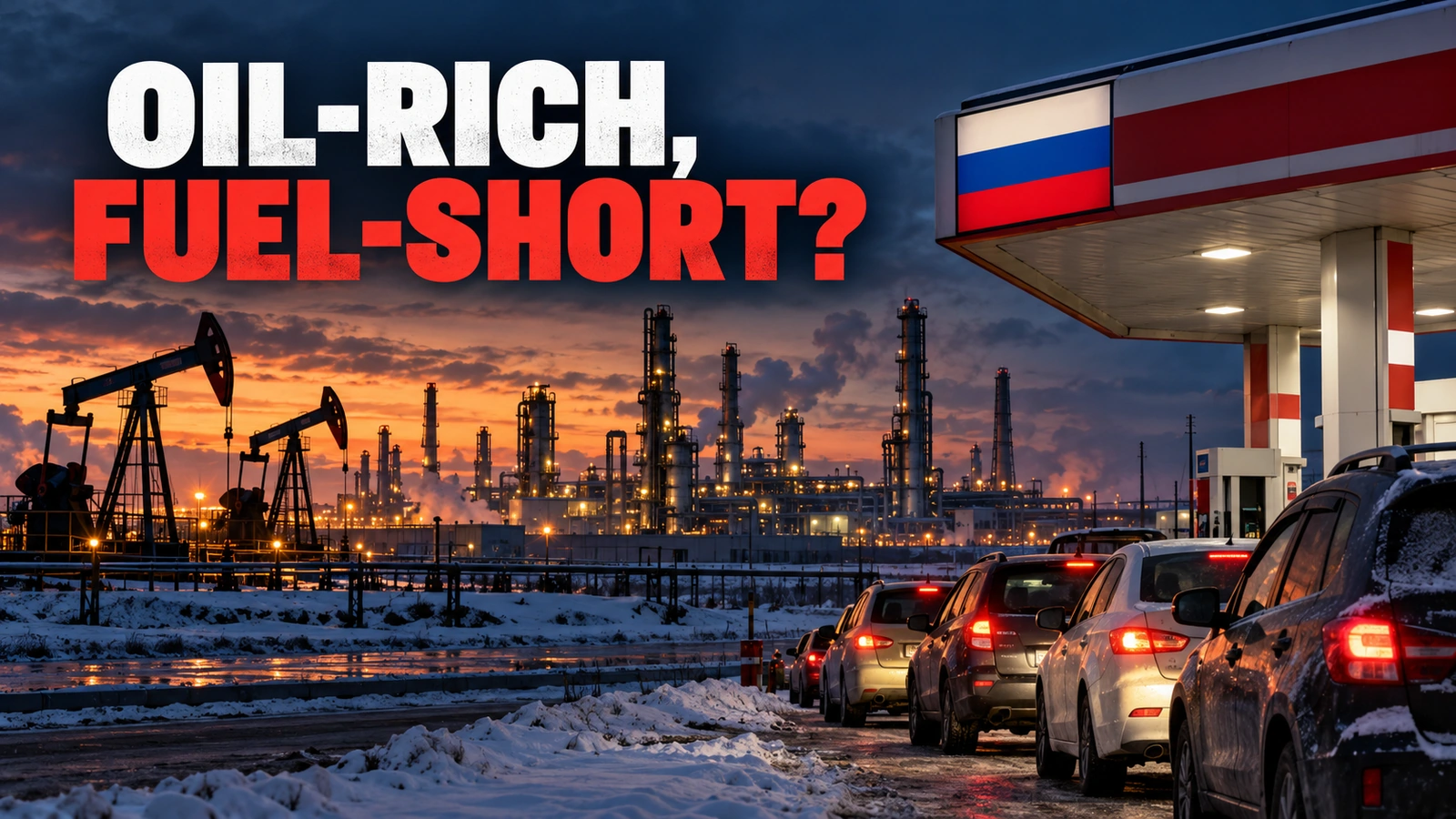
※ Images in this article are AI-generated illustrations created to help explain the story. They are not actual photographs, and depictions of people, places, or events may differ slightly from reality.
Why Doesn’t Having Plenty of Oil Guarantee Plenty of Gasoline?
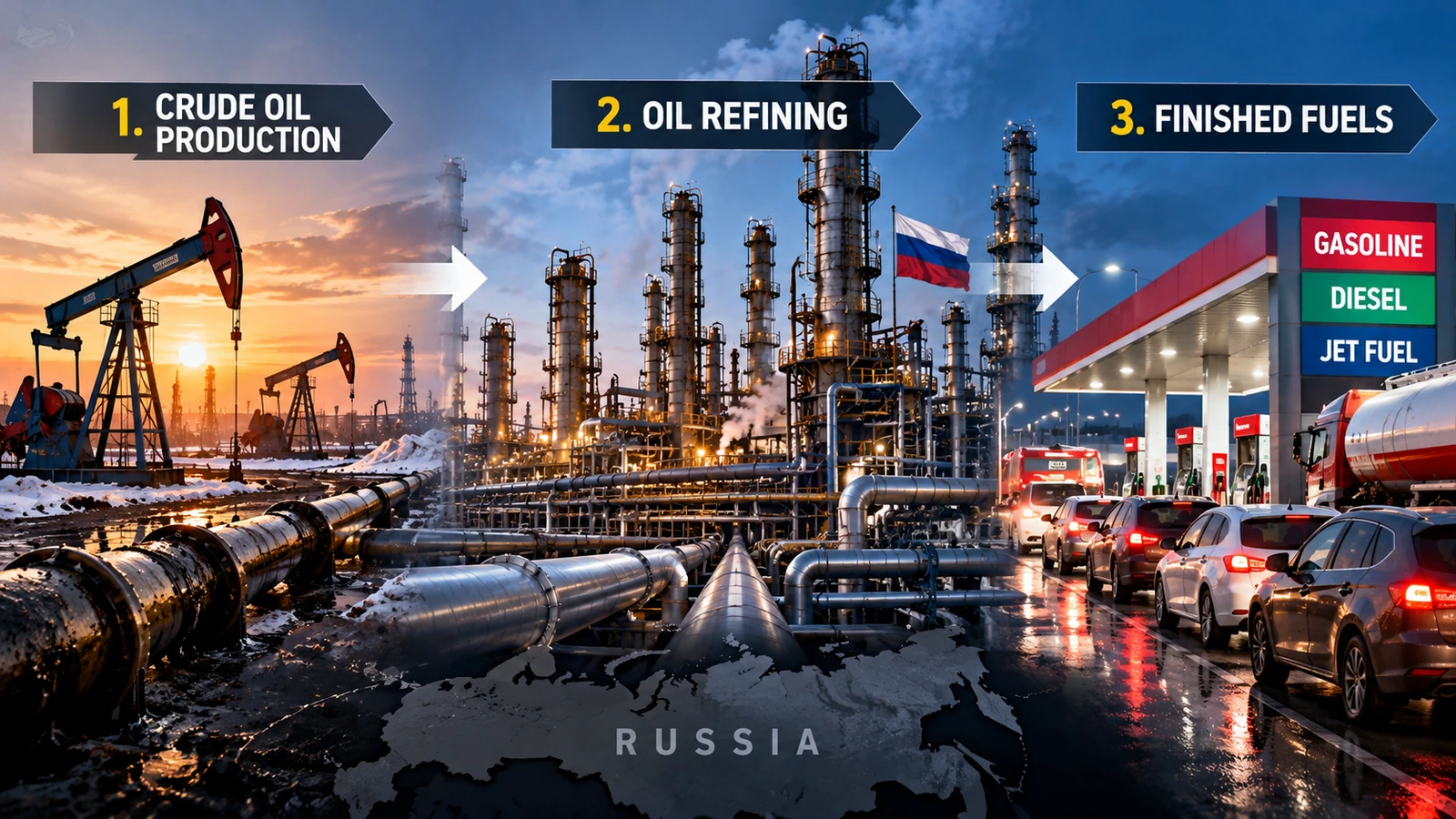
Crude oil is a raw material. Gasoline and diesel are manufactured products. A country can have enormous oil reserves and still experience fuel shortages if its refineries cannot turn enough of that oil into usable products.
Oil coming out of the ground does not go straight into a car’s fuel tank.
It first goes to a refinery, where industrial equipment separates and converts crude oil into products such as gasoline, diesel, jet fuel, and chemical feedstocks.
The U.S. Energy Information Administration explains that refining involves three broad steps: separation, conversion, and treatment. Each requires specialized industrial equipment. (EIA)
Think of it like having a warehouse full of wheat but not enough functioning flour mills.
The wheat hasn’t disappeared. But without the machinery needed to process it, the supply of flour can still fall.
That’s the basic problem Russia is facing.
According to the International Energy Agency (IEA), Russia has 32 major oil refineries with approximately 6.5 million barrels per day of installed refining capacity. Historically, it has been the world’s third-largest producer of refined petroleum products, behind the United States and China.
Yet in June 2026, Russian refineries processed only about 3.8 million barrels per day of crude oil—roughly 30% less than a year earlier and the lowest level in more than two decades.
Reported gasoline production was down approximately 20% compared with 2025, while diesel production was estimated to have fallen by nearly 30%. (IEA)
That helps explain why an oil-rich country can end up struggling to supply its own drivers.
And it raises another question: How did so much of Russia’s refining capacity become vulnerable?
How Did Ukrainian Drones Turn Russian Refineries Into Major Targets?
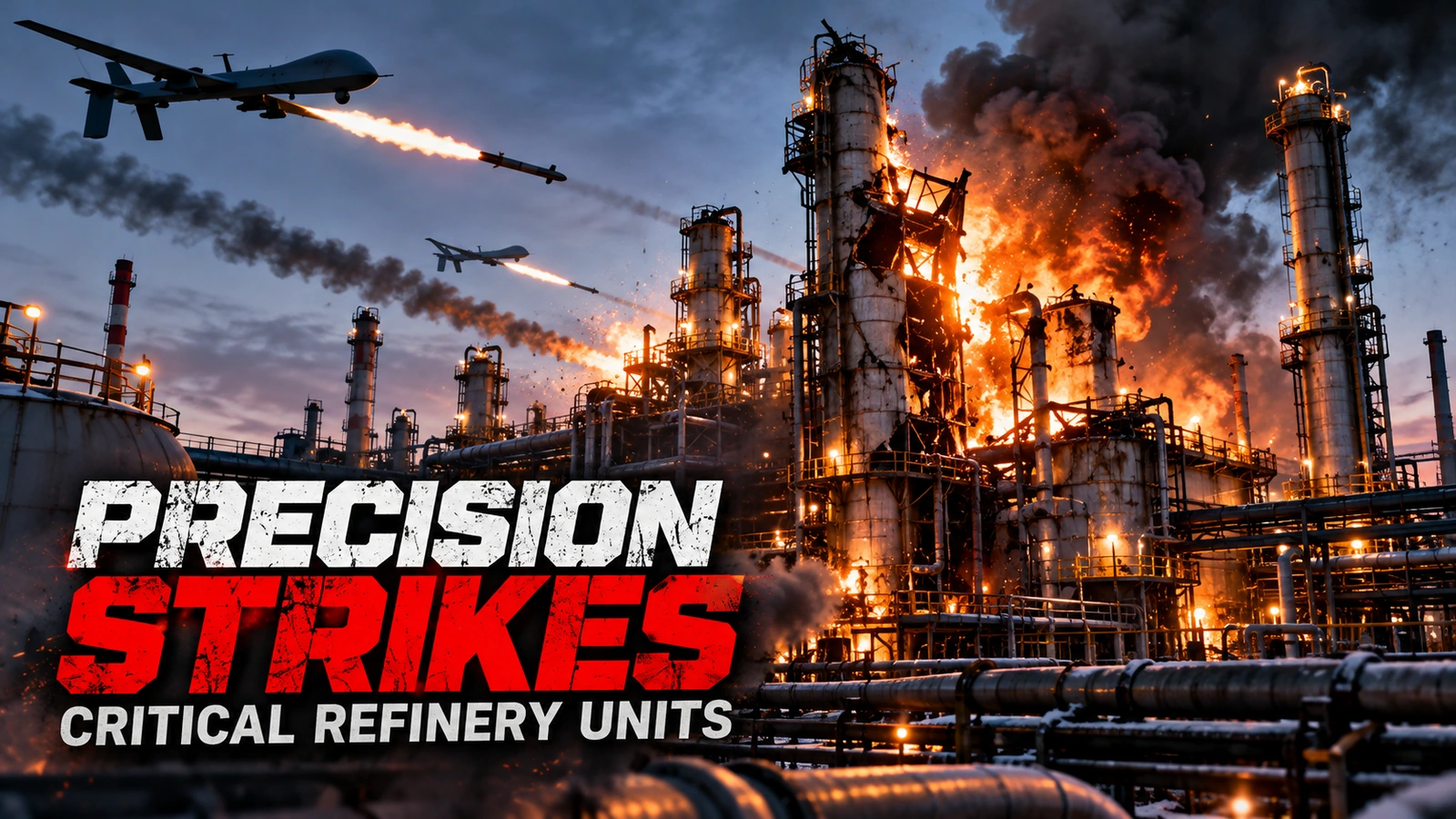
Ukraine’s drone campaign has become increasingly focused on the machinery that makes Russian refineries work.
Rather than concentrating only on oil storage tanks, Ukrainian forces have increasingly targeted essential processing units. Damaging these systems can reduce fuel output even when much of the refinery remains physically intact.
The scale of the campaign is substantial.
According to the IEA, a Russian refinery was struck, on average, once every three days during the first eight months of 2026.
By late August, only five of Russia’s 32 major refineries had escaped Ukrainian drone attacks. Those five facilities were in eastern Siberia or Russia’s Far East, thousands of miles from the Ukrainian border. (IEA)
That does not mean 27 refineries were completely destroyed or permanently shut down. Some suffered limited damage and continued operating, while others experienced prolonged outages.
The distinction matters because Ukraine’s strategy is not necessarily to destroy every refinery. Repeatedly disrupting their most important equipment can also impose substantial economic costs.
One example came on July 7, 2026, when Ukrainian drones struck the Omsk refinery in Siberia—Russia’s largest—about 1,550 miles from the Ukrainian border.
Motorists in Omsk began lining up for gasoline as supply concerns and panic buying spread. (Reuters)
The attacks have continued.
On October 15, Ukraine resumed strikes on Russian oil infrastructure, targeting a refinery in the Ryazan region southeast of Moscow. The attack followed a brief pause in energy-related strikes and renewed disagreements over a proposed ceasefire. Russia reported damage, although the visible impact of this particular strike appeared limited. (Reuters)
Ukraine views Russian energy facilities as economically and militarily important targets. Oil revenue helps finance the Russian state, while refined fuels are essential to transportation, agriculture, industry, and military logistics.
But weakening Russia’s fuel production does not automatically mean its armed forces run out of fuel. Military operations depend on stockpiles, supply priorities, transport networks, and other factors.
The more immediate, measurable effects are lower refinery output, disrupted fuel distribution, and higher costs.
How Serious Are Russia’s Fuel Shortages?
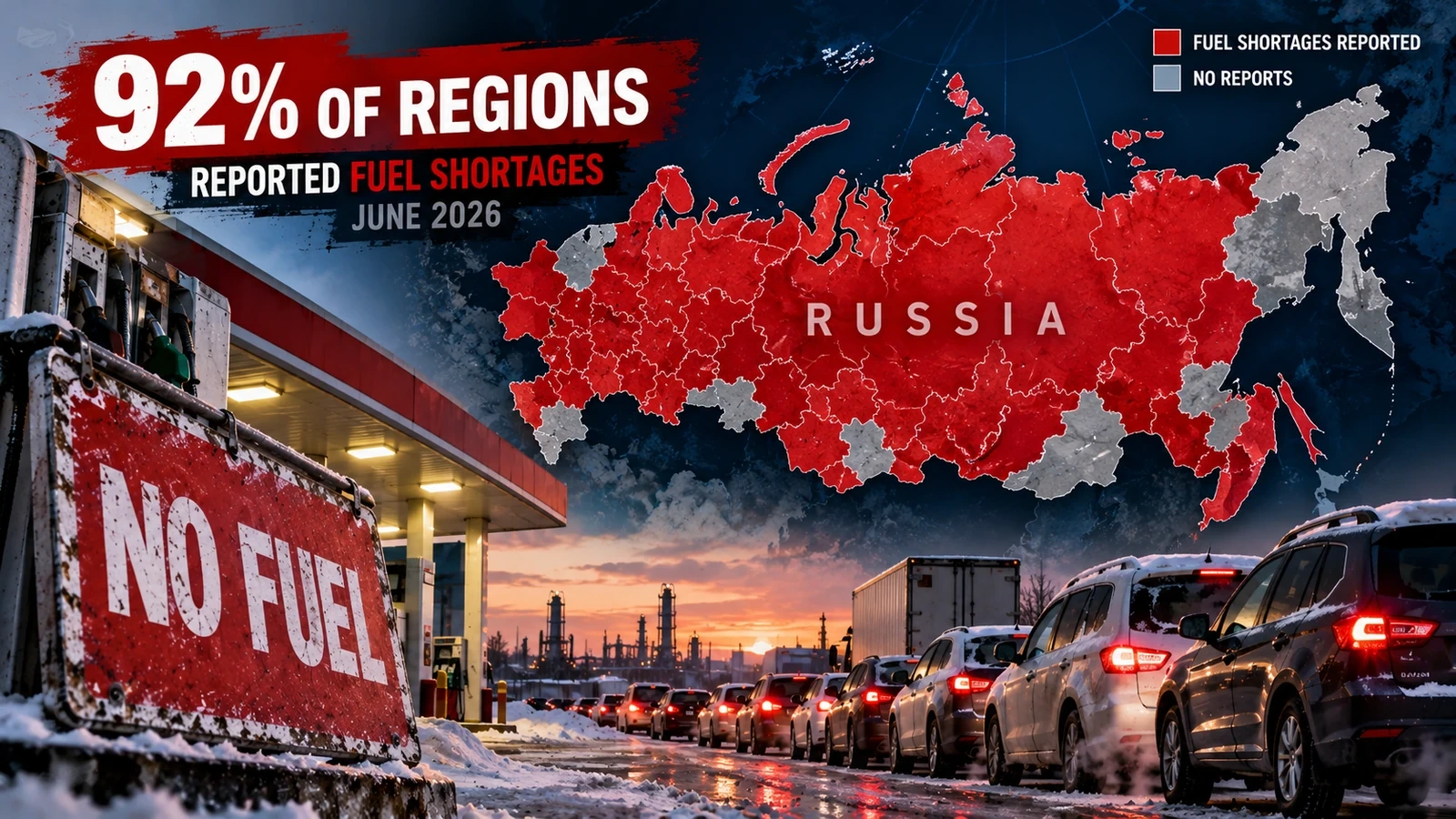
The shortages have been widespread, but they have not affected every part of Russia equally or remained equally severe throughout the year.
By the end of June 2026, fuel shortages had been reported in 92% of Russian regions, according to the IEA.
About two-thirds of the country’s regions had introduced some form of fuel rationing, including purchase limits or QR-code systems. Some drivers reported waiting as long as 40 hours at gas stations.
Conditions improved in some areas during July, but additional refinery attacks brought renewed shortages in August. (IEA)
That helps explain why fuel availability has been so unpredictable.
A gas station might have gasoline one week and face delivery interruptions the next. A large city may receive priority supplies while smaller communities experience more severe restrictions.
The supply problem has also pushed prices higher.
Russia’s national statistics agency reported that, by August 26, average gasoline prices had increased by more than 19% since the beginning of 2026. Diesel prices were up roughly 18% over the same period. (IEA)
Why Would Russia Import Gasoline?
Because domestic refining capacity has struggled to meet demand, Russia has turned to foreign suppliers.
The IEA reported that Russia received gasoline by rail from Belarus and Kazakhstan. Russian oil companies also imported gasoline by sea, with shipments arriving from Morocco, South Korea, India, and Türkiye during July and August.
However, neighboring suppliers could not fully replace Russia’s lost refining output. (IEA)
That creates an unusual situation: a major oil-exporting country is buying finished fuel from abroad because its domestic refineries cannot consistently produce enough.
The government has also restricted exports to prioritize Russian consumers.
On September 30, Russia extended a diesel export ban through the end of October, with certain exceptions for countries covered by intergovernmental agreements. Moscow subsequently partially eased the restrictions in connection with a new international diesel arrangement. (Reuters)
These emergency measures show how difficult the balance has become.
Russia needs fuel for its own population and economy. But it also wants to sell petroleum products abroad, both to earn revenue and to maintain its position as an important energy supplier.
Why Are Damaged Refineries So Difficult to Repair?
The most serious refinery damage can take months to repair because modern refining equipment is highly specialized, and Russia faces restrictions on access to some foreign industrial technology.
A refinery is not a single machine that can simply be switched back on after a fire.
Different units perform different jobs. Some separate crude oil into basic components. Others use catalysts, high temperatures, hydrogen, or complex chemical processes to produce higher-value fuels.
Ukraine’s attacks have increasingly targeted these more sophisticated systems.
The IEA estimates that minor damage to a basic crude distillation unit can sometimes be repaired within one or two weeks.
Serious damage to more complex secondary refining equipment, however, can take six to eight months to repair on average.
The Moscow refinery suffered such extensive damage during a June 2026 strike that it was reportedly expected to remain offline until early 2027. (IEA)
Western restrictions on refinery equipment and technology have added to the difficulties. A Washington Post investigation published October 11 examined how Ukrainian attacks have concentrated on particularly difficult-to-replace components.
There is another complication: a refinery can be repaired and then attacked again.
Each new interruption requires additional inspection, replacement parts, specialized labor, and time. Repeated attacks can also make maintenance planning increasingly difficult.
This creates a problem that extends beyond the physical damage from any single strike.
Even facilities that are repaired successfully must operate under the continuing risk of another disruption.
Is Russia’s Fuel Crisis a Sign That Its Entire Economy Is Collapsing?
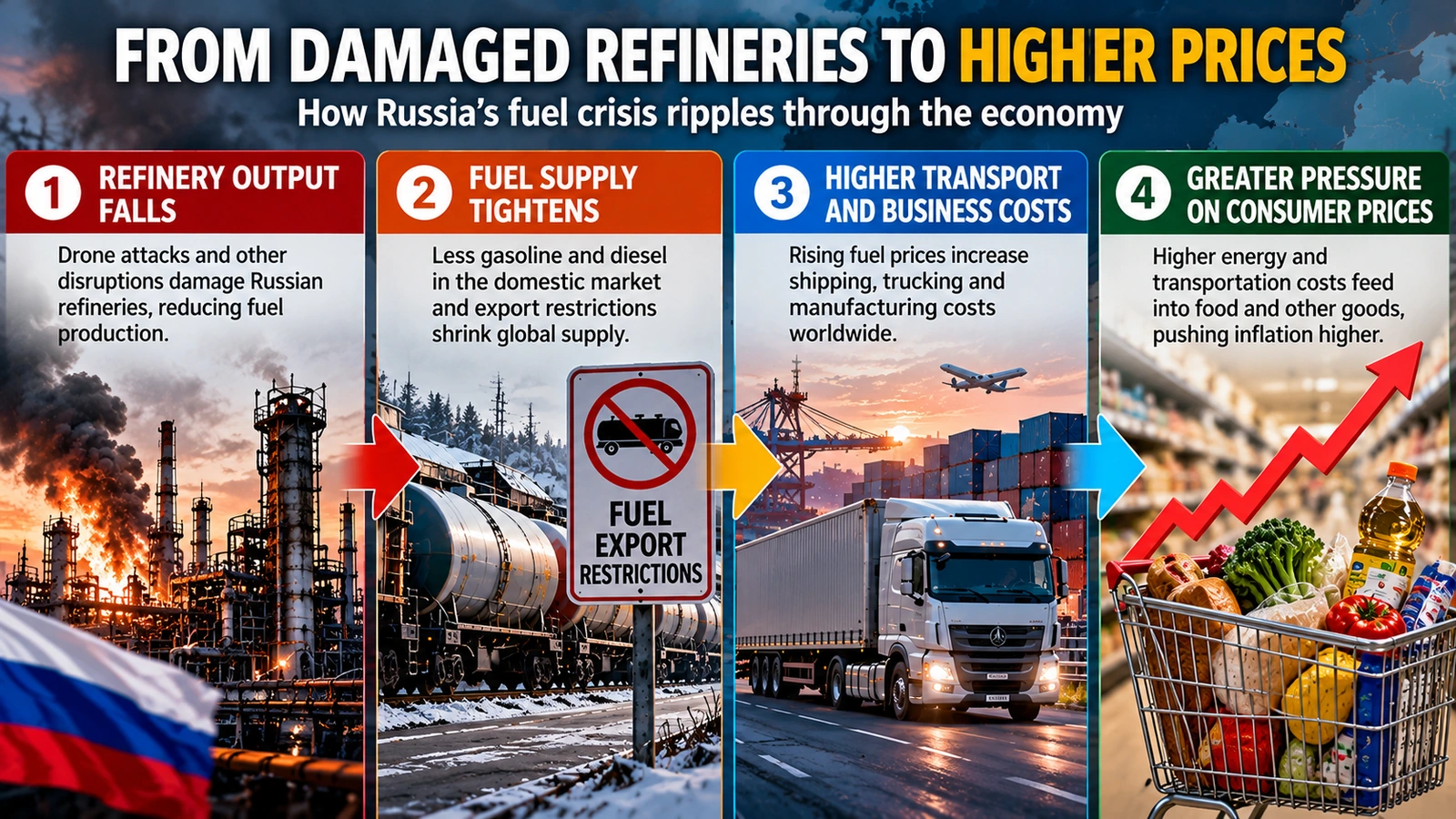
No. Russia’s fuel crisis is evidence of serious economic pressure, but it does not establish that the country’s entire economy has collapsed.
To understand the difference, it helps to separate three problems: disruptions to fuel production, rising costs throughout the economy, and slower overall economic growth.
The fuel problem can intensify the other two.
Diesel powers trucks, agricultural equipment, construction machinery, and many industrial operations. When diesel becomes scarce or more expensive, transportation and production costs can rise.
Companies may pass some of those increases on to consumers, adding to inflation.
But Russian businesses face other pressures as well, including financing costs, trade restrictions, labor shortages, and the diversion of resources toward the war.
Why Did Russia’s Economy Grow Earlier in the War?
Government spending, especially military-related spending, helped support economic activity after Russia’s full-scale invasion of Ukraine began in February 2022.
Defense production creates demand for factories, equipment, workers, and materials. Soldiers’ pay and military contracts also inject money into the economy.
These activities can increase measured gross domestic product, or GDP.
But GDP measures economic production. It does not automatically tell us whether ordinary households are enjoying better living standards.
A factory producing more ammunition contributes to GDP. That does not necessarily mean families have more affordable housing, better consumer goods, or stronger long-term economic prospects.
Heavy defense spending can also compete with civilian industries for workers, equipment, and investment.
The International Monetary Fund has noted that defense spending booms can stimulate economic activity in the short term while also creating inflationary and fiscal pressures. (IMF)
What Do Russia’s Current Economic Numbers Show?
The Bank of Russia’s own indicators point to an economy experiencing considerable strain rather than a straightforward collapse.
| Economic indicator | Latest referenced figure | What it suggests |
|---|---|---|
| 2026 GDP growth forecast | 0%–1% | Very weak expected growth |
| Central bank key rate | 14% as of September 11 | Borrowing remains expensive |
| Annual inflation | 6.4% in September 2026 | Prices are still rising above target |
| Central bank inflation target | 4% | Inflation remains elevated |
These are the Bank of Russia’s forecast and published monetary indicators, not independent estimates.
The central bank lowered its 2026 growth forecast partly because of temporary reductions in production capacity in certain industries.
It also identified fuel-market disruptions as a contributor to inflationary pressure. (Bank of Russia)
These numbers tell two different stories.
Russia’s economy continues functioning, and some industries remain active. At the same time, growth is weak, borrowing is expensive, and disrupted fuel supplies are making an already difficult environment harder.
Oil revenue remains an important reason Russia can keep financing its government and military.
In fact, Reuters estimated that Russia’s oil and gas tax revenue would reach approximately $12 billion in October 2026, around 10% higher than a year earlier, partly because of the timing of tax payments. The same report estimated that cumulative revenue for January through October would still be 14% below the comparable 2025 period. (Reuters)
That is an important complication.
Damaged refineries can weaken Russia’s economy even while higher global energy prices help support some of its oil-related revenues.
The two developments are not mutually exclusive.
Why Does Russia’s Fuel Crisis Matter for U.S. Diesel Prices?
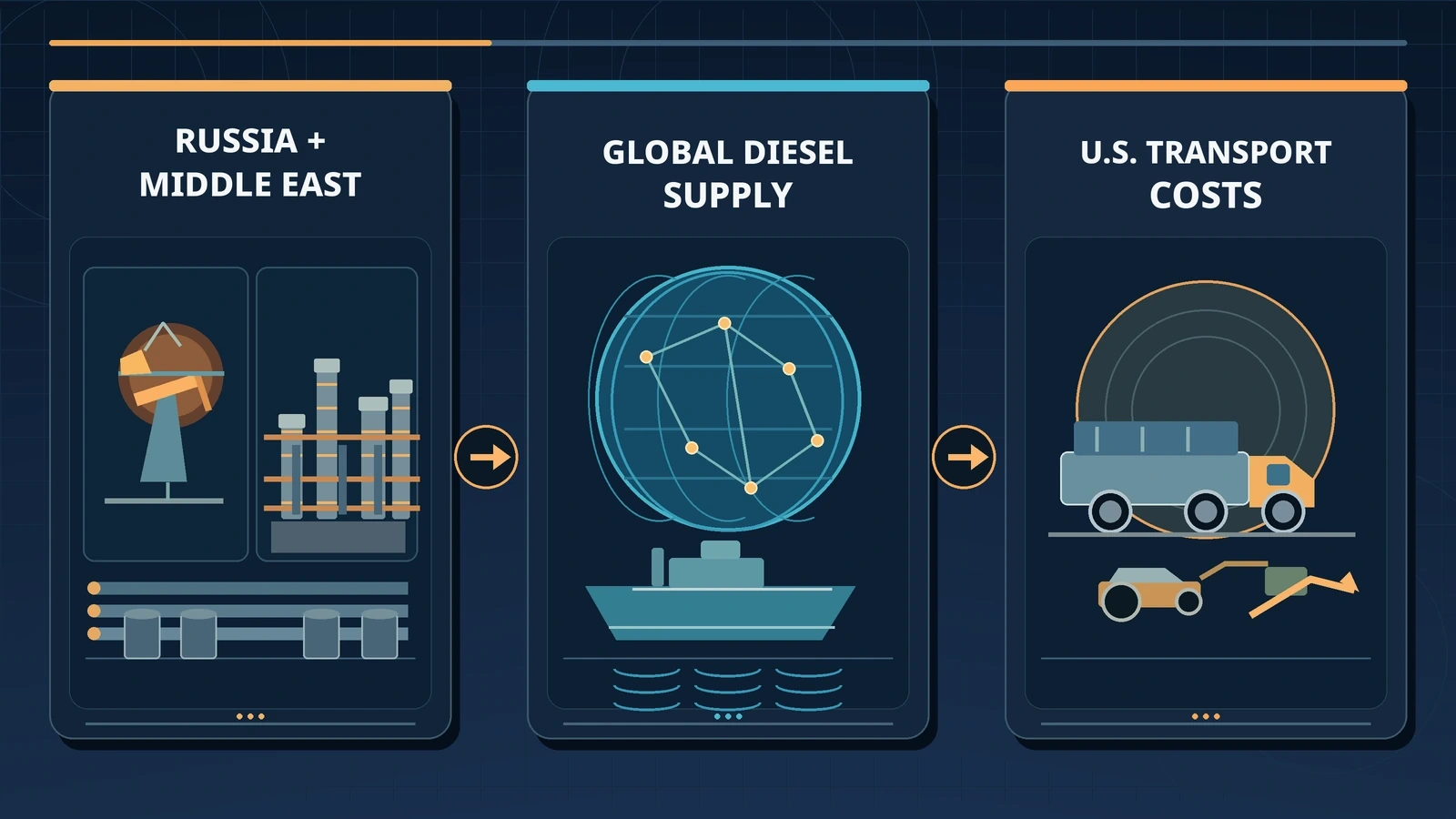
Russia’s refinery problems matter to the United States because diesel is traded internationally, and shortages in one major exporting country can tighten the global market.
But Russia’s refinery outages are only one part of the current fuel-price problem.
The Middle East has also experienced major disruptions, particularly amid the conflict involving Iran and interruptions to regional energy supplies.
When major suppliers in different parts of the world produce or export less diesel at the same time, international buyers have fewer alternatives.
According to an October 14 Reuters report citing the IEA, diesel supply losses associated with Russia and the Middle East amounted to approximately 1.3 million barrels per day in September 2026, equivalent to about 4.5% of global demand.
The IEA warned that the resulting shortages could persist well into 2027. (Reuters)
Why Is Diesel Especially Important?
American drivers often pay more attention to regular gasoline prices. But diesel is essential to much of the economy.
Trucks use diesel to transport consumer goods. Farmers use it to operate agricultural machinery. Construction firms depend on diesel-powered equipment, and many commercial and industrial operations use it directly or indirectly.
That means higher diesel costs can eventually affect the prices Americans pay for products and services, even if their own vehicles run on gasoline.
The United States produces significant quantities of diesel and is also an exporter. Nevertheless, its fuel markets are connected to international prices and supply conditions.
The IEA has identified reduced Russian diesel exports as a source of additional pressure on an already tight global market. (IEA)
Still, there is a distinction between saying that Russia’s lost production adds pressure and claiming that Ukrainian attacks caused America’s entire fuel-price surge.
The much broader Middle East disruption has been a major driver of the sharp price increases seen in 2026. Russia’s refinery damage has made a difficult global supply situation even tighter.
That distinction is now at the center of a political disagreement.
Why Is Washington Allowing Russian Diesel Exports While Ukraine Attacks Russian Refineries?
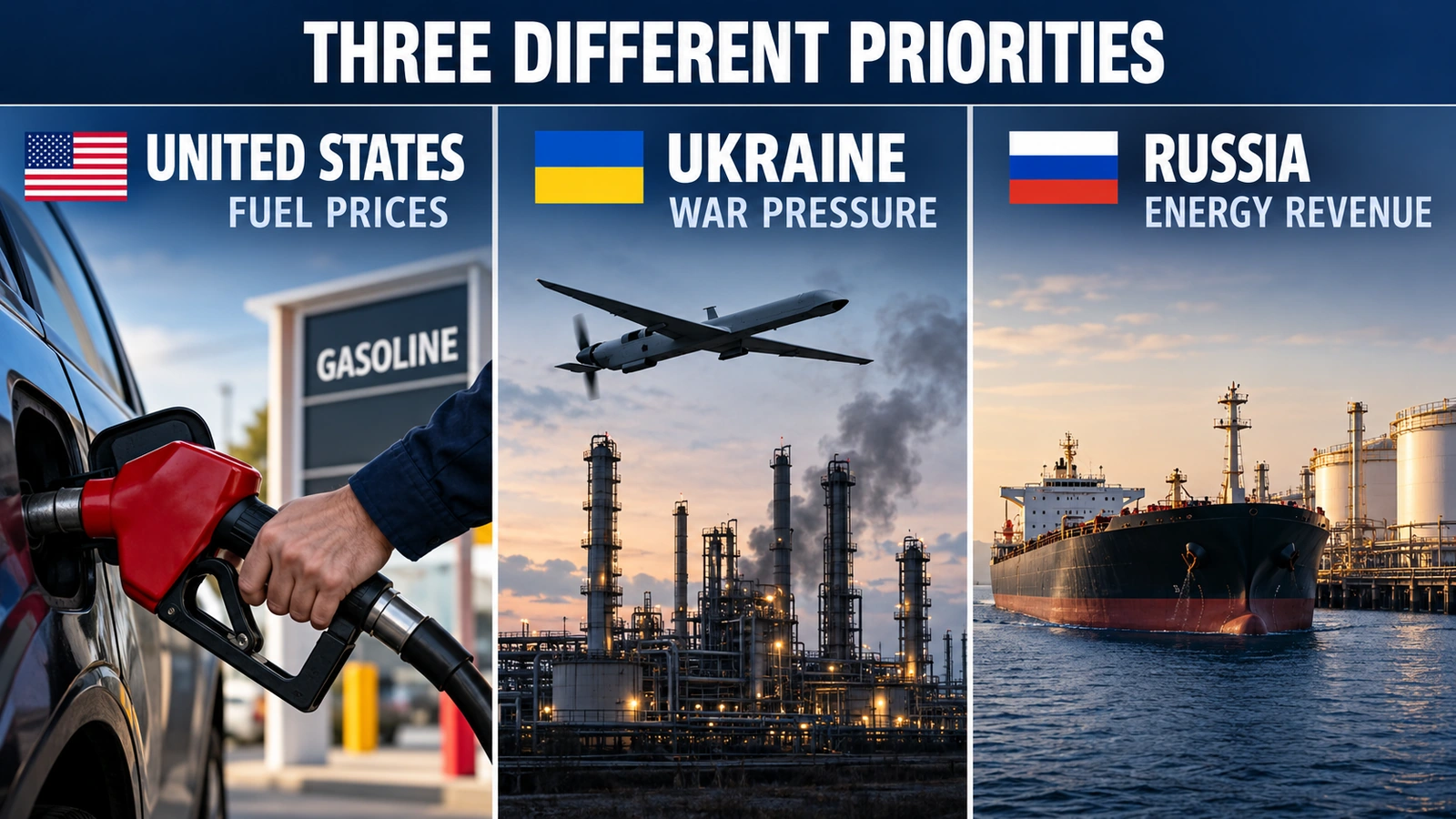
The Trump administration has allowed certain transactions involving Russian diesel because it wants to ease pressure on fuel markets and encourage renewed peace negotiations.
Ukraine objects because additional Russian energy revenue could help Moscow continue financing the war.
On October 9, 2026, the U.S. Treasury Department issued Russia-related General License 135, authorizing specified transactions involving the sale, delivery, unloading, and importation of Russian-origin diesel. (U.S. Treasury)
President Trump announced that Russia would supply more than 300,000 metric tons of diesel to U.S. and global markets initially, with additional shipments planned.
But the quantities involved are small compared with total U.S. diesel consumption.
Reuters reported that the initial promised amount would cover less than a full day of U.S. demand. Experts have questioned whether the arrangement can meaningfully reduce American fuel prices. (Reuters)
That does not mean the arrangement is insignificant politically.
The White House sees additional supply as a way to help stabilize markets. U.S. officials have also described economic incentives as a possible means of drawing Russia back toward peace negotiations.
Ukraine sees a different risk: easing restrictions could strengthen Russia’s finances without securing meaningful concessions.
Why Did the Disagreement Escalate in October?
The dispute intensified when Ukraine resumed attacks on Russian refineries.
Trump publicly criticized the renewed strikes on October 16, arguing that they were contributing to elevated fuel prices.
Zelenskyy defended Ukraine’s position, pointing to Russia’s continued attacks on Ukrainian energy infrastructure and rejecting the suggestion that a mutually observed energy ceasefire was already in place. (Reuters)
On October 15, the Kremlin also confirmed that diesel exports had resumed following the U.S.-Russia arrangement. Shipping information showed one tanker carrying Russian diesel toward Morocco, illustrating that the arrangement concerns global markets and not exclusively direct deliveries to the United States. (Reuters)
Then the sanctions debate widened.
In an executive order dated October 16, Trump waived the application of substantial sanctions and tariffs provided for under the Lindsey O. Graham Sanctioning Russia and Iran Act of 2026, citing U.S. national interests.
The waiver did not automatically repeal every other existing U.S. sanction against Russia. It addressed specified measures under the new law. (White House)
For Ukraine, the concern is that reducing economic pressure could make Moscow less willing to compromise.
For the Trump administration, the argument is that additional energy supplies and diplomatic incentives could help address immediate economic and geopolitical problems.
Whether either approach produces meaningful progress remains uncertain.
Do Western Sanctions Still Matter If Russia Can Keep Selling Oil?
Yes. Sanctions can make Russian oil exports more expensive, less profitable, and more difficult to arrange even when they do not completely stop shipments.
The original Western approach was not designed simply to remove every barrel of Russian crude from the global market.
That could have created major supply shortages and higher international prices.
Instead, the oil price cap system introduced in December 2022 sought to limit Russia’s earnings while keeping some Russian oil flowing.
Under the system, businesses providing certain services—such as shipping, insurance, and financing—face restrictions tied to the sale price of Russian oil.
The rules have changed over time and are not identical across participating jurisdictions.
For example, the European Union’s crude oil price cap was reduced from the original $60 per barrel to $47.60 in 2025 and then to $44.10 effective February 1, 2026. The EU subsequently suspended its automatic adjustment mechanism until July 2027. (European Commission, January 2026 · European Commission, July 2026)
Russia has responded partly by redirecting exports toward Asian customers and relying more heavily on shipping arrangements outside Western service networks.
The U.S. Energy Information Administration reported that Europe’s share of Russian crude oil and condensate exports fell from 51% in 2020 to approximately 11% in the first half of 2025, as Russia shifted more exports toward Asia. (EIA)
Russia has also used tankers commonly described as a shadow fleet—vessels operating through ownership, insurance, and shipping arrangements that can be harder for sanctioning governments to monitor or restrict.
These arrangements have helped Russia continue exporting oil, but they can introduce additional shipping costs and operational risks.
An important distinction remains: sanctions on crude oil exports and physical damage to refineries affect different parts of the energy business.
| Pressure on Russia | How it works | Main effect |
|---|---|---|
| Crude oil price caps | Restrict certain services for oil sold above applicable limits | Pressure on export revenue |
| Shipping sanctions | Restrict designated vessels, operators, or related transactions | Higher costs and fewer available routes |
| Technology restrictions | Limit access to certain equipment and components | Greater difficulty maintaining and repairing infrastructure |
| Ukrainian refinery strikes | Physically damage fuel-processing facilities | Reduced refining capacity and fuel output |
The measures can reinforce one another, but they do not guarantee that Russian energy exports stop.
Oil markets can also move against the intended economic pressure.
For example, higher global oil prices can support Russian export revenue even when the country faces refinery damage, shipping difficulties, and sanctions.
This is why judging the effectiveness of sanctions requires more than checking whether Russia is still selling oil.
It requires examining how much it sells, what it earns after expenses, how easily it can maintain production, and how much revenue remains available to support government spending.
What Happens Next for Russia’s Fuel Supply and the War?
The outlook depends on three connected developments: Russia’s ability to repair refineries, Ukraine’s ability and willingness to continue attacks, and the direction of global energy markets.
The IEA warned in September that Russian refining activity could struggle to recover meaningfully while attacks continued.
At the same time, diesel markets were already experiencing pressure from reduced Middle Eastern supply and limited spare refining capacity elsewhere. (IEA)
There are several possible paths.
If Russian refineries recover and attacks diminish, domestic fuel availability could improve. If strikes continue to damage complex equipment, production disruptions could persist.
Higher global oil prices might help Moscow earn more from crude exports, but they do not automatically restore lost refining capacity.
The U.S. diesel arrangement adds another uncertainty. Even if Russian diesel shipments increase, the initial quantities appear too limited to resolve the global shortage on their own.
And the political question remains unresolved.
Washington wants to control fuel prices and pursue diplomacy. Kyiv wants to preserve pressure on Russia’s ability to finance and sustain the war. Moscow wants to keep its energy sector operating and maintain the revenue that supports its economy.
Those interests do not neatly align.
For Americans, the practical indicators worth watching include international diesel inventories, refinery production in Russia and the Middle East, U.S. fuel prices, and any further changes to energy-related sanctions.
For Russia, the central question is whether it can restore fuel production faster than continuing attacks and other disruptions reduce it.
Bottom Line: What This Story Really Means
Russia has enormous oil resources, but producing crude oil is not the same as producing enough gasoline and diesel for an entire country.
Ukrainian drone attacks have exposed that vulnerability by repeatedly striking Russian refineries, damaging critical equipment and disrupting fuel production.
The resulting shortages have forced emergency export restrictions, encouraged fuel imports, and added pressure to an economy already dealing with the costs of a prolonged war.
But this is not proof that Russia’s economy is collapsing. The country continues to produce and export significant quantities of oil, and high international energy prices can offset some of its financial difficulties.
The consequences extend beyond Russia.
Lower Russian diesel exports, combined with disruptions in the Middle East, have tightened global fuel markets and complicated efforts to reduce energy costs in the United States.
That has created a difficult political question: Should Washington increase pressure on Russia’s energy sector to weaken its capacity to wage war, or allow some Russian diesel back into international markets to help stabilize fuel supplies?
The answer involves competing economic, military, and diplomatic priorities.
Russia’s fuel shortage reveals something broader about modern economies: having abundant natural resources does not guarantee security if the infrastructure needed to process and deliver them becomes vulnerable.
Russian Fuel Shortage: Key Questions Explained
Q. Is Russia actually running out of oil?
No. Russia remains a major crude oil producer. The central problem is that refinery damage has reduced its ability to convert crude oil into enough gasoline, diesel, and other petroleum products.
Q. How many Russian refineries have Ukrainian drones hit?
As of late August 2026, only five of Russia’s 32 major refineries had not been attacked, according to the IEA. Being hit does not necessarily mean a refinery was completely destroyed or shut down.
Q. Why are Russian drivers waiting in line for gasoline?
Refinery outages, distribution disruptions, seasonal demand, and purchasing restrictions have made gasoline supplies unreliable in some regions. Conditions vary substantially by location and over time.
Q. Has Russia started importing gasoline?
Yes. The IEA reported gasoline shipments to Russia from Belarus, Kazakhstan, and several other countries during the summer of 2026 to help compensate for domestic supply shortages.
Q. How long does it take to repair a damaged oil refinery?
It depends on the equipment damaged. Minor damage to basic refining units may take one or two weeks to repair, while serious damage to complex secondary units can require six to eight months on average.
Q. Is Russia’s economy collapsing because of the fuel shortage?
No clear evidence establishes an economy-wide collapse. Russia faces weak growth, inflation, financing costs, and fuel disruptions, but it continues to generate significant revenue from energy exports.
Q. Are Ukrainian attacks responsible for high U.S. diesel prices?
They have contributed to tighter international diesel supplies, but they are not the sole or primary explanation for the broader price surge. Major supply disruptions involving the Middle East have also played an important role.
Q. Why did the United States allow Russian diesel transactions in October 2026?
The Trump administration sought additional diesel supplies and potential diplomatic leverage with Moscow. Ukraine criticized the decision because increased energy revenue could help Russia continue financing its war.
Q. Does the U.S. diesel arrangement mean all sanctions against Russia have ended?
No. The Treasury authorization covers specified diesel-related transactions, while the separate October 16 executive order waived designated measures under a newer sanctions law. Other sanctions and restrictions remain relevant.
Q. What is the biggest risk for Russia’s fuel supply going forward?
Repeated damage to difficult-to-replace refinery equipment could prevent production from recovering even when crude oil remains available. The duration and intensity of future attacks, repairs, and supply restrictions will be important.
Did this help make the story clearer? 🙂
WIN keeps unpacking the “why” behind the news—clearly and simply!
Sources
Russian Refinery Damage and Domestic Fuel Shortages
Oil Refining and Russia’s Economic Indicators
U.S. Energy Information Administration — Refining Crude Oil: The Refining Process
Bank of Russia — Monetary Policy Indicators
Bank of Russia — Summary of the August 2026 Key Rate Discussion
Reuters — Russia’s Oil and Gas Revenue Seen Up 10% Year-on-Year in October, October 15, 2026
Global Diesel Supply and U.S.–Russia Energy Policy
Reuters — Diesel Shortages Could Persist Well Into 2027, IEA Says, October 14, 2026
U.S. Treasury — Issuance of Russia-Related General License 135, October 9, 2026
Reuters — What’s in the Diesel Deal Between Putin and Trump?, October 12, 2026
Russian Oil Exports and Sanctions
European Commission — EU Adopts 21st Package of Sanctions Against Russia, July 23, 2026
Keep Reading
Why Can a Middle East Oil Disruption Affect U.S. Fuel Prices?
Russia’s refinery problems are one source of pressure on the global diesel market. This related story explains why even a major oil producer like Saudi Arabia can struggle to deliver supplies when crucial routes are disrupted—and how that can affect prices in the United States.
Saudi Arabia Built a Pipeline to Bypass Hormuz—So Why Is Its Oil Route Still at Risk?