Why Is SpaceX’s AI Revenue Now Bigger Than Starlink’s?

Wasn’t SpaceX supposed to be a rocket company?
For years, the answer seemed straightforward. Elon Musk’s company built rockets, launched satellites, and turned Starlink into a global internet service.
Then came a financial report that made the company look very different.
On October 20, 2026, SpaceX disclosed that its artificial intelligence business had generated more quarterly revenue than Starlink and its other satellite connectivity operations.
Not by a small amount, either.
SpaceX’s AI business brought in approximately $7.6 billion, compared with $5.2 billion from connectivity, primarily Starlink. (SpaceX SEC Filing)
That sounds like a dramatic change in what SpaceX actually does.
But there is a twist: Starlink still produced substantially more operating profit than the AI business.
So how did a company famous for reusable rockets become such a large AI infrastructure provider? And does earning more revenue from AI mean that rockets and satellites are becoming less important?
The answers reveal how dramatically SpaceX’s business has changed—and why its biggest source of sales is not necessarily its strongest source of profit.
※ Images in this article are AI-generated illustrations created to help explain the story. They are not actual photographs, and depictions of people, places, or events may differ slightly from reality.
Where Did SpaceX’s $14.6 Billion in Quarterly Revenue Actually Come From?
AI accounted for more than half of SpaceX’s total revenue in the third quarter of 2026. That is the clearest indication that the company is no longer financially defined by rocket launches alone.
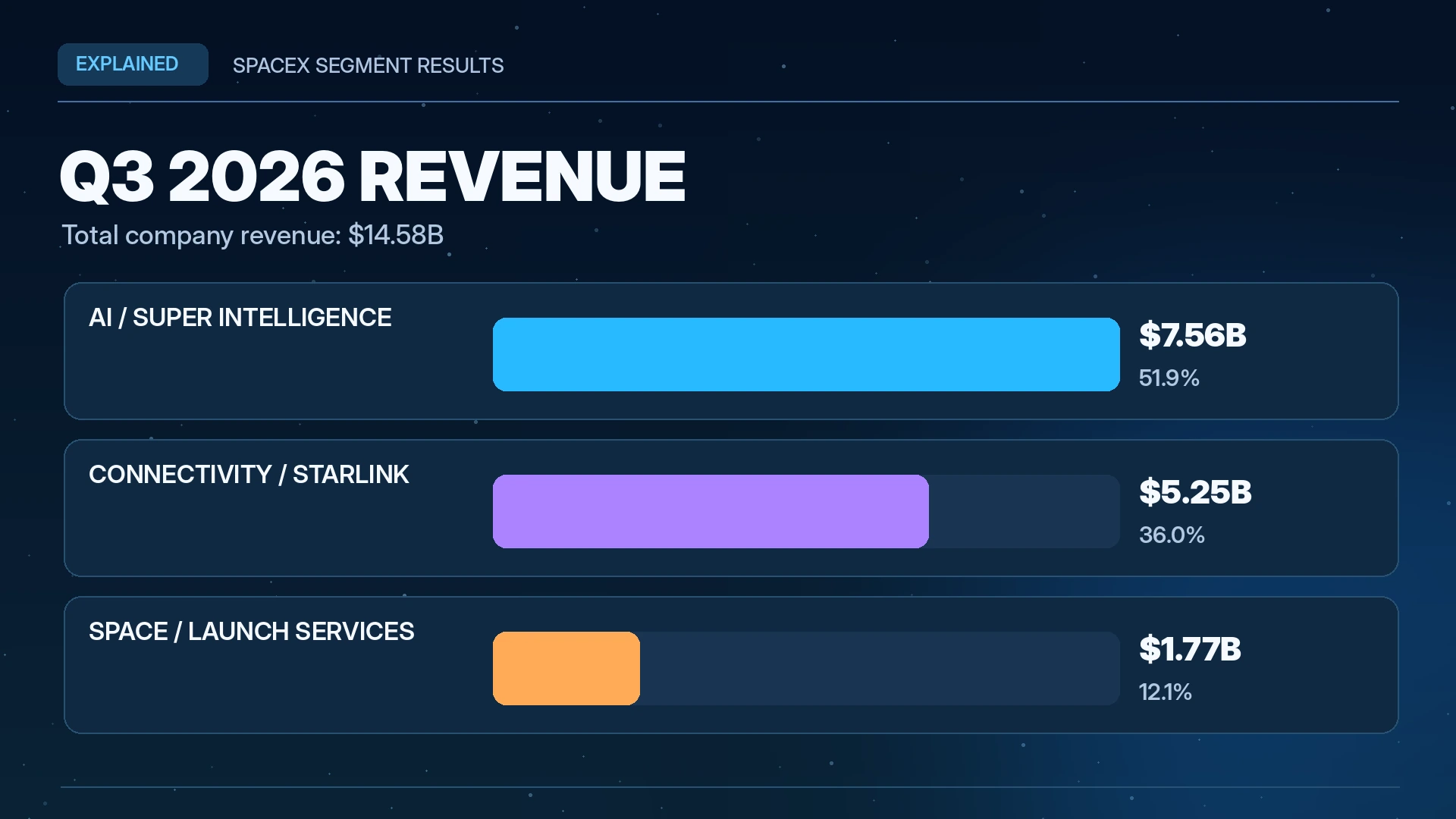
According to SpaceX’s October 20 earnings release, the company reported approximately $14.58 billion in total revenue for the three months ended September 30, up 161% from the same quarter a year earlier. It also reported $4.4 billion in net income, reversing a year-earlier loss. (SpaceX SEC Filing · Reuters)
Here is the revenue breakdown:
| Business segment | Q3 2026 revenue | Share of total |
|---|---|---|
| Super Intelligence (AI) | $7.56 billion | 51.9% |
| Connectivity (primarily Starlink) | $5.25 billion | 36.0% |
| Space (rockets and launch services) | $1.77 billion | 12.1% |
| Total | $14.58 billion | 100% |
Figures are rounded. Percentages are calculated from SpaceX’s reported segment results.
The figures are surprising because SpaceX’s public identity has been built around rockets and satellites.
Yet the segment responsible for launching spacecraft generated just over one-tenth of the company’s quarterly revenue.
The change was also remarkably fast.
In the second quarter of 2026, connectivity revenue of $4.29 billion was still significantly greater than AI revenue of $2.56 billion.
By the third quarter, AI revenue had nearly tripled from the preceding quarter.
That growth pushed AI into first place. (SpaceX Q2 Earnings Release · SpaceX Q3 Earnings Release)
But this did not happen because SpaceX suddenly discovered how to build a better rocket.
It happened because SpaceX had become the parent company of several powerful businesses that were not originally part of its launch operations.
How Did a Rocket Company End Up Owning an AI Business?
SpaceX acquired Elon Musk’s AI company xAI in February 2026, then expanded further by acquiring the AI coding company Cursor in August.
That corporate history is essential to understanding the revenue figures.
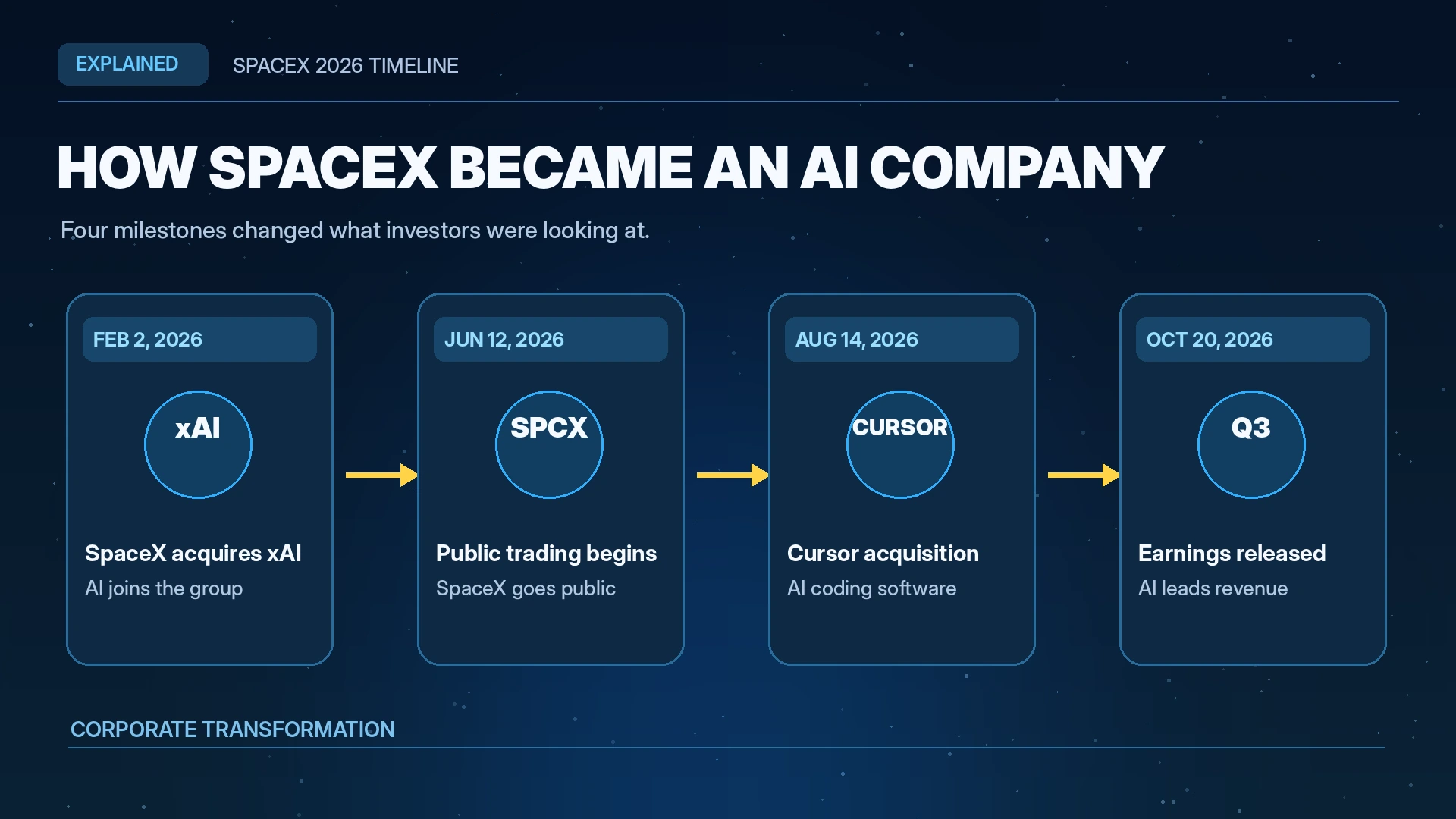
The transformation unfolded through several major developments.
| Date | What happened | Why it matters |
|---|---|---|
| February 2, 2026 | SpaceX acquired xAI | Brought AI computing, Grok, and the X-related business into the group |
| June 12, 2026 | SpaceX shares began public trading | Investors gained access to the combined business through publicly traded stock |
| August 14, 2026 | SpaceX completed its acquisition of Cursor | Added an established AI coding business |
| October 20, 2026 | SpaceX released its third-quarter results | Revealed AI as its largest quarterly revenue segment |
SpaceX’s IPO disclosures describe the February acquisition of xAI and the earlier acquisition of X by xAI. The company’s financial statements also account for those common-control combinations in the historical periods presented. (SpaceX IPO Prospectus · SpaceX IPO Announcement)
The August acquisition of Cursor added another important piece.
Cursor makes AI-assisted coding software used by developers to write, understand, and modify computer code.
SpaceX disclosed that Cursor contributed approximately $608 million in revenue between the acquisition’s closing date and September 30. (SpaceX SEC Filing)
That helps explain why AI revenue increased so rapidly.
Some of SpaceX’s new scale came from combining businesses, not simply from growing the original rocket company.
There is another important distinction: although SpaceX consolidated the historical results of xAI and X for comparable reporting periods, Cursor’s contribution began after its August acquisition.
So the quarterly comparison reflects a combination of growing operations, newly activated customer contracts, and an acquisition.
It would be misleading to attribute the entire increase to Grok subscriptions alone.
What Is SpaceX Actually Selling to AI Customers?
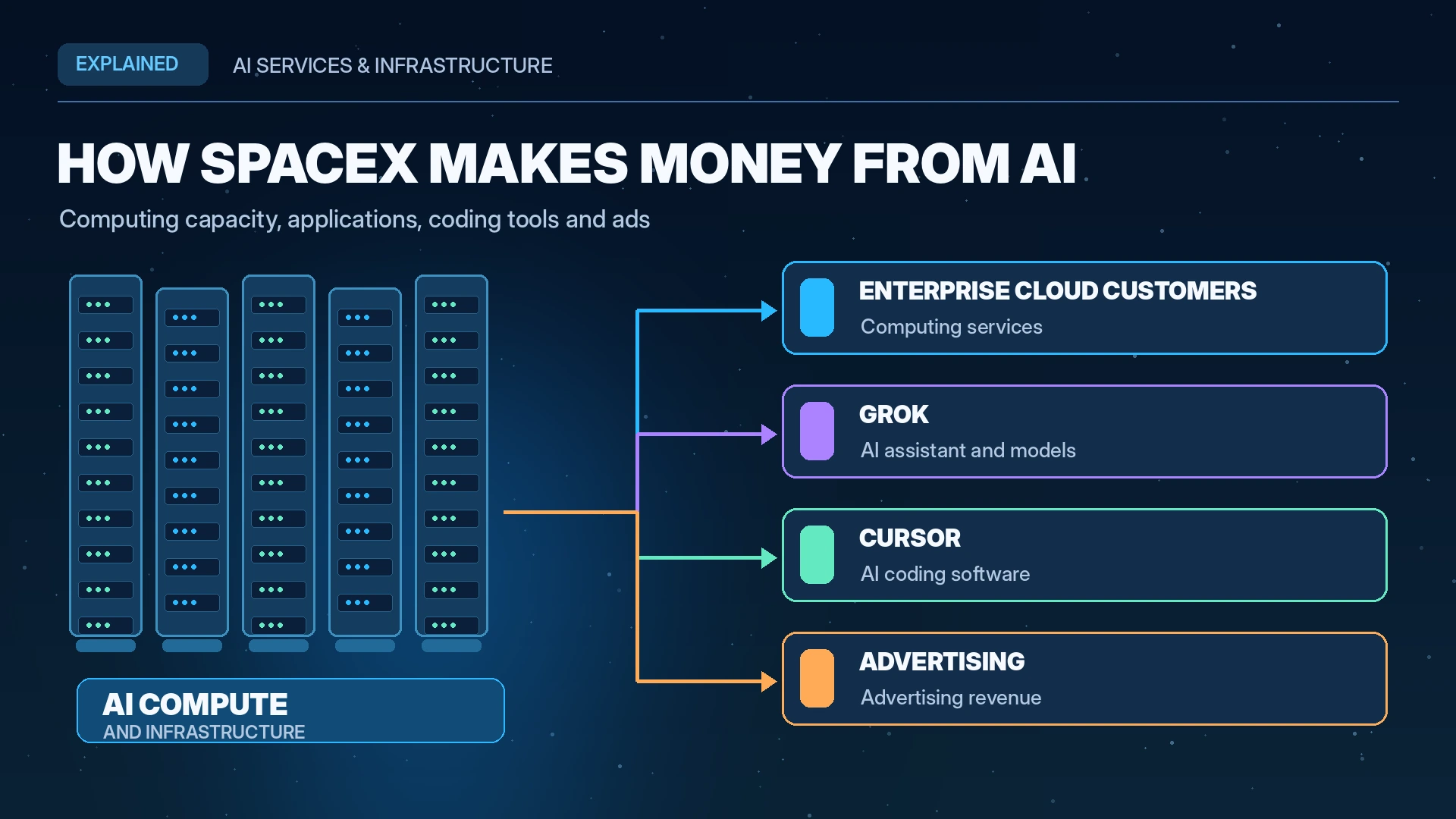
SpaceX is making much of its AI money by providing expensive computing capacity to other technology companies—not merely by charging people to use Grok.
That is perhaps the most overlooked part of the earnings story.
Artificial intelligence requires enormous computing resources.
Training advanced AI models and running them for millions of users involve specialized chips, powerful servers, electricity, cooling equipment, and high-speed networking.
Building that infrastructure can cost billions of dollars.
Not every AI company wants to own or operate all the physical equipment it needs.
Some companies instead pay providers to supply computing capacity.
Think of a company that needs a large warehouse but does not want to construct one. It can lease space from a business that has already built the warehouse.
AI computing works on a somewhat similar principle, although the technology and service agreements are much more complicated.
SpaceX can construct and operate major AI computing facilities, then sell access to that computing capacity.
Reuters reported that customers using SpaceX’s AI infrastructure include Anthropic, Google, and Reflection AI. (Reuters)
AI Revenue Is More Than Grok
SpaceX’s Super Intelligence segment includes several different revenue sources.
The company’s third-quarter filing divided the segment into two broad categories:
| Revenue category | Q3 2026 |
|---|---|
| AI solutions and infrastructure | $7.02 billion |
| Advertising | $538 million |
| Total Super Intelligence revenue | $7.56 billion |
These categories matter because the $7.02 billion figure includes AI solutions and infrastructure together. It is not a separately reported total for cloud rentals alone.
SpaceX said the segment’s growth was primarily driven by new cloud service agreements, the acquisition of Cursor, and growing use of Grok. (SpaceX SEC Filing)
Grok and Cursor are AI products people and businesses can use directly.
Computing infrastructure is different: it can earn money by supplying the hardware capacity that other AI businesses need.
SpaceX is participating in both markets.
That makes the company more than a rocket manufacturer with an AI chatbot attached.
It is increasingly an operator of the physical infrastructure on which large-scale AI depends.
If AI Brings In More Revenue, Why Is Starlink Still More Profitable?
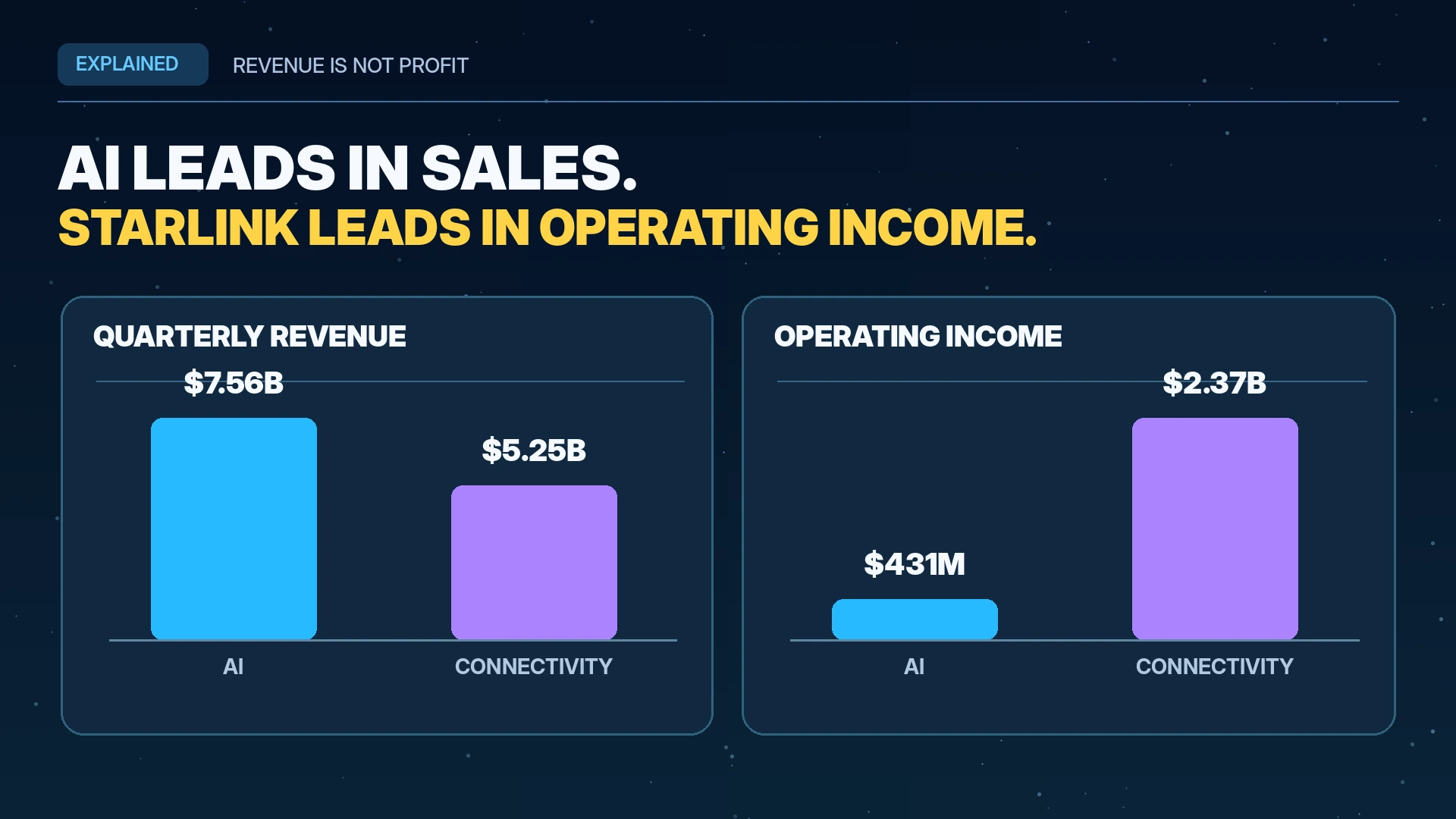
Starlink’s connectivity business generated approximately $2.37 billion in operating income in the third quarter, compared with $431 million for SpaceX’s AI segment.
The difference between revenue and profit is crucial.
Revenue is the amount a business brings in from its products and services.
Operating income is what remains after the operating costs and expenses reported for that business are deducted.
The two figures can tell very different stories.
SpaceX’s official financial results make that clear:
| Segment | Q3 revenue | Operating income |
|---|---|---|
| AI (Super Intelligence) | $7.56B | $431M |
| Connectivity (primarily Starlink) | $5.25B | $2.37B |
| Space | $1.77B | -$7M |
Source: SpaceX third-quarter 2026 segment results. Figures are rounded.
Despite having considerably less revenue, connectivity generated more than five times the operating income of AI. (SpaceX SEC Filing)
This does not mean the AI business performed poorly.
In fact, its reported operating result improved sharply from a $1.26 billion loss in the second quarter to a $431 million profit in the third.
But the amount of revenue a business generates tells only part of the story.
Why Do Different Profit Measures Give Different Impressions?
SpaceX also reported approximately $4.95 billion in adjusted EBITDA for its AI segment, compared with $3.50 billion for connectivity.
Adjusted EBITDA is a non-GAAP measure that excludes certain costs and accounting items, such as depreciation and stock-based compensation, from the calculation.
It can be useful for comparing operating performance, but it is not the same as operating income or cash left after building new infrastructure.
SpaceX’s AI segment, for example, recognized approximately $1.2 billion in stock-based compensation associated with the Cursor acquisition during the quarter.
That expense affected reported operating income, while certain adjusted measures exclude it. (SpaceX SEC Filing)
So two apparently contradictory statements can both be correct:
AI led SpaceX in quarterly revenue and adjusted EBITDA.
Connectivity led SpaceX in reported operating income.
Understanding which financial measure a headline is referring to makes a significant difference.
Why Is SpaceX Spending So Much on AI Infrastructure?
SpaceX is investing heavily because expanding AI computing capacity requires enormous upfront spending—and the company expects demand for that capacity to keep growing.
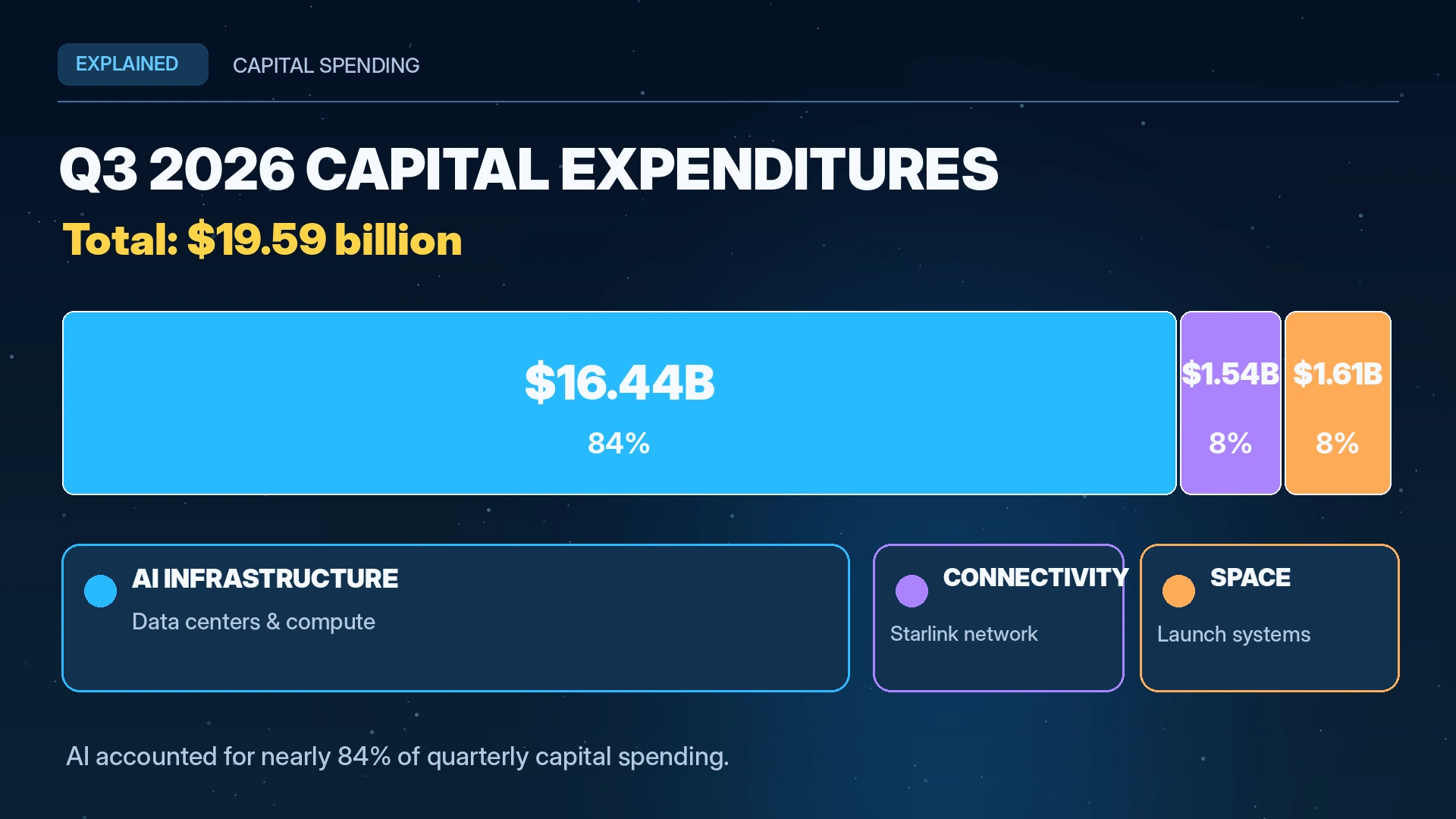
In the third quarter of 2026, SpaceX reported approximately $19.59 billion in capital expenditures, commonly called capex.
Of that amount, $16.44 billion went toward its Super Intelligence segment.
That is nearly 84% of the company’s total capital spending for the quarter. (SpaceX SEC Filing)
Capital expenditures are investments in assets expected to provide value over time.
A company may spend money building a data center today and use that facility to provide services for years.
The expenditure does not automatically mean the company recorded an equivalent operating loss during the quarter.
That is why the AI business could report positive operating income while SpaceX simultaneously invested much more money in new AI infrastructure than the segment generated in quarterly revenue.
What Does 1.7 Gigawatts of Computing Capacity Mean?
SpaceX also reported that its nameplate computing capacity had reached approximately 1.7 gigawatts as of September 30, up from 1.4 gigawatts at the end of June.
This figure describes the scale of its computing infrastructure in power-capacity terms. It is not a measure of how many AI questions its systems can answer, and it does not mean the facilities continuously consume that exact amount of electricity. (SpaceX SEC Filing)
Why does power capacity matter?
Because modern AI data centers are constrained by much more than the availability of computer chips.
They also need sufficient electricity, suitable sites, cooling systems, networking equipment, and the ability to operate those systems reliably.
A company that can assemble all those resources quickly may attract customers whose demand for computing capacity exceeds what they can build themselves.
The opportunity is substantial, but so is the financial risk.
Infrastructure built with borrowed or shareholder capital must eventually generate enough economic returns to justify its cost.
A revenue surge is encouraging.
Whether the infrastructure produces attractive returns over many years is a separate question.
Does This Mean Starlink Is Becoming Less Important?
No. Starlink remains a major source of SpaceX’s operating profit, and its satellite internet business continues to grow.
SpaceX reported 13.6 million Starlink consumer subscribers as of September 30, 2026, compared with 12 million at the end of June.
It also reported approximately $2.13 billion in quarterly enterprise and government connectivity revenue.
Those customers include organizations that need communications services in environments where conventional ground-based networks may be limited or unavailable. (SpaceX SEC Filing)
Starlink’s business model is different from SpaceX’s AI infrastructure operation.
AI computing customers purchase access to computing resources and software capabilities.
Starlink customers pay for connectivity delivered through a network of satellites and ground infrastructure.
Both businesses involve significant equipment investment, but their customers, costs, competitive pressures, and revenue patterns differ.
One Quarter Does Not Tell the Whole Story
There is an easily missed detail in the earnings report.
Although AI surpassed connectivity in third-quarter revenue, connectivity still had greater revenue over the first nine months of 2026.
| Segment | First nine months of 2026 |
|---|---|
| Connectivity | $12.80 billion |
| AI (Super Intelligence) | $10.94 billion |
| Space | $3.35 billion |
Source: SpaceX SEC filing, nine months ended September 30, 2026.
That distinction matters.
AI became SpaceX’s largest revenue segment for the third quarter. It had not yet overtaken connectivity in year-to-date revenue.
The latest results indicate how quickly the balance is changing, but they do not establish that AI will remain the largest segment every quarter.
If AI Is Growing So Fast, Why Does SpaceX Still Need Rockets?
Because the rocket business supports activities that can be valuable far beyond the revenue earned from individual launches.
SpaceX’s launch operations perform two broad functions.
They carry payloads for outside customers, including government and commercial organizations.
They also deploy satellites for SpaceX’s own networks.
In the third quarter of 2026, the company reported 35 launches, including 23 internal launches.
SpaceX also reported its first revenue-generating Starship mission, which deployed 26 Starlink V3 satellites. The company said those satellites represented a major increase in broadband downlink capacity compared with a Falcon 9 Starlink launch. (SpaceX SEC Filing)
Here is why that matters.
A rocket launch carrying SpaceX’s own satellites does not necessarily create the same kind of third-party launch revenue as a commercial customer mission.
But putting additional satellites into service can expand Starlink’s ability to sell communications services later.
In that sense, rocket manufacturing and launch operations help build infrastructure from which another SpaceX business earns revenue.
The company is trying to apply a similar long-term investment philosophy to AI: build expensive infrastructure first, then generate revenue by providing services that use it.
The analogy is useful, but the markets are different.
Starlink sells connectivity through satellites.
SpaceX’s current AI infrastructure business primarily uses terrestrial computing facilities.
Both require engineering and substantial capital, but one does not automatically guarantee the success of the other.
Is SpaceX Planning to Put AI Data Centers in Space?
SpaceX has discussed future space-based AI computing, but the AI revenue reported for the third quarter does not mean its current data centers are operating in orbit.
This is an important distinction because SpaceX’s rockets and AI infrastructure now belong to the same company.
A reader might reasonably assume that combining those businesses means SpaceX is already running enormous AI computing systems on satellites.
That is not what the October earnings report establishes.
The company’s IPO disclosures describe its AI computing infrastructure as beginning on Earth, with longer-term ambitions to extend computing activities into space.
The current business involves large terrestrial computing facilities, including infrastructure associated with its Colossus development. (SpaceX IPO Prospectus)
Placing substantial AI computing capacity in orbit would introduce challenges involving launch cost, cooling, radiation, communications, maintenance, and power generation.
Those issues make the business case for orbital data centers very different from the economics of renting computing capacity in terrestrial facilities.
SpaceX’s ownership of both rockets and AI technology could eventually create opportunities that other companies lack.
But a potential future advantage is not the same as a demonstrated commercial capability today.
The billions of dollars in AI revenue reported for the third quarter should therefore be understood primarily in the context of terrestrial AI infrastructure, software, and the other businesses included in SpaceX’s Super Intelligence segment.
What Should Investors Watch After SpaceX’s Earnings Surprise?
The next stage is less about whether SpaceX can report a dramatic AI revenue number and more about whether it can sustain that growth while earning attractive returns.
Three developments are especially important.
1. Can AI Growth Continue Beyond the Recent Acquisitions?
Cursor’s acquisition contributed to third-quarter results, while new cloud services agreements increased infrastructure revenue.
Future reports will help show whether recurring customer demand can sustain the expansion after those initial changes.
2. Will AI Infrastructure Spending Generate Strong Returns?
The third quarter demonstrated substantial demand and greatly improved AI operating performance.
It also showed enormous capital expenditures.
Investors will need to examine not just revenue and adjusted EBITDA, but operating income, cash generation, infrastructure spending, and the costs of financing that expansion.
3. Can Starlink Keep Growing While AI Takes More Investment?
Starlink remains a profitable and expanding connectivity business.
Further subscriber growth, enterprise contracts, and improved network capabilities could strengthen SpaceX’s financial foundation even as AI becomes a larger part of the company.
SpaceX became publicly traded in June 2026, with shares listed under the ticker SPCX. That makes the company’s segment performance and capital allocation directly relevant to public-market investors. (SpaceX IPO Announcement)
The challenge for management is to expand AI without undermining the financial strength supporting its satellite and space businesses.
Bottom Line: What This Story Really Means
SpaceX’s third-quarter earnings revealed something far more important than a single impressive revenue figure.
A company originally built around launching rockets now generates more quarterly revenue from AI than from its satellite connectivity business.
But this was not simply the result of launching AI products or persuading millions of people to subscribe to Grok.
The transformation reflects the acquisition of xAI, the addition of Cursor, rapidly expanding AI infrastructure, and major cloud computing agreements.
Just as importantly, the largest revenue segment is not necessarily the most profitable.
AI generated approximately $7.6 billion in quarterly revenue, but connectivity still produced considerably more reported operating income.
Meanwhile, SpaceX is spending heavily to expand its AI computing infrastructure, creating opportunities for future growth alongside substantial financial commitments.
The real story is not that SpaceX has stopped being a rocket company.
It is that rockets, satellite networks, computing infrastructure, and AI software now sit inside one increasingly complex business.
Whether that combination creates lasting advantages will depend on much more than one quarter of extraordinary AI sales.
SpaceX AI Revenue: Key Questions Explained
Q. How much AI revenue did SpaceX report in Q3 2026?
SpaceX reported approximately $7.56 billion in Super Intelligence revenue for the quarter ended September 30, 2026, representing about 52% of total company revenue.
Q. How much revenue did Starlink generate during the same quarter?
SpaceX’s Connectivity segment, consisting primarily of Starlink-related operations, generated approximately $5.25 billion.
Q. Is SpaceX’s AI business now bigger than its rocket business?
By quarterly revenue, yes. SpaceX reported $7.56 billion from AI compared with approximately $1.77 billion from its Space segment in Q3 2026.
Q. Is Grok responsible for all of SpaceX’s AI revenue?
No. The Super Intelligence segment includes computing infrastructure, AI solutions, software products such as Grok and Cursor, and advertising. The company’s disclosure does not attribute all AI revenue to Grok.
Q. When did SpaceX acquire xAI?
SpaceX acquired xAI effective February 2, 2026, bringing Musk’s AI operations into the SpaceX corporate group.
Q. Is SpaceX’s AI business more profitable than Starlink?
Not by reported operating income in Q3 2026. Connectivity earned approximately $2.37 billion in operating income, compared with $431 million for AI, although AI reported higher adjusted EBITDA.
Q. How much did SpaceX spend on AI infrastructure in Q3 2026?
SpaceX reported approximately $16.44 billion in Super Intelligence capital expenditures, accounting for about 84% of the company’s quarterly capital spending.
Q. Has AI surpassed Starlink in SpaceX’s annual revenue?
Not for the first nine months of 2026. Connectivity generated approximately $12.80 billion, compared with $10.94 billion for AI. AI led in the third quarter alone.
Q. Is SpaceX running AI data centers in orbit?
The company’s reported AI infrastructure business is primarily terrestrial. Space-based computing is part of its longer-term ambitions, not proof that its current major AI facilities are operating in orbit.
Q. Can investors buy SpaceX stock?
Yes. SpaceX began public trading in June 2026 under the Nasdaq ticker SPCX. Its reported earnings now provide public-market investors with information about its combined space, connectivity, and AI operations.
Did this help make the story clearer? 🙂
WIN keeps unpacking the “why” behind the news—clearly and simply!
Sources
SpaceX’s Official Third-Quarter Financial Results
SpaceX — Second Quarter 2026 Earnings Release and Financial Results, SEC Filing, August 4, 2026
Corporate Structure, Acquisitions, and IPO
SpaceX — 2026 IPO Prospectus, Including xAI Merger and AI Infrastructure Disclosures
SpaceX — Completion of Initial Public Offering, June 15, 2026
Independent Reporting and Business Context
Reuters — SpaceX Quarterly Revenue Jumps, Beats Estimates as AI Business Surges, October 20, 2026
Keep Reading
Could the Next Generation of AI Data Centers Actually Move Into Space?
SpaceX’s AI revenue comes primarily from businesses operating on Earth, but the combination of AI computing and space technology raises a different question: Could data centers eventually operate in orbit? Google’s Project Suncatcher research explores the technical challenges behind that idea.
Why Is Google Sending AI Chips Into Space—and Could Data Centers Really Move Off Earth?