Why Did Harry Kane Finally Win the Ballon d’Or at 33?

For years, Harry Kane seemed to have everything a great striker could want—except the trophies people kept using to judge him. He scored relentlessly for Tottenham and England, yet the question followed him: Could a player be considered one of soccer’s very best without winning the biggest prizes?
Now Kane has won the 2026 men’s Ballon d’Or at age 33. He didn’t win the World Cup or the Champions League to get there. Instead, a remarkable scoring season, major domestic success with Bayern Munich, and a voting system that puts individual performance first combined to produce the biggest personal award of his career.
※ Images in this article are AI-generated illustrations created to help explain the story. They are not actual photographs, and depictions of people, places, or events may differ slightly from reality.
The interesting part is not simply that Kane finally won. It is why his particular season was enough to beat players with their own powerful claims to the award—and how different his career looks from just two years ago.
What Happened at the 2026 Ballon d’Or Ceremony?
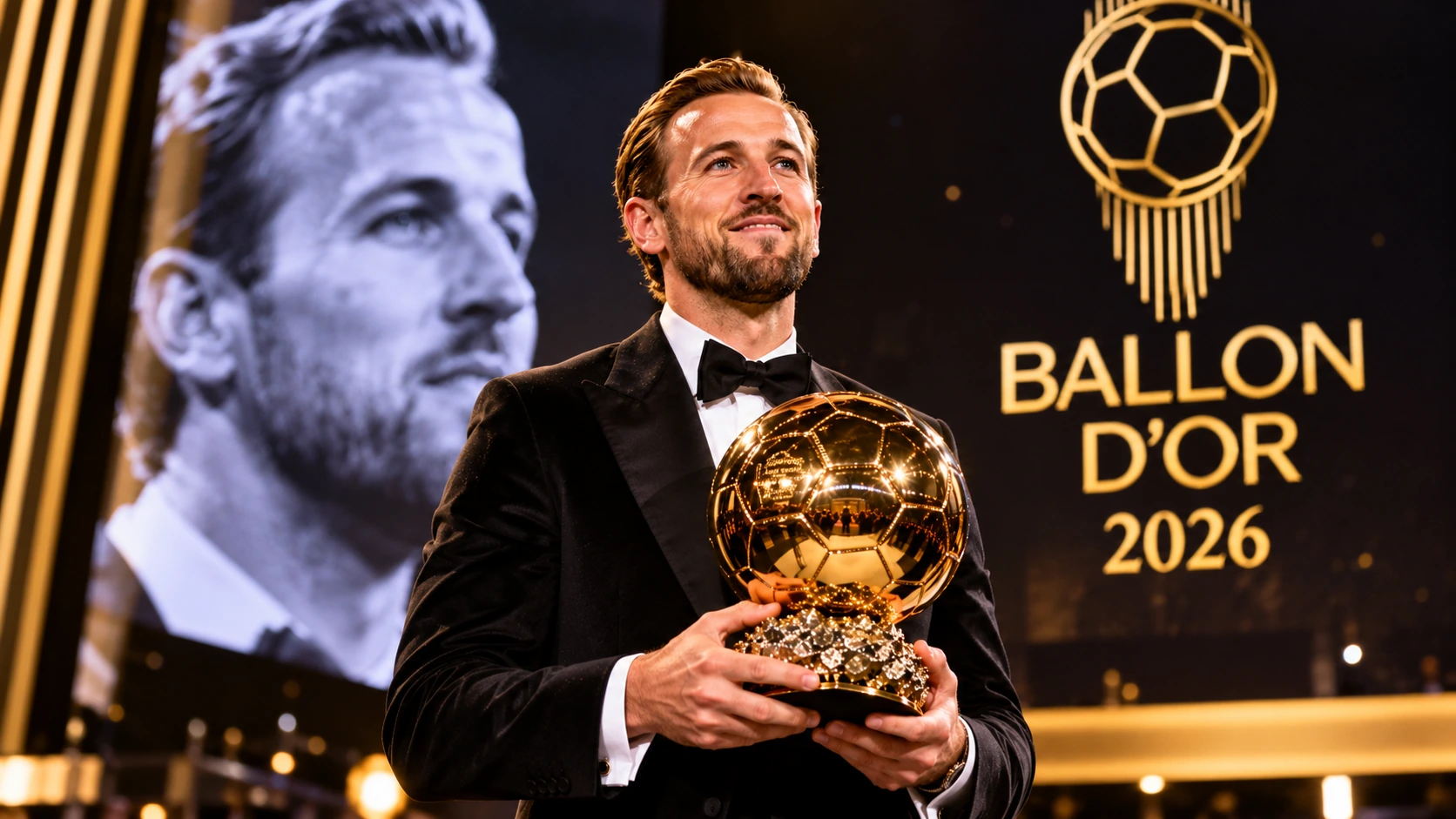
Kane won the men’s Ballon d’Or on October 26, 2026, at London’s Palladium Theatre. Real Madrid’s Kylian Mbappé finished second, and Barcelona’s Lamine Yamal placed third. It was Kane’s first Ballon d’Or and the first time an Englishman had won the men’s prize since Michael Owen in 2001. (UEFA · Reuters)
The award honors the player judged to have had the strongest season. It is not a lifetime-achievement prize, and it is not automatically given to the player whose team wins the Champions League or World Cup.
Before the ceremony, the debate centered on whether Kane’s remarkable scoring season would outweigh the competing cases made for Mbappé and Yamal.
For Kane, the result was an enormous jump. Before 2026, his best Ballon d’Or placing had been 10th. He was widely respected as an elite goal scorer, but had never finished close to the very top of this particular vote. (Sky News)
How Extraordinary Were Harry Kane’s 73 Goals?
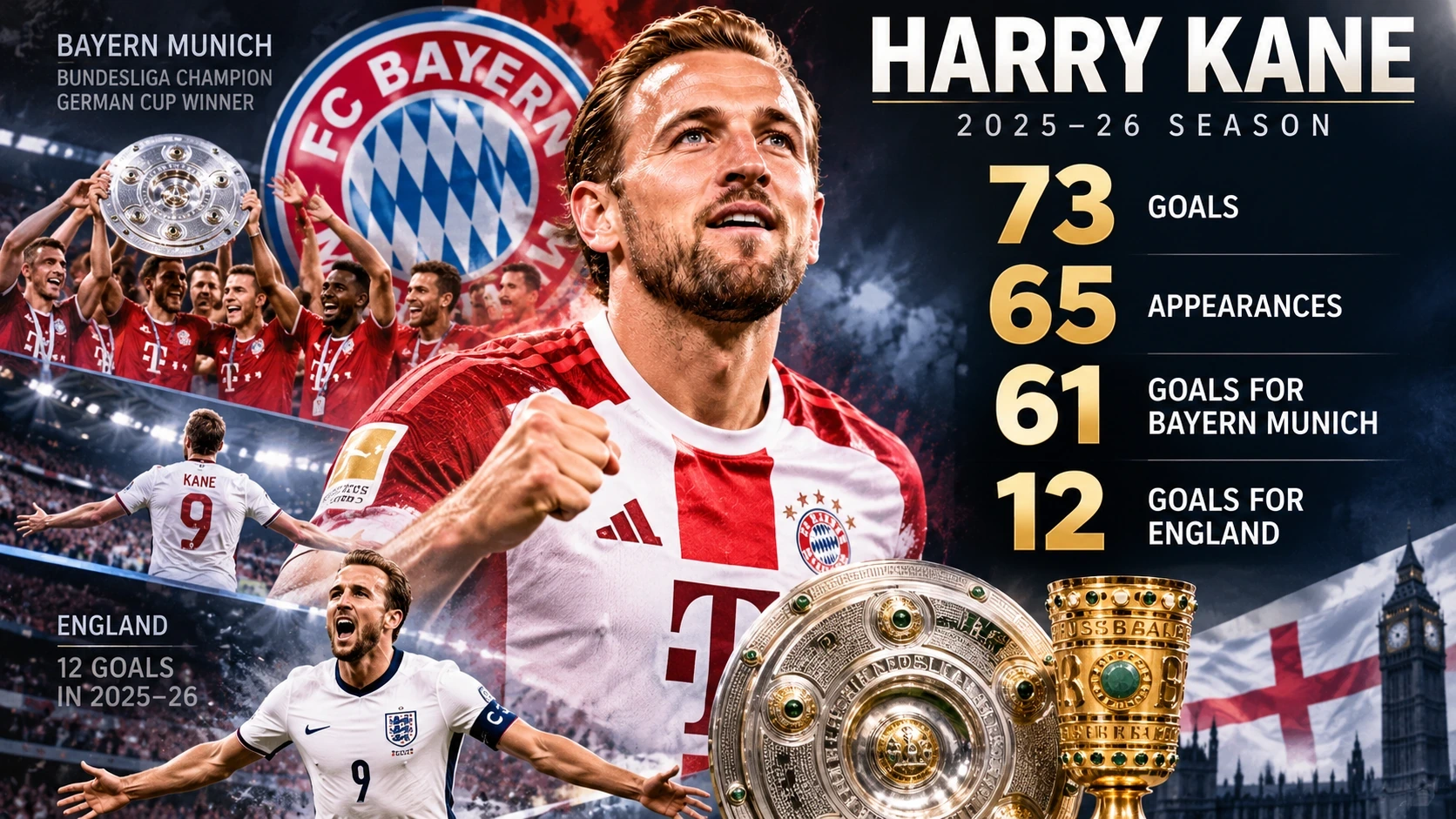
Kane scored 73 goals in 65 appearances for Bayern Munich and England during the 2025–26 award period. Of those, 61 came in 51 club games and 12 in 14 appearances for his country. That is more than a goal per game across both teams, not merely a strong stretch in one competition. (England Football · Bundesliga)
His Bayern goals were spread across different competitions, making the total harder to dismiss as the product of one unusually favorable setting.
| Competition | Kane’s goals | Why it mattered |
|---|---|---|
| German Bundesliga | 36 | Led the league in scoring for a third straight season |
| UEFA Champions League | 14 | Delivered against elite European competition |
| German Cup (DFB-Pokal) | 10 | Helped Bayern win the domestic cup |
| Franz Beckenbauer Supercup | 1 | Added to his club total |
| England national team | 12 | Included six at the 2026 World Cup |
| Combined | 73 | 61 for Bayern plus 12 for England |
The Bundesliga’s official breakdown identifies the same 61 club goals, including 36 in league play and 14 in the Champions League. England’s World Cup campaign finished in third place, with Kane scoring six goals during the tournament. (Bundesliga · England Football)
The raw total wasn’t just eye-catching. Kane produced goals in domestic league matches, elimination tournaments and international competition—the different stages on which voters could judge whether he was consistently decisive.
How Did Kane Go From a Trophy Drought to a Winning Season?
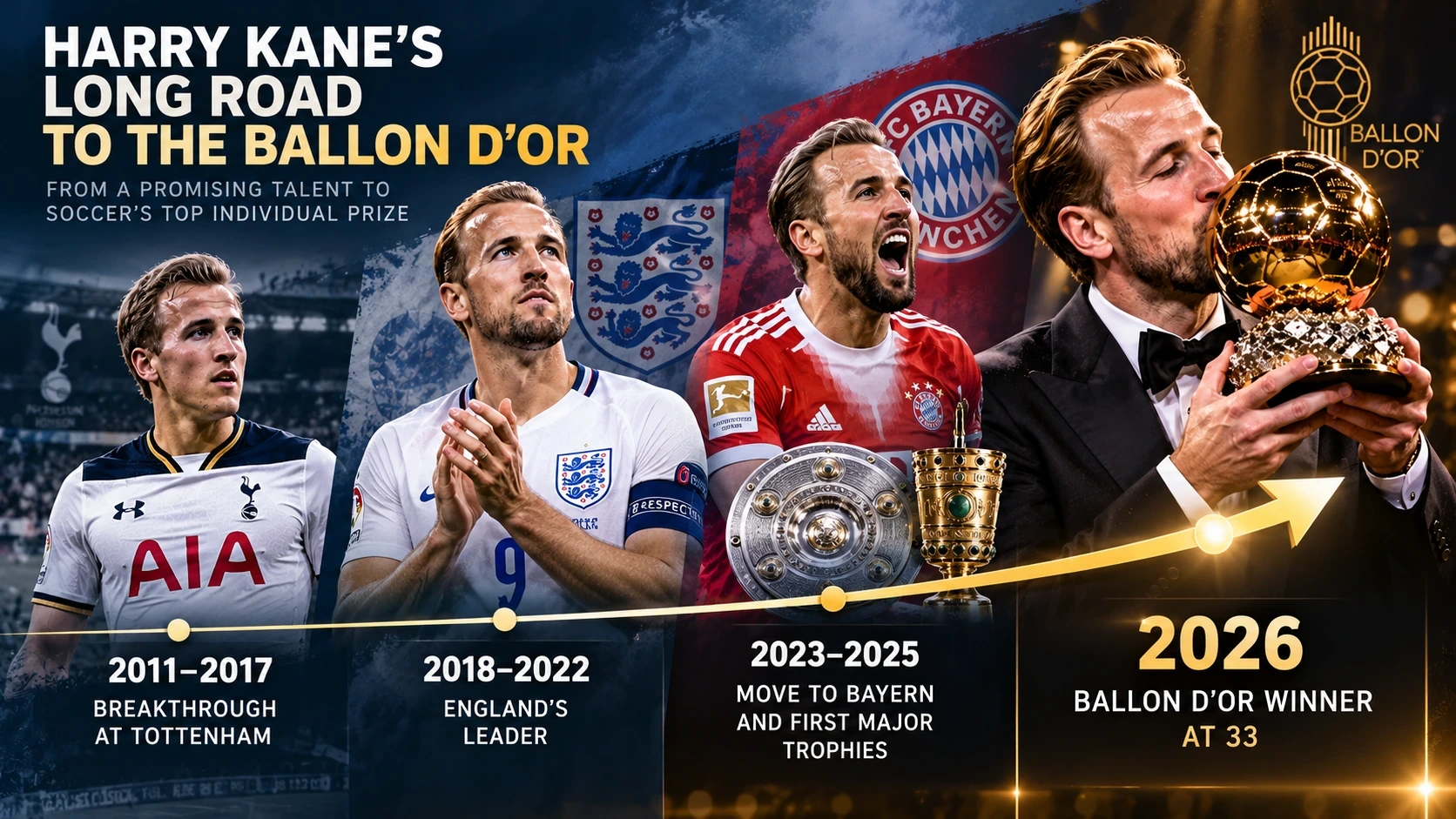
For most of his career, Kane’s reputation contained a strange contradiction: he was a prolific striker without a major senior team trophy. His years at Tottenham brought individual records and deep tournament runs, but not the silverware critics said a world-class player needed.
His move from Tottenham to Bayern Munich in 2023 was supposed to change that. Even Bayern, a club accustomed to titles, finished Kane’s first season there without a major trophy. The drought finally ended with Bayern’s 2024–25 Bundesliga championship, the first major team title of his senior career. (Bundesliga · Reuters)
Then came another title-winning season. Bayern retained the Bundesliga in 2025–26 and also won the German Cup, completing the domestic league-and-cup double. Kane also collected a Franz Beckenbauer Supercup title in the award period. Meanwhile, his extraordinary scoring form continued rather than dropping once his team started winning. (Bundesliga · England Football)
| When | What changed |
|---|---|
| 2023 | Kane left Tottenham for Bayern Munich |
| 2023–24 | Bayern finished his first season without a major team trophy |
| 2024–25 | Kane won the Bundesliga, ending his major team-trophy drought |
| 2025–26 | Bayern retained the league title and won the German Cup; Kane scored 73 for club and country |
| October 26, 2026 | Kane won his first Ballon d’Or at age 33 |
His old reputation did not vanish because voters suddenly decided that trophies were everything. It changed because elite individual production and major team success finally appeared together.
Why Could Kane Win Without the World Cup or Champions League?
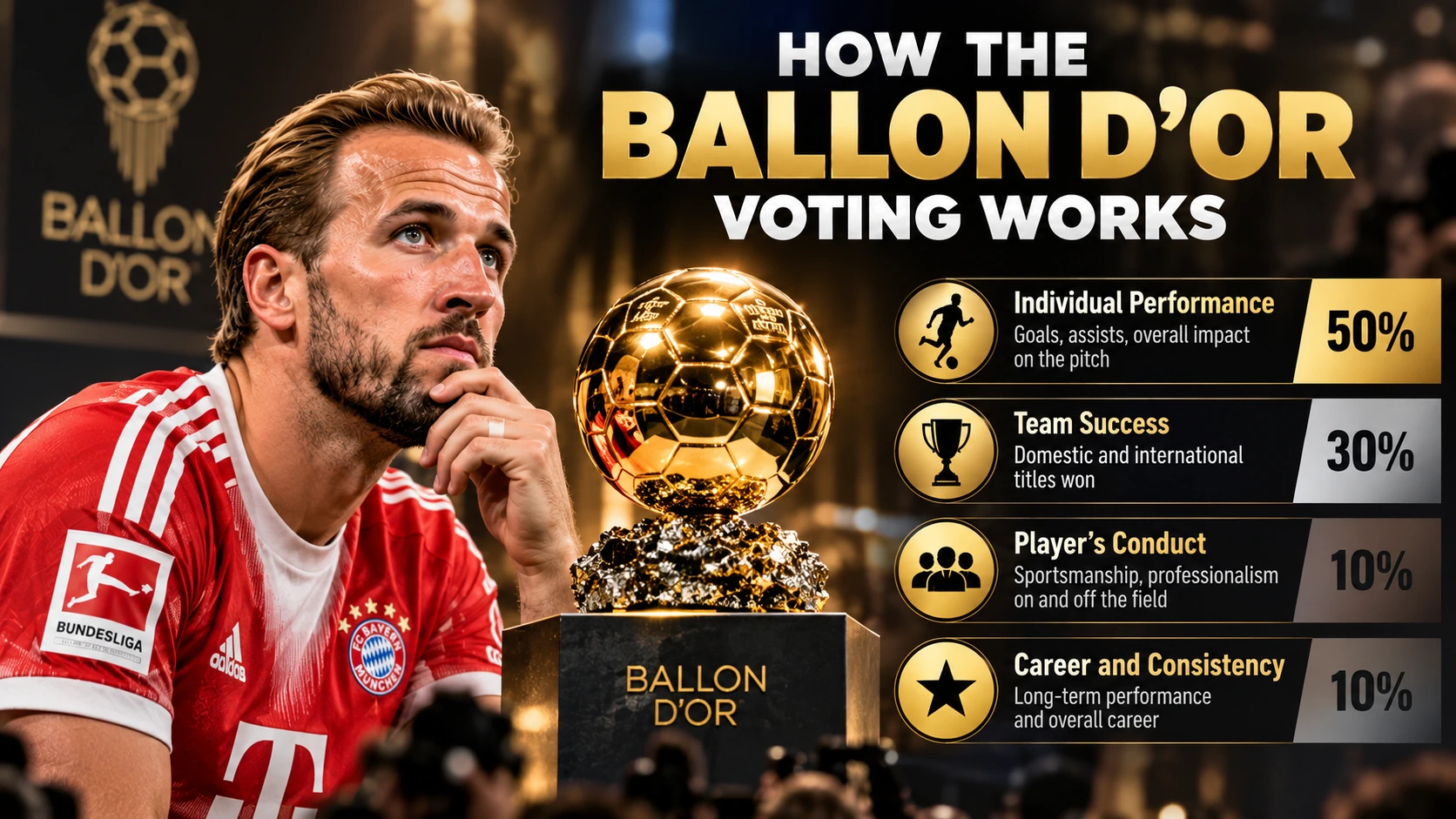
Because winning the World Cup or Champions League is not a requirement for the Ballon d’Or. Kane’s Bayern side reached the Champions League semifinals, and England finished third at the World Cup. Neither team won those competitions, but the award’s criteria do not treat either trophy as an automatic pass to first place. (UEFA · England Football)
For the 2026 award, France Football’s official regulations ranked three factors in this order: individual performance and decisive impact; collective achievements and titles; then class and fair play. The assessment period ran from August 3, 2025, through July 19, 2026, and included the World Cup. (Ballon d’Or Official Regulations)
That is why treating the award as a simple count of medals misses the point. A Champions League winner can make a strong case on team results, but a player who dominated individually across a season can also prevail. Kane’s 73 goals gave voters a compelling reason to put him first, even without soccer’s two biggest team titles.
Who actually casts the votes?
The men’s award is chosen by an international panel of 100 specialized journalists, one from each of the 100 highest-ranked FIFA nations. Each selects 10 names from a 30-player shortlist. First place earns 15 points, second 12, third 10, and lower ranks receive progressively fewer points. The player with the highest combined total wins. (Ballon d’Or Official Regulations)
This is not a public popularity vote. It also does not mean every journalist used exactly the same reasoning. The regulations set the standards; the voters weigh each candidate’s season and award the points.
Why Was This a Historic Moment for English Soccer?
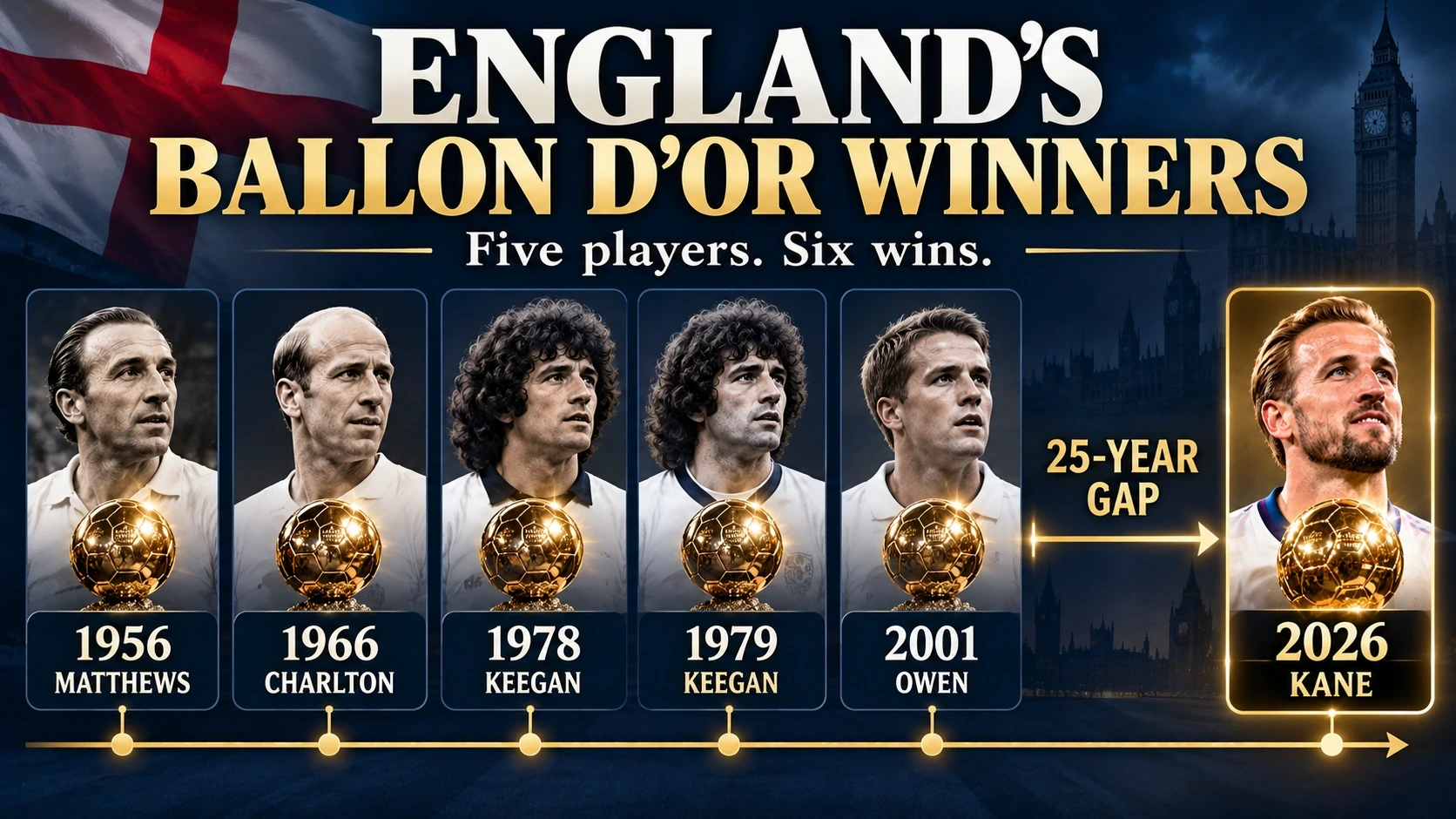
Kane became only the fifth Englishman to win the Ballon d’Or, ending a 25-year gap since Michael Owen’s victory in 2001. There had been other celebrated English players during that period, but none had finished first in the men’s voting. (England Football)
The list is shorter than many fans might expect:
| English winner | Year or years won |
|---|---|
| Stanley Matthews | 1956 |
| Bobby Charlton | 1966 |
| Kevin Keegan | 1978, 1979 |
| Michael Owen | 2001 |
| Harry Kane | 2026 |
Kane also became the first Bayern Munich player to win since Karl-Heinz Rummenigge in 1981. And there was a historical symmetry to the ceremony itself: the 70th edition was held in London, honoring the city and country of Stanley Matthews, the award’s inaugural winner. (Bayern Munich · UEFA)
For English fans, that is more than a numerical milestone. It connects the country’s modern captain with a small group of players who received one of soccer’s most internationally recognized individual honors.
What Does Winning at 33 Change About Kane’s Legacy?
The award answers one question decisively: Kane no longer needs to be described as a world-class striker who has never won a major team trophy—or as a superstar who has never won the Ballon d’Or. Both descriptions are now out of date.
His career shows why the timing matters. He had already built a formidable scoring record before his first major team title arrived in 2025. The 2026 Ballon d’Or acknowledges what happened after that breakthrough: more trophies, even more goals, and a season that stood out across club and international soccer.
There are still achievements Kane has not claimed, including a World Cup and Champions League title. Those are separate team ambitions; they are not conditions that must be fulfilled to validate his Ballon d’Or. The next meaningful question is whether Bayern and England can turn his individual excellence into success on those stages.
His win also offers a caution against treating a player’s legacy as fixed by age 30. Kane’s previous Ballon d’Or best was 10th. At 33, the same player stood first—not because his earlier work suddenly counted as extra votes, but because this particular season met the award’s standards more convincingly than anyone else’s. (Sky News · Ballon d’Or Official Regulations)
Bottom Line: What This Story Really Means
Harry Kane won the 2026 Ballon d’Or at 33 because his 73-goal season combined extraordinary individual performance with important team trophies, and the award’s voting rules prioritize individual impact over a checklist of tournament victories.
The bigger story is the reversal of a familiar career narrative. Kane spent years being measured by the trophies he lacked. He now has domestic titles, a historic individual honor, and a different question hanging over the rest of his career: how much more can he win?
Harry Kane Ballon d’Or: Key Questions Explained
Q. Who won the men’s Ballon d’Or in 2026?
Harry Kane of Bayern Munich and England won the men’s award on October 26, 2026, in London.
Q. How old was Harry Kane when he won?
He was 33. Kane was born on July 28, 1993, and received the award in October 2026.
Q. Who finished second and third in the 2026 voting?
Kylian Mbappé finished second, followed by Lamine Yamal in third.
Q. How many goals did Kane score in the award period?
He scored 73 in 65 games: 61 for Bayern Munich and 12 for England during the 2025–26 evaluation period.
Q. Did Kane win the 2026 World Cup?
No. England finished third, with Kane scoring six goals during the tournament.
Q. Did Bayern Munich win the Champions League in 2025–26?
No. Bayern reached the semifinals. Kane nevertheless scored 14 goals in the competition.
Q. What was Kane’s first major team trophy?
The 2024–25 Bundesliga title with Bayern Munich, won after years without a major senior team trophy.
Q. Is the Ballon d’Or decided by fan voting?
No. The men’s award is decided by 100 specialized journalists using a ranked points ballot.
Q. When was the previous English men’s Ballon d’Or win?
Michael Owen won in 2001, 25 years before Kane’s 2026 victory.
Did this help make the story clearer? 🙂 WIN keeps unpacking the “why” behind the news—clearly and simply!
Sources
Award Results and Official Voting Rules
UEFA — Harry Kane Wins the 2026 Men’s Ballon d’Or
Ballon d’Or — Official 2026 Criteria and Voting Regulations
Reuters — England’s Kane Wins Ballon d’Or
Scoring Record and England’s Performance
England Football — Harry Kane Wins 2026 Ballon d’Or
Bundesliga — Breaking Down Kane’s 2025–26 Numbers
Career Background and Historical Context
Bundesliga — Kane Celebrates His First Major Team Title