Why Was Macklemore Dropped From Ed Sheeran’s Tour—and Who Actually Had the Power?
Wasn’t this Ed Sheeran’s tour?
If Sheeran wanted Macklemore to stay, couldn’t he simply keep him on the bill?

That is what made this story much more complicated than a typical opening-act change. Messina Touring Group, the promoter of Sheeran’s U.S. Loop Tour, said venues had warned that concerts would not go ahead if Macklemore remained on the lineup. Sheeran, meanwhile, said the final decision was made by the promoter and venues—not by him. (Reuters · AP)
But that still leaves an obvious question: how can one of the biggest touring musicians in the world say a major decision on his own tour was not his to make?
The answer is that a stadium tour is not controlled by one person. The headliner, promoter and venue each hold a different kind of power—and this dispute forced those normally invisible relationships into public view.
What Happened Before the Philadelphia Concert?

The sequence matters because the Philadelphia concert was not the beginning of the controversy. It was the moment Sheeran finally addressed a dispute that had been growing for about two weeks.
| Date | What happened |
|---|---|
| September 4–5 | Macklemore appeared during Sheeran’s MetLife Stadium dates in New Jersey and made pro-Palestinian remarks, including “Free Palestine.” |
| September 14 | Messina Touring Group said Macklemore would no longer appear on the remaining support dates after venues said they would not host the shows with him on the lineup. |
| September 15–16 | Sheeran said the decision was not his, while other artists connected to the tour announced they were withdrawing in solidarity with Macklemore. |
| September 19 | The Loop Tour resumed at Lincoln Financial Field in Philadelphia without an opening act. Sheeran addressed the controversy from the stage and apologized for how the situation had unfolded. |
Reuters reported the original remarks during the September 4 MetLife show, while AP coverage referred to the September 5 New Jersey performance; Sheeran played MetLife on both dates. The safest way to understand the sequence is that Macklemore’s remarks during the early-September New Jersey stop triggered the dispute that became public the following week. (Reuters · AP)
So Who Actually Controls a Stadium Tour?
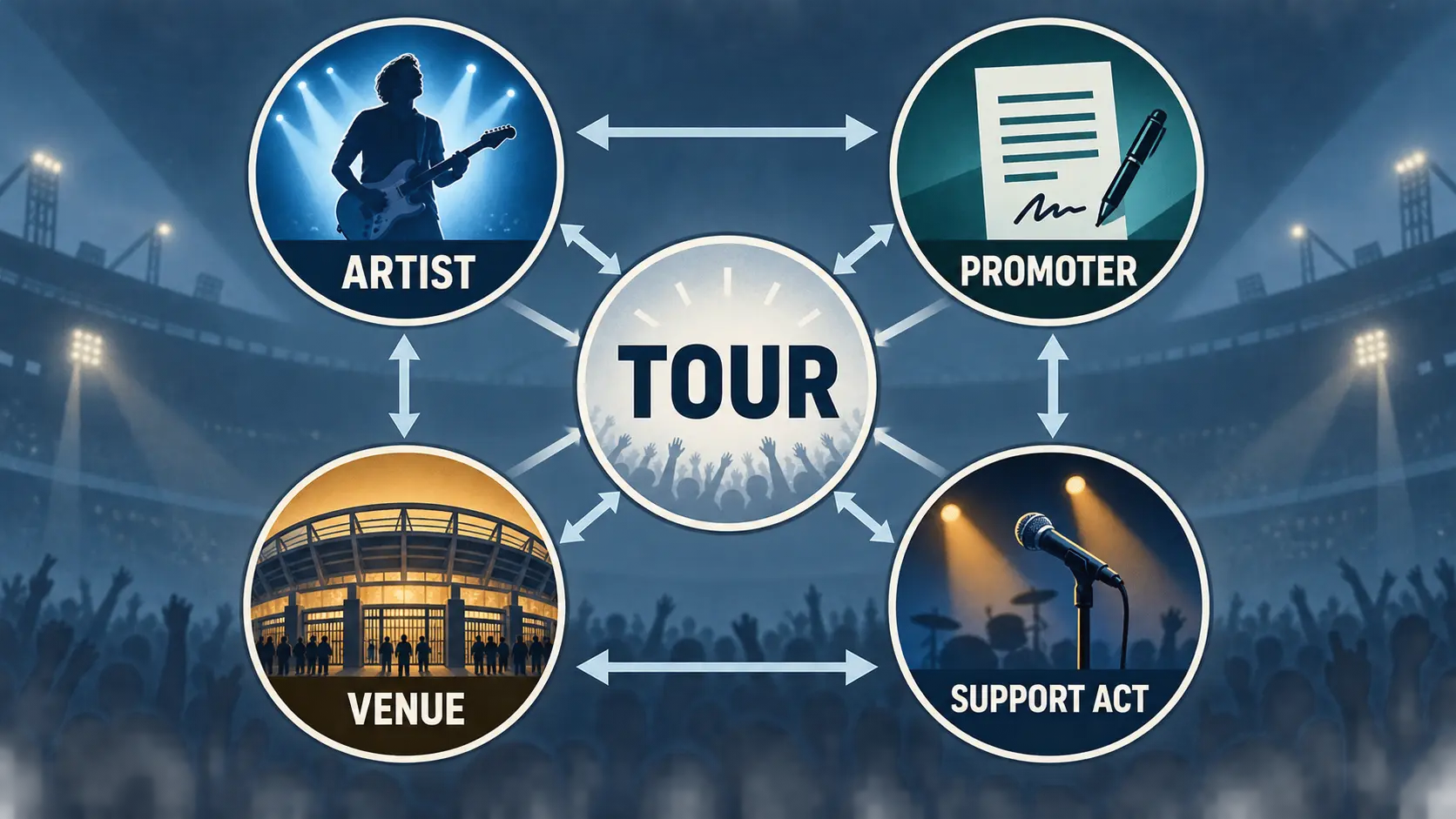
The simplest way to picture a stadium tour is as a four-way business relationship.
| Player | What that party generally controls | What mattered here |
|---|---|---|
| Headlining artist | Creative direction, performance and enormous commercial leverage | Sheeran said he tried to keep the parties together but did not make the final removal decision |
| Tour promoter | Financing, contracts, ticketing coordination and dealings with venues | Messina Touring Group announced that Macklemore would no longer appear |
| Venue/operator | Access to the building and the conditions under which a concert can take place | Multiple venues reportedly said they would not stage the show with Macklemore on the bill |
| Support act | Its own performance and contractual participation | Macklemore was removed; several other artists later withdrew |
AP interviewed music-industry figures who described promoters as the primary business operators behind large tours: they put up money, pay acts and negotiate with venues. But those same experts said a superstar capable of filling stadiums normally has extraordinary influence over what happens under their name. (AP)
That is why both statements can be true at the same time: the promoter may hold the contract and make the formal lineup decision, while the headliner still has enormous practical leverage.
Could Ed Sheeran Really Have Been Powerless?
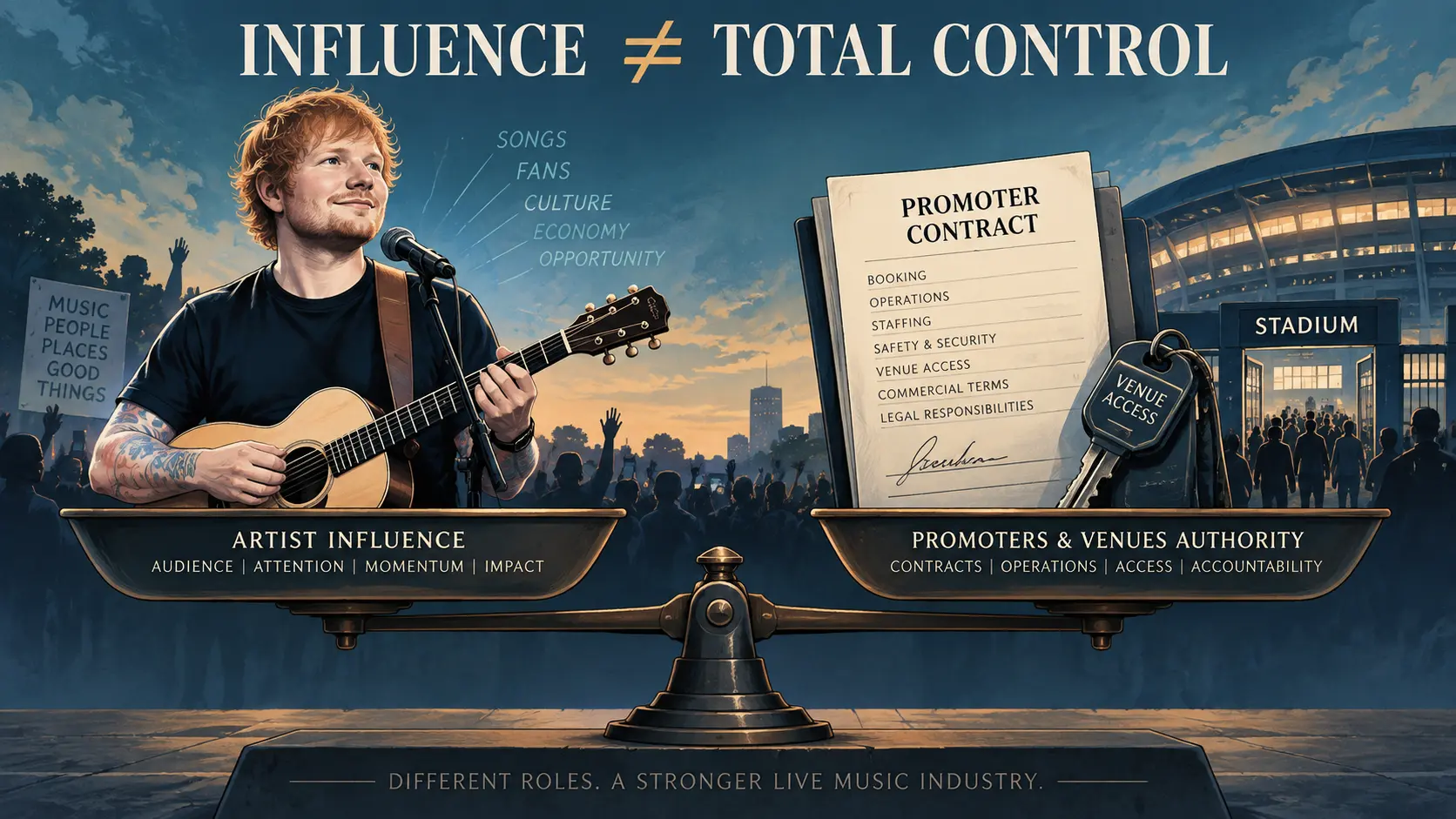
There is no public copy of the relevant tour contracts showing exactly which party had a unilateral veto over Macklemore.
That matters. Without the contracts, it would be too strong to say either that Sheeran personally fired Macklemore or that Sheeran had absolutely no ability to influence the outcome.
Sheeran said he spent days talking with venues and trying to find a compromise, but ultimately described the promoter and venues’ position as final. Messina Touring Group separately said venues had warned that keeping Macklemore on the lineup could lead to tour dates being canceled. (AP · Reuters)
At the same time, the industry experts interviewed by AP said artists at Sheeran’s level generally have substantial approval power because the tour’s commercial value depends heavily on them.
So the most accurate answer is not “Sheeran controlled everything” or “Sheeran controlled nothing.”
The dispute involved several parties with different forms of leverage.
Why Did the Venues Object to Macklemore?

Not every venue publicly explained its position.
Robert Kraft, owner of the New England Patriots and Gillette Stadium, did. Kraft said Gillette would not provide a platform for what he characterized as hate speech and cited both Macklemore’s recent stage material and what Kraft described as a broader history of antisemitic rhetoric and imagery. (GBH)
Macklemore rejected the idea that his advocacy for Palestinians amounted to antisemitism. He argued that criticism of the Israeli government and support for Palestinian rights should not be treated as hostility toward Jewish people. Reuters reported both his position and the venue dispute when his removal was announced. (Reuters)
Macklemore also alleged that Kraft encouraged other venue owners to take a similar position. Kraft confirmed his own objection at Gillette Stadium, but the public reporting does not establish that Kraft personally controlled every venue or single-handedly ordered Macklemore’s removal from the entire tour.
That distinction is important: one part is confirmed venue action; another part is Macklemore’s account of how broader pressure spread.
Why Did the Other Acts Walk Away Too?

Macklemore’s removal might have remained a one-person lineup dispute. It did not.
Artists connected to the tour—including Beoga, Lukas Graham, Aaron Rowe and Finneas—announced withdrawals in solidarity with Macklemore. Beoga had also been joining Sheeran during portions of his performances. (AP)
That changed the practical meaning of the controversy. The issue was no longer simply whether one opening act could appear at certain stadiums. It became a test of what other performers were willing to do when they disagreed with a tour decision.
The Philadelphia show on September 19 therefore opened without a billed opening act. Sheeran walked onstage alone before other musicians joined him later in the concert. (AP)
What Did Ed Sheeran Say in Philadelphia?

The Philadelphia concert marked a clear change in Sheeran’s public response.
Earlier in the week, he had said his concerts were not meant to become political forums. On September 19, however, he addressed the conflict directly. He condemned the Hamas-led October 7, 2023 attacks in Israel and described the situation in Gaza as “catastrophic and unjustifiable.” He also apologized for mistakes in how he had handled the tour controversy. (Reuters · AP)
Sheeran also said he was deeply concerned about venues preapproving what performers could say or do onstage.
That did not reverse Macklemore’s removal. It did, however, move Sheeran from explaining who made the decision to publicly questioning the broader practice that helped produce it.
Is This Actually a First Amendment Case?

Not automatically.
Sheeran used the language of “freedom of speech,” and the controversy clearly involves a broader cultural debate over what artists should be allowed to say onstage. But that is not identical to proving a violation of the First Amendment.
Under U.S. constitutional law, the First Amendment generally restricts government action, not every decision made by a private person or business. A private entity can sometimes be treated as a government actor in limited circumstances, which means the legal analysis can depend heavily on the facts. (Congress.gov Constitution Annotated)
No reported court ruling has determined that Macklemore’s removal from the Loop Tour violated the First Amendment.
So there are really two different questions:
| Question | What it means |
|---|---|
| Was Macklemore’s speech restricted as a practical matter? | Yes. His participation in future tour dates ended after venues objected to the lineup. |
| Has a court ruled that this was unconstitutional censorship? | No. That is a separate legal question involving government-action requirements and the specific facts of any claim. |
Calling the controversy a “free speech debate” is therefore reasonable. Calling it a proven First Amendment violation would go beyond what has been established.
What Happens to the Loop Tour Now?
As of September 21, the tour is continuing.
Sheeran is scheduled to play Gillette Stadium in Foxborough, Massachusetts, on September 25 and 26—the same stadium whose owner publicly objected to Macklemore’s participation. AP reported there was no strong evidence that the broader tour would be canceled because of the dispute. (AP · Gillette Stadium)
The more interesting question is what the tour looks like from here.
Will replacement supporting acts be added? Will venues seek clearer limits on what performers may say? Will artists insist on stronger contractual protection over stage content? And will future stadium tours spell out these issues before a controversy reaches the point of cancellation threats?
Those questions matter well beyond Ed Sheeran and Macklemore. Stadium tours are enormous businesses involving artists, promoters, venues, insurers, employees and hundreds of thousands of ticket buyers.
Most of the time, those parties’ competing powers stay backstage.
This time, everyone got to see them.
Why It Matters in One Sentence
The Macklemore controversy shows that even a superstar’s tour is not controlled by the superstar alone: artists, promoters and venues each hold different forms of power, and a dispute over one performer can expose who actually has leverage when those interests collide.
Ed Sheeran and Macklemore Tour: Key Questions Explained
Q. Why was Macklemore removed from Ed Sheeran’s U.S. tour?
Messina Touring Group said venues on upcoming dates told the promoter they would not allow concerts to proceed with Macklemore on the lineup. The promoter then announced that he would no longer appear on the remaining support dates.
Q. Did Ed Sheeran personally fire Macklemore?
Sheeran said he did not make the final decision. Publicly available reporting shows the formal decision came through the promoter after venue objections, although industry experts say a headliner of Sheeran’s stature normally has significant influence over tour decisions.
Q. What is Messina Touring Group?
Messina Touring Group is the promoter of the U.S. leg of Sheeran’s Loop Tour. A promoter typically handles major business functions including contracts, financing and negotiations with venues.
Q. Did Robert Kraft personally remove Macklemore from the entire tour?
That has not been established. Kraft confirmed that Macklemore would not be permitted to perform at Gillette Stadium, while Macklemore alleged that Kraft also encouraged other venue owners to object.
Q. Why did other performers withdraw?
Several artists connected to the tour said they were leaving in solidarity with Macklemore after his removal. Their decisions turned an opening-act dispute into a wider conflict over artistic expression and control of the tour.
Q. Was the September 19 Philadelphia concert canceled?
No. The concert went ahead at Lincoln Financial Field, but there was no opening act. Sheeran began the show alone and was joined by other musicians later.
Q. What did Ed Sheeran say about Gaza at the Philadelphia show?
Sheeran condemned the October 7 attacks in Israel and described the situation in Gaza as “catastrophic and unjustifiable.” He also apologized for mistakes in how he handled the tour controversy.
Q. Is Macklemore’s removal automatically a First Amendment violation?
No. The First Amendment generally requires government action before a constitutional free-speech claim arises. The broader controversy involves freedom of expression, but no court has ruled that Macklemore’s removal violated the First Amendment.
Q. Is Macklemore returning to the Loop Tour?
There is no confirmed report as of September 21 that Macklemore has been reinstated. The tour is continuing without him on the announced remaining support dates.
Did this help make the story clearer? 🙂
WIN keeps unpacking the “why” behind the news—clearly and simply!
Sources
Macklemore’s Removal and the Tour Dispute
Reuters — Macklemore Dropped From Ed Sheeran’s U.S. Tour After “Free Palestine” Remarks
AP — How Artists, Promoters and Venues Share Power on Major Tours
Philadelphia Concert and Sheeran’s Statement
AP — Ed Sheeran Addresses Gaza as the Loop Tour Resumes in Philadelphia
Reuters — Ed Sheeran Apologizes and Addresses Gaza During Philadelphia Concert
Venue Objections and Free-Speech Context
GBH — Robert Kraft Explains His Decision Regarding Macklemore at Gillette Stadium
Congress.gov Constitution Annotated — State Action Doctrine and Free Speech