Why Did the FDA Ease Estrogen Patch Warnings—and What Risks Remain?

Did a menopause treatment that once carried prominent warnings about breast cancer, heart disease, and dementia suddenly become safer?
That is an understandable question after the U.S. Food and Drug Administration approved revised warning labels for three estrogen skin-patch products on October 30, 2026.
The change sounds dramatic. For years, many women were told to approach hormone therapy cautiously because of potentially serious health risks. Now, some of those warnings are being removed from the most prominent part of the drug label.
But the FDA has not declared estrogen patches risk-free. The agency changed how certain risks are presented, not whether every underlying risk exists.
And as more women consider hormone therapy, another problem has emerged: Some patients are struggling to find their prescribed estrogen patches at pharmacies. (HHS · Reuters)

※ Images in this article are AI-generated illustrations created to help explain the story. They are not actual photographs, and depictions of people, places, or events may differ slightly from reality.
To understand what this decision means, it helps to separate three different questions: What changed on the label, what medical research actually shows, and what remains important when choosing menopause treatment.
What Did the FDA Actually Change?
On October 30, the FDA approved updated labeling for three additional estradiol transdermal patch products from two applicants.
Estradiol is a form of estrogen. A transdermal patch delivers the hormone through the skin and into the bloodstream.
The affected products were identified in subsequent medical-news reporting as Minivelle, Vivelle, and Vivelle-Dot. The FDA had already approved similar labeling changes for six other menopause hormone therapy products on February 12, 2026. (HHS · MDSpire News)
What is a boxed warning?
A boxed warning, sometimes called a black-box warning, is the FDA’s most prominent safety warning on a prescription drug label. It highlights serious risks that patients and healthcare professionals need to consider.
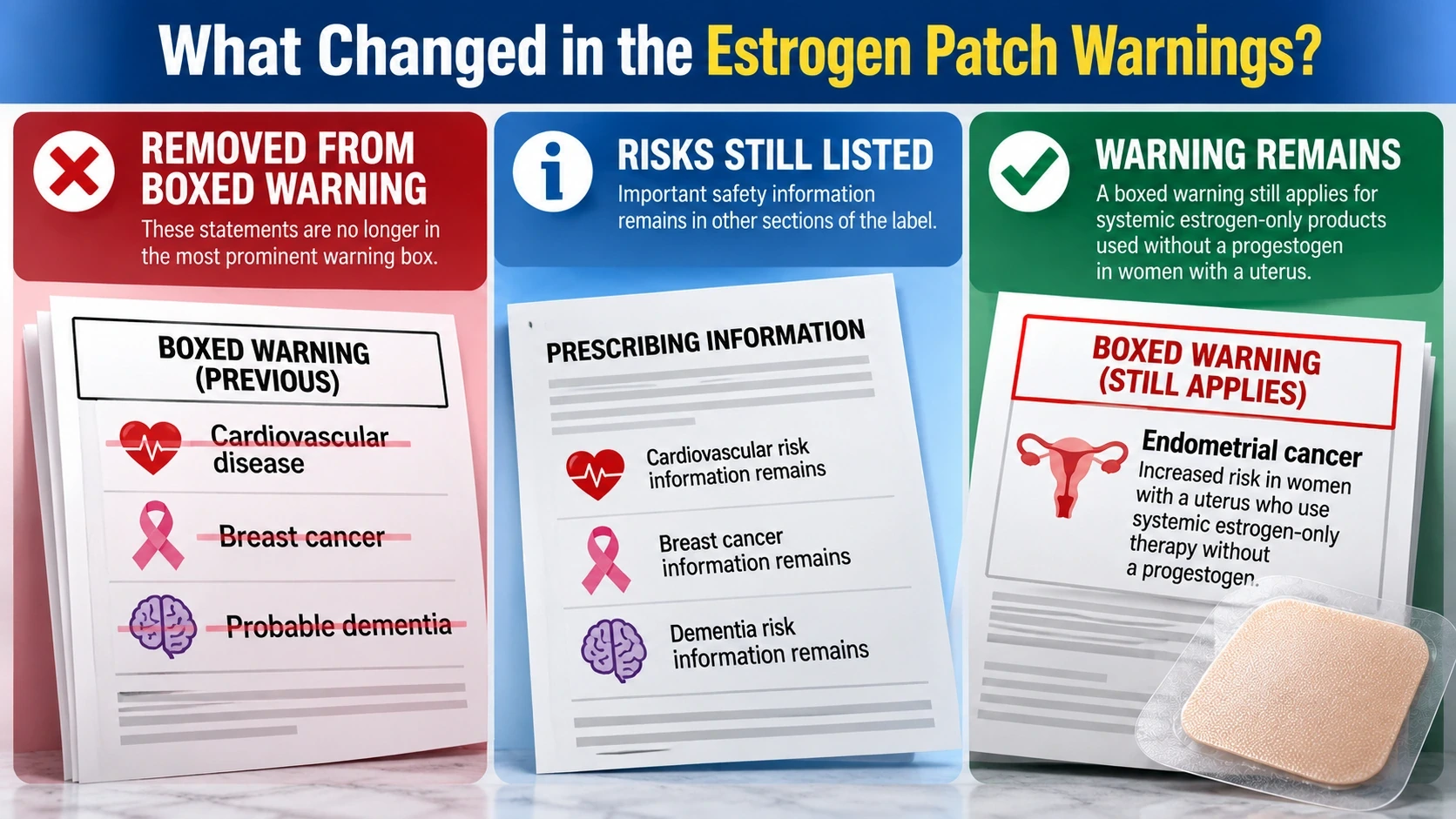
The FDA’s latest action removes statements about cardiovascular disease, breast cancer, and probable dementia from that boxed warning section.
But there is an important distinction.
| Safety information | What changed? |
|---|---|
| Cardiovascular disease | Removed from the boxed warning; relevant risks remain elsewhere in prescribing information |
| Breast cancer | Removed from the boxed warning; relevant cancer information remains elsewhere |
| Probable dementia | Removed from the boxed warning under the revised labeling |
| Endometrial cancer | Boxed warning remains for systemic estrogen-only products used without a progestogen in women with a uterus |
The FDA says it is not removing cardiovascular and breast cancer risk information from other warning sections, and it is not seeking removal of the endometrial cancer boxed warning for systemic estrogen-only products. (FDA)
This was a labeling decision, not the approval of a newly invented hormone treatment.
So why did the original warnings become so prominent in the first place?
Why Did Hormone Therapy Carry These Warnings for So Long?
The controversy goes back more than two decades, particularly to a major research program called the Women’s Health Initiative, or WHI.
Researchers were studying whether postmenopausal hormone therapy could help prevent diseases such as heart disease and osteoporosis.
The findings raised serious concerns.
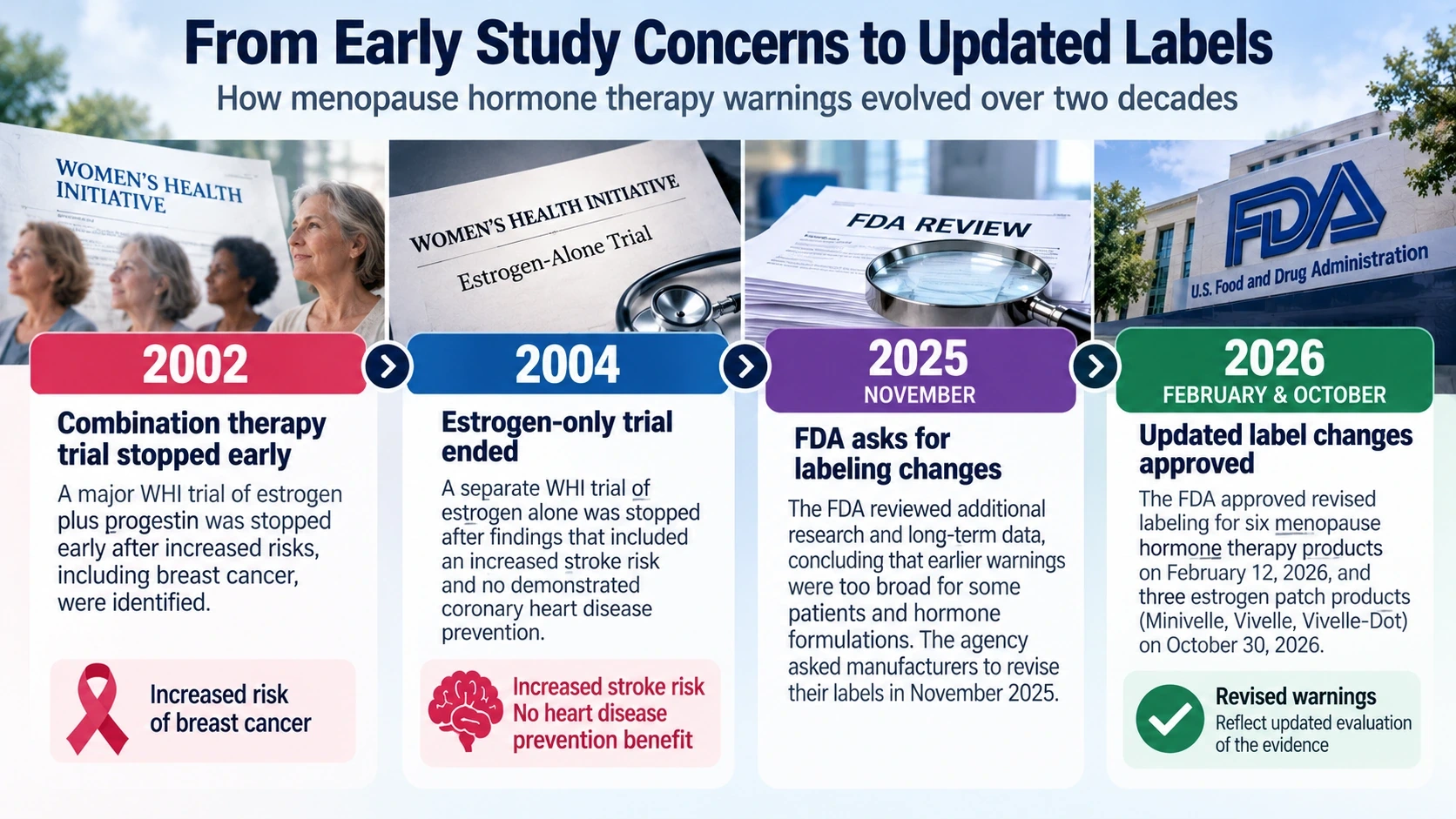
In 2002, a large trial of estrogen combined with a progestin was stopped early after researchers identified increased risks, including breast cancer. A separate estrogen-only trial ended in 2004 after findings that included increased stroke risk and no demonstrated coronary heart disease prevention.
Additional WHI research involving women ages 65 to 79 reported an increased risk of probable dementia with certain hormone regimens. (FDA)
Those findings influenced prescribing habits for years. Many women became reluctant to take hormone therapy, and some clinicians became more cautious about recommending it.
What did researchers reconsider?
One important issue was the age of the women studied.
Participants in the original WHI hormone trials averaged approximately 63 years old. Yet women seeking treatment for disruptive hot flashes and night sweats often begin experiencing those symptoms in their late 40s or early 50s.
The trials also studied specific oral hormone formulations, including conjugated equine estrogens and, in the combination trial, medroxyprogesterone acetate.
They did not directly test every estrogen formulation, dose, or method of delivery used today.
That distinction matters because the risks and benefits of starting hormone therapy at 52 may differ from starting it at 70. The specific formulation and medical history also matter.
The FDA reviewed subsequent research and long-term follow-up data, eventually asking manufacturers in November 2025 to revise their warning labels. The first six products received approved changes in February 2026, followed by the three patch products in October. (FDA · HHS)
The original research findings have not simply disappeared. Rather, regulators are reconsidering how broadly those findings should be applied to different patients and treatments.
Does an Estrogen Patch Work Differently From a Hormone Pill?
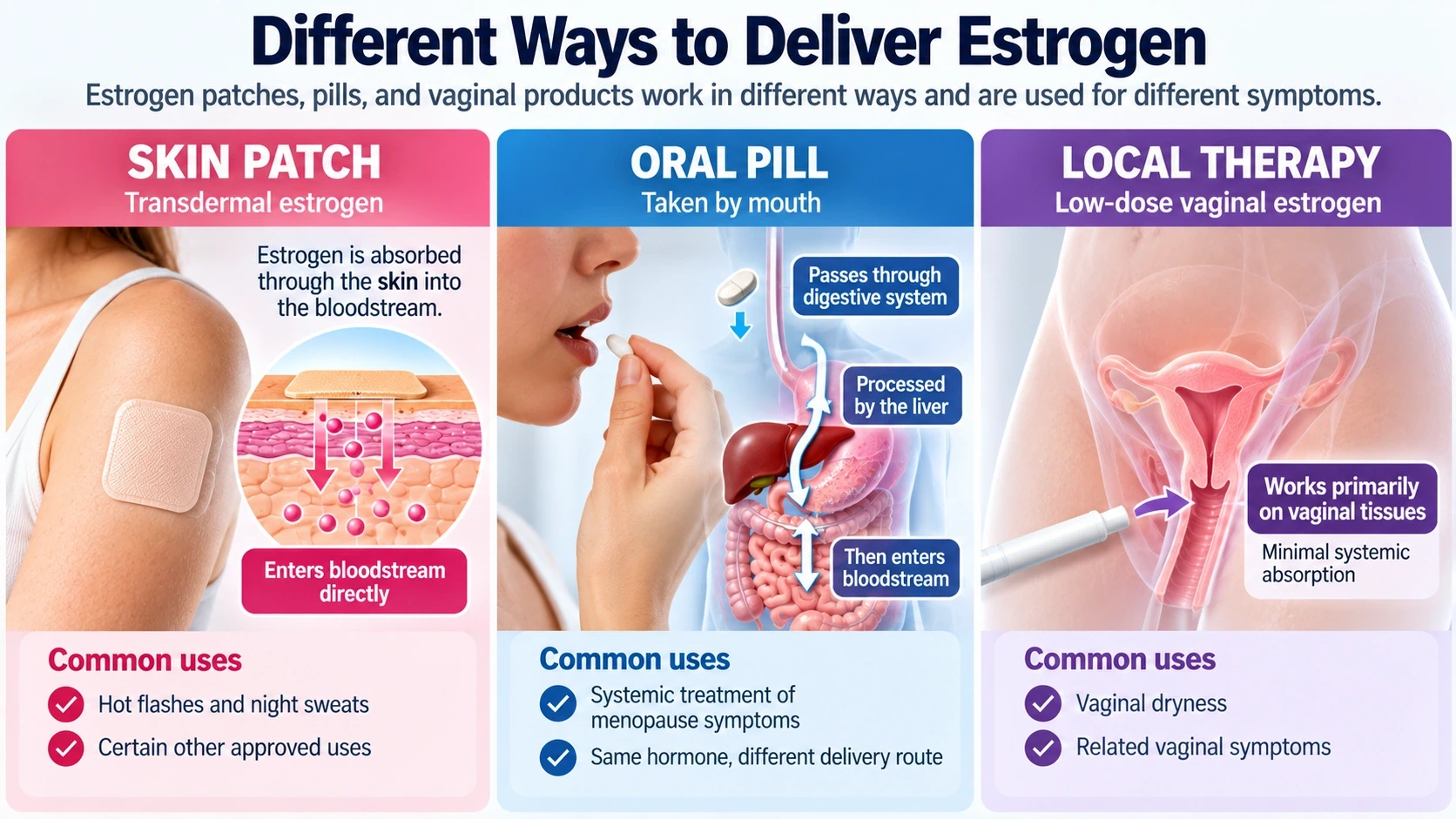
Yes. An estrogen patch and an oral estrogen pill both deliver hormones, but they enter the body differently.
A patch releases estrogen through the skin into the bloodstream. An oral estrogen pill passes through the digestive system and the liver before reaching systemic circulation.
This difference can affect how hormone therapy influences blood-clotting factors.
The American College of Obstetricians and Gynecologists (ACOG) notes that patches and certain other non-oral formulations may carry less risk of blood clots than estrogen taken by mouth. That does not mean patches have no clotting risk. (ACOG)
Another distinction is between systemic and local treatment.
| Treatment | Primary delivery | Typical treatment purpose |
|---|---|---|
| Estrogen patch | Through skin into bloodstream | Hot flashes, night sweats, and certain other approved uses |
| Oral hormone therapy | Through digestive system | Systemic treatment of menopause symptoms |
| Low-dose vaginal estrogen | Primarily acts on vaginal tissues | Vaginal dryness and related symptoms |
These treatments are not automatically interchangeable.
For example, a woman experiencing severe night sweats may need a different approach from someone whose only symptom is vaginal dryness.
There is another crucial distinction that has nothing to do with patches versus pills: whether the patient still has a uterus.
Using systemic estrogen alone in someone with a uterus can increase the risk of endometrial cancer. Adding an appropriate progestogen helps protect the uterine lining.
That is why a new label that looks less alarming does not eliminate the need to choose the correct treatment regimen. (FDA)
Who Needs to Be Careful Even Under the New Label?

Women who have a history of certain cancers, blood clots, stroke, heart attack, liver disease, or unexplained vaginal bleeding still need particular caution.
For some, systemic hormone therapy may be inappropriate.
FDA and ACOG patient guidance continues to describe serious contraindications or reasons for caution, including a history of breast cancer, blood clots, stroke, or heart attack. (ACOG · FDA)
Does age still matter?
Yes. When therapy is appropriate, professional guidance generally favors starting systemic menopause hormone treatment before age 60 or within 10 years of menopause onset.
The American College of Obstetricians and Gynecologists’ updated guidance emphasizes symptom relief and an individual assessment of benefits and risks rather than treating hormone therapy as universally appropriate. (AP)
That timing is not an automatic eligibility rule. A younger patient may still have important risk factors, and an older patient may need a more detailed discussion rather than a decision based solely on age.
For patients considering treatment, the practical questions include their symptom severity, personal and family medical history, whether they have a uterus, and which treatment route is appropriate.
Does everyone agree with the FDA’s decision?
No.
The FDA argues that earlier boxed warnings presented risks too broadly, particularly when applied to younger, otherwise healthy women seeking treatment for menopause symptoms.
Some researchers and clinicians have criticized the agency’s process and the public explanation of the scientific evidence behind the changes. They worry that moving risk statements out of the prominent warning box could lead patients to underestimate remaining risks. (The Guardian)
There is an important middle ground between those positions: Hormone therapy can be highly effective for appropriate patients without being the right choice for everyone.
Why Are So Many Women Having Trouble Finding Estrogen Patches?
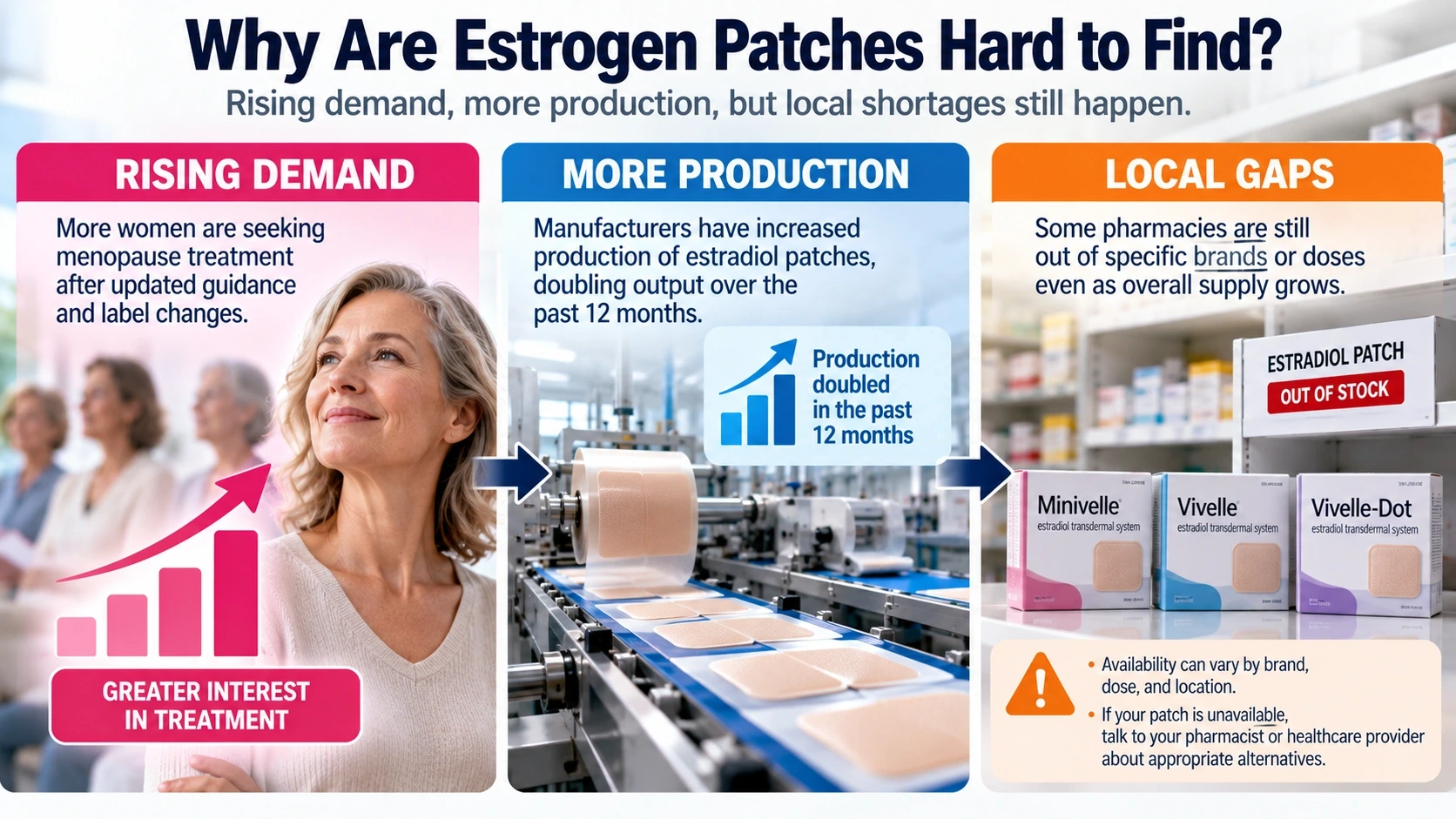
Because demand has been rising faster than some parts of the supply chain can comfortably accommodate.
As awareness of menopause treatment has increased and the FDA has begun revising warning labels, more women have sought hormone therapy.
Manufacturers have been increasing production. According to HHS, overall estradiol patch market output doubled over the preceding 12 months.
Yet some patients have reported difficulty obtaining specific patches. The availability of a product can vary by manufacturer, dose, replacement schedule, and location. (HHS)
Reuters reported on October 28 that supply pressures had also affected certain injectable and vaginal estrogen products as patients looked for alternatives to hard-to-find patches. (Reuters)
Is there a nationwide estrogen patch shortage?
The FDA said on October 30 that it was not aware of an imminent nationwide shortage based on the information available to the agency.
That does not mean every pharmacy has every prescribed product in stock.
A particular brand or dosage may be difficult to obtain even while national production is increasing.
Patients who cannot find their usual prescription should ask their pharmacist or healthcare professional about available, medically appropriate alternatives rather than changing the dose or application schedule on their own. (FDA)
The supply problem highlights a practical challenge: Making treatment more acceptable through updated labeling is only part of improving access. Patients also need reliable supplies of the medications they are prescribed.
What Happens Next for Menopause Treatment?
The FDA is continuing to review proposed labeling changes submitted by other hormone therapy manufacturers.
As of its October 30 announcement, HHS said 29 drug companies had submitted proposed revisions. The agency is also working with manufacturers on production capacity and evaluating whether certain vaginal estrogen products might eventually be available without a prescription.
Over-the-counter availability has not been approved by this announcement. Any such change would require a separate FDA review and approval. (HHS)
Three developments are worth following: whether additional products receive revised labels, whether pharmacy availability improves, and how clinicians communicate the difference between a less prominent warning and a treatment’s actual safety profile.
For patients, the immediate takeaway is practical. An updated warning label can be a reason to revisit a treatment discussion with a healthcare professional, but it is not a reason to independently start, stop, or change prescription hormone therapy.
Bottom Line: What This Story Really Means
The FDA’s October 30 decision reflects a major shift in how federal regulators communicate the risks of menopause hormone therapy.
The agency is moving away from broad, highly prominent warnings that were influenced by older studies of particular hormone regimens and patient populations.
That may encourage more women to discuss treatments that can meaningfully improve symptoms such as hot flashes and night sweats.
But a warning becoming less prominent is not the same as a medical risk disappearing.
Breast cancer, cardiovascular disease, blood clots, and uterine cancer remain important considerations depending on the formulation, individual health history, and treatment regimen.
The most useful question is not whether estrogen patches are now universally safe. It is whether a particular treatment offers a favorable balance of benefits and risks for the person considering it.
Estrogen Patches: Key Questions Explained
Q. Which estrogen patch products received updated warning labels in October 2026?
The three products identified in medical-news reporting are Minivelle, Vivelle, and Vivelle-Dot. The FDA announced approval of three labeling changes on October 30, 2026.
Q. Did the FDA approve a completely new menopause treatment?
No. The October 30 action approved changes to prescribing information for existing estradiol patch products. It did not introduce a new hormone treatment.
Q. Does removing a boxed warning mean the medicine has no serious risks?
No. Important cardiovascular and breast cancer risk information remains in other sections of the prescribing information, and certain boxed warnings remain.
Q. Why is there still a uterine cancer warning?
Systemic estrogen used without an appropriate progestogen can increase endometrial cancer risk in women who have a uterus. The updated estrogen-only labels retain that boxed warning.
Q. Are estrogen patches safer than estrogen pills?
Some evidence suggests transdermal estrogen may pose a lower blood-clot risk than oral estrogen, but patches are not risk-free. The appropriate choice depends on medical history and other factors.
Q. Is it better to begin hormone therapy before age 60?
For eligible patients, beginning before age 60 or within 10 years of menopause is generally associated with a more favorable benefit-risk assessment. Individual contraindications still matter.
Q. Can estrogen patches now be purchased without a prescription?
No. The October 30 labeling change did not make estrogen patches available over the counter. The FDA is separately exploring possible nonprescription access for certain vaginal estrogen products.
Q. What should patients do if their prescribed estrogen patch is unavailable?
They should contact their pharmacist or healthcare professional to identify an appropriate available option. Different brands, doses, and application schedules should not be treated as automatically interchangeable.
Did this help make the story clearer? 🙂
WIN keeps unpacking the “why” behind the news—clearly and simply!
Sources
October 2026 FDA Decision and Updated Drug Labels
Reuters — October 30, 2026 Approval of Warning Changes for Three Estrogen Patch Products
MDSpire News — Identification of Three Estradiol Patch Products
FDA — Hormone Replacement Therapies: Risk Information and Boxed Warnings
Scientific Background and Clinical Guidance
FDA — November 2025 Request for Menopausal Hormone Therapy Labeling Changes
FDA — February 12, 2026 Approval of Initial Hormone Therapy Label Changes
American College of Obstetricians and Gynecologists — Hormone Therapy for Menopause
AP — New Guidance on Menopause Symptom Treatment
The Guardian — October 30, 2026 Reporting on FDA Warning Changes and Scientific Debate
Supply and Patient Access
Reuters — October 28, 2026 Report on Estrogen Patch Supply Pressures