If Binance Lost $6.3 Billion, Why Does It Say Customer Funds Are Safe?

Imagine hearing that an exchange holding people’s cryptocurrency has lost more than $6 billion to hackers. Your first thought probably isn’t about blockchain technology. It’s much simpler: Is my money gone, too?
That’s the question at the center of the record-breaking Binance hack. The exchange reported that approximately $6.3 billion in crypto assets was stolen from its online-connected wallets on October 29, 2026. Yet Binance says customers will not bear the financial loss. Those claims can both be true—but only if the company can replace the assets that disappeared and restore access to them.

※ Images in this article are AI-generated illustrations created to help explain the story. They are not actual photographs, and depictions of people, places, or events may differ slightly from reality.
By October 31, Binance said it had replenished 90% of the affected assets. That is encouraging progress, but it does not mean 90% of the stolen coins had been recovered from the attackers. The difference is crucial. (Binance)
How Could Hackers Move So Much Crypto So Quickly?
Most of the money moved in roughly 20 minutes, according to blockchain investigators. Binance says the compromise began around 20:05 UTC on October 29—4:05 p.m. Eastern time. Analytics firm TRM Labs traced approximately $6.36 billion moving across ten blockchains; Binance’s own estimate is about $6.3 billion. The figures reflect different estimates of the same attack, not separate thefts. (Binance · TRM Labs)
A hot wallet is cryptocurrency storage connected to online systems so an exchange can process deposits and withdrawals. That’s convenient for everyday transactions. It also means that someone who compromises the systems approving withdrawals may be able to move assets very quickly.
The suspected weak point was not a customer falling for a scam one account at a time. Binance initially pointed to a compromised employee laptop, later said investigators found additional points of intrusion, and reported no evidence that wallet private keys had leaked. TRM’s analysis instead highlights suspicious use of transaction-signing permissions and prearranged authorizations. The precise full attack path remains under investigation. (Binance · TRM Labs)
Think of it as a payment operation in which the system that approves transfers is compromised. The transfers can appear properly authorized to the network even when the organization never intended to make them. The blockchain may record those transfers correctly; that does not mean the people behind them had legitimate permission.
If the Coins Were Stolen, Where Is the Replacement Money Coming From?

Binance says it is paying for the shortfall with its own resources, including its corporate treasury, its Secure Asset Fund for Users (SAFU), and part of its futures insurance fund. The exchange said on October 30 that it had set aside more than $6.34 billion in company funds and resources to address the theft, including approximately $5 billion already held in the affected token types. That commitment is not the same as saying all the stolen coins were found. (Binance · Reuters)
SAFU is an emergency reserve Binance established in 2018, designed to help protect users during serious incidents. It has been maintained at roughly $1 billion, according to Binance. That is far less than the size of this breach, which is why the company’s wider financial resources matter. The futures insurance fund has a different usual purpose: cushioning certain losses in leveraged trading. Binance says it has reallocated part of that fund while retaining required coverage. (Binance)
Rather than sending every customer a check for part of the stolen total, Binance is buying or allocating replacement crypto assets to restore backing for balances owed to customers. That distinction also matters because a customer’s account might still display the same balance while withdrawals are temporarily unavailable.
Does 90% Replenished Mean 90% of the Stolen Crypto Was Recovered?
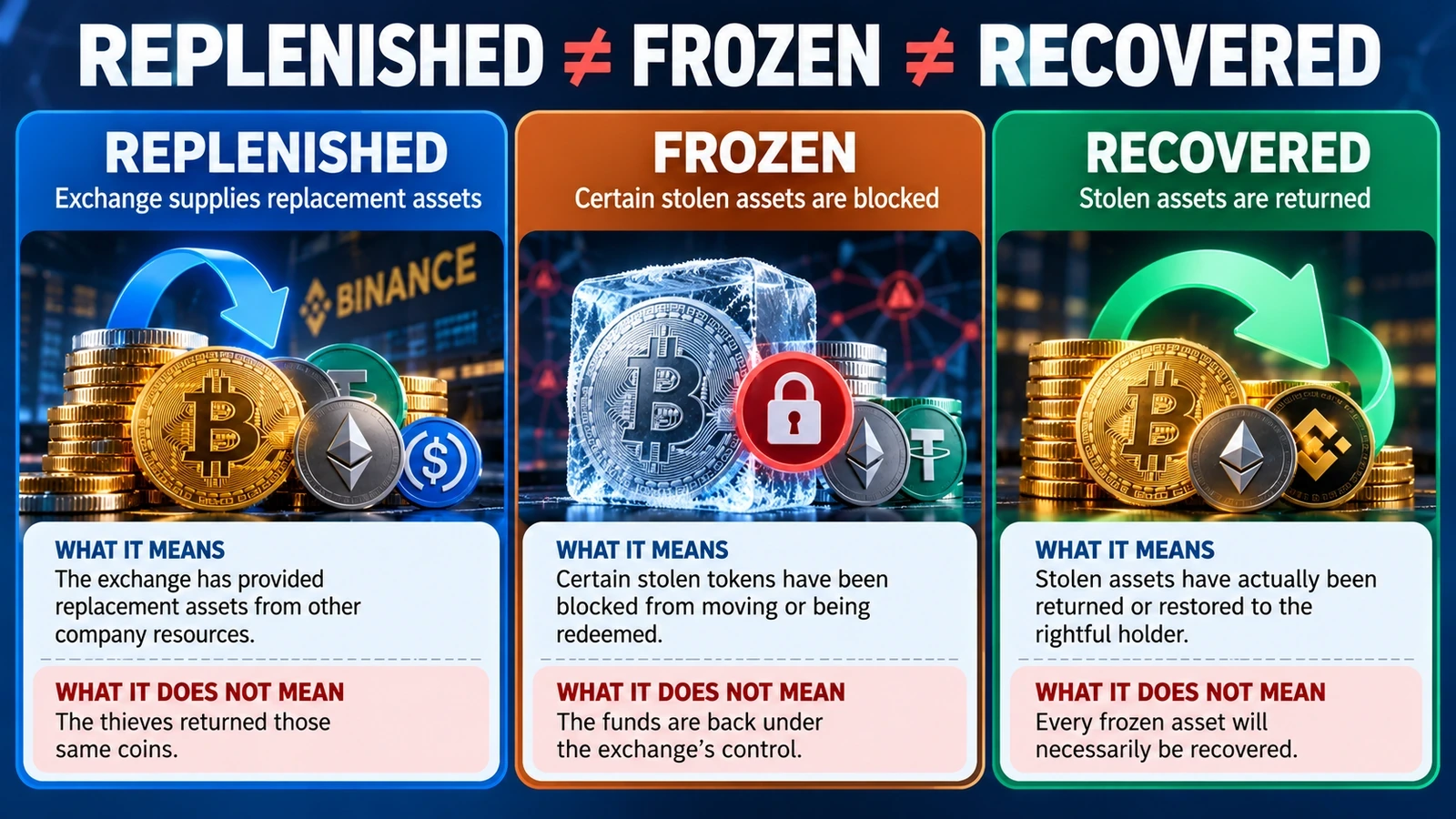
No. Replenished, frozen, and recovered describe three different things. Binance said on October 31 that it had restored backing for about 90% of the affected crypto, with ten major tokens—including bitcoin, ether, and several stablecoins—fully backed. It said the remaining portion involved less-liquid tokens that could take longer to acquire. (Binance)
| Term | What it means | What it does not mean |
|---|---|---|
| Replenished | The exchange has supplied replacement assets from other resources. | The thieves returned those same coins. |
| Frozen | Certain stolen tokens have been blocked from moving or being redeemed. | The funds are back under the exchange’s control. |
| Recovered | Stolen assets have actually been returned or restored to the rightful holder. | Every frozen asset will necessarily be recovered. |
Binance reported that roughly $3 billion in stolen assets had been frozen with the help of industry partners. Firms that issue centralized stablecoins can sometimes block tokens associated with an attacker. Bitcoin and ether generally cannot be frozen by an issuer in the same way, which makes tracing and retrieving them harder. (Binance · TRM Labs)
Neither the frozen amount nor the assets bought with company money should be treated as additional money stolen. They are different responses to the same underlying loss. And while Binance says the main customer balances are backed, an exchange’s published reserve snapshot is not the same thing as a completed independent audit of every liability or a guarantee against future failures.
Why Did the FBI Identify North Korea as the Attacker?
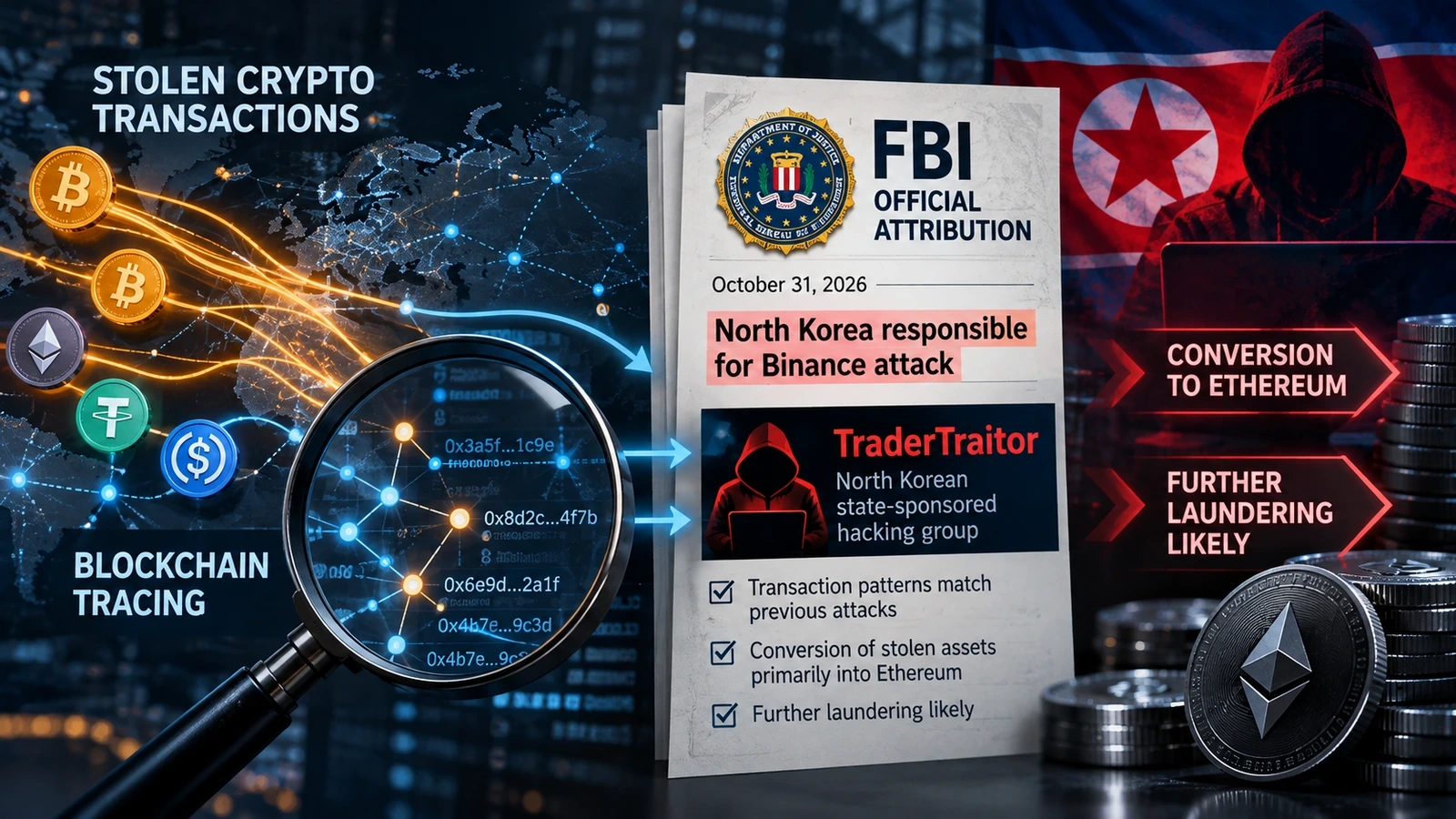
On October 31, the FBI publicly attributed the Binance theft to TraderTraitor, a North Korean state-sponsored hacking operation. It said investigators had observed actors converting stolen assets primarily into ether and warned that further laundering was likely. This was a U.S. law-enforcement attribution, not a court conviction of named defendants. (FBI)
The assessment did not emerge out of nowhere. Blockchain investigation firm TRM Labs had already linked the attack to TraderTraitor using transaction evidence and other intelligence, citing patterns seen in earlier breaches. The FBI’s announcement strengthened the public attribution, but it did not establish that every detail of the intrusion method was known. (TRM Labs · Reuters)
That helps explain why investigators pay attention to the next transaction after a theft. Moving stolen cryptocurrency through swaps and decentralized financial services can make the trail harder to follow and reduce the chance that freezeable tokens remain within reach.
What Does This Mean for U.S. Crypto Owners?

First, Binance.com and Binance.US are separate companies and platforms. Binance.US says it was established for the U.S. market and cannot access or combine customer accounts held on the global exchange. The announced breach concerned Binance’s global platform; that does not by itself establish that Binance.US customer wallets were compromised. (Binance.US)
Second, Binance’s promise to cover this theft is a company commitment, not U.S. federal deposit insurance. The FDIC explicitly says crypto assets are not insured deposits, and its coverage does not protect customers against a crypto company’s failure or theft. An exchange’s emergency fund is different from a government-backed guarantee. (FDIC)
For anyone holding crypto on an exchange, the practical questions are which legal entity holds the account, whether withdrawals work, how reserves are verified, and what the platform promises if something goes wrong. Those questions matter even if you have never used Binance.
What Happens Next for Binance Customers?
Three developments matter more than another headline about the size of the theft.
First is withdrawal access. Binance suspended withdrawals while conducting security checks. In its October 31 update, it said it expected to resume withdrawals on Sunday, November 1, subject to further confirmation. That was a stated target, not proof that every withdrawal channel had already reopened. (Binance)
Second is verifiable backing. Binance says it took a new proof-of-reserves snapshot at 00:00 UTC on October 31 and expects the full cryptographic proof for ten listed assets by Tuesday, November 3. A snapshot may help customers check specified holdings at a particular moment, but it cannot eliminate every operational or financial risk. (Binance)
Third is the fate of the outstanding assets and the stolen funds themselves. Binance still needs to replenish less-liquid tokens fully, while investigators try to prevent the attackers from laundering or moving assets that have not been frozen.
The sequence to watch is straightforward: access restored → missing backing replaced → proof published → further recovery documented. Each step answers a different part of the question customers actually care about.
Bottom Line: What This Story Really Means
Binance’s approximately $6.3 billion hack was a theft from exchange-controlled cryptocurrency wallets, with most of the outflow occurring in a short burst on October 29. The FBI has attributed the operation to North Korea’s TraderTraitor group, while the full technical investigation continues.
The answer to why Binance says customers’ funds are safe is not that hackers gave back all the money. Binance says it is using its own financial resources to restore the assets backing customer accounts. It reported 90% replenishment by October 31 and promised to cover the remainder.
The promise still has to be measured against completed replenishment, the return of normal withdrawals, and verifiable disclosures. It also should not be confused with FDIC insurance or with proof that frozen stolen assets have been recovered.
Binance Hack: Key Questions Explained
Q. How much cryptocurrency was stolen from Binance?
Binance estimated approximately $6.3 billion was stolen on October 29, 2026. Blockchain firm TRM Labs estimated about $6.36 billion using transaction-level valuations.
Q. Did the Binance hack drain every customer’s personal wallet?
No such conclusion follows from the reported breach. The theft involved Binance-controlled hot wallets; Binance says it will replace the affected assets so customers bear no financial loss.
Q. What is the Binance SAFU fund?
SAFU is an emergency reserve established by Binance to help protect users during serious incidents. Binance says it is drawing on SAFU alongside other corporate resources, not relying on SAFU alone.
Q. Has Binance recovered 90% of the stolen funds?
Not as stated. Binance’s 90% figure referred to replenishing asset backing, not retrieving 90% of the original stolen coins from the hackers.
Q. Why were some stolen tokens frozen?
Certain stablecoin issuers and blockchain partners can block identified assets or transactions. Freezing can limit an attacker’s access, but it is not equivalent to returning those assets to Binance.
Q. Who does the FBI say carried out the hack?
The FBI attributed the attack to TraderTraitor, an operation associated with North Korea, on October 31, 2026. That is an official investigative attribution, not a criminal conviction.
Q. Is Binance.US the same company as the hacked exchange?
No. Binance.US describes itself as separate and independent from the global Binance.com exchange. The reported global exchange breach does not by itself establish a compromise of Binance.US accounts.
Q. Are cryptocurrency holdings protected by FDIC insurance?
No. FDIC deposit insurance does not cover cryptocurrency assets or protect against failure of a nonbank crypto exchange.
Q. When will Binance withdrawals and reserve verification return?
As of the October 31 announcement, Binance was targeting November 1 for withdrawal resumption and November 3 for its full proof-of-reserves publication covering ten listed assets. Those were forward-looking targets, not confirmed completions.
Did this help make the story clearer? 🙂 WIN keeps unpacking the “why” behind the news—clearly and simply!
Sources
The Theft and Technical Investigation
Binance — Security Incident Update #2, October 30, 2026
TRM Labs — North Korea Steals $6.36 Billion From Binance
Reuters — How the Record Cryptocurrency Theft Unfolded
Customer Funds, Replacement and Recovery
Binance — Recovery Update #3, October 31, 2026
Reuters — Binance Says 90% of Stolen Assets Have Been Replenished
Attribution and U.S. Customer Protections
FBI — North Korea Responsible for Binance Attack, October 31, 2026