
2027 Tax Brackets Are Rising—Will Your Tax Bill Actually Go Down?

Higher tax brackets sound like higher taxes. So why are some Americans likely to pay less?
The IRS has announced its federal income tax brackets and standard deductions for 2027. The seven tax rates are staying exactly where they are, from 10% to 37%. Yet the income thresholds are moving up, and the standard deduction is getting larger.
That combination can lower a federal income tax bill even without a tax rate cut.
But there is a catch: a larger deduction does not mean you save that entire amount in taxes. And the benefit will not be identical for a single worker, a married couple or someone living on retirement income.
The IRS announced the adjustments on November 5, 2026. They generally apply to income earned in 2027 and tax returns filed in 2028. (IRS)

※ Images in this article are AI-generated illustrations created to help explain the story. They are not actual photographs, and depictions of people, places, or events may differ slightly from reality.
The interesting question is not simply how much the IRS raised the numbers. It is how those changes work together when an actual tax bill is calculated.
What Actually Changed in the IRS’s 2027 Tax Rules?
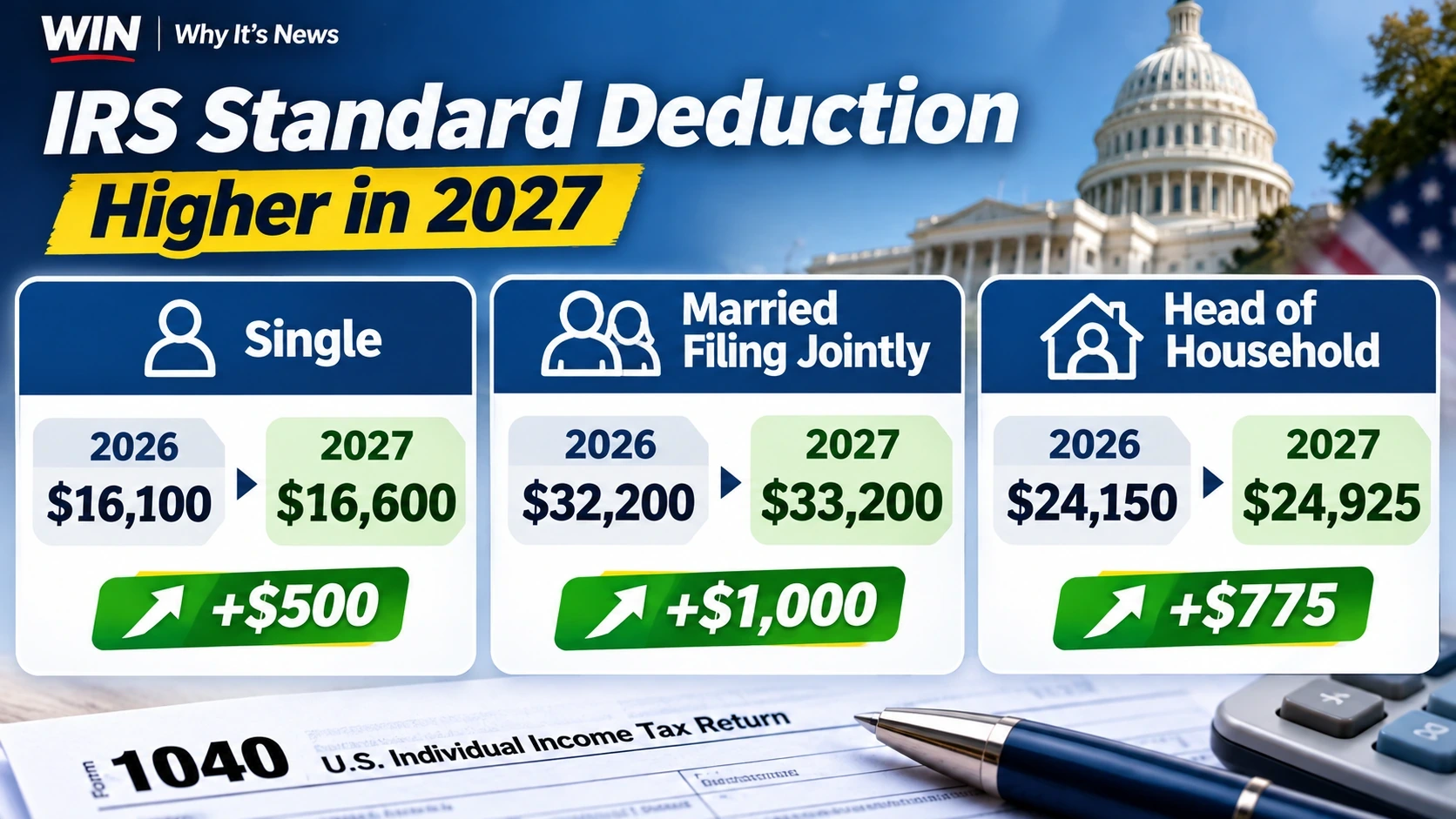
The IRS raised both the amount of income covered by lower tax brackets and the standard deduction taxpayers can subtract before calculating taxable income. The underlying federal income tax rates did not change.
The standard deduction is a set amount that eligible taxpayers can subtract from income instead of claiming individual itemized deductions. A larger standard deduction generally means less income is subject to federal income tax.
Here is the comparison:
| Filing status | 2026 deduction | 2027 deduction |
|---|---|---|
| Single | $16,100 | $16,600 |
| Married filing jointly | $32,200 | $33,200 |
| Head of household | $24,150 | $24,925 |
These are the basic standard deduction amounts. Different rules can apply to dependents and taxpayers who qualify for additional deductions based on age or blindness. (IRS: 2027 Adjustments · IRS: 2026 Rules)
For a married couple filing jointly, the new basic deduction is $1,000 higher than in 2026.
That does not mean the couple receives a $1,000 tax refund. It means that, assuming they qualify for the standard deduction, an additional $1,000 can be excluded from taxable income compared with the previous year’s basic deduction.
The amount of actual tax savings depends on which tax rates would otherwise apply to that income.
And the standard deduction is only half the explanation.
Why Can Your Taxes Fall When Tax Rates Stay the Same?
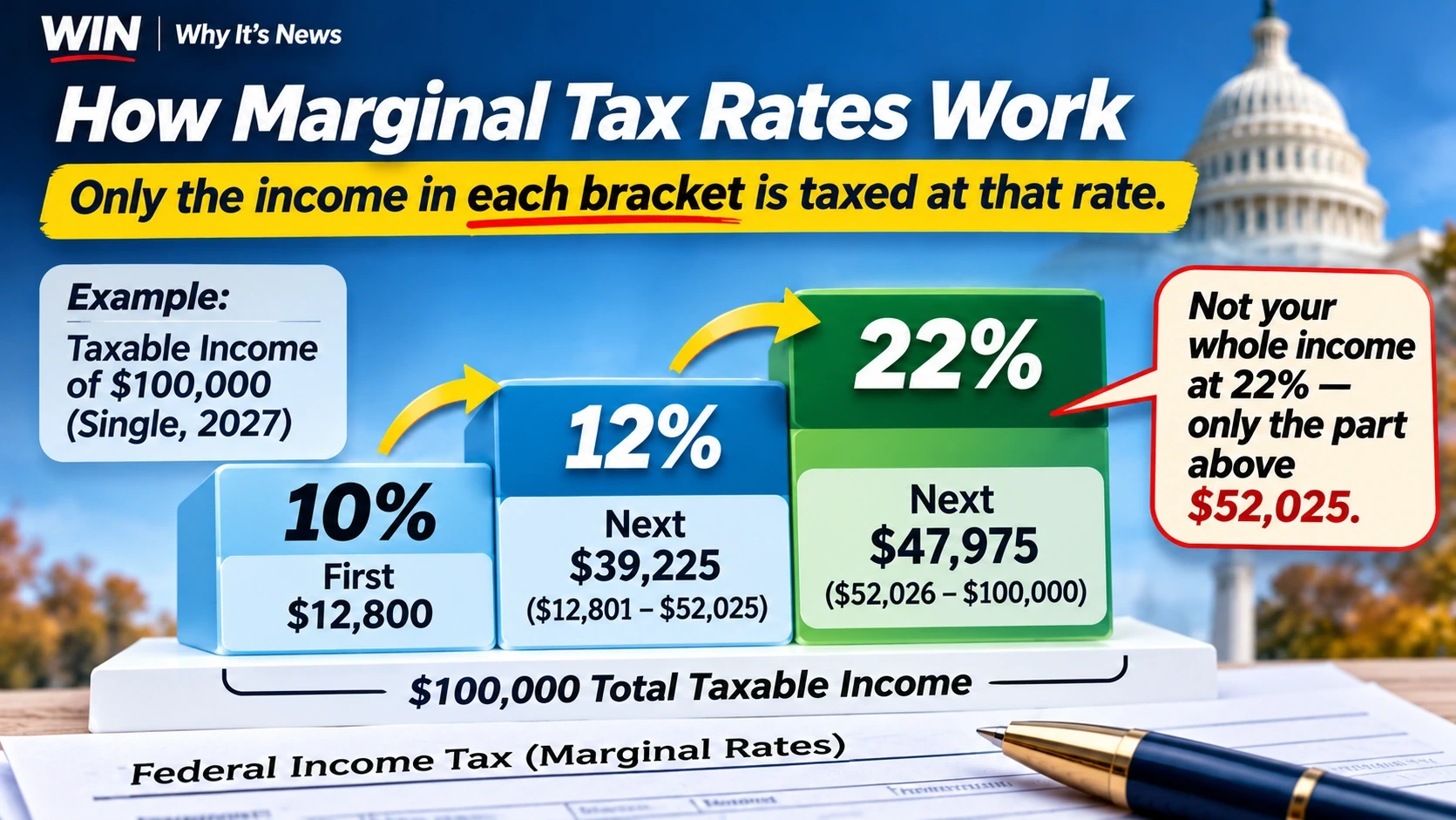
Federal income tax brackets are progressive: different portions of taxable income are taxed at different rates. The IRS’s 2027 adjustments let more income remain in lower-rate portions of that system.
This is where a common misunderstanding causes confusion.
Suppose someone moves from the 12% bracket into the 22% bracket. That does not mean the IRS suddenly taxes every dollar they earned at 22%.
Only the income above the relevant threshold enters the 22% bracket.
For 2027, the seven federal income tax rates remain:
| Rate | Single taxable income | Married filing jointly |
|---|---|---|
| 10% | Up to $12,800 | Up to $25,600 |
| 12% | Over $12,800–$52,025 | Over $25,600–$104,050 |
| 22% | Over $52,025–$109,125 | Over $104,050–$218,250 |
| 24% | Over $109,125–$208,325 | Over $218,250–$416,650 |
| 32% | Over $208,325–$264,550 | Over $416,650–$529,100 |
| 35% | Over $264,550–$661,375 | Over $529,100–$793,650 |
| 37% | Over $661,375 | Over $793,650 |
These thresholds apply to taxable income, not necessarily the salary printed on a paycheck. (IRS · Tax Foundation)
Why does the IRS adjust the brackets?
The reason is inflation.
When wages rise because prices are increasing, workers may earn more dollars without becoming meaningfully better off.
If tax brackets never adjusted, those cost-of-living raises could push more income into higher brackets, increasing taxes even when purchasing power had barely improved.
Economists call this bracket creep.
Inflation adjustments help reduce that problem by moving taxable income thresholds upward. They do not compensate taxpayers for every dollar of increased living costs, but they limit one way inflation can quietly raise federal income taxes.
An ordinary household example makes the difference easier to see.
How Much Could a Married Couple Earning $150,000 Actually Save?

Consider a married couple filing jointly with $150,000 in adjusted gross income in both 2026 and 2027.
Assume they take the basic standard deduction, have ordinary taxable income, and do not qualify for other deductions or credits. Their filing status and other circumstances remain unchanged.
Here is how the federal income tax calculation works under the two sets of brackets.
| Calculation | Tax year 2026 | Tax year 2027 |
|---|---|---|
| Adjusted gross income | $150,000 | $150,000 |
| Basic standard deduction | $32,200 | $33,200 |
| Taxable income | $117,800 | $116,800 |
| Federal income tax before credits | $15,340 | $14,779 |
Illustrative calculation using the published marginal tax rates and brackets, excluding other taxes, credits and special tax treatments. (IRS: 2026 Rate Tables · IRS: 2027 Adjustments)
The result is approximately $561 less in federal income tax with exactly the same assumed income.
Two changes produce that difference.
First, the married couple deducts an additional $1,000 from income.
Second, the 2027 tax brackets allow more of their taxable income to remain within the lower rates before the 22% bracket applies.
Does that mean everyone will save $561?
No. This is one illustrative household, not an IRS estimate of average savings.
Someone earning less may see a smaller dollar benefit. A higher-income household may experience a different result depending on its deductions, income mix and applicable taxes.
An increase in earnings can also offset the benefit of the inflation adjustments.
And a lower calculated income tax bill is not the same thing as a larger refund. A refund depends on how much tax was already withheld or paid during the year.
The bracket changes create the opportunity for lower taxes under otherwise comparable circumstances. They do not guarantee a particular result.
What Changes for Parents, Retirees and Older Married Couples?

The 2027 changes go beyond tax brackets. Families with eligible children and some older taxpayers have additional provisions worth examining.
Parents: The child tax credit is increasing
The maximum child tax credit rises from $2,200 in 2026 to $2,300 per qualifying child in 2027.
The maximum refundable portion also increases by $100, reaching $1,800. Actual eligibility and the amount a family can claim depend on applicable requirements, including income and qualifying-child rules. (IRS)
There is an important distinction here.
A deduction reduces the income used to calculate taxes.
A tax credit, by contrast, can directly reduce the tax owed, subject to its particular rules.
That means a $100 increase in an available tax credit is not the same thing as a $100 increase in the standard deduction.
Retirees: There are two different age-related deductions to understand
Taxpayers age 65 or older may qualify for an additional standard deduction on top of the regular amount.
For 2027, that age-based addition is generally $2,100 for a qualifying single filer and $1,700 for each qualifying spouse filing jointly. (Tax Foundation)
There is also a separate enhanced deduction for eligible seniors that began in 2025.
Under the law in effect as of November 2026, eligible taxpayers age 65 or older can claim an additional deduction of up to $6,000 per person for tax years 2025 through 2028.
A married couple can potentially qualify for up to $12,000 if both spouses meet the requirements.
However, the enhanced deduction begins to phase out when modified adjusted gross income exceeds $75,000 for individual filers or $150,000 for joint filers. Eligible taxpayers may claim it whether they itemize or use the standard deduction. (IRS: Senior Deduction Guidance)
This does not mean Social Security benefits have become universally tax-free. The enhanced deduction can reduce taxable income for qualifying seniors, but it does not eliminate every rule governing the taxation of retirement income.
It is also not a brand-new 2027 deduction. The IRS’s latest announcement updates inflation-adjusted amounts, while the temporary senior deduction comes from earlier legislation.
What about families making gifts?
The IRS has also increased the annual federal gift-tax exclusion from $19,000 per recipient in 2026 to $20,000 in 2027.
That is relevant to people transferring money to children or other relatives. However, exceeding the annual exclusion does not automatically mean the giver owes gift tax; separate reporting requirements and lifetime exclusion rules can apply. (IRS)
These provisions show why two households earning similar amounts may still end up with very different tax bills.
When Do the New Tax Brackets Apply—and What Should You Check?
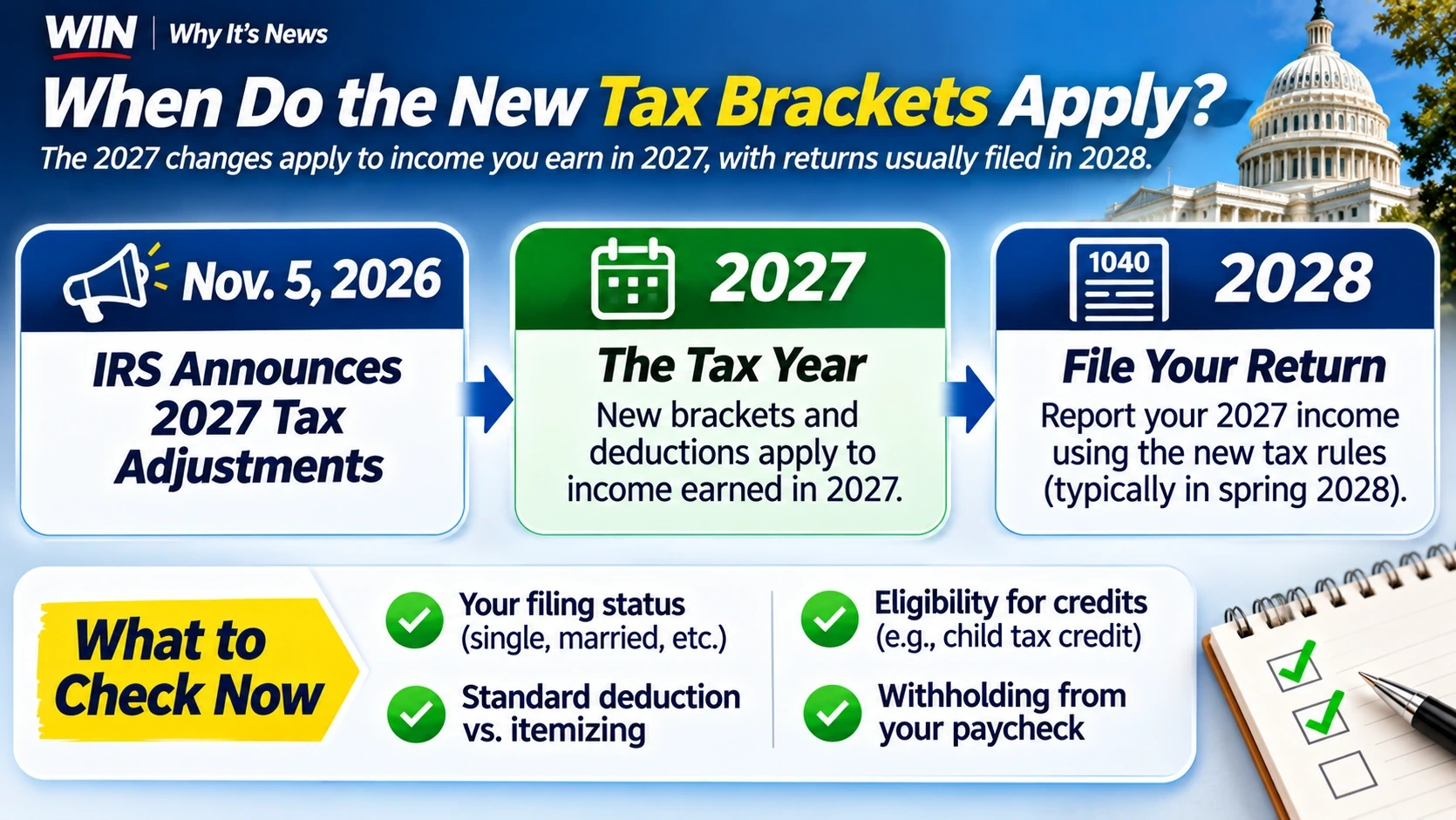
The 2027 brackets apply to income earned during the 2027 tax year. Most taxpayers will use them when filing their 2027 federal income tax returns in 2028.
That distinction matters because the year printed on a tax return is not always the year in which the return is filed.
| When | Which tax rules apply? |
|---|---|
| Income earned in 2026 | 2026 rules, generally filed in 2027 |
| Income earned in 2027 | 2027 rules, generally filed in 2028 |
The IRS announced its 2027 adjustments on November 5, 2026, through Revenue Procedure 2026-35. These figures reflect the law as it stood at the time of the announcement; subsequent legislation could change applicable provisions. (IRS)
For taxpayers planning ahead, several questions are more useful than simply asking whether their bracket went up.
- Filing status: Will you file as single, married filing jointly or head of household?
- Deductions: Is the standard deduction still more advantageous than itemizing?
- Other benefits: Will you qualify for child-related credits or age-related deductions?
- Withholding: Will the amount withheld from your paychecks reasonably match your expected tax liability?
Taxpayers with more complicated finances, including self-employment income, substantial investment gains or multiple sources of retirement income, may need to look beyond the ordinary federal income tax brackets.
State income taxes also operate under separate rules. An IRS federal inflation adjustment does not automatically change a state’s tax rates or deductions.
For most households, the practical next step is to compare expected 2027 income and deductions under the new rules, rather than assume a particular refund or savings figure.
Bottom Line: What This Story Really Means
The IRS’s 2027 announcement sounds complicated, but the central change is straightforward.
Federal tax rates remain the same, while income thresholds and standard deductions increase. That allows some taxpayers to keep more income in lower tax brackets and potentially owe less federal income tax than they otherwise would.
The benefit is not a flat payment, a guaranteed refund or a reduction in every household’s taxes.
A married couple with $150,000 in adjusted gross income could see an illustrative $561 reduction in federal income tax under otherwise identical circumstances. A different household could see a different result.
Parents may also benefit from a higher child tax credit, while qualifying seniors can have additional deductions that require their own eligibility checks.
The broader purpose of these annual adjustments is to keep inflation from pushing taxpayers into higher effective tax burdens simply because the dollar amounts on their paychecks have risen.
Whether that creates meaningful financial relief depends on what happens to their income, other tax provisions and living expenses.
2027 Tax Brackets: Key Questions Explained
Q. Did the IRS raise federal income tax rates for 2027?
No. The seven federal income tax rates remain 10%, 12%, 22%, 24%, 32%, 35% and 37%. The income thresholds determining where each rate begins have increased.
Q. What is the standard deduction for married couples in 2027?
The basic standard deduction for married couples filing jointly is $33,200, compared with $32,200 for 2026. Additional deductions may be available depending on eligibility.
Q. What is the 2027 standard deduction for single taxpayers?
The basic standard deduction is $16,600, up from $16,100 in 2026. Qualifying taxpayers may be eligible for additional deductions.
Q. Will moving into a higher tax bracket make all my income subject to that rate?
No. Under the progressive federal income tax system, only the taxable income within a particular bracket is subject to that bracket’s rate.
Q. Does a $1,000 increase in the standard deduction mean $1,000 in tax savings?
No. An additional $1,000 deduction generally reduces taxable income by $1,000. The actual tax savings depend on the tax rates that would otherwise apply.
Q. What is the child tax credit for 2027?
The maximum credit is $2,300 per qualifying child, with up to $1,800 potentially refundable, subject to applicable eligibility rules.
Q. Can taxpayers age 65 or older claim the additional $6,000 senior deduction in 2027?
Yes, if they qualify. The enhanced senior deduction is available for tax years 2025 through 2028 under current law, with income-based phaseouts and other requirements.
Q. Will the 2027 tax brackets affect my tax return filed in spring 2027?
Generally, no. Returns filed in spring 2027 normally report income earned in 2026 and use the 2026 tax rules. The 2027 brackets generally apply to returns filed in 2028.
Q. Does a lower federal income tax bill guarantee a bigger refund?
No. Refunds depend on tax withholding, estimated tax payments and the final calculated tax liability. A lower liability does not guarantee a larger refund if payments or withholding also change.
Did this help make the story clearer? 🙂
WIN keeps unpacking the “why” behind the news—clearly and simply!
Sources
Official 2027 Tax Changes and Income Brackets
IRS — Tax Year 2027 Inflation Adjustments, November 5, 2026
IRS — Revenue Procedure 2026-35 Announcement
KPMG — Revenue Procedure 2026-35: Inflation Adjustments for 2027
Prior-Year Comparisons and Tax Calculations
IRS — 2026 Federal Income Tax Tables and Standard Deduction
Tax Foundation — 2027 Federal Income Tax Brackets and Standard Deduction
Senior Deductions and Family Tax Benefits
IRS — Working Families Tax Cuts: Individuals and Workers
IRS — Eligibility for the Enhanced Senior Deduction
Keep Reading
Why Can a Tax Adjustment Help While Everyday Prices Still Feel High?
Inflation adjustments can reduce the pressure of rising tax thresholds, but they do not reverse increases in groceries, housing or other household expenses. The difference between economic figures and actual purchasing power helps explain why the financial relief may feel smaller than expected.
If the U.S. Economy Is Growing 3.4%, Why Are Americans Still Struggling With Inflation?