Why Did AI Stocks Plunge After the Midterms—and Does It Mean the Boom Is Over?

Wasn’t artificial intelligence supposed to be one of the biggest growth stories of the decade?
Companies are still building AI systems. Technology giants continue investing in chips, servers, and data centers. Yet on November 5, some of the biggest names in the industry suffered extraordinary stock-market losses.
Nvidia fell more than 9%. AMD lost over 17%. The Nasdaq plunged 5.5% in a single session.
So what happened? Did investors suddenly discover that AI wasn’t going to be profitable?
Not exactly. The selloff was driven largely by fears that the enormous expansion of AI infrastructure could become slower, more expensive, and less profitable than investors had expected.
The results of the November 3 midterm elections brought those concerns into sharper focus. But the market’s reaction also exposed a deeper vulnerability: AI-related stock prices had become heavily dependent on expectations of continued rapid growth.

※ Images in this article are AI-generated illustrations created to help explain the story. They are not actual photographs, and depictions of people, places, or events may differ slightly from reality.
And then something interesting happened. On Friday, November 6, technology stocks recovered part of their losses.
That rebound makes Thursday’s collapse worth understanding rather than simply labeling it the end of the AI boom.
How Bad Was the November 5 Stock Market Selloff?
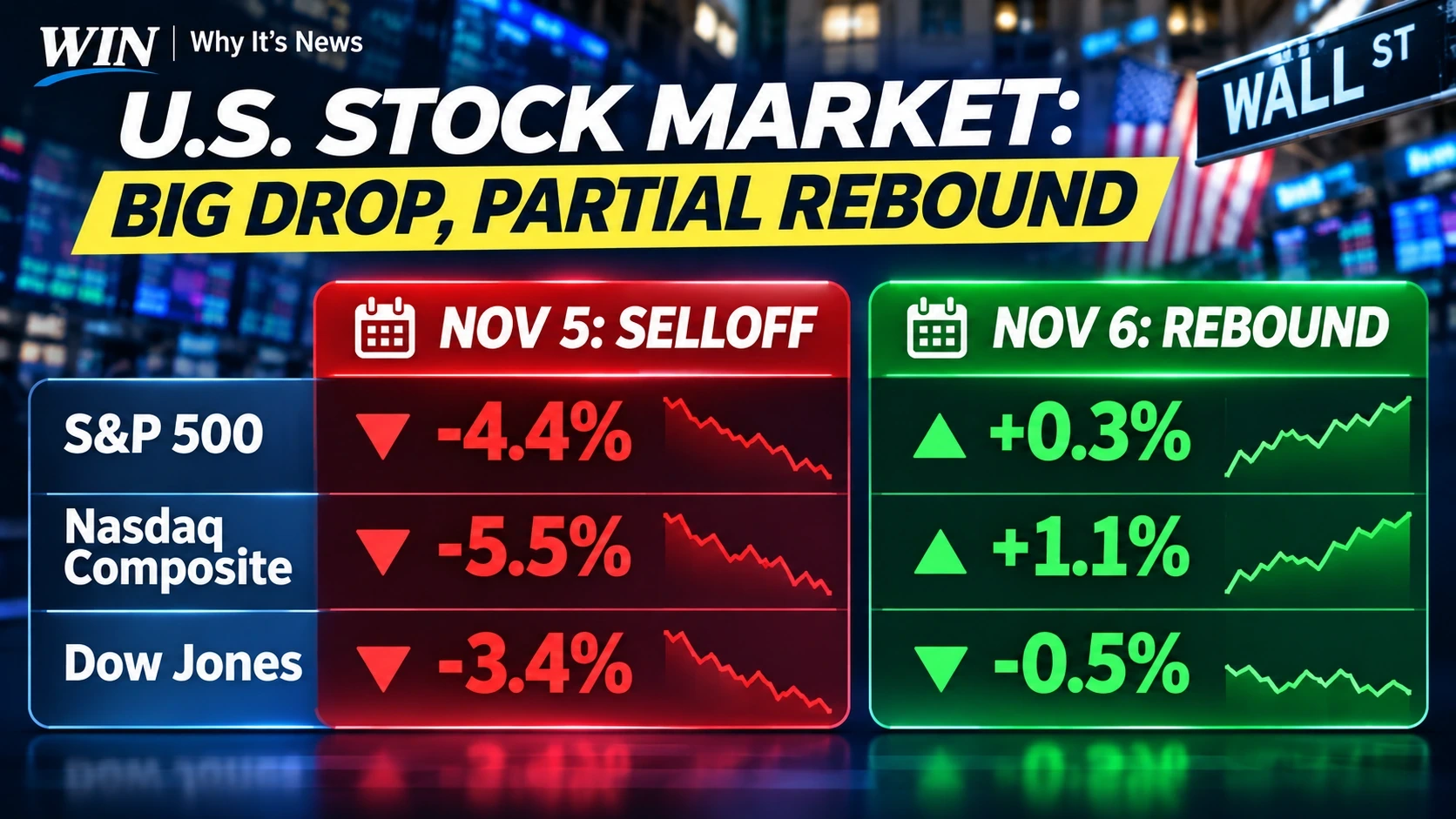
The November 5 decline was one of Wall Street’s most severe trading sessions in more than a year.
The S&P 500 fell 4.4%, its worst daily decline since the market turmoil surrounding President Donald Trump’s tariff announcements in April 2025. The Dow Jones Industrial Average lost more than 1,800 points, while the Nasdaq suffered particularly heavy losses because of its exposure to technology companies. (AP)
Here is what happened across the two trading sessions:
| Market index | Thu., Nov. 5 | Fri., Nov. 6 |
|---|---|---|
| S&P 500 | -4.4% | +0.3% |
| Nasdaq Composite | -5.5% | +1.1% |
| Dow Jones | -3.4% | -0.5% |
The semiconductor industry took an even larger hit. The Philadelphia Semiconductor Index dropped approximately 12% on Thursday, with Nvidia, AMD, Micron, and other chipmakers among the most heavily sold stocks. (Reuters)
Friday’s partial rebound did not undo the damage. The Nasdaq still finished the week down 3.4%, while the S&P 500 lost 2.7% for the week. (Reuters)
The surprising part is that the selloff occurred immediately after a strong post-election rally on November 4.
Why did investors change their minds so quickly?
Why Did the Midterm Elections Suddenly Become a Problem for AI Stocks?
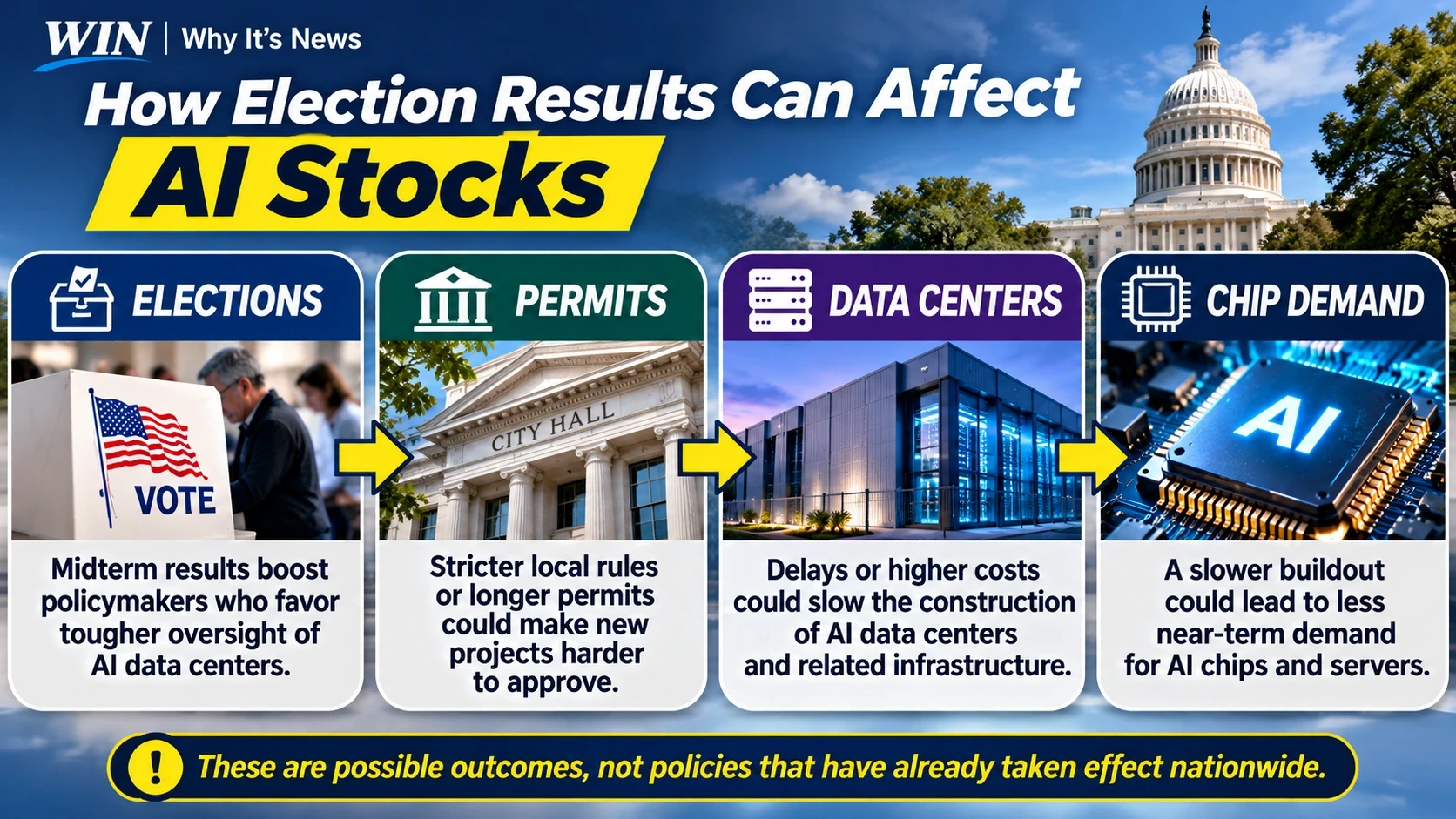
The election changed investors’ expectations about future data center development—not because a nationwide ban had suddenly taken effect.
Democrats’ victories in the November 3 midterm elections strengthened politicians who had called for tougher oversight of AI data centers.
In several states and communities, opposition to new facilities had become a politically significant issue.
The objections weren’t necessarily about artificial intelligence itself. Many residents were concerned about the physical infrastructure required to support it.
Large data centers consume substantial electricity, may require significant water for cooling, and can create pressure on local infrastructure.
Communities have questioned whether construction will increase electricity costs, strain water supplies, or require public subsidies.
Following the election, voters in multiple locations supported measures restricting data center development, while successful candidates in several states had backed tighter oversight or temporary pauses. (Reuters)
That raised a difficult question for investors: What happens if the projects that were supposed to drive years of AI growth become harder to build?
The Chain of Risk Investors Were Reconsidering
| Potential development | Why investors care |
|---|---|
| Tougher local permitting | New facilities could take longer to build |
| Higher electricity and infrastructure costs | AI projects could become more expensive |
| Delayed data center construction | Chip and server purchases could be postponed |
| Slower investment growth | Expected earnings at suppliers could weaken |
This is a chain of possible consequences, not evidence that every step has already occurred.
The distinction matters. State and local authorities have important roles in land use and permitting, while Congress could separately pursue national legislation or oversight. An election victory does not automatically establish new federal rules.
A Brookings Institution analysis published on November 4 described how the election could change the political environment surrounding data center construction.
Wall Street was reacting to that uncertainty before the full policy consequences were known.
If AI Is Still Growing, Why Did Nvidia and Other Chip Stocks Fall So Much?
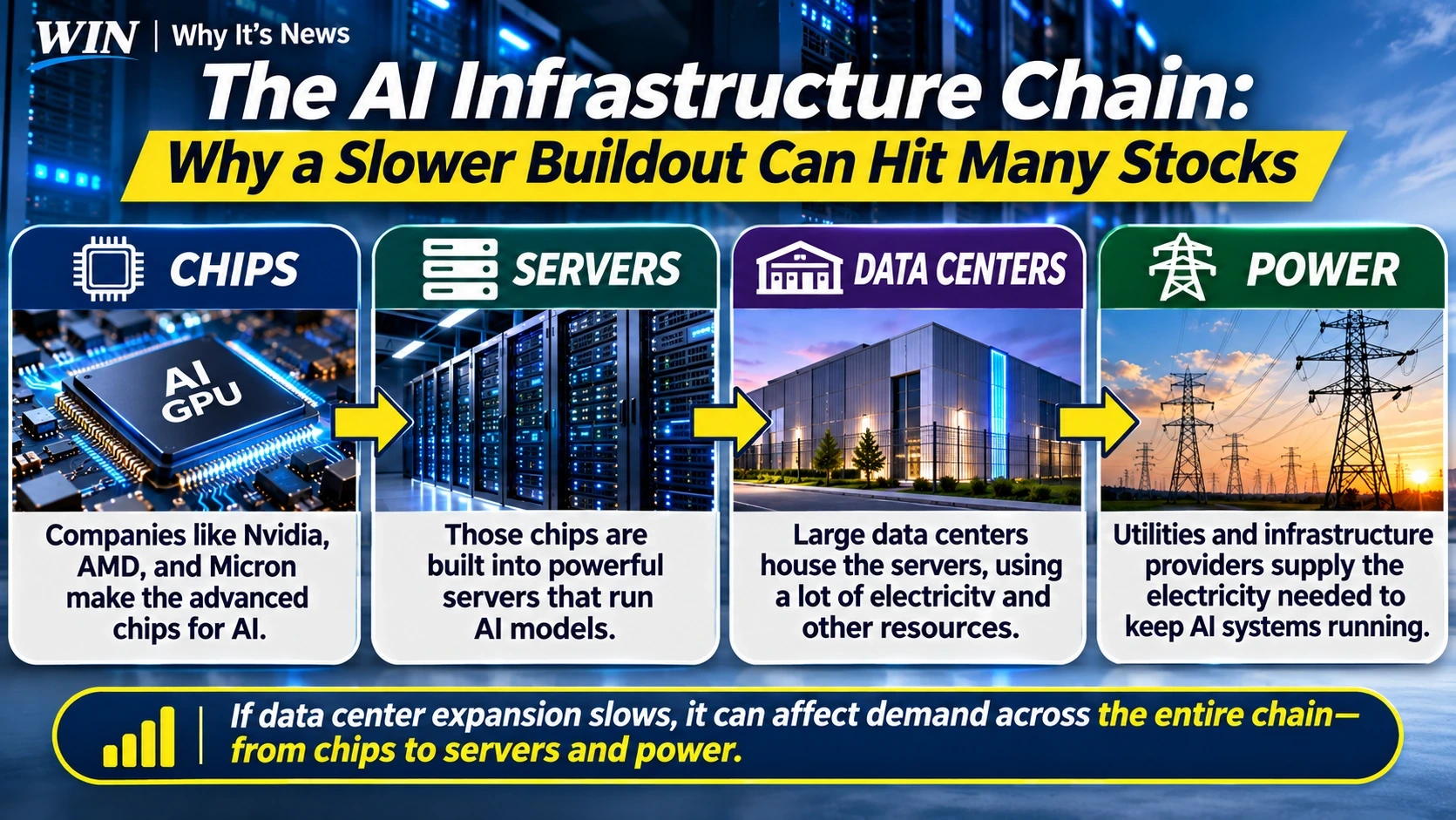
Because a company’s stock price reflects expectations about its future profits, not simply how successful its technology is today.
That distinction explains much of Thursday’s selling.
Consider Nvidia. Its AI chips are central to the computing systems used to train and operate advanced AI models. As technology companies expand those systems, Nvidia can benefit from additional demand.
But stock investors also have to decide how much future growth is already reflected in the company’s share price.
A business can remain highly profitable while its stock falls sharply if investors begin expecting lower future growth than they previously assumed.
The broader AI investment chain creates the same sensitivity across multiple industries.
Chipmakers supply processors and memory. Server companies assemble computing systems. Data center developers build facilities. Utilities and equipment suppliers provide the power infrastructure needed to operate them.
If investors begin expecting slower data center expansion, they may revise their expectations for companies throughout that chain—even before actual orders decline.
That’s why the November 5 selloff spread well beyond Nvidia.
Nvidia fell approximately 9.3%, while AMD dropped 17.3% and Micron lost roughly 17.5%. (AP)
There were also company-specific concerns. Qualcomm shares fell after its reported smartphone-chip sales disappointed expectations. That was a separate earnings issue, not direct evidence that all AI computing demand had suddenly disappeared. (Reuters)
These pressures landed on a sector whose shares had already benefited from exceptionally optimistic expectations.
The technology hadn’t stopped working. Investors were reconsidering how much future success they should pay for today.
Does the Nasdaq Correction Mean the AI Bubble Has Burst?
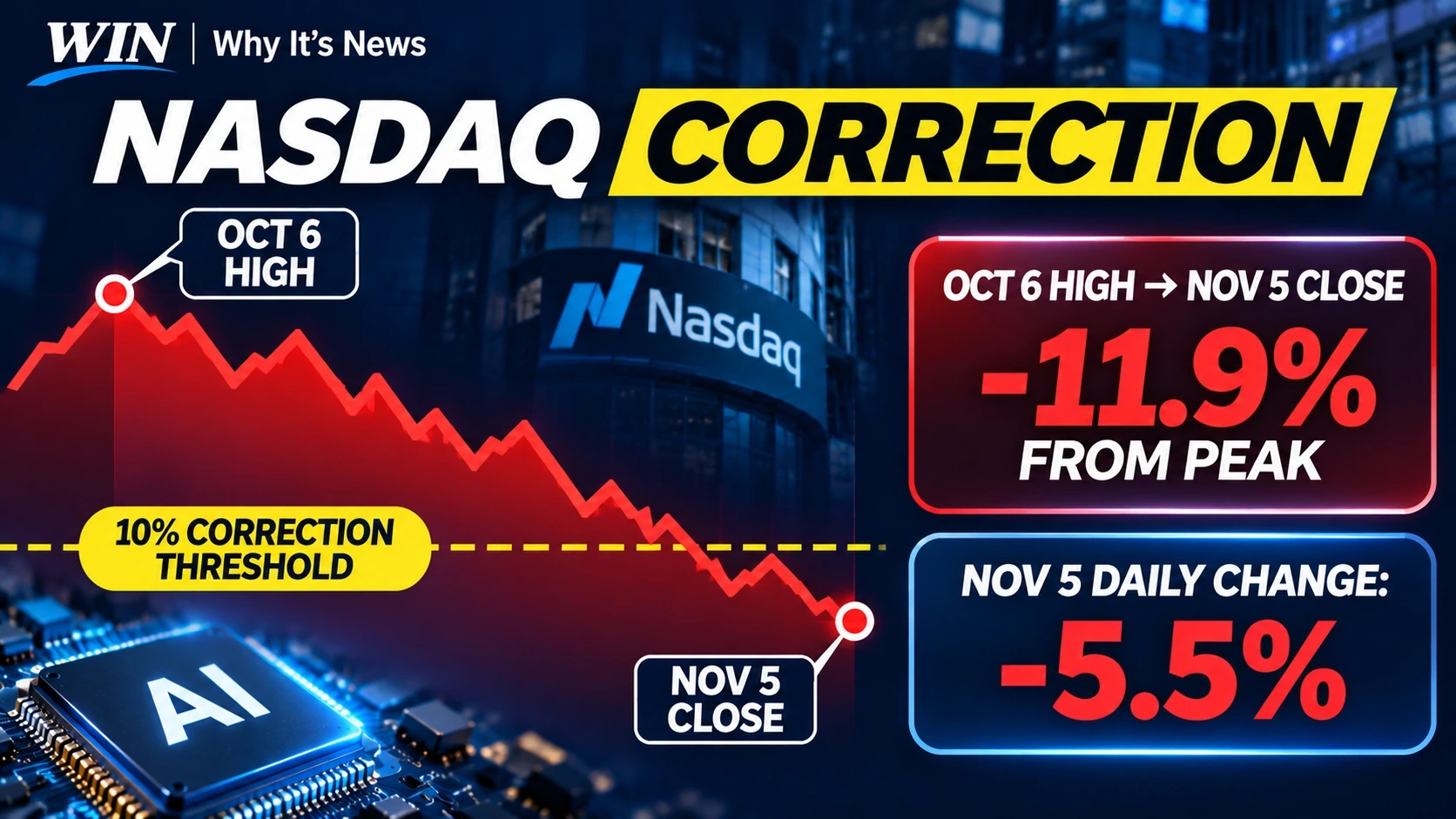
No. A market correction describes how far prices have fallen from a recent high. It does not, by itself, establish that an industry has failed or that a bubble has burst.
Wall Street commonly describes an index as being in correction territory when it has declined at least 10% from its recent peak.
A bear market is generally associated with a drop of 20% or more.
On November 5, the Nasdaq Composite closed about 11.9% below its October 6 record high, putting it in correction territory. (AP)
That is different from saying the Nasdaq fell 11.9% in a single day. Its November 5 daily loss was 5.5%.
A correction can reflect changing expectations, profit-taking, economic risks, or a combination of factors.
It can also be an early warning that investors had placed too much confidence in a particular growth story.
The question for AI companies is whether the investments being made today will eventually produce enough earnings to justify the prices investors have been willing to pay.
AI Growth and AI Stock Returns Are Not the Same Thing
Imagine a company expected to double its profits over the next few years.
Investors might be willing to pay a very high price for its shares because they expect extraordinary growth.
Now suppose that company continues growing, but its future profit outlook becomes less impressive than expected.
Its business could still be successful. Yet its stock could decline because investors are no longer willing to pay the same premium for that growth.
That is the risk the AI selloff brought into focus.
Why Did Technology Stocks Rebound on November 6?
The Friday rebound showed that investors had not reached a consensus that the AI investment boom was finished.
The Nasdaq gained approximately 1.1%, and the S&P 500 rose 0.3%. Semiconductor stocks recovered some of their losses, including gains in Nvidia and AMD. (Reuters)
Buyers returned to shares that had fallen sharply the previous day, while other investors continued reassessing the risks surrounding AI infrastructure.
A stronger-than-expected October jobs report added another complication.
The U.S. economy added 165,000 jobs in October, exceeding market expectations. Stronger employment figures can support confidence in economic activity, but they can also increase concerns that the Federal Reserve may keep interest rates higher or raise them to contain inflation. (Bureau of Labor Statistics · Reuters)
Higher borrowing costs matter to companies financing expensive infrastructure projects. They can also make investors less willing to pay high prices for profits expected far into the future.
So Friday’s rebound was encouraging for some investors, but it wasn’t proof that Thursday’s concerns had disappeared.
The market was still deciding how to balance AI’s long-term potential against the cost of building it.
What Could This Mean for Your 401(k) or Retirement Savings?
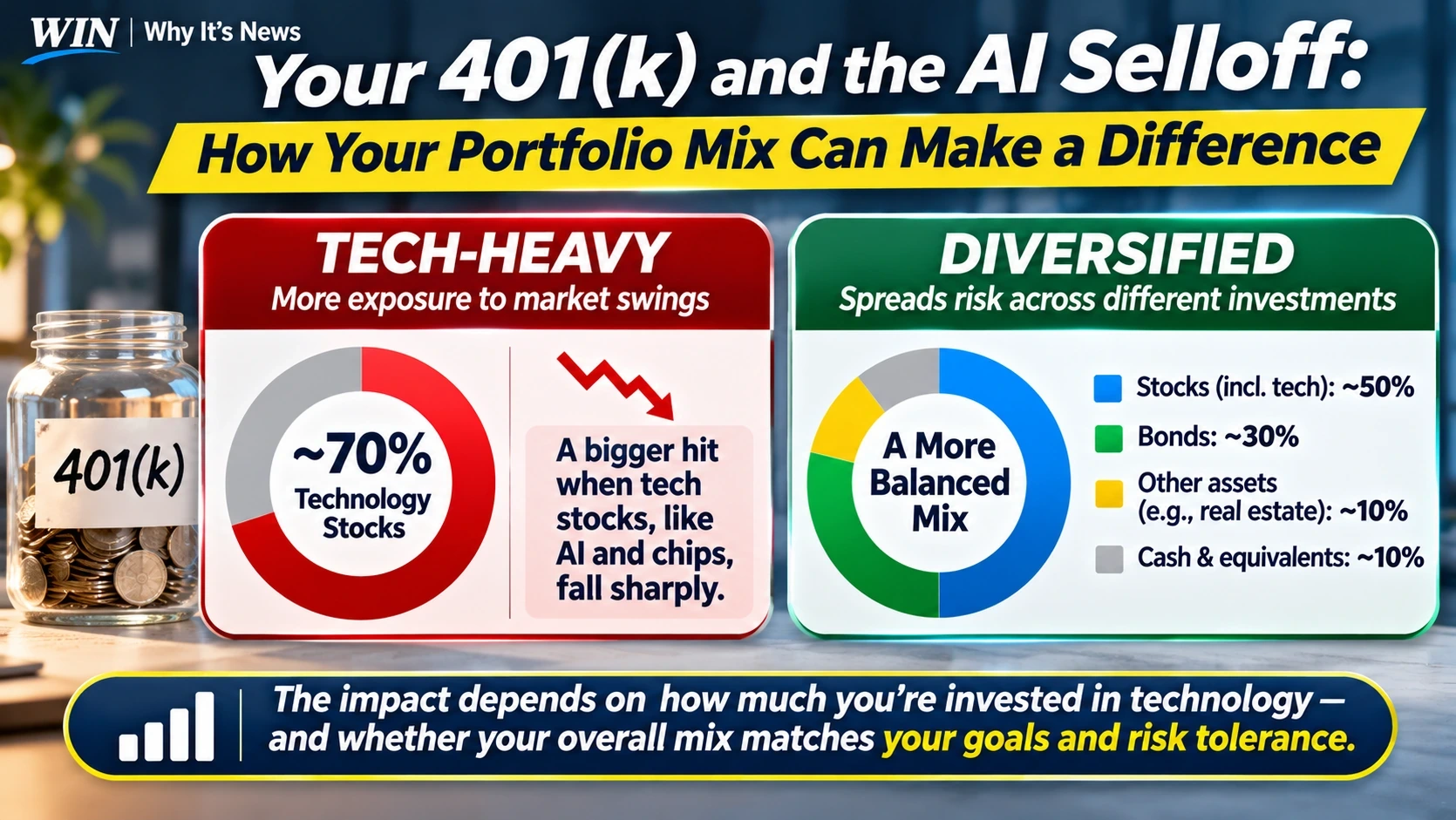
The effect depends on what you own, how concentrated your investments are, and when you expect to need the money.
Someone holding a Nasdaq-focused exchange-traded fund may experience a very different result from someone whose retirement savings are spread across stocks, bonds, and other assets.
A broad-market index fund may also hold substantial positions in leading technology companies, because large companies often account for a significant share of market-value-weighted indexes.
Owning several funds doesn’t automatically eliminate that exposure if those funds hold many of the same stocks.
The U.S. Securities and Exchange Commission explains that diversification involves spreading investments both across asset categories and within them. It also emphasizes that investment time horizons and risk tolerance should influence asset allocation. (Investor.gov)
There is a practical difference between an investor who may not need retirement savings for decades and someone who expects to begin withdrawing money soon.
For both, the more useful question is not whether Thursday’s decline was frightening. It is whether their portfolio still matches their financial needs and ability to withstand further losses.
What Should Investors Watch Next?
Several developments could help determine whether the November 5 selloff becomes a temporary market correction or part of a longer reassessment of AI investments.
First, watch how newly elected officials approach data center permits, electricity costs, tax incentives, and possible construction restrictions. Announcements and campaign promises matter, but enacted policies and actual project decisions will offer stronger evidence.
Second, watch spending plans and financial results from major AI infrastructure customers. Investors will be looking for signs that companies are maintaining, delaying, or revising their expansion plans.
Third, follow the financial results of chipmakers and infrastructure suppliers. New orders, customer demand, profit margins, and earnings forecasts can reveal whether investors’ concerns are beginning to appear in business performance.
Finally, interest rates and financing conditions deserve attention. Data centers require substantial investment, and the economics of building them can change as financing costs rise or fall.
No single economic report or trading session can settle all these questions.
The coming evidence will matter more than an attempt to predict the market’s direction from one dramatic day.
Bottom Line: What This Story Really Means
The November 5 stock-market plunge did not establish that artificial intelligence had stopped growing.
It exposed how strongly the market’s expectations depend on continued investment in AI infrastructure.
Investors were already questioning whether companies could earn enough from massive AI spending to justify elevated stock prices. The midterm election results then intensified concerns that data center expansion could face political opposition, delays, and additional costs.
That combination hit semiconductor companies especially hard, and the selling spread across Wall Street.
Friday’s partial rebound showed that investors were still willing to back the AI growth story. But it did not resolve the underlying uncertainty.
The question is no longer just how powerful AI technology can become. It is whether the enormous infrastructure required to support it can be built profitably, on schedule, and at the scale investors expect.
That is what the next round of policy decisions, corporate earnings, and investment announcements will help answer.
AI Stocks: Key Questions Explained
Q. Why did AI stocks fall so sharply on November 5, 2026?
Investors worried that political opposition and possible restrictions could slow the construction of AI data centers. Concerns about expensive infrastructure, lofty stock valuations, and company-specific earnings disappointments also contributed.
Q. How much did Nvidia stock fall on November 5?
Nvidia shares fell approximately 9.3% during the November 5 trading session.
Q. Did the 2026 midterm elections ban new AI data centers?
No. The election results did not impose a nationwide ban. They strengthened political support for restrictions or closer oversight in some jurisdictions, raising uncertainty about future projects.
Q. How much did the Nasdaq fall?
The Nasdaq Composite fell approximately 5.5% on November 5, closing about 11.9% below its October 6 record high.
Q. What does a Nasdaq correction mean?
A correction generally means an index has fallen at least 10% from a recent high. It is a market measurement, not proof that an economic recession or an industry collapse has begun.
Q. Did AI stocks recover on November 6?
Some recovered part of their losses. The Nasdaq rose about 1.1% and several semiconductor stocks rebounded, but the broader technology selloff had not been fully reversed.
Q. Does a stock-market decline mean AI companies are losing money?
Not necessarily. Stock prices reflect investor expectations about future profits, risks, and valuations. A company’s shares can fall even while its business continues growing.
Q. Could the AI selloff affect retirement accounts?
Yes. The impact depends on how much exposure an account has to technology stocks and other affected investments. Diversification can reduce concentration risk but does not guarantee protection against losses.
Q. What could determine whether AI stocks recover?
Future corporate earnings, AI infrastructure spending, data center permitting decisions, and interest-rate conditions are among the important factors to monitor. None guarantees a particular market outcome.
Did this help make the story clearer? 🙂
WIN keeps unpacking the “why” behind the news—clearly and simply!
Sources
November 5 Market Selloff and Semiconductor Losses
Associated Press — A Brutal Selloff for AI Stocks Sends Wall Street Reeling
Reuters — Investors Wipe Trillions From Nasdaq as AI and Data Center Stocks Fall
Midterm Elections and Data Center Policy
Reuters — Data Centers Took a Beating in the Midterms. AI Firms Felt the Pain
Brookings Institution — How the 2026 Midterms Could Reshape Data Center Policy
November 6 Recovery and Economic Conditions
Reuters — Nasdaq Rebounds but Posts Fourth Straight Weekly Decline
Associated Press — How Major U.S. Stock Indexes Fared Friday, November 6, 2026
Bureau of Labor Statistics — Employment Situation, October 2026
Retirement Savings and Investment Risk
U.S. Securities and Exchange Commission — Asset Allocation and Diversification
Keep Reading
Why Are Tech Companies Developing Their Own AI Chips?
The stock-market selloff highlighted how important the economics of AI computing have become. Microsoft’s chip strategy illustrates why major technology companies are looking for ways to manage those costs while continuing to use Nvidia hardware.
Why Is Microsoft Making Maia 300 AI Chips When It Still Buys Nvidia GPUs?
Why Can Stocks Rise When Economic News Looks Weak?
Friday’s strong jobs report raised questions about interest rates, while an earlier weak report produced a very different market reaction. Understanding how investors interpret economic data helps explain why apparently good news can sometimes hurt stocks—and bad news can sometimes help them.
Why Did Stocks Rise After a Weak Jobs Report—and What Does 29,000 New Jobs Really Mean?