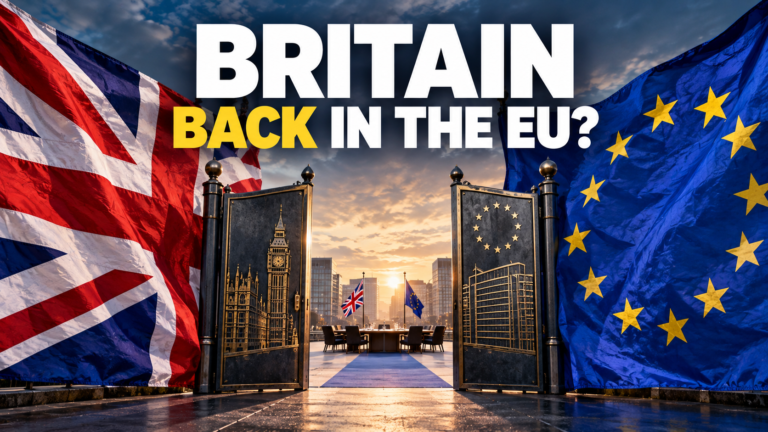
Why Is Canada Moving Closer to Europe—and What Would “EU Associate Membership” Actually Mean?

Why is Canada talking about an “associate membership” with the European Union when it is not even a European country?
And if Canada is not actually joining the EU, what is changing?
The short answer is that Canada is trying to build a much deeper strategic relationship with Europe without becoming a full EU member. On September 20, Prime Minister Mark Carney and French President Emmanuel Macron agreed to expand cooperation in space, defense, aerospace, energy, business, and other strategic areas during a meeting in Saint-Pierre-et-Miquelon, the small French territory just off Canada’s Atlantic coast. (Government of Canada · Reuters)
Macron also backed the proposal for Canada to become the EU’s first associate member. (AP) But the phrase “associate member” sounds more settled than it really is: no such formal EU status currently exists. (AP · Reuters)

※ Images in this article are AI-generated illustrations created to help explain the story. They are not actual photographs, and depictions of people, places, or events may differ slightly from reality.
So the real story is not “Canada joins Europe.” It is how far Canada can diversify its trade, defense, energy, and technology relationships while remaining economically and geographically tied to the United States.
What Did Canada and France Actually Agree to on September 20?
Canada and France agreed to turn political talk about closer ties into concrete work in several strategic sectors. Their governments directed space agencies, defense ministries, and industry to explore shared space infrastructure, including launch systems and ground reception and control facilities. They also agreed to deepen cooperation in defense, aerospace, wildfire management, energy security, and trade diversification. (Government of Canada)
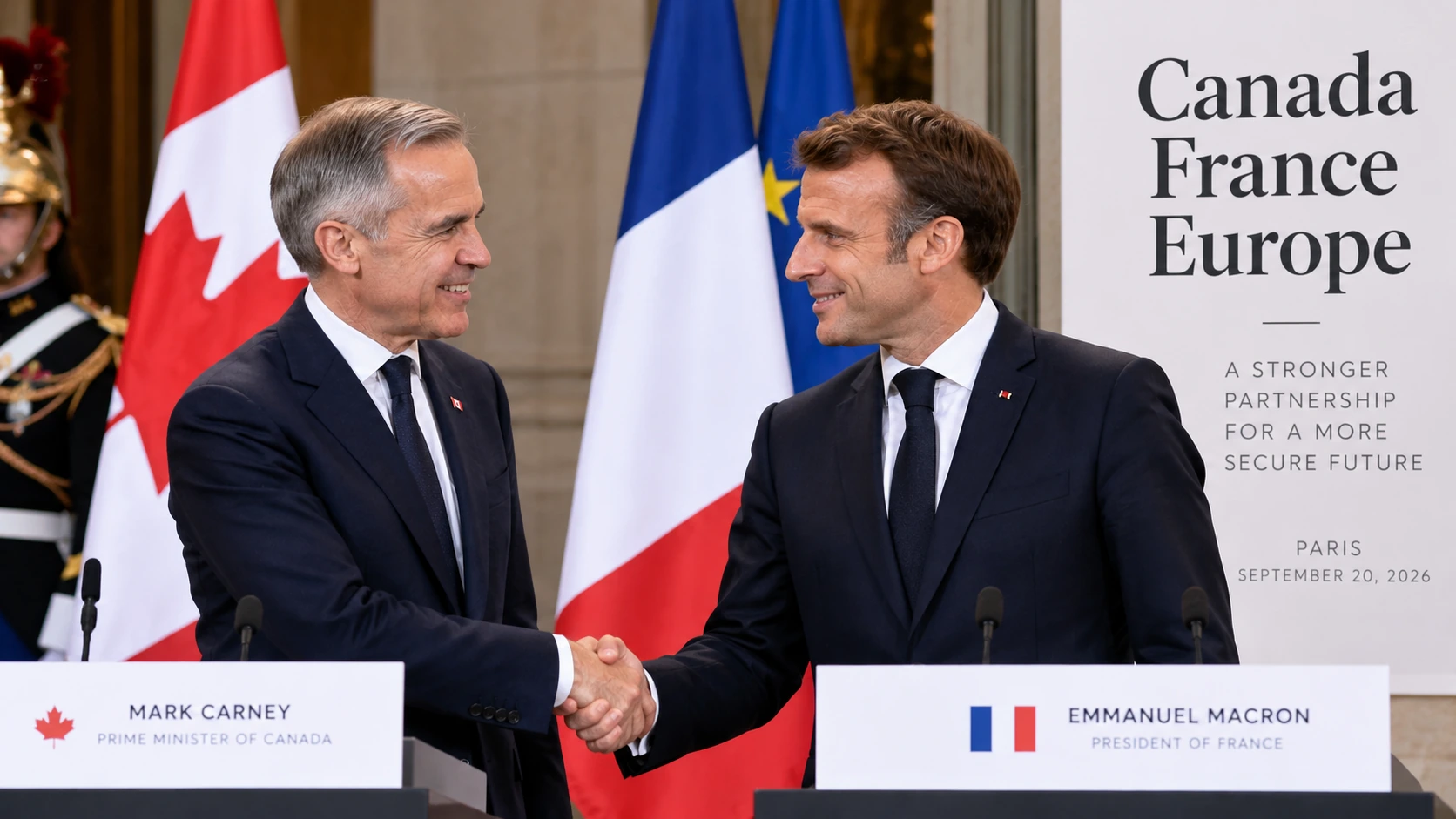
The location mattered too. Saint-Pierre-et-Miquelon is French territory only a short distance from Newfoundland, making France a North American neighbor of Canada. The leaders used that setting to emphasize that Canada-Europe ties are not only diplomatic—they also intersect with North Atlantic security, energy routes, the Arctic, and cross-border communities. (Government of Canada)
| What was announced | What was not announced |
|---|---|
| Deeper Canada-France cooperation in space, defense, energy, aerospace, and trade | Canada becoming a full EU member |
| Support for a broader Canada-EU “Alliance for the Future” | Automatic access to the EU Single Market |
| Work toward shared strategic infrastructure | Canadian voting rights inside EU institutions |
| Political support from Macron for a closer Canada-EU relationship | A finished legal definition of “associate membership” |
What Does “EU Associate Membership” Actually Mean?
Right now, it does not have a fixed legal meaning. The European Union has no existing membership category called “associate member,” so Canada and the EU would first have to define what the status includes, what obligations Canada would accept, and what approval process would be required. (Reuters · AP)
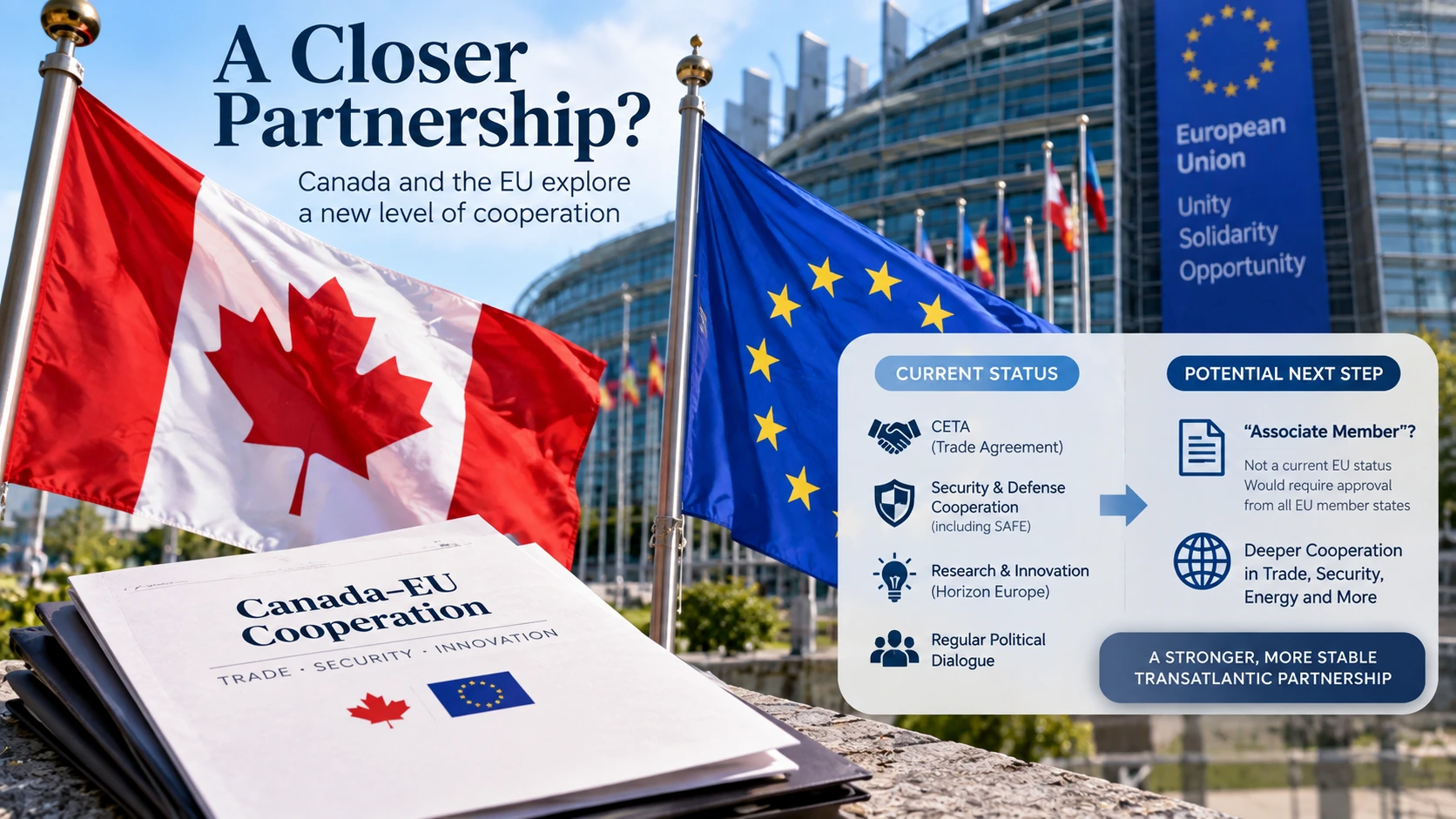
European Commission President Ursula von der Leyen proposed the idea on September 16, saying she wanted to open the door to Canada becoming the EU’s first associate member. A day later, Carney welcomed the ambition while making clear that Canada was not seeking full EU membership. (European Commission · Prime Minister of Canada · AP)
That distinction matters. Full EU membership would require a formal accession process and the ability to take on the rights and obligations of EU membership. Canada is not pursuing that route. What Carney and von der Leyen are discussing instead is a new strategic framework that could deepen cooperation in trade, defense, technology, energy, critical minerals, the Arctic, and economic security. (European Commission · Prime Minister of Canada)
Because the status does not yet exist, the label should not be treated as a finished deal. Any formal model would still have to win the necessary support from EU member states, and the legal path would depend on how the arrangement is designed. AP notes that formal association agreements and other major decisions governing the EU’s external relationships require unanimous approval from all 27 member countries. (AP)
Why Is Canada Looking Beyond the United States Now?
Canada is not abandoning the United States. It is trying to reduce the risk of depending too heavily on one market at a time when U.S.-Canada trade relations have become more contentious.
In 2025, 71.7% of Canada’s merchandise exports still went to the United States, down from 75.9% in 2024. That makes the U.S. overwhelmingly important to Canadian exporters even as Ottawa tries to expand non-U.S. trade. (Statistics Canada)
The political backdrop also matters. President Donald Trump criticized the EU’s associate-member proposal and threatened tariffs or other trade restrictions against Europe if he viewed the move as hostile. Carney responded that Canada would choose its own international partnerships. The European Commission said the proposal was intended to strengthen Canada-EU cooperation rather than target another country. (Reuters · Reuters)
That creates an unusual tension: the more Canada tries to protect itself from trade concentration, the more those diversification efforts can become part of its political relationship with Washington.
Why Does Europe Want Canada Closer Too?
EU leaders have highlighted Canada’s complementary strengths in areas where Europe is trying to build greater resilience: energy, critical minerals, defense production, the Arctic, artificial intelligence, quantum technology, and secure supply chains. (European Commission)
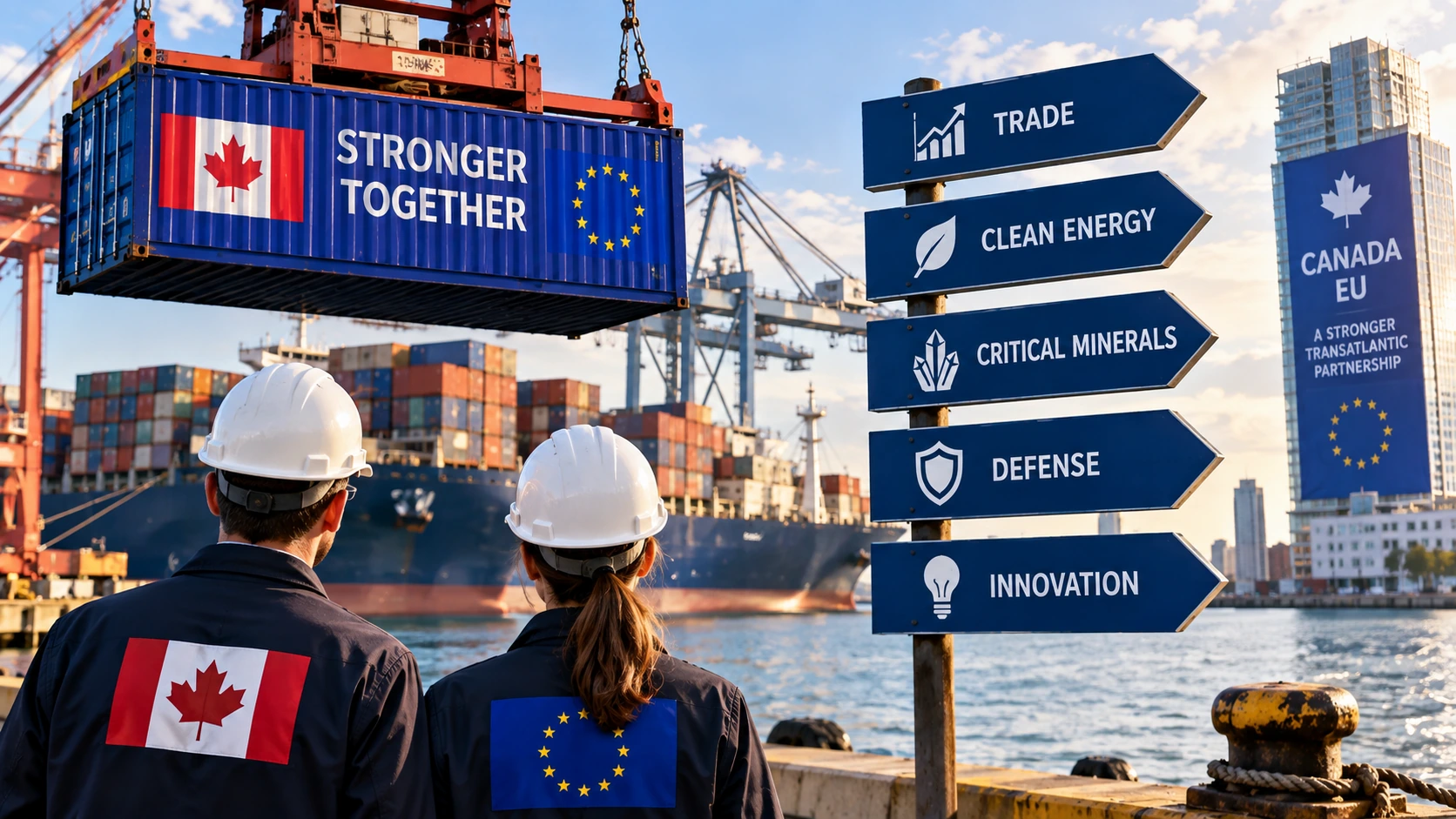
Canada and the EU already have important building blocks. Their Comprehensive Economic and Trade Agreement, or CETA, has applied provisionally since 2017. The EU is Canada’s second-largest trading partner for goods and services after the United States, and total Canada-EU trade in goods and services reached C$178.6 billion in 2025. (Global Affairs Canada)
Defense cooperation has also moved beyond symbolism. In June 2026, the EU formally concluded an agreement allowing Canada to participate in its SAFE defense procurement program, making Canada the first non-European country to participate in that instrument. (Council of the European Union)
So the proposed new relationship would not start from zero. It would build on an existing trade agreement, a defense partnership, and growing cooperation in technology and strategic industries.
Why Was the Carney-Macron Meeting in Saint-Pierre-et-Miquelon So Symbolic?
Because it made the geography visible. France is not only a European power across the Atlantic; through Saint-Pierre-et-Miquelon, it is also physically present just off Canada’s Atlantic coast.
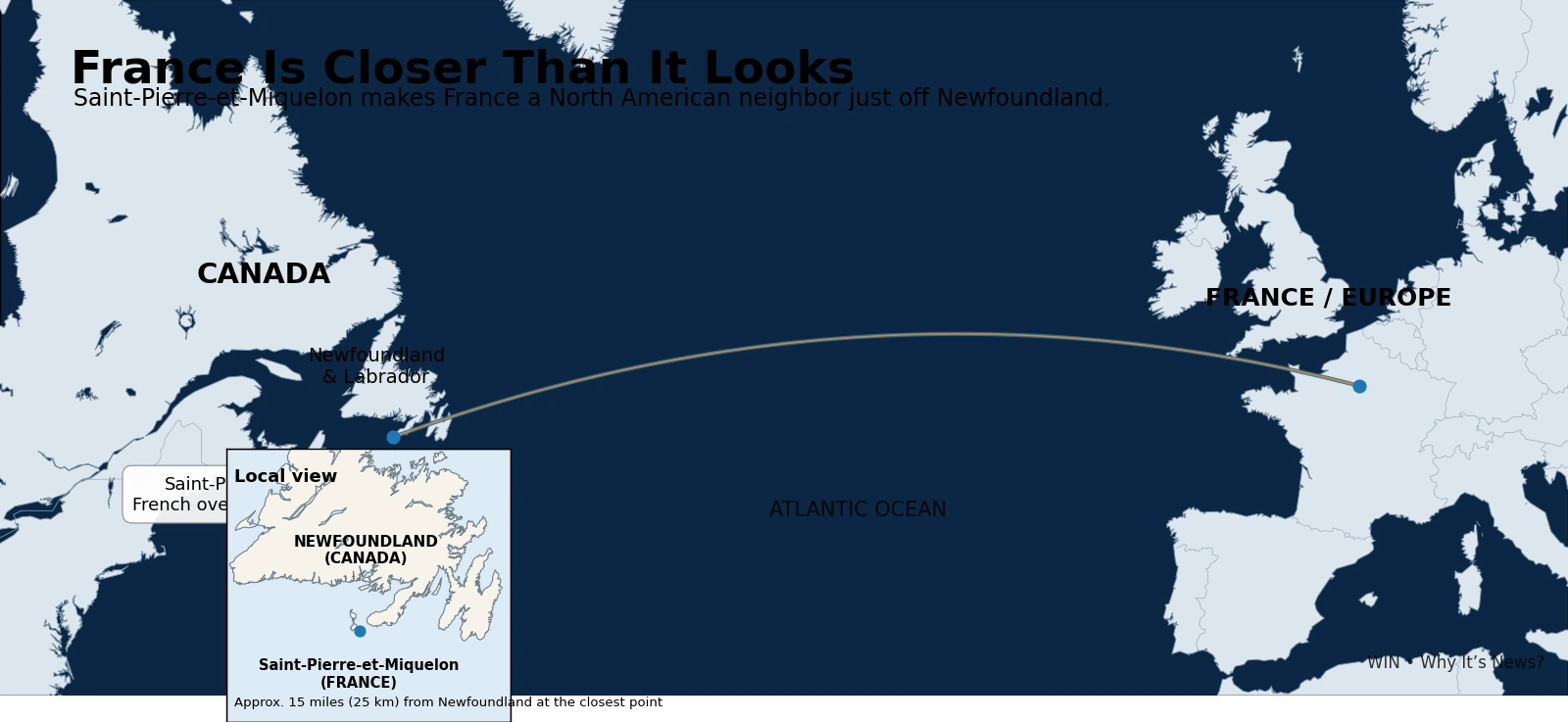
During the September 20 visit, Carney and Macron highlighted the islands’ historical and economic ties with Atlantic Canada and described the territory as a strategic link between Canada and Europe. They also assigned a regional commission to expand work on trade, energy transition, climate resilience, and cross-border security. (Government of Canada)
The setting reinforced the political message: Europe is not an abstract alternative market for Canada. In the North Atlantic, France and Canada already share overlapping security, climate, transportation, and economic interests.
Could Europe Ever Replace the United States for Canada?
Not in the foreseeable future. The U.S. remains far larger as a destination for Canadian exports, and the two economies are tied together by geography, energy networks, manufacturing supply chains, transportation systems, and decades of cross-border investment.
Europe can still reduce concentration risk without replacing the United States. That is the practical logic behind diversification: Canada does not need to move most of its trade away from the U.S. for additional markets and supply relationships to give it more options.
| Relationship | What it gives Canada | Main limitation |
|---|---|---|
| United States | Geographic proximity, massive market, deeply integrated supply chains | High dependence creates vulnerability when trade policy changes |
| European Union | Large second market, CETA, defense and technology cooperation | Distance, regulation, and a much smaller share of Canadian exports |
| Proposed new EU framework | Potentially deeper cooperation in strategic sectors | Rights, obligations, and legal structure are still undefined |
This is why “Canada is pivoting away from the United States” can be misleading if taken too literally. The more precise description is that Canada is trying to build more alternatives around a relationship with the U.S. that remains economically central.
What Happens Next?
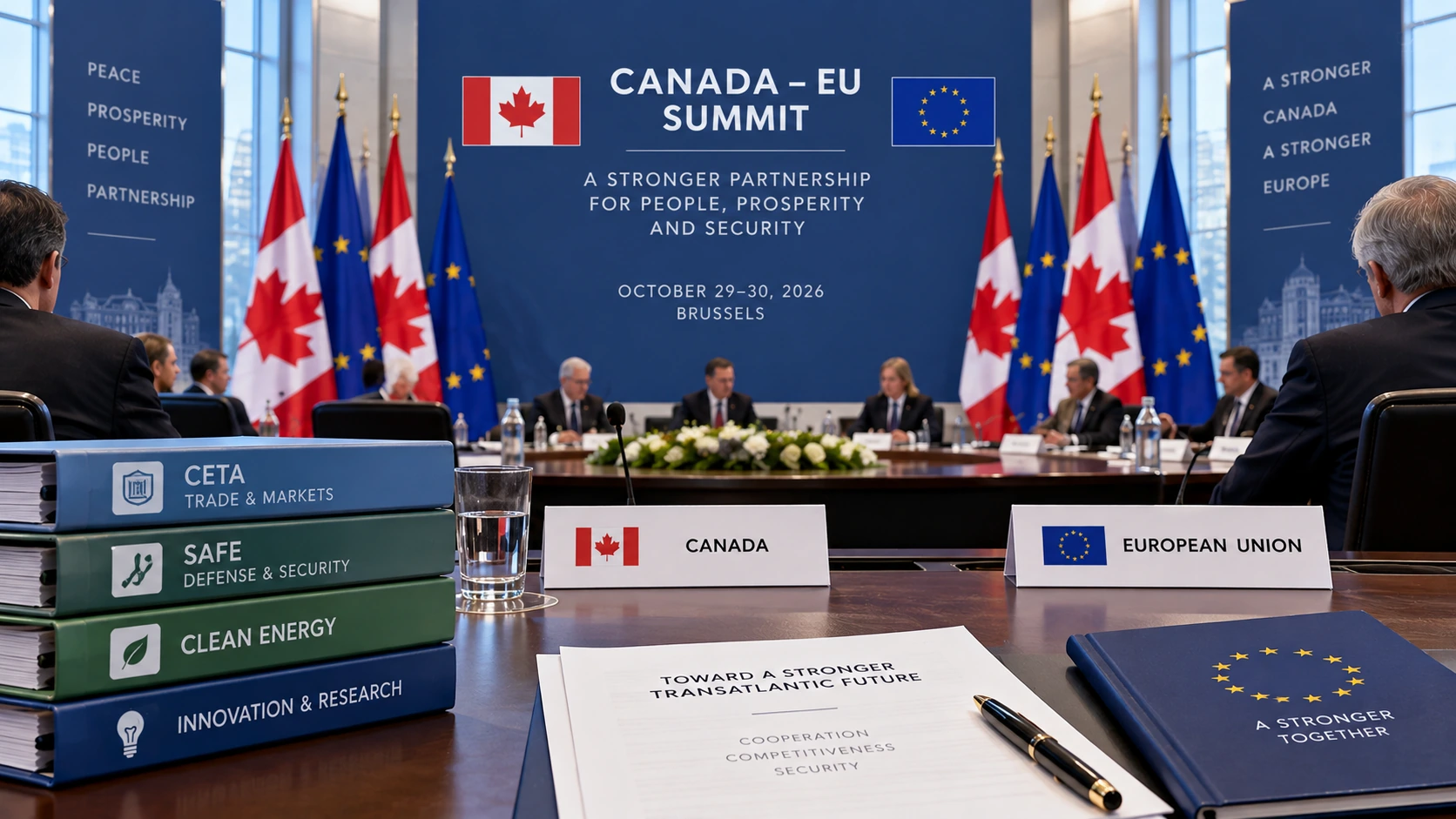
The next step is to turn political language into legal and practical details. Canada and EU leaders are expected to continue discussing the proposed “Alliance for the Future,” including the meaning of any associate status and the sectors where integration could go beyond CETA. Carney has pointed to the October 29–30 Canada-EU summit in Montreal as an opportunity to start defining the relationship. (AP · Reuters)
The questions to watch are concrete:
- Would Canada receive new market access beyond CETA?
- Would Canadian companies gain broader access to European procurement and strategic projects?
- What regulatory standards would Canada have to accept?
- Would there be new mobility rights for workers, students, or young people?
- How much authority would EU member states retain over the arrangement?
- Would the status require changes to EU treaties or a separate agreement?
Until those details are negotiated, “associate membership” is better understood as a political direction than a finished institutional category.
Why It Matters in One Sentence
Canada’s Europe push is not about joining the EU tomorrow—it is about creating enough new trade, defense, energy, and technology options that Canada is less exposed when its relationship with the United States becomes more difficult.
Canada EU Associate Membership: Key Questions Explained
Q. Is Canada becoming a full member of the European Union?
No. Canada is not pursuing ordinary full EU membership, and the proposed “associate member” status does not currently exist as a defined EU membership category.
Q. What did Macron support on September 20?
Macron backed closer Canada-EU ties and supported the idea of Canada developing an associate relationship with the EU while France and Canada announced deeper cooperation in several strategic sectors.
Q. Does “associate membership” give Canada voting rights in the EU?
Not automatically. No rights have been finalized, and there is currently no established EU associate-membership category that gives Canada institutional voting rights.
Q. Why does Canada want closer ties with Europe now?
Canada wants to diversify trade and strategic partnerships because the United States still dominates Canadian exports while recent U.S.-Canada trade disputes have highlighted the risks of relying heavily on one market.
Q. Could the EU replace the U.S. as Canada’s main economic partner?
Not realistically in the near term. The U.S. remains far more important to Canadian trade, but Europe can still give Canada more options in sectors such as defense, energy, critical minerals, and technology.
Q. What is CETA, and why is it not enough by itself?
CETA is the existing Canada-EU trade agreement. It reduces many trade barriers, but Carney’s proposed Alliance for the Future reaches beyond trade into defense, industrial policy, technology, energy security, the Arctic, and possible new mobility arrangements.
Q. What is SAFE, and why does it matter here?
SAFE is a €150 billion EU financial instrument that supports joint defense procurement. Canada became the first non-European country to participate, showing that Canada-EU strategic cooperation is already moving beyond conventional trade ties.
Q. What should readers watch next?
The most important development will be whether Canada and the EU can define specific rights, obligations, and legal mechanisms for the proposed relationship—and whether all necessary EU governments support it.
Did this help make the story clearer? 🙂
WIN keeps unpacking the “why” behind the news—clearly and simply!
Sources
September 20 Canada-France Agreement
Prime Minister of Canada — Carney Meets President Emmanuel Macron
Reuters — Canada’s Carney Calls for Stronger Ties With France
AP — Macron Backs Canada as an EU Associate Member
EU Associate Membership Proposal
European Commission — 2026 State of the Union Address
Prime Minister of Canada — Carney’s Address to the European Parliament
Reuters — EU Opens the Door to Canada as Its First ‘Associate Member’
AP — What the EU’s Offer of ‘Associate Member’ to Canada Might Mean
Trade, Defense, and Existing Canada-EU Ties
Statistics Canada — Canadian International Merchandise Trade, 2025
Global Affairs Canada — Canada and the European Union
Council of the European Union — SAFE Agreement With Canada
U.S.-Canada Political Context and Next Steps
Reuters — Canada and EU Alliance Proposal Draws U.S. Criticism
Reuters — Canada-EU Relationship Still Faces Practical Limits