If Trump Is Open to Talks With Iran, Why Are Both Sides Threatening a Bigger War?
If the United States and Iran are still threatening each other, why is President Donald Trump also saying he could meet Iran’s president?
And if Iran says it wants a path back to negotiations, why are Iran-backed Houthi forces firing missiles and drones at Saudi Arabia?
Those developments can look contradictory. They are easier to understand if you stop looking at the crisis as a single war.
Three connected conflicts are now overlapping: the direct U.S.-Iran confrontation, the revived Saudi-Houthi war in Yemen, and a struggle over two of the world’s most important oil-shipping routes.
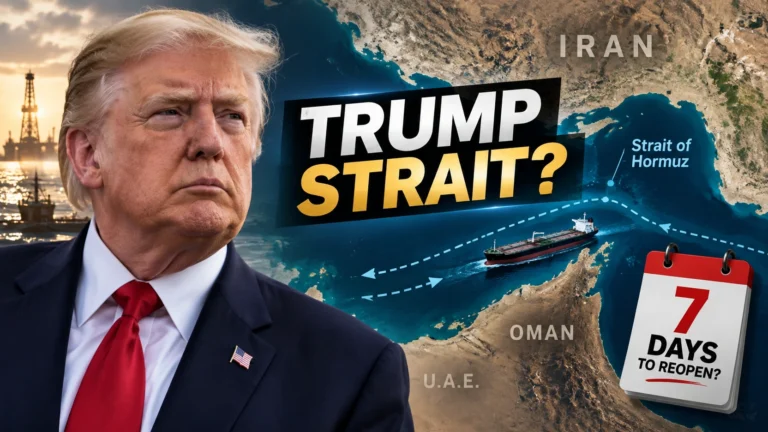
On September 20, Trump warned of severe consequences if Tehran did not reach a deal while also saying he was open to meeting Iranian President Masoud Pezeshkian during the U.N. General Assembly gathering in New York. Iran’s military, meanwhile, warned that another U.S. attack would trigger broader retaliation. (Reuters)
That combination — threats on one side of the sentence and negotiations on the other — is the part that needs explaining.

What Actually Changed Over the Weekend?
The biggest change was not simply another U.S.-Iran threat. The conflict widened through Yemen and Saudi Arabia at the same time that a possible diplomatic opening appeared in New York.
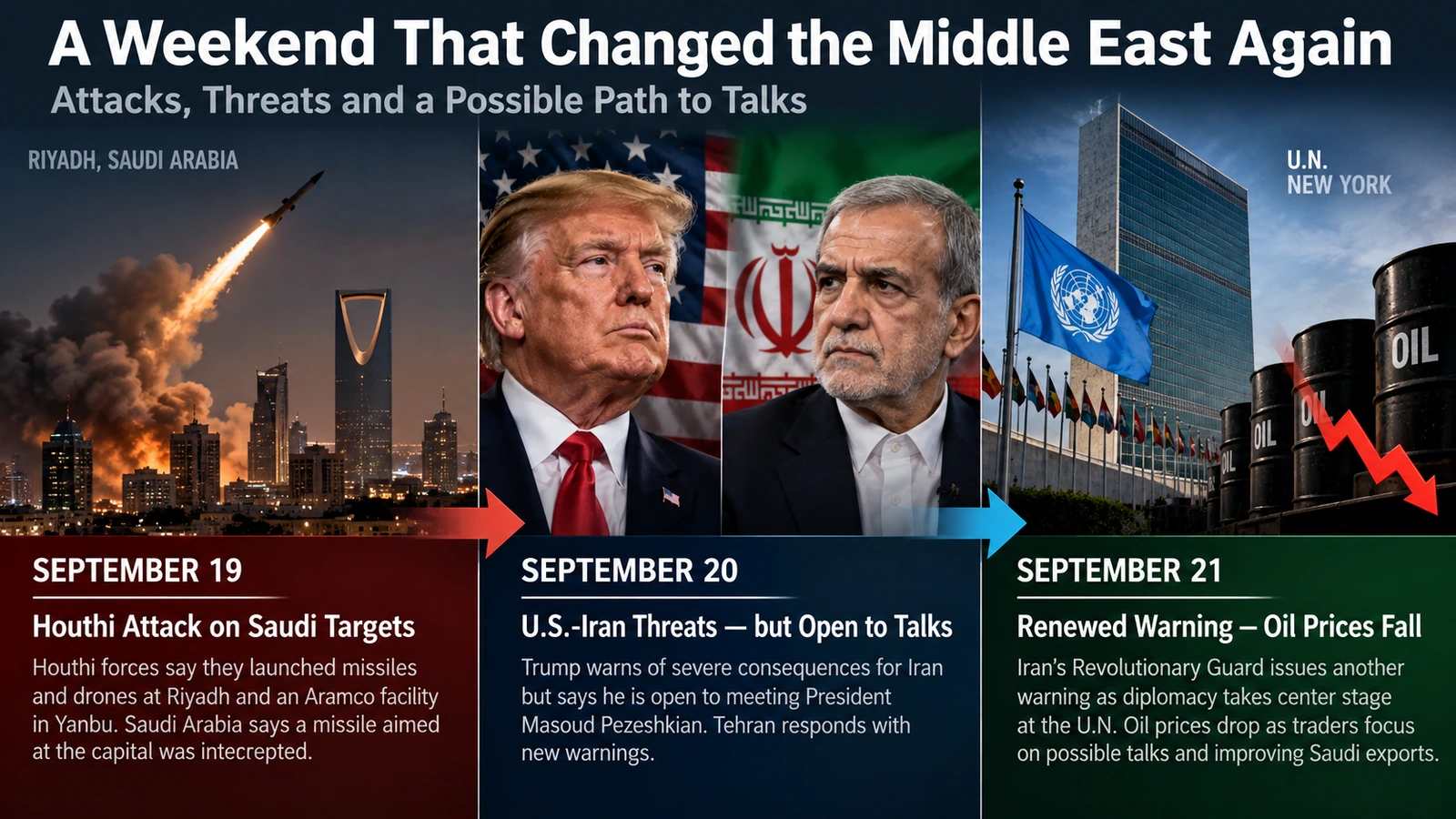
Houthi forces said they targeted sites in Riyadh with missiles and drones on September 19. Saudi forces said a ballistic missile aimed at the capital was intercepted, while smoke and flames were seen near Riyadh’s main airport. The Houthis also said they attacked an Aramco facility in the Red Sea city of Yanbu. (Reuters)
A day later, Trump publicly kept open the possibility of meeting Pezeshkian even as Washington and Tehran exchanged new threats. On September 21, Iran’s Revolutionary Guard warned that further U.S. escalation could lead it to change its strategy, weaponry and targets. (AP)
So the sequence looks like this:
| Date | What changed |
|---|---|
| September 19 | Houthis attack Saudi targets, including an attempted strike on Riyadh |
| September 20 | Trump threatens further consequences for Iran but says he is open to meeting Pezeshkian |
| September 21 | Iran’s Revolutionary Guard issues another warning as diplomacy becomes a focus at the U.N. |
| September 21 | Oil prices fall on hopes of diplomacy and improving Saudi exports, even as fighting continues |
Oil markets reacted to both sides of the story. Brent crude settled at $100.34 a barrel on September 21, down 3.4%, while U.S. West Texas Intermediate fell to $95.78 as traders focused on the possibility of diplomacy and a partial recovery in Saudi exports. (Reuters)
Why Talk About a Deal While Threatening More War?
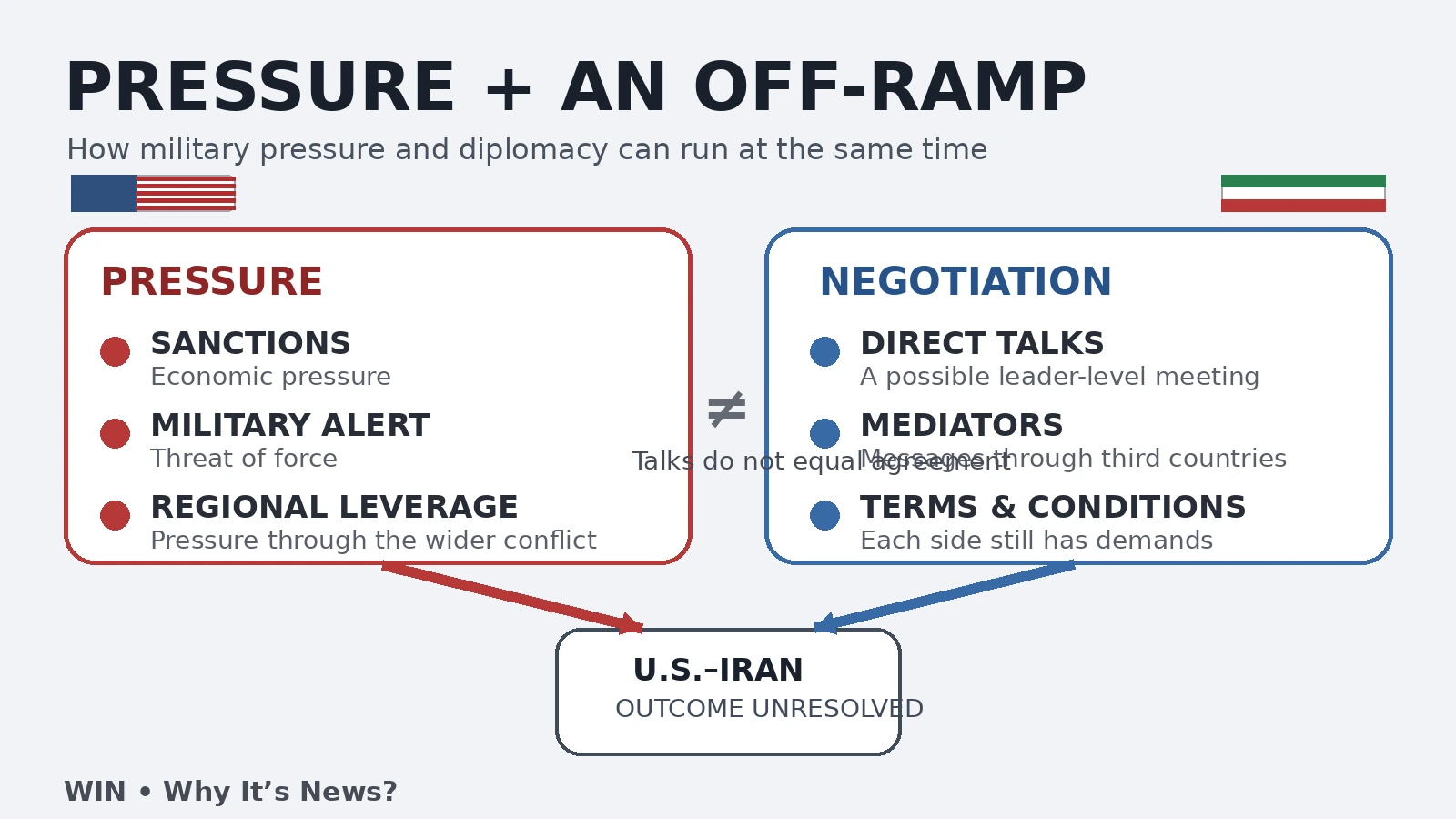
Because negotiation and pressure are not always opposites in international conflicts.
Governments can use military threats, economic pressure or battlefield leverage while leaving a diplomatic exit open. In practice, pressure can continue during negotiations because each side may be trying to improve its bargaining position before making concessions.
That does not prove that either Washington or Tehran has already decided to compromise.
Publicly, their positions still remain far apart. Iran has told mediators that its conditions for ending the war include ending the fighting on all fronts, releasing Iranian assets seized by the United States and ending the U.S. naval blockade of Iranian ports. Trump, meanwhile, has continued to threaten much harsher consequences while saying he would be willing to meet Pezeshkian. (AP · Reuters)
The important distinction is between being willing to talk and being ready to accept the other side’s terms.
Those are not the same thing.
Where Do the Houthis Fit Into the U.S.-Iran Conflict?
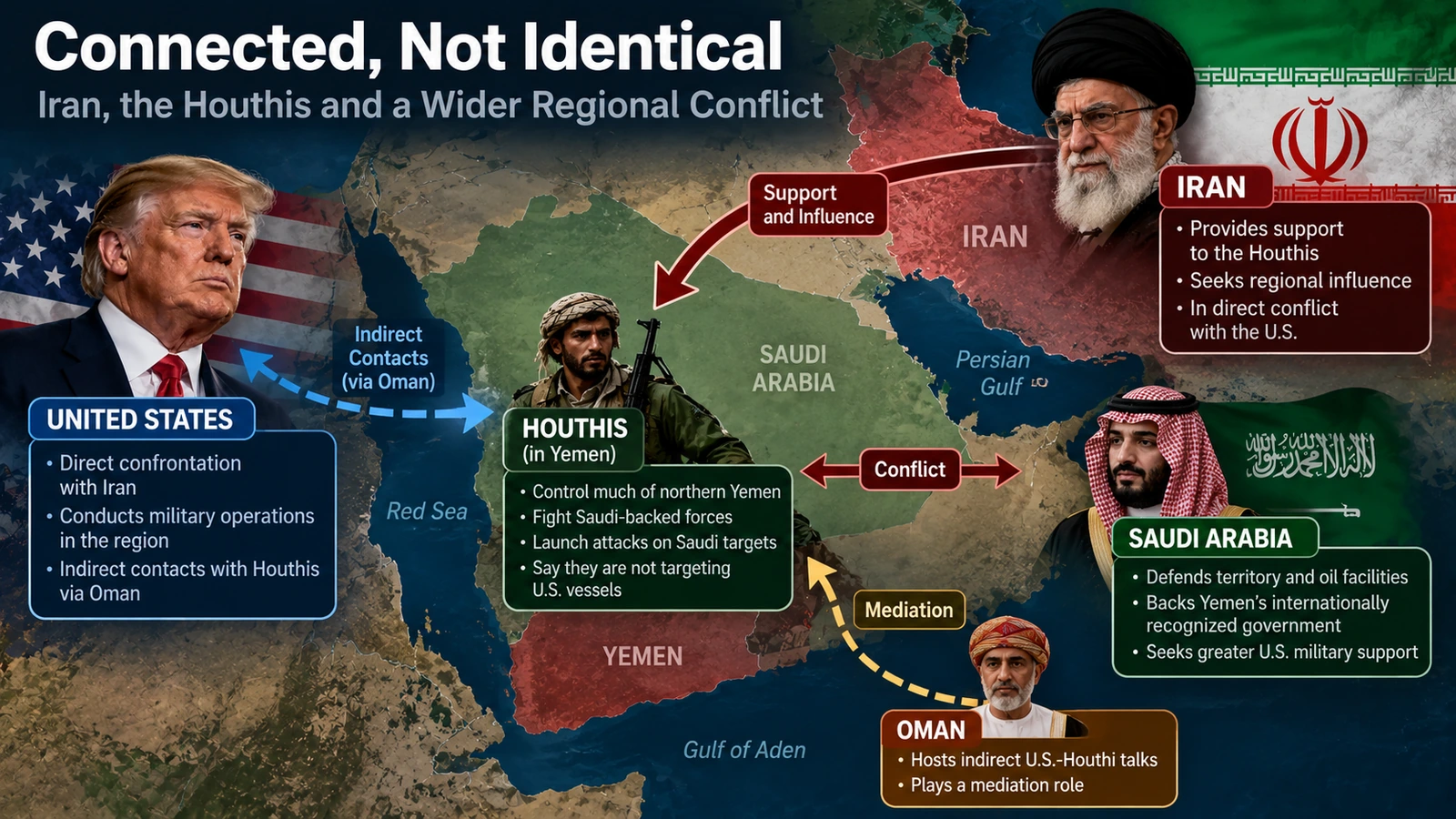
The Houthis are backed by Iran, but describing them simply as Iranian troops would be misleading.
The movement controls much of northern Yemen and has its own political, territorial and economic goals. The Houthis took Yemen’s capital, Sanaa, in 2014, and a Saudi-led coalition intervened the following year to support Yemen’s internationally recognized government. (AP)
Iran has provided support to the Houthis, and their military activities can advance Iranian strategic interests. But support and influence are not the same as proof that Tehran directly orders every Houthi operation.
The reporting reviewed for the Riyadh attack does not establish that Iran ordered that specific strike. That distinction matters because treating every Houthi action as a direct Iranian command can make the regional conflict look more centralized than the available evidence supports. (AP)
There is another revealing detail: a senior Houthi official told the Associated Press that the group had assured Washington it did not intend to attack U.S. vessels in the Red Sea, while continuing to threaten Saudi targets. Reuters separately reported that U.S. officials met Houthi representatives at the U.S. Embassy in Muscat, with Oman helping organize the meeting. (AP · Reuters)
That creates an unusual structure:
| Actor | Main immediate conflict |
|---|---|
| United States | Direct war and negotiations with Iran |
| Iran | Conflict with the U.S. and broader regional pressure |
| Houthis | War against Saudi-backed forces in Yemen and attacks on Saudi targets |
| Saudi Arabia | Defending territory, oil infrastructure and Yemeni allies |
| Oman, Qatar, Pakistan | Various mediation roles in regional diplomacy |
Why Is Saudi Arabia Back in the Middle of This?
Because the renewed Houthi offensive has brought Yemen’s war back to Saudi Arabia’s border and directly threatened the kingdom’s oil system.
The Houthis made rapid territorial gains along Yemen’s Red Sea coast in September. By September 21, Reuters reported that Houthi fighters were trying to secure strategic highlands that could help them consolidate those gains, while Saudi-backed forces remained on the defensive. Nearly 130,000 Yemenis had been displaced inside the country during the renewed fighting. (Reuters)
For Saudi Arabia, the problem is larger than attacks on individual cities.
The kingdom spent years trying to reduce its exposure to the Yemen war. Now it faces renewed Houthi attacks at the same time that its other major oil-export route — through the Strait of Hormuz — is already constrained by the U.S.-Iran conflict.
Saudi Crown Prince Mohammed bin Salman sought U.S. military help against the Houthis, but Trump declined to authorize direct U.S. strikes, according to Reuters. (Reuters)
This is why a battle inside Yemen can suddenly become a major international energy story.
Why Do the Strait of Hormuz and Bab el-Mandeb Matter at the Same Time?
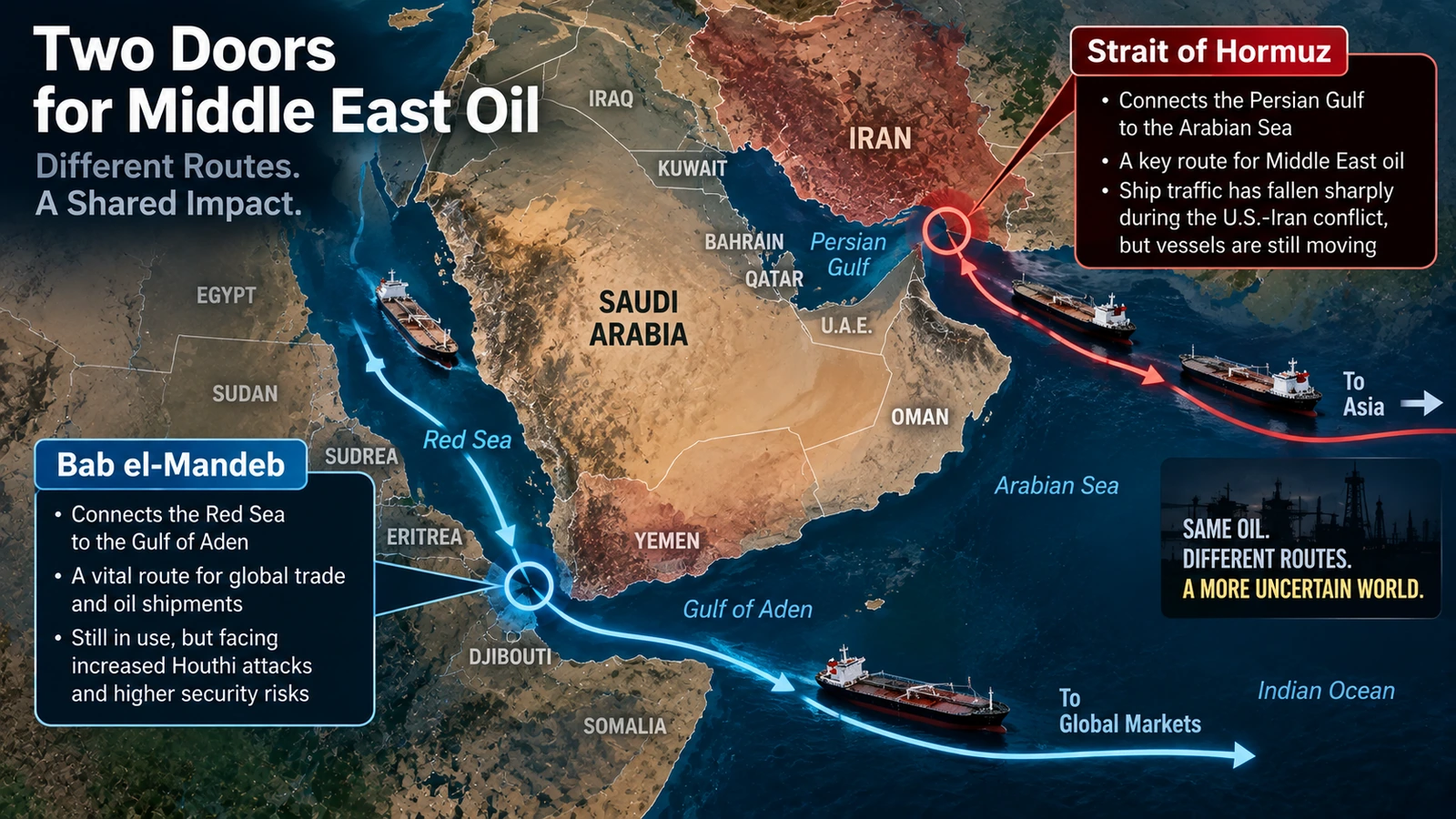
Because they are two different doors into the same energy system.
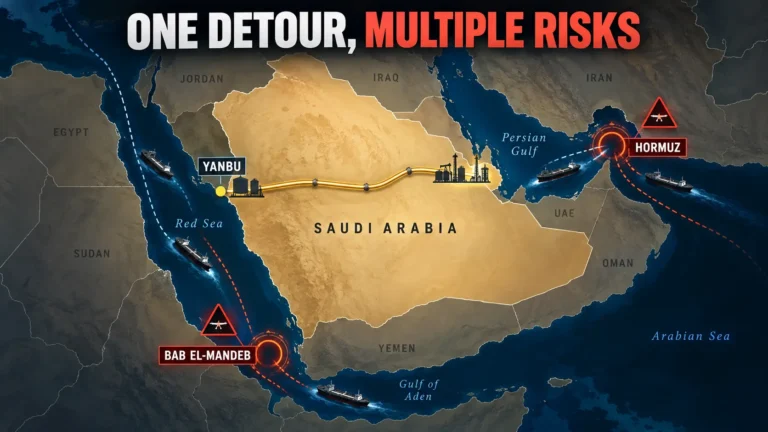
The Strait of Hormuz sits between Iran and Oman and connects the Persian Gulf to the Arabian Sea. Before the current war, it was one of the world’s most important oil routes.
Bab el-Mandeb sits between Yemen and the Horn of Africa. It connects the Red Sea with the Gulf of Aden and the Indian Ocean.
A simple way to picture it: Hormuz is the Persian Gulf’s seaward door, while Bab el-Mandeb is the Red Sea’s southern door.
U.S. Energy Information Administration data show just how much the war has reshaped those routes. Oil flows through Hormuz averaged 21.6 million barrels per day in the fourth quarter of 2025 but fell to 4.9 million barrels per day in the second quarter of 2026. At the same time, Bab el-Mandeb flows rose to 8.1 million barrels per day as more traffic shifted toward the Red Sea route. EIA cautions that 2026 Hormuz tracking data are unusually difficult to measure and subject to revision. (U.S. EIA)
That shift created a vulnerability.
When Hormuz became harder to use, Saudi Arabia relied more heavily on routes toward the Red Sea. But Houthi advances and attacks are now putting pressure on that alternative as well.
Are Both Straits Actually Closed?
No. That would overstate the situation.
Shipping through Hormuz has fallen dramatically, but vessels are still moving through it. Reuters counted 17 trackable commodity vessels crossing during the weekend before September 21, compared with 37 a week earlier and roughly 125 large commercial vessels per day before the war. Some tankers also travel with tracking transponders switched off, making the visible numbers incomplete. (Reuters)
Bab el-Mandeb also remains in use. Reuters reported 51 vessel crossings over the same weekend, down from 57 a week earlier. The Houthis have said their blockade is aimed at Saudi-linked shipping rather than all vessels, and a Houthi official told AP the group was not targeting U.S. vessels. Those are Houthi statements, not guarantees that navigation will remain safe. (Reuters · AP)
So the better description is not “two closed straits.”
It is two increasingly risky chokepoints whose disruption is making oil transportation slower, more complicated and more expensive.
How Can Trouble in Yemen Affect Oil Prices in the United States?
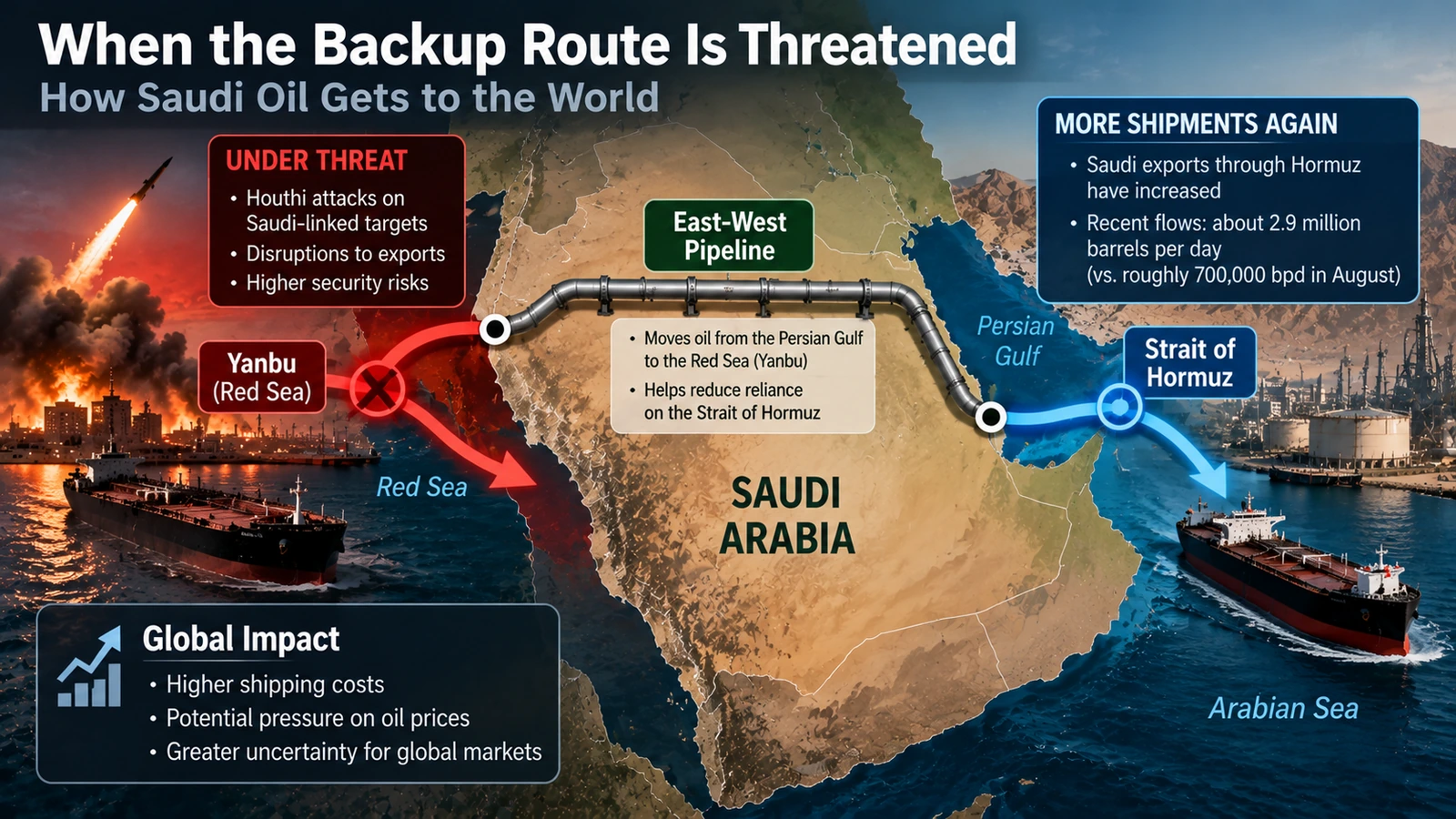
The connection runs through Saudi Arabia’s ability to move crude oil to global buyers.
Saudi Arabia has an East-West pipeline designed to move oil from the Persian Gulf side of the country toward Yanbu on the Red Sea, helping it bypass Hormuz. That route becomes especially valuable when Persian Gulf shipping is disrupted.
But Houthi attacks have affected the East-West system and the Red Sea export route. Reuters reported no visible Saudi crude loadings from Yanbu after September 16. Saudi Aramco responded by increasing shipments back through Hormuz, with recent flows reaching about 2.9 million barrels per day compared with roughly 700,000 barrels per day in August. (Reuters)
That is almost the opposite of what Saudi Arabia would normally want during a Hormuz crisis: the kingdom is having to use more of the route it had been trying to avoid.
Crude oil is only one part of what Americans pay at the pump. Refining costs, inventories, regional supply, taxes and transportation also matter.
But when war raises the cost and uncertainty of moving millions of barrels of oil, that risk can feed into fuel prices far beyond the Middle East.
So Is Diplomacy Now More Likely?
There is an opening for diplomacy, but a diplomatic opening is not the same as a deal.
Pezeshkian is due in New York for the U.N. General Assembly, and the United States approved visas for Iran’s core delegation despite the ongoing war. Trump has publicly said he is open to meeting the Iranian president. As of September 21, however, public reporting had not established that such a meeting was actually scheduled. (Reuters)
Iran has already communicated conditions through mediators. Washington and Tehran still disagree over major issues including the war itself, economic restrictions and navigation through Hormuz.
And the military situation is still moving in the opposite direction.
On September 21, Iran’s Revolutionary Guard warned that further escalation could change its targets and tactics, while a tanker entering Hormuz was struck by an unidentified projectile, injuring two crew members. No public evidence cited by AP established who fired the projectile. (AP)
That is why the U.N. gathering matters: it provides a place for direct meetings, indirect messages and mediation at exactly the moment when both military risk and economic pressure are rising.
It does not guarantee that any of those contacts will produce an agreement.
What Should Americans Watch Next?
Four developments will show whether this crisis is moving toward de-escalation or another round of confrontation.
First, watch whether a Trump-Pezeshkian meeting is actually announced. Public willingness to meet matters less than whether officials establish a negotiating process.
Second, watch whether Iran changes or clarifies its conditions for reopening negotiations and easing restrictions around Hormuz.
Third, watch the Saudi-Houthi front. A reduction in attacks on Saudi territory and oil facilities would remove one major source of pressure. More attacks would do the opposite.
Fourth, watch actual tanker traffic rather than declarations about blockades. The number of ships moving through Hormuz and Bab el-Mandeb, along with Saudi loadings from Yanbu, gives a clearer picture of how much energy supply is really being disrupted.
For Americans traveling in the region, the security implications are already concrete. The U.S. State Department currently lists Saudi Arabia at Level 3, “Reconsider Travel,” citing the risk of Iranian drone and missile targeting of American interests, armed conflict, terrorism, exit bans and local laws regarding social media activity. (U.S. State Department)
Why It Matters in One Sentence
The U.S. and Iran can threaten each other while still exploring talks because pressure and diplomacy are operating at the same time — but the revived Saudi-Houthi conflict means the war now threatens both of the Middle East’s critical oil-export routes, making every new military or diplomatic move economically important far beyond the region.
Trump Iran Talks: Key Questions Explained
Q. Is Trump actually negotiating a peace deal with Iran?
Not yet, based on the public information available as of September 21. Trump has said he is open to meeting President Masoud Pezeshkian, while Iran has communicated negotiating conditions through mediators, but no new comprehensive agreement has been announced. (Reuters)
Q. Why is Trump threatening Iran if he is willing to meet its president?
Threats and negotiations can occur simultaneously. Governments sometimes apply military or economic pressure while maintaining a diplomatic channel, although public statements alone do not reveal how willing either side actually is to compromise.
Q. Did Iran order the Houthis to attack Riyadh?
The reporting reviewed here does not establish that Iran directly ordered the specific Riyadh attack. The Houthis are backed by Iran, but they are also a Yemeni movement with their own leadership, territorial interests and conflict with Saudi Arabia. (AP)
Q. Are the Houthis attacking American ships?
A senior Houthi official told AP that the group had assured Washington it would not target U.S. vessels in the Red Sea and said the current campaign was directed at Saudi Arabia. That is the Houthis’ stated position, not a guarantee about future actions. (AP)
Q. Is the Strait of Hormuz completely closed?
No. Traffic has fallen dramatically, but ships are still moving through the strait, including some vessels that do not appear in normal tracking data because their transponders are turned off. (Reuters)
Q. Is Bab el-Mandeb completely closed?
No. Shipping continues through Bab el-Mandeb, although traffic has declined and Saudi-linked shipping faces heightened Houthi threats. (AP)
Q. Why does Saudi Arabia care about both Hormuz and Bab el-Mandeb?
Hormuz is the main seaward exit from the Persian Gulf, while Bab el-Mandeb connects the Red Sea to the Indian Ocean. Saudi Arabia can shift some oil between Gulf and Red Sea export routes, so pressure on both waterways reduces its flexibility.
Q. Why did oil prices fall even though the fighting got worse?
Markets reacted to more than the fighting. Oil prices fell on September 21 as Saudi exports partly recovered and traders focused on possible U.S.-Iran diplomacy during the U.N. gathering. (Reuters)
Q. What could signal that the crisis is actually easing?
Confirmed negotiations, reduced attacks on Saudi Arabia, increased commercial traffic through Hormuz and Bab el-Mandeb, and more normal Saudi export flows would all be tangible signs of reduced pressure. None by itself would prove that the wider conflict had ended.
Did this help make the story clearer? 🙂
WIN keeps unpacking the “why” behind the news—clearly and simply!
Sources
U.S.-Iran Threats and Diplomacy
Reuters — Iran and U.S. trade threats after Houthi attacks escalate regional conflict
Reuters — U.S. allows Iranian leaders to attend the U.N. General Assembly
Saudi-Houthi Fighting and Yemen
Reuters — Flames and smoke seen near Riyadh airport as Houthis claim attacks on Saudi capital
Reuters — U.S. officials met Houthi representatives in Oman
Reuters — Saudi crown prince sought U.S. military help against the Houthis
Reuters — Houthis push for control of Yemen highlands as fighting intensifies
Associated Press — Iran’s Revolutionary Guard warns U.S. over escalation
Oil Routes and Maritime Chokepoints
U.S. Energy Information Administration — Strait of Hormuz and Bab el-Mandeb oil-flow data
Reuters — Vessels trickle through Strait of Hormuz as Middle East conflict persists
U.S. Travel and Security Guidance
U.S. Department of State — Saudi Arabia Travel Advisory, September 15, 2026