Paramount Can Now Buy Warner Bros.—What Happens to HBO, CNN and CBS?

Wait—did Paramount just buy HBO and CNN?
Not quite. On September 30, a federal judge approved Paramount Skydance’s settlement with 12 states that had sued to stop its acquisition of Warner Bros. Discovery. That removed the major legal obstacle that had kept the companies from closing the deal. Paramount has said the transaction could now close as soon as early October. (AP · Reuters)
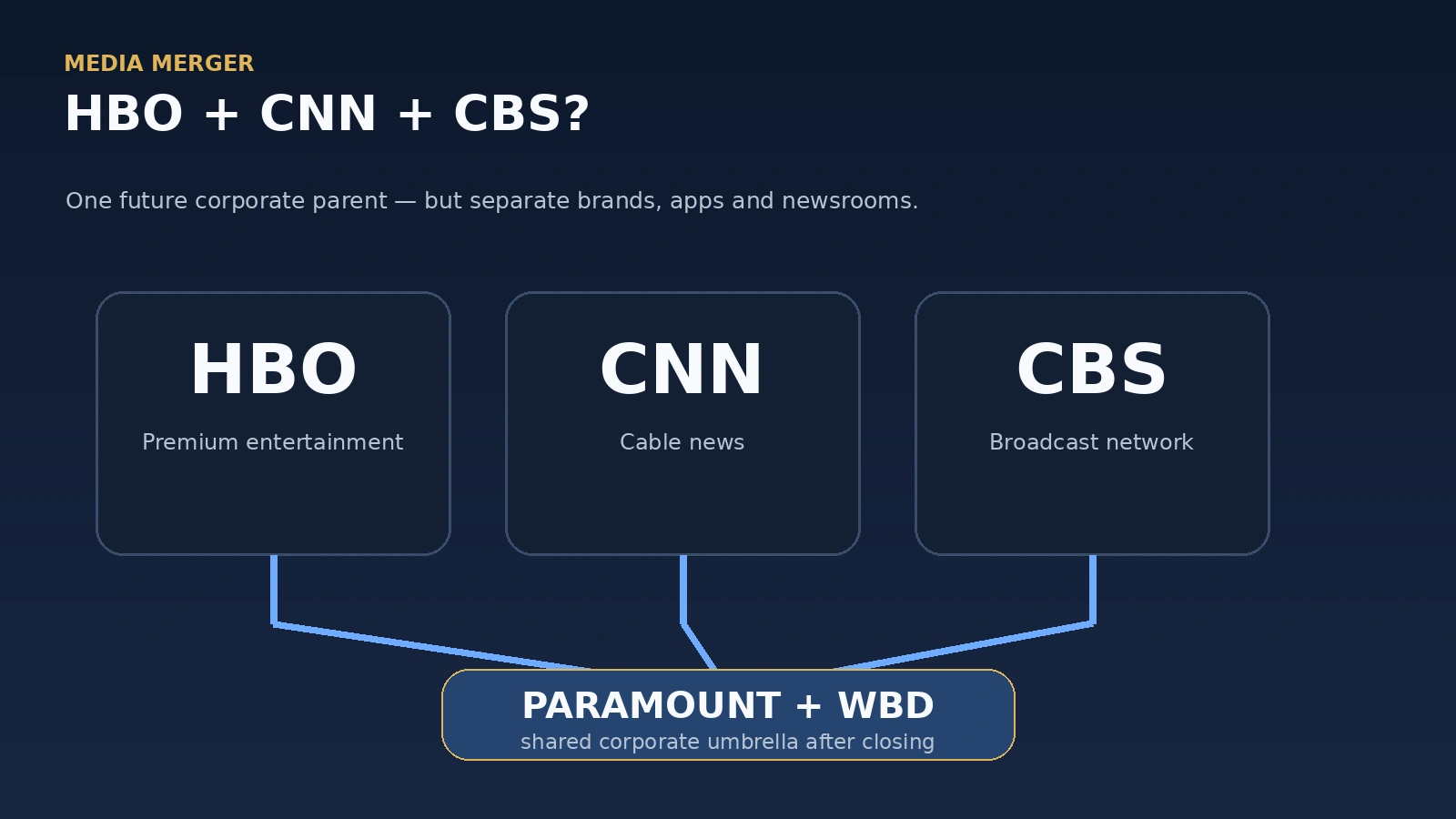
CBS is already part of Paramount. HBO and CNN are part of Warner Bros. Discovery.
If the acquisition closes as planned, all three will ultimately sit under the same corporate parent.
But that does not mean HBO, CNN and CBS instantly become one channel, one newsroom or one streaming service.
※ Images in this article are AI-generated illustrations created to help explain the story. They are not actual photographs, and depictions of people, places, or events may differ slightly from reality.
And there is another reason this story can be confusing: Warner Bros. Discovery had previously been preparing to split itself into two companies.
So how did we get from a Warner breakup to a Paramount takeover that could put HBO, CNN and CBS under one parent?
What Did the Judge Actually Approve?
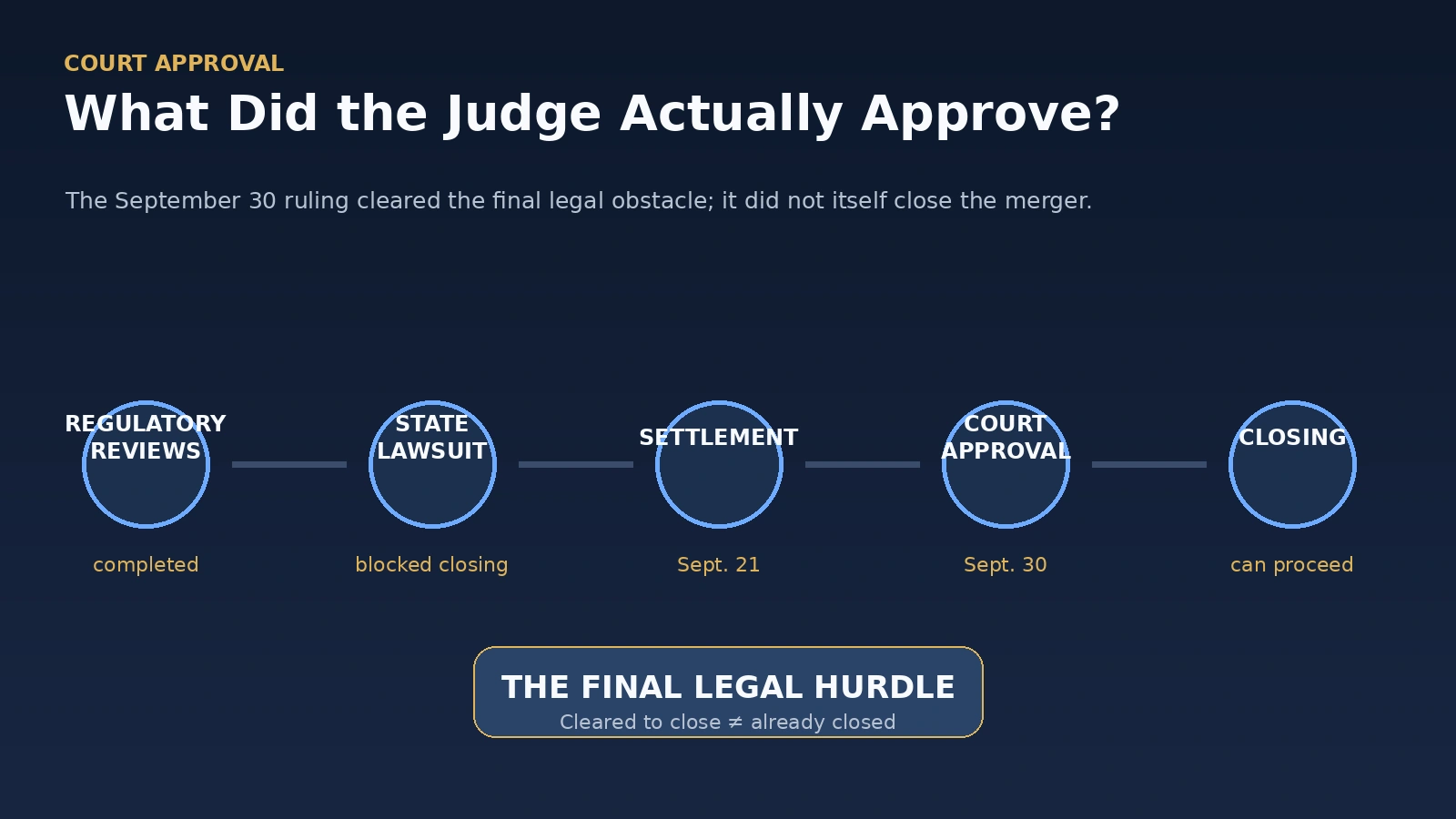
The judge did not suddenly approve the entire merger from scratch.
By August, Paramount said it had already obtained all regulatory clearances required by the merger agreement, including reviews in the United States and dozens of other jurisdictions. The remaining problem was a lawsuit filed by California and 11 other states arguing that the merger would harm competition. (Paramount)
Those states reached a settlement with Paramount on September 21. U.S. District Judge Araceli Martínez-Olguín approved that settlement on September 30, turning its commitments into a court-enforceable consent decree and clearing the path toward closing. (California Attorney General · AP)
The path looks like this:
| Date | What Happened | Why It Mattered |
|---|---|---|
| June 9, 2025 | WBD announced plans to split into two public companies. (WBD) | HBO and CNN were headed toward different corporate homes. |
| Feb. 27, 2026 | Paramount and WBD signed their merger agreement at $31 per WBD share. (Paramount) | Paramount became the buyer after a bidding battle for WBD. |
| April 23, 2026 | WBD shareholders approved the merger agreement. (SEC) | A major shareholder condition was satisfied. |
| July 13, 2026 | Twelve states sued to block the deal. (California Attorney General) | The acquisition could not proceed on its expected timetable. |
| Aug. 14, 2026 | Paramount said required regulatory reviews had been completed. (Paramount) | The state lawsuit became the key remaining obstacle. |
| Sept. 21, 2026 | Paramount and the states announced a settlement. (California Attorney General) | The states accepted enforceable conditions instead of continuing to seek a complete block. |
| Sept. 30, 2026 | The federal judge approved the settlement. (Reuters) | The companies could move toward closing. |
That last distinction matters: cleared to close is not the same thing as already closed.
Wasn’t Warner Bros. Discovery Supposed to Split HBO and CNN Apart?
Yes. That was the plan.
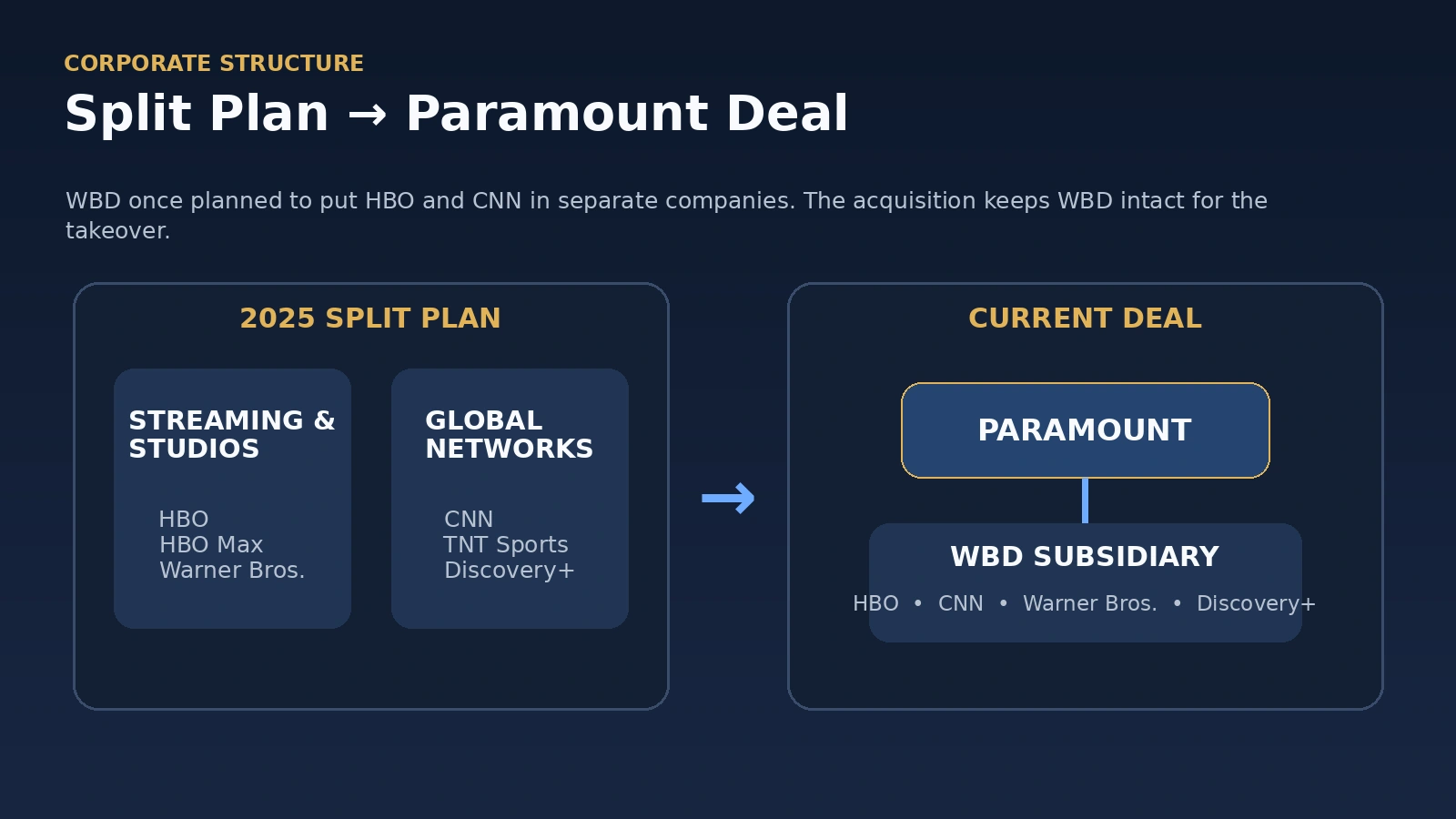
In June 2025, Warner Bros. Discovery announced that it intended to divide itself into two publicly traded companies. The future Streaming & Studios company was supposed to contain the movie and television studios, HBO and HBO Max. A separate Global Networks company was supposed to contain CNN, TNT Sports, Discovery and Discovery+. (Warner Bros. Discovery)
That is why some readers may remember hearing that HBO and CNN were about to go their separate ways.
The Paramount deal changed the path.
The merger agreement says Paramount’s obligation to complete the acquisition depends, among other things, on WBD not having completed that planned separation before the merger. In the transaction now moving toward closing, WBD instead survives as a wholly owned subsidiary of Paramount Skydance. (SEC)
So the simpler way to picture it is:
The old plan: split HBO and CNN into different companies.
The current deal: Paramount buys the WBD company that still contains both.
So Who Will Actually Control HBO, CNN and CBS?
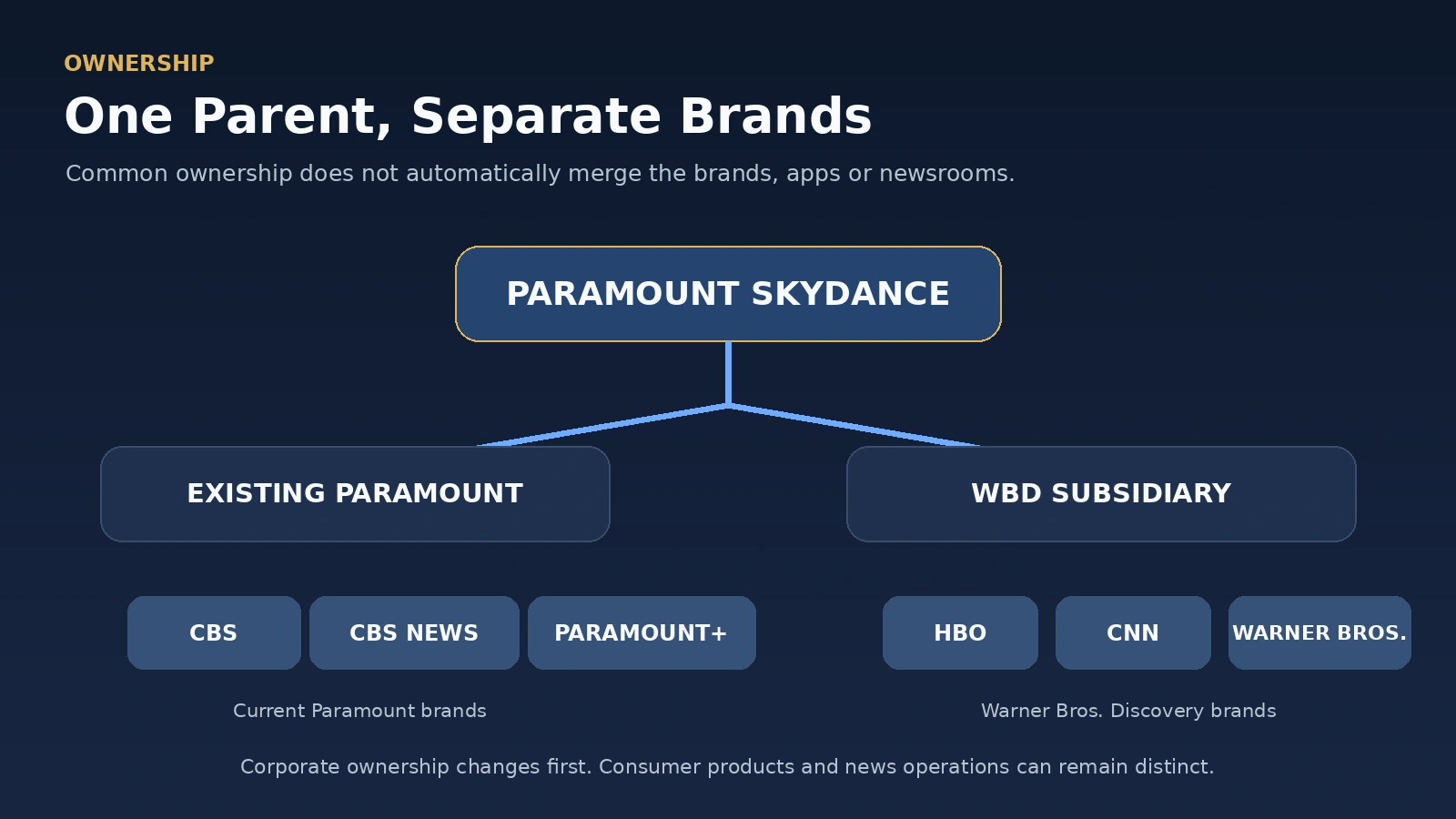
If the transaction closes, the corporate parent will be Paramount Skydance Corporation.
The legal merger structure calls for a Paramount subsidiary to merge into WBD, with WBD surviving as a wholly owned Paramount subsidiary. That means HBO, HBO Max, CNN, Warner Bros. studios and WBD’s other businesses would ultimately sit below the Paramount parent company. (SEC)
CBS and Paramount+ are already on the Paramount side.
| Brand or Business | Before Closing | After Closing |
|---|---|---|
| CBS / CBS News | Paramount | Paramount corporate group |
| Paramount+ | Paramount | Paramount corporate group |
| HBO / HBO Max | Warner Bros. Discovery | WBD subsidiary within Paramount |
| CNN | Warner Bros. Discovery | WBD subsidiary within Paramount |
| Warner Bros. studios | Warner Bros. Discovery | WBD subsidiary within Paramount |
That tells us who the corporate owner is. It does not tell us that every operation will be managed identically.
There is also a separate question of voting control over the parent company.
Paramount filings identify the Ellison family as Paramount’s controlling stockholder. They also state that after the WBD transaction closes, the Ellison family and RedBird will remain the sole holders of Paramount’s voting Class A shares. David Ellison is Paramount’s chairman and CEO. (SEC)
Paramount announced on September 30 that Mattel CEO Ynon Kreiz will join Paramount on October 5 and, when the merger closes, become co-CEO alongside Ellison. Ellison will lead strategy, creative and technology, while Kreiz will oversee day-to-day operations and integration. (Paramount)
Why Did 12 States Try to Stop the Deal?
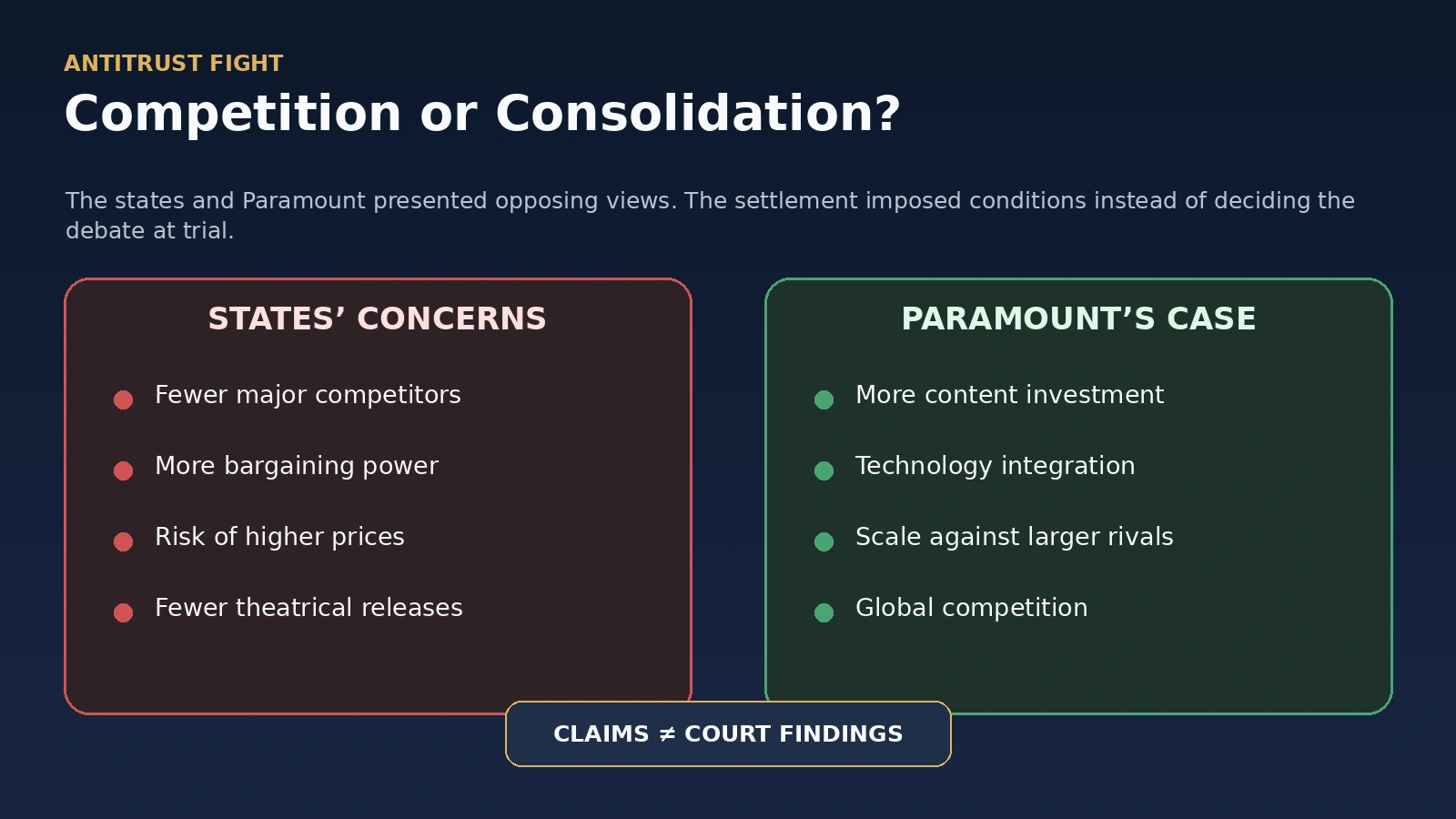
The states’ case was fundamentally about market concentration.
California and the other states argued that Paramount and Warner Bros. currently compete against each other in theatrical movies and basic cable. Combining them, the lawsuit alleged, would remove an important competitor and give the merged company more leverage over theaters and television distributors. (California Attorney General)
The states said the two companies together would account for roughly 27% of wide-release theatrical film distribution and 27% of basic cable channel licensing in the markets alleged in their complaint. They warned that less competition could eventually mean higher prices, fewer releases or less bargaining power for theaters and cable distributors. Those were the states’ allegations in the antitrust case—not findings that a court made after a full trial. (California Attorney General)
Paramount argued the opposite.
The company said competition authorities in 68 jurisdictions had reviewed the transaction and allowed it to proceed, and it argued that combining the businesses would support more content investment, technology integration and competition against larger global entertainment and technology companies. (Paramount)
The settlement did not require either argument to become the official truth.
Instead, it imposed specific rules meant to address several of the states’ concerns.
What Did Paramount Have to Promise to Get the Case Settled?
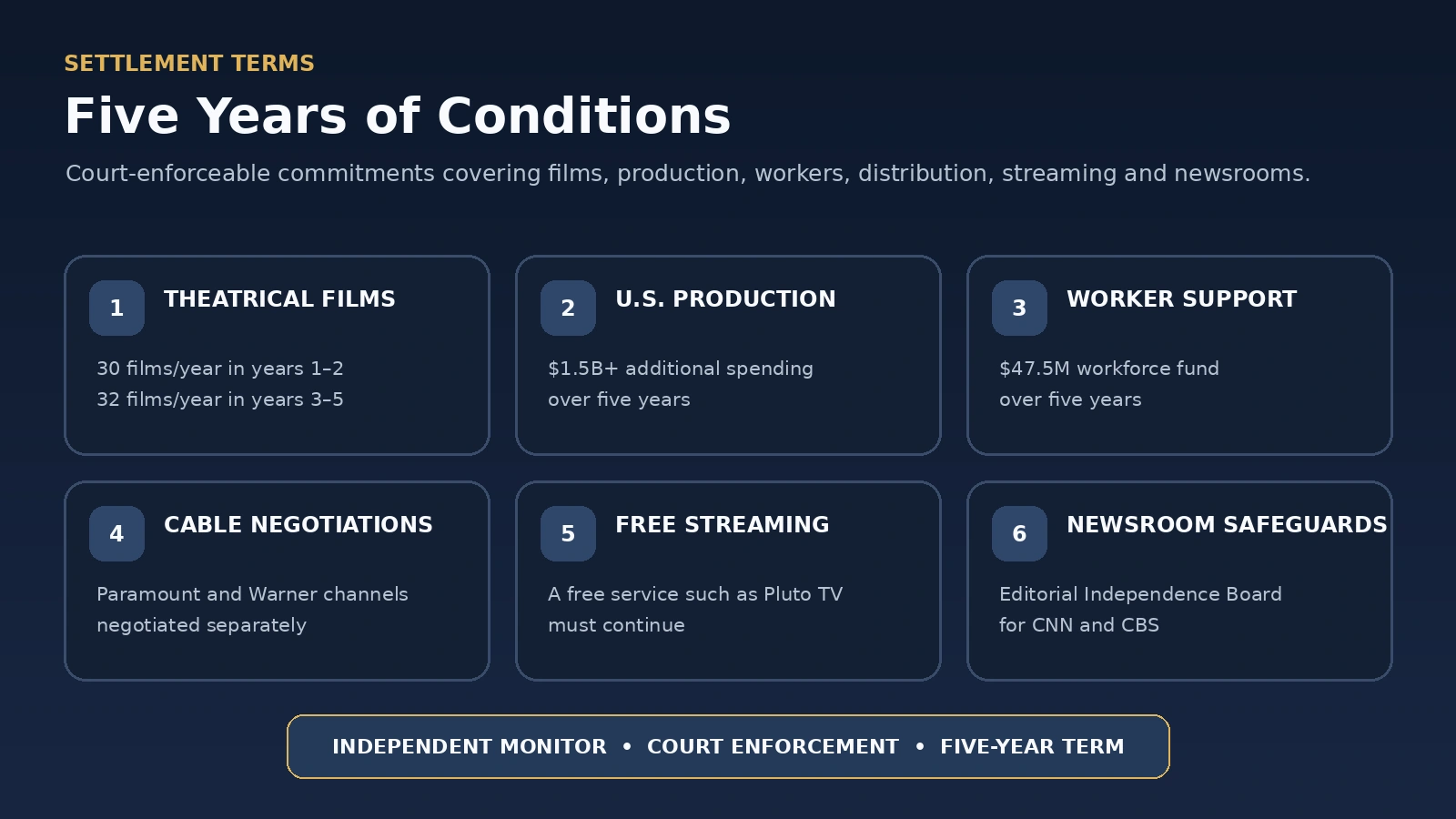
Quite a lot.
The September settlement creates five years of court-enforceable obligations covering movies, workers, cable distribution, streaming and news operations. (California Attorney General · Reuters)
| Commitment | What Paramount Agreed To |
|---|---|
| Theatrical films | Release 30 films per year in the first two years and 32 per year in years three through five |
| Wide releases | At least 20 wide releases in each of the first two years and 21 in each of the following three |
| Independent films | At least four independent films each year |
| U.S. production | Spend at least $1.5 billion more over five years than its 2025 U.S. production baseline |
| Worker support | Provide a $47.5 million workforce fund over five years |
| Cable negotiations | Negotiate Paramount and Warner Bros. basic cable channels separately |
| Free streaming | Continue offering a free streaming service, such as Pluto TV |
| News operations | Establish a News Editorial Independence Board for CNN and CBS |
| Enforcement | Accept an independent monitor overseeing compliance |
The film requirement has unusually sharp penalties.
If Paramount fails to hit the annual film target, the settlement says it can be required to divest Miramax and pay $30 million for each film below the required number, with money directed to industry worker benefit funds, California film and television programs and antitrust enforcement. (California Attorney General · Reuters)
That helps explain why this is more than a simple promise to “keep making movies.”
The commitments are designed to remain enforceable after the companies become one corporate group.
Does This Mean Paramount+ and HBO Max Will Become One Streaming Service?
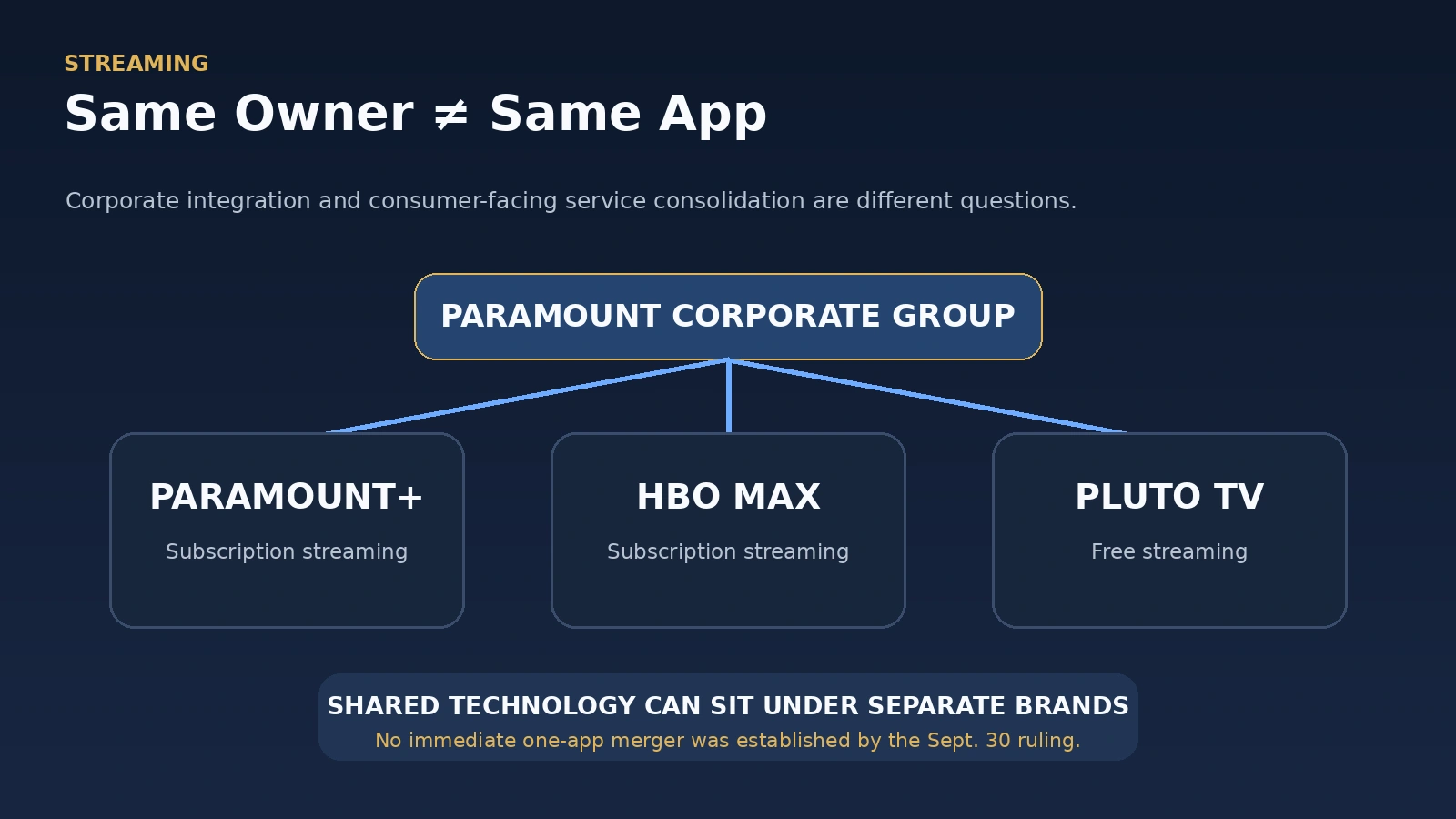
No immediate one-app conversion has been announced as part of the court approval.
Paramount’s original deal announcement described Paramount+, HBO Max and Pluto as parts of the future combined direct-to-consumer business. It also said the merger could produce savings by integrating technology, including consolidating streaming technology stacks. (Paramount)
Those are not the same thing.
A company can run multiple consumer brands on shared technology without immediately eliminating any of them.
The settlement itself also requires the merged company to continue offering a free streaming service such as Pluto TV. (California Attorney General)
So viewers should separate three questions:
Who owns the services? Paramount would own the corporate group.
Do the services share technology? Paramount has said technology integration is part of its plan.
Will HBO Max and Paramount+ become one subscription product? That has not been established by the September 30 court ruling.
Pricing, bundles, brand strategy and the long-term app lineup remain decisions to watch after closing.
What Happens to CNN and CBS News?
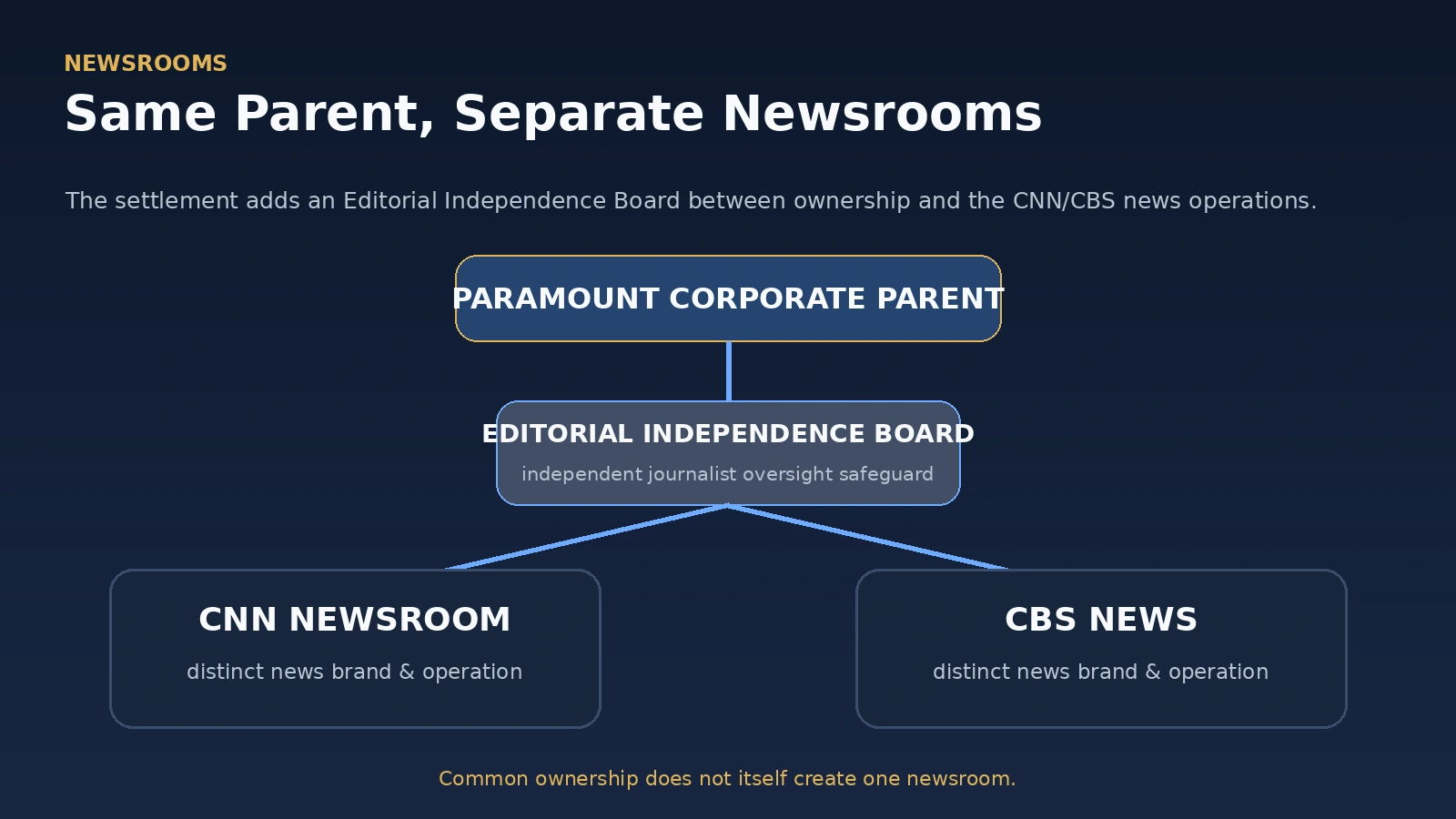
They would share a corporate parent, but the settlement specifically creates an editorial-independence safeguard.
Paramount agreed to establish a News Editorial Independence Board to help CNN and CBS maintain journalistic independence. New York’s attorney general said the board would be composed of independent journalists. AP reported that the decree calls for five active or retired journalists with at least 10 years of experience, appointed by and reporting to the combined company’s board. (New York Attorney General · AP)
That does not mean CNN becomes CBS News or CBS News becomes CNN.
They remain distinct news brands and operations unless management later announces a different structure.
It also does not guarantee that ownership will never influence broader corporate decisions. The board is a safeguard created by the settlement; how it works in practice will only become clear after the combined company begins operating under the decree.
For readers, that is probably the most important distinction: common ownership and editorial merger are not the same thing.
Why Do Some Stories Call This an $81 Billion Deal and Others Say $110 Billion?
Both numbers can be correct because they measure different things.
Paramount agreed to pay $31 in cash for each WBD share, valuing Warner Bros. Discovery’s equity at about $81 billion. The companies put the transaction’s enterprise value at about $110 billion, a broader measure that reflects the value of the business including debt. (Paramount)
Think of it like buying a house with a mortgage attached.
The value of the owner’s equity and the total economic value of the property plus its financing obligations are not necessarily the same number.
That is why one report may describe the transaction as an $81 billion merger while another uses the $110 billion enterprise-value figure.
Neither number automatically means the other one is wrong.
What Happens Next?
The next event to watch is the actual closing.
As of the September 30 court ruling, the merger had been cleared to move forward but had not yet been completed. Paramount has indicated that it intends to close quickly, with early October cited as the expected timing. (AP · Reuters)
After that, the harder work begins.
The companies have projected more than $6 billion in eventual synergies from technology integration, corporate efficiencies, procurement, real estate and other operational changes. (Paramount)
For consumers, employees and journalists, however, the most revealing announcements will be more concrete:
- Which services stay separate?
- How are HBO Max and Paramount+ positioned?
- Which cable networks remain distinct?
- Who is appointed to the News Editorial Independence Board?
- How does the company meet its theatrical-release commitments?
- Where do the promised savings come from?
The judge’s order answers the question of whether the state lawsuit still blocks the deal.
It does not answer every question about what the combined company will eventually look like.
Bottom Line: What This Story Really Means
Paramount has not simply “merged HBO, CNN and CBS into one thing.”
The September 30 ruling cleared the legal path for Paramount Skydance to complete its acquisition of Warner Bros. Discovery. If the transaction closes, CBS, HBO, CNN, Paramount+, HBO Max, Warner Bros. and many other major media properties will ultimately share the same corporate parent.
But the brands, streaming services and newsrooms remain separate operations unless management later decides otherwise.
And because 12 states challenged the concentration of so much entertainment and media power, Paramount will enter the merger under five years of court-enforceable conditions covering movie output, U.S. production spending, workers, cable negotiations, free streaming and news-editorial safeguards.
So the biggest change is not that HBO suddenly becomes CBS or CNN becomes Paramount News.
The bigger change is that an unusually large group of major U.S. movie, television, streaming and news brands would sit inside the same corporate structure.
Paramount Merger: Key Questions Explained
Q. Has Paramount already completed its purchase of Warner Bros. Discovery?
No. As of the September 30 court ruling, the deal had been cleared to move toward closing, but the companies had not yet announced that the merger itself was complete.
Q. Why is the Paramount–Warner deal sometimes valued at $81 billion and sometimes at $110 billion?
The $81 billion figure refers to WBD’s equity value under the $31-per-share offer. The approximately $110 billion figure is enterprise value, a broader measure that includes the company’s debt and other financial obligations.
Q. Does Paramount already own CBS?
Yes. CBS and CBS News are already part of Paramount. HBO and CNN currently belong to Warner Bros. Discovery.
Q. Who will control the combined company?
Warner Bros. Discovery is scheduled to become a wholly owned subsidiary of Paramount Skydance. SEC filings say that after closing, the Ellison family and RedBird will remain the sole holders of Paramount’s voting Class A shares.
Q. Will CNN and CBS News become one newsroom?
No such newsroom merger has been announced. They would share a corporate parent, while the settlement also requires a News Editorial Independence Board intended to help preserve editorial independence.
Q. Will Paramount+ and HBO Max automatically merge into one app?
No immediate consumer-facing merger of the two services has been announced. Paramount has discussed integrating streaming technology, but shared technology does not necessarily mean the brands or subscriptions immediately become one service.
Q. What happened to Warner Bros. Discovery’s plan to split HBO and CNN into separate companies?
WBD had planned to place HBO and Warner Bros. studios in one company and CNN and other networks in another. The Paramount transaction instead requires WBD to remain intact for the acquisition rather than completing that separation first.
Q. Why did the states sue to block the merger?
The 12 states alleged that combining two major film studios and major cable businesses would reduce competition and give the merged company greater bargaining power over theaters and television distributors. Paramount disputed that assessment and argued the merger would support investment and competition.
Q. What conditions did Paramount accept in the settlement?
Among other commitments, Paramount agreed to minimum annual theatrical film output, at least $1.5 billion in additional U.S. production spending over five years, a $47.5 million workforce fund, separate negotiations for Paramount and Warner cable channels, continued free streaming and editorial-independence protections for CNN and CBS.
Did this help make the story clearer? 🙂
WIN keeps unpacking the “why” behind the news—clearly and simply!
Sources
Court Approval and Antitrust Settlement
Reuters — Paramount Gets Court Green Light on Warner Bros. Deal
California Attorney General — Settlement in Warner Bros./Paramount Litigation
Reuters — Key Terms of Paramount’s Warner Bros. Discovery Settlement With U.S. States
Merger Terms, Ownership and Corporate Control
Paramount — Definitive Agreement to Acquire Warner Bros. Discovery
SEC — Warner Bros. Discovery Definitive Merger Proxy
SEC — Warner Bros. Discovery Shareholder Vote Results
SEC — Paramount Skydance June 2026 Filing on Voting Control and Merger Financing
Warner Bros. Discovery Structure and Post-Merger Leadership
Warner Bros. Discovery — Planned Separation Into Two Public Companies
Paramount — Regulatory Conditions Satisfied for Warner Bros. Discovery Acquisition
Paramount — Ynon Kreiz Named Co-CEO of the Anticipated Combined Company
New York Attorney General — Newsroom and Worker Protections in the Paramount–Warner Settlement
Keep Reading
Why does CNN’s editorial independence matter beyond this merger?
The Paramount settlement creates a new safeguard for CNN and CBS, but ownership is only one pressure point for a newsroom. This earlier WIN explainer looks at a separate fight over CNN’s ability to gather news at the White House and why access rules can raise First Amendment questions.
Can the White House Ban Entire News Organizations—and What Happens If They Sue?