
Christa Pike Survived Tennessee’s Lethal Injection—What Went Wrong, and Can the State Try Again?

How can someone receive Tennessee’s full lethal-injection sequence—including the backup dose—and still be alive afterward?
And if the state already tried to carry out the death sentence once, can it legally try again?
Those are now the two questions at the center of the Christa Pike case. Tennessee attempted to execute Pike on September 30, 2026, but she remained alive after the state administered both the primary and backup pentobarbital doses allowed by its protocol. She was taken from Riverbend Maximum Security Institution to a Nashville-area hospital. As of October 1, her lawyers said she was in critical condition and receiving “life-saving” care. (Tennessee Department of Correction · AP · Reuters)
The most important point is also the simplest: officials have not yet established why the execution failed. Tennessee says its staff followed the approved protocol. Pike’s lawyers and witnesses have described serious problems establishing IV access. What happened to the drug once it was administered—and why it did not produce the expected result—is now part of the investigation.

※ Images in this article are AI-generated illustrations created to help explain the story. They are not actual photographs, and depictions of people, places, or events may differ slightly from reality.
What Actually Happened on September 30?
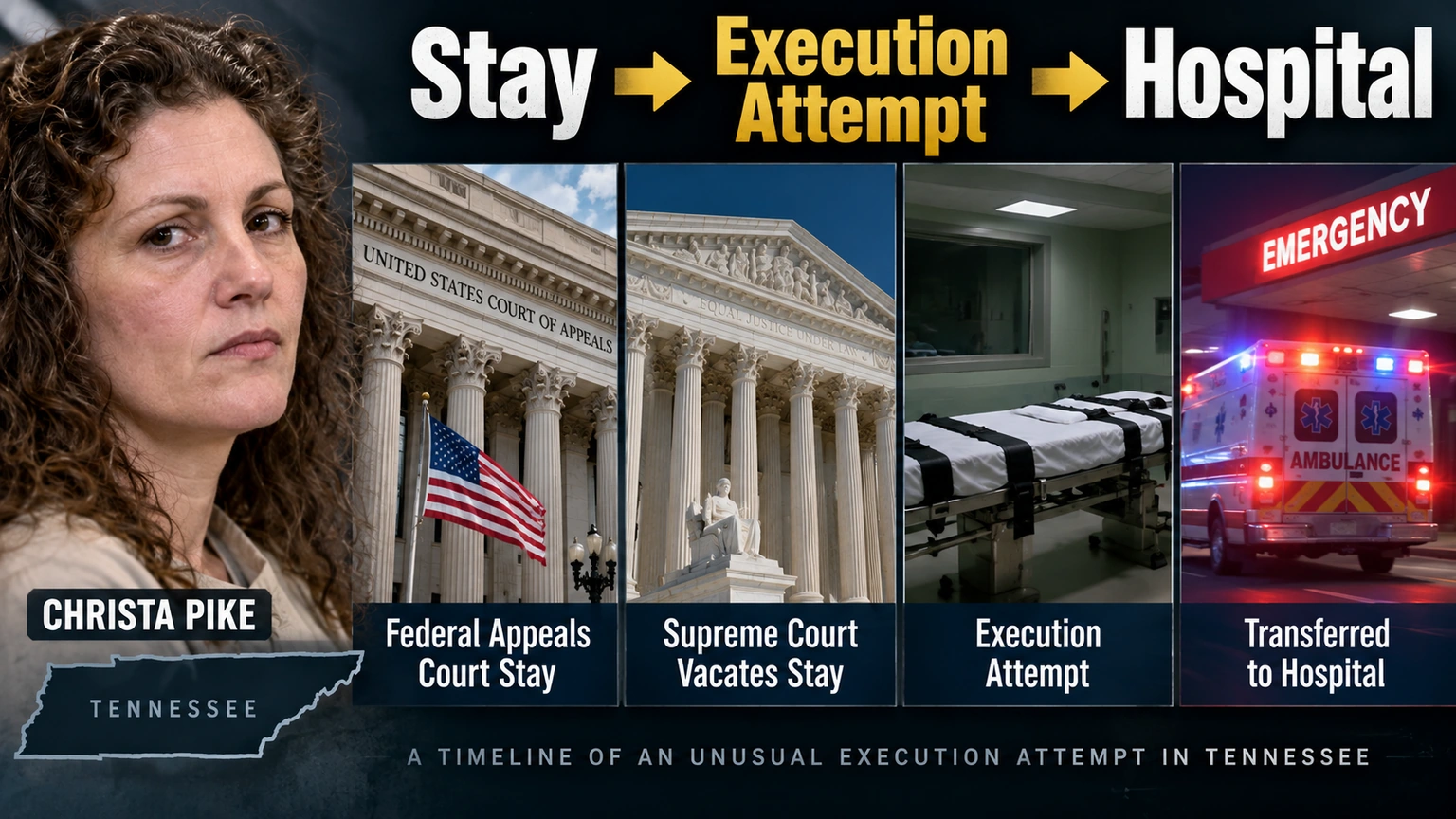
Pike’s execution was originally scheduled for the morning of September 30. About an hour before the planned time, the U.S. Court of Appeals for the Sixth Circuit issued a stay so it could consider a pending legal challenge. Later that day, the U.S. Supreme Court vacated the stay, clearing the legal obstacle that had temporarily stopped the execution. The Supreme Court did not decide the merits of all of Pike’s underlying claims; it removed that particular stay. (U.S. Supreme Court)
Tennessee then proceeded that evening at Riverbend Maximum Security Institution in Nashville. Witnesses reported difficulty establishing IV access. The state ultimately administered the primary pentobarbital sequence and, because Pike remained alive, the backup sequence contemplated by the protocol. She continued breathing and was later transported by ambulance for medical care. (AP · Reuters)
Tennessee’s Department of Correction issued a late-night statement saying it had followed every step of the state’s established execution protocol and that the protocol did not permit additional procedures beyond what had already been done. (Tennessee Department of Correction)
Pike, 50, was sentenced to death for the 1995 murder of 19-year-old Colleen Slemmer, a fellow student at a Job Corps program in Knoxville. Pike was 18 at the time of the crime. Had the execution been completed, she would have been the first woman executed by Tennessee in more than 200 years. (AP)
So Why Did the Lethal Injection Fail?
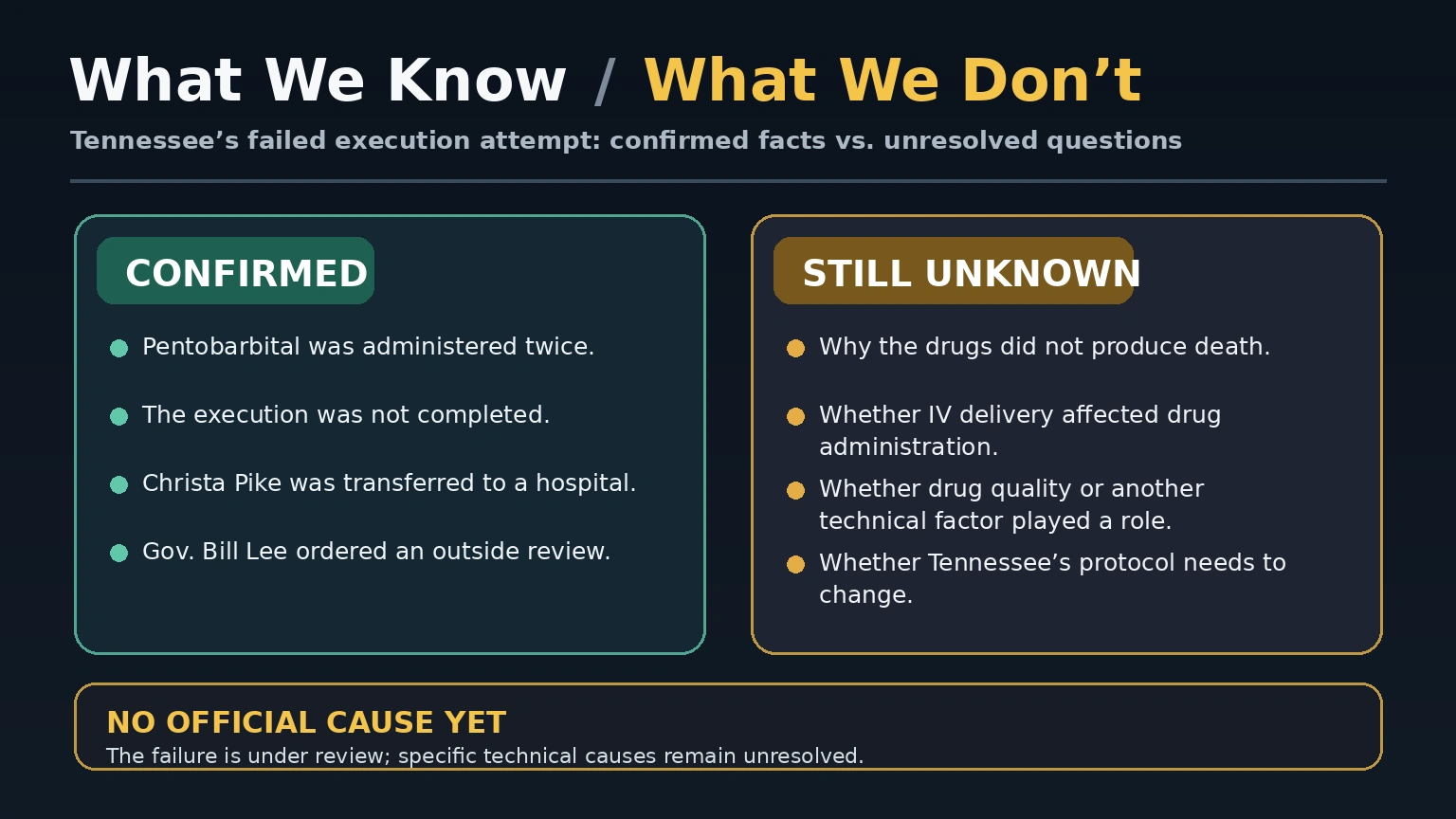
No confirmed explanation is available yet. That is why Governor Bill Lee ordered an outside review rather than announcing a cause immediately after the failed execution. (Reuters)
What is confirmed is unusually stark:
| What is confirmed | What is still unresolved |
|---|---|
| The execution team had difficulty establishing IV access. | Whether both drug sequences reached Pike’s bloodstream exactly as intended. |
| Tennessee says it followed the approved protocol. | Whether a problem with the IV lines affected drug delivery. |
| The protocol’s primary and backup pentobarbital sequences were administered. | Whether drug quality, preparation or another technical factor played any role. |
| Pike remained alive and required hospital care. | Whether Pike’s medical conditions materially affected what happened. |
Pike’s attorneys had warned before the execution that she had unusually difficult venous access and medical issues that could complicate the procedure. After the failed attempt, AP reported multiple needle marks and continuing questions about whether the IV process functioned as intended. Those facts make IV delivery an obvious area for investigators to examine, but they do not yet establish that IV failure was the sole cause. (AP)
That distinction matters. A headline can easily turn “there were IV problems” into “the IV problems caused the survival.” The first is supported by reporting. The second is still an investigative conclusion that has not been reached.
How Is Tennessee’s Lethal-Injection Protocol Supposed to Work?
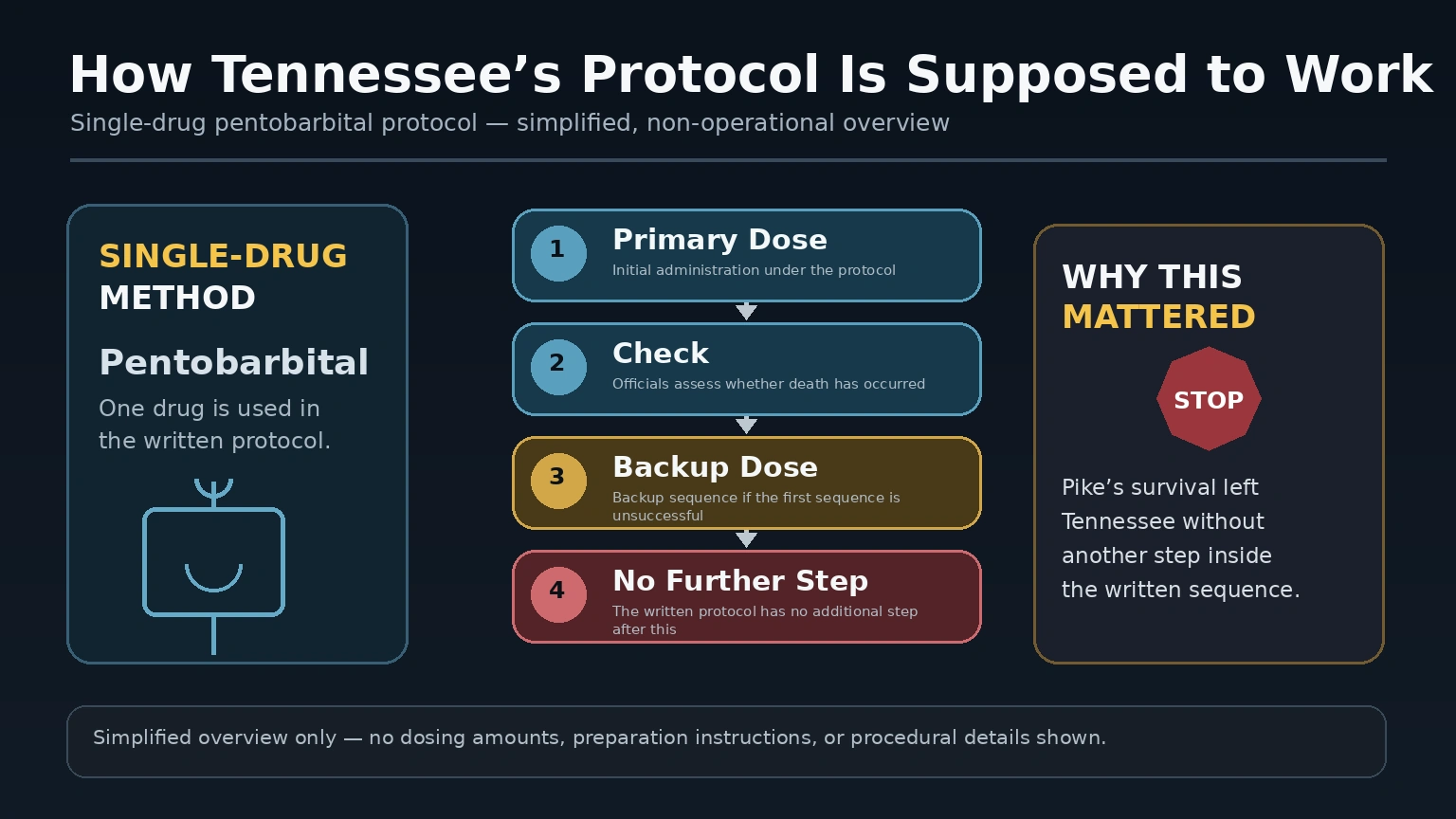
Tennessee moved to a revised single-drug pentobarbital protocol in December 2024 after executions had been paused and the Department of Correction reviewed its procedures. The Tennessee Supreme Court is responsible for setting execution dates, while the Department of Correction carries out the execution under its protocol. (Tennessee Department of Correction)
Pentobarbital is a powerful barbiturate. In an execution protocol, the state uses a quantity intended to produce profound unconsciousness and then stop vital functions. Tennessee’s written process includes a primary drug sequence and a backup sequence if the prisoner has not died. (AP)
Pike’s case exposed the gap at the end of that flowchart. After the backup sequence was used and she was still alive, the Department of Correction said there was no additional step authorized by the protocol. The execution could not simply continue improvising new procedures. (Tennessee Department of Correction)
That is one reason this case is so unusual: the question is not merely why the state could not start the execution. It is why the execution did not produce death after the protocol had progressed to its final authorized drug step.
Why Is Pike’s Case Different From Tennessee’s Other Failed Execution This Year?
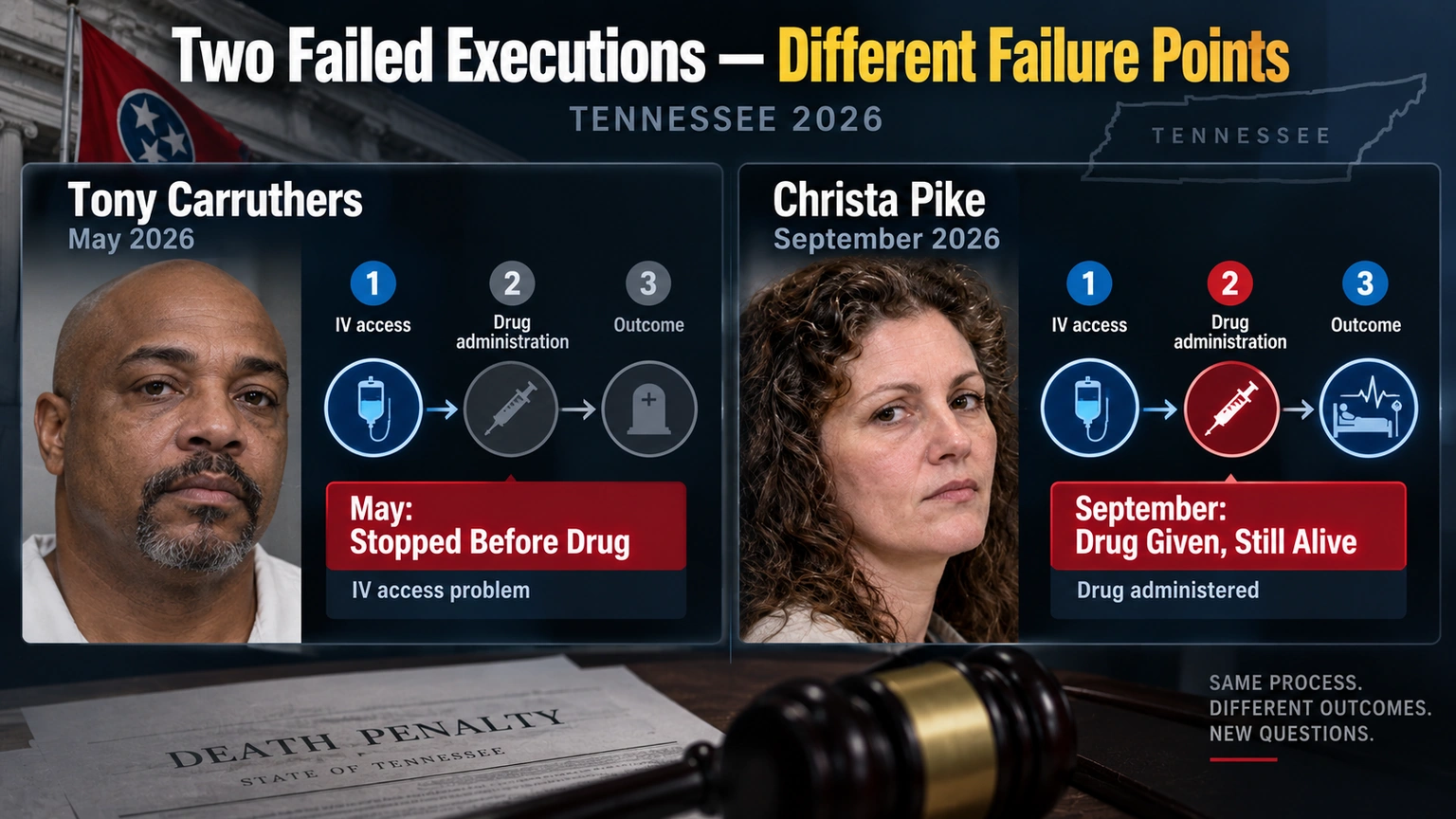
Because Tennessee had already failed to execute another prisoner just four months earlier.
On May 21, 2026, the state called off the execution of Tony Carruthers after staff could not establish the required backup IV access despite prolonged attempts. The lethal drug was not administered, and Governor Lee granted Carruthers a one-year reprieve. (AP · Tennessee Governor)
Pike’s case went further.
| May 2026 — Tony Carruthers | September 2026 — Christa Pike |
|---|---|
| Execution stopped during IV-access stage. | Execution proceeded through drug administration. |
| Required backup access could not be established. | Primary and backup pentobarbital sequences were administered. |
| No completed lethal-drug administration. | Pike remained alive after the drug protocol was exhausted. |
| One-year reprieve for Carruthers. | Hospitalization, statewide pause and third-party review. |
That difference is why Pike’s survival has drawn such intense legal and medical scrutiny. Failed executions caused by an inability to establish IV access have happened before. AP reported that Pike’s case may be unprecedented in modern U.S. practice because she survived after the execution drugs themselves had been administered. (AP)
Can Tennessee Try to Execute Christa Pike Again?
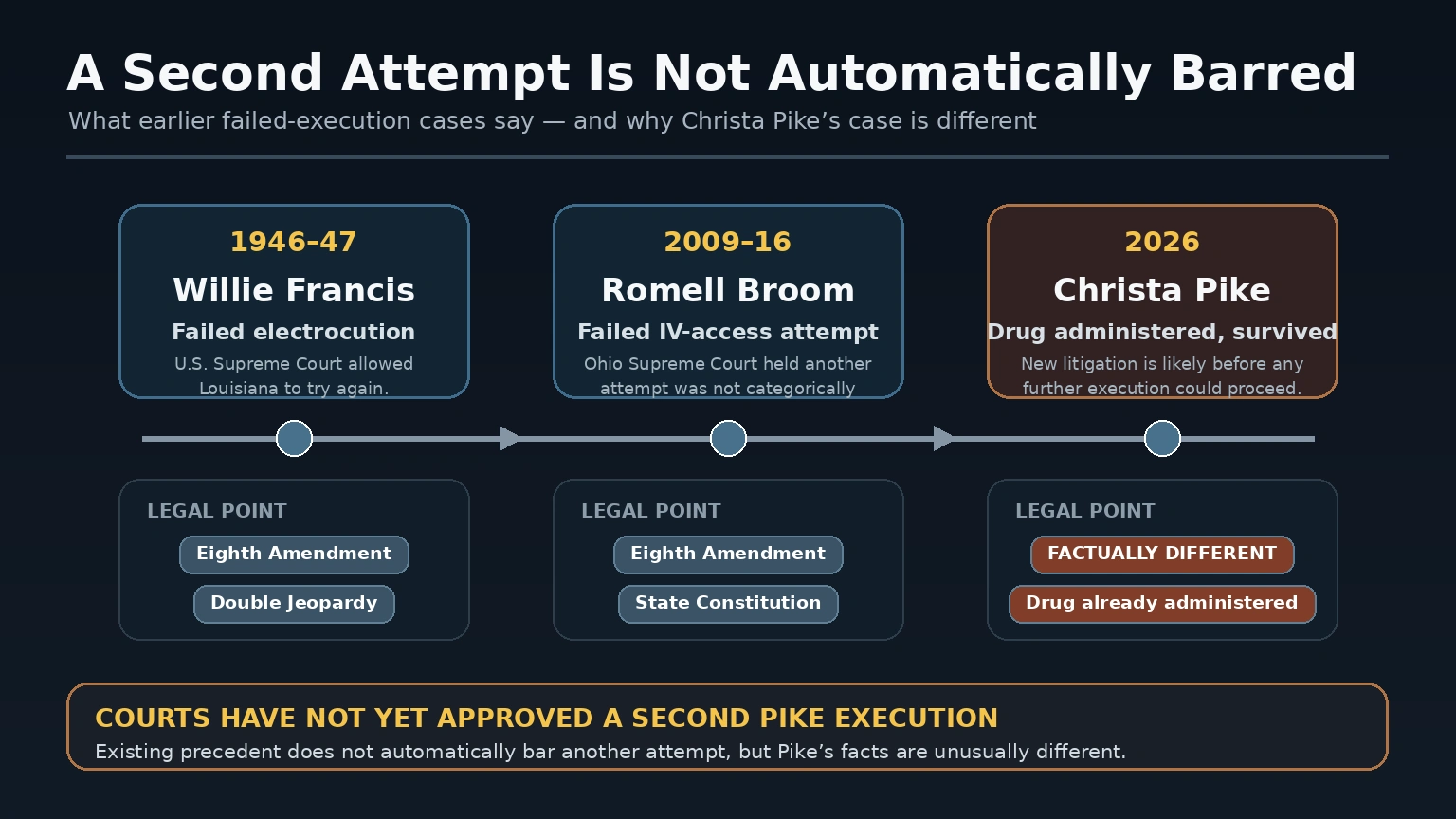
Potentially—but not now, and not without new legal proceedings. Existing U.S. precedent does not create an automatic constitutional rule that a failed execution permanently cancels a death sentence.
The key historical case is Louisiana ex rel. Francis v. Resweber from 1947. Willie Francis survived a failed electrocution after the electric chair malfunctioned. The U.S. Supreme Court allowed Louisiana to attempt the execution again, rejecting the argument that a second attempt was automatically barred by double jeopardy or the Eighth Amendment. (U.S. Reports via Library of Congress)
A more recent example is Romell Broom in Ohio. In 2009, officials abandoned his execution after repeated failures to establish usable IV access. In 2016, the Ohio Supreme Court held that another execution attempt was not categorically barred by the federal or state constitutions. Broom died of natural causes in prison before Ohio carried out another attempt. (Supreme Court of Ohio)
But Pike’s case is not identical to either precedent. Tennessee says it moved beyond IV preparation and administered the execution drug under both the primary and backup portions of its protocol. Her lawyers are therefore expected to argue that subjecting her to another execution attempt after the medical consequences of the first one would raise a different Eighth Amendment question. (Reuters)
So the accurate answer is not “Tennessee can definitely execute her again” or “Tennessee is legally forbidden from trying again.” The stronger answer is: a second attempt is not automatically barred by existing precedent, but Pike’s unusual facts create new constitutional arguments that courts may have to resolve.
What Does Governor Bill Lee’s Pause Actually Change?
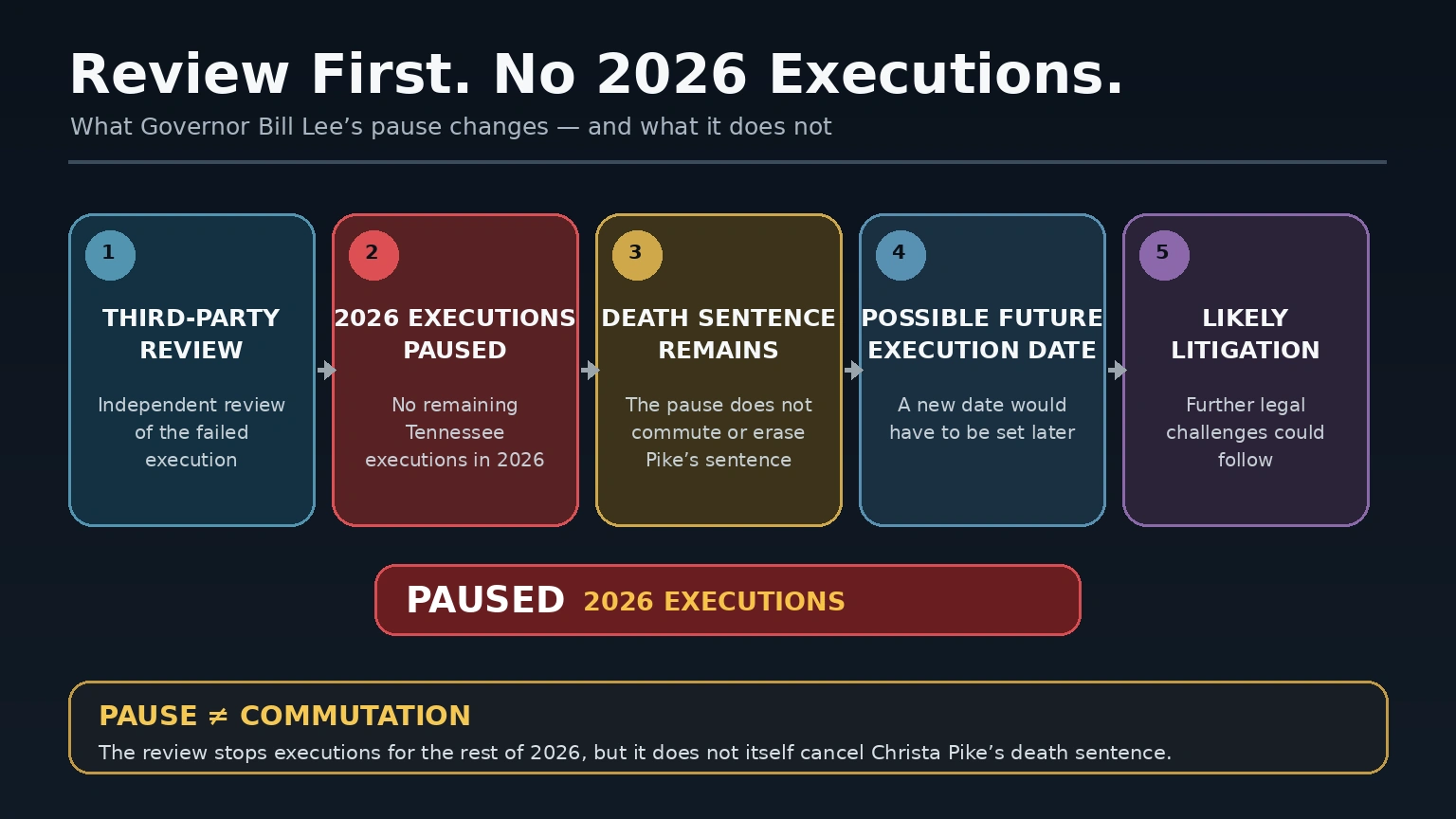
Governor Lee’s action stops Tennessee executions for the rest of 2026 and orders a third-party review of what happened. It does not commute Pike’s death sentence to life imprisonment, and it does not by itself vacate the judgment against her. (Reuters · AP)
Pike’s September 30 execution date had been set by the Tennessee Supreme Court. That date has now passed without the sentence being completed. Tennessee’s own Department of Correction explains that the state supreme court is responsible for scheduling execution dates, so any future attempt would require another date to be set after the current pause and whatever legal challenges follow. (Tennessee Supreme Court · Tennessee Department of Correction)
The pause also affects the broader Tennessee system. Gary Wayne Sutton had been scheduled for execution in December 2026, but Lee’s order means that execution will not go forward this year while the review is underway. (Tennessee Supreme Court · Reuters)
The practical sequence now looks like this: determine what failed, decide whether the protocol must change, address Pike’s medical condition and new constitutional claims, and only then confront the question of whether Tennessee will seek another execution date.
Why Does This Case Matter Beyond One Prisoner?
The Pike case puts three separate questions into the same story: whether Tennessee can reliably carry out its own protocol, whether a person can constitutionally be subjected to another execution after surviving drug administration, and what a state should do when its written procedure reaches the end without producing the result it was designed to produce.
Those questions exist regardless of how someone views Pike’s crime or the death penalty itself.
For the victim’s family, the case comes after more than three decades of litigation and an execution date they expected would bring the criminal sentence to completion. For Pike’s lawyers, the failed execution is now evidence they will use to argue that another attempt would expose her to unconstitutional suffering. For Tennessee, the immediate issue is administrative and legal: the state must explain how an execution reached the protocol’s final step and still ended with the prisoner being taken to a hospital. (AP · Reuters)
That is why the next important news may not be a new execution date. It may be the findings of the independent review—and whether those findings show a problem with IV access, drug delivery, the protocol itself, or some combination that has not yet been established.
Bottom Line: What This Story Really Means
Christa Pike survived Tennessee’s September 30 execution attempt after the state administered the primary and backup pentobarbital sequences allowed by its lethal-injection protocol. No official investigation has yet determined why she survived, and she remained in critical condition under hospital care as of October 1.
The failed attempt does not automatically erase her death sentence. U.S. precedent has allowed states to try again after failed executions, but Pike’s case is unusually different because the execution drug was actually administered and she survived. Tennessee has now paused all executions for the rest of 2026, ordered an outside review, and left the next legal question for another day: whether the state will seek a new execution date—and whether courts will permit another attempt under these facts.
Christa Pike: Key Questions Explained
Q. Did Christa Pike survive a lethal-injection execution attempt?
Yes. Tennessee attempted to execute Pike on September 30, 2026, but she remained alive after the protocol’s primary and backup pentobarbital sequences and was taken to a hospital.
Q. What is Christa Pike’s condition now?
As of October 1, her lawyers said she was in critical condition and receiving life-saving medical care. Tennessee had not publicly provided a detailed medical prognosis.
Q. Why did the lethal injection fail?
That has not been officially determined. IV-access problems were documented, but investigators have not yet established whether drug delivery, the IV lines, the drug itself, Pike’s medical condition or another factor caused the failure.
Q. What drug did Tennessee use in the execution attempt?
Tennessee uses pentobarbital as the single drug in its current lethal-injection protocol. The protocol includes a primary sequence and a backup sequence if the prisoner has not died.
Q. Did Tennessee say it followed its execution protocol?
Yes. The Tennessee Department of Correction said it followed every step of the established protocol and that the protocol did not authorize additional procedures after the steps already taken.
Q. Can Tennessee legally try to execute Christa Pike again?
Possibly. Existing U.S. precedent does not automatically prohibit a second execution attempt after a failed one, but Pike’s case presents unusual facts that are likely to generate new Eighth Amendment litigation.
Q. Would a second attempt violate double jeopardy?
Not automatically under existing Supreme Court precedent. In Francis v. Resweber, the Court allowed Louisiana to make a second execution attempt after the first failed, although Pike’s case differs because Tennessee administered lethal-injection drugs before the execution was stopped.
Q. Has Governor Bill Lee commuted Pike’s death sentence?
No. Lee paused executions for the rest of 2026 and ordered a third-party review, but that is not the same as commuting Pike’s sentence to life imprisonment.
Q. What has to happen before Tennessee could try again?
Under the current pause, Tennessee would first have to complete or otherwise lift the review-related halt, address Pike’s new legal challenges, and obtain another execution date from the Tennessee Supreme Court if the state decides to seek one.
Did this help make the story clearer? 🙂
WIN keeps unpacking the “why” behind the news—clearly and simply!
Sources
Failed Execution and Current Medical Status
Tennessee Department of Correction — Media Advisory: Christa Pike #261368
AP — Christa Pike Is in Critical Condition After Tennessee’s Failed Execution Attempt
Reuters — Christa Pike Gets “Life-Saving Medical Care” After Surviving Tennessee Execution
Tennessee Protocol and 2026 Execution Failures
Tennessee Department of Correction — TDOC Completes Lethal Injection Protocol Review
AP — The Drug Used in Tennessee’s Failed Execution Has Come Under Past Scrutiny
AP — Tennessee Fails to Execute Tony Carruthers After IV Difficulties
Tennessee Governor — Gov. Lee Grants Temporary Reprieve for Tony Von Carruthers
Court Orders and Second-Attempt Precedent
U.S. Supreme Court — Nelsen v. Pike, Order Vacating Stay
Tennessee Supreme Court — Order Setting Christa Pike’s Execution Date
Library of Congress — U.S. Reports: Francis v. Resweber, 329 U.S. 459 (1947)