How Did DNA Solve a Ted Bundy Murder Case After 52 Years?

Why would police still be investigating a murder connected to Ted Bundy decades after his execution?
For years, investigators suspected Bundy in the 1974 killing of Melissa Ann Smith, a 17-year-old from Utah. But suspicion was not the same as an officially resolved case. Then, evidence from a different teenager’s murder gave detectives a way to revisit what had been preserved from Smith’s body.
On October 27, 2026—exactly 52 years after Smith was found—Utah authorities announced that they had closed her homicide investigation and attributed her death to Bundy. The breakthrough came from connecting DNA evidence across two old cases, not from a new confession or a new criminal trial. (AP · KPCW)
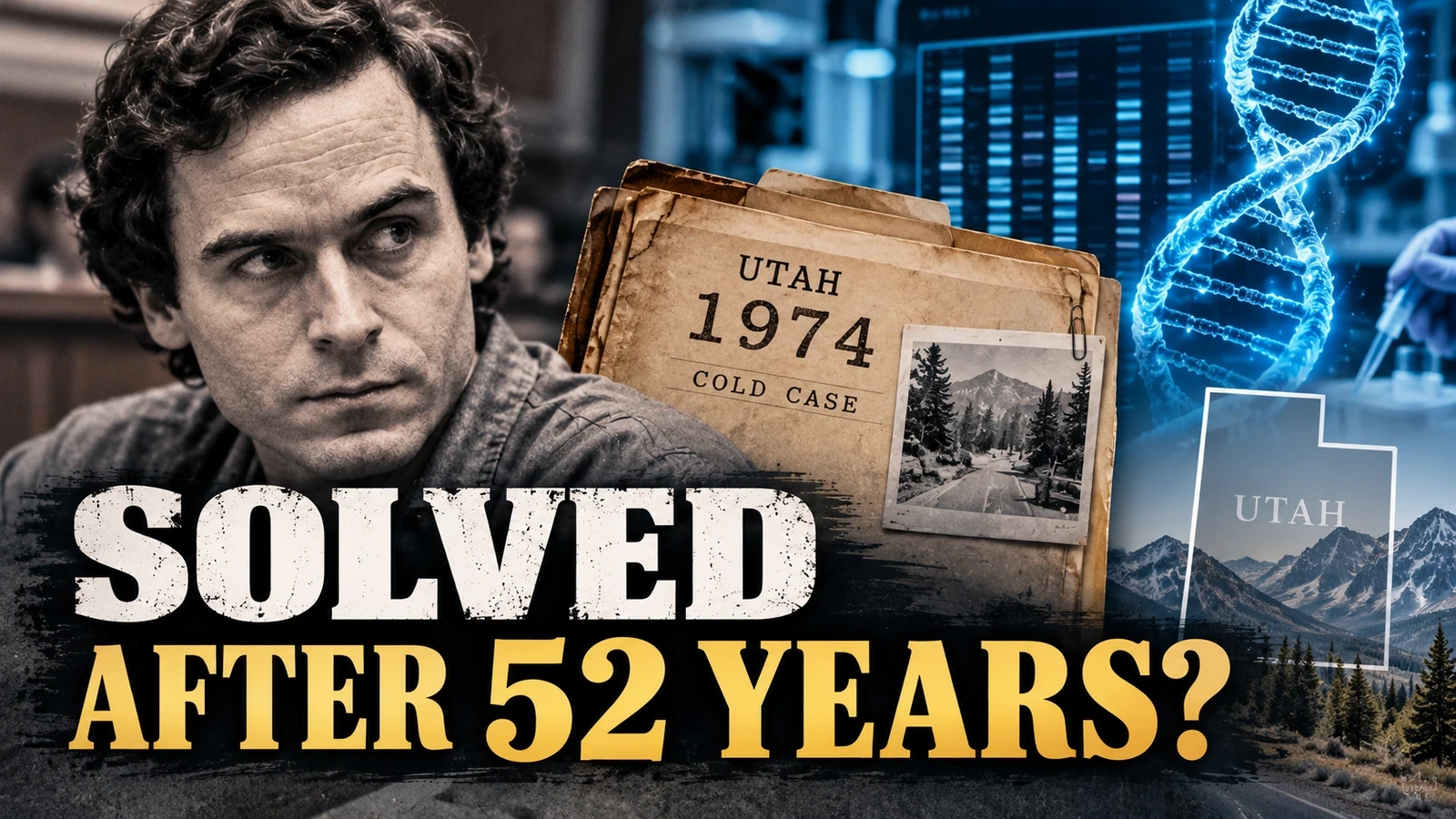
※ Images in this article are AI-generated illustrations created to help explain the story. They are not actual photographs, and depictions of people, places, or events may differ slightly from reality.
The important question is how investigators turned that long-standing suspicion into a finding they were prepared to stand behind.
What Happened to Melissa Ann Smith in 1974?
Smith disappeared on October 18, 1974, after going out in the Midvale area, south of Salt Lake City. On October 27, a hunter discovered her body in a wooded area of Summit County. Her father, Louis Smith, was Midvale’s police chief at the time. (The Salt Lake Tribune · KPCW)
Bundy’s name had been considered in connection with her death for decades. Yet the authorities did not formally name him as the killer or close the investigation in 1974. As Summit County Sheriff Kacey Bates explained at the October 2026 announcement, speculation about a suspect was not enough to finish the case. (KPCW)
That distinction matters: a notorious suspect may seem like an obvious explanation, but investigators still need evidence connecting that person to the particular crime.
How Did DNA From Another Bundy Case Provide the Missing Link?
The crucial connection ran through Laura Ann Aime, another 17-year-old murdered in Utah in 1974. In April 2026, the Utah County Sheriff’s Office announced that renewed testing of evidence in Aime’s case had linked DNA from her body to Bundy’s known DNA profile held in Florida. Officials closed her homicide investigation. (Utah County Sheriff’s Office · Reuters)
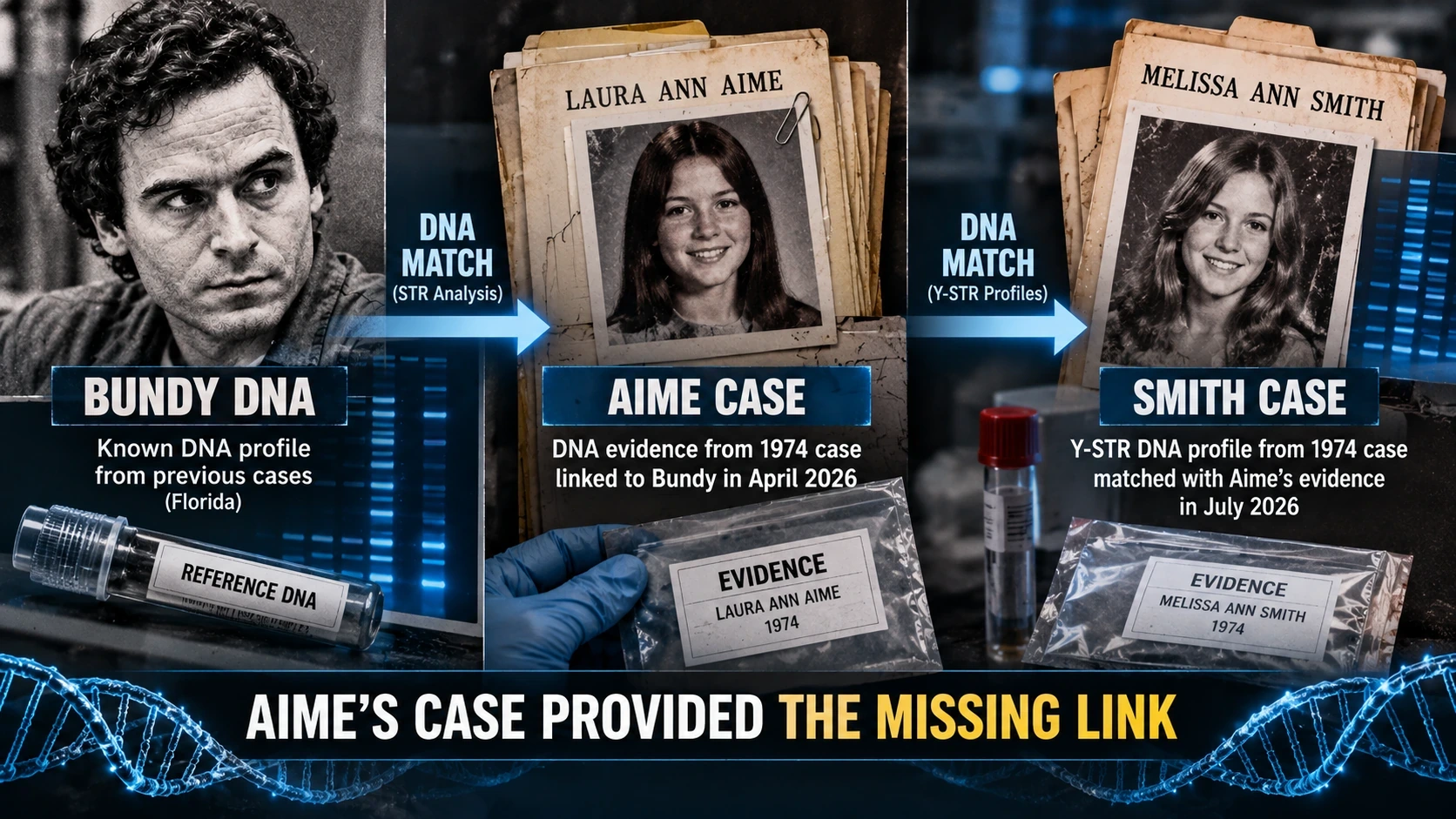
That earlier result gave investigators something useful to compare with surviving evidence from Smith’s case. On July 14, the Utah State Crime Lab found that Y-STR DNA profiles from the two cases matched. The combined findings were presented to the Summit County Attorney’s Office on October 7, before the public announcement on October 27. (The Salt Lake Tribune · USA TODAY)
The sequence is important. The April breakthrough established the DNA connection in Aime’s case. The July comparison linked biological evidence in Smith’s case to that evidence. Investigators then evaluated the DNA alongside other facts about how the crimes occurred.
Why Did This Take 52 Years?
The evidence was old, but the tools available to examine it had changed. Utah’s crime lab adopted forensic capabilities in 2023 that could work with smaller, degraded or mixed DNA samples—material that can be difficult to interpret using older methods. The decision to preserve evidence allowed investigators to test it again as those methods improved. (AP)
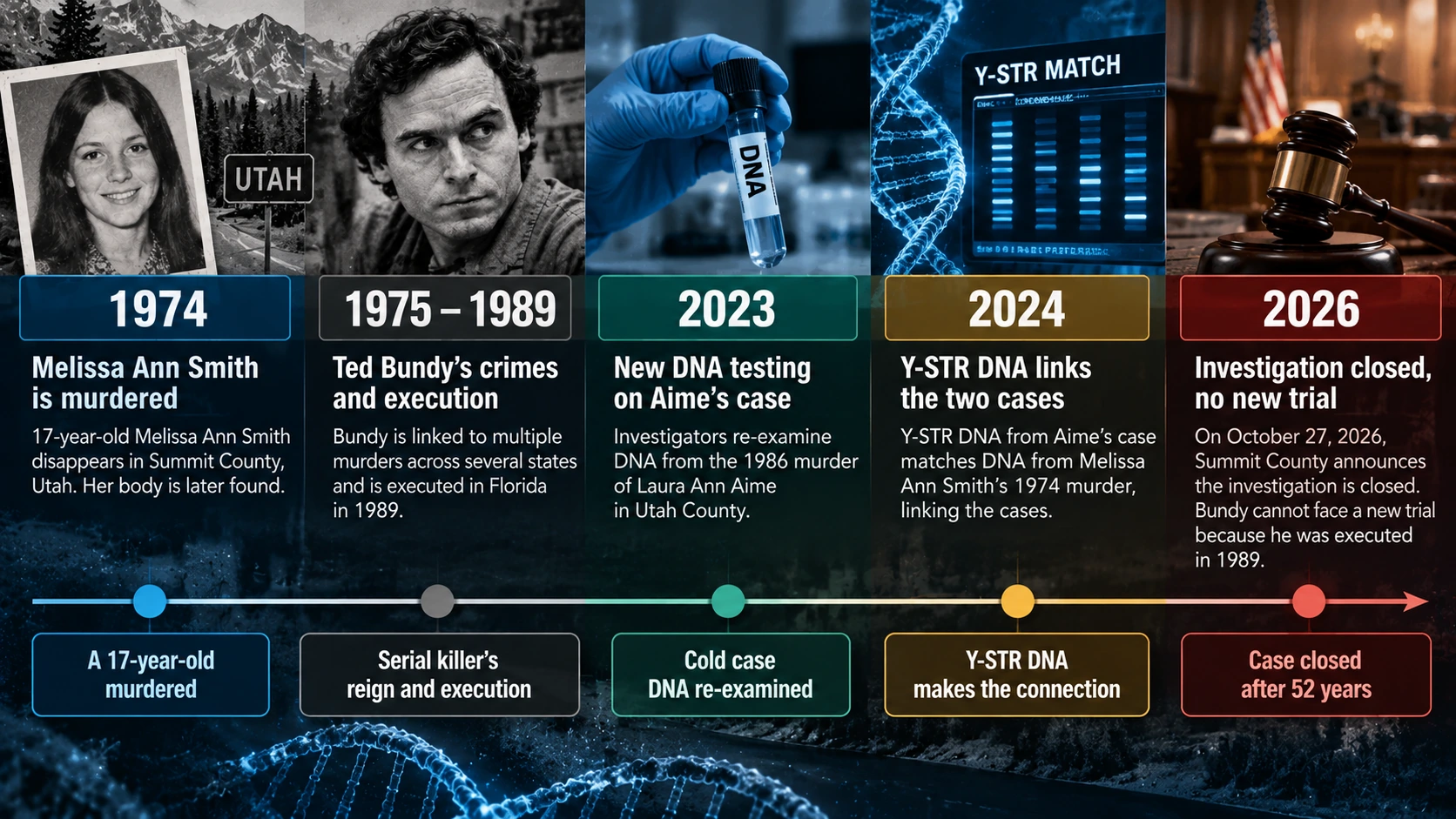
| Date | Why It Matters |
|---|---|
| October 1974 | Smith disappears and is found dead nine days later. |
| January 1989 | Bundy is executed in Florida; Smith’s case remains unresolved. |
| April 1, 2026 | Utah County announces that DNA evidence identifies Bundy in Aime’s 1974 murder. |
| July 14, 2026 | Analysts match Y-STR profiles recovered in the Aime and Smith investigations. |
| October 7, 2026 | The combined findings are presented for county attorney review. |
| October 27, 2026 | Summit County announces that Smith’s homicide investigation is closed. |
This was not a case where detectives suddenly discovered that Bundy had once been a suspect. They had known that possibility for years. What changed was their ability to test old biological evidence and connect it to a separate investigation that had acquired a stronger scientific foundation. (The Salt Lake Tribune · Utah County Sheriff’s Office)
Does a Y-STR DNA Match Prove One Person’s Identity?
Not by itself. Y-STR testing examines markers on the Y chromosome, which is passed down through the paternal line. That makes it useful for detecting and comparing male DNA in difficult evidence samples, but male relatives in the same paternal line can share a Y-STR profile. The FBI explicitly warns that Y-chromosome analysis alone cannot uniquely identify one individual. (FBI Laboratory)
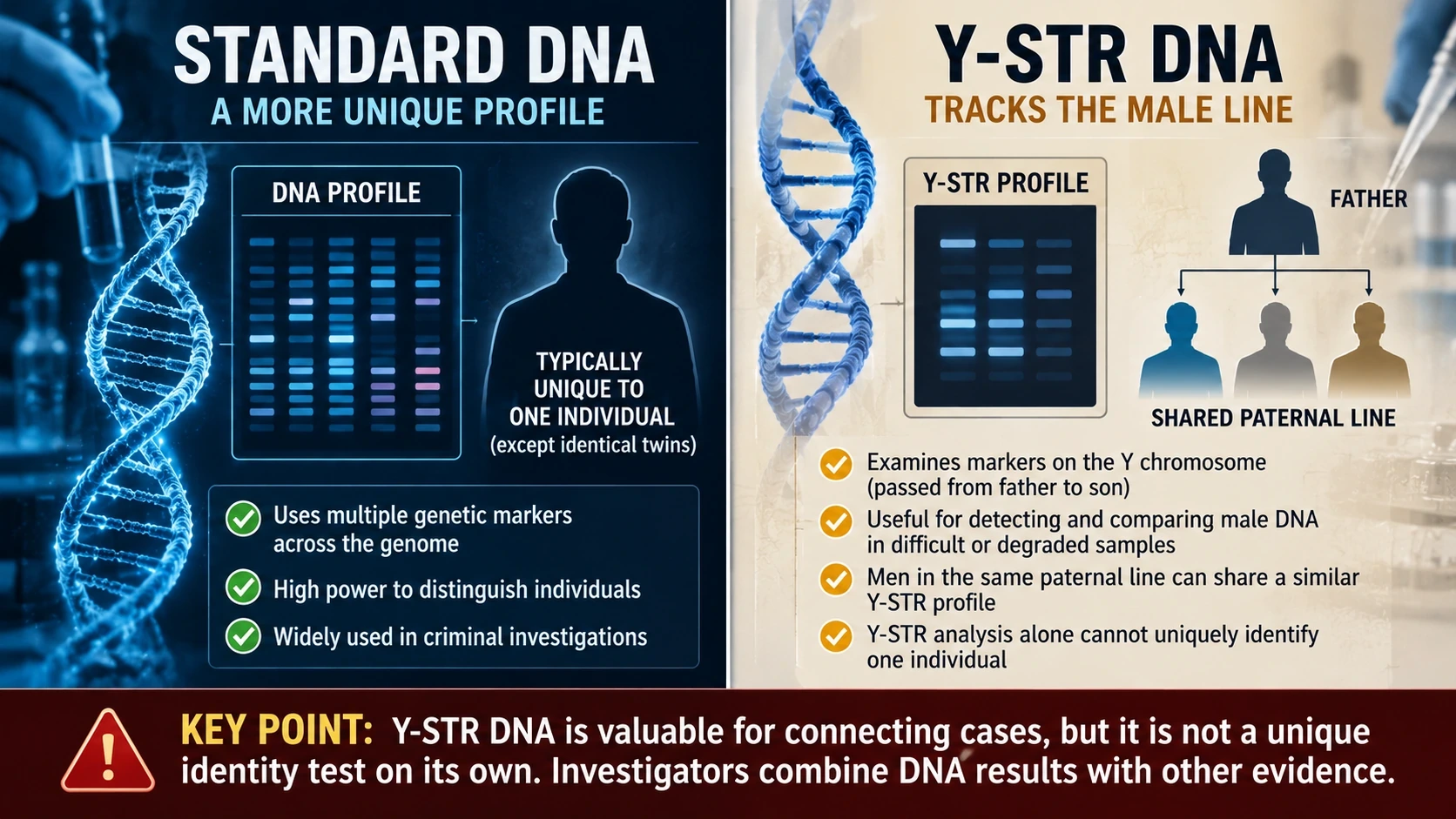
That does not invalidate Summit County’s conclusion. The Aime investigation had already connected evidence to Bundy’s known reference profile. In Smith’s case, prosecutors said they considered the new genetic comparison together with evidence involving pattern, motive, means and opportunity before attributing the killing to him. (KPCW · AP)
The distinction is between a genetic link that helps investigators connect cases and the broader investigative judgment about who committed a crime.
Does Closing the Case Mean Bundy Was Convicted of Smith’s Murder?
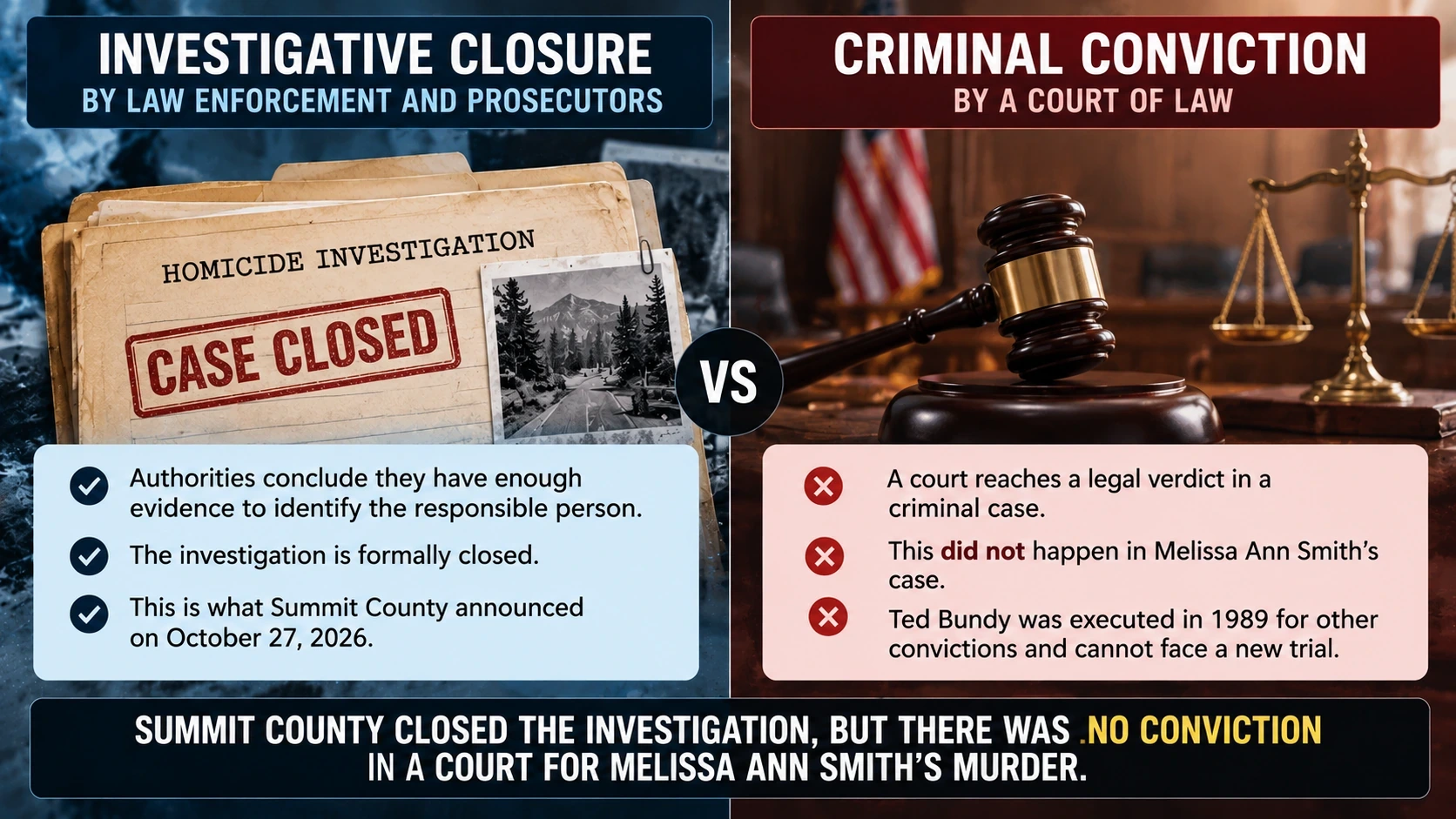
No. Summit County closed its investigation and formally attributed Smith’s death to Bundy; a court did not convict him of her murder. Bundy was executed in Florida on January 24, 1989, after convictions in other cases. He cannot face a new criminal trial. (AP)
| Investigative Closure | Criminal Conviction |
|---|---|
| Authorities determine they have enough evidence to identify the responsible person and close the file. | A court reaches a legal verdict in a criminal case. |
| This is what Summit County announced on October 27, 2026. | This did not happen in Smith’s case. |
For Smith’s family, the announcement provides an official account of responsibility after more than half a century. It does not reverse the loss, produce a new sentence or turn the investigative finding into a jury verdict. Authorities said Smith’s surviving relatives had been informed of the results. (The Salt Lake Tribune · AP)
Could DNA Help Resolve Other Unanswered Bundy Cases?
Possibly, when usable evidence survives and investigators can establish a reliable connection. But a confirmed link in one homicide does not automatically resolve every disappearance associated with Bundy.
Utah investigators said they are continuing to examine the case of Nancy Wilcox, a 16-year-old who disappeared in 1974. Detective Ben Pender emphasized that Bundy’s involvement in her case remains uncertain. Smith’s case is closed; Wilcox’s is not. (AP · KPCW)
That is also why evidence preservation matters beyond any single high-profile killer. A sample collected decades ago may become useful when scientific methods improve—but each investigation still needs its own evidentiary basis.
Bottom Line: What This Story Really Means
The Melissa Ann Smith murder investigation did not close because authorities finally decided to believe an old suspicion. It closed because DNA evidence from Laura Ann Aime’s case provided a new connection to Smith’s preserved evidence, and officials combined that result with the broader circumstances of the crime.
October 27, 2026, marked an official investigative conclusion 52 years after Smith’s body was found—not a new conviction. The larger lesson is that old evidence can still answer difficult questions, provided it is preserved, properly tested and interpreted with care.
Ted Bundy DNA: Key Questions Explained
Q. Who was Melissa Ann Smith?
Melissa Ann Smith was a 17-year-old from Midvale, Utah, who disappeared on October 18, 1974. Her body was discovered nine days later in Summit County.
Q. Why did authorities reopen the evidence after so many years?
Improved forensic testing made it possible to examine older biological samples, while the DNA breakthrough in Laura Ann Aime’s case provided a new comparison.
Q. What did Laura Ann Aime’s case have to do with Smith’s murder?
Evidence from Aime’s case had been linked to Bundy’s reference DNA. Investigators then found matching Y-STR profiles in evidence from the Aime and Smith cases.
Q. Can Y-STR DNA identify Ted Bundy on its own?
No. Y-STR profiles can be shared by men in the same paternal line. Investigators relied on the genetic findings alongside other case evidence.
Q. Was Ted Bundy ever convicted of killing Melissa Ann Smith?
No. Authorities attributed Smith’s murder to Bundy and closed the investigation in 2026, decades after his execution, but there was no conviction in her case.
Q. Why was October 27, 2026, significant?
It was exactly 52 years after Smith’s body was discovered and the day Summit County publicly announced that her homicide investigation was closed.
Q. Are investigators still looking into other possible Bundy victims?
Yes. Officials specifically said the Nancy Wilcox case remains under investigation, with Bundy’s responsibility not established.
Did this help make the story clearer? 🙂 WIN keeps unpacking the “why” behind the news—clearly and simply!
Sources
The 2026 Smith Case Announcement and Timeline
Associated Press — DNA Links Bundy to Melissa Ann Smith’s 1974 Killing
The Salt Lake Tribune — Utah Authorities Close the Melissa Ann Smith Case
KPCW — Reporting From the October 27, 2026, News Conference
Earlier Evidence and the Laura Ann Aime Investigation
Utah County Sheriff’s Office — Laura Ann Aime Homicide Case Closure
Reuters — April 2026 DNA Finding in the Aime Case
How Forensic DNA Comparisons Work
FBI Laboratory — DNA Casework and the Limits of Y-Chromosome Testing