Why Was Luigi Mangione’s Arrest Bodycam Released Nearly Two Years Later—and Does It Matter to His Case?

Wasn’t Luigi Mangione arrested back in 2024?
So why are people only now seeing the full police bodycam from that arrest?
And if the video shows officers questioning him, searching his belongings and discovering crucial evidence, does its release suddenly change the criminal case?
The most important answer comes first: the footage is newly public, but it is not newly discovered evidence. Judges and lawyers had already examined large portions of it during earlier suppression fights over what police could legally search and which statements prosecutors could use.
On October 2, 2026, recordings from Mangione’s December 9, 2024 arrest in Altoona, Pennsylvania, were unsealed after news organizations sought public access. The footage covers the McDonald’s encounter, the arrest, the trip to the police station and later searches there. (AP · ABC News)
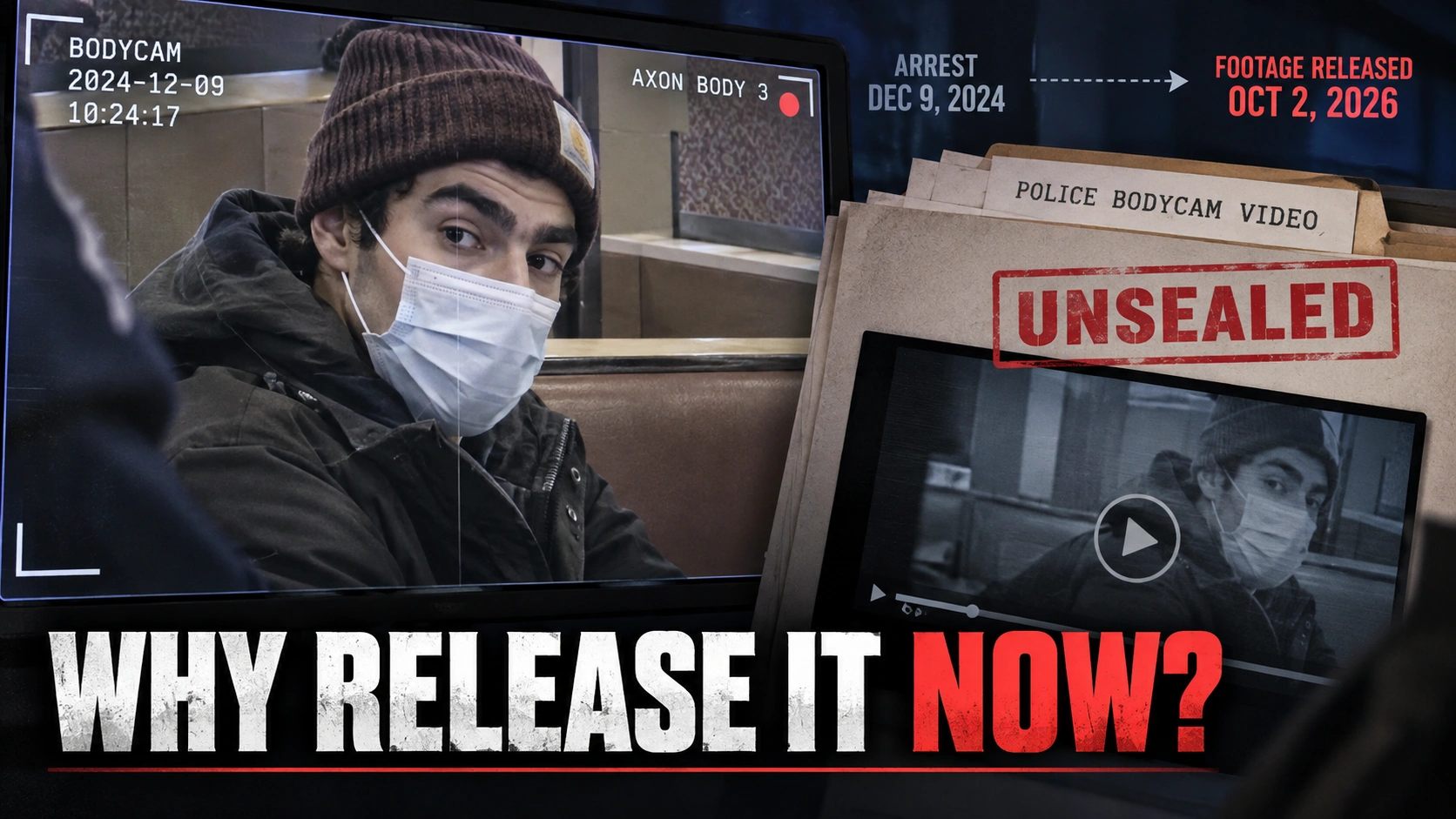
※ Images in this article are AI-generated illustrations created to help explain the story. They are not actual photographs, and depictions of people, places, or events may differ slightly from reality.
That distinction—new to the public, but not new to the courts—is what makes the latest headline easier to understand.
What Was Released on October 2—and Why Now?
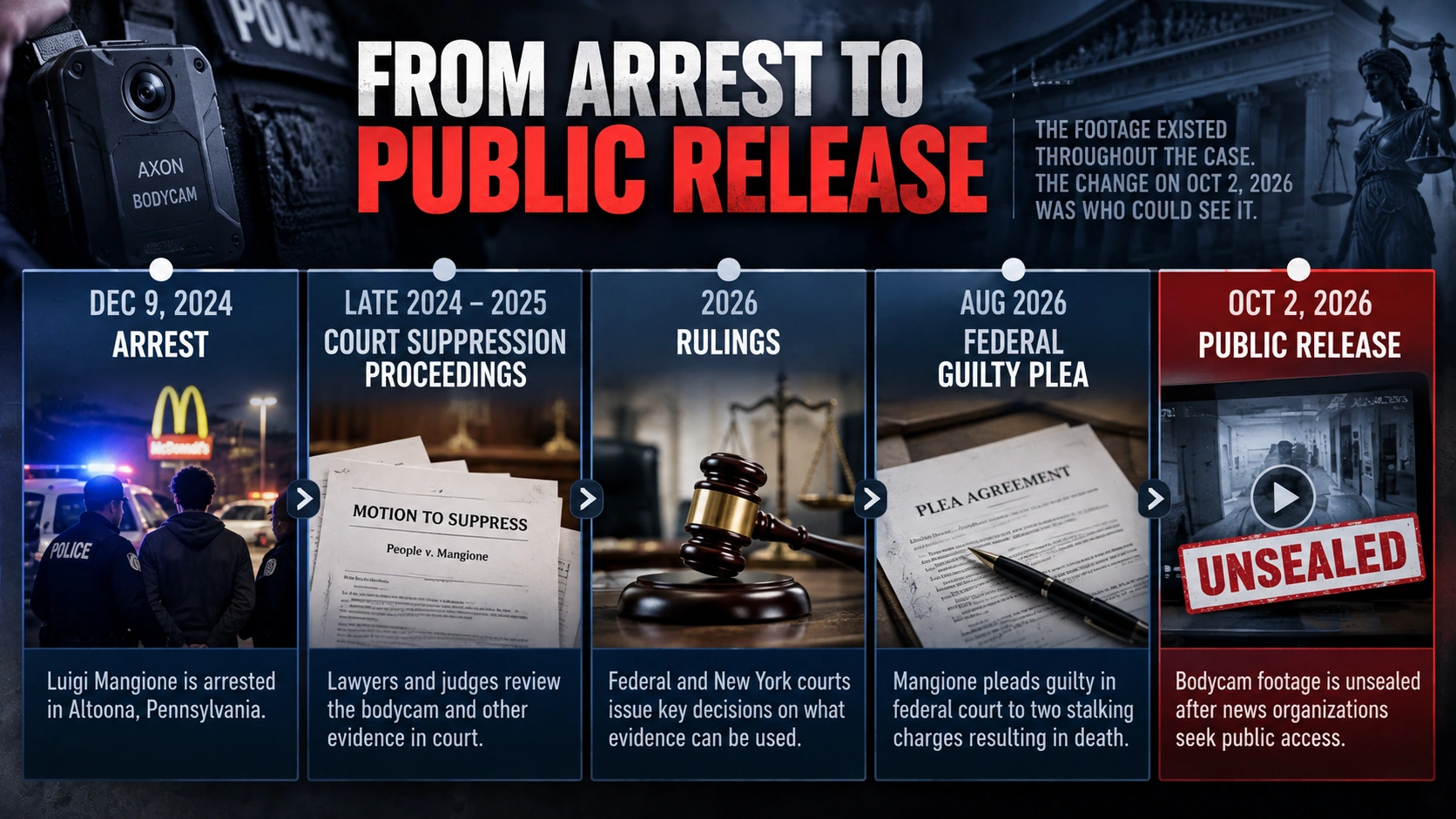
The October 2 release was fundamentally a court-access story.
The recordings were made during Mangione’s arrest on December 9, 2024, five days after UnitedHealthcare CEO Brian Thompson was shot and killed outside a Manhattan hotel. Parts of those recordings later became evidence in court proceedings over Mangione’s arrest and the searches of his belongings. (AP)
Most of the footage, however, had not been available for the general public to watch. AP reported that a Manhattan judge unsealed the recordings after CNN petitioned for their release, while ABC News said it was among news organizations that had sought access. (AP · ABC News)
That is why “released” can be misleading if it sounds like investigators just discovered the recordings.
They did not.
The change on October 2 was who could see them.
What Does the Luigi Mangione Bodycam Actually Show?
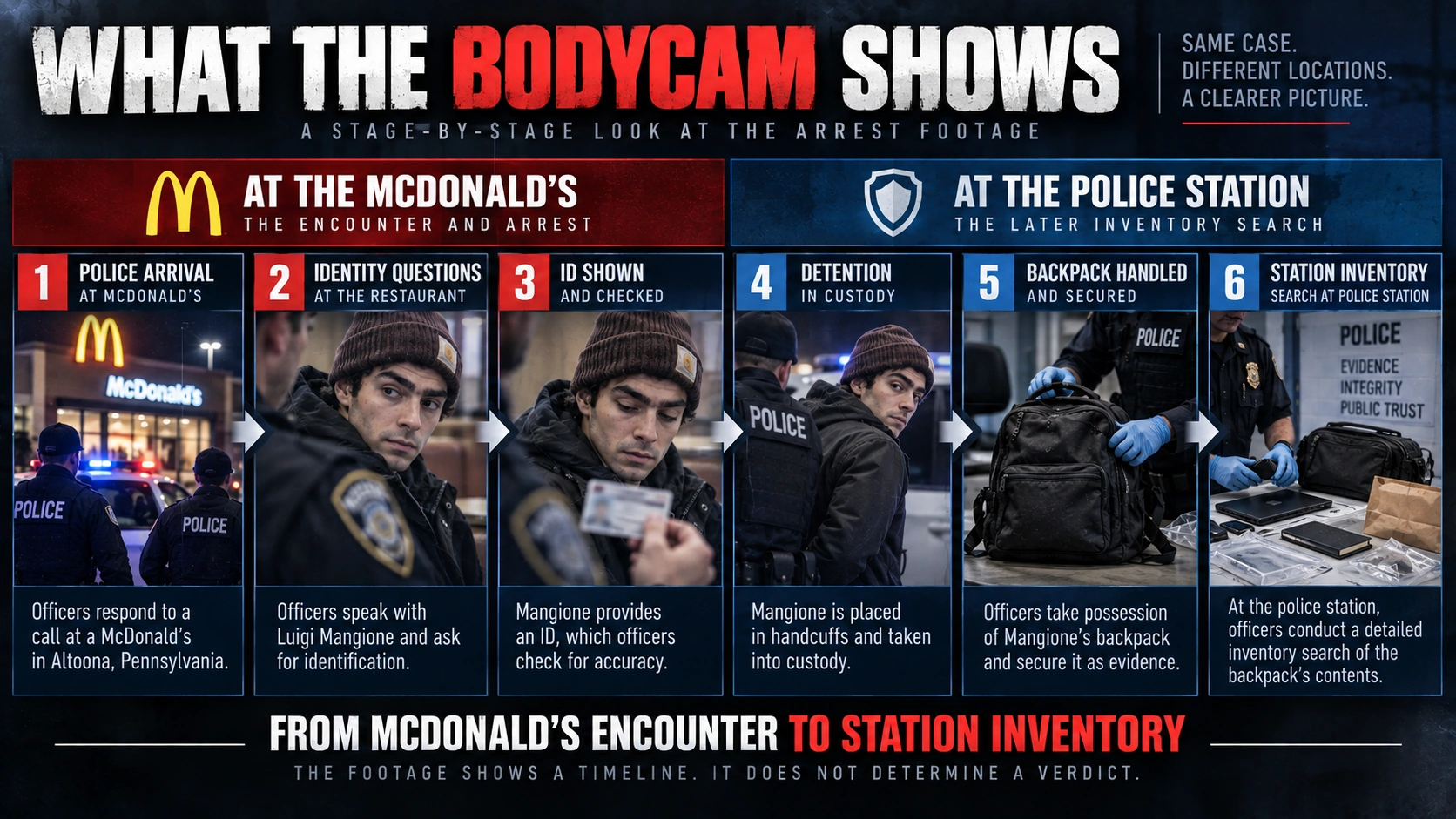
The recordings show the arrest developing in stages rather than as one instantaneous police action.
Officers approached Mangione at a McDonald’s in Altoona after an employee reported seeing someone who resembled the man being sought in the Thompson investigation. Mangione initially presented a New Jersey driver’s license bearing the name Mark Rosario before eventually identifying himself. (New York State Courts)
The footage then shows officers restraining him, reading him his rights and handling his belongings. Later recordings show police going through the backpack at the station, where officers located a handgun, a silencer and other items. ABC News also reported that the public release includes a redacted version of footage from a later strip search. (ABC News · New York State Courts)
Federal authorities later said the firearm and other evidence recovered after the arrest linked Mangione to Thompson’s killing. Mangione subsequently admitted in federal court that he shot Thompson. (U.S. Attorney’s Office, SDNY)
But watching the video raises a legal question that is more complicated than simply asking, “What did police find?”
The real question was when, where and under what legal authority they found it.
Why Did the Backpack Search Become Such a Big Legal Fight?
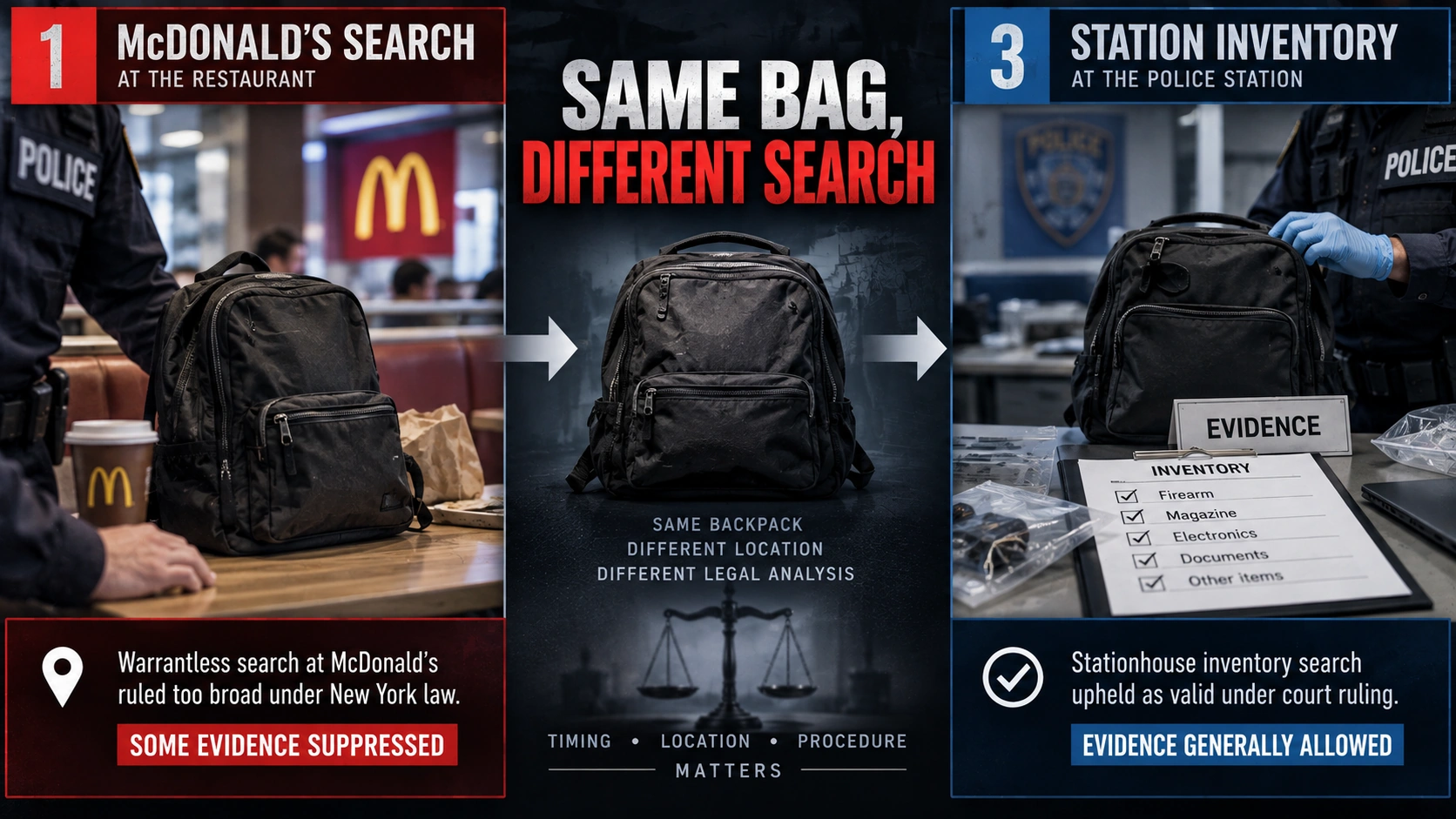
Because the law does not ask only whether incriminating evidence was found.
It also asks whether police were legally allowed to search for it at that particular moment.
In May 2026, New York Supreme Court Justice Gregory Carro ruled that the warrantless search of Mangione’s backpack at the McDonald’s went too far under New York law. By then, the court found, the bag was under police control and was no longer within Mangione’s “grabbable area.” The judge also rejected the argument that an emergency search for a weapon or explosives justified the way officers searched the bag there. (New York State Courts)
As a result, the state court suppressed items discovered during that McDonald’s backpack search, including a magazine, cellphone, passport, wallet and computer chip. (New York State Courts)
But the analysis changed once the backpack arrived at the police station.
There, the court found that Altoona police had an established inventory-search procedure—a routine process used to catalogue and safeguard a detainee’s property. The judge concluded that officers substantially followed that procedure and that the stationhouse inventory was valid. (New York State Courts)
That is why a single backpack can produce two different answers.
The legal question is not simply, “Was the bag searched?”
It is, “Which search are we talking about?”
Which Evidence Did New York Exclude—and Which Evidence Survived?
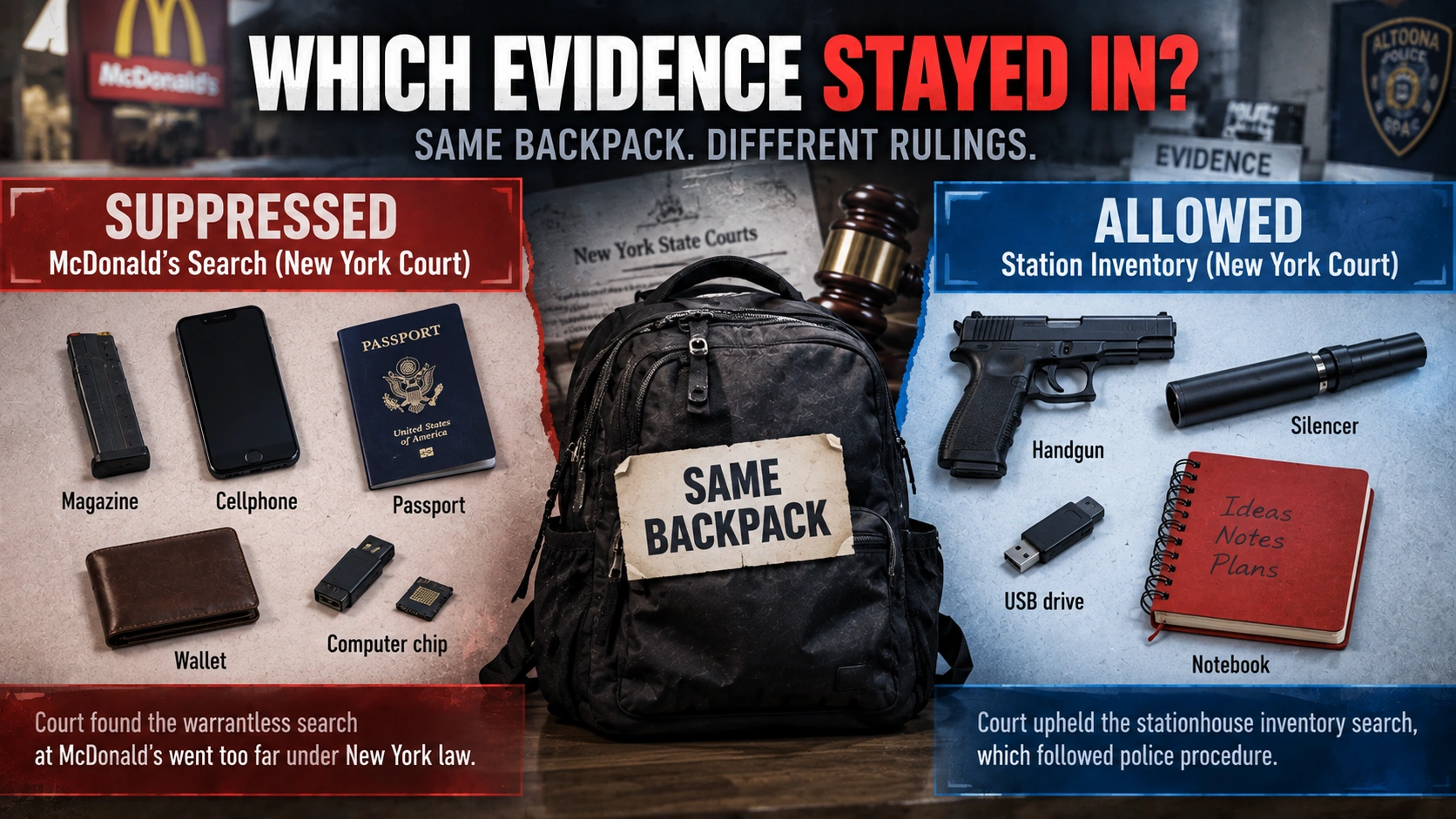
This is one of the easiest parts of the story to misunderstand.
The New York ruling was not “the backpack search was illegal, so everything inside disappeared from the case.”
It separated different searches and different pieces of evidence.
| Stage | What the New York court found | Result |
|---|---|---|
| Initial interaction at McDonald’s | Mangione was initially not yet in custody for Miranda purposes | Many early statements remained usable |
| Backpack search at McDonald’s | Police lacked a sufficient justification for that warrantless search | Magazine, cellphone, passport, wallet and computer chip suppressed |
| Inventory search at police station | Altoona had a valid inventory policy and substantially followed it | Later stationhouse inventory upheld |
| Certain questions after custody began | Some interrogation occurred before proper Miranda protection | Certain answers suppressed |
| Routine identifying information | Treated as pedigree information | Remained admissible |
The court specifically noted that the red notebook was not suppressed based on the McDonald’s search because officers had not opened or searched it there. At the station, the judge upheld the inventory process that included the handgun, silencer, USB drive and notebook. (New York State Courts)
The same ruling also drew a line through the conversation captured on video. The judge found that Mangione was not initially in custody when only a few officers were speaking with him in the restaurant. But once more than eight officers were present and effectively surrounded him, the legal analysis changed. Some answers to interrogation after that point were suppressed, while basic identifying information remained admissible. (New York State Courts)
That is what a suppression hearing actually does.
It does not decide whether a defendant is guilty.
It decides what evidence the prosecution may use when trying to prove the case.
Why Did the Federal and New York Courts Reach Different Results?
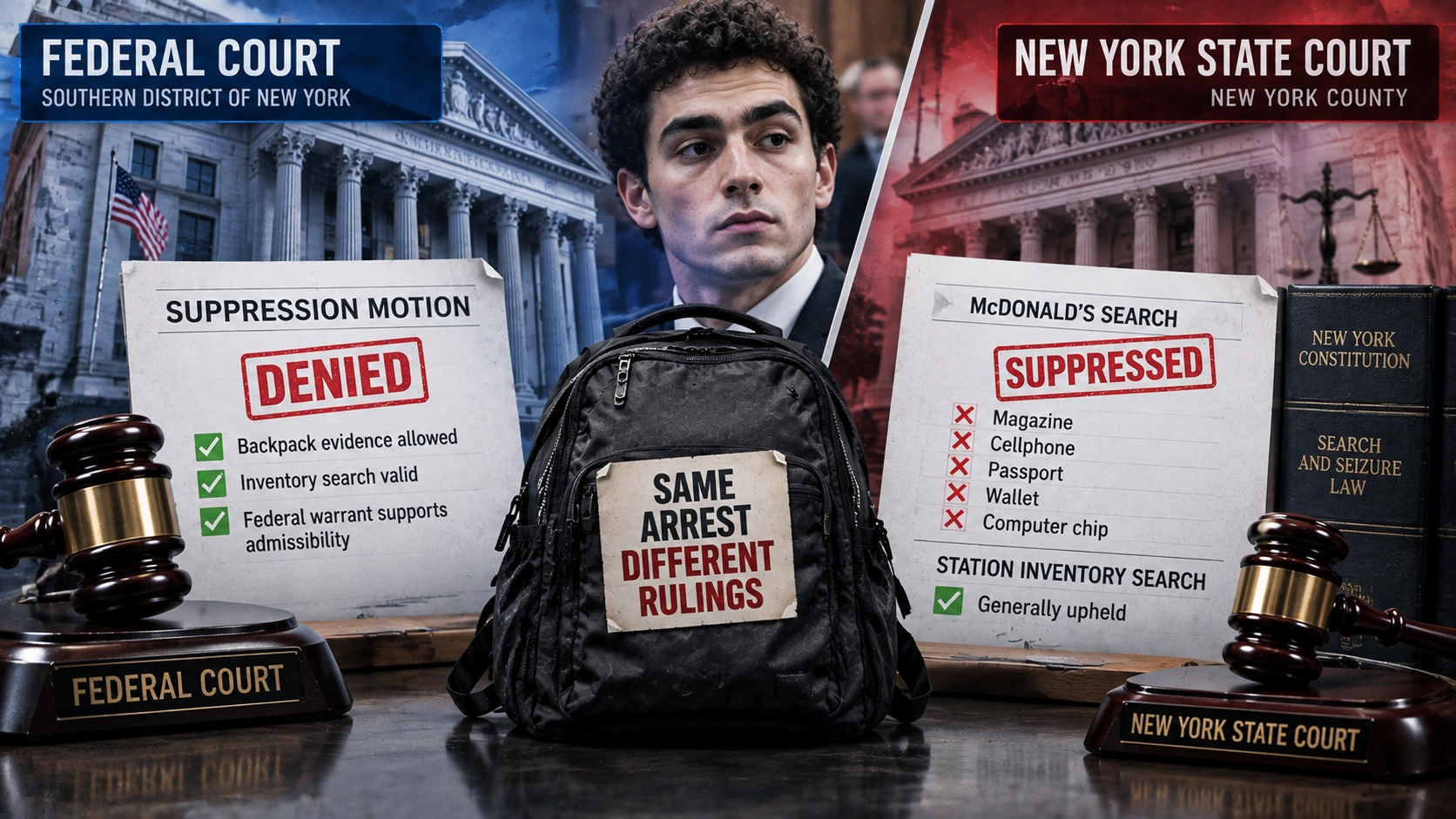
Because these were different prosecutions applying different legal frameworks.
In the federal case, U.S. District Judge Margaret Garnett denied Mangione’s motion to suppress the backpack and its contents. The federal court concluded that multiple doctrines supported admissibility, including the stationhouse inventory search and the eventual federal search warrant. (U.S. District Court, SDNY)
The New York state court took a different view of the McDonald’s search.
Justice Carro explicitly said New York law governed the suppression issues in the New York prosecution and noted that New York’s state constitutional protections against searches can be broader than the federal Fourth Amendment standard. He therefore suppressed some evidence from the restaurant search while still approving the later police-station inventory search. (New York State Courts)
| Federal case | New York state case |
|---|---|
| Federal suppression motion over backpack contents denied | Some evidence from McDonald’s search suppressed |
| Inventory search supported admissibility | Station inventory also upheld |
| Federal warrant supplied an additional basis | New York rejected the prosecution’s effort to use the later Pennsylvania warrant to cure the earlier McDonald’s search |
| Federal constitutional rules governed | New York court applied New York search-and-seizure law |
This is not one judge saying another judge was “wrong.”
It is a reminder that the same police conduct can be analyzed differently when separate sovereigns prosecute the case under different bodies of law.
Does the October Bodycam Release Change Mangione’s Case Now?
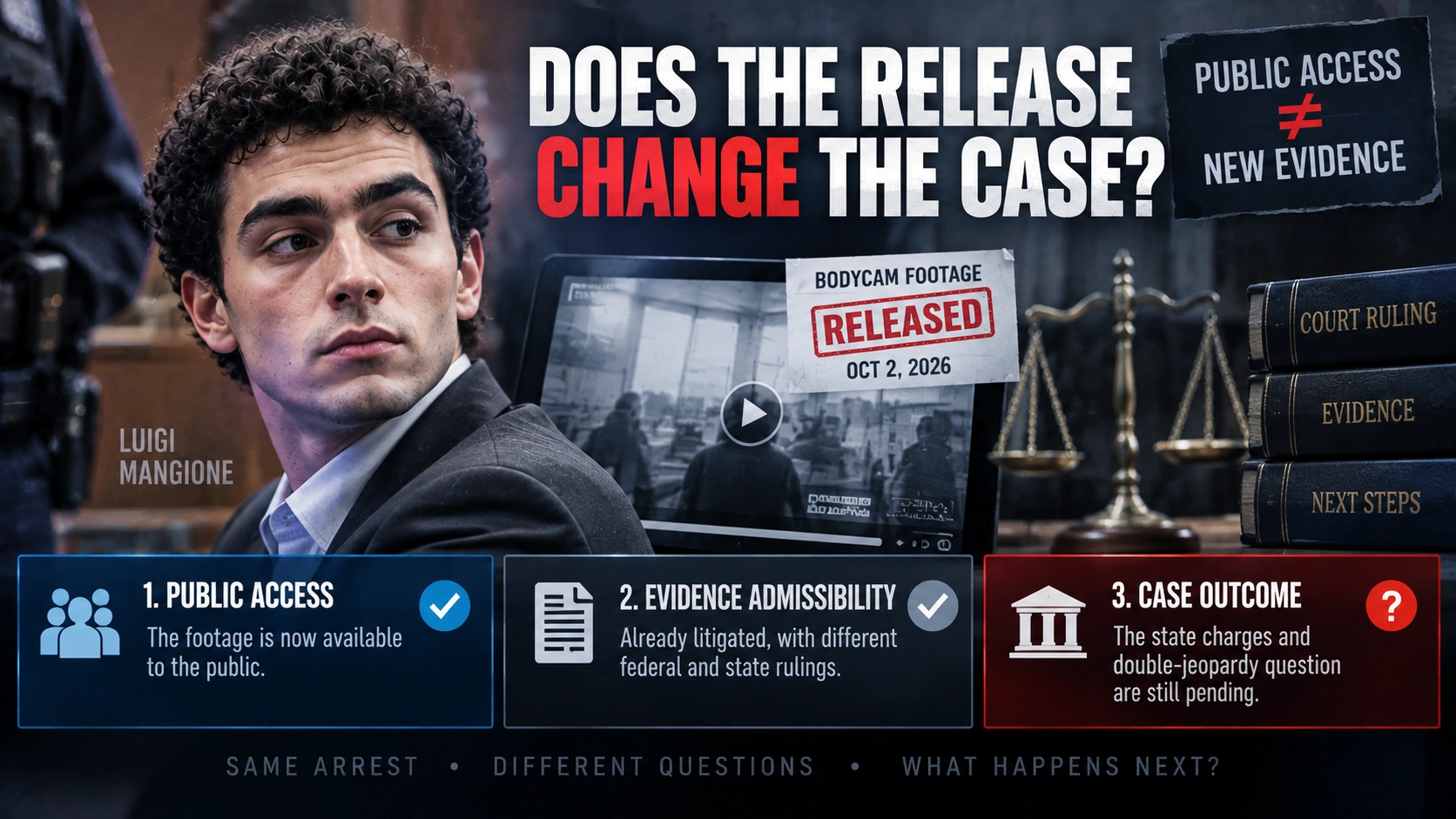
Not by itself.
The October 2 unsealing makes the recordings available to journalists and the public. It does not automatically reverse the earlier suppression rulings, add new criminal charges or reopen decisions that judges have already made about the footage.
The easiest way to separate the issues is to think of three different questions:
| Question | What it asks | Current status |
|---|---|---|
| Can the public watch the bodycam? | Court access and unsealing | Yes, footage was released October 2 |
| Can prosecutors use evidence from the arrest? | Search-and-seizure and Miranda rules | Already litigated, with different federal and state results |
| Can New York continue its prosecution after the federal guilty plea? | Successive prosecution and double jeopardy | Still pending |
The third question is now the more important unresolved legal fight.
On August 14, Mangione pleaded guilty in federal court to interstate stalking resulting in death and cyberstalking through interstate facilities resulting in death. Each count carries a maximum potential sentence of life imprisonment. His federal sentencing is scheduled for December 18. (U.S. Attorney’s Office, SDNY)
Immediately after that plea, his lawyers asked the New York court to dismiss the remaining state murder and weapons counts under New York’s statutory double-jeopardy protections and the Due Process Clause. The defense motion targets counts three through ten; a separate forged-identification count is not included in that request. (New York State Courts — Defense Motion)
That dispute is separate from the bodycam release.
What Happens Next?
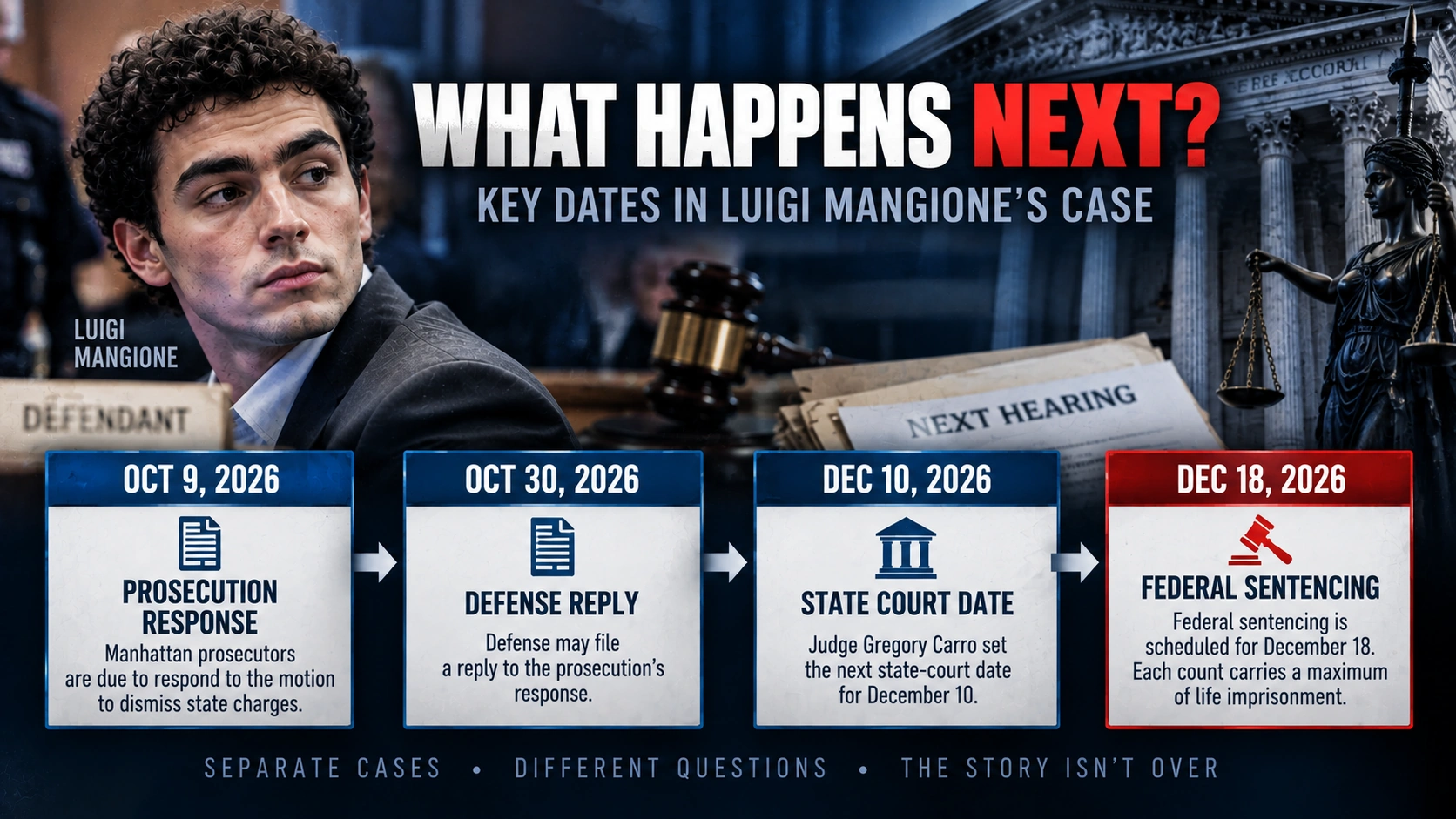
The next major deadline is October 9, 2026, when Manhattan prosecutors are due to respond to Mangione’s motion seeking dismissal of the state murder and weapons charges.
The defense may reply by October 30. Judge Gregory Carro set December 10 as the next state-court date. (New York State Courts — August 17 Order)
Eight days later, on December 18, Mangione is scheduled to be sentenced in the federal case. The statutory maximum is life imprisonment, but the sentence itself will be determined by the federal judge. (U.S. Attorney’s Office, SDNY)
So the bodycam release is visually dramatic, but the next consequential development may arrive in a much less dramatic form:
a court filing.
The question to watch is whether New York can continue prosecuting Mangione after his federal guilty plea—not whether the public can now watch the arrest that started the legal battle.
Bottom Line: What This Story Really Means
The Luigi Mangione bodycam is making headlines now because the public is finally seeing extensive footage from an arrest that happened in December 2024.
But the October release does not create new evidence or automatically change the case. The recordings had already played an important role in court battles over the backpack search, Miranda warnings and the admissibility of evidence.
The most revealing part of the story is the legal split inside one arrest: New York suppressed some evidence found during the McDonald’s search but upheld the later station inventory, while the federal court rejected the broader backpack-suppression challenge.
And the biggest unresolved question has moved beyond the bodycam entirely.
It is now whether New York’s state prosecution can continue after Mangione’s August federal guilty plea.
Luigi Mangione: Key Questions Explained
Q. When was Luigi Mangione arrested?
Mangione was arrested on December 9, 2024, at a McDonald’s in Altoona, Pennsylvania, five days after Brian Thompson was killed in Manhattan. (AP)
Q. Why was the Luigi Mangione bodycam released in October 2026?
The footage was unsealed after news organizations sought court access to recordings that had largely remained unavailable outside earlier court proceedings. (AP)
Q. Is the bodycam footage new evidence?
No. The footage is newly available to the public, not newly discovered by prosecutors or the courts. Portions had already been examined during suppression litigation.
Q. Did a judge throw out all the evidence found in Mangione’s backpack?
No. A New York judge suppressed certain items found during the warrantless McDonald’s search but upheld the later stationhouse inventory search. (New York State Courts)
Q. Was the gun suppressed in the New York state case?
No. The May 2026 state ruling treated the stationhouse inventory as valid. The handgun was discovered during that station search, while the court specifically suppressed several items found during the earlier McDonald’s backpack search. (New York State Courts)
Q. Why did the federal court allow the backpack evidence?
The federal judge concluded that the station inventory search and other doctrines, including a later federal search warrant, supported admitting the backpack contents. The federal suppression motion was denied. (U.S. District Court, SDNY)
Q. Has Luigi Mangione been convicted?
Mangione pleaded guilty on August 14, 2026, to two federal stalking charges resulting in death and admitted shooting Brian Thompson. The separate New York state charges remain pending unless the state court dismisses them. (U.S. Attorney’s Office, SDNY)
Q. Why is Mangione asking New York to dismiss its case?
His lawyers argue that the federal guilty plea triggers New York protections against a successive state prosecution arising from the same conduct. Prosecutors are due to respond to that motion by October 9, 2026. (New York State Courts — Defense Motion · New York State Courts — August 17 Order)
Q. What are the next important dates?
Manhattan prosecutors are due to respond to the dismissal motion by October 9, the defense may reply by October 30, the next state date is December 10, and federal sentencing is scheduled for December 18. (New York State Courts — August 17 Order · U.S. Attorney’s Office, SDNY)
Did this help make the story clearer? 🙂 WIN keeps unpacking the “why” behind the news—clearly and simply!
Sources
Bodycam Release and Arrest Footage
Associated Press — Police bodycam footage of Luigi Mangione’s arrest released
ABC News — Full body camera footage released from Luigi Mangione’s arrest
Search-and-Seizure Rulings
New York State Courts — People v. Mangione, May 18, 2026 Decision and Order
U.S. District Court, Southern District of New York — Federal Backpack Suppression Opinion
Federal Plea and Current New York Proceedings
U.S. Attorney’s Office, Southern District of New York — Luigi Mangione Pleads Guilty