
Why Does America Still Change the Clocks—and What Would Permanent Daylight Saving Time Actually Change?

Wait—if almost nobody enjoys changing the clocks twice a year, why not just stop?
That sounds like the easy part.
The harder question is which clock America should keep.
Keep daylight saving time all year, and winter evenings stay lighter—but winter mornings get darker. Keep standard time all year, and the sun rises earlier—but summer evenings lose an hour of clock-time daylight.
That trade-off became a much bigger political story on October 3, when President Donald Trump intensified his push for permanent daylight saving time and publicly shared what he said was Republican Sen. Tom Cotton’s cellphone number, urging people to pressure Cotton to support the bill. Cotton, who represents Arkansas, opposes permanent daylight saving time because of the effect it would have on dark winter mornings. (Reuters · AP)
And despite all the attention, Americans are still scheduled to change their clocks again.
On November 1, 2026, most of the country will move clocks back one hour and return to standard time. (U.S. Naval Observatory)
※ Images in this article are AI-generated illustrations created to help explain the story. They are not actual photographs, and depictions of people, places, or events may differ slightly from reality.
So if Washington is arguing about ending clock changes, why are we still falling back?
Because ending the switch and deciding which time to make permanent are two different decisions.
What Would the Sunshine Protection Act Actually Do?
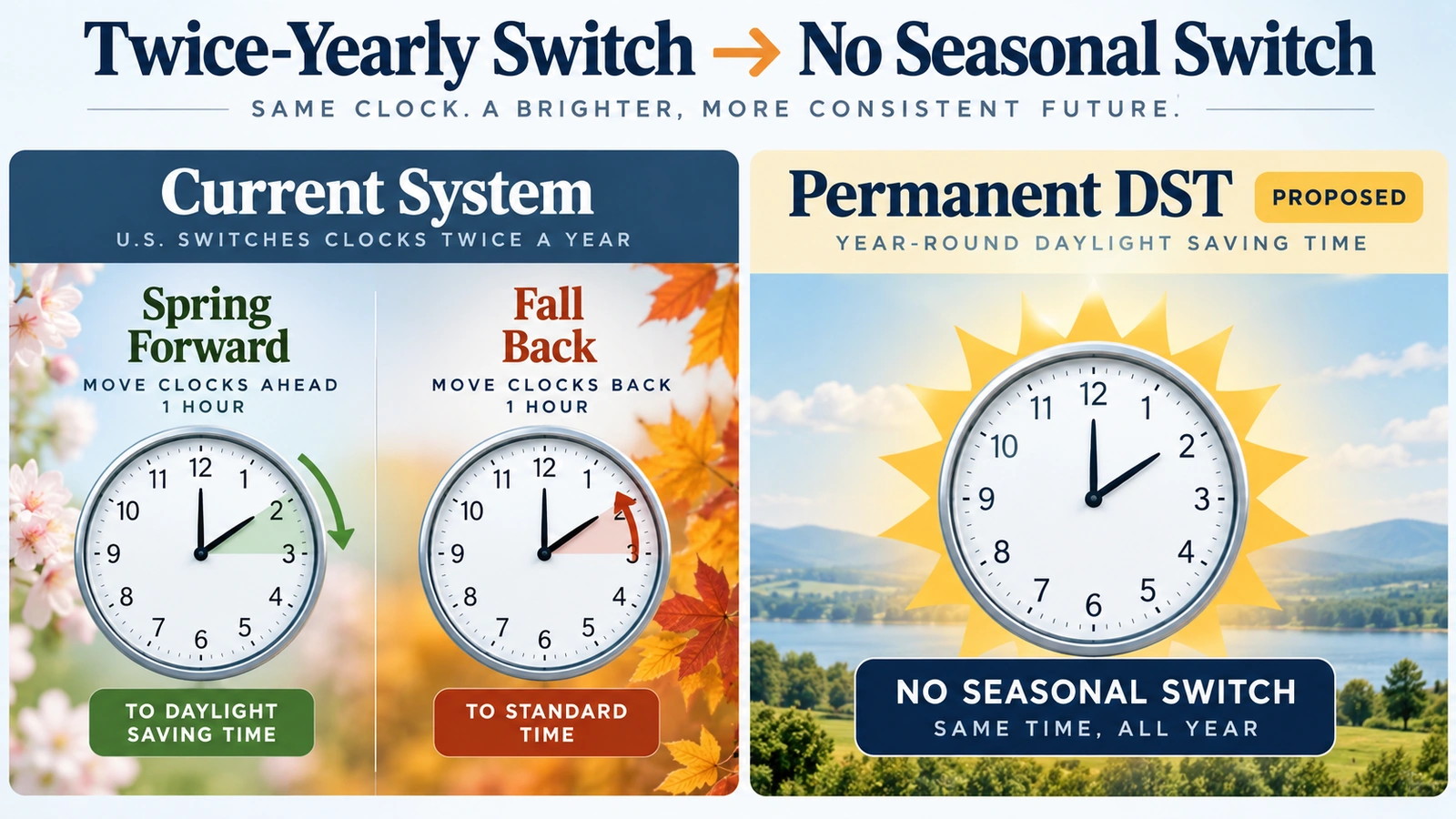
The Sunshine Protection Act would end the seasonal clock change by effectively keeping most of the United States on the current daylight-saving clock year-round.
The House passed H.R. 139, the Sunshine Protection Act of 2025, on July 14 by a 308–117 vote. The Senate received the bill on July 15, read it twice and referred it to the Committee on Commerce, Science, and Transportation. As of October 5, the Senate had not passed it. (U.S. House Clerk · GovInfo)
That means the bill has not become law.
It still needs Senate approval and the president’s signature.
Under current federal law, states can choose to stay on standard time all year, as Hawaii and most of Arizona already do. But states generally cannot simply choose permanent daylight saving time on their own. The federal Uniform Time Act controls that structure. (U.S. Department of Transportation)
H.R. 139 would repeal the federal seasonal daylight-saving period and advance the legal standard time in U.S. time zones by one hour. States and areas already exempt from daylight saving time would be allowed to choose between their existing standard time and the newly advanced standard time under the bill’s exemption language. (GovInfo)
The easiest way to picture the change is this:
| System | Winter | Summer | Change clocks? |
|---|---|---|---|
| Current system | Standard time | Daylight saving time | Yes, twice a year |
| Permanent daylight saving time | Daylight saving time | Daylight saving time | No |
| Permanent standard time | Standard time | Standard time | No |
And that reveals the real dispute.
Almost everyone can agree that changing clocks is annoying.
They do not agree on which side of the clock change should disappear.
Why Isn’t “Stop Changing the Clocks” the Same as “Permanent Daylight Saving Time”?
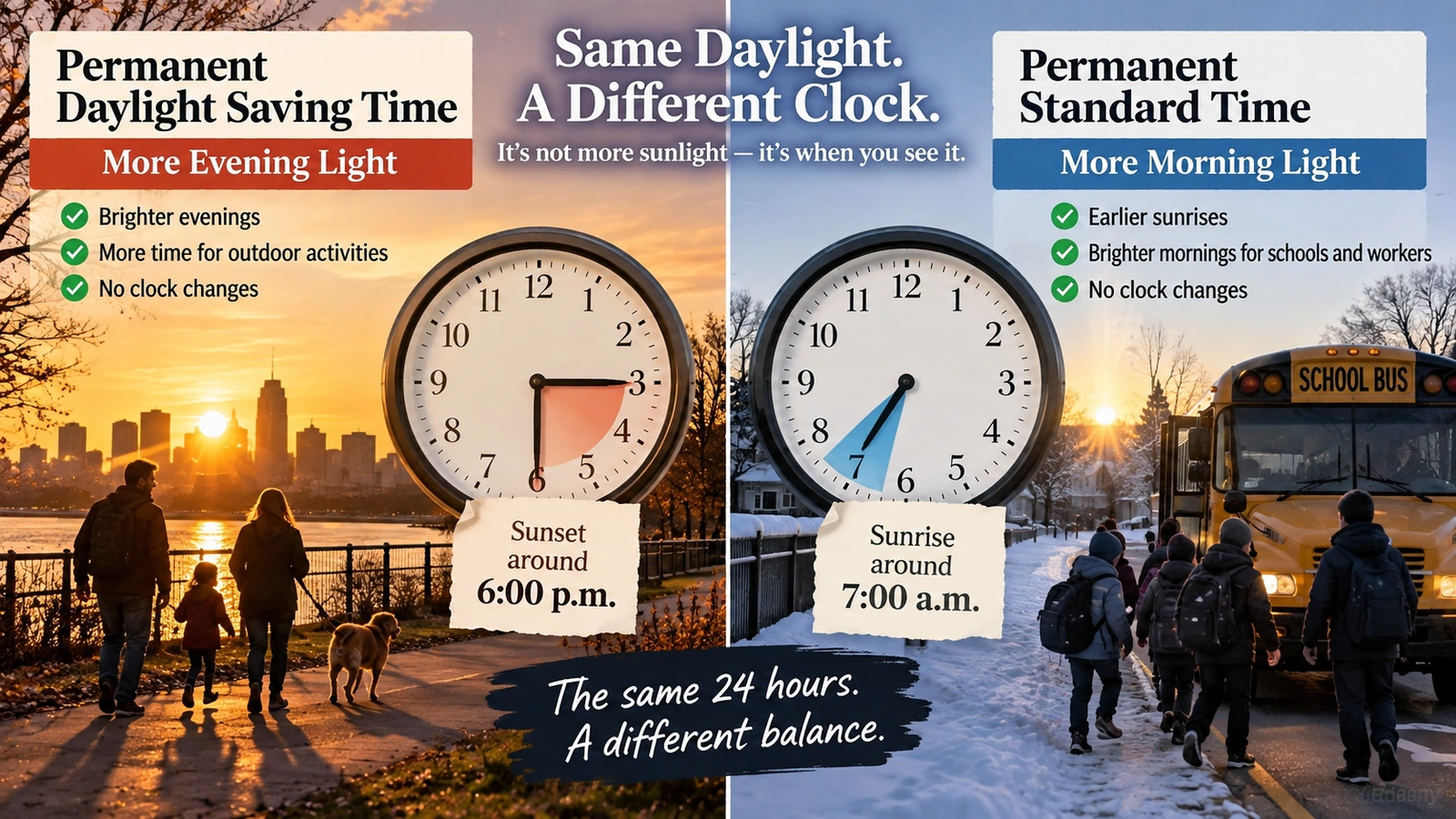
Because permanent daylight saving time does not create an extra hour of sunlight.
It changes what the clock says when that sunlight arrives.
Think of a winter day with roughly 10 hours of daylight. Moving the clock forward does not make that day longer. It simply labels sunrise and sunset one hour later.
That is why two people can both say, “Stop changing the clocks,” while supporting opposite policies.
One person may want light at 5:30 p.m. instead of 4:30 p.m.
Another may care more about having daylight at 7:30 a.m. instead of waiting until 8:30 a.m.
A 2025 AP-NORC poll captured that split. Only 12% of U.S. adults favored the existing twice-a-year clock-changing system. Asked which permanent arrangement they preferred, 56% chose year-round daylight saving time and 42% chose year-round standard time. The nationwide poll surveyed 1,289 adults and had an overall margin of sampling error of plus or minus 3.8 percentage points. (AP-NORC)
There is even a competing legislative approach.
The bipartisan Sunshine for Our Kids Act, introduced on July 9, would make standard time the national default while allowing states to adopt permanent daylight saving time through state law. It has not advanced as far as the House-passed Sunshine Protection Act. (Rep. Mary Gay Scanlon)
So Congress is not simply debating whether Americans should stop moving their clocks.
It is debating where that hour of daylight should appear on the clock.
How Dark Would Winter Mornings Actually Get?
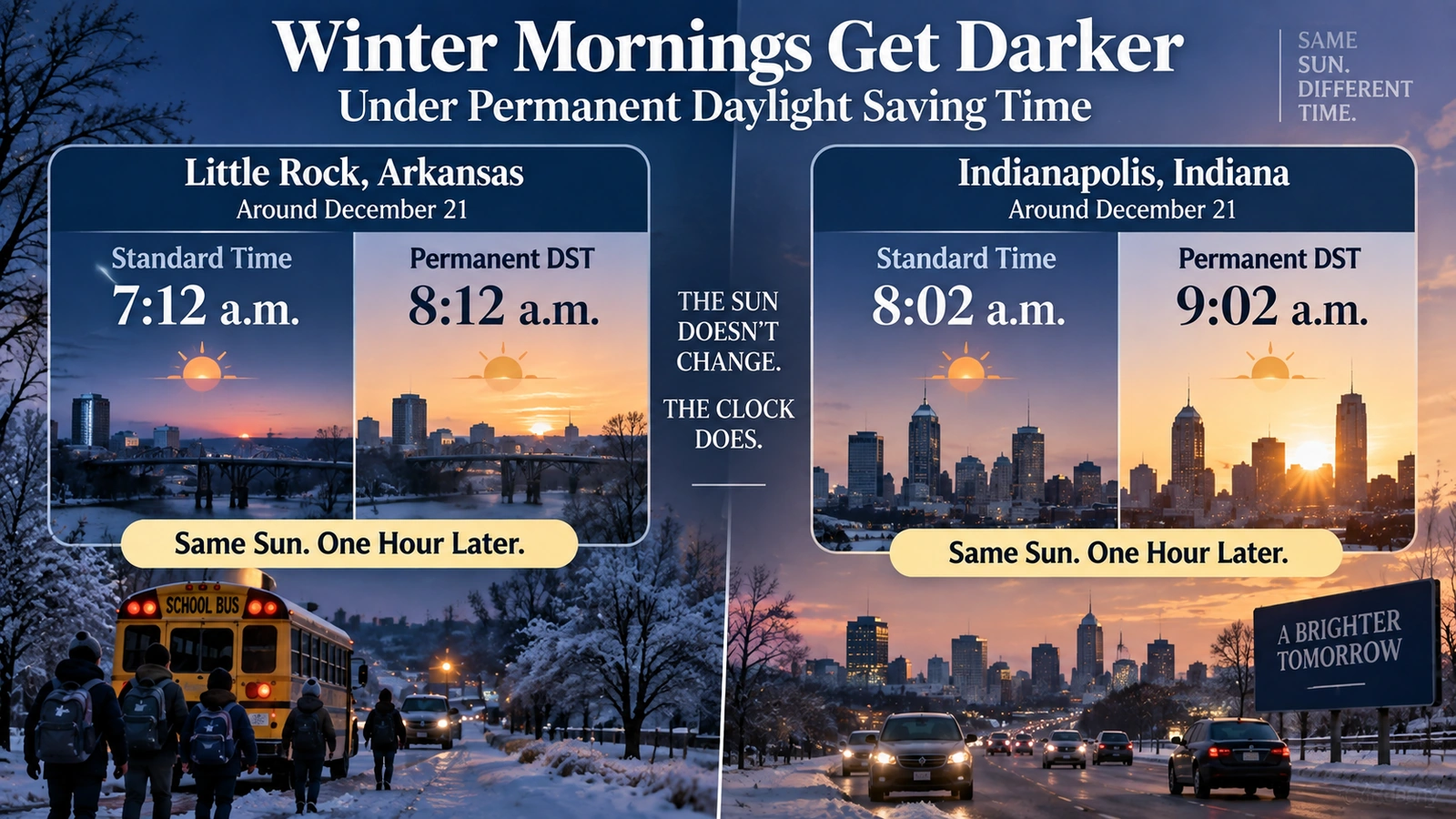
This is the argument that makes permanent daylight saving time much more complicated than it first sounds.
Take Little Rock, Arkansas.
Around December 21, the sun rises at about 7:12 a.m. under standard time. If the same solar event were labeled using daylight saving time, sunrise would be about 8:12 a.m. The trade-off is that a roughly 5:02 p.m. sunset would instead appear around 6:02 p.m. on the clock. (Timeanddate.com)
Indianapolis shows why geography matters even more.
Around December 21, its standard-time sunrise is about 8:02 a.m. Keeping daylight saving time through winter would move that clock time to roughly 9:02 a.m. Sunset would shift from about 5:23 p.m. to 6:23 p.m. (Timeanddate.com)
| City around Dec. 21 | Standard-time sunrise | Sunrise under permanent DST | Standard-time sunset | Sunset under permanent DST |
|---|---|---|---|---|
| Little Rock | ~7:12 a.m. | ~8:12 a.m. | ~5:02 p.m. | ~6:02 p.m. |
| Indianapolis | ~8:02 a.m. | ~9:02 a.m. | ~5:23 p.m. | ~6:23 p.m. |
The sun itself has not moved.
The same daylight has been shifted one hour later on the clock.
For an office worker who wants to walk the dog after work, that may sound appealing.
For a child waiting for a school bus—or someone starting a construction shift before 8 a.m.—the same change can look very different.
That is why geography, school schedules, commuting patterns, and work hours matter so much in this debate.
If Clock Changes Disrupt Sleep, Why Do Sleep Experts Oppose Permanent Daylight Saving Time?
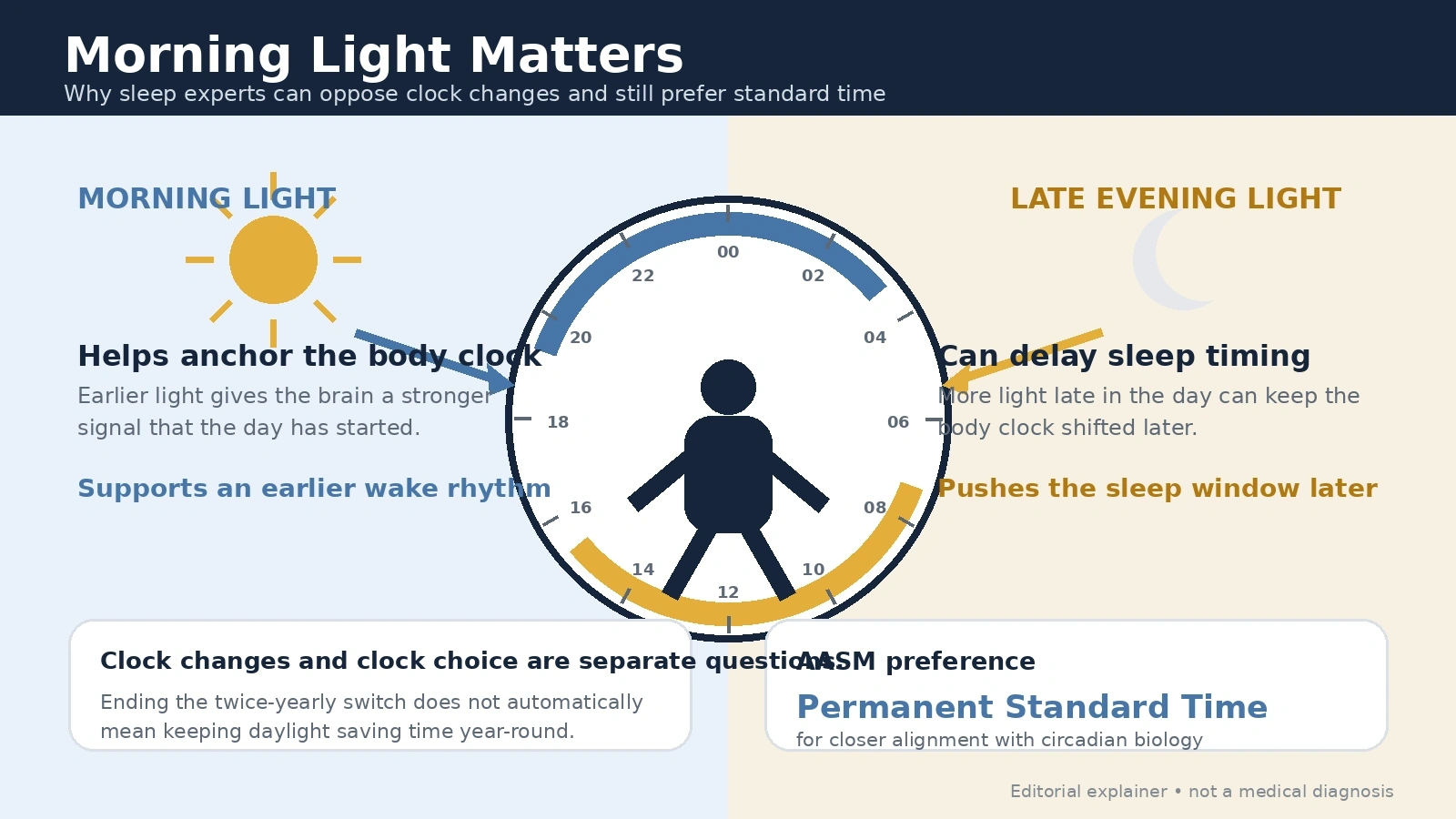
Because there are really two separate sleep questions.
The first is what happens when the clock suddenly moves by an hour. That transition can disrupt sleep and alertness.
The second is what happens when society permanently schedules morning activities one hour farther from the natural solar cycle.
The American Academy of Sleep Medicine supports ending seasonal clock changes—but it recommends permanent standard time, not permanent daylight saving time. Its position is that standard time aligns more closely with human circadian biology. (American Academy of Sleep Medicine)
Morning light is an important signal to the body’s internal clock. Permanent daylight saving time moves more light into the evening while delaying morning light, especially in winter.
That distinction is easy to miss in political arguments.
A person can believe that the twice-yearly switch is unhealthy or disruptive and still oppose the Sunshine Protection Act because they believe Congress is choosing the wrong permanent clock.
So the scientific argument is not simply:
“Changing clocks is bad, therefore permanent daylight saving time is good.”
For the American Academy of Sleep Medicine, the preferred conclusion is closer to:
“Stop changing the clocks—and keep standard time.”
Didn’t America Already Try Permanent Daylight Saving Time?
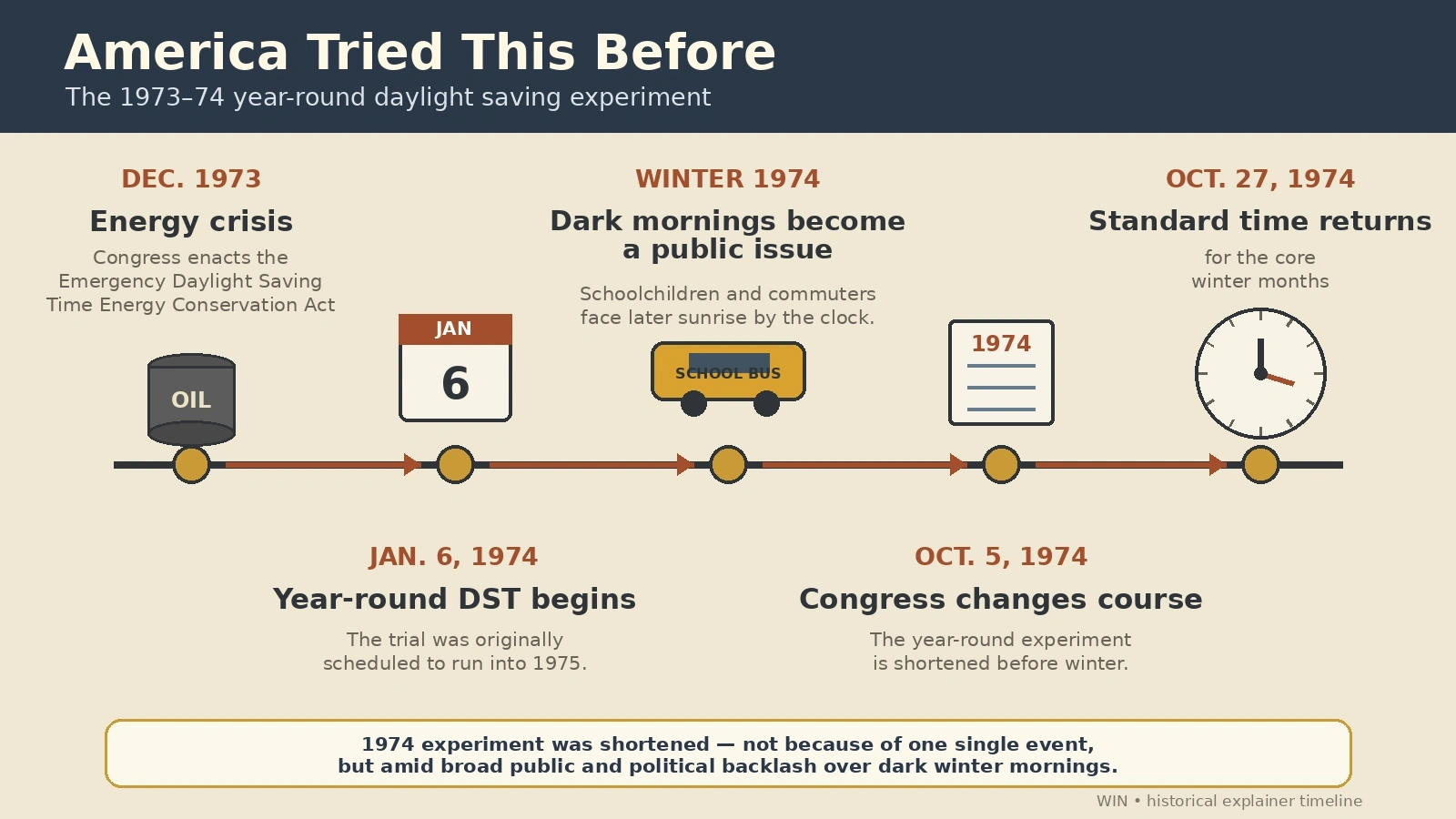
Yes—and that history is one reason today’s debate is so intense.
During the 1973 energy crisis, Congress enacted the Emergency Daylight Saving Time Energy Conservation Act. The measure was signed on December 15, 1973, and year-round daylight saving time began on January 6, 1974, as part of a trial that was originally scheduled to run until April 1975. (GovInfo)
The dark mornings quickly became controversial, particularly for schoolchildren. Congressional records from the period include complaints about children walking to school or waiting for buses before dawn, and a later Senate hearing described the negative public reaction to dark mornings for schoolchildren as a reason Congress changed the experiment. (GovInfo)
Congress amended the law on October 5, 1974, requiring a return to standard time beginning October 27, 1974, through February 23, 1975, when daylight saving time resumed. The original year-round trial therefore did not continue through that winter as first planned. (GovInfo)
The lesson is not necessarily that 2026 must produce the same result.
Work schedules have changed. School policies differ. Cars, lighting, and energy use are different. Remote work did not exist in anything like its modern form.
But the 1974 episode explains why opponents keep returning to one very specific question:
What will people think when the first truly dark January mornings arrive?
Why Are Trump and Tom Cotton Fighting Over This Now?

Trump and Cotton are not arguing over whether changing clocks can be irritating.
They disagree over what should replace the current system.
Trump has pressed Congress to adopt permanent daylight saving time. On October 3, he devoted multiple social-media posts and comments to the issue and publicly shared what he said was Cotton’s phone number while urging people to contact the Arkansas senator. (Reuters)
Cotton’s response focused on winter mornings. He said he dislikes changing clocks too, but argued that year-round daylight saving time would leave Arkansas children traveling to school in darkness. (AP)
The disagreement is not limited to Cotton.
Reuters reported on October 2 that Senate opposition was broad enough to stall the bill despite the House’s 308–117 vote. Sen. John Kennedy of Louisiana was among the Republicans opposing the measure, while Sen. Rick Scott of Florida remained a prominent supporter. (Reuters)
That matters because one of the easiest mistakes to make with this story is to treat it as a Trump-versus-Cotton personality dispute.
The phone-number episode made the fight dramatic.
But the legislative problem existed before October 3: senators remain divided over the underlying policy.
So Will Americans Still Change Their Clocks This Fall?
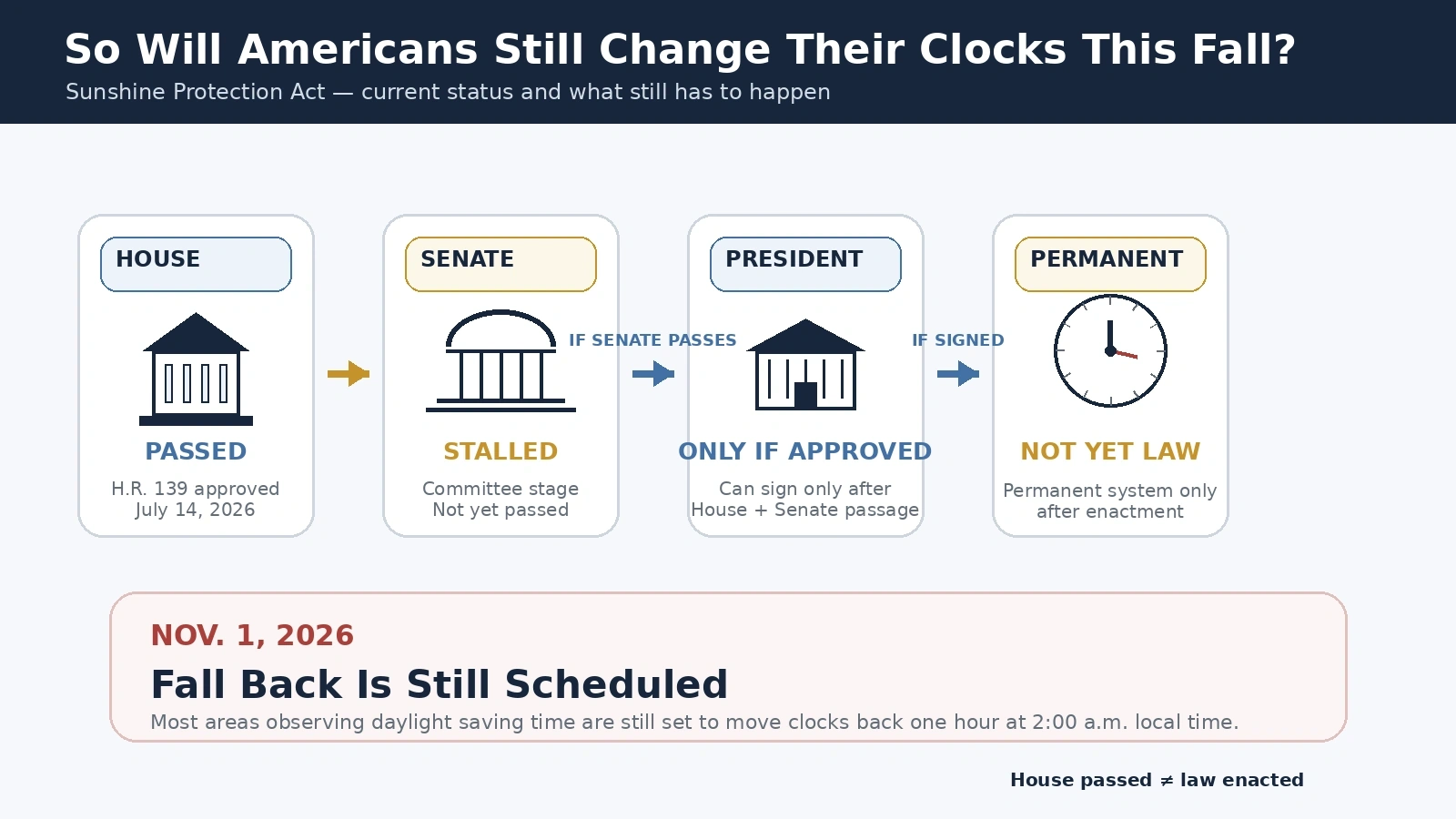
Yes. Under current law, most Americans are still scheduled to set their clocks back one hour on November 1, 2026, at 2 a.m. local time. (U.S. Naval Observatory)
As of October 5, H.R. 139 remained at the Senate committee stage. The Senate has not approved the bill, so the scheduled November clock change remains in place. (GovInfo · Reuters)
So the immediate sequence is straightforward:
| Step | Status |
|---|---|
| House passes Sunshine Protection Act | Completed July 14 |
| Bill sent to Senate | Completed July 15 |
| Senate approves identical bill | Not completed |
| President signs it | Cannot happen until Congress passes it |
| Permanent clock system takes effect | Not yet law |
That means phones, computers, and network-connected clocks will still change automatically where daylight saving time is observed, while many ovens, car clocks, and older devices may need manual adjustment.
And after Americans do it again, Congress will still face exactly the same question.
Not whether changing clocks is annoying.
But whether the country prefers darker winter mornings, darker winter evenings, or the seasonal compromise it already has.
Bottom Line: What This Story Really Means
America’s daylight-saving-time argument sounds simple until you separate two questions.
The first is whether the country should continue moving clocks twice a year. There is substantial public dissatisfaction with that system.
The second is much harder: if the clock changes end, which time should become permanent?
The Sunshine Protection Act chooses the equivalent of permanent daylight saving time. That would preserve more evening light in winter but push sunrise one hour later by the clock. In some western parts of time zones, that could mean sunrise around or after 9 a.m. near the shortest days of the year.
The American Academy of Sleep Medicine favors the opposite solution—permanent standard time—because it says standard time aligns better with human circadian biology.
And America has seen the political consequences of this trade-off before. The 1974 experiment with winter daylight saving time was shortened after dark mornings became deeply unpopular.
For now, none of those arguments changes the clock on your wall.
Most Americans are still falling back on November 1.
Permanent Daylight Saving Time: Key Questions Explained
Q. Has permanent daylight saving time already passed Congress?
No. The House passed the Sunshine Protection Act, H.R. 139, on July 14, 2026, but the Senate has not approved it. Without Senate passage and the president’s signature, it does not become law. (U.S. House Clerk · GovInfo)
Q. Will Americans still change their clocks in November 2026?
Yes. Most areas that observe daylight saving time are scheduled to move clocks back one hour on November 1, 2026, at 2 a.m. local time. (U.S. Naval Observatory)
Q. Would permanent daylight saving time give Americans more daylight?
No. It would not increase the amount of daylight in a day. It would move the clock labels for sunrise and sunset one hour later during months that currently use standard time.
Q. What is the biggest practical objection to permanent daylight saving time?
The most prominent practical objection in the current debate is darker winter mornings. In some cities near the western edge of a time zone, sunrise could occur around or after 9 a.m. by the clock near the winter solstice. (Timeanddate.com)
Q. Do sleep experts support ending the twice-yearly clock change?
Yes, but the American Academy of Sleep Medicine favors permanent standard time rather than permanent daylight saving time. It says standard time better aligns with human circadian biology. (American Academy of Sleep Medicine)
Q. Why can’t a state simply choose permanent daylight saving time now?
Under current federal law, a state may exempt itself from daylight saving time and remain on standard time, but it does not have authority to adopt permanent daylight saving time on its own. (U.S. Department of Transportation)
Q. Did the United States really try year-round daylight saving time before?
Yes. A federal trial began on January 6, 1974, during the energy crisis. Congress amended the law later that year so the country returned to standard time for part of the winter, shortening the year-round experiment. (GovInfo)
Q. What happens next with the Sunshine Protection Act?
The Senate would have to approve H.R. 139 before it could go to the president. As of October 5, the bill remained referred to the Senate Commerce, Science, and Transportation Committee, so the November 1 clock change remained scheduled. (GovInfo)
Did this help make the story clearer? 🙂 WIN keeps unpacking the “why” behind the news—clearly and simply!
Sources
October 2026 Dispute and Current Legislative Status
Reuters — Trump shares Republican senator’s phone number in feud over time switch
Reuters — Trump push to end U.S. clock switching hits dead end
Federal Law and the Sunshine Protection Act
U.S. House Clerk — Roll Call 238 on H.R. 139
GovInfo — H.R. 139, Sunshine Protection Act of 2025, referred in Senate
GovInfo — H.R. 139, House-passed bill text
U.S. Department of Transportation — Uniform Time
U.S. Naval Observatory — 2026 Daylight Saving Time Dates
Health, Public Opinion, and Alternative Policy
Rep. Mary Gay Scanlon — Sunshine for Our Kids Act
Winter Sunrise Examples and the 1974 Experiment
Timeanddate.com — Little Rock sunrise and sunset times, December 2026
Timeanddate.com — Indianapolis sunrise and sunset times, December 2026
GovInfo — U.S. Code notes on the Emergency Daylight Saving Time Energy Conservation Act
GovInfo — Senate hearing discussing the 1974 daylight-saving experiment