Why Did U.S. Intelligence Sharing With Ukraine Falter—and Is It Back?

How can a country have sophisticated air defenses and still be caught off guard when missiles are coming?
That question has become painfully relevant in Ukraine.
For several days, Ukrainian officials complained that Russian ballistic missiles were arriving without the advance warnings they had come to expect from their American partners. President Donald Trump, however, maintained that the United States was still sharing intelligence.
Then, on October 18, 2026, Ukrainian President Volodymyr Zelenskyy said the information was flowing again.
He thanked Washington for restoring the support but did not provide a detailed account of what had been interrupted.
The immediate issue appears to have been the availability of crucial missile-warning intelligence—not necessarily the complete shutdown of every intelligence-sharing channel between the two countries.
And that distinction matters because detecting a missile, intercepting it, and maintaining the political relationship that makes those defenses possible are three very different things.
※ Images in this article are AI-generated illustrations created to help explain the story. They are not actual photographs, and depictions of people, places, or events may differ slightly from reality.
What Did Zelenskyy Actually Say About U.S. Intelligence Sharing?
Zelenskyy said American intelligence sharing had been interrupted for a period and was subsequently restored. The United States has not publicly provided a detailed explanation of the alleged interruption.
During an interview with NBC’s Meet the Press aired on October 18, Zelenskyy said the flow of intelligence had been blocked and later restored. He expressed gratitude to the United States, saying, “Now it works.” (Reuters)
According to the Kyiv Independent’s account of the interview, Zelenskyy said Ukraine had gone three days without receiving the crucial American intelligence during Russian ballistic missile attacks.
That is a serious allegation. It is also important to understand exactly what has—and has not—been established publicly.
Why do the accounts differ?
Earlier in the week, Trump said Washington was continuing to provide intelligence to Ukraine.
Ukrainian officials, meanwhile, described attacks that had occurred without the warnings they expected. On October 13, Zelenskyy publicly complained about receiving no advance notice from partners ahead of a Russian strike on Kyiv. (Reuters · AP)
Both accounts could reflect different understandings of what constitutes intelligence sharing.
For example, cooperation might continue in some areas even while a particular warning service is unavailable or restricted. That is a possible explanation, not a confirmed description of what happened.
Public reporting has not established which intelligence products were withheld, who authorized any restriction, or the precise time they were restored.
What is clear is that Ukraine reported losing access to warnings it considered essential—and its president now says that problem has been resolved.
Why Is U.S. Intelligence So Important for Ukraine’s Missile Defense?
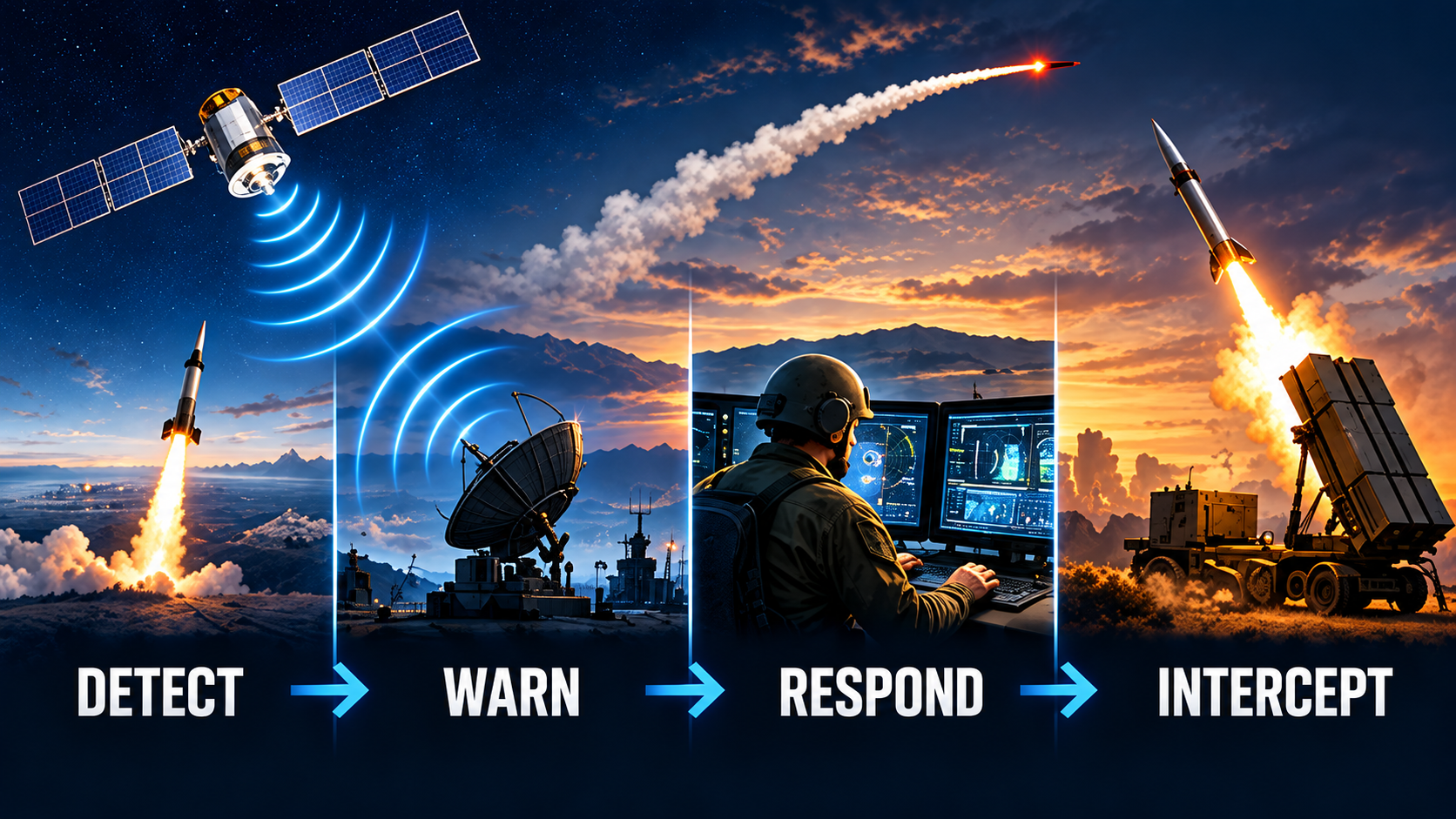
Because knowing that a ballistic missile is coming can be just as important as having a weapon capable of shooting it down.
Ukraine uses a combination of radar systems, military communications, fighter aircraft, and ground-based air defenses to protect its territory.
But ballistic missiles present a particularly difficult challenge.
Unlike slower drones, ballistic missiles can travel at extremely high speeds. Depending on their launch point and trajectory, defenders may have only a short time to respond.
U.S. intelligence capabilities can help provide early indications of missile launches. That information can give Ukrainian defenders additional time to assess the threat and prepare their response.
Zelenskyy has specifically emphasized the value of American intelligence for identifying Russian ballistic missile launches. (Kyiv Independent)
Detection and interception are different jobs
A simplified missile-defense process works like this:
| Stage | What happens | Why it matters |
|---|---|---|
| Detection | Sensors identify a possible missile launch | Establishes an initial threat warning |
| Warning | Relevant information reaches defenders | Provides time to prepare |
| Tracking and response | Ukrainian systems assess the approaching threat | Supports defensive decisions |
| Interception | An available defensive weapon attempts to stop the missile | May prevent a strike if successful |
The actual process is more complicated. Not every sensor, intelligence source, or decision is controlled by the same organization.
And having an early warning does not mean an interceptor will automatically succeed.
Consider a household smoke alarm.
The alarm cannot put out a fire. But without it, a person may have far less time to escape or respond.
Missile warnings serve a comparable early-alert function, although modern air defense involves much more complex technology and military coordination.
Why can’t Ukraine simply rely on its own systems?
Ukraine has significant domestic surveillance and air defense capabilities, along with support from European partners.
The difficulty is that not all intelligence systems provide the same information or the same warning time.
Some assets help detect launches. Others track targets after they become visible. Different systems may cover different geographic areas or types of threats.
That is why losing access to a particular American capability could matter even if other intelligence cooperation continues.
The consequences are especially serious when Russian attacks target densely populated cities or electrical infrastructure.
At an October 16 European Council meeting, Zelenskyy called for additional ballistic missile interceptors as Russia intensified attacks on Ukraine’s energy sector. (Office of the President of Ukraine)
An early warning and an interceptor solve different problems. Ukraine needs both.
Why Have Trump and Zelenskyy Been Clashing Again?

The dispute over intelligence comes amid a broader disagreement about how to pressure Russia and how the war should end.
Washington has criticized Ukrainian attacks on Russian oil infrastructure, while Kyiv argues that those facilities help finance Russia’s war effort.
The Trump administration has also taken steps to ease some restrictions affecting Russian energy, drawing criticism from Ukraine.
These disagreements intensified as Russian strikes continued against Ukrainian cities and infrastructure. (Reuters · AP)
Why does Russian oil matter so much?
Russia’s energy industry remains an important source of government revenue.
Ukraine has repeatedly targeted refineries and other oil-related facilities inside Russia, seeking to damage Moscow’s ability to sustain the war.
For Kyiv, this is part of its strategy to impose costs on the country attacking it.
Trump has expressed concern that such strikes contribute to higher global energy prices.
Those concerns have become more prominent amid broader international energy disruptions and pressure on fuel costs.
The two governments are therefore approaching the same problem from different directions.
| Issue | U.S. administration’s position | Ukraine’s position |
|---|---|---|
| Russian refinery strikes | Raises concerns about energy prices and negotiations | Sees the facilities as economically important to Russia’s war effort |
| Energy ceasefire | Seeks restraint in attacks on energy infrastructure | Wants Russia to stop attacking Ukrainian energy facilities |
| Russia-related energy restrictions | Has eased some restrictions | Argues relief can benefit Moscow |
| Military cooperation | Remains part of Washington’s broader diplomatic strategy | Is essential to Ukraine’s defense |
These are summaries of publicly expressed positions, not evidence of a mutually agreed policy.
On October 15, Ukraine resumed attacks on Russian oil facilities after Zelenskyy said Russia had continued attacking Ukrainian energy targets despite the ceasefire initiative. (AP)
Was intelligence sharing restricted to pressure Ukraine?
That possibility has been raised, but a direct cause-and-effect relationship has not been independently established.
Zelenskyy said his government had been warned that intelligence cooperation could be affected if Ukraine continued its attacks on Russian refineries. (Ukrainska Pravda)
The timing has prompted questions about whether military cooperation was being used as diplomatic leverage.
But timing alone does not establish motive.
There has been no sufficiently detailed public U.S. explanation establishing that the reported missile-warning interruption was ordered as punishment for refinery strikes.
The confirmed political context is that Washington and Kyiv were in disagreement over energy strategy while Ukraine reported problems receiving warnings.
That alone helps explain why the episode has attracted attention.
Has the United States Suspended Intelligence Sharing With Ukraine Before?
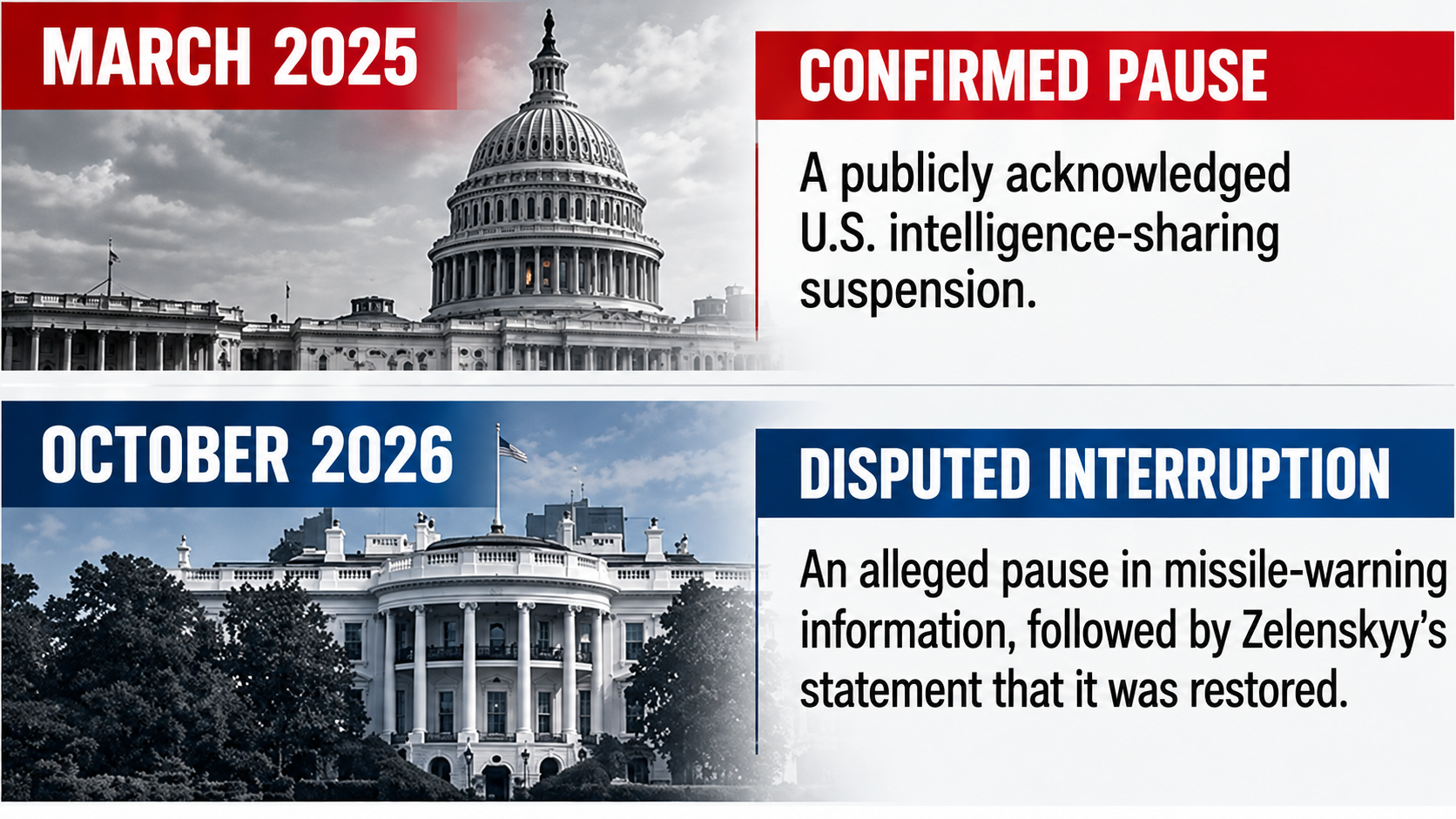
Yes. In March 2025, the Trump administration openly suspended intelligence sharing and military assistance before restoring them following negotiations.
That earlier episode offers a useful comparison, although the circumstances of the October 2026 dispute are not identical.
In March 2025, CIA Director John Ratcliffe confirmed a suspension of intelligence sharing amid mounting pressure on Ukraine to engage in U.S.-led peace discussions.
Following talks in Jeddah, Saudi Arabia, on March 11, American and Ukrainian officials announced that the pause would be lifted. (AP · Reuters)
How the two episodes compare
| Question | March 2025 | October 2026 |
|---|---|---|
| Was a disruption reported? | Yes | Yes |
| Was a U.S. suspension publicly acknowledged? | Yes | Not in the same clear terms |
| What was affected? | Intelligence sharing and military assistance | Crucial missile-warning intelligence, according to Ukraine |
| Was a restoration reported? | Yes, after negotiations in Jeddah | Yes, by Zelenskyy on October 18 |
| Is the exact scope known publicly? | A broad pause was acknowledged | Details remain incomplete |
The difference is significant.
In 2025, American officials publicly acknowledged suspending assistance and then announced its restoration.
In October 2026, Zelenskyy has described an interruption and its resolution, while Trump previously maintained that intelligence sharing continued.
The precise scope of the more recent disruption has not been publicly documented in comparable detail.
The earlier episode nevertheless demonstrates something important: intelligence cooperation is not necessarily insulated from political disagreements between allies and partners.
For Ukraine, that creates a vulnerability that cannot be addressed solely by purchasing more weapons.
Is Intelligence Sharing the Same as Patriot Missiles or Starlink?
No. These are different kinds of support, and problems affecting one do not necessarily mean the others have stopped working.
The distinction became especially important because Ukraine’s recent disputes with Washington also involved satellite communication services and shortages of air-defense interceptors.
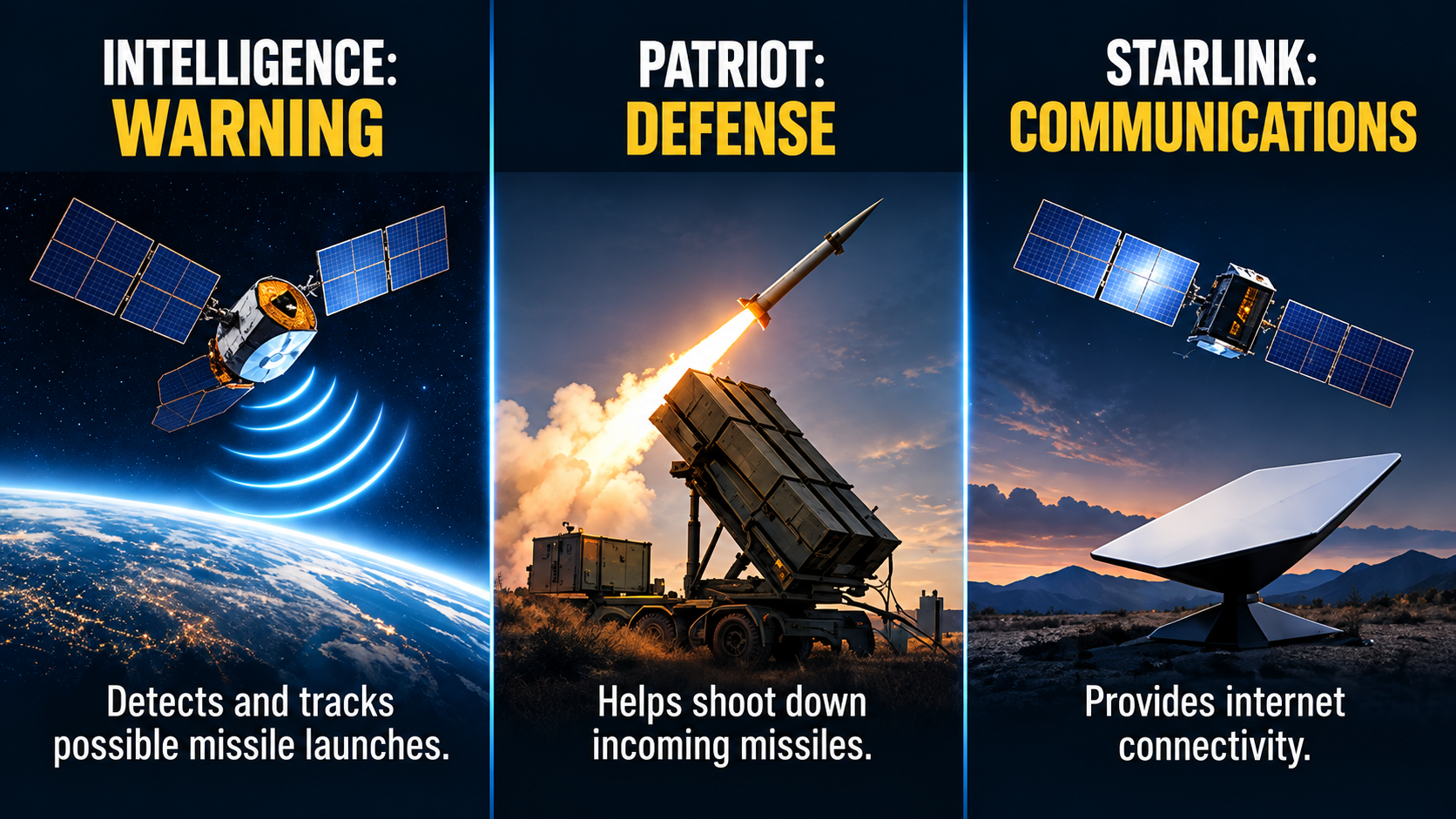
Three types of military support that are often confused
| Capability | Main function | Why Ukraine needs it |
|---|---|---|
| U.S. missile-warning intelligence | Helps identify incoming missile threats | Gives defenders earlier warning |
| Patriot air defense systems | Detect and attempt to intercept hostile aircraft and missiles | Provides a means to stop certain incoming threats |
| Starlink satellite communications | Supplies connectivity for communications and some military operations | Helps maintain links between personnel and equipment |
The systems can complement one another, but they are not interchangeable.
For example, intelligence might indicate that a missile has been launched.
A Patriot battery must still detect or track the threat, receive relevant instructions through its own command structure, and have an appropriate interceptor available.
Likewise, a working Starlink terminal does not by itself replace missile-launch intelligence.
What happened with Starlink?
Ukraine has also complained about restrictions affecting certain Starlink-related military operations.
According to Reuters, Ukrainian officials said changes to satellite connectivity interfered with some drone missions. SpaceX and American officials offered competing explanations of responsibility for the restrictions. (Reuters)
The controversy has also involved Starshield, the name used for SpaceX’s government-oriented satellite services.
The exact technical arrangements and responsibility for particular restrictions have been disputed.
But the important distinction is straightforward:
Restoring a flow of missile-warning intelligence does not automatically resolve a separate satellite communications dispute.
Nor does it replenish Ukraine’s inventory of defensive missiles.
That is why one positive announcement about intelligence cooperation should not be confused with a full restoration of every form of military support.
Does Restored Intelligence Sharing Mean U.S.–Ukraine Relations Have Recovered?
Not necessarily. It is a meaningful improvement in an essential area of cooperation, but it does not settle the wider diplomatic dispute.
Intelligence sharing is unusually sensitive because it requires both technical compatibility and continuing political approval.
Countries can disagree on diplomatic policy while their militaries continue working together.
They can also maintain diplomatic communications while limiting particular categories of military assistance.
The United States and Ukraine currently face disagreements concerning energy infrastructure strikes, Russia-related economic restrictions, military support, and the terms of possible peace negotiations.
Yet contacts between the two governments have continued.
On October 18, Zelenskyy spoke with Trump associates Steve Witkoff and Jared Kushner as American efforts to revive negotiations remained active, according to Axios. (Axios)
The contacts suggest that the diplomatic relationship remains functional despite the friction.
They do not establish that Washington and Kyiv have reached a broader agreement.
Why does this matter to the United States?
For Americans, this is more than a dispute between two foreign governments.
The United States has invested substantial military, financial, and diplomatic resources in Ukraine’s defense since Russia’s full-scale invasion in February 2022.
How Washington handles cooperation with Kyiv affects several American priorities.
First, it shapes U.S. credibility with security partners. Governments that depend on American defense technology will pay attention to how reliably that support is delivered during disputes.
Second, it influences relations with European allies, many of whom regard Russia’s war as a direct threat to European security.
Third, the issue is connected to American domestic debates over foreign assistance, defense spending, and whether Washington should prioritize diplomatic pressure or sustained military support.
There are competing arguments.
Supporters of using American assistance as diplomatic leverage argue that Washington should retain the ability to press partners toward negotiations.
Critics warn that interrupting assistance used to protect civilians could increase risks on the ground and weaken confidence in the United States.
The October episode illustrates the stakes of that disagreement without proving which approach will ultimately produce a negotiated settlement.
What Should We Watch Next?
The next development will be whether restored intelligence cooperation remains reliable—and whether diplomatic discussions produce a wider understanding between Washington and Kyiv.
Several questions remain unresolved.
1. Will missile-warning cooperation continue without further interruptions?
The strongest evidence of improvement would be sustained operational cooperation, rather than a single announcement.
Because intelligence arrangements are classified, the public may not receive a complete technical explanation.
2. Can Ukraine obtain enough air-defense interceptors?
Even the best warning is of limited use if defenders lack sufficient missiles or other means of protection.
Ukraine has continued asking its partners to strengthen its air defenses as Russian attacks target energy systems and civilian areas.
3. Will the Starlink and Starshield disputes be resolved separately?
Connectivity for military systems remains a different issue from intelligence sharing.
The outcome will matter for Ukrainian drone operations and battlefield communications.
4. Could new diplomatic talks reduce tensions?
Zelenskyy has expressed interest in further discussions with Washington.
Whether those talks result in policy changes, security commitments, or movement toward peace negotiations remains uncertain.
5. Will Russia’s attacks on Ukraine’s energy infrastructure continue?
This question may matter most immediately to Ukrainian civilians.
A restored warning service may improve the ability to respond to some missile threats. It cannot, by itself, end attacks or guarantee that homes, hospitals, and power facilities will be protected.
Bottom Line: What This Story Really Means
Volodymyr Zelenskyy’s October 18 announcement suggests that a crucial part of U.S.–Ukraine intelligence cooperation is functioning again after a disputed interruption.
The immediate concern was not simply whether two governments were exchanging information.
It was whether Ukraine was receiving the timely warning information needed to prepare for Russian ballistic missile attacks.
The crucial distinction is between restoring a particular defense capability and repairing an entire political relationship.
Ukraine says the intelligence problem has been resolved. The precise scope and cause of the reported interruption remain unclear, and Trump previously insisted that intelligence sharing had continued.
Meanwhile, disagreements over Russian oil infrastructure, sanctions, military communications, and negotiations have not disappeared.
For Ukraine, the lesson is that effective air defense depends on several things working together: reliable warnings, available weapons, functioning communications, and continued international cooperation.
For the United States, the episode raises a broader question about how military assistance should be managed when Washington’s diplomatic goals differ from those of a country it supports.
Restoring the warning link may reduce an immediate vulnerability.
It is not the same as resolving the war—or even the diplomatic tensions surrounding it.
U.S.–Ukraine Intelligence Sharing: Key Questions Explained
Q. Has the United States resumed intelligence sharing with Ukraine?
According to President Volodymyr Zelenskyy, yes. On October 18, 2026, he said previously interrupted intelligence cooperation was working again. The United States has not publicly detailed the scope of the alleged interruption.
Q. Did the United States completely cut off intelligence to Ukraine?
A complete suspension of all intelligence sharing has not been independently established for October 2026. Ukraine reported that crucial missile-warning information was unavailable during Russian attacks, while Trump maintained that intelligence sharing continued.
Q. How long did Ukraine go without U.S. missile warnings?
Zelenskyy said Ukraine had gone three days without receiving the critical intelligence during ballistic missile attacks. The precise technical start and end times have not been publicly confirmed.
Q. Why does Ukraine need American missile intelligence?
American capabilities can help identify Russian ballistic missile launches and provide early warning. That information gives Ukrainian forces more time to prepare defensive responses.
Q. Can Patriot missiles defend Ukraine without American intelligence?
Yes, Patriot systems have their own radar and engagement capabilities. However, additional early-warning intelligence can improve overall preparation and coordination. An interruption in external intelligence does not automatically disable a Patriot battery.
Q. Did Trump suspend intelligence sharing to pressure Zelenskyy?
The motive has not been independently established. The dispute occurred amid American criticism of Ukrainian attacks on Russian oil infrastructure, and Zelenskyy reported warnings that cooperation could be restricted. No detailed public U.S. explanation has confirmed a specific retaliatory order.
Q. Has the United States stopped sharing intelligence with Ukraine before?
Yes. In March 2025, the Trump administration acknowledged a pause in intelligence sharing and military assistance. Cooperation resumed following U.S.–Ukraine negotiations in Saudi Arabia.
Q. Is the intelligence dispute related to Starlink?
Both issues involve technologies important to Ukraine’s defense, but they are separate. Intelligence sharing concerns information about threats, while Starlink primarily provides satellite communications and connectivity.
Q. Does restored intelligence sharing mean Trump and Zelenskyy have reconciled?
No broader reconciliation has been established. Diplomatic contacts continued on October 18, but disagreements over energy strikes, Russia policy, military support, and peace negotiations remain.
Did this help make the story clearer? 🙂
WIN keeps unpacking the “why” behind the news—clearly and simply!
Sources
Intelligence Sharing and October 18 Announcement
U.S.–Ukraine Disagreements and Diplomatic Contacts
Reuters — Trump-Zelenskiy Rift Threatens Vital Support for Kyiv (October 17, 2026)
AP — Ukraine Resumes Russian Oil Refinery Strikes Amid Dispute With Trump (October 15, 2026)
Axios — Zelensky Speaks to Witkoff and Kushner Amid U.S.–Ukraine Crisis (October 18, 2026)
Military Technology and Defense Needs
Reuters — Ukraine Accuses SpaceX of Disrupting Drone Missions as U.S. Ties Worsen (October 14, 2026)
Earlier Intelligence Suspension in March 2025
Reuters — U.S. and Ukraine Agree to Restore Security Support After Jeddah Talks (March 11, 2025)
AP — U.S. Resumes Military Aid and Intelligence Sharing After Talks in Saudi Arabia (March 11, 2025)