Why Did GM Stock Fall After a $20 Billion Share Buyback Announcement?

A company announces that it could spend $20 billion buying back its own shares. That sounds like good news for investors.
So why would its stock fall?
That’s exactly what happened to General Motors after its October 20, 2026, earnings announcement.
GM reported a profitable quarter, beating Wall Street’s earnings expectations. It also unveiled a massive new stock buyback authorization, yet investors responded by selling shares.
The apparent contradiction comes down to something important: A buyback can improve the financial picture for shareholders, but it cannot erase concerns about how much money a company will earn in the future.
And there was another detail behind GM’s headline-grabbing announcement. The company had authorized $20 billion in future repurchases—not promised to spend that entire amount immediately.

※ Images in this article are AI-generated illustrations created to help explain the story. They are not actual photographs, and depictions of people, places, or events may differ slightly from reality.
What Did GM Actually Announce on October 20?
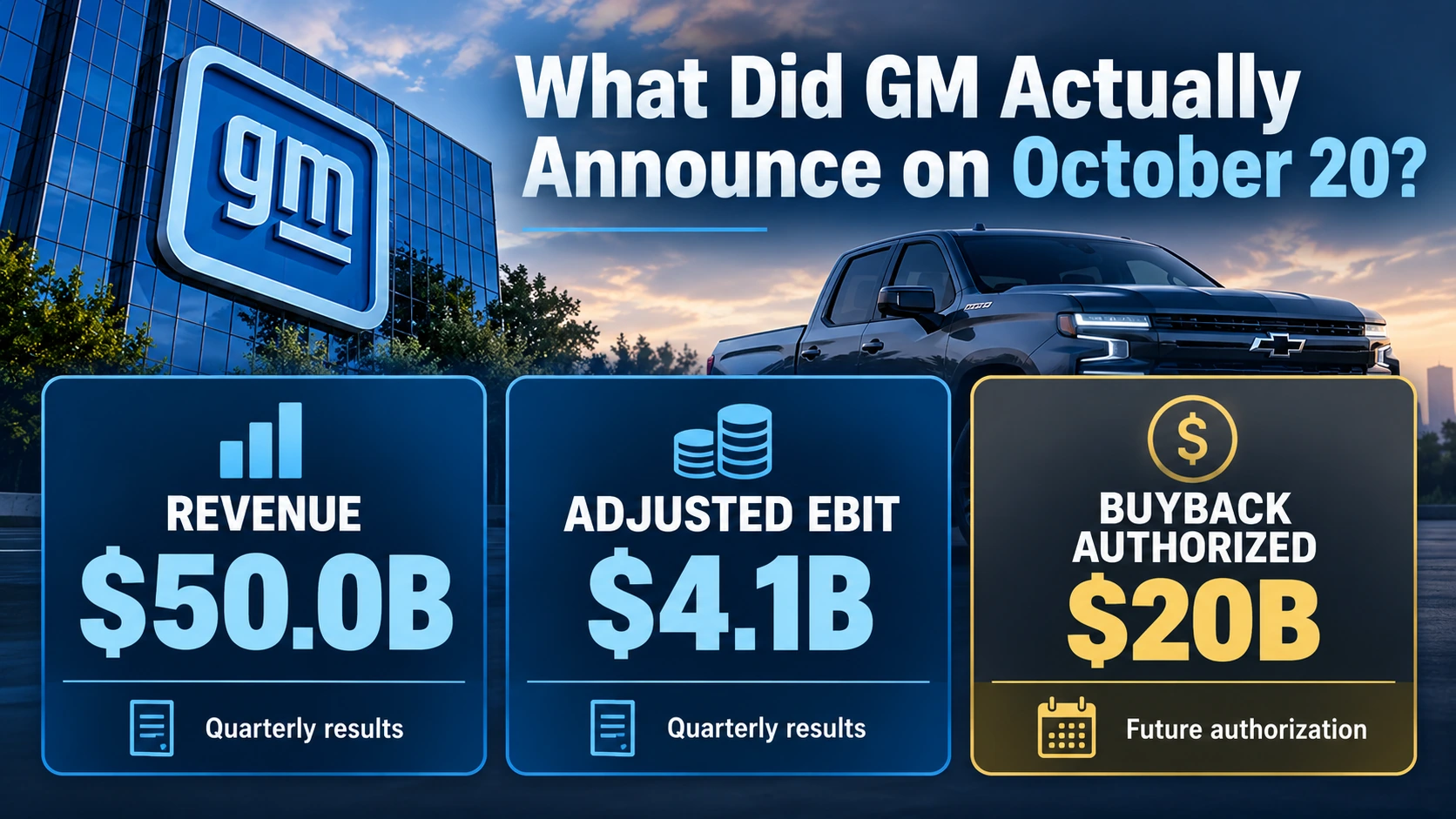
General Motors announced three major developments on October 20: strong third-quarter earnings, updated financial guidance, and a new $20 billion share repurchase authorization.
The company reported approximately $50 billion in revenue, $3.3 billion in net income attributable to stockholders, and $4.1 billion in adjusted earnings before interest and taxes, commonly called adjusted EBIT.
Adjusted EBIT is a measure of operating performance that excludes certain items. It isn’t the same as the company’s final net profit.
GM also reported adjusted earnings of $3.70 per share, exceeding analysts’ expectations. Its adjusted operating profit was approximately 22% higher than a year earlier. (General Motors SEC filing · Reuters)
Those are substantial results for an automaker operating in a competitive and cost-sensitive industry.
Here’s how the announcements fit together:
| Announcement | What it means |
|---|---|
| $50.0 billion in quarterly revenue | GM generated substantial sales during the third quarter. |
| $4.1 billion in adjusted EBIT | The underlying business produced strong operating earnings. |
| $20 billion buyback authorization | GM’s board approved additional share repurchases over multiple years. |
| Updated 2026 guidance | GM narrowed its forecast for full-year earnings. |
The first two figures describe how GM performed during the past quarter.
The third concerns how the company may use cash to repurchase shares over time.
The fourth looks forward—and helps explain why investors weren’t entirely satisfied.
Why Did Investors Focus on GM’s Outlook Instead of the Buyback?
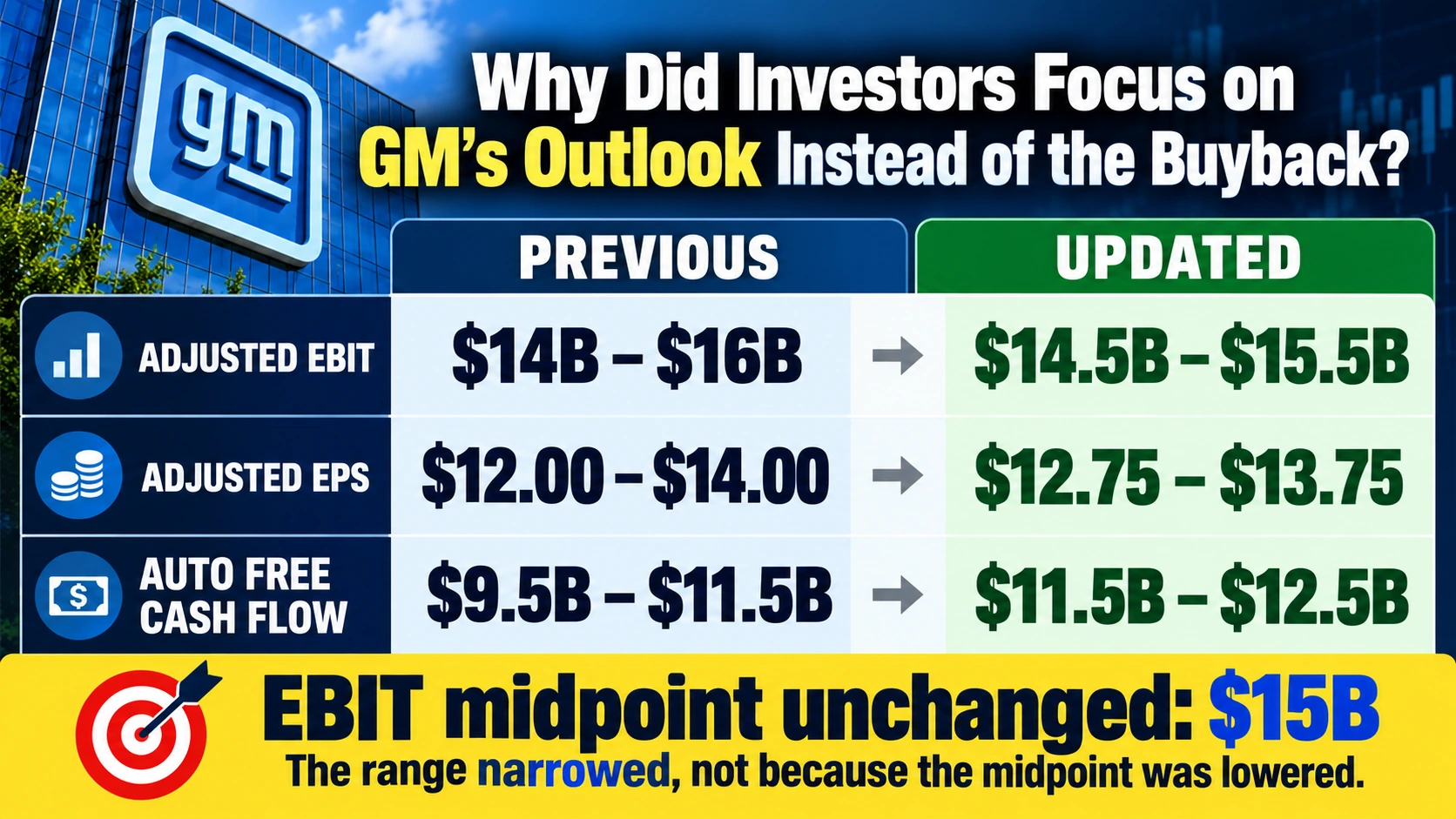
Investors buy stocks based largely on expectations of future earnings, not just profits already reported.
A business can post an excellent quarter and still disappoint Wall Street if its outlook falls short of what investors had hoped to see.
GM’s updated 2026 forecast illustrates that distinction.
What changed in GM’s earnings guidance?
GM narrowed its projected full-year adjusted operating profit to between $14.5 billion and $15.5 billion, compared with its previous range of $14 billion to $16 billion.
The midpoint remained $15 billion.
Its adjusted earnings-per-share forecast narrowed to $12.75–$13.75, compared with the earlier $12–$14 range.
Meanwhile, GM increased its outlook for adjusted automotive free cash flow, a measure of cash generated by its automotive operations after certain spending.
| 2026 financial metric | Previous guidance | Updated guidance |
|---|---|---|
| Adjusted EBIT | $14B–$16B | $14.5B–$15.5B |
| Adjusted EPS | $12.00–$14.00 | $12.75–$13.75 |
| Adjusted automotive free cash flow | $9.5B–$11.5B | $11.5B–$12.5B |
These are GM’s official figures, published with its October 20 earnings announcement. (General Motors SEC filing)
The revisions were not uniformly negative. In particular, the stronger cash flow outlook was favorable.
But the company did not increase the midpoint of its adjusted operating-profit forecast despite delivering a strong third quarter.
The revised adjusted EPS range also had a midpoint of $13.25, below the roughly $13.41 analysts expected, according to LSEG data cited by Reuters.
That helps explain the market’s reaction. Strong current earnings were not enough to offset disappointment with the forecast. (Reuters)
Why does a small forecast difference matter?
Stock prices reflect what investors think will happen next.
Imagine investors have already priced a strong quarter into a company’s shares. When that company reports those expected results, there may be little reason for the stock to rise.
If management then signals greater uncertainty about the coming months, investors may lower the price they’re willing to pay.
GM shares fell nearly 7% on October 20 as the market weighed its outlook and rising costs against the buyback announcement. (AP)
The selloff does not mean GM’s third-quarter performance was poor. It means investors were less enthusiastic about what might come next.
How Do Stock Buybacks Work—and Why Aren’t They a Guaranteed Win?
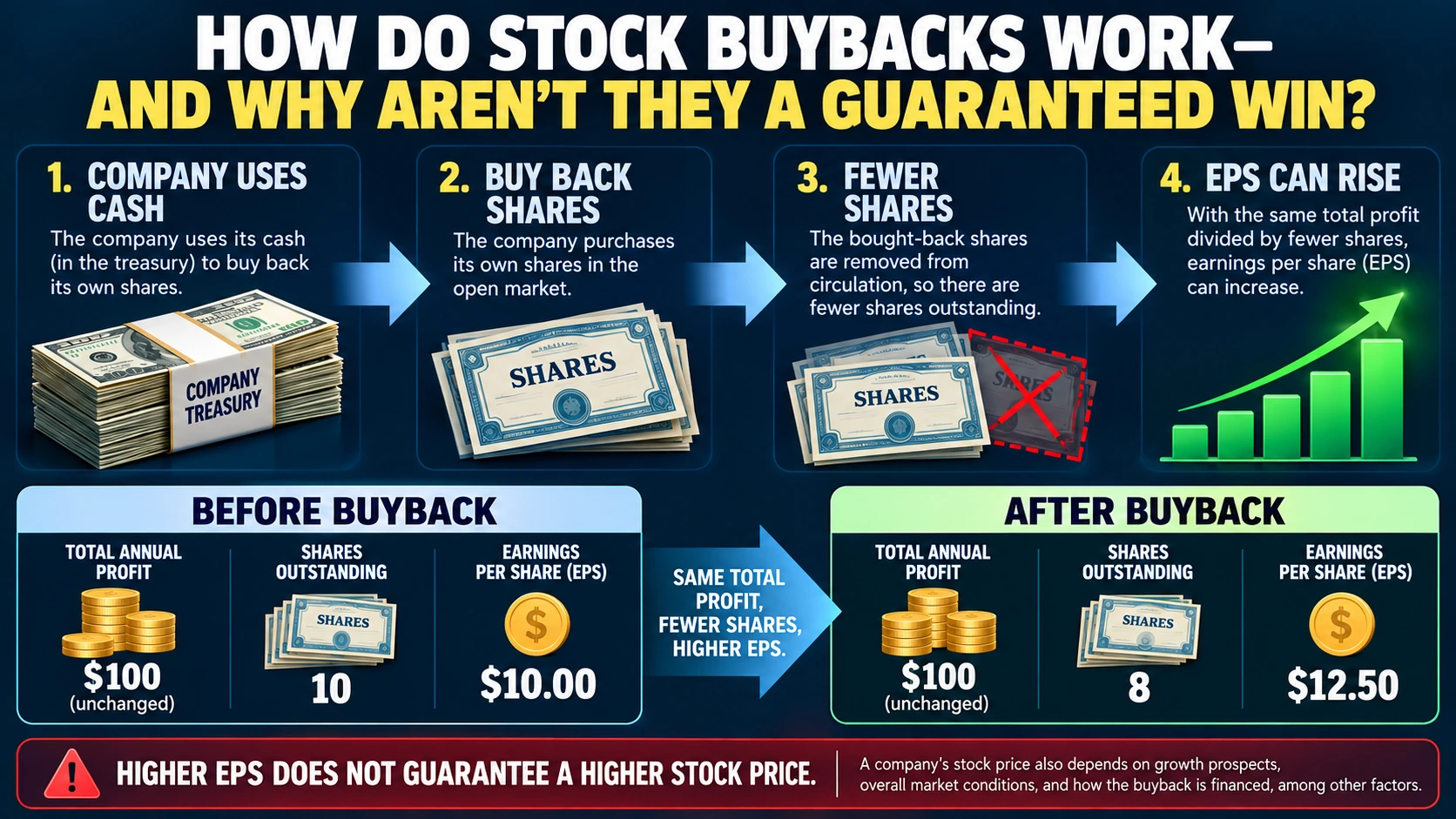
A stock buyback occurs when a company purchases shares of its own stock, generally using available cash.
When those shares are retired or otherwise excluded from the outstanding share count, the company’s profits are divided among fewer shares.
This can increase earnings per share (EPS) even if the company hasn’t increased its total earnings.
The U.S. Securities and Exchange Commission’s investor education website defines EPS in terms of company profit relative to its common share count. (Investor.gov)
A simple example
Imagine a hypothetical business earning $100 in annual profit.
| Before buyback | After buyback | |
|---|---|---|
| Total annual profit | $100 | $100 |
| Shares used in EPS calculation | 10 | 8 |
| Earnings per share | $10.00 | $12.50 |
The company’s total profit hasn’t changed.
Yet its earnings per share have increased because that profit is now divided among fewer shares.
This is one reason investors often welcome stock buybacks.
A smaller share count can also increase a remaining shareholder’s percentage ownership, assuming that shareholder keeps the same number of shares.
But the calculation has an important limitation.
Higher EPS doesn’t necessarily mean a higher stock price
A buyback doesn’t automatically make the company’s factories more productive, products more competitive, or future earnings more certain.
It also requires the company to spend cash.
If a business uses billions of dollars to repurchase shares at an expensive price, investors may question whether that money could have earned a better return elsewhere.
Alternatively, if future profits decline, a smaller share count may not prevent earnings per share from falling.
Consider a company whose total earnings fall substantially while its outstanding share count also declines. The reduced number of shares may soften the decrease in EPS, but it cannot guarantee EPS growth.
Stock prices also depend on how much investors are willing to pay for each dollar of earnings. That valuation can fall if investors become worried about the business.
A buyback changes the distribution of ownership and earnings per share. It does not guarantee that the market will value those shares more highly.
Did GM Really Commit to Spending All $20 Billion?
No. GM authorized up to $20 billion in additional share repurchases, but the announcement did not obligate the company to spend that amount immediately—or even to use the entire authorization.
This distinction is easy to miss.
A buyback authorization gives management permission to repurchase shares within an approved amount.
Actual repurchases take place later, according to the company’s decisions and market conditions.
GM’s October 20 announcement specifically described the program as a multi-year authorization with no expiration date. The company also stated that it could suspend or discontinue the program at its discretion. (General Motors SEC filing)
In practical terms:
| Term | What it actually means |
|---|---|
| Buyback authorization | The board permits the company to purchase shares up to an approved amount. |
| Actual repurchase | The company spends money to acquire shares. |
| Share retirement | Repurchased shares are permanently removed from outstanding stock. |
| Remaining authorization | The unused amount the company may still repurchase, subject to its decisions. |
A company’s announcement of a large authorization can signal confidence in its financial position or its assessment of the stock’s value.
But investors still need to distinguish that signal from completed transactions.
Had GM already been buying back shares?
Yes. The new authorization followed an earlier repurchase program.
GM announced that it had completed the $6 billion share repurchase program announced in January 2026.
Its reported outstanding common shares also declined over several years:
| Reporting date | Shares outstanding |
|---|---|
| End of 2023 | Approximately 1.2 billion |
| End of 2024 | 995 million |
| End of 2025 | 904 million |
| September 30, 2026 | 849 million |
The figures show that GM’s outstanding share count had already fallen substantially before the new $20 billion authorization. (General Motors SEC filing)
That reduction is real.
But it also raises a useful question: If GM was already reducing the number of shares in circulation, why was the market still concerned?
The answer lies in the actual automotive business, particularly its dependence on profitable pickup trucks and its exposure to rising costs.
Why Do Pickup Trucks and Rising Costs Matter So Much to GM Stock?
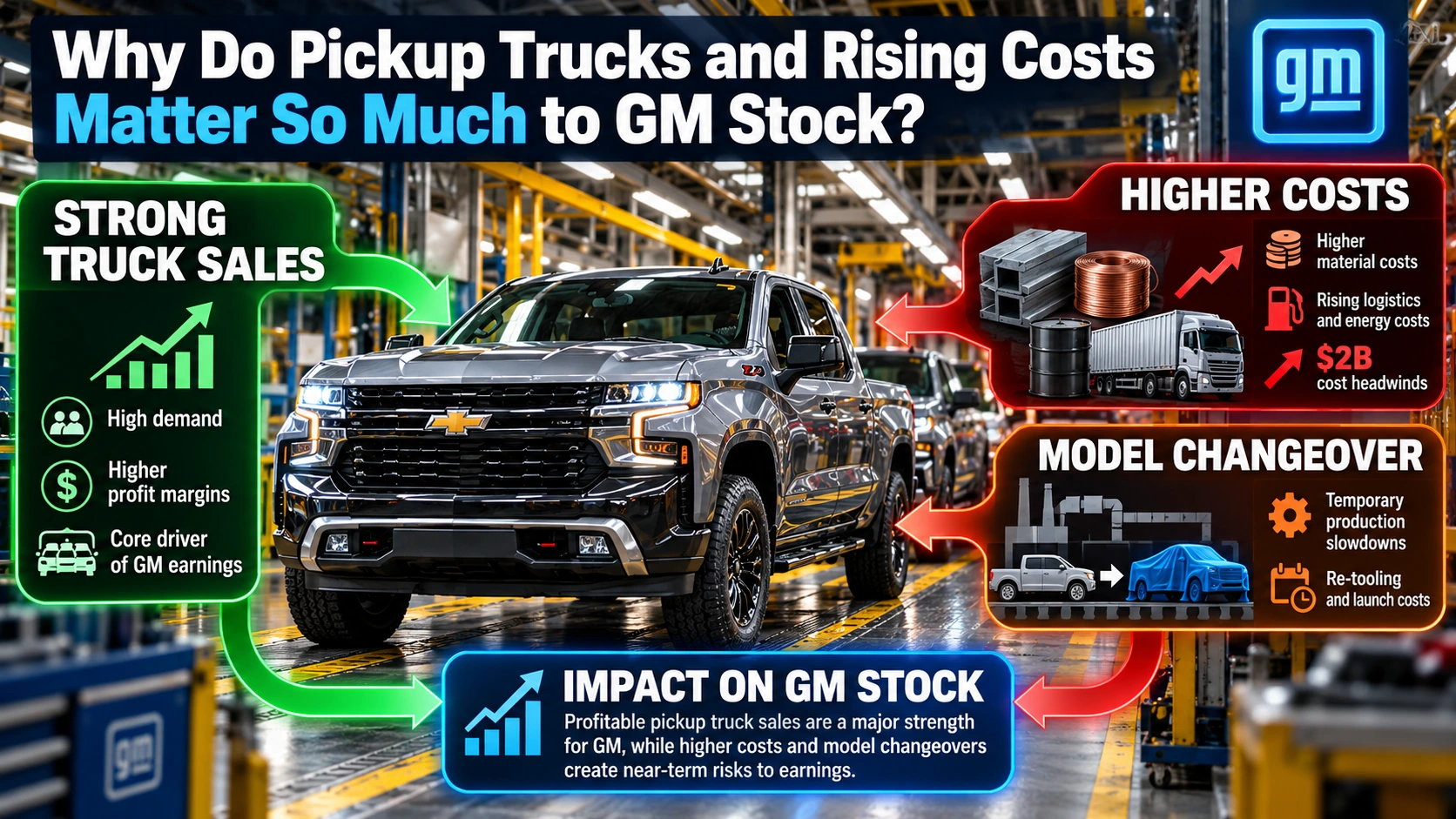
General Motors relies heavily on profitable trucks and large vehicles.
Strong demand for Chevrolet Silverado and GMC Sierra pickups helped support its third-quarter earnings.
But a profitable vehicle business can still face rising costs that reduce future margins.
A margin is the portion of revenue remaining after the relevant costs have been deducted. If it becomes more expensive to manufacture vehicles, a company may earn less on each vehicle sold unless it raises prices or lowers other expenses.
GM identified several pressures in its October earnings materials, including commodity inflation, transportation and logistics costs, and DRAM memory components used in vehicles.
The company estimated approximately $2 billion in combined cost headwinds from commodity inflation, logistics, and memory costs for 2026. (Reuters)
That’s important because higher steel and copper prices can affect an automaker even when consumers continue buying its most popular vehicles.
GM also faces a major product transition.
Its next-generation Chevrolet Silverado and GMC Sierra light-duty pickups are part of its 2027 product strategy. Launching redesigned vehicles requires manufacturing changes and can temporarily disrupt production.
GM’s near-term outlook included pressure from lower pickup deliveries around the transition, according to Reuters. (Reuters)
That doesn’t necessarily mean demand for GM trucks has weakened.
A factory may need to temporarily adjust production to prepare for a new model even when customers still want the previous one.
For investors, however, timing matters. A short disruption in producing highly profitable vehicles can affect quarterly earnings.
Could 2027 be better for GM?
GM believes its upcoming vehicles and operating improvements provide opportunities for growth.
In her October 20 shareholder letter, CEO Mary Barra highlighted the upcoming Silverado and Sierra launches, improvements in vehicle quality and operating efficiency, and expansion of software and services such as OnStar and Super Cruise.
The company also emphasized continued growth in cash generation and long-term shareholder returns. (General Motors)
But improving results in 2027 depends partly on factors outside GM’s control.
Higher commodity prices, logistics expenses, interest rates, and demand for new vehicles could affect how much profit the company ultimately earns.
Those are forward-looking expectations, not guaranteed outcomes.
This is one reason a large repurchase authorization cannot answer every question investors have about the next year.
Could the $20 Billion Buyback Still Help GM Shareholders?
Yes. The program could benefit remaining shareholders over time if GM executes repurchases effectively while maintaining healthy earnings and cash flow.
Buying back shares can reduce the outstanding share count, potentially increasing the portion of future earnings attributable to each remaining share.
It can also provide one way for a company to return excess capital to shareholders without committing to a larger recurring dividend.
But there are trade-offs.
Buybacks and dividends are not the same thing
A dividend is a cash payment made to shareholders according to the company’s declared dividend terms.
A buyback generally involves the company purchasing shares from investors who sell. Shareholders who continue holding their stock don’t automatically receive a cash payment simply because the company announces a buyback.
GM’s October 20 announcement included a quarterly cash dividend of $0.18 per common share, separate from the new repurchase authorization.
The dividend was declared payable on December 17, 2026, to shareholders of record as of December 4, 2026. (General Motors SEC filing)
Both dividends and buybacks can return capital to investors, but they work differently.
| Stock buyback | Cash dividend | |
|---|---|---|
| How it works | Company purchases its own shares | Company distributes cash to eligible shareholders |
| Direct cash to investors who keep their shares | No automatic payment | Yes, if they qualify for the dividend |
| Potential benefit | Greater ownership percentage and EPS support | Direct cash income |
| Main limitation | Depends on purchase price, execution, and future performance | Uses company cash and may be changed in the future |
There is no universal rule that one is always better than the other.
Investors must consider the company’s financial condition, share valuation, investment needs, and future profitability.
A buyback can be a sensible use of cash when a company has financial flexibility and believes its shares are attractively valued.
It can also be less appealing if the company overpays for its stock or neglects important investments.
What Should GM Shareholders Watch Next?
The next important developments will be less about the headline size of the buyback and more about GM’s ability to deliver the earnings and cash flow needed to support it.
Four developments deserve particular attention.
First, GM’s fourth-quarter profitability. Investors will be able to compare actual results with the company’s latest guidance and assess the impact of higher costs and pickup production transitions.
Second, the 2027 outlook. Updated forecasts will show whether management still expects improved profitability and how it plans to address commodity inflation.
Third, the rollout of redesigned pickup trucks. Investors will want to see whether the next-generation Silverado and Sierra can maintain strong sales, support pricing, and improve GM’s longer-term earnings potential.
Fourth, actual share repurchases. Future financial filings should reveal how aggressively GM uses its new authorization and how its outstanding share count changes.
These developments are related.
If GM sustains strong profits, produces ample cash, and repurchases stock at sensible prices, the authorization could strengthen its shareholder-return story.
If costs remain elevated or earnings weaken, investors may continue to question whether the buyback is enough to justify a higher stock valuation.
The size of the announcement alone cannot settle that question.
Bottom Line: What This Story Really Means
GM’s stock fell after the company announced a $20 billion buyback because investors were weighing more than the potential benefits of fewer outstanding shares.
General Motors reported strong third-quarter results and improved its expected automotive free cash flow.
But its updated annual earnings outlook failed to provide the level of reassurance investors wanted. Rising costs and uncertainty surrounding future pickup truck production also weighed on sentiment.
The $20 billion authorization is significant, but it represents permission for future share repurchases—not money already spent or a promise that the stock will rise.
A buyback can make each remaining share represent a larger portion of the business. It cannot, by itself, make that business more profitable.
For GM, the question ahead is whether its core automotive operations can deliver enough future earnings and cash flow to make that capital-return strategy worthwhile.
That’s why a seemingly positive $20 billion announcement could coincide with a falling share price.
GM Stock Buyback: Key Questions Explained
Q. Did GM announce a $20 billion stock buyback in October 2026?
Yes. On October 20, 2026, General Motors announced that its board had authorized an additional $20 billion in share repurchases under a multi-year program.
Q. Has GM already spent the entire $20 billion?
No. The announcement authorized future purchases. The program has no expiration date, and GM may suspend or discontinue repurchases at its discretion.
Q. Does a stock buyback automatically raise the stock price?
No. Buybacks can reduce the share count and support earnings per share, but stock prices still depend on future profits, valuations, market expectations, and other risks.
Q. Did GM report weak earnings in the third quarter of 2026?
No. GM reported approximately $50 billion in revenue and $4.1 billion in adjusted operating profit, with adjusted earnings per share exceeding analysts’ expectations.
Q. Why were investors disappointed with GM’s earnings outlook?
GM’s updated adjusted earnings-per-share guidance had a midpoint below analysts’ consensus estimates. Investors also weighed rising manufacturing costs and uncertainty surrounding the next year.
Q. How can a stock buyback increase earnings per share?
When a company reduces the shares used to calculate EPS, the same amount of earnings is divided among fewer shares. That can increase EPS even without an increase in total profit.
Q. Is a stock buyback the same as a dividend?
No. A dividend provides cash to eligible shareholders, while a buyback involves the company purchasing its own shares. Investors who continue holding their shares do not automatically receive cash from a buyback.
Q. Why are Chevrolet Silverado and GMC Sierra trucks important to GM’s earnings?
These pickups are important contributors to GM’s North American business. Strong sales support profits, while manufacturing costs or temporary production disruptions can affect future results.
Q. What will determine whether GM’s buyback benefits shareholders?
The outcome will depend on GM’s future earnings, cash generation, the prices paid for repurchased shares, and management’s execution of the program.
Did this help make the story clearer? 🙂
WIN keeps unpacking the “why” behind the news—clearly and simply!
Sources
GM’s Official Earnings Results and Share Repurchase Authorization
General Motors — October 20, 2026, Earnings Release and Repurchase Authorization (SEC Exhibit)
General Motors — Third-Quarter 2026 SEC Form 10-Q
Earnings Outlook, Cost Pressures, and Market Reaction
Reuters — GM Shares Sink as Automaker Signals Rising Cost Pressures, October 20, 2026
General Motors — Q3 2026 Letter to Shareholders
AP — U.S. Stock Market Report, October 20, 2026