Why Was One of Virginia’s Most Powerful Democrats Charged in a Marijuana Conspiracy?

How does a politician who helped push for marijuana legalization end up facing federal drug-trafficking charges?
That is the question surrounding L. Louise Lucas, one of Virginia’s most influential Democratic lawmakers.
For years, Lucas has advocated expanding legal access to cannabis. She also helped open a marijuana-related business in Portsmouth, Virginia. Yet federal prosecutors now accuse her of leading an illegal operation that distributed large quantities of marijuana, laundered proceeds, and used political influence for financial gain.
The case has an unexpected twist: Virginia allows adults to possess marijuana within certain limits, but recreational marijuana sales are not yet legal.
And the allegations go beyond what happened inside a store. Prosecutors claim Lucas used her position in the state Senate to protect and benefit the alleged operation.
Lucas has characterized the government’s actions as an effort to intimidate her, while the Justice Department denies that politics drove the prosecution.
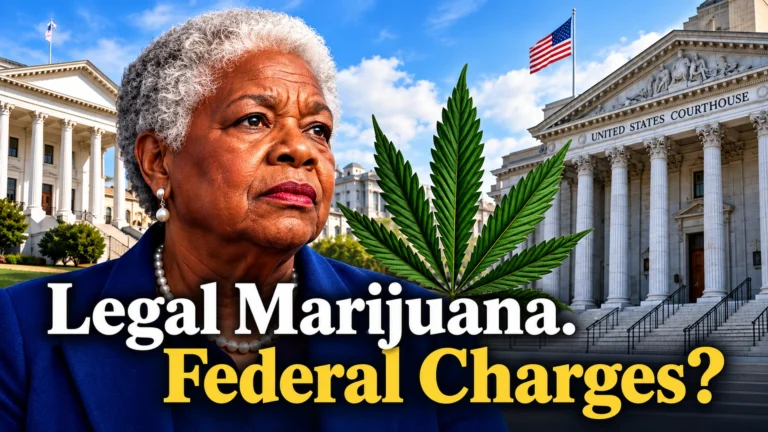
※ Images in this article are AI-generated illustrations created to help explain the story. They are not actual photographs, and depictions of people, places, or events may differ slightly from reality.
Understanding this controversy requires separating three questions: What is actually illegal, what prosecutors say Lucas did, and what the government must still prove in court.
What Did Prosecutors Actually Charge Louise Lucas With?
On October 22, 2026, the Justice Department announced that a federal grand jury had indicted Lucas and six other people in an alleged marijuana distribution and corruption scheme.
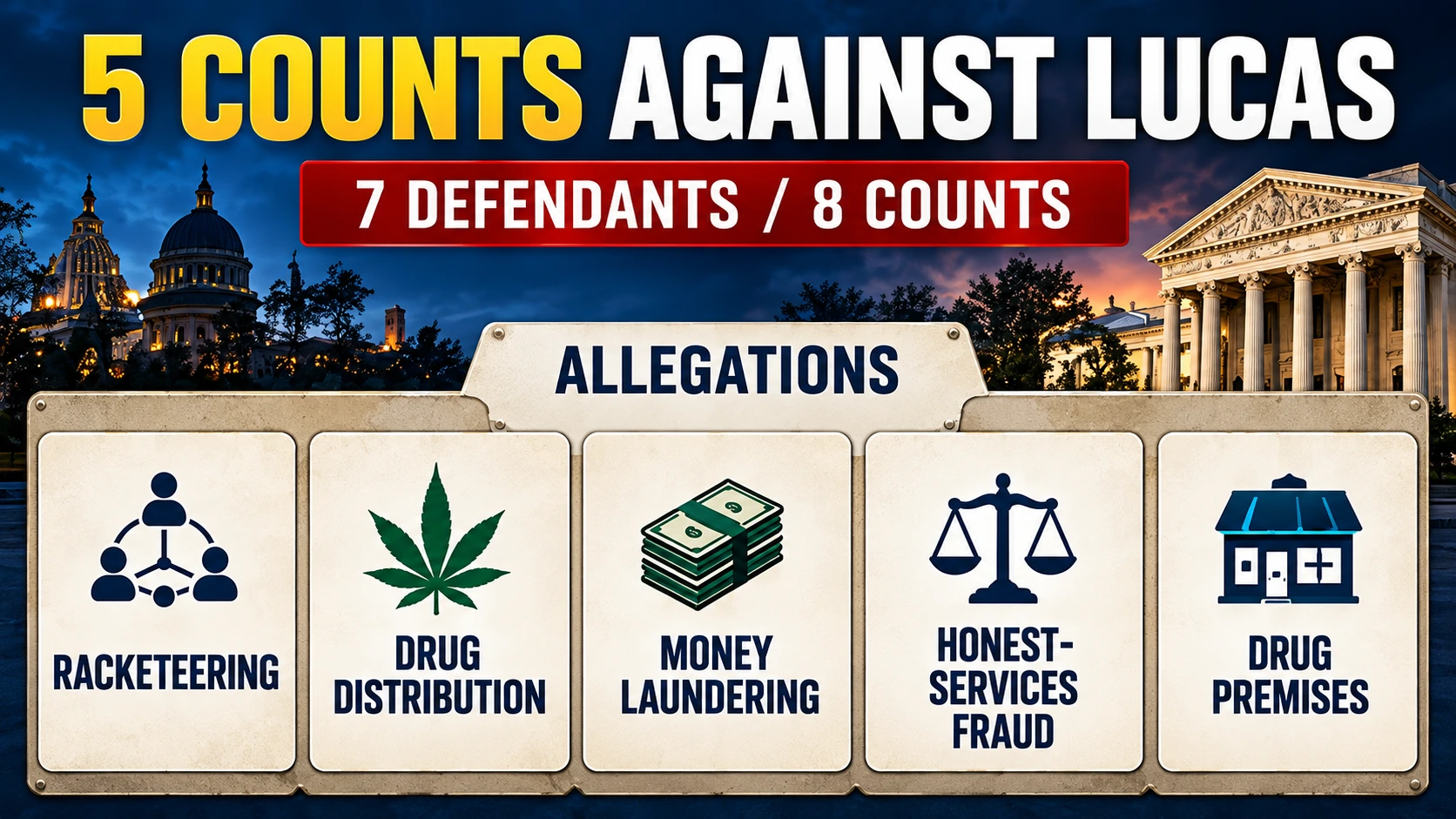
Lucas, 82, was charged in five counts of an eight-count indictment. The other defendants include two daughters, a grandson, and three associates.
Federal prosecutors allege that Lucas directed a criminal enterprise that acquired and distributed at least 100 kilograms of marijuana—roughly 220 pounds—and moved money connected to those activities. (U.S. Department of Justice · AP)
What do the five charges mean?
| Federal charge | What prosecutors must establish |
|---|---|
| Racketeering conspiracy | An alleged agreement involving an enterprise and a pattern of qualifying criminal activity |
| Marijuana distribution conspiracy | An alleged agreement to distribute marijuana illegally |
| Money laundering conspiracy | An alleged agreement to conduct unlawful transactions involving criminal proceeds |
| Conspiracy to commit honest-services fraud | An alleged agreement involving a corrupt exchange of official influence for private benefit |
| Maintaining a drug-involved premises | Allegedly using or maintaining property for prohibited drug activities |
These are different legal theories, not five separate findings of guilt.
The broader indictment also contains firearm-related and wire-fraud allegations involving defendants in the case. Those additional charges should not automatically be attributed to Lucas personally.
The indictment was returned on October 14 and unsealed on October 22. Lucas surrendered to federal authorities that morning and made an initial court appearance in Norfolk.
She was subsequently released on her own recognizance, meaning she was allowed to remain out of custody subject to court requirements rather than being held pending trial. (CBS News · AP)
An indictment means prosecutors have formally brought criminal charges. It does not mean Lucas or any other defendant has been convicted.
That distinction matters throughout this case because the government’s account is still an accusation that must be tested through the legal process.
How Can Marijuana Be Legal in Virginia but Selling It Still Be a Crime?
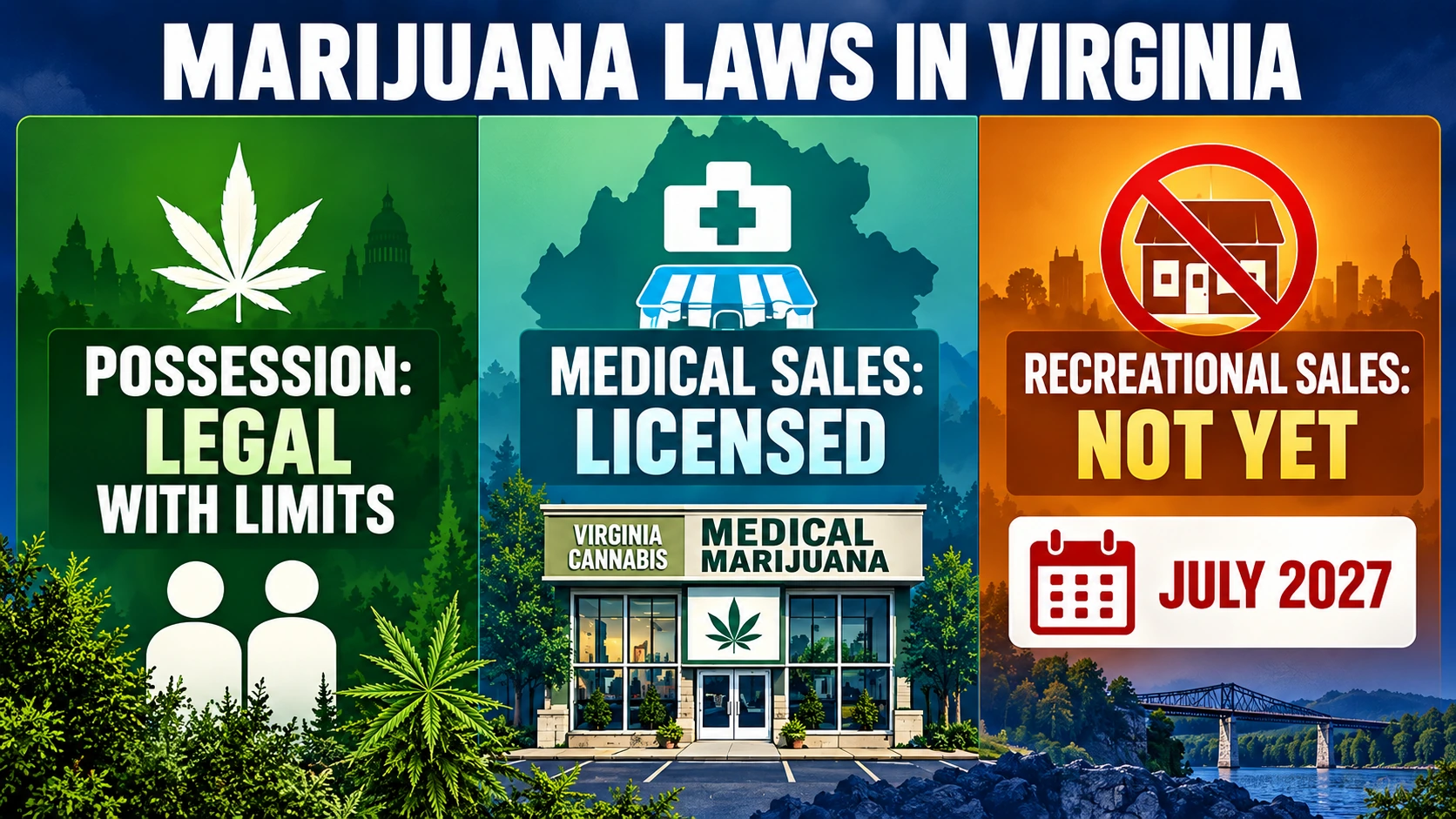
Virginia’s cannabis laws contain a distinction that is easy to miss: The state legalized certain adult possession and home-growing activities before establishing a regulated recreational retail market.
In 2021, Virginia began allowing adults 21 and older to possess limited amounts of marijuana. The state also allowed restricted home cultivation and noncommercial sharing.
But possessing marijuana and operating a business that sells it are not the same legal activity.
The Virginia Cannabis Control Authority confirms that nonmedical recreational sales remain illegal until the state’s regulated retail market can begin on July 1, 2027. (Virginia Cannabis Control Authority)
What is legal right now?
| Activity | Virginia’s rules in October 2026 |
|---|---|
| Adult possession | Public possession of up to 2 ounces for personal use by adults 21 and older; other rules apply in private residences |
| Home cultivation | Up to four plants per household, subject to conditions |
| Sharing marijuana | Noncommercial sharing of up to 2 ounces between adults 21 and older, subject to conditions |
| Medical cannabis sales | Legal through properly licensed facilities |
| Recreational retail sales | Not yet permitted |
| Licensed recreational retail market | Scheduled to begin July 1, 2027 |
These distinctions are established in the state’s cannabis laws and consumer guidance.
Think about the difference between owning something and having permission to operate a store selling it.
The government may allow an adult to possess a product while still requiring a separate business license, approved supply chain, safety controls, and legal authorization before commercial sales can occur.
That is essentially what happened in Virginia: personal-use legalization came first, while the commercial marketplace developed much more slowly.
Why did the state take so long to allow recreational sales?
Virginia’s path toward legal retail marijuana has involved several years of disagreement over licensing, regulation, and implementation.
Earlier proposals to establish recreational sales were blocked, including legislation vetoed under former Republican Gov. Glenn Youngkin.
In 2026, lawmakers and Democratic Gov. Abigail Spanberger ultimately established a regulated retail market beginning in July 2027 through the state budget after disagreements over earlier legislation.
The Virginia Cannabis Control Authority has been developing the licensing system and regulations needed for that transition. (Virginia Cannabis Control Authority · Federal indictment, background chronology)
This delayed opening created an unusual marketplace.
Residents could legally possess marijuana under certain conditions, while most businesses still could not lawfully sell recreational marijuana.
Some stores sold permitted hemp-derived products. Others faced scrutiny over whether products marketed as hemp were actually unlawful marijuana.
That distinction is central to the allegations against Lucas and her associates.
What Did the Alleged Family Marijuana Business Have to Do With Her Political Power?
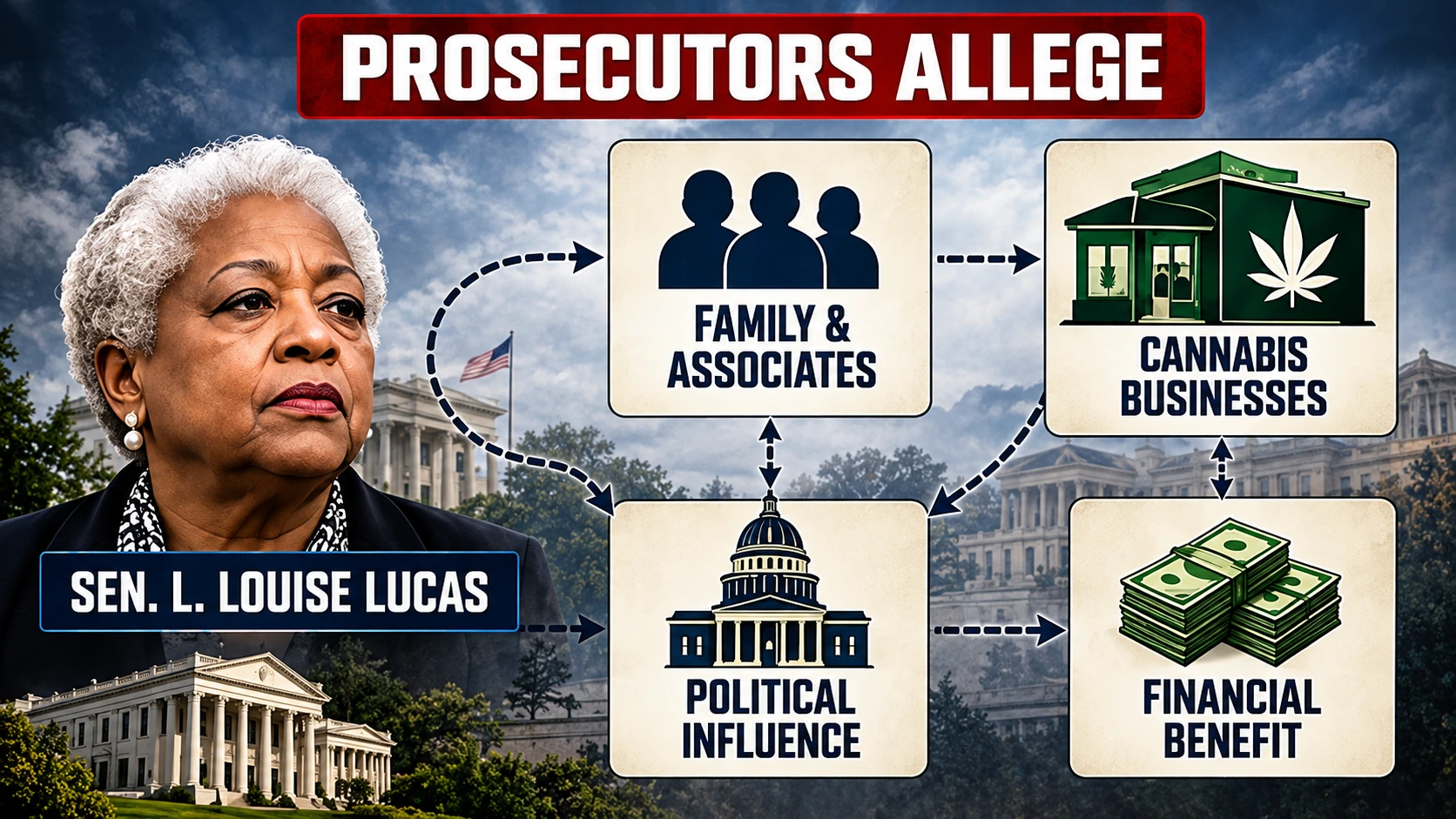
The federal case is about more than accusations of selling marijuana without authorization.
Prosecutors allege that Lucas helped direct an enterprise involving relatives and business associates, while using her public office to advance its interests.
That is why the indictment includes racketeering, money laundering, and corruption-related allegations. (U.S. Department of Justice)
Who was involved in the business?
Lucas partnered with Carlton Upton Jr. in a business organization associated with cannabis-related shops, including The CBD Shoppe and The Cannabis Outlet.
The Cannabis Outlet opened in Portsmouth in 2021, and Lucas has publicly acknowledged an ownership interest in the business.
The indictment also names members of her family, including daughters Lisa Lucas-Burke and Theresa Lucas-Lamb and grandson Ryan Eichelberger. Prosecutors describe a wider network of business operations and financial activity. (U.S. Department of Justice)
Family relationships and business ownership are not crimes by themselves.
The legal question is whether prosecutors can prove the individuals knowingly participated in the alleged unlawful activities.
Why is her position in the Virginia Senate so important?
Lucas has served in Virginia’s Senate since the early 1990s. She holds the position of president pro tempore and chairs the Senate Finance and Appropriations Committee.
The finance committee handles decisions involving Virginia’s budget, taxation, and public spending.
That gives its chair substantial influence over legislation with financial consequences.
Federal prosecutors allege Lucas attempted to use her political position to protect the marijuana business from scrutiny and influence legislation in ways that benefited the alleged enterprise.
They also claim she sought to help a business associate obtain a future recreational marijuana license through an arrangement involving financial benefits. (U.S. Department of Justice · AP)
This is where the case becomes a public-corruption controversy.
Supporting marijuana legalization is a legitimate political position. A lawmaker may advocate creating new businesses, tax revenue, and employment opportunities.
A lawmaker also may have private investments, subject to applicable disclosure and ethics rules.
But prosecutors are alleging something different: that government influence was improperly connected to personal financial benefit.
The difference between advocating a policy and corruptly using public office for private gain is one of the central questions prosecutors must prove.
How Did the Investigation Reach This Point?
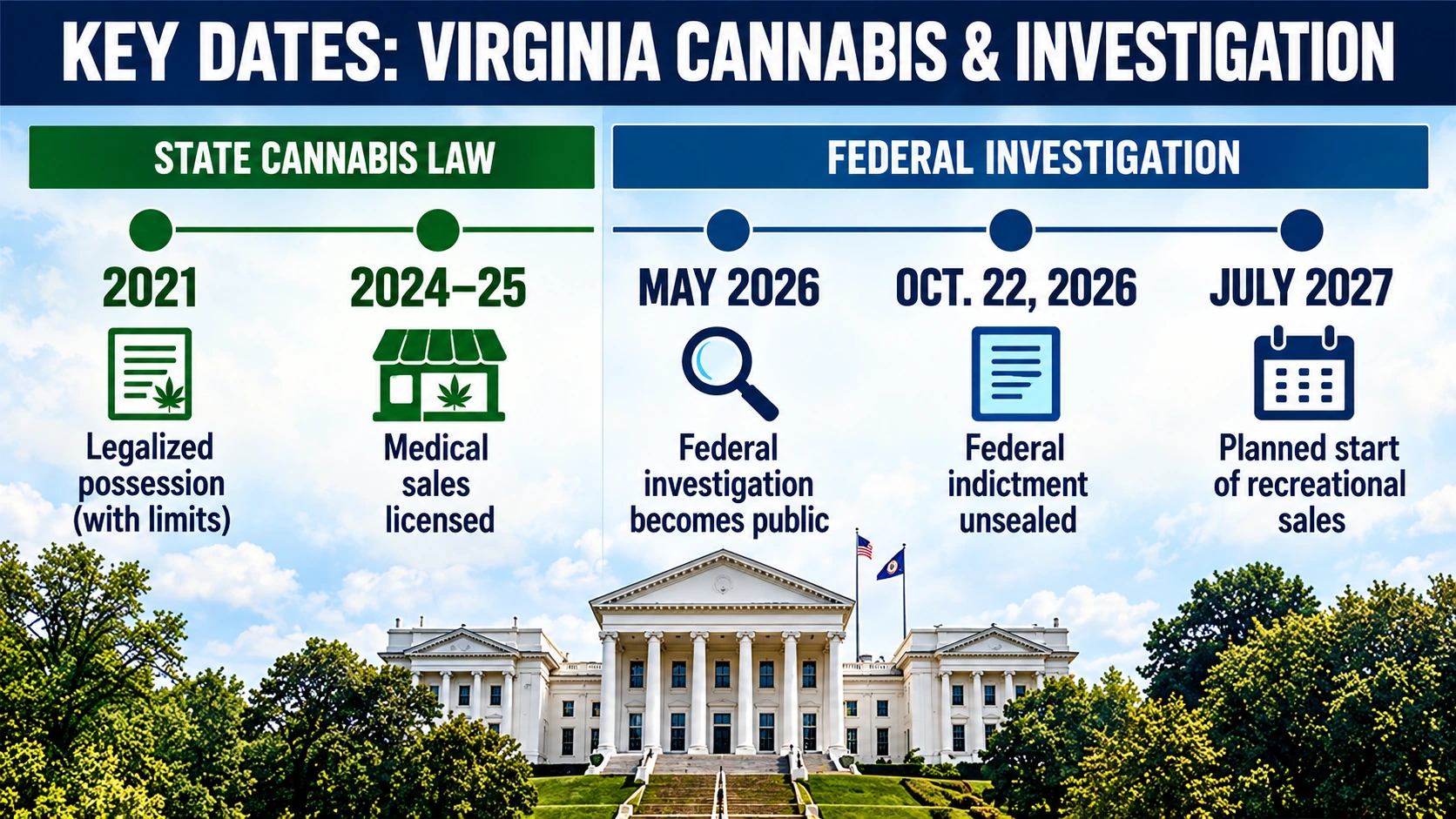
The October indictment did not emerge from a single incident.
The investigation extends back years, overlapping with Virginia’s evolving marijuana laws and the growth of Lucas’s cannabis business interests.
The publicly documented timeline helps explain the sequence.
| Date | What happened |
|---|---|
| 2021 | Virginia began allowing limited adult marijuana possession; The Cannabis Outlet opened |
| 2024–2025 | Investigators allegedly made controlled marijuana purchases at the shop |
| May 6, 2026 | Federal agents searched The Cannabis Outlet and The CBD Shoppe |
| October 14, 2026 | A federal grand jury returned the indictment under seal |
| October 22, 2026 | The indictment was unsealed; Lucas surrendered and appeared in federal court |
| November 16, 2026 | Lucas’s next scheduled court appearance |
| July 1, 2027 | Virginia’s licensed recreational retail marijuana market is scheduled to begin |
The alleged controlled purchases in 2024 and 2025 are described in the indictment; they are part of the government’s case, not findings made after a trial.
Federal investigators searched The Cannabis Outlet and The CBD Shoppe on May 6, 2026. Reporting also described searches involving Lucas’s Portsmouth office. These developments came months before the indictment became public.
Lucas characterized the investigation as intimidation when the searches occurred. (Federal indictment · AP)
The timeline also matters because the disputed business activities allegedly took place before Virginia’s planned recreational retail market was authorized to open.
The fact that a regulated marketplace is scheduled to begin in 2027 would not retroactively authorize transactions that were unlawful when they occurred.
Why Is This a Federal Case Instead of Just a Virginia Business Violation?
Federal prosecutors can pursue marijuana-related offenses under federal criminal law, even when a state has relaxed its own rules concerning cannabis.
But the federal-state distinction became more complicated in 2026.
In April, the Justice Department moved certain FDA-approved marijuana products and qualifying state-licensed medical marijuana products into Schedule III under the federal Controlled Substances Act.
That change did not amount to blanket federal legalization of recreational marijuana distribution. Broader rescheduling remained a separate regulatory process. (Drug Enforcement Administration)
For the Lucas case, the distinction is important.
The allegations concern distribution outside the legally authorized framework, along with separate financial and corruption-related offenses.
Even a future relaxation of federal drug restrictions would not automatically authorize bribery, money laundering, or unlawful commercial activity.
What does racketeering mean in this case?
Racketeering generally concerns an enterprise connected to a pattern of specified criminal activity.
The Racketeer Influenced and Corrupt Organizations Act, commonly known as RICO, allows prosecutors to pursue certain enterprise-based criminal schemes.
In this case, prosecutors are attempting to connect alleged marijuana distribution, financial transactions, and misuse of political influence into a wider criminal enterprise.
That theory requires more than showing that several people knew one another or worked together.
Prosecutors must establish the applicable elements of the charged racketeering conspiracy, including the necessary connection to an enterprise and qualifying criminal conduct.
The same principle applies to the financial allegations.
Money laundering is not simply depositing business earnings into a bank. Criminal liability depends on specific requirements concerning unlawful proceeds, knowledge, and the nature of the financial transactions or agreements.
The more serious federal charges therefore turn on evidence about conduct, knowledge, agreements, and alleged financial benefits—not merely on whether Lucas owned a cannabis-related storefront.
Why Has the Indictment Become a Political Controversy?
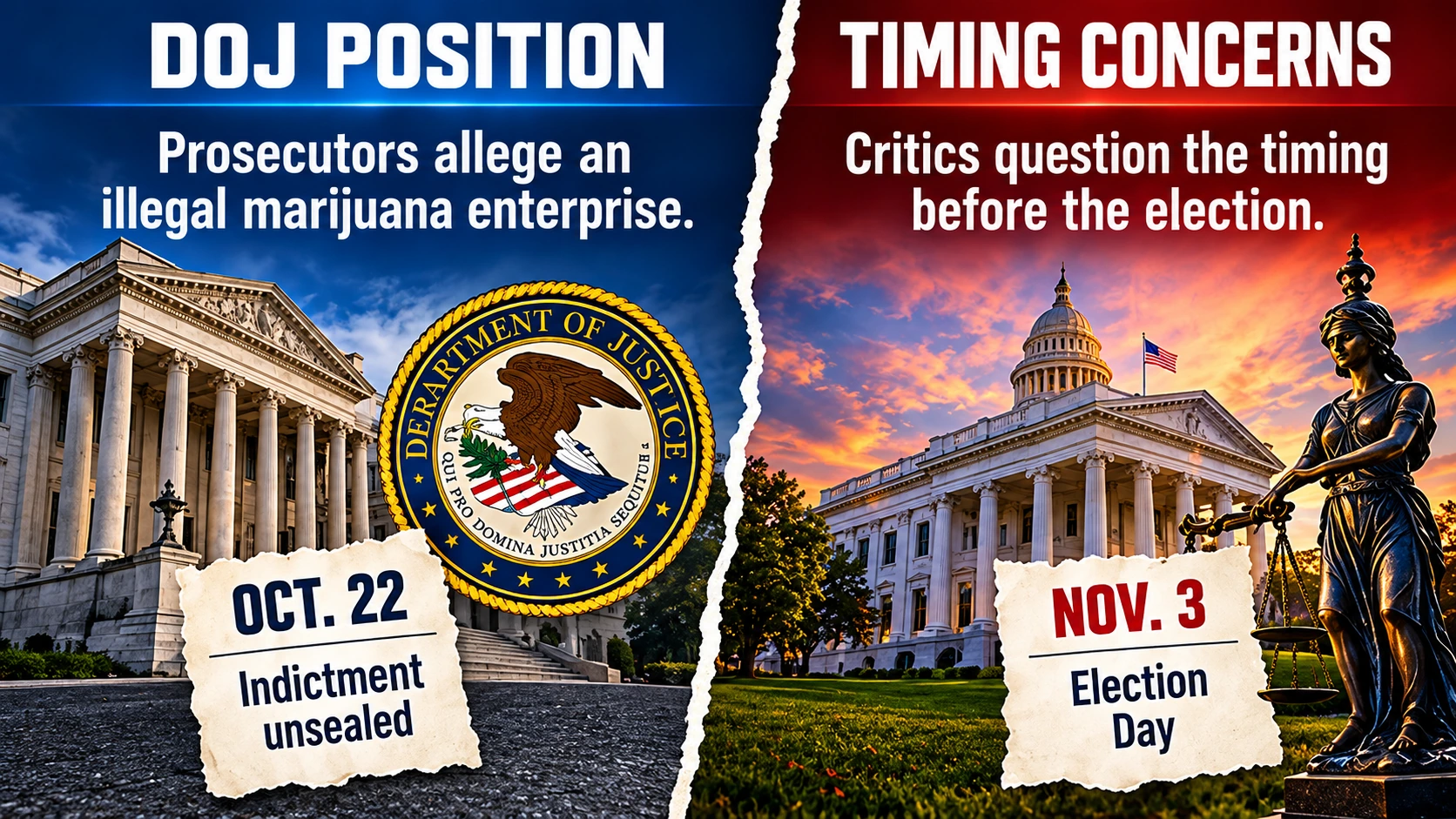
The indictment has attracted political scrutiny partly because Lucas is a prominent Democrat and an outspoken critic of President Donald Trump.
It also became public on October 22, less than two weeks before the November 3 midterm elections.
Lucas herself was not on the ballot, but the timing brought attention to the Justice Department’s handling of politically sensitive investigations.
What has Lucas said?
In a statement posted on social media after the charges were announced, Lucas portrayed the federal government’s actions as an attempt to silence and intimidate her.
She invoked her experiences growing up under segregation and said she would continue standing up for herself.
Her public statement did not directly respond to every factual allegation in the indictment.
Brian Woolfolk, a defense lawyer representing Lucas, also criticized the proceedings and indicated that a more detailed response would follow as the defense reviewed the case. (CBS News · AP)
What does the Justice Department say?
Attorney General Todd Blanche rejected suggestions that the case was a political retaliation effort.
He said the investigation began before Trump’s second administration and defended the prosecution as a response to alleged criminal conduct.
The Justice Department maintains that the indictment reflects evidence presented to a federal grand jury rather than political considerations. (Reuters)
Why did Virginia’s governor raise concerns?
Democratic Gov. Abigail Spanberger emphasized Lucas’s presumption of innocence and her family’s right to respond to the allegations.
Spanberger also criticized the timing of the indictment near an election, arguing that it could further erode public confidence in the Justice Department.
Her remarks did not establish that the charges were false or that prosecutors acted unlawfully. They raised a separate concern about prosecutorial timing and public trust. (Office of Governor Abigail Spanberger)
These are two issues that need to remain separate:
| Question | What is currently established? |
|---|---|
| Was Lucas federally indicted? | Yes. The indictment was made public on October 22 |
| Has she been proven guilty? | No. The allegations remain subject to criminal proceedings |
| Did the government choose the timing for political reasons? | The timing is disputed; improper political motivation has not been established |
| Did the investigation begin before Trump’s current term? | Justice Department officials say it did |
| Does the indictment itself prove corruption? | No. Prosecutors must prove their case through the legal process |
A credible assessment must consider both the prosecution’s evidence and any challenge to how the case was investigated or brought.
Neither serious allegations nor accusations of political retaliation should be treated as proven merely because one side has made them.
Does a Federal Indictment Automatically Remove Louise Lucas From Office?
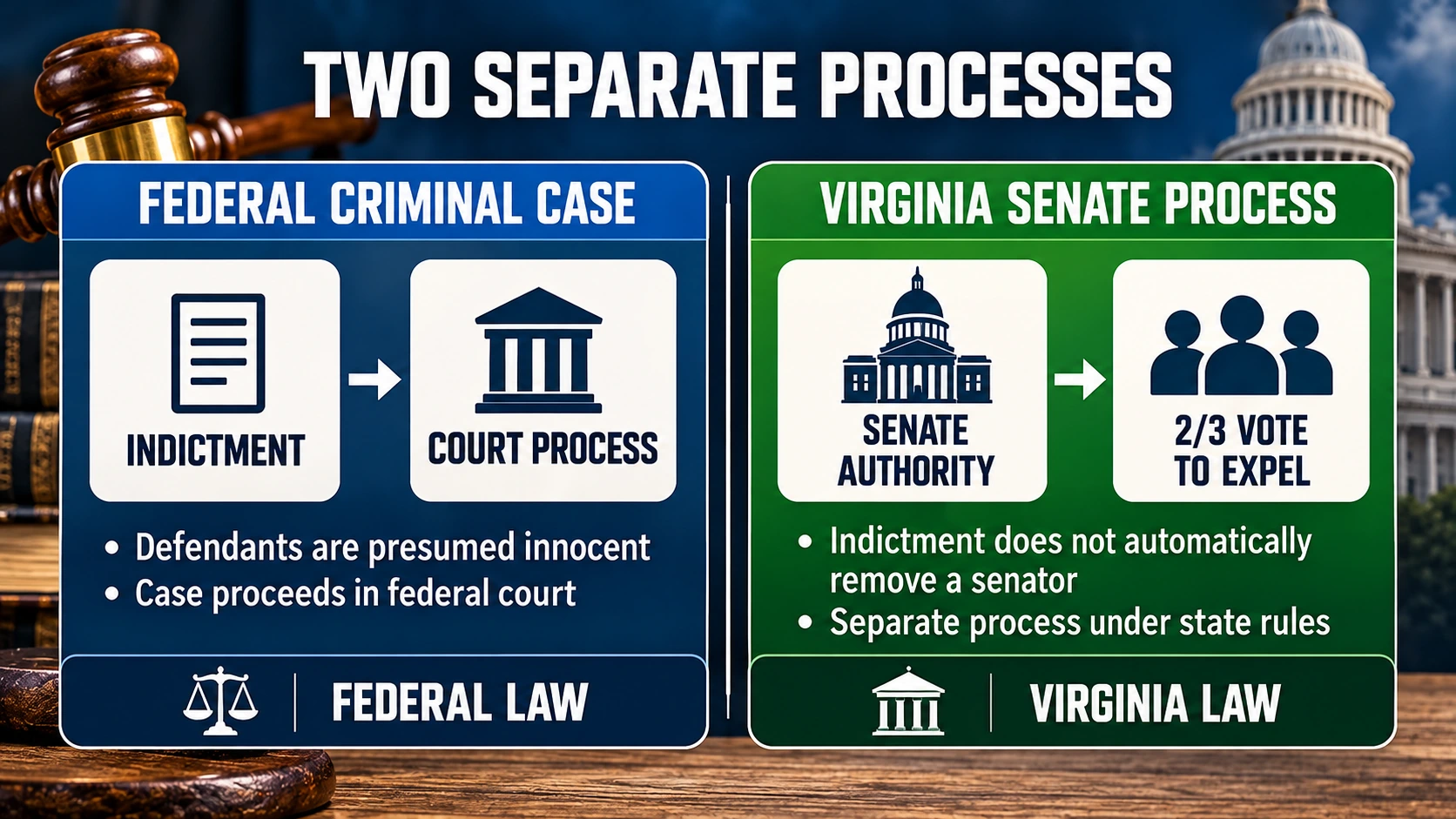
No. A federal indictment does not automatically remove a Virginia state senator from office.
Criminal proceedings and legislative membership are governed by different processes.
Lucas’s criminal case will proceed through federal court. Separately, Virginia’s legislature has constitutional authority over the qualifications and conduct of its members.
Article IV, Section 7 of the Virginia Constitution provides that either legislative chamber may expel one of its members with the concurrence of two-thirds of its elected membership. (Constitution of Virginia)
That is a separate decision, not an automatic consequence of a federal indictment.
What could happen to her political influence?
Lucas chairs one of Virginia’s most powerful legislative committees.
Even without an immediate change in her formal status, a criminal prosecution could affect her ability to exercise political influence, maintain colleagues’ support, and shape future legislation.
Those are political possibilities, not established outcomes.
Virginia Senate Democratic leader Scott Surovell described the allegations as serious while emphasizing Lucas’s right to defend herself.
Her ability to remain influential may depend on how the legal case develops and how fellow lawmakers respond. (AP)
What Happens Next in the Louise Lucas Case?
The next scheduled formal step is Lucas’s arraignment on November 16, 2026, in federal court in Newport News, Virginia.
At an arraignment, the defendant is formally addressed concerning the charges and enters a plea.
Lucas was released after her initial appearance on October 22 rather than being held in custody while the case proceeds. (WTVR)
Beyond the upcoming court date, several developments will matter.
1. The prosecution’s evidence
Prosecutors will need to support the indictment’s allegations with admissible evidence.
That may include business and financial records, testimony, investigative findings, and evidence concerning the alleged agreements.
An indictment alone is not enough to secure a conviction.
2. The defense’s response
Lucas and the other defendants will have opportunities to challenge the allegations, contest evidence, and raise legal defenses.
The defense’s factual response will be especially important in evaluating whether the government can establish the alleged relationship between business activity and political influence.
3. The federal court process
The case could involve pretrial motions, further hearings, negotiated resolutions, or a trial.
None of those possible outcomes should be presented as predetermined.
4. Virginia’s political response
The state Senate may face questions about Lucas’s committee leadership and political responsibilities as the proceedings continue.
But the legal and political consequences will depend on subsequent events, not simply the announcement of charges.
The central question now is whether prosecutors can substantiate the alleged criminal enterprise and show how Lucas personally participated in the conduct charged.
Bottom Line: What This Story Really Means
The Louise Lucas indictment sits at the intersection of three complicated issues: marijuana legalization, political influence, and federal criminal law.
Virginia allows certain marijuana possession and home-growing activities, but its licensed recreational retail market is not scheduled to open until July 2027.
Federal prosecutors allege that Lucas and her associates operated outside the law, moved proceeds from illegal marijuana sales, and used political influence to benefit the alleged operation.
Lucas has challenged the government’s actions as intimidation, while the Justice Department insists the prosecution is based on evidence rather than politics.
The key distinction is that supporting marijuana legalization is not the alleged crime. The government must prove the specific unlawful distribution, financial, and corruption-related conduct described in the indictment.
For now, Lucas remains a defendant, not a convicted criminal.
What happens in court—and what the evidence ultimately establishes—will determine whether this case becomes a proven corruption scandal or an unsuccessful prosecution.
Louise Lucas Indictment: Key Questions Explained
Q. Who is L. Louise Lucas?
L. Louise Lucas is a longtime Democratic Virginia state senator from Portsmouth. She serves as the Senate’s president pro tempore and chairs its Finance and Appropriations Committee.
Q. When was Louise Lucas indicted?
A grand jury returned the federal indictment on October 14, 2026, and it was made public on October 22. Lucas surrendered to authorities and appeared in federal court on October 22.
Q. How many charges does Louise Lucas face?
Lucas faces five counts in a broader eight-count indictment involving seven defendants. Her charges include racketeering conspiracy, marijuana distribution conspiracy, money laundering conspiracy, honest-services fraud conspiracy, and maintaining a drug-involved premises.
Q. Is marijuana legal in Virginia?
Certain activities are legal for adults 21 and older, including limited possession and home cultivation. Nonmedical recreational retail sales remain prohibited until the licensed market is scheduled to begin in July 2027.
Q. Did Louise Lucas own a marijuana business?
Yes. Lucas has publicly acknowledged an ownership interest in The Cannabis Outlet in Portsmouth. Business ownership itself is not the criminal allegation; the case concerns allegedly unlawful activity associated with the business and other defendants.
Q. What does the indictment allege about her family?
Prosecutors allege that relatives and business associates participated in a wider marijuana distribution and financial scheme. Two of Lucas’s daughters and a grandson are among the seven defendants. Their involvement and criminal liability must be established individually.
Q. Why are federal prosecutors involved if Virginia allows marijuana possession?
Federal criminal law remains applicable to unauthorized marijuana distribution and related offenses. Virginia’s limited legalization does not automatically protect conduct that violates federal law.
Q. Has Louise Lucas been found guilty?
No. An indictment is a formal accusation, not a conviction. The prosecution must prove the charges through the criminal justice process.
Q. Was the indictment politically motivated?
Lucas has characterized the government’s actions as intimidation, while federal officials deny political retaliation. The announcement’s timing has drawn criticism, but improper political motivation has not been established.
Q. Does Louise Lucas have to resign from the Virginia Senate?
An indictment does not automatically require removal from office. Virginia’s Constitution provides a separate legislative expulsion process requiring a two-thirds vote of the chamber’s elected membership.
Q. When is Louise Lucas’s next court date?
Her next scheduled federal court appearance is November 16, 2026, for arraignment in Newport News, Virginia. Court schedules can change.
Did this help make the story clearer? 🙂
WIN keeps unpacking the “why” behind the news—clearly and simply!
Sources
Federal Indictment and Criminal Allegations
Official Federal Indictment — Case No. 4:26-cr-75
Associated Press — Virginia Senator Louise Lucas Accused of Leading a Marijuana Criminal Conspiracy
Reuters — Top Virginia Democratic Lawmaker Charged Over Alleged Illegal Cannabis Operation
Virginia Cannabis Laws and Federal Regulation
Virginia Cannabis Control Authority — Laws and Regulations
Virginia Cannabis Control Authority — Retail Marijuana Market
Drug Enforcement Administration — Marijuana Rescheduling Regulatory Actions
Political Reaction and Court Proceedings
Office of Governor Abigail Spanberger — October 22 Statement
CBS News — Federal Charges Against Virginia Senator L. Louise Lucas
WTVR — Governor Spanberger Reacts to Federal Charges Against Senator Lucas
Legislative Authority and Removal Procedures
Constitution of Virginia — Article IV, Section 7: Organization of General Assembly