Why Did the Supreme Court Block Student IDs in New Hampshire Just Before the Midterms?

Can a college ID suddenly stop counting in an election? And if a judge says a state’s voting instructions go too far, why would the Supreme Court step in to stop that judge?
Those questions became urgent in New Hampshire after the U.S. Supreme Court intervened on October 22, 2026, less than two weeks before the midterm elections. Its emergency order allowed state officials to enforce a broader restriction on student IDs while an appeal continues. (Supreme Court · AP)
This was not a final Supreme Court ruling that New Hampshire’s law is constitutional. The justices temporarily halted a lower court’s order. The distinction matters because the dispute is about two different things: what the legislature wrote and what state officials told election workers the law meant.
※ Images in this article are AI-generated illustrations created to help explain the story. They are not actual photographs, and depictions of people, places, or events may differ slightly from reality.
The story gets clearer once the law and the state’s interpretation of it are separated.
What Did New Hampshire Actually Ban?
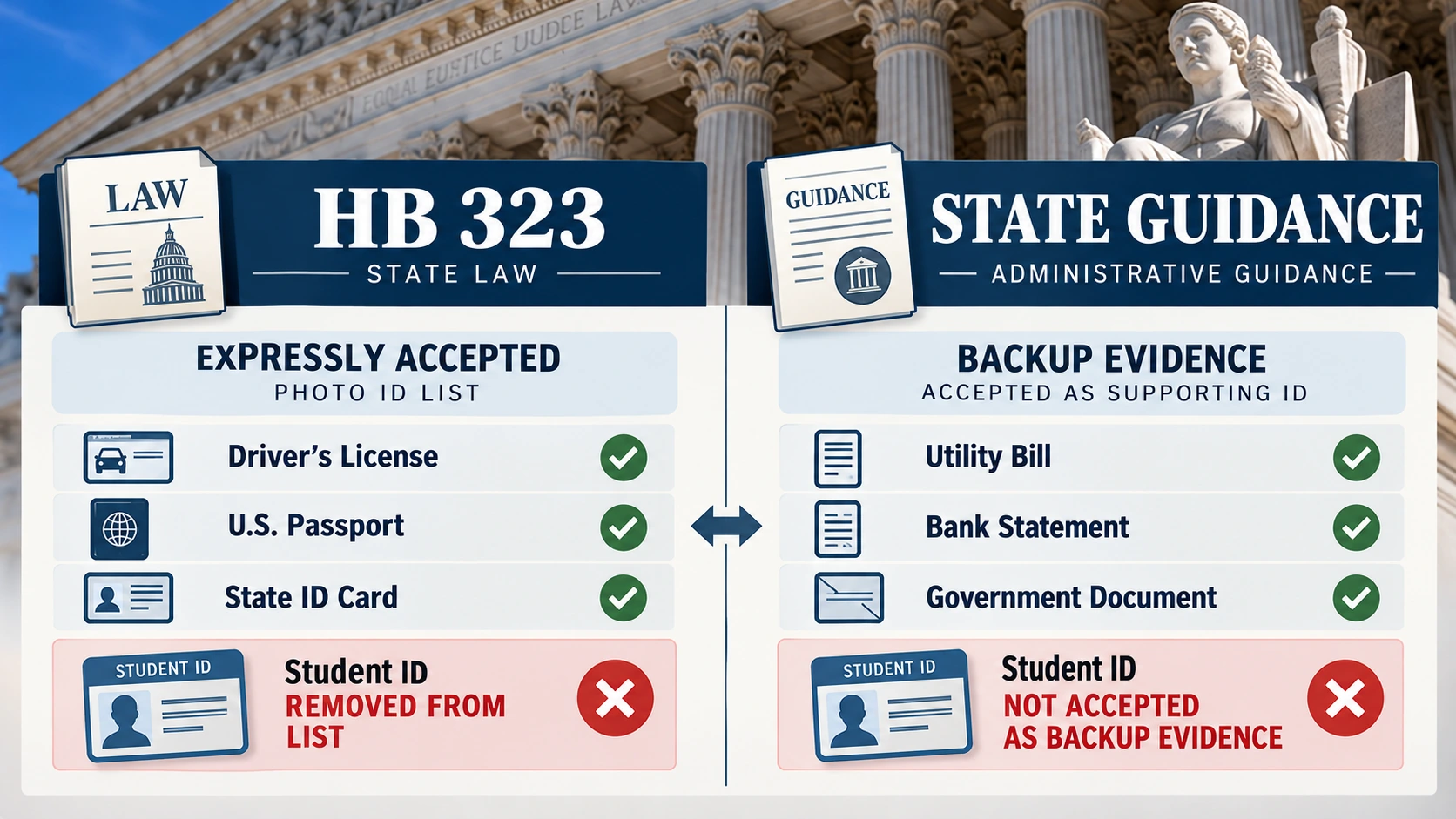
New Hampshire’s HB 323 removed student IDs from the forms of photo identification expressly accepted for obtaining a ballot. Gov. Kelly Ayotte signed the measure on April 3, and it took effect June 2. Before that change, qualifying high school and college IDs had been recognized under the state’s voter ID law. (New Hampshire Legislature · New Hampshire Public Radio)
But HB 323 was not the whole fight. New Hampshire’s law also contains provisions allowing election officials to evaluate other evidence of a person’s identity when standard identification is unavailable. Secretary of State David Scanlan issued guidance interpreting the new rules to exclude student IDs even from that secondary consideration.
A federal judge later found that the guidance went beyond the law itself. The judge distinguished a card being automatically accepted from a card being considered alongside other evidence. Those are not the same legal question. (U.S. District Court)
| Question | HB 323 | State guidance challenged in court |
|---|---|---|
| Can a student ID count as expressly accepted photo ID? | No | No |
| Could officials consider it as supporting evidence under other provisions? | The text did not expressly eliminate that possibility | The guidance said no |
| What did the lower court do? | Left the statute in place | Temporarily blocked the broader prohibition |
The disagreement was therefore narrower—and more legally interesting—than a simple argument about whether students should have ID cards.
How Did the Dispute Reach the Supreme Court?
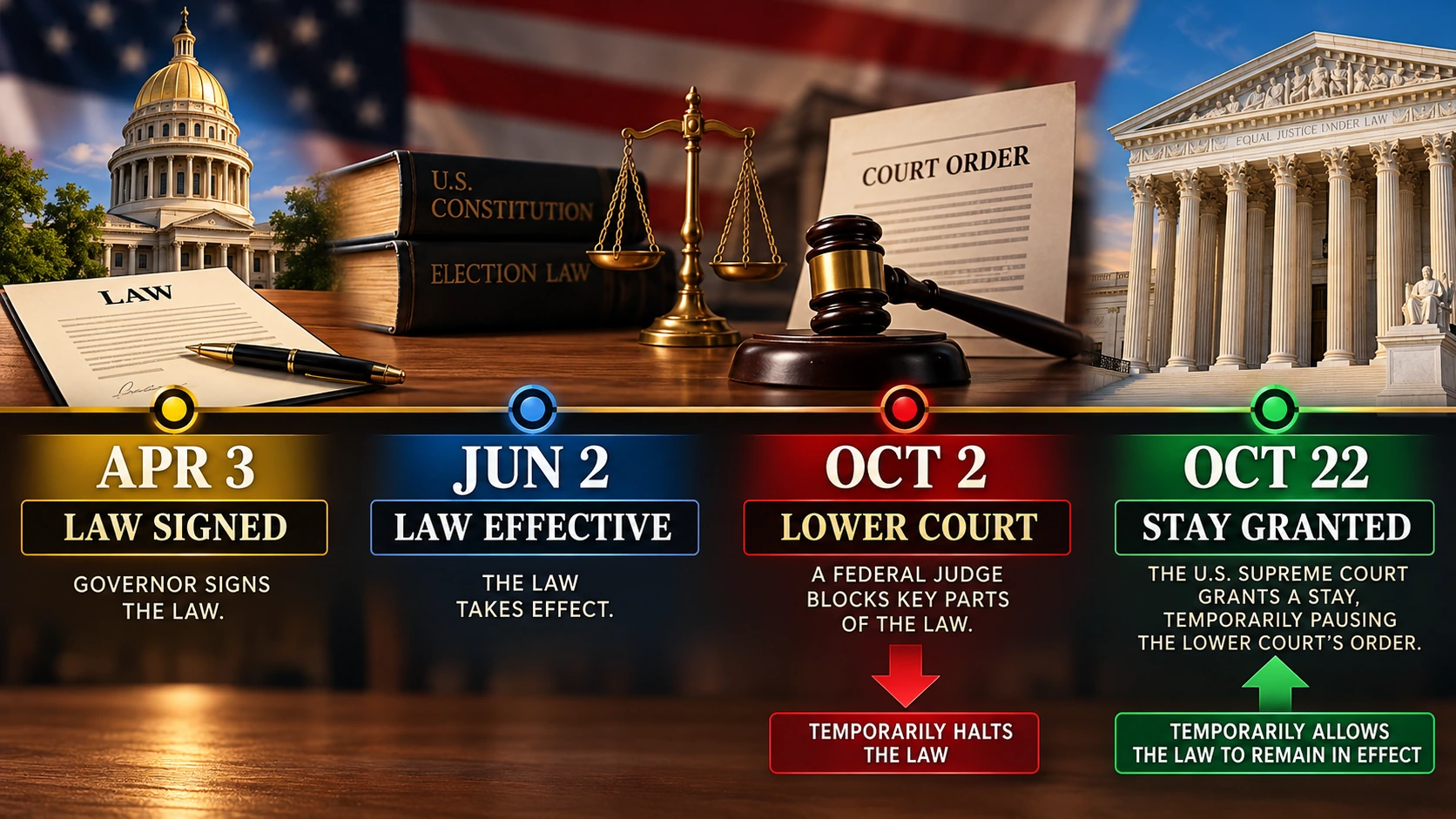
A voting-rights group, the Coalition for Open Democracy, challenged both HB 323 and the state guidance. The plaintiffs argued that the restrictions placed an unjustified burden on younger voters, invoking constitutional protections including the First, Fourteenth, and Twenty-Sixth Amendments. The state defended its approach as an election-integrity measure. (U.S. District Court)
On October 2, U.S. District Judge Joseph Laplante declined to suspend HB 323 itself, finding that the challengers had not shown a sufficient likelihood of success against the statute at that preliminary stage. He did, however, block the secretary of state’s broader directive and require corrected guidance. (New Hampshire Public Radio)
The state appealed. After the U.S. Court of Appeals for the First Circuit declined to pause the district judge’s injunction, state officials sought emergency relief from the Supreme Court. On October 22, the justices granted that request, staying the lower court orders while further proceedings continue. (Democracy Docket · Supreme Court)
That sequence is important: the Supreme Court stopped a preliminary injunction; it did not conduct a full trial or issue a final verdict on the underlying constitutional claims.
Why Did the Supreme Court Intervene So Close to Election Day?
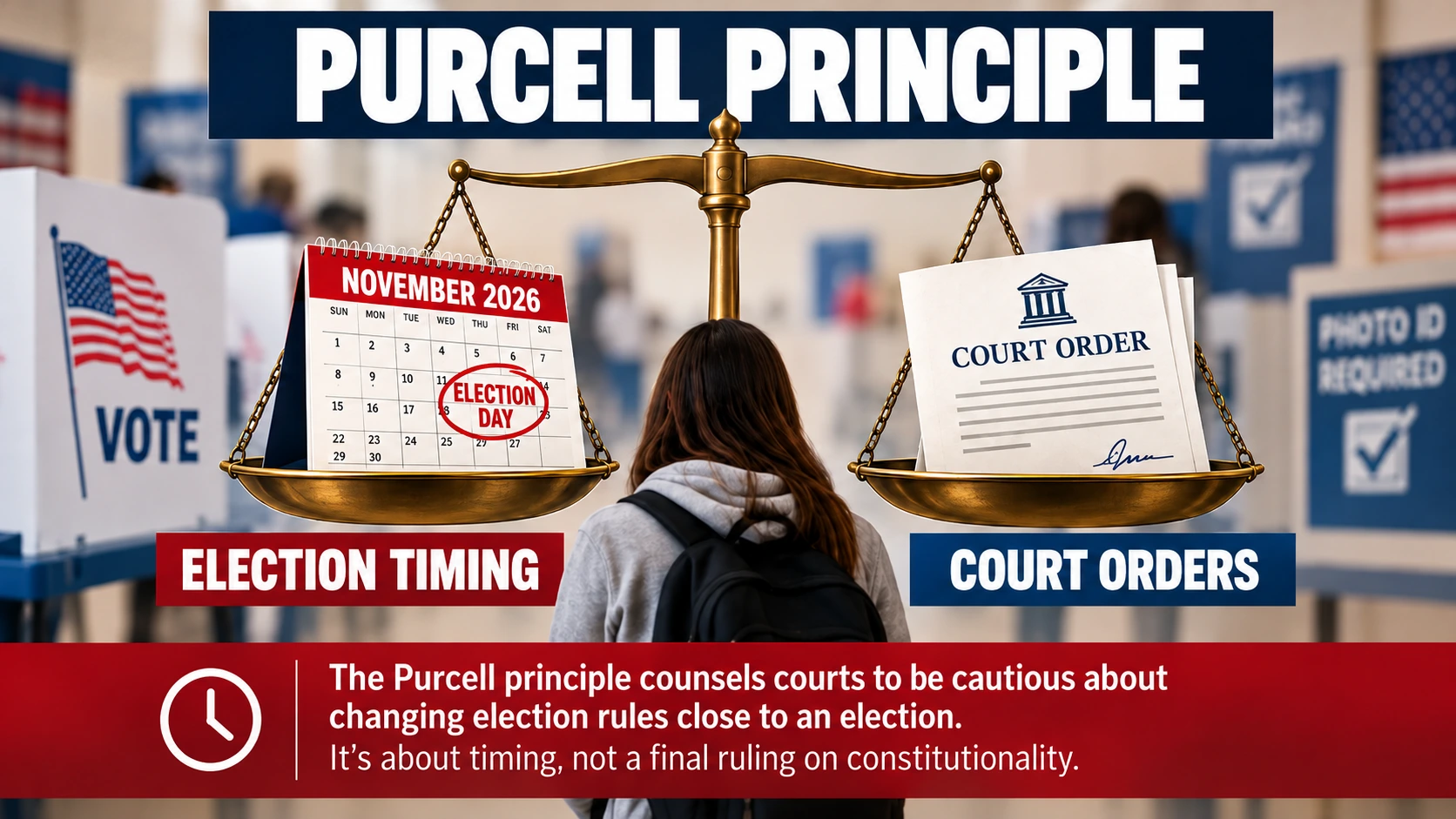
The justices relied on the Purcell principle, a doctrine cautioning lower federal courts against changing election rules shortly before an election. The concern is that late judicial intervention can confuse voters and election administrators when there is little time to adjust. (Supreme Court)
In this case, the Supreme Court said the district court had not identified a reason to depart from that approach. Its short, unsigned order put the lower court’s injunction on hold. The Court did not publish a vote count, and Justice Ketanji Brown Jackson was the only justice to publicly dissent. (Supreme Court · AP)
Think of the principle as a warning about changing the rules of an event right before it begins. Even a proposed correction can raise questions about which instructions are operative. But that analogy leaves a difficult question: what if the existing instructions are themselves misleading?
That was the heart of the disagreement between the Court’s unsigned order and Jackson’s dissent.
Why Did Justice Jackson Disagree?
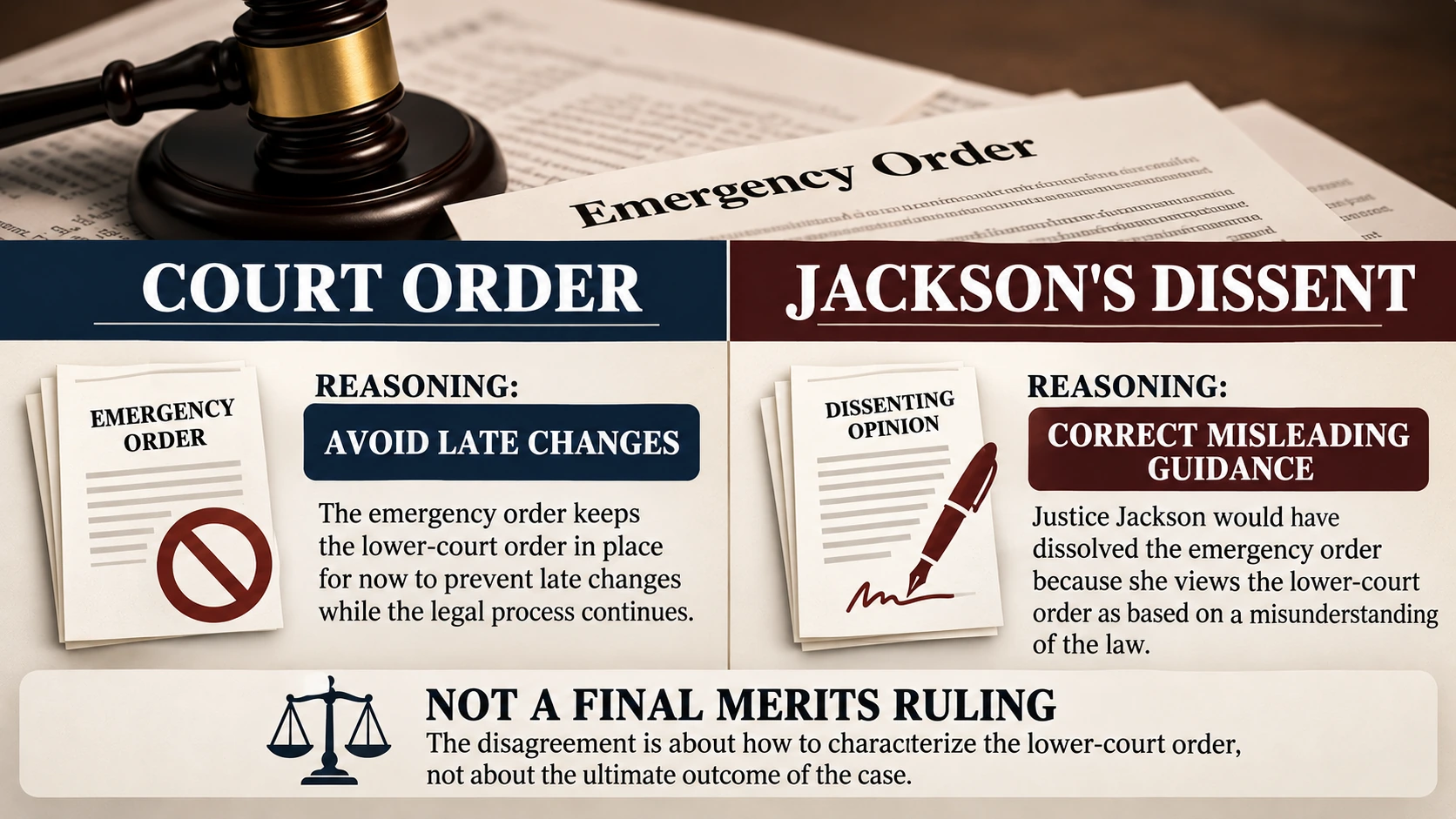
Jackson argued that the lower court had not actually changed New Hampshire’s law. In her view, Judge Laplante had ordered officials to correct public guidance that overstated the law’s restrictions. That made the injunction a way to prevent confusion, not create it. (Supreme Court, Jackson dissent)
The difference is subtle but central:
| Supreme Court’s order | Jackson’s dissent |
|---|---|
| A lower court should ordinarily avoid late changes affecting election administration. | Correcting a misleading account of existing law is not the same as changing that law. |
| The district court had not justified departing from that timing principle. | Leaving inaccurate guidance in place could itself confuse and burden voters. |
| The injunction should be paused pending appeal. | The injunction should remain in effect while the dispute proceeds. |
New Hampshire officials argued that changing public messaging and training close to the election could cause serious administrative confusion. The challengers countered that the district court’s clarification had already been operating for weeks and that reversing it would create fresh uncertainty. These were the parties’ competing arguments, not findings that either side had proved every predicted consequence. (Courthouse News)
Does This Mean the Student ID Restriction Is Constitutional?
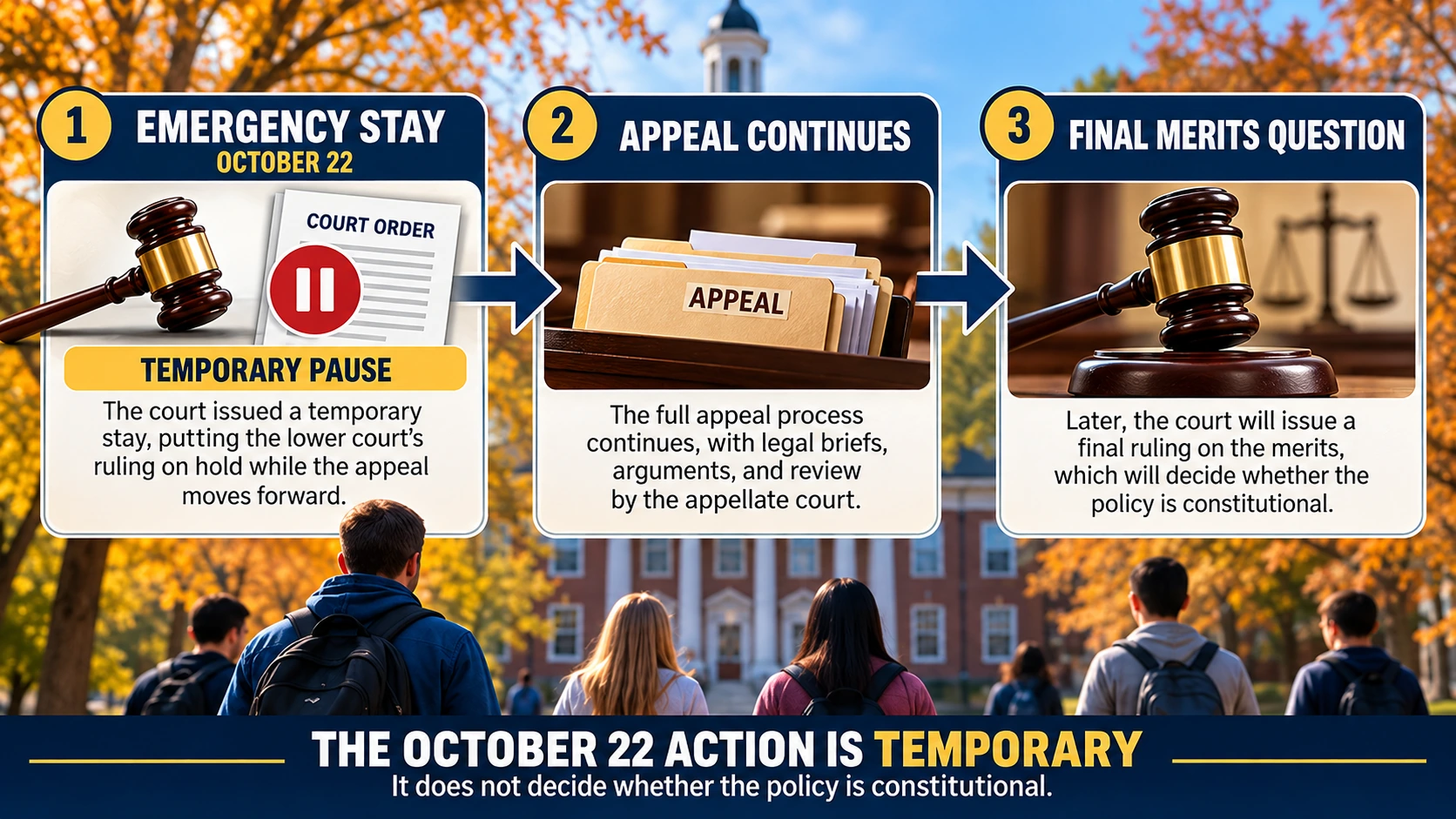
No. The October 22 order is about what remains in effect during litigation, not a final judgment on constitutionality. The Supreme Court stayed the district court’s October 2 and October 5 orders pending the First Circuit appeal and potentially further Supreme Court review under the terms of its order. (Supreme Court)
Two different questions remain worth separating. First, did New Hampshire lawmakers have the constitutional authority to remove student IDs from the expressly accepted list? Second, did the secretary of state’s guidance legally go further than the statute allowed? The district court treated those as separate issues, and the Supreme Court’s emergency intervention did not settle both on the merits.
It is also incorrect to read this as a nationwide ban on student IDs. The case concerns New Hampshire’s law and the state officials administering it, not a single federal rule governing every state.
Why Is the Dispute So Significant for Young Voters?
The restriction is about identification documents, not about whether students as a group are legally entitled to vote. Still, document rules can have uneven practical effects. Voting-rights advocates argue that students who do not possess other qualifying documents may face a greater burden, while supporters say government-issued identification offers more consistent safeguards. (AP · New Hampshire Public Radio)
State Rep. Donald McFarlane, a sponsor of HB 323, has argued that colleges do not use the same controls as government agencies when issuing cards. Advocates challenging the restriction say it places unnecessary obstacles in front of younger voters. Neither the policy rationale nor the predicted burden should be confused with a final judicial finding. (AP · Coalition for Open Democracy)
With a competitive U.S. Senate contest on the state’s ballot, the issue has political importance beyond the legal technicalities. But the order itself does not establish how many people will be affected, whether the restriction will change turnout, or who will win any race. Those claims would require separate evidence. (AP)
What Happens Next in the New Hampshire Case?
The legal challenge continues in the U.S. Court of Appeals for the First Circuit. The Supreme Court’s stay is tied to that appeal and to any timely request for the justices to take the case for full review. If the justices decline such review, the order says the stay will end automatically; if they agree to hear the case, it specifies when the stay would terminate after the Court’s judgment. (Supreme Court)
The next major question is not simply whether the state can enforce the restriction for the November election. It is whether a higher court will eventually address the constitutional challenge and the gap between what HB 323 says and how officials interpreted it.
Bottom Line: What This Story Really Means
On October 22, the Supreme Court allowed New Hampshire officials to enforce their stricter treatment of student IDs while a lower-court appeal proceeds. The justices relied on a rule against late judicial changes to election administration; Justice Jackson said the lower court was merely correcting misleading guidance.
The practical restriction is immediate, but the broader legal question is not finally resolved. That is why a one-paragraph emergency order can have important consequences without answering whether the challenged policy is constitutional.
New Hampshire Student ID Voting Ban: Key Questions Explained
Q. Did the Supreme Court issue a final ruling against student IDs?
No. It temporarily stayed lower-court orders while an appeal continues; it did not issue a final ruling on the constitutional claims.
Q. What is HB 323?
It is a New Hampshire law that removed student IDs from the expressly accepted photo-identification documents for obtaining a ballot. The measure took effect June 2, 2026.
Q. Why was the secretary of state’s guidance controversial?
The guidance went beyond excluding student IDs as automatically accepted photo ID. It also barred consideration of those cards as supporting evidence under other provisions, which the district judge found legally unjustified at the preliminary stage.
Q. What is the Purcell principle?
It is a judicial principle cautioning federal courts against changing election rules too close to an election because late changes may cause confusion.
Q. Was the Supreme Court’s vote 8–1?
The order did not publish a vote count. Justice Ketanji Brown Jackson was the only justice to publicly dissent, which is not the same as an announced 8–1 vote.
Q. Did Justice Jackson support the district court’s decision?
Yes. She argued that the district court had ordered a correction to potentially misleading state guidance rather than a last-minute change in the law itself.
Q. Does this ruling apply to every state?
No. The dispute concerns New Hampshire’s law, its interpretation, and the orders issued in this particular federal case.
Q. Is the lawsuit over?
No. The case remains on appeal, and the Supreme Court’s emergency stay does not dispose of the underlying merits.
Did this help make the story clearer? 🙂 WIN keeps unpacking the “why” behind the news—clearly and simply!
Sources
Supreme Court Order and Judicial Reasoning
U.S. Supreme Court — Scanlan v. Coalition for Open Democracy, Order and Dissent (October 22, 2026)
Cornell Legal Information Institute — Text of the Supreme Court Order and Jackson Dissent
State Law and Lower-Court Proceedings
New Hampshire Legislature — HB 323 Bill History and Status
U.S. District Court for the District of New Hampshire — October 2 Preliminary Injunction Order
Democracy Docket — New Hampshire Student ID Ban Challenge Case Timeline
Reporting and Responses
Associated Press — Supreme Court Allows New Hampshire to Ban Student IDs in the Midterms
Courthouse News — Supreme Court Emergency Order and Parties’ Arguments
Coalition for Open Democracy — Statement Responding to the Supreme Court Stay
Keep Reading
How Are Other Voting Disputes Reaching Federal Courts Before the Midterms?
New Hampshire’s case concerns student identification, while a separate California lawsuit raises questions about how courts should handle disputed voter eligibility close to Election Day. Both show why the timing and scope of election-related court orders matter.
Why Is the Justice Department Trying to Block Ballots From 20,000 California Voters?