Why Is South Korea’s Current Account Surplus Bigger Than Germany and Japan’s Combined?

South Korea has just posted a number that sounds almost impossible: its current account surplus was larger than Germany’s and Japan’s combined.
Does that mean South Korea has overtaken those two industrial giants economically? No. It means something narrower—but still remarkable. The country is earning far more from the rest of the world than it is paying out, and an extraordinary boom in semiconductor exports is doing much of the work.
The surprise is not simply that Korean chips are selling well. It is how dramatically the global AI investment race has reshaped a major measure of international economic strength—and how quickly that advantage could change.

※ Images in this article are AI-generated illustrations created to help explain the story. They are not actual photographs, and depictions of people, places, or events may differ slightly from reality.
How Big Was South Korea’s Surplus Compared With Germany and Japan?
In the second quarter of 2026, South Korea recorded a $116.63 billion current account surplus, according to IMF data made available through the Bank of Korea. Among 36 major economies with comparable figures for that quarter, only China posted a larger surplus.
Germany and Japan, both famous for their advanced manufacturing industries, posted much smaller individual surpluses. Even added together, they fell short of South Korea. The comparison was reported on October 25, 2026. (Yonhap · KBS World)
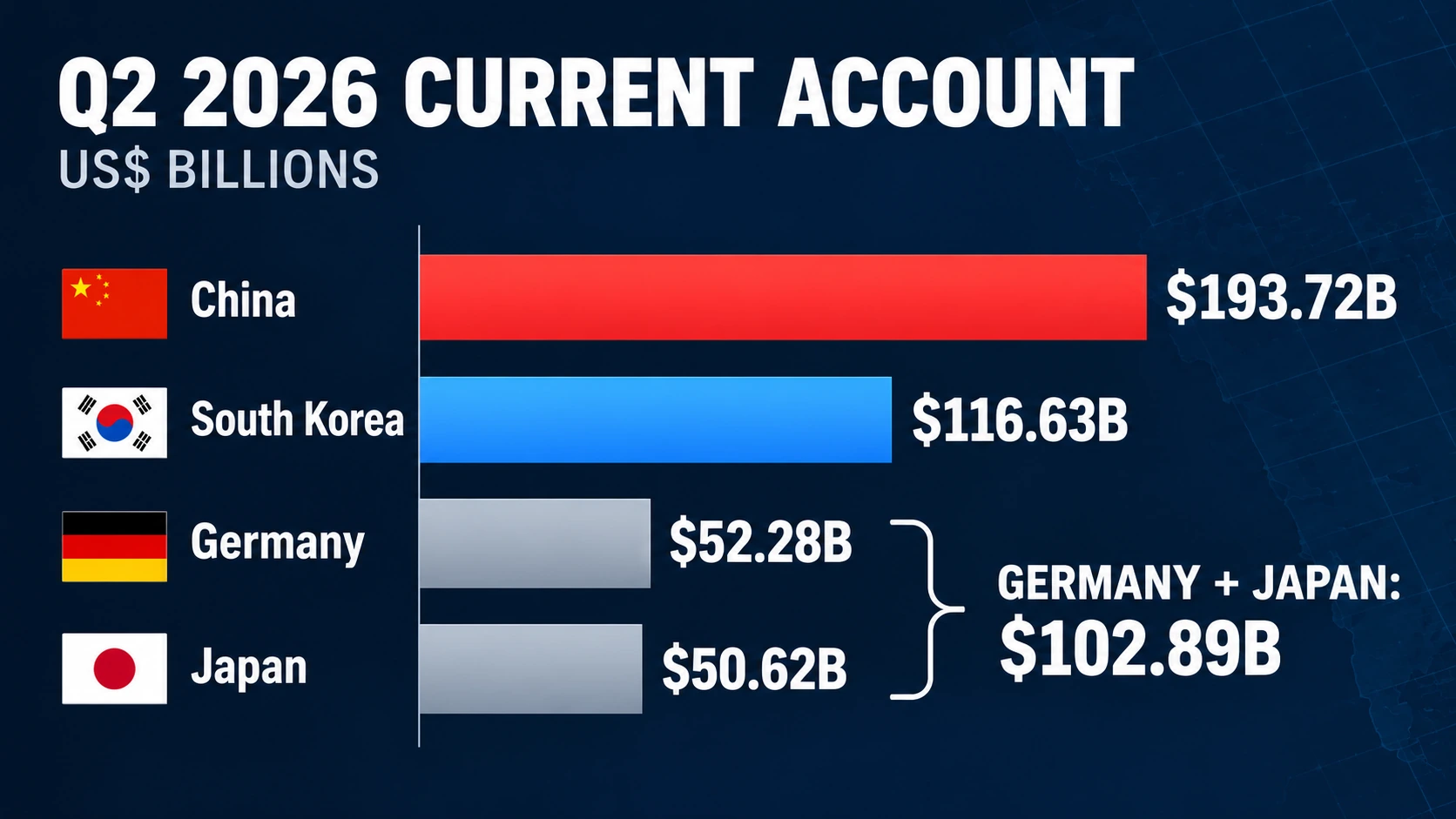
| Economy | Q2 2026 current account surplus |
|---|---|
| China | $193.72 billion |
| South Korea | $116.63 billion |
| Germany | $52.28 billion |
| Japan | $50.62 billion |
| Germany + Japan | Approximately $102.89 billion |
Figures are rounded individually, so the sum of Germany’s and Japan’s displayed figures may differ slightly from the combined total calculated using unrounded data.
South Korea exceeded the combined German and Japanese total by roughly $13.74 billion. It was the first such result since comparable data for all three economies became available in 1996. A year earlier, Korea’s quarterly surplus had been just $28.39 billion. (Aju Press)
That is a stunning change. But understanding it requires one distinction that the headline alone cannot explain.
What Does a Current Account Surplus Actually Measure?
A current account surplus means a country receives more from the rest of the world through goods, services, income, and certain transfers than it pays out through those same channels. It is not the size of the economy, the government’s cash balance, or corporate profit.
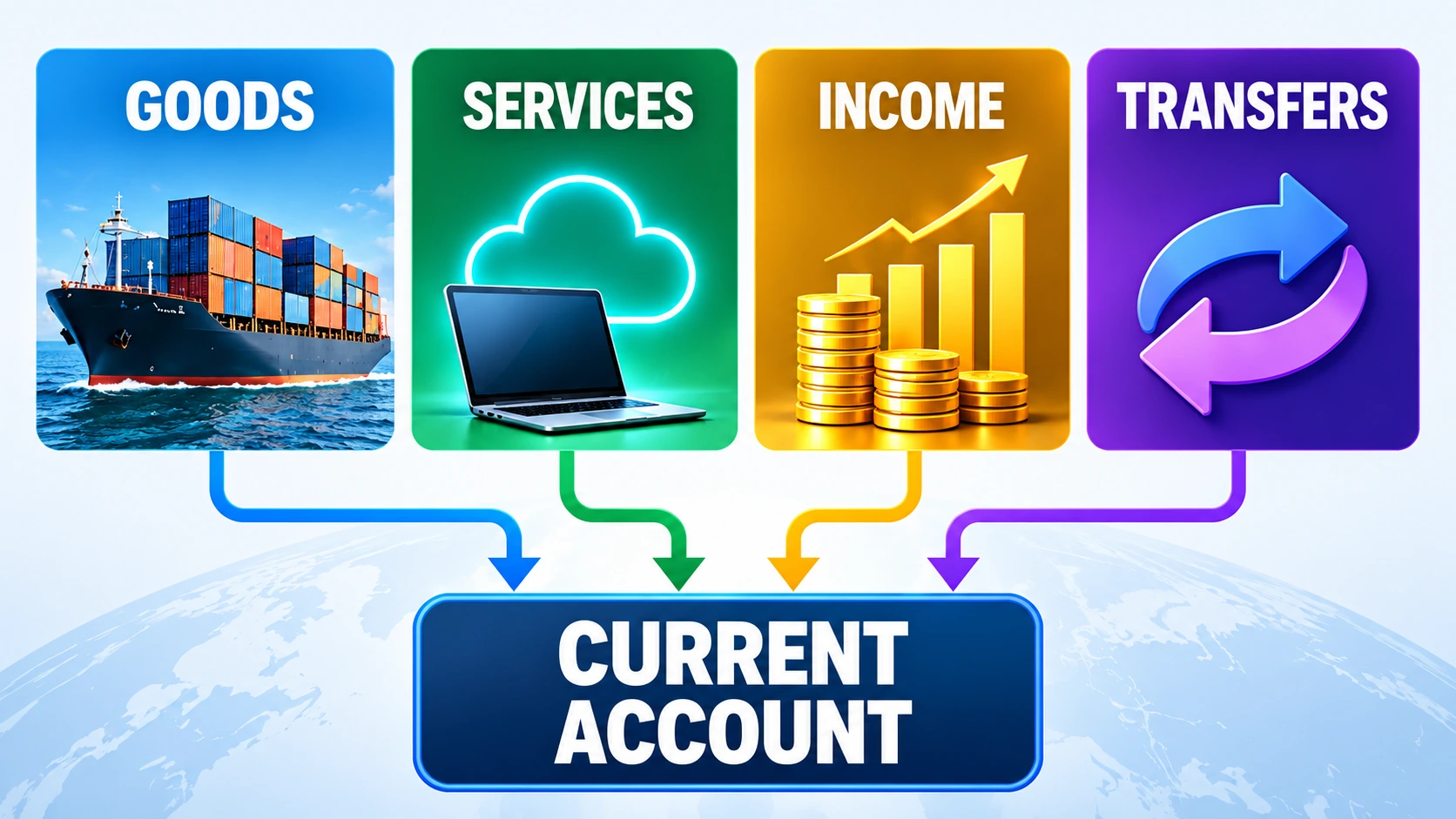
The IMF’s explanation of global current account balances separates the measure into four components:
| Component | Everyday example |
|---|---|
| Goods | Exporting chips and importing oil |
| Services | Selling software services or paying for overseas travel |
| Primary income | Receiving overseas dividends or paying interest to foreign investors |
| Secondary income | Receiving or sending certain transfers without a direct exchange of goods or services |
The trade balance usually refers to exports minus imports of goods, although the precise terminology can vary. The current account is broader: it also captures services and income flows.
Think of two businesses. One sells more products overseas, while the other earns dividends from foreign investments. Both can generate external income, but through different channels. At the national level, the current account brings those flows together and nets them against payments abroad.
That also explains why Korea’s $116.63 billion surplus does not mean its factories produced $116.63 billion more than German and Japanese factories. GDP measures economic output; the current account measures net transactions with the rest of the world. A larger surplus does not automatically mean a larger or healthier economy.
Why Are AI Chips Driving Such a Huge Increase?
South Korea is benefiting from a combination of strong demand for memory chips and sharply higher semiconductor prices. The growth of AI data centers has made advanced memory a crucial part of computing infrastructure, giving major Korean producers a powerful export tailwind.

South Korean semiconductor exports reached $113.89 billion in the second quarter, up 181.6% from the same period a year earlier. That is export revenue, not a semiconductor-only current account surplus. The two statistics should not be added together or treated as interchangeable. (Yonhap)
The distinction between prices and quantities matters. If a chipmaker sells the same number of chips at higher prices, its export revenue can rise even without a matching jump in physical shipments. Strong demand can push both the number sold and the price upward.
The Bank of Korea described this year’s semiconductor-led improvement in Korea’s terms of trade—the prices of exports relative to imports—as unusually strong. In an August research note, the central bank argued that higher chip export prices, rather than simply cheaper imported energy, were driving income gains. It also warned that the benefits were concentrated in certain businesses and households. (Bank of Korea)
That is why the semiconductor boom can transform a national statistic so quickly without making every part of the economy equally prosperous.
Has the Momentum Continued Beyond the Second Quarter?
So far, yes—but the full-year ranking remains a forecast, not a completed result. During July and August 2026, South Korea recorded a combined current account surplus of $88.19 billion, above the roughly $80.82 billion combined for Germany and Japan. (Aju Press)
The IMF’s October 2026 World Economic Outlook projects South Korea’s full-year current account surplus at approximately $421.95 billion, second behind China’s projected $863.21 billion among 190 countries and regions covered by that comparison. Unlike the second-quarter figures, these are estimates for the entire year. (IMF World Economic Outlook database · KBS World)
The strength of exports has also remained visible in more recent trade data. South Korea’s Ministry of Trade, Industry and Resources reported that September merchandise exports reached $120.94 billion, with semiconductor exports up 263% from a year earlier. A monthly trade figure is not the same thing as a monthly current account figure, but it helps explain why the external surplus has stayed elevated. (Ministry of Trade, Industry and Resources)
It would be premature to treat the IMF’s year-end projection as a fact already achieved. The result could change with global demand, chip prices, imports, and overseas income flows.
Why Should Americans Care About South Korea’s Surplus?
Because the same AI infrastructure buildout reshaping US technology spending is helping drive Korea’s export boom. American AI companies, cloud providers, and data center operators depend on global semiconductor supply chains; Korean memory-chip producers are important participants in that ecosystem.
The relationship works in both directions. Strong orders for advanced memory can support Korean exporters, while tight supplies or high memory prices can affect the costs and schedules of companies building AI systems. If AI spending slows, demand for certain high-value chips could weaken, affecting suppliers far beyond Korea.
A Korean current account surplus does not mean the United States has an equally large deficit with South Korea. The measure covers Korea’s transactions with all foreign economies, not only the United States. It also includes income and services, not just products crossing the border.
For American readers, the more useful question is not which country has “won” a ranking. It is how concentrated global demand for AI hardware has become—and how a shift in that demand could ripple through tech companies, suppliers, and markets on both sides of the Pacific.
Could the Semiconductor Boom Become a Weakness?
Yes. A boom concentrated in one industry can make a country more exposed to that industry’s next downturn. In Korea’s case, slower AI infrastructure spending, a fall in memory prices, or greater competition from foreign chipmakers could erode export revenue and narrow the surplus.
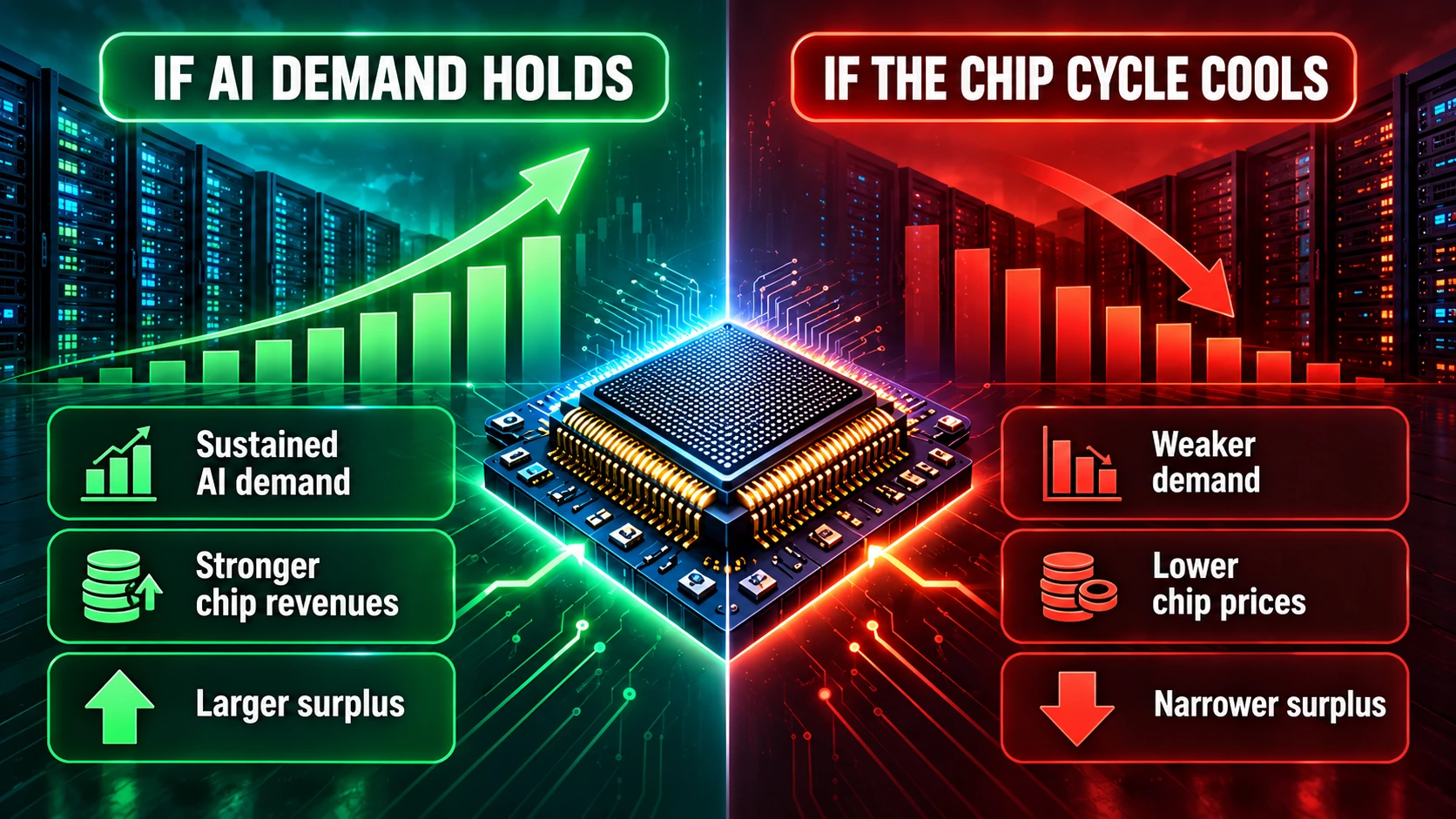
The Bank of Korea itself has highlighted the risk. Its October 22 economic assessment described the semiconductor cycle as a major uncertainty even as the bank expected strong growth to continue. (Bank of Korea)
There is also a second problem: the biggest export gains do not necessarily spread quickly through the rest of the economy. Chip manufacturing is capital-intensive, and the benefits can be concentrated in companies, investors, and regions directly connected to the industry. Other sectors may still struggle with demand, costs, or hiring even during a spectacular export boom. (Bank of Korea research)
That does not make the surplus meaningless. It makes economic diversification important: building opportunities in other industries while the chip boom provides resources to invest.
What Should Investors and Policymakers Watch Next?
Three developments will tell us whether Korea’s remarkable surplus reflects a lasting improvement or a particularly favorable moment in the semiconductor cycle.
First, watch global AI spending and memory-chip prices. Strong prices can lift export earnings quickly, while reversals can cut them just as fast. Second, look at whether non-chip exports and other industries begin sharing in the growth. Third, compare future actual current account releases with the IMF’s full-year outlook rather than assuming the projection is locked in.
The IMF’s October projections illustrate that risk. They put Korea’s surplus at approximately $295.66 billion in 2029, substantially below the projected 2026 level. But projections describe a possible path under current assumptions, not a fixed expiration date for the chip boom. (IMF World Economic Outlook database · The Kyunghyang Shinmun)
Bottom Line: What This Story Really Means
South Korea’s second-quarter 2026 current account surplus was larger than Germany’s and Japan’s combined for the first time in comparable records going back to 1996. It ranked second only to China among 36 major economies with available quarterly data.
That is an extraordinary external surplus, not proof that South Korea has become the world’s second-largest economy. The immediate engine is booming semiconductor exports, powered by global AI demand and stronger chip prices.
For the United States, the story is a reminder that the AI economy is built on international supply chains. For South Korea, the challenge is to turn an exceptional semiconductor windfall into prosperity that lasts after the next change in the chip cycle.
South Korea Current Account Surplus: Key Questions Explained
Q. How much was South Korea’s current account surplus in the second quarter of 2026?
It was $116.63 billion. That ranked second behind China among 36 major economies with comparable second-quarter data.
Q. Did South Korea’s surplus really exceed Germany’s and Japan’s combined?
Yes. Germany and Japan together recorded approximately $102.89 billion, about $13.74 billion less than South Korea.
Q. Does this make South Korea the world’s second-largest economy?
No. The ranking concerns the current account surplus, not GDP, economic output, or total national wealth.
Q. What is the difference between a trade surplus and a current account surplus?
A trade surplus focuses on net exports and imports of goods in common usage. The current account also includes services, cross-border income, and certain transfers.
Q. Why do semiconductors matter so much to this result?
Strong worldwide AI-related demand and higher memory-chip prices have boosted the value of Korea’s semiconductor exports, helping raise its goods surplus.
Q. Is South Korea guaranteed to finish 2026 in second place?
No. The IMF projects a second-place finish and a surplus of about $421.95 billion, but that is a forecast rather than a final result.
Q. Does South Korea’s surplus mean all Korean households are better off?
Not automatically. The gains can be concentrated among chipmakers and their investors, while other businesses and workers benefit less directly.
Q. What could cause the surplus to shrink?
Weaker AI investment, falling chip prices, stronger competition, or changes in Korea’s imports and overseas income could reduce the surplus.
Did this help make the story clearer? 🙂 WIN keeps unpacking the “why” behind the news—clearly and simply!
Sources
Second-Quarter Figures and Country Comparisons
Yonhap News Agency — South Korea’s Q2 Current Account Surplus Ranks Second
Aju Press — South Korea’s Surplus Exceeds Germany and Japan Combined
Current Account Definitions and the 2026 Outlook
International Monetary Fund — World Economic Outlook Database, October 2026
IMF — Understanding Global Imbalances
KBS World — South Korea’s Q2 Surplus and the IMF Forecast
Semiconductor Export Growth and Economic Risks
Bank of Korea — Real-Economy Spillovers from the Semiconductor Upturn
Bank of Korea — Recent Economic Developments, October 2026
Ministry of Trade, Industry and Resources — September 2026 Export Results
Keep Reading
Why Do AI Accelerators Need So Much High-Bandwidth Memory?
South Korea’s chip-export boom reflects demand for the hardware behind AI systems. Microsoft’s Maia 300 design offers a closer look at how powerful accelerators use high-bandwidth memory—and why that demand reaches far beyond the companies designing AI processors.
Why Is Microsoft Making Maia 300 AI Chips When It Still Buys Nvidia GPUs?