How Did Hackers Take $6.3 Billion From Binance—and Will Customers Lose Their Money?

How can billions of dollars in cryptocurrency leave an exchange in minutes while the company insists its customers will not lose their money?
That is the question behind the extraordinary Binance hack of October 29, 2026. Attackers moved roughly $6.3 billion in digital assets out of wallets controlled by the global exchange. Binance says it will cover the losses. But the method of attack is still under investigation, billions remain outside confirmed freezes, and customers have faced temporary withdrawal restrictions. (Binance · TRM Labs)

※ Images in this article are AI-generated illustrations created to help explain the story. They are not actual photographs, and depictions of people, places, or events may differ slightly from reality.
The crucial distinction is between what was stolen from the exchange, what has been frozen, and what Binance has promised to replace. Those are three different things.
How Did $6.3 Billion Leave Binance So Quickly?

Most of the stolen value moved in roughly 20 minutes, beginning at 4:05 p.m. Eastern on October 29. Blockchain intelligence firm TRM Labs tracked about $6.36 billion leaving Binance-controlled wallets across ten networks, including Ethereum, Bitcoin, Tron, Solana and the XRP Ledger. The dollar estimate varies slightly with token prices and the measurement time. (TRM Labs)
The target was the exchange’s hot-wallet infrastructure. A hot wallet is a cryptocurrency wallet connected to systems that can move funds quickly. Exchanges need this access to process customers’ deposits and withdrawals, but it also creates a particularly sensitive point of attack.
This does not mean millions of customers individually clicked a malicious link or had their personal accounts broken into. Investigators are examining how attackers were able to make the exchange’s own infrastructure authorize transfers to outside addresses.
Did Hackers Steal Binance’s Private Keys?
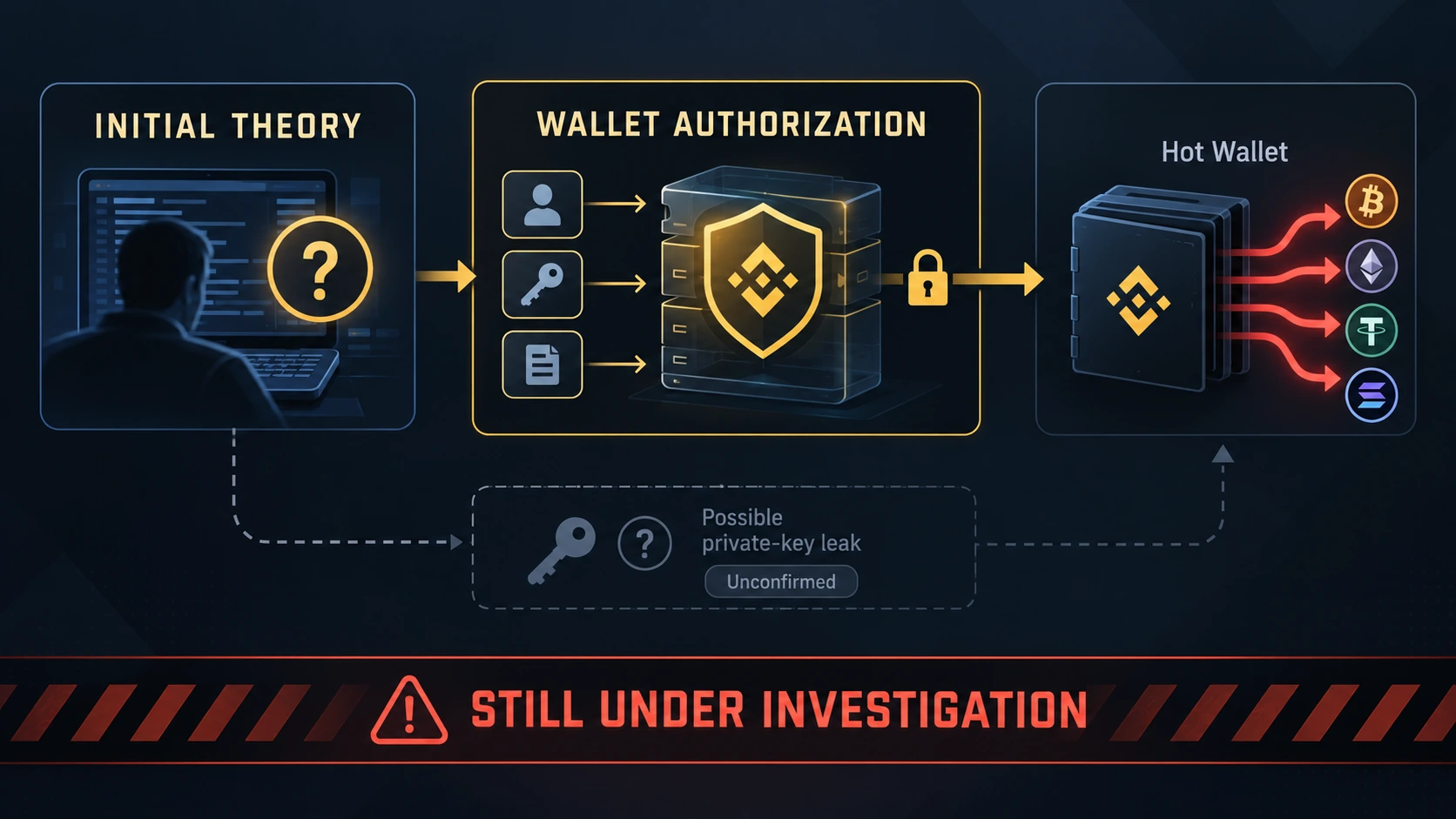
Not according to the evidence Binance has disclosed so far. The company says it has found no evidence that wallet private keys were leaked. That does not establish exactly how the attackers gained control; it means the investigation has not identified that particular kind of compromise. (Binance)
Binance initially suggested a compromised DevOps engineer’s laptop may have provided access to an internal service that could submit unauthorized withdrawals. Its October 30 update then said investigators had found additional points of breach, making the original explanation incomplete. (Binance)
Separately, TRM Labs identified the misuse of an Ethereum authorization feature called EIP-7702 in part of the theft. In everyday terms, that feature can let a wallet authorize software to act on its behalf. TRM says the attacker used this capability to direct funds out of a Binance hot wallet. Investigators have not yet established the entire intrusion sequence across all ten networks. (TRM Labs)
The lesson is that a crypto transfer can be correctly executed by the blockchain even when the instruction that triggered it was unauthorized. A blockchain recording a transaction does not mean the exchange intended to make it.
If About $3 Billion Was Frozen, Is That Money Back?
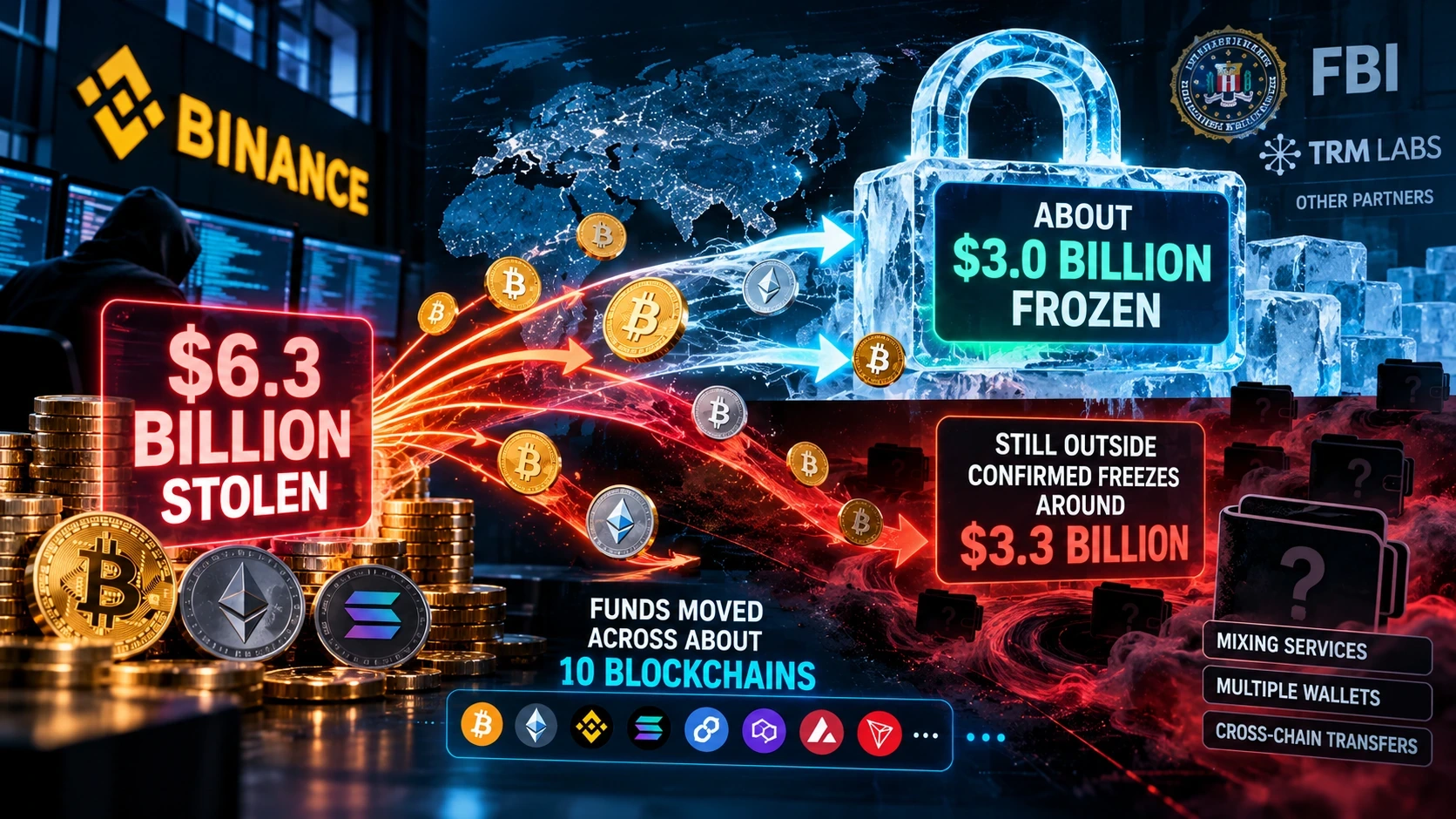
No. Frozen is not the same as recovered. By October 30, Binance said approximately $3 billion in assets linked to the theft had been frozen on-chain with help from token issuers and other industry partners. Freezing can stop certain tokens from being transferred, but it does not automatically put them back in Binance’s wallets. (Binance · Reuters)
| Term | What it means for this hack |
|---|---|
| Stolen | Crypto was transferred out of Binance-controlled wallets without authorization. |
| Frozen | Some affected tokens have been restricted from further movement; they have not necessarily been returned. |
| Recovered | Assets have actually been returned to the rightful holder or brought back under authorized control. |
| Replaced | Binance uses other funds to restore the assets backing customer balances, whether or not the stolen assets are recovered. |
Why can some assets be frozen at all? The issuers of certain stablecoins can restrict movement of tokens under their control. But Bitcoin and many other cryptocurrencies do not have an equivalent issuer-operated freeze button. That makes the kind of asset stolen important to the recovery effort. (TRM Labs)
Will Customers Lose Their Money—or Is Binance Paying?
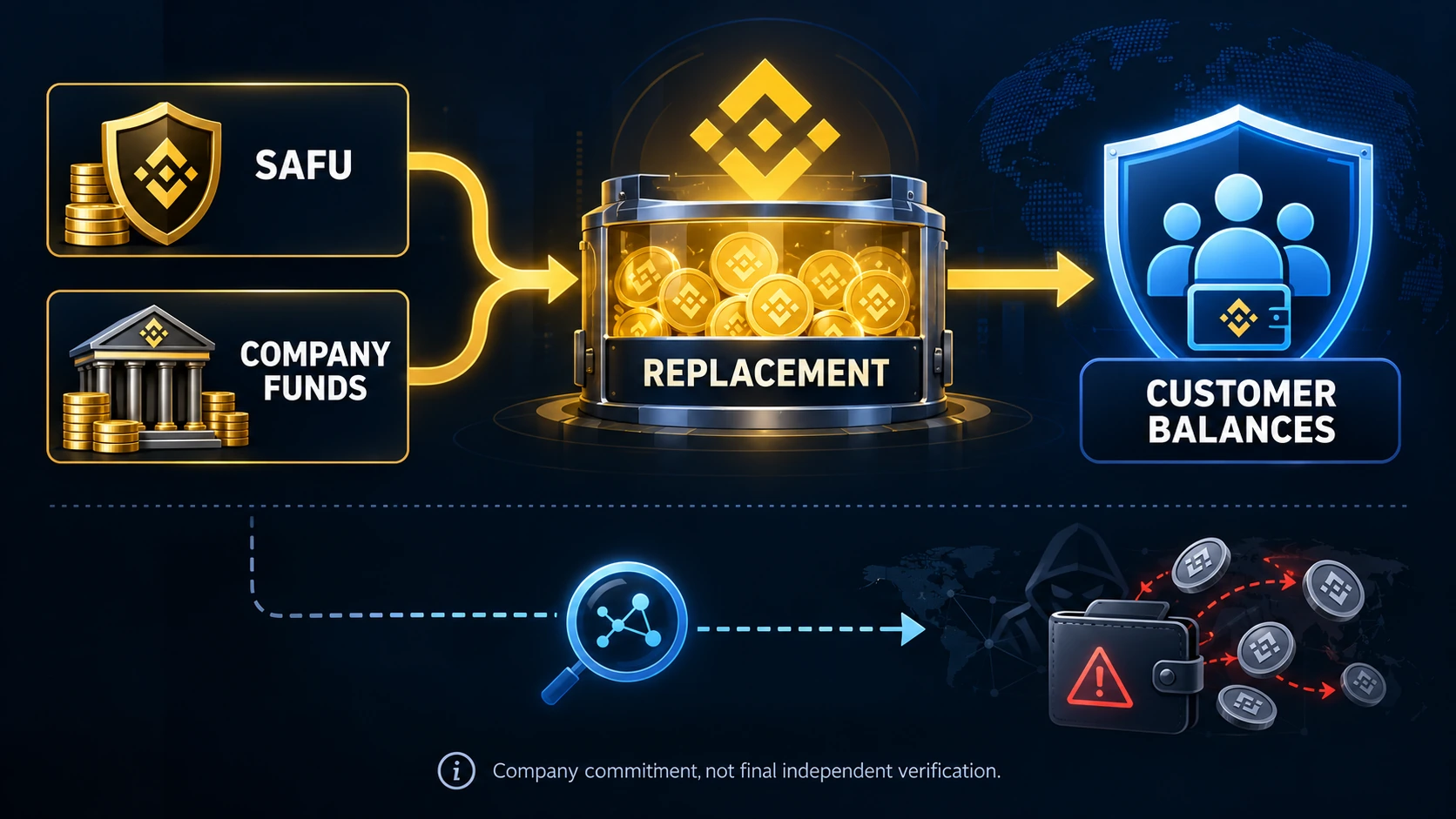
Binance says customers will not bear the $6.3 billion loss. It has pledged to use its Secure Asset Fund for Users (SAFU), an emergency protection reserve, together with company treasury funds to replace the stolen assets. This is the company’s stated commitment, not proof that every operational and accounting issue has already been resolved. (Binance)
In its October 30 update, Binance said it had set aside more than $6.34 billion in company funds, including $5 billion already held in the affected types of tokens. It said it was acquiring the remaining tokens and would provide an updated proof of reserves by Monday, November 2. Proof of reserves is a way to show whether an exchange has assets backing reported customer balances; readers should still distinguish a published snapshot from a complete independent guarantee of solvency. (Binance · Binance Proof of Reserves)
Withdrawals are a separate question. Binance temporarily halted withdrawals for security checks and said it was targeting a phased reopening around November 1, subject to verification. A displayed account balance and the ability to withdraw it immediately are not the same thing. (Binance)
Was North Korea Behind the Binance Hack?

A U.S. blockchain intelligence company says it has high confidence North Korea’s TraderTraitor operation was responsible. TRM Labs based its assessment on blockchain activity and other intelligence, but that is an investigator’s attribution—not a public judicial finding establishing the identity of the attackers in this case. (TRM Labs · Reuters)
The comparison is striking. In February 2025, attackers stole approximately $1.5 billion from the Bybit exchange. The FBI formally attributed that earlier theft to North Korea’s TraderTraitor activity. The Binance theft is roughly four times as large, although the two incidents do not yet have the same level of publicly established attribution. (FBI · TRM Labs)
Are Binance.US Accounts Affected—and What Happens Next?
Binance.US says it was not affected by the global Binance incident. That matters because Binance.com and Binance.US are separate legal platforms, even though they share a brand and common majority ownership. U.S. users should check which company actually holds their account rather than assuming the names refer to one exchange. (Binance.US · The Washington Post)
There is another important U.S. distinction: cryptocurrency is not insured by the FDIC the way eligible deposits at an FDIC-insured bank are. Binance’s promise to make customers whole is a company commitment, not federal deposit insurance. (FDIC)
Here is the sequence to watch, separating confirmed events from the company’s targets:
| Date | Confirmed event or announced next step |
|---|---|
| October 29 | Unauthorized transfers began; most of the stolen value moved in roughly 20 minutes. |
| October 30 | Binance confirmed the roughly $6.3 billion loss and announced its replacement-funding plan. |
| Around November 1 | Binance’s target, not a guarantee, for phased withdrawal restoration after security checks. |
| November 2 | Binance’s planned publication of an updated proof-of-reserves report. |
These dates come from Binance’s October 30 update and TRM Labs’ analysis. Neither an announced reopening target nor a planned reserve report proves that the investigation is finished. (Binance · TRM Labs)
For anyone with funds on an affected platform, the practical priorities are to use official support channels, avoid unsolicited recovery messages or links, and check withdrawal availability and the published reserve figures rather than assuming either is already normal. Binance itself has warned users to rely on its official announcements. (Binance · TechCrunch)
Bottom Line: What This Story Really Means
The Binance hack is not simply a story about digital coins disappearing. It shows how much trust customers place in the security systems and financial resources of an exchange that holds and moves crypto on their behalf.
The theft is confirmed; the exact intrusion path is not yet settled. Roughly $3 billion has been frozen, but frozen assets have not necessarily been returned. Binance has committed to replace the lost funds, while the real tests are whether withdrawals resume safely, customer assets are demonstrably backed, and investigators can explain what failed.
Binance Hack: Key Questions Explained
Q. How much cryptocurrency was stolen from Binance?
Binance estimated the loss at approximately $6.3 billion. TRM Labs tracked roughly $6.36 billion across ten blockchains, with small differences depending on valuation and timing.
Q. How long did the Binance hack take?
Most of the stolen value moved in about 20 minutes starting at 4:05 p.m. Eastern on October 29, 2026. Additional transfers were observed later.
Q. Were individual Binance customers’ accounts hacked?
The public evidence points to unauthorized transfers from Binance-controlled wallets, not a finding that each customer’s personal account was compromised.
Q. Did the attackers obtain Binance’s private keys?
Binance says it has found no evidence that private keys were leaked. Investigators are still determining the full path of the breach.
Q. Has Binance recovered the $3 billion it froze?
Not necessarily. A freeze prevents movement of certain affected assets; recovery requires a separate process to return control to an authorized holder.
Q. Will Binance repay customers?
Binance says it will cover the losses using SAFU and corporate funds. Whether the promised protection is fully implemented should be assessed through restored operations and verified asset backing.
Q. Is Binance.US the same company as Binance.com?
No. They are separate legal platforms, although they share a brand and common majority ownership. Binance.US said it was unaffected by the breach.
Q. Who is suspected of carrying out the attack?
TRM Labs attributes it with high confidence to North Korea’s TraderTraitor operation. That assessment should not be mistaken for a final official finding in the Binance case.
Q. When will Binance withdrawals fully resume?
Binance targeted a phased resumption around November 1, subject to security checks. That was a target announced October 30, not confirmation that withdrawals had resumed.
Did this help make the story clearer? 🙂 WIN keeps unpacking the “why” behind the news—clearly and simply!
Sources
Binance’s Confirmed Loss and Customer-Fund Response
Binance — Security Incident Update #2, October 30, 2026
Reuters — Binance Sets Aside More Than $6.34 Billion, October 30, 2026
Binance — Proof of Reserves Overview
Transaction Analysis and Attribution
TRM Labs — Analysis of the $6.36 Billion Binance Theft, October 29, 2026
Binance — Initial Security Incident Update, October 30, 2026
FBI — North Korea Responsible for the 2025 Bybit Hack
U.S. Platform and Consumer Protection
Binance.US — About the Separate U.S. Exchange
FDIC — Deposit Insurance and Products Not Covered
The Washington Post — Binance.US Says It Is Unaffected, October 29, 2026