Why Were Whole Foods Ashwagandha Capsules Recalled—and Is Your Bottle Affected?

You take a supplement because you hope it will help you feel better. So what happens when the supplement itself becomes the subject of a health warning?
That is the concern behind a recall involving ashwagandha capsules sold under Whole Foods Market’s 365 brand. The supplement, commonly associated with stress relief and sleep, may contain Salmonella bacteria.
But there’s an important distinction: The recall does not cover every ashwagandha supplement, or even every bottle of this particular product. It identifies one manufacturing lot.
And although the company reported no illnesses when the recall was announced on October 30, 2026, customers with affected bottles have been told not to take them. (FDA)
※ Images in this article are AI-generated illustrations created to help explain the story. They are not actual photographs, and depictions of people, places, or events may differ slightly from reality.
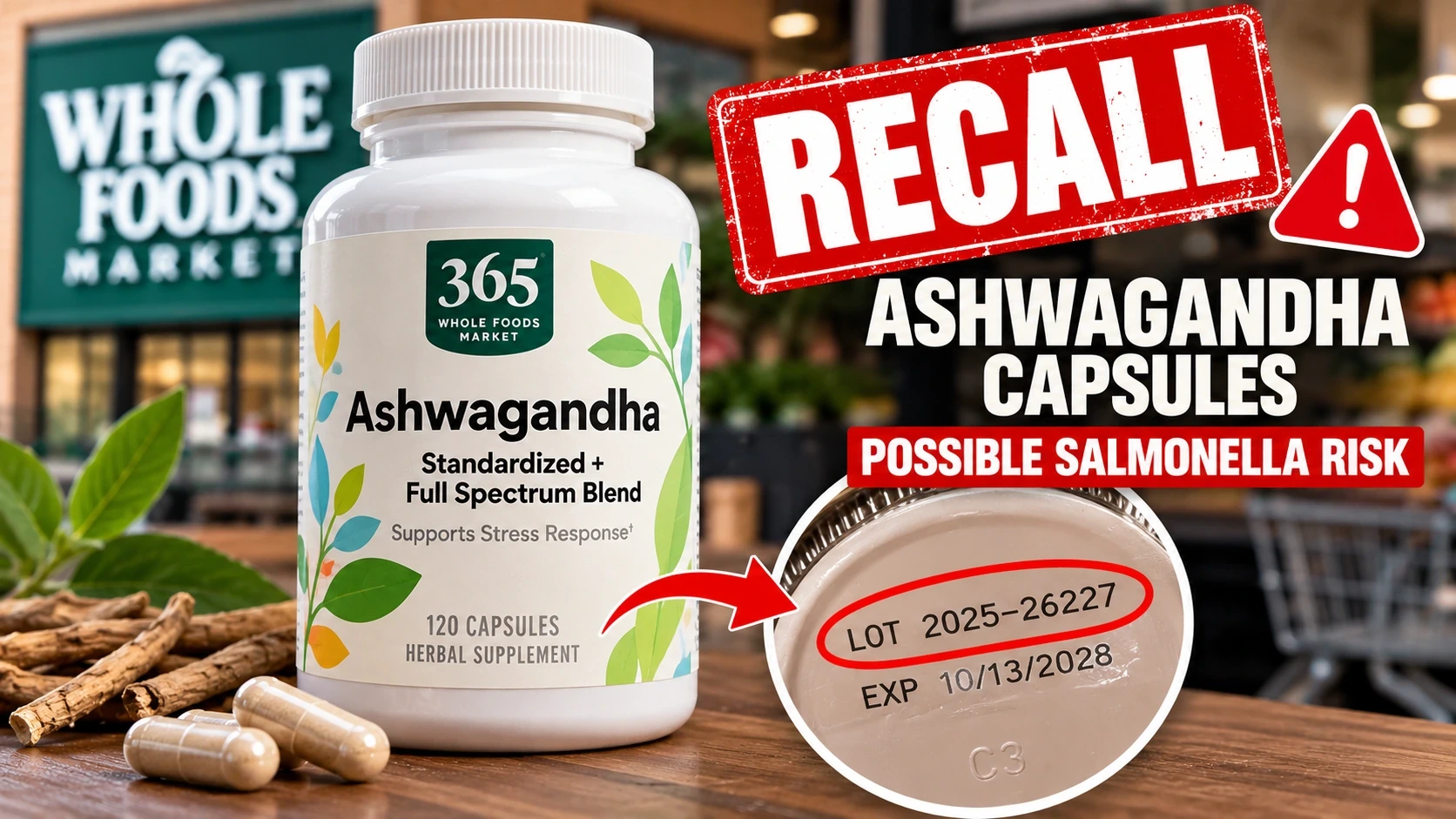
The most useful thing you can do right now is check the bottom of your bottle. A specific lot number and expiration date determine whether it matches the recall notice.
There is also a broader question worth understanding: How can a dietary supplement remain on sale for months before a potential contamination problem is discovered?
Which Whole Foods Ashwagandha Bottles Are Being Recalled?
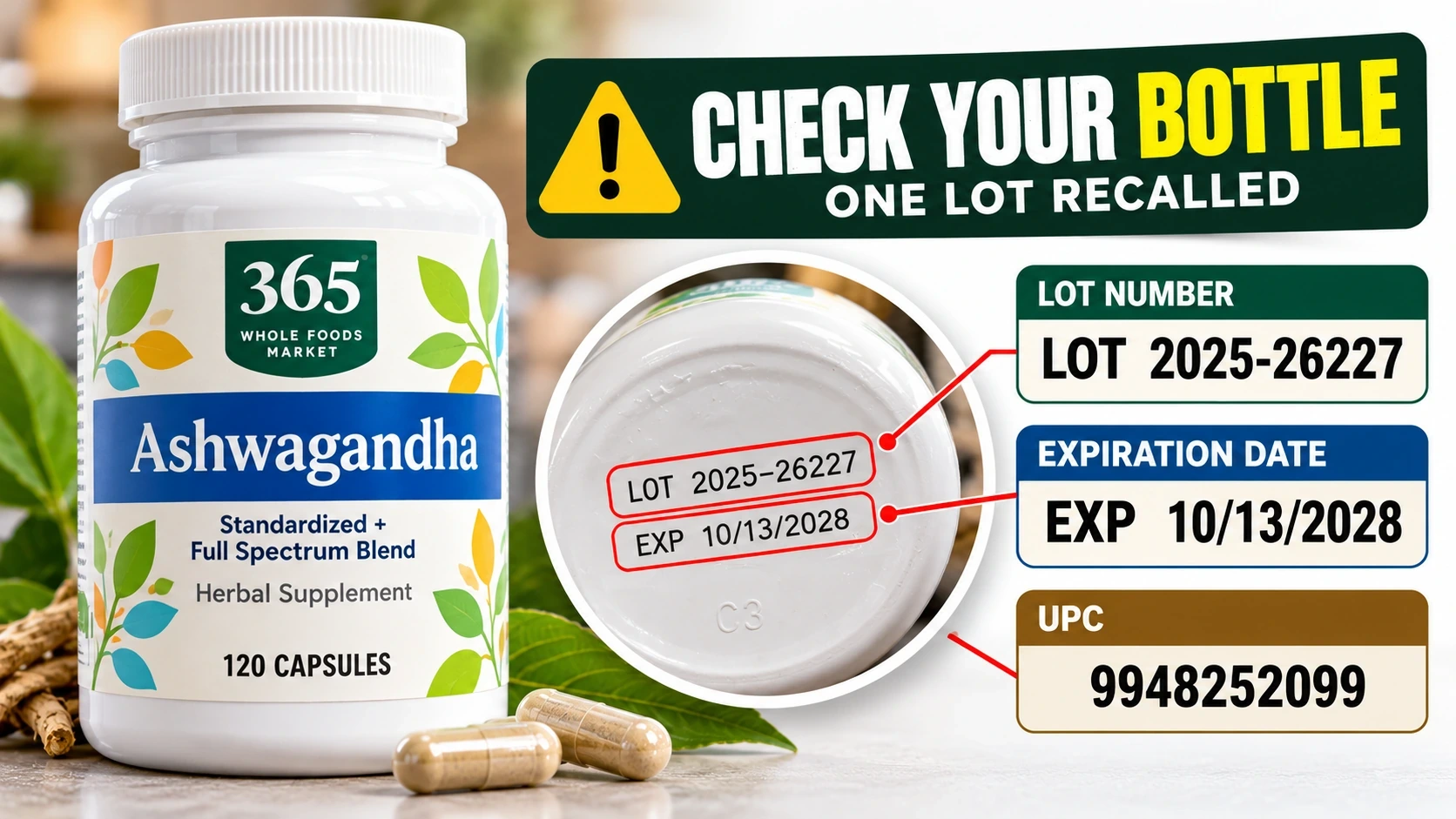
The recall covers one lot of 365 Whole Foods Market Standardized + Full Spectrum Blend Ashwagandha Capsules, packaged in white plastic bottles containing 120 capsules.
Vitality Works Inc., based in Albuquerque, New Mexico, announced the recall. The FDA published the company’s notice on October 30, 2026. (FDA)
Here are the details to check:
| Identification | Recalled product |
|---|---|
| Brand | 365 Whole Foods Market |
| Product | Standardized + Full Spectrum Blend Ashwagandha |
| Bottle size | 120 capsules |
| Lot number | 2025-26227 |
| Expiration date | October 13, 2028 |
| UPC | 9948252099 |
| Recalling company | Vitality Works Inc. |
The lot number and expiration date are printed on the bottom of the bottle, not necessarily in the most noticeable part of the front label.
If your bottle matches those details, the company says to stop using it.
If you own a different brand, a different size, or a bottle with another lot number, that product is not identified in this particular recall. That does not establish the safety of every other supplement; it simply defines the scope of the October 30 announcement.
Why Was the Supplement Recalled If No One Has Reported Getting Sick?
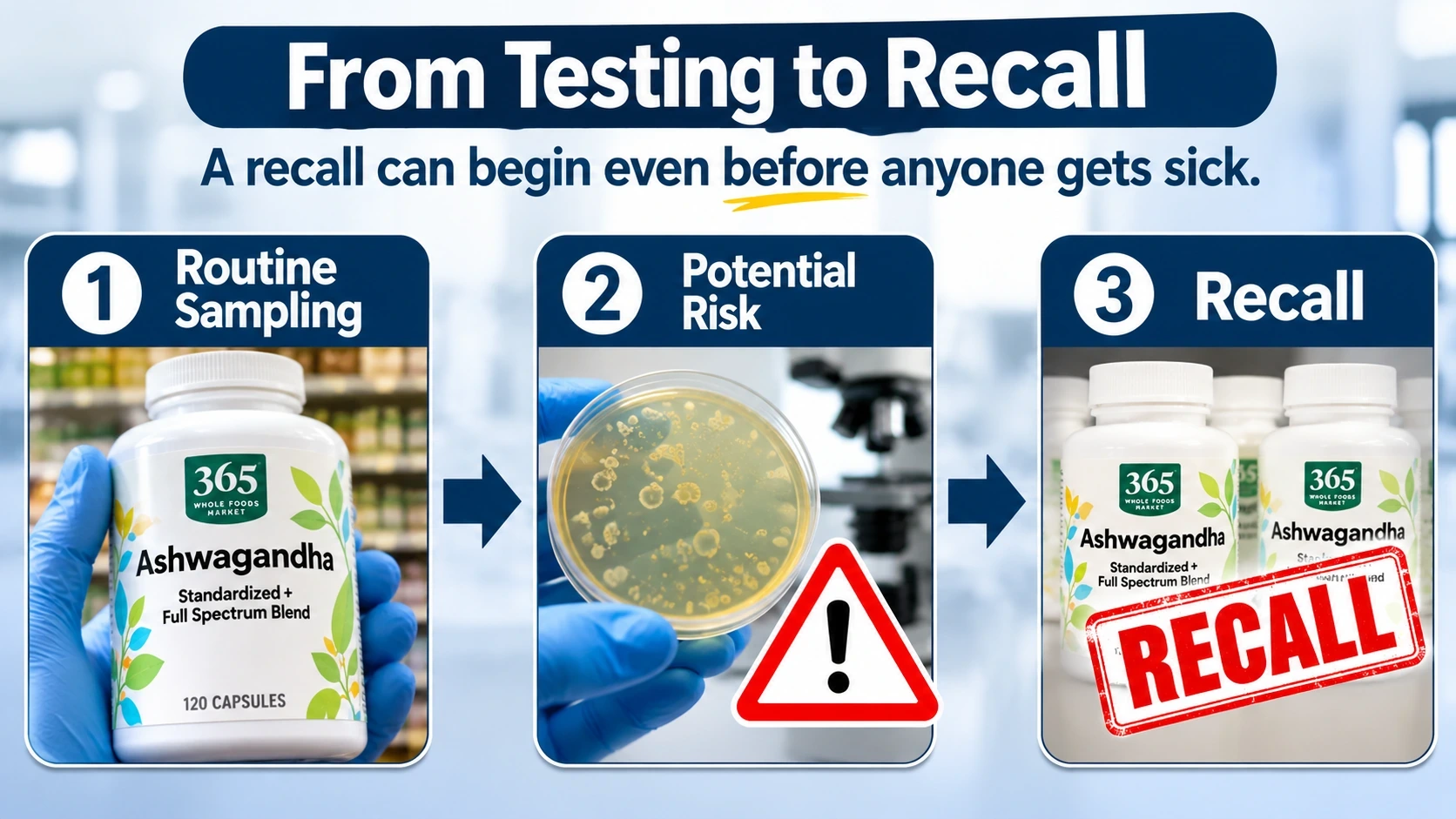
A recall does not require people to become sick first. Companies can remove potentially unsafe products from circulation when testing or other evidence raises a concern.
In this case, Vitality Works said the possible Salmonella contamination was identified through routine sampling of a single retail unit.
The announcement did not provide a detailed account of the contamination’s origin, the number of bottles affected, or the full testing results. It also did not report any illnesses as of the announcement date. (FDA)
That leaves three different questions:
| Question | What is known |
|---|---|
| Is there a safety concern? | Yes. The company identified possible Salmonella contamination. |
| Has every bottle been shown to contain Salmonella? | No such finding was reported. |
| Have illnesses been linked to the product? | None had been reported when the notice was issued. |
The absence of reported illness is reassuring, but it is not proof that the recalled lot is safe to consume.
The FDA also explains that it publishes company recall announcements as a public service. In this situation, Vitality Works is the recalling company, while the FDA is the federal agency making the notice publicly available.
Where Were the Recalled Capsules Sold—and Does an Amazon Purchase Count?
Yes. The recall includes affected capsules sold through Amazon.com as well as Whole Foods Market stores.
According to the company announcement, the product was available for purchase from November 24, 2025, through October 20, 2026.
The FDA describes the recall as nationwide. Its announcement also lists Whole Foods Market retail distribution in 30 states and Washington, D.C., while online sales through Amazon.com extended its reach beyond individual stores. (FDA · Scripps News)
This is why the purchase location alone cannot establish whether a bottle is affected.
Someone who ordered the supplement online months ago may still have part of the bottle at home. Someone who bought it at a Whole Foods store may already have finished it.
The deciding factor is the product’s identification information, especially its manufacturing lot.
The expiration date also deserves attention. A bottle marked October 13, 2028, may appear perfectly usable based on its printed shelf life. But an expiration date is not a guarantee against contamination, and it does not override a recall.
What Should You Do If You Have a Recalled Bottle?
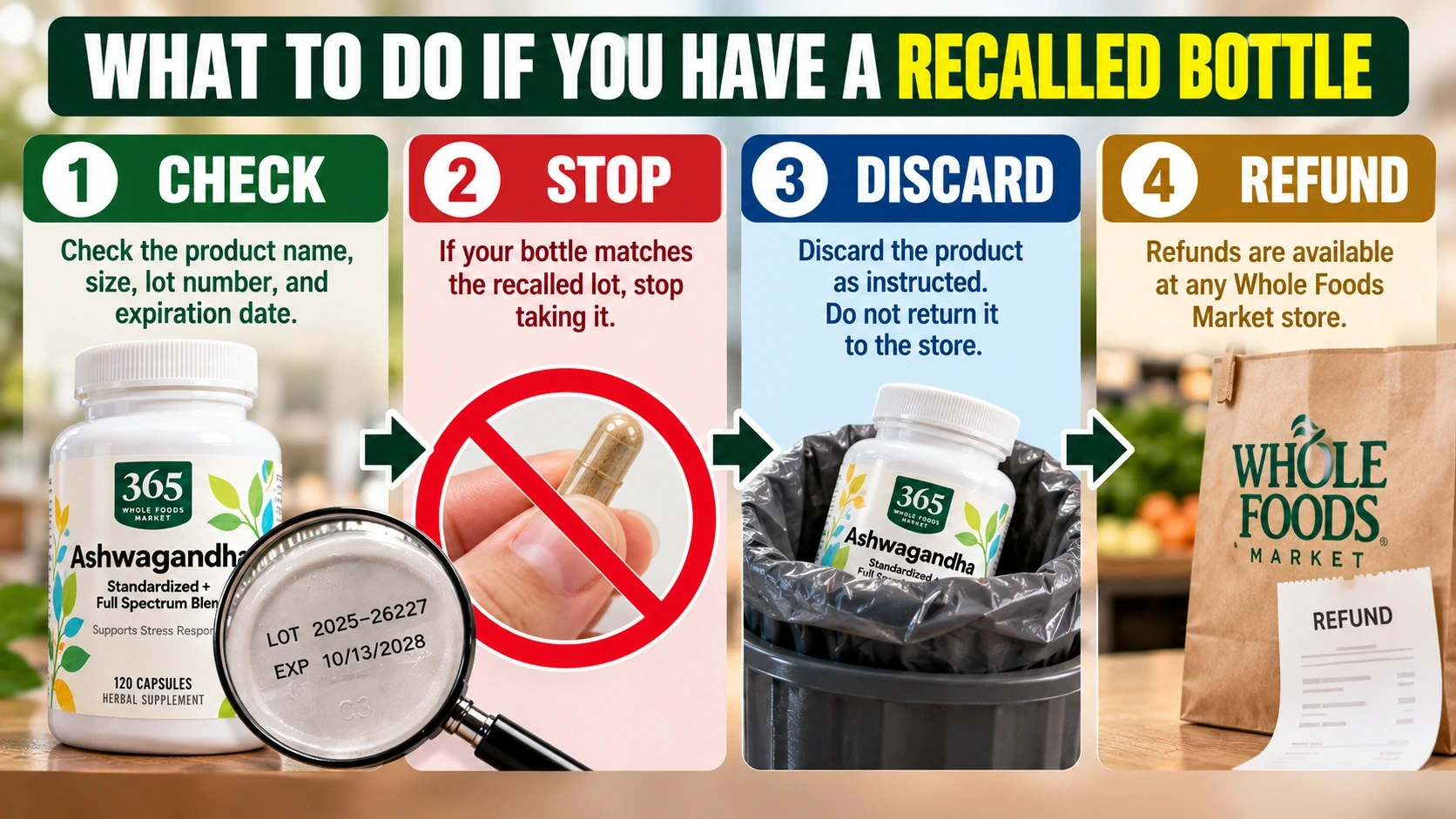
The company’s instruction is straightforward: Do not consume the recalled capsules. Discard them, and do not return the product to the store.
Refunds are available at any Whole Foods Market store, according to the October 30 notice. (FDA)
A practical sequence is:
- Check the product name, bottle size, lot number, and expiration date.
- If the bottle matches the recalled lot, stop taking it.
- Record the identifying information or photograph the label for reference, then discard the product as instructed.
- Contact Whole Foods Market about a refund, particularly if you are unsure what purchase information the store requires.
The public announcement does not specify whether a receipt is required or describe a separate refund procedure for Amazon buyers. Avoid assuming those details without checking with the retailer or recalling company.
For recall-related questions, Vitality Works lists the following contact:
Vitality Works Inc.: (505) 268-9950
Consumer service hours are Monday through Friday, 8 a.m. to 5 p.m. Mountain Time.
If the printed lot code is damaged or unreadable, contacting the company is more reliable than guessing from the appearance of the bottle.
What If You’ve Already Taken the Ashwagandha Capsules?
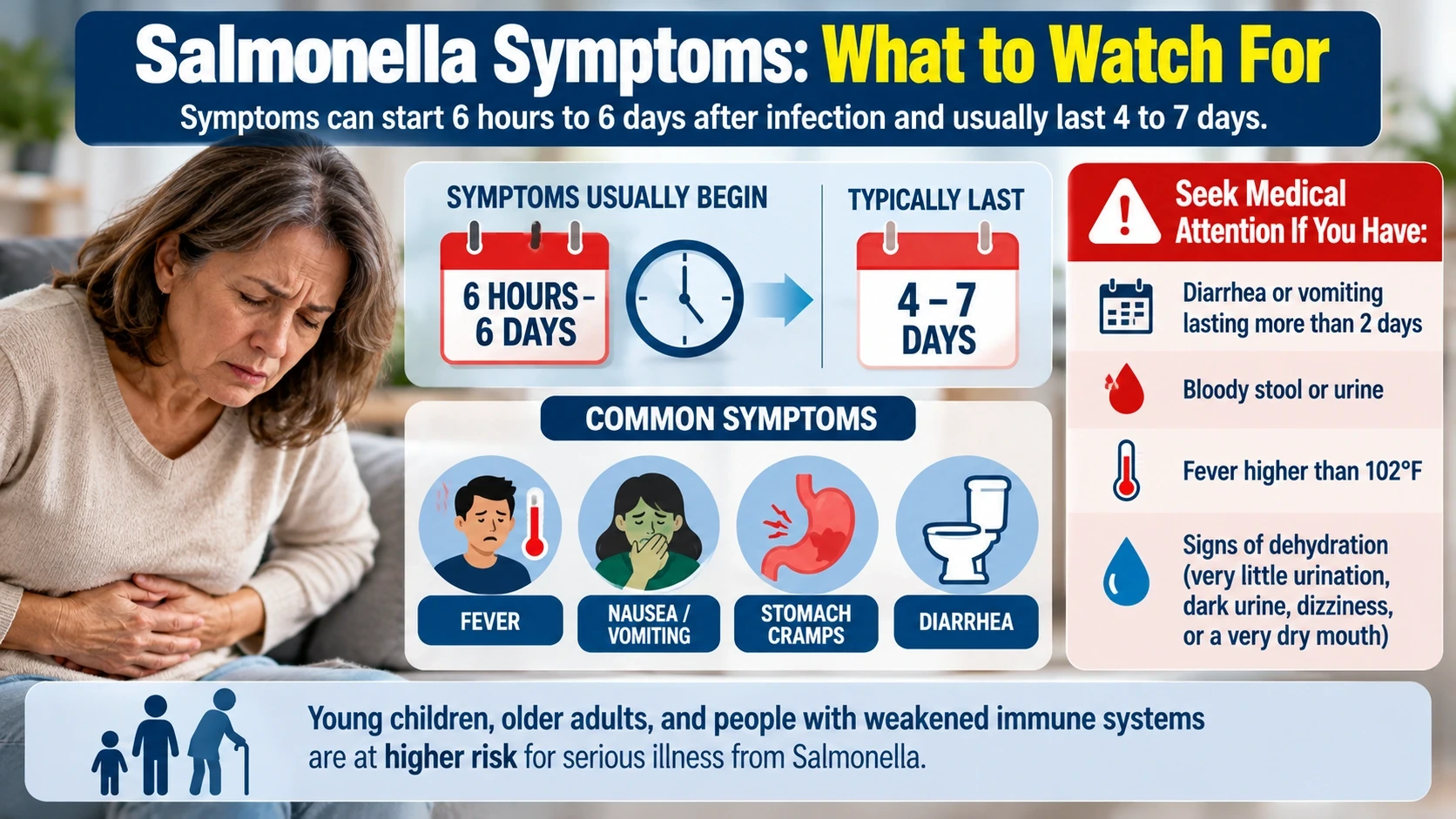
Taking a capsule from the recalled lot does not automatically mean you have been infected with Salmonella.
The company had not reported illnesses associated with the product when it issued the recall. Still, anyone who has taken the affected supplement should know what symptoms to watch for.
The Centers for Disease Control and Prevention says Salmonella infections commonly cause diarrhea, fever, and stomach cramps. Nausea and vomiting can also occur.
Symptoms usually begin 6 hours to 6 days after infection and generally last 4 to 7 days. (CDC)
When should you seek medical attention?
The CDC advises contacting a healthcare professional if you experience symptoms such as:
- Diarrhea or vomiting lasting more than two days.
- Bloody stool or urine.
- Fever higher than 102°F.
- Signs of dehydration, including very little urination, dark urine, dizziness, or a very dry mouth.
Severe symptoms, an inability to keep fluids down, or rapidly worsening illness warrant prompt medical care.
Young children, older adults, and people with weakened immune systems face a greater risk of serious Salmonella illness. The bacteria can occasionally spread beyond the digestive tract and cause severe complications. (CDC)
If you contact a healthcare professional after developing symptoms, mention the recalled supplement and when you last took it.
There is no reason to assume that every person who consumed the product will get sick. But the lack of symptoms does not make it appropriate to continue using a recalled bottle.
Does the Recall Mean Ashwagandha Itself Is Dangerous?
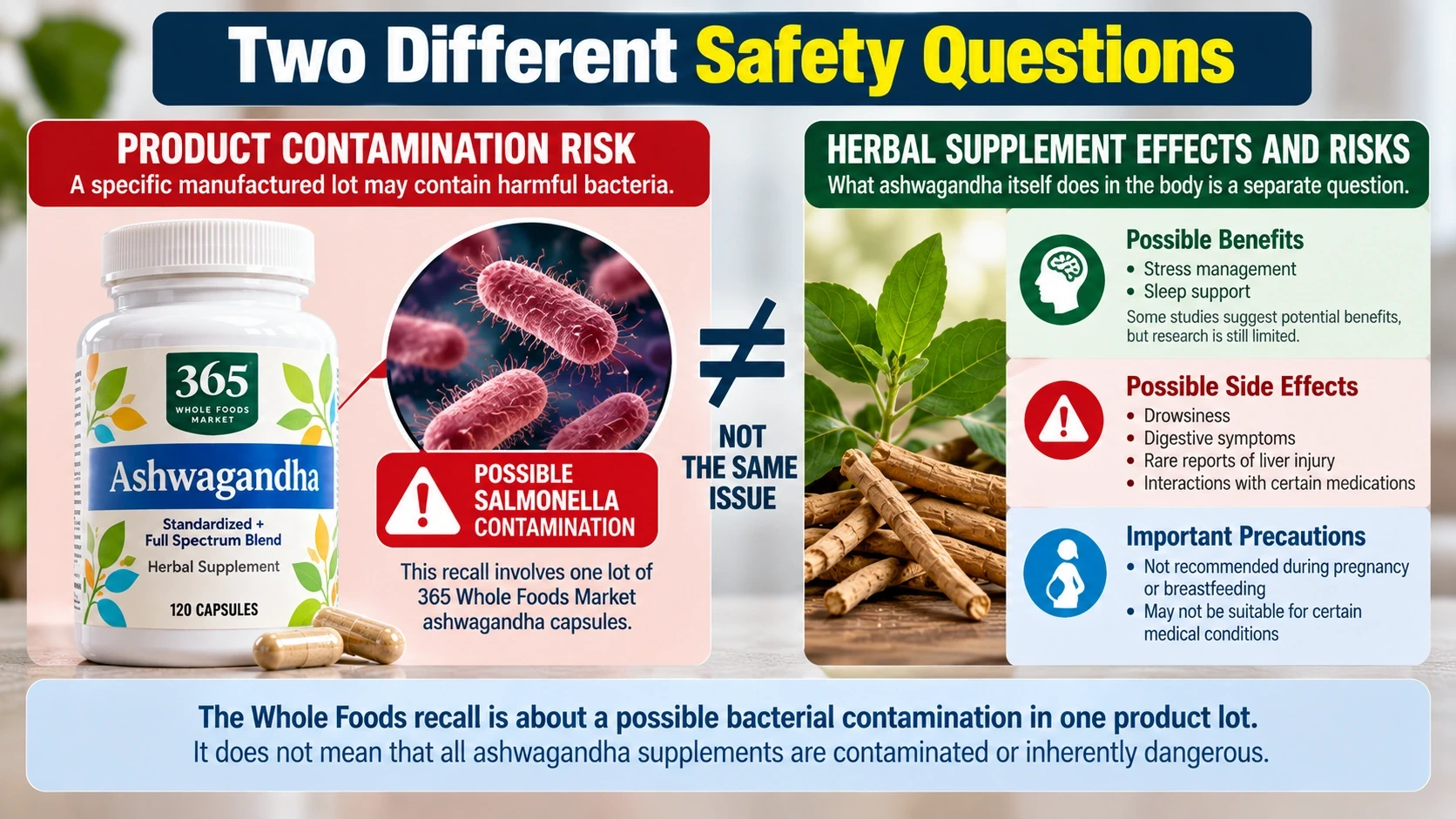
No. A recall involving possible bacterial contamination does not establish that ashwagandha as an ingredient is contaminated or inherently dangerous.
These are two different safety questions.
One concerns whether a specific manufactured product may contain harmful bacteria. The other concerns what ashwagandha itself does in the body, including potential benefits, side effects, and medication interactions.
Ashwagandha, also known as Withania somnifera, is an herb traditionally used in Ayurvedic medicine. In the United States, it is commonly marketed in supplements promoted for stress management, sleep, and other wellness purposes.
The National Institutes of Health’s National Center for Complementary and Integrative Health reports that some ashwagandha preparations may help with stress and insomnia. However, research remains limited, and there is insufficient evidence to support many other proposed uses.
The NIH also identifies possible side effects and precautions, including drowsiness, digestive symptoms, rare reports of liver injury, and interactions with certain medications. It advises against use during pregnancy or breastfeeding and identifies additional situations in which the herb is not recommended. (NIH NCCIH)
That means a bottle can raise two separate concerns even if they have nothing to do with each other:
| Type of concern | What it means |
|---|---|
| Product contamination | A specific lot may contain a harmful microorganism. |
| Ingredient-related health risk | The herb may have side effects, interactions, or uncertain benefits even when the product is not contaminated. |
The Whole Foods recall concerns the first problem.
Understanding the second is still important for anyone considering taking ashwagandha regularly.
Why Can Dietary Supplements Be Sold Without FDA Approval?
Unlike prescription drugs, dietary supplements generally do not need FDA approval for safety and effectiveness before they are marketed.
Under the Dietary Supplement Health and Education Act of 1994, manufacturers are primarily responsible for ensuring that their supplements comply with applicable safety, manufacturing, and labeling requirements.
The FDA can inspect facilities, monitor the marketplace, investigate problems, and take enforcement action. Certain new dietary ingredients are also subject to notification requirements before marketing. But dietary supplements do not undergo the same premarket approval process as new drugs. (FDA)
This helps explain why a supplement may be sold for months before a potential problem is discovered.
It does not mean supplement manufacturers are exempt from safety rules. They remain legally responsible for complying with applicable requirements.
Nor does every recall reveal a systemic failure. Contamination concerns can arise in many categories of food and health products, and testing can help identify risks before illnesses are reported.
For consumers, the distinction matters because a familiar retailer, attractive packaging, or natural-ingredient label should not be mistaken for an FDA guarantee that a product has been individually tested and approved.
What Should Consumers Watch for Next?
The most useful developments would be any further announcements about additional lots, the investigation into the possible contamination, or illnesses that may be linked to the product.
As of the October 30 announcement, the company had identified one recalled lot and reported no illnesses. The notice did not establish how many bottles were potentially affected or where any contamination may have originated.
Consumers can follow the FDA recall announcement for the official product description and any subsequent information.
Until further information changes the instructions, people with the affected lot should follow the existing recall guidance rather than wait for proof of an illness outbreak.
Bottom Line: What This Story Really Means
The Whole Foods ashwagandha recall is not a warning that every herbal supplement is unsafe.
It is a specific product safety action involving one lot of 365 Whole Foods Market ashwagandha capsules that may be contaminated with Salmonella.
If you have a 120-count bottle with lot number 2025-26227 and expiration date October 13, 2028, do not take it. The company instructs consumers to discard the product and says refunds are available at Whole Foods Market stores.
No illnesses had been reported when the recall was announced, but that does not eliminate the potential risk.
The wider lesson is that supplements involve more than one kind of safety question. Consumers need to consider both the quality of the product they purchase and the medical evidence surrounding the ingredient they intend to take.
Ashwagandha Recall: Key Questions Explained
Q. Which Whole Foods ashwagandha capsules are recalled?
The recall covers 365 Whole Foods Market Standardized + Full Spectrum Blend Ashwagandha Capsules, 120 count, with lot number 2025-26227 and expiration date October 13, 2028.
Q. How do I find the recalled lot number?
Check the bottom of the white supplement bottle. The lot number and expiration date are printed there.
Q. Are all ashwagandha supplements being recalled?
No. The October 30 recall identifies one lot of a specific 365 Whole Foods Market product. It does not cover every brand or every ashwagandha supplement.
Q. Were the affected supplements sold on Amazon?
Yes. The company said the affected product was available through Amazon.com and Whole Foods Market stores between November 24, 2025, and October 20, 2026.
Q. Has anyone gotten Salmonella from the recalled capsules?
No illnesses had been reported as of the company’s October 30, 2026, announcement. That does not establish that the recalled product is safe.
Q. What are the symptoms of Salmonella infection?
Common symptoms include diarrhea, fever, and stomach cramps. Symptoms usually begin 6 hours to 6 days after infection, although not everyone exposed will become ill.
Q. Can I return the recalled supplement to Whole Foods?
The company instructs consumers to discard the recalled product rather than return it to the store. Refunds are available at Whole Foods Market locations.
Q. Does the FDA approve ashwagandha supplements before they are sold?
No. Dietary supplements generally do not require FDA approval for safety and effectiveness before marketing. Manufacturers must still comply with applicable federal safety and labeling requirements.
Q. Is ashwagandha safe to take every day?
Its safety depends on individual circumstances, and long-term safety information is limited. The herb can cause side effects and interact with medications, so regular use should be discussed with a healthcare professional.
Did this help make the story clearer? 🙂
WIN keeps unpacking the “why” behind the news—clearly and simply!
Sources
Official Recall Details and Product Identification
Scripps News — Whole Foods Ashwagandha Capsules Recalled Over Possible Salmonella Contamination
Salmonella Symptoms and Medical Risks
CDC — Symptoms of Salmonella Infection
CDC — Clinical Overview of Salmonellosis
Ashwagandha Research and Dietary Supplement Regulation
NIH National Center for Complementary and Integrative Health — Ashwagandha: Usefulness and Safety