Who Hacked Binance for $6.3 Billion—and Is Your Crypto Safe?

How can $6.3 billion disappear from a cryptocurrency exchange while customers are still told their money is safe?
That is the question at the center of the Binance hack. The FBI attributed the theft to a North Korean state-sponsored hacking group on October 31, 2026. Binance, meanwhile, promised to replace the stolen assets with its own resources rather than pass the loss on to customers.
Replacing missing assets is not the same as recovering stolen coins. Understanding that difference explains both the reassurance from Binance and the risks that remain. (FBI · Binance)

※ Images in this article are AI-generated illustrations created to help explain the story. They are not actual photographs, and depictions of people, places, or events may differ slightly from reality.
What Actually Happened in the $6.3 Billion Binance Hack?
Attackers drained cryptocurrency from Binance-controlled hot wallets, which are wallets connected to systems that can process transfers. Binance placed the loss at roughly $6.3 billion and said the unauthorized withdrawals began around 20:05 UTC on October 29 (4:05 p.m. Eastern). The blockchain analytics company Elliptic estimated a slightly higher $6.43 billion based on its transaction analysis. (Binance · Elliptic)
The attack occurred on October 29. October 31 became a major new development because the FBI publicly identified the suspected perpetrator and Binance announced that it had replenished about 90% of the affected assets. The recovery effort continued into November. (FBI · Reuters)
| Date | What changed |
|---|---|
| October 29 | Unauthorized transfers drained Binance hot wallets. |
| October 30 | Binance disclosed the estimated $6.3 billion loss, paused withdrawals, and promised to absorb it. |
| October 31 | The FBI attributed the theft to North Korea’s TraderTraitor operation; Binance reported 90% asset replenishment. |
| November 1 | Binance reported approximately 95% replenishment and began restoring withdrawals in phases. |
| November 2 | Reuters reported substantial withdrawals after the partial reopening, while Binance said outflows were stabilizing. |
These are different stages of one incident—not five separate hacks. (Binance · Reuters)
How Did Hackers Get Past Binance’s Security?
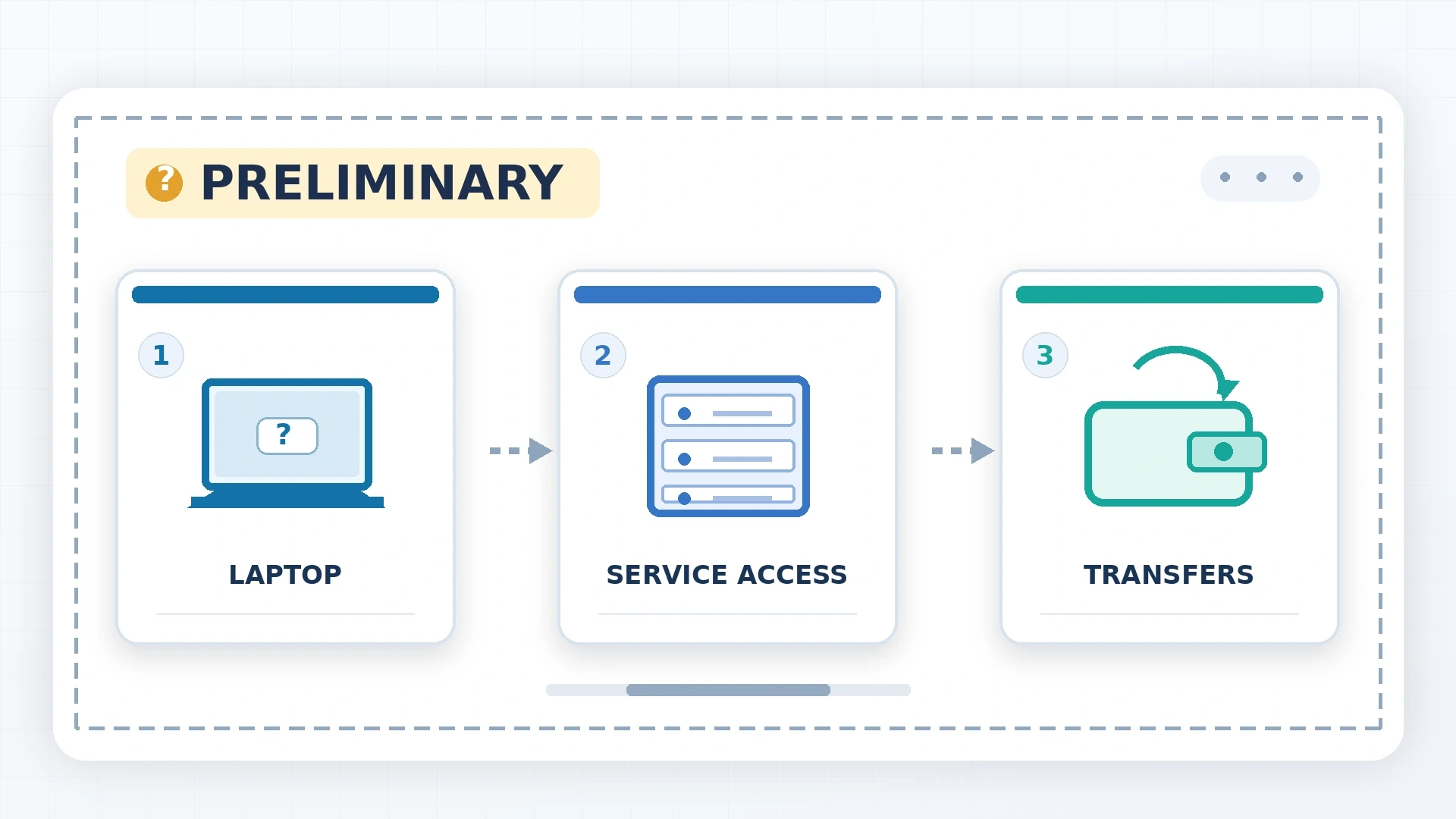
The complete entry route has not been established publicly. Binance initially said a compromised laptop belonging to a DevOps engineer might have allowed an attacker to reach a service container and submit unauthorized withdrawal transactions. A later update said investigators had found additional breach points. (Binance)
The distinction matters because a private key—the secret credential authorizing a crypto transfer—is only one possible point of failure. Elliptic’s analysis suggests the attackers may have manipulated the systems responsible for approving transactions, rather than simply breaking cryptocurrency’s underlying mathematics. Binance said it had found no evidence that wallet private keys were leaked, but that statement does not settle how every part of the breach occurred. (Elliptic · Binance)
Think of it as a secure vault with a sophisticated electronic approval system: the vault’s lock may be sound even if criminals manage to abuse the process that tells it when to open. That is an analogy, not a confirmed account of this particular intrusion.
Why Is the FBI Blaming North Korea?

The FBI said on October 31 that North Korea was responsible and identified the operation as TraderTraitor. It also said investigators had observed the actors converting stolen assets primarily into ether, with further laundering expected through decentralized finance and instant-swap services. This is a public law-enforcement attribution, not a court verdict identifying and convicting individual hackers. (FBI)
The name is not new. In February 2025, the FBI also attributed the theft of approximately $1.5 billion from crypto exchange Bybit to TraderTraitor. Elliptic said the Binance attackers’ transaction patterns and links to earlier illicit fund flows supported its own assessment of North Korean involvement. (FBI · Elliptic)
For U.S. readers, the international significance is that a theft at a private exchange may also be a national-security issue. U.S. officials have linked North Korean cryptocurrency theft to efforts to generate funds for the regime. That does not mean every stolen coin has already reached North Korea or been converted into usable cash. (FBI)
Was the Stolen Crypto Recovered—or Just Replaced?
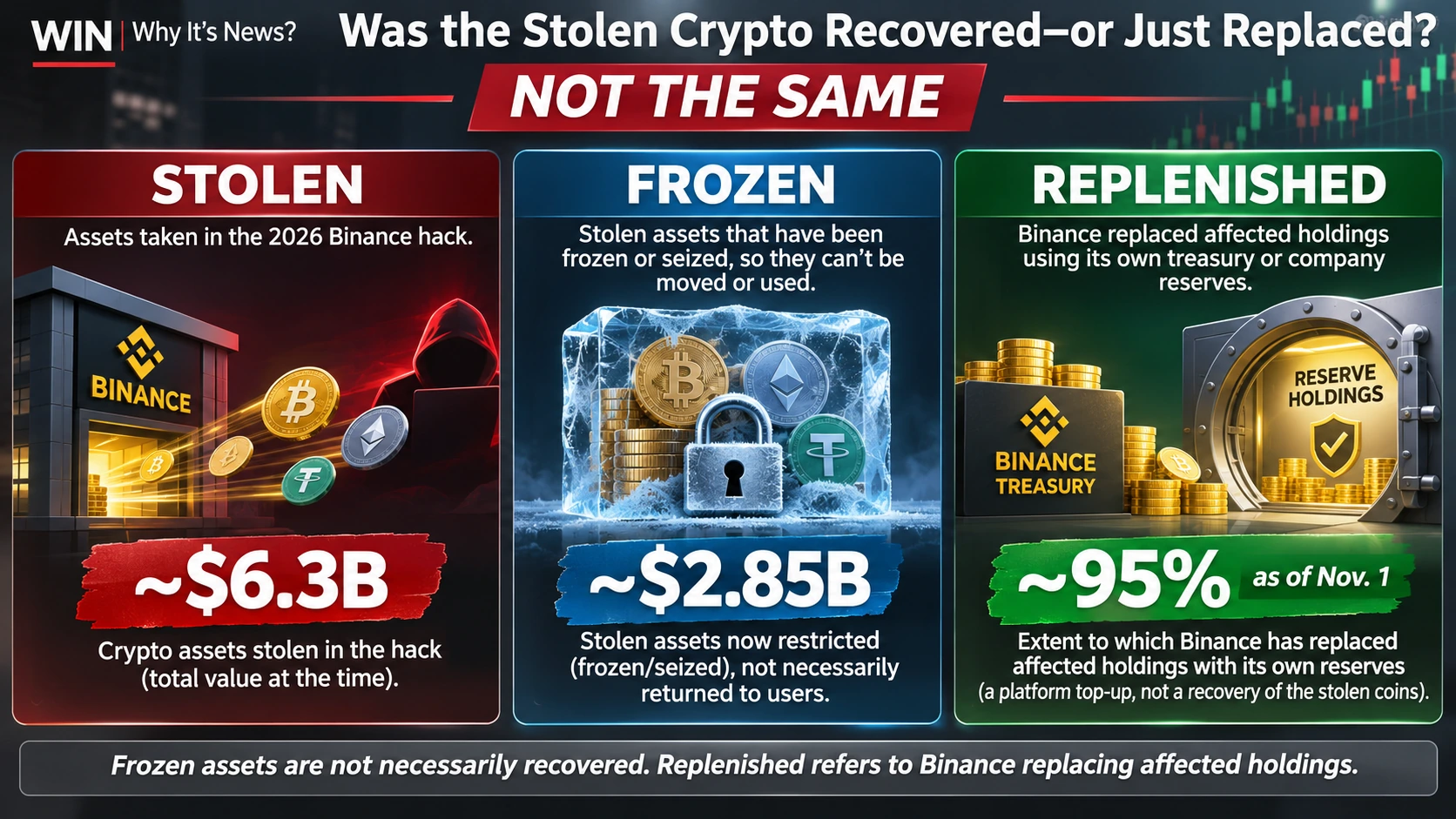
Mostly replaced by Binance, not recovered from the attackers. This is the most important distinction in the financial side of the story. Binance said it had replenished about 90% of the affected assets by October 31 and increased that figure to roughly 95% on November 1. The remaining assets were less liquid tokens that the company said would take longer to obtain. (Binance · Binance)
Three numbers describe three very different things:
| Measure | What it tells you | What it does not prove |
|---|---|---|
| About $6.3 billion stolen | Binance’s estimate of the assets taken | That every customer personally lost that amount |
| About $2.85 billion frozen or seized | Elliptic’s independently verified amount restricted as of its November 1 update | That the money has been returned to Binance |
| About 95% replenished | Binance’s November 1 statement about replacing affected asset holdings | That 95% of the original stolen coins were recovered |
Elliptic said the frozen or seized portion was largely stablecoins, including tokens whose issuers can restrict transfers from designated addresses. Native bitcoin and ether do not have a comparable central issuer able to freeze a wallet. That makes the remaining funds harder to stop once they are moved or swapped. (Elliptic)
The FBI and private investigators are also tracking movement through crypto swaps and multiple blockchain networks. A public blockchain can make transactions visible, but following a transfer is not the same as controlling the funds or forcing their return. (FBI · Elliptic)
Are Binance Customers Safe, and Can They Withdraw Their Money?

Binance says it will absorb the losses using corporate resources, its Secure Asset Fund for Users (SAFU), and other designated funds. The company reported that ten major assets, including bitcoin, ether, USDT, and USDC, had been fully backed again. That is Binance’s financial commitment and reserve disclosure—not an unconditional outside guarantee. (Binance)
Binance began restoring withdrawals in phases on November 1, with availability depending on the token and blockchain network. In a November 2 report, Reuters said net withdrawals reached about $3.64 billion during the first nine and a half hours after the partial reopening, while the exchange reported that the pace was stabilizing. Those withdrawals show users were testing access to funds; they do not, on their own, establish whether the exchange is fully secure. (Binance · Reuters)
Binance also published a proof-of-reserves snapshot and said its full cryptographic proof for ten major tokens was expected on November 3. A snapshot can help users check whether specified assets are backed at a particular point in time. It is not, by itself, a complete security audit or a guarantee that future withdrawals will always work. (Binance)
For Americans, one further distinction matters: crypto assets are not protected by ordinary FDIC deposit insurance. Binance’s pledge to cover this theft should not be confused with the federal protection that applies to eligible bank deposits. (FDIC)
Binance.US is a separate platform from the global Binance exchange. Binance.US said it was not affected by this breach and that its customers’ funds and services remained secure. That statement applies to Binance.US; it does not establish that every service on the global exchange has fully recovered. (ABC News)
What Should Users Watch Next?
Three developments will show whether Binance is moving beyond emergency damage control.
First, withdrawal access: users need to see whether the specific token and network they use are available without unusual delays. A phased reopening is progress, but it is not the same as a platform-wide return to normal.
Second, independently checkable backing: Binance’s promised proof-of-reserves material and subsequent updates will matter more than an isolated reassurance that balances are safe. The company’s numbers should be understood as dated disclosures rather than permanent guarantees.
Third, the technical investigation and asset tracing: Binance has promised a post-incident report, while investigators continue monitoring stolen-asset flows. The unanswered question is how the attackers gained such sweeping transaction authority—and what changes can prevent it from happening again. (Binance · FBI)
Customers looking for updates should use Binance’s official status and support channels, review their own withdrawal availability, and be cautious of unsolicited messages offering special recovery assistance. No customer needs to assume that a message claiming to recover stolen funds is legitimate merely because the exchange suffered a real breach.
Bottom Line: What This Story Really Means
The FBI’s October 31 attribution turned a huge exchange hack into a broader story about North Korean cyber operations. Binance’s response introduced another critical question: can an exchange replace billions in stolen assets quickly enough to protect the people who trust it with their money?
As of November 1, Binance said it had replenished approximately 95% of the affected assets, and withdrawals were being restored in stages. That is significant progress, but it is not equivalent to recovering 95% of the stolen crypto or proving that every underlying security problem has been fixed. The next tests are usable withdrawals, verifiable reserves, and a credible explanation of how the breach happened.
Binance Hack: Key Questions Explained
Q. When did the $6.3 billion Binance hack happen?
The unauthorized withdrawals began on October 29, 2026. The FBI’s North Korea attribution and Binance’s 90% replenishment update came on October 31.
Q. Did the FBI confirm who was responsible?
The FBI publicly attributed the theft to North Korea’s TraderTraitor operation. That is a law-enforcement finding, not a criminal conviction of named individuals.
Q. How much did Binance say was stolen?
Binance estimated the loss at roughly $6.3 billion. Blockchain analytics firm Elliptic calculated approximately $6.43 billion using its own methodology.
Q. Does 95% replenished mean Binance recovered 95% of the stolen crypto?
No. Binance said it had replaced about 95% of the affected holdings as of November 1, largely using its own resources. Replenishment is different from recovering the original stolen coins.
Q. What does it mean when stolen cryptocurrency is frozen?
It means transactions involving particular assets have been restricted or those assets otherwise secured. Freezing does not necessarily mean ownership has been returned to the victim.
Q. Can customers withdraw their cryptocurrency now?
Binance began restoring withdrawals in phases on November 1. Actual access depends on the token and blockchain network, so customers should check the exchange’s current official status.
Q. Are customer crypto holdings FDIC-insured?
No. Crypto assets are not covered by standard FDIC deposit insurance, even when an exchange promises to cover a specific security incident.
Q. What is proof of reserves supposed to show?
It is intended to help demonstrate that an exchange holds assets backing specified customer balances at a particular point in time. It does not independently establish that the exchange’s systems are free of vulnerabilities.
Did this help make the story clearer? 🙂 WIN keeps unpacking the “why” behind the news—clearly and simply!
Sources
The Attack and Binance’s Recovery Updates
Binance — Security Incident Update #2, October 30
Binance — Asset Replenishment Update, October 31
Binance — Withdrawals Resume in Phases, November 1
Reuters — Binance Outflows After Phased Reopening, November 2
North Korean Attribution and Stolen-Asset Tracking
FBI — North Korea Responsible for $6 Billion+ Binance Attack, October 31
Elliptic — Analysis of the Binance Theft, updated November 1
FBI — North Korea Responsible for $1.5 Billion Bybit Hack, February 2025
FBI — Cryptocurrency Funds Stolen by North Korea
Consumer Protection Context
FDIC — What Deposit Insurance Does and Does Not Cover
ABC News — FBI Says North Korea Responsible for Binance Breach; Binance.US Response, October 31