Why Is Zelda: Ocarina of Time Winning Rave Reviews 28 Years Later?

How does a video game from 1998 end up near the top of the review charts in 2026?
That is the surprising story behind Nintendo’s new version of The Legend of Zelda: Ocarina of Time.
Originally released for the Nintendo 64, the game helped define what a three-dimensional adventure could be. Now, 28 years later, Nintendo has rebuilt it for the Nintendo Switch 2—and critics are responding with remarkably high scores.
The remake officially launched on November 5, 2026. Ahead of release, it reached a Metacritic score of 96, putting it at the top of the site’s 2026 game rankings at that point. The original’s legendary score of 99, however, remained unbeaten. (Nintendo · VGC)
It would be easy to explain the excitement as nostalgia. Millions of players remember exploring Hyrule, meeting Princess Zelda, and solving puzzles alongside Link.
But nostalgia alone doesn’t explain why professional reviewers are praising a game designed before smartphones, modern online gaming, or today’s enormous open-world adventures.
The stronger explanation is that Nintendo preserved much of the original game’s carefully constructed adventure while removing frustrations that made it feel old.
And that raises a more interesting question: What did a game from 1998 understand about game design that still works nearly three decades later?
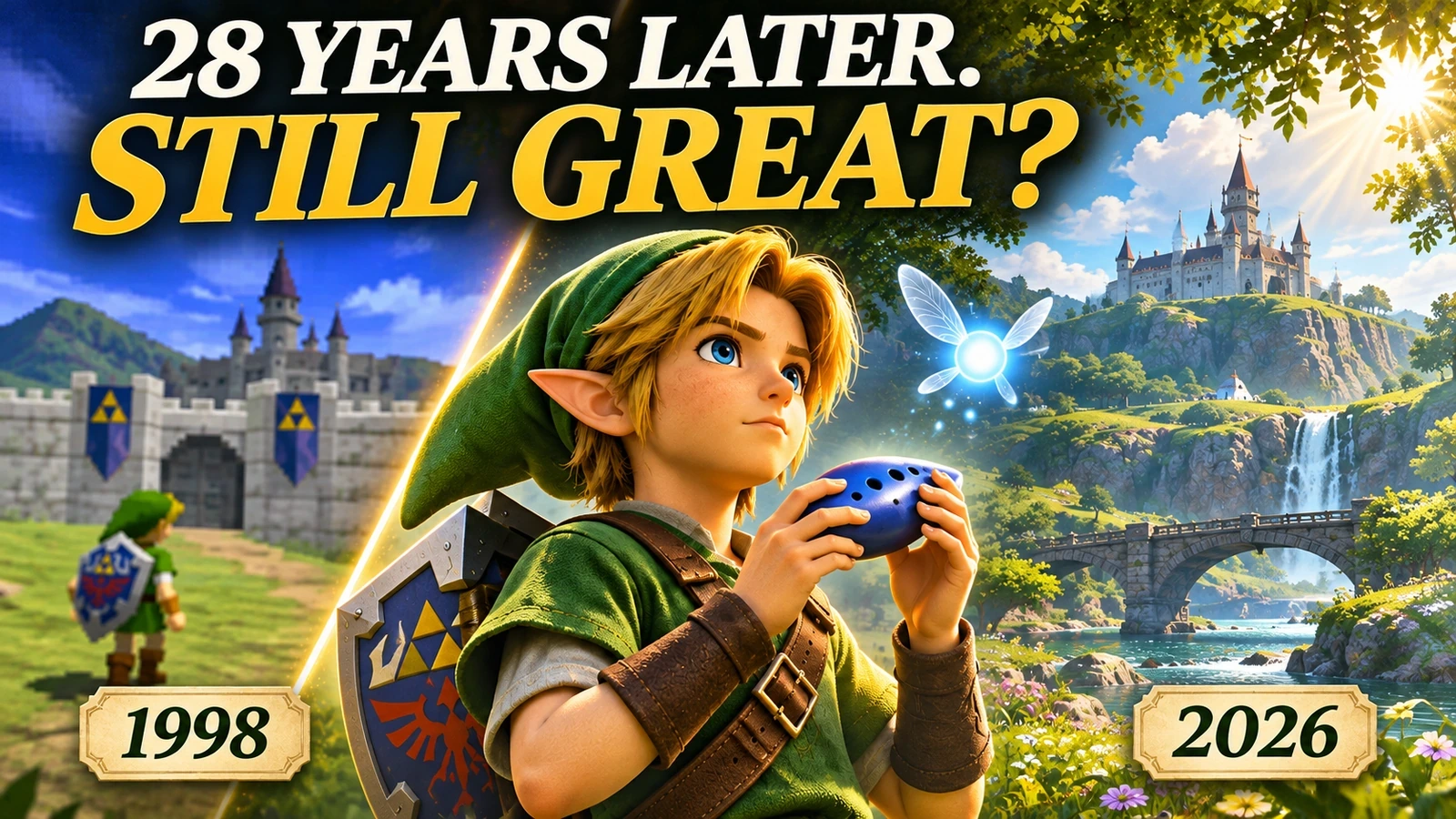
※ Images in this article are AI-generated illustrations created to help explain the story. They are not actual photographs, and depictions of people, places, or events may differ slightly from reality.
Why Was the Original Ocarina of Time So Important?
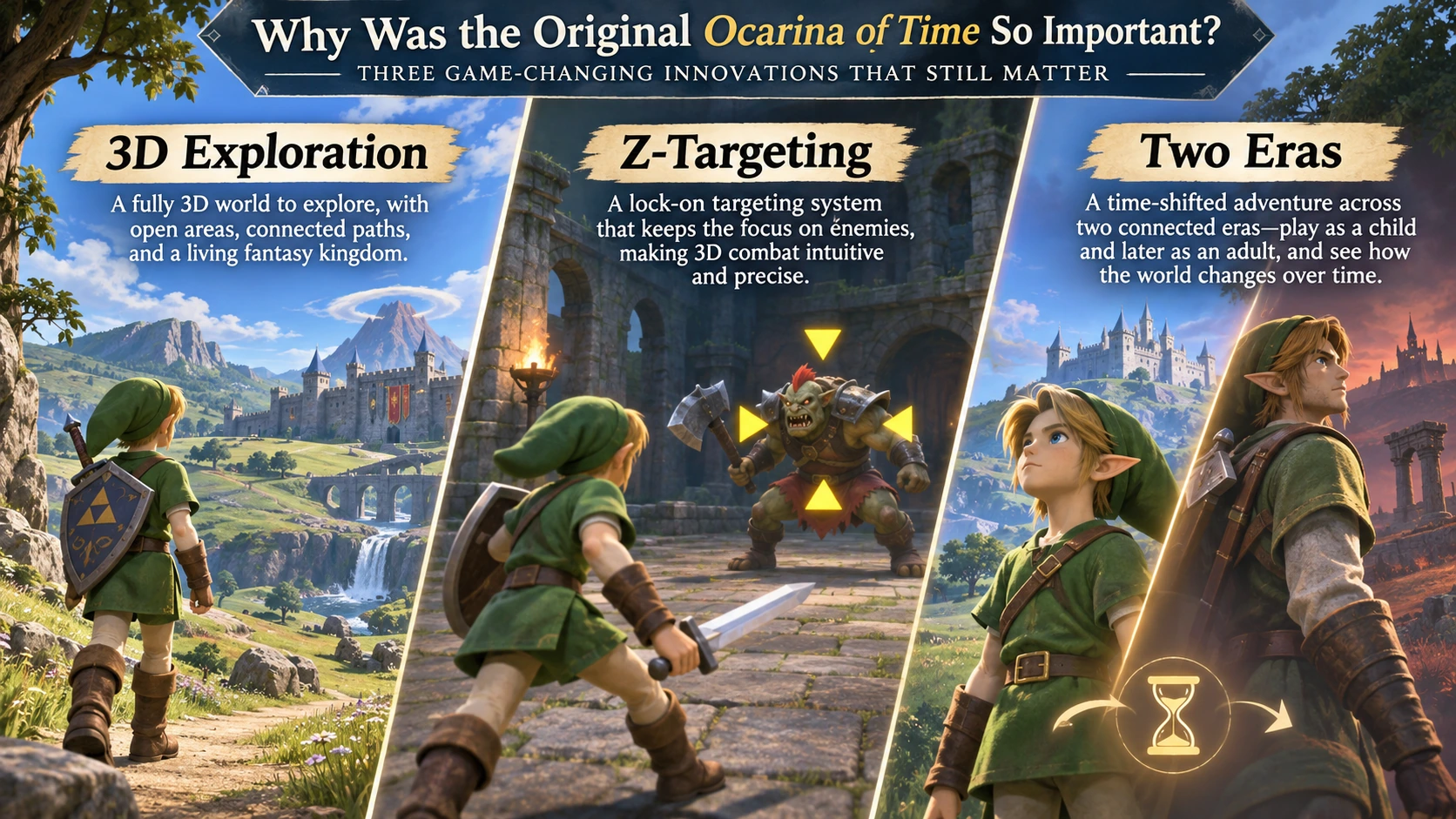
Ocarina of Time mattered because it successfully brought Zelda’s exploration, puzzles, and combat into a fully three-dimensional world.
That sounds ordinary now. In 1998, it was a major design challenge.
Earlier Zelda adventures were primarily experienced from an overhead perspective. Players could see the world around Link and understand where enemies were positioned.
A 3D environment changed everything. Players now needed to control both a character and a camera while fighting enemies, navigating buildings, and exploring unfamiliar spaces.
Nintendo’s answer included Z-targeting, a system that allowed the camera to lock onto an enemy or other target. Instead of constantly adjusting the camera during combat, players could concentrate on movement and attacks.
In a November 2026 developer interview, Zelda series producer Eiji Aonuma explained how the system emerged from the challenges of developing the franchise’s first 3D installment. Its underlying approach has remained important to the series ever since. (Nintendo)
The game also connected exploration to a distinctive story mechanic: Link could experience Hyrule as both a child and an adult.
That changed more than his appearance. The passage of time affected the world around him, creating new puzzles, obstacles, and discoveries.
Players weren’t merely moving across a map. They were learning how different parts of a carefully designed world connected.
The result received extraordinary critical recognition. The Nintendo 64 original holds a Metacritic score of 99, the highest score in the review aggregator’s historical rankings. (Metacritic)
But being groundbreaking in 1998 is not the same as being enjoyable in 2026.
So what survived the transition?
What Did Nintendo Actually Change in the 2026 Remake?
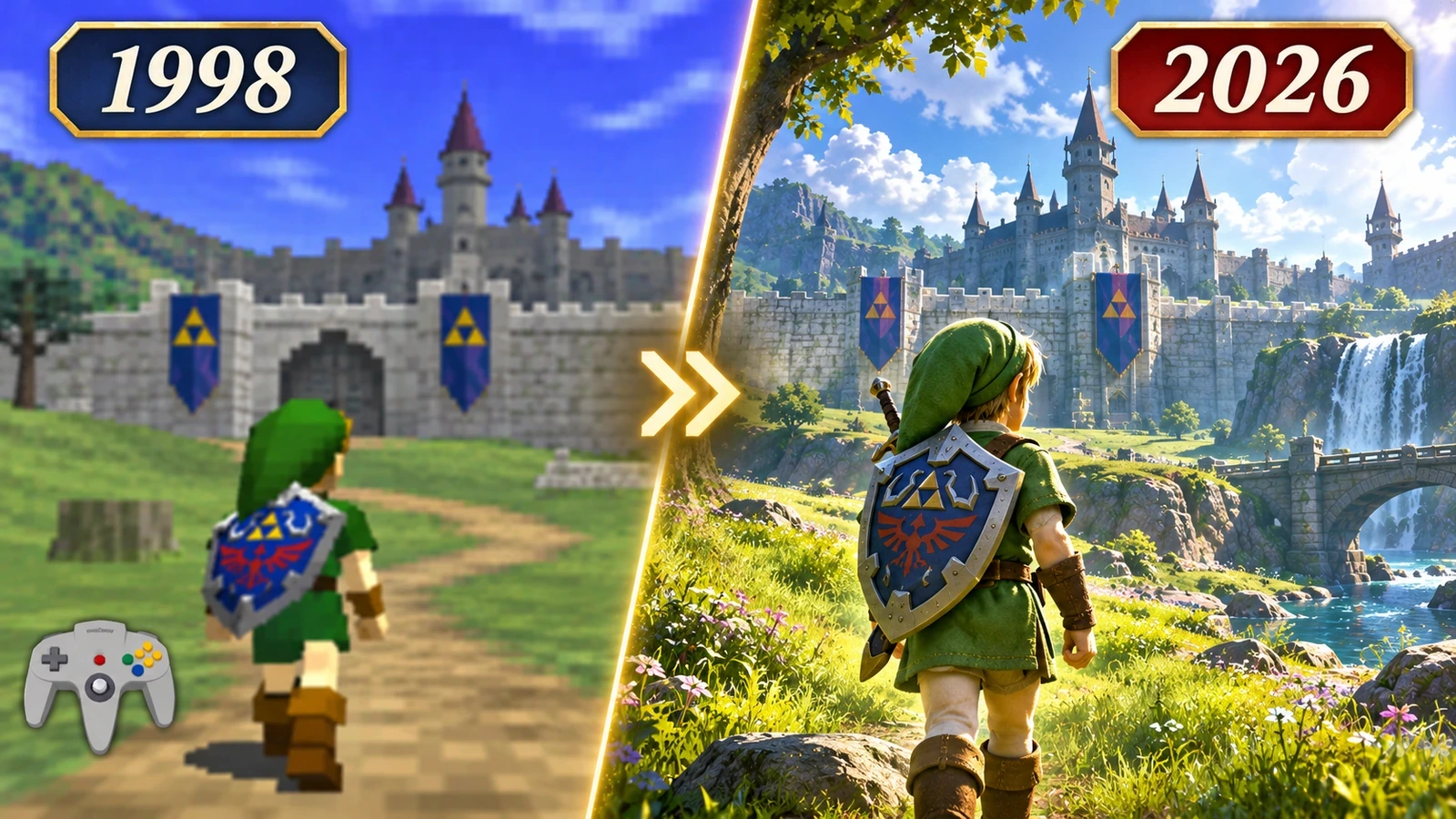
Nintendo rebuilt the game rather than simply displaying the old version at a higher resolution.
The Switch 2 release features substantially redesigned environments, updated character models, fully voiced cutscenes, expanded dialogue, orchestral music, and modernized movement and camera controls.
Nintendo confirmed these changes when announcing the remake and detailed them again at launch. (Nintendo)
But the biggest difference is not necessarily what Nintendo added. It’s what Nintendo chose to leave recognizable.
| Feature | 1998 Nintendo 64 original | 2026 Switch 2 remake |
|---|---|---|
| Visuals | Early polygonal 3D environments | Rebuilt environments with detailed modern graphics |
| Camera | Restricted camera movement and Z-targeting | Freely adjustable camera with updated controls |
| Jumping | Mostly automatic at designated locations | Dedicated jump button |
| Story presentation | Limited dialogue presentation without modern voiced cutscenes | Expanded dialogue and fully voiced cutscenes |
| Music | Nintendo 64-era soundtrack | Symphonic arrangements and additional music |
| Core adventure | Young and adult Link, dungeons, exploration, and puzzles | The same fundamental adventure, refined for modern players |
The interesting part of this comparison is the final row.
Nintendo could have transformed Ocarina of Time into a dramatically larger open-world game. It could have replaced the original dungeon structure or rewritten the story around completely different mechanics.
Instead, the development team deliberately protected the experience that made the original memorable.
Director HokWai Ng explained that the team wanted modern technology to improve how the game looked and felt without changing its essential identity. (Nintendo)
That approach helps explain why reviewers describe the remake as simultaneously familiar and fresh.
Why Does a Smaller, More Structured Adventure Still Work?
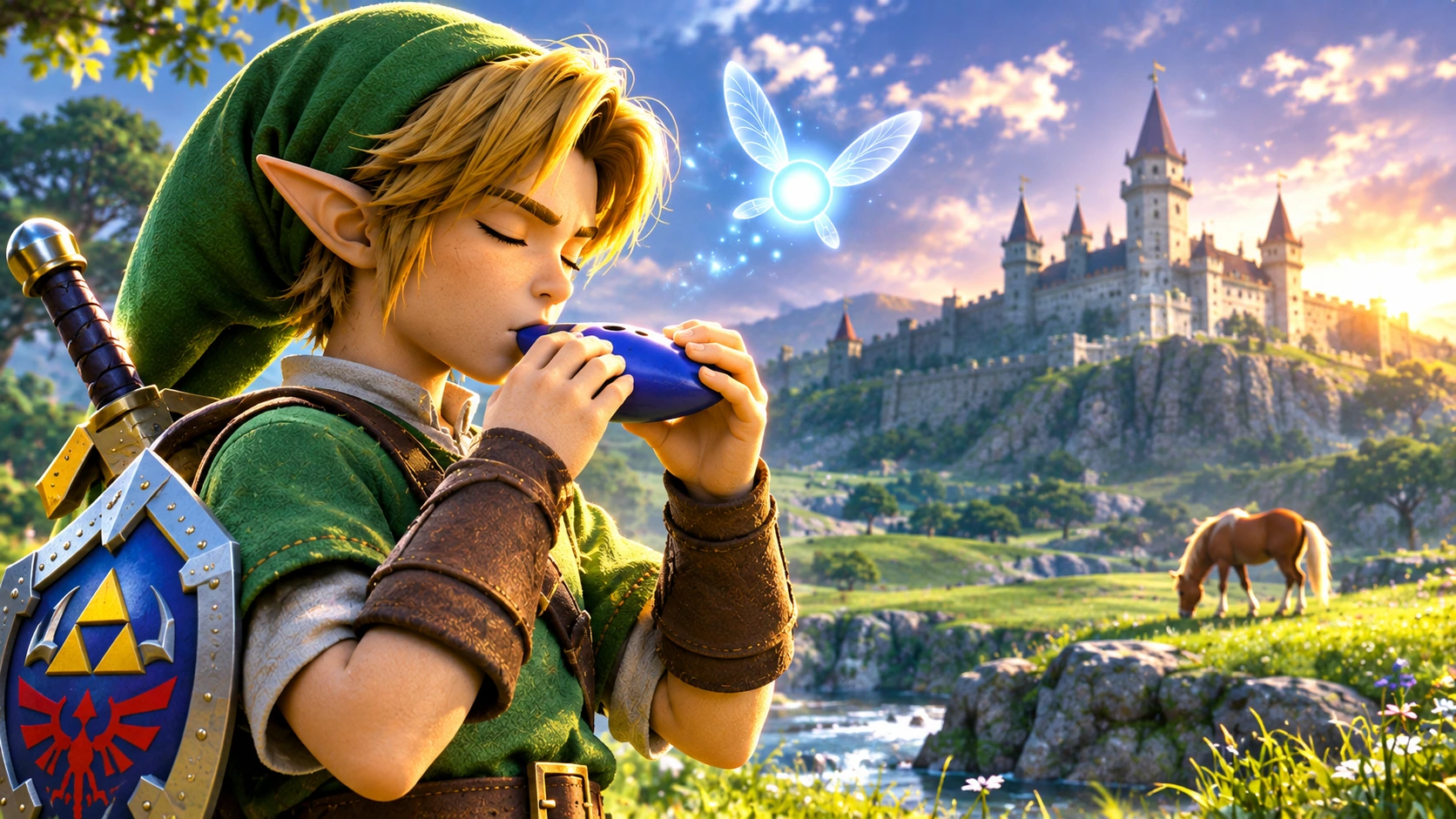
Ocarina of Time still works because its adventure is built around a strong sequence of discoveries, challenges, and rewards.
Modern Zelda games such as Breath of the Wild and Tears of the Kingdom give players enormous freedom to explore and experiment.
Ocarina of Time takes a more directed approach.
A player discovers an obstacle, learns a new ability or obtains an item, and later realizes that the solution to an earlier mystery is now within reach.
That structure creates a satisfying chain of discoveries.
Consider a simple example: You encounter an inaccessible passage, leave to explore another area, and eventually obtain an ability that makes the passage reachable.
The pleasure comes not only from finding the answer, but from remembering the earlier problem and understanding how the world fits together.
There is a difference between exploring a huge space and exploring a world in which nearly every important location has a carefully designed purpose.
Neither approach is inherently better. They create different kinds of adventure.
In Nintendo’s developer interviews, the team distinguished Ocarina of Time’s more self-contained structure from the expansive design of newer Zelda games. Preserving that distinction was part of the remake’s central philosophy. (Nintendo)
For players accustomed to sprawling modern games, that compact design can feel refreshing.
And for returning players, it means the locations they remember still have the relationships and significance they expect.
How Did Nintendo Fix the Parts That Had Aged Poorly?
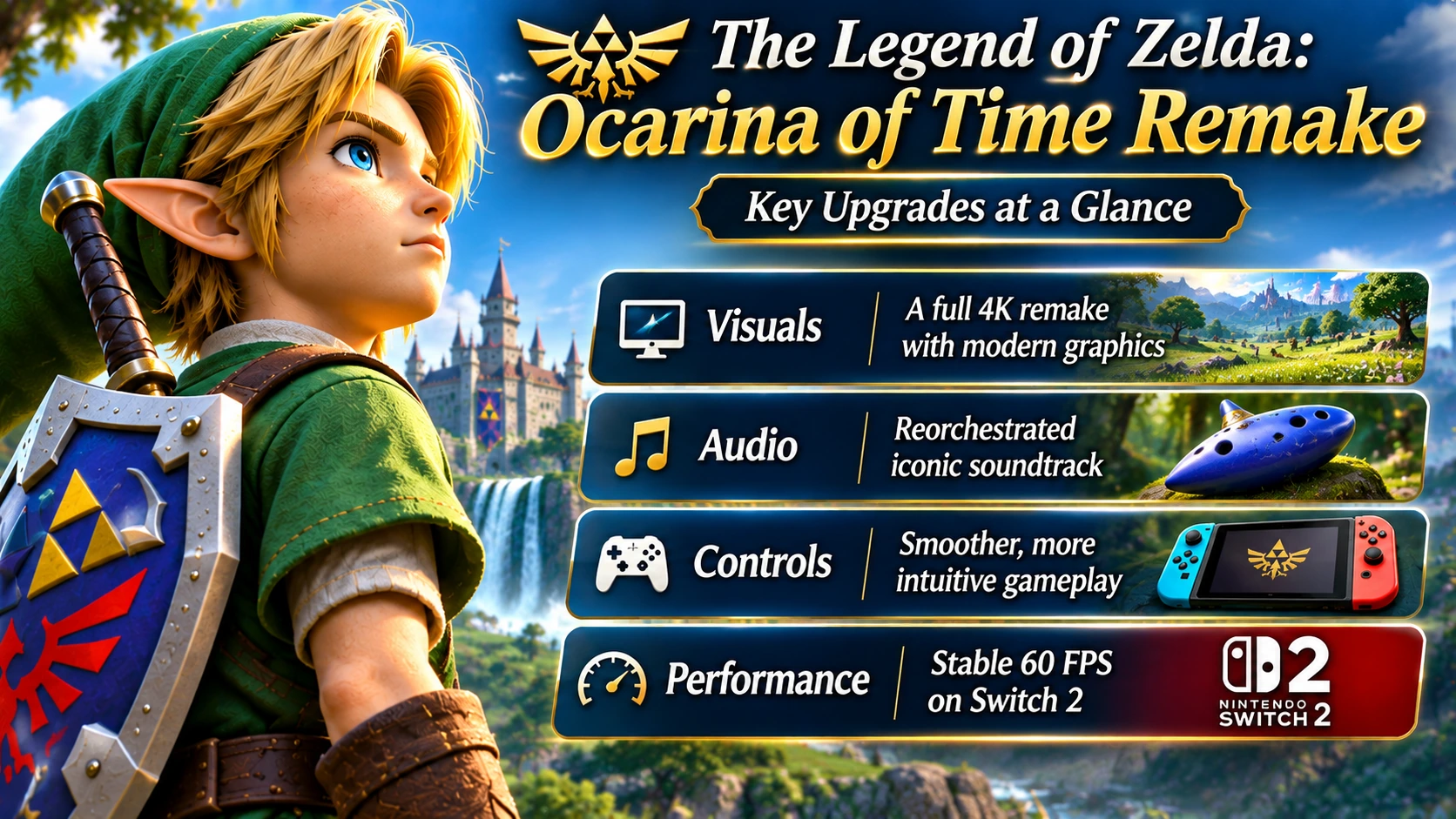
One reason old games can become frustrating is that their controls and interfaces were built around the limitations of their original hardware.
Nintendo addressed that problem without discarding the underlying puzzles.
A particularly revealing example is the Water Temple.
In the Nintendo 64 game, this dungeon became notorious partly because players frequently needed to open menus, change equipment, and navigate a complicated underwater environment.
Aonuma, who worked on the original dungeon, acknowledged the frustration in a 2026 developer interview.
For the remake, Nintendo made item switching easier and changed some obstructive walls so players could better understand how rooms connected.
The developers also updated how Link jumps and how the camera moves, which required adjustments to existing environments and puzzles. (Nintendo)
These may sound like modest improvements. But they address an important difference between difficulty and inconvenience.
A satisfying puzzle asks players to think. An outdated interface can make them struggle merely to perform the actions they already understand.
Nintendo appears to have focused on removing some of that unnecessary friction.
The remake also introduces features such as the Threads of Time, which helps players follow the story and their progress, and a combat-focused area where they can revisit defeated enemies.
Players can even use the Switch 2’s microphone to hum or play learned ocarina melodies, allowing the game to respond to real-world sounds. (Nintendo)
These additions modernize the experience while keeping the original’s identity recognizable.
How Do the New Reviews Compare With the Original?
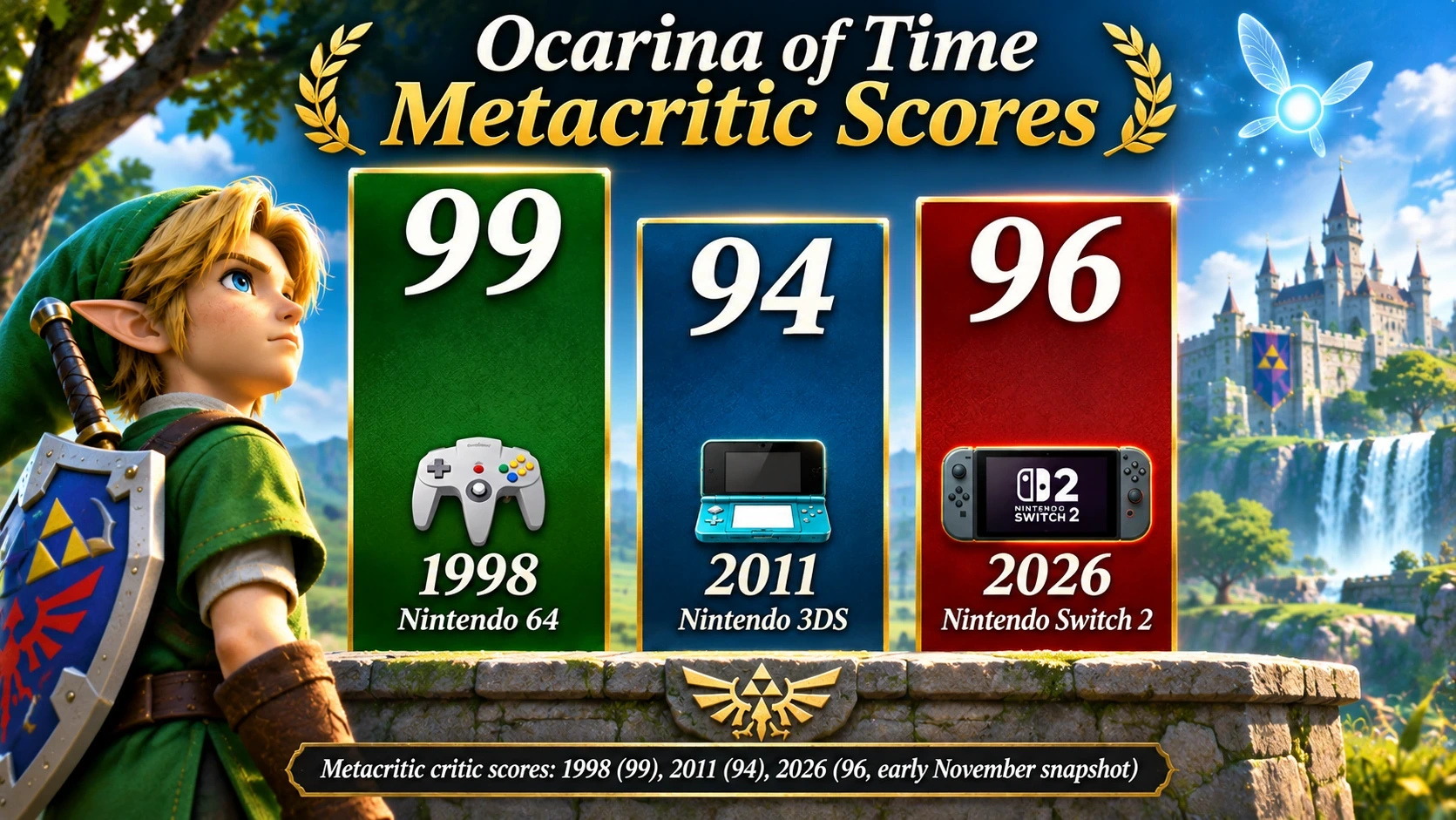
The critical response is striking because all three major versions of Ocarina of Time have received exceptionally high ratings.
| Release | Platform | Metacritic score |
|---|---|---|
| Original, 1998 | Nintendo 64 | 99 |
| Ocarina of Time 3D, 2011 | Nintendo 3DS | 94 |
| Full remake, 2026 | Nintendo Switch 2 | 96 |
The 2026 figure reflects the early review period around November 4. Aggregated scores can change as additional reviews are added. (Metacritic — Original · Metacritic — 3DS · VGC)
These numbers do not mean every version is objectively better than nearly every other game.
Metacritic aggregates published professional reviews, and scores reflect the critics, expectations, and competitive environment of each release period.
Still, it is remarkable for three versions of essentially the same adventure to receive such strong reviews across nearly three decades.
The 2026 remake earned praise for its detailed environments, more approachable controls, music, and preservation of the original’s world design.
Nintendo Life awarded it 9 out of 10, praising the modernization while also identifying weaknesses. Other publications, including IGN and GameSpot, also awarded it 9 out of 10. (Nintendo Life · Nintendo Everything)
The pattern suggests that the original game’s strengths were not limited to the excitement surrounding new technology in 1998.
Its fundamentals remain appealing even when judged alongside modern releases.
Does the Remake Have Any Weaknesses?
Yes. The most common criticism is that Nintendo played things relatively safe.
Although the presentation and controls have been rebuilt, much of the original adventure remains recognizable.
That can be a strength for returning fans, but it also means players who know the original extremely well may find relatively few surprises.
Nintendo Life highlighted several specific concerns, including the absence of Master Quest, an alternative, more challenging version associated with earlier releases.
Its review also noted some visual compromises during handheld play and limitations involving manual save files. (Nintendo Life)
These are meaningful distinctions.
A highly rated remake does not automatically deliver the greatest amount of new content, the most demanding gameplay, or the most technically flawless presentation.
The positive reviews instead suggest that Nintendo’s combination of preservation and modernization succeeds particularly well for the experience it set out to deliver.
Someone looking for an entirely new Zelda adventure may therefore have different expectations from someone who wants to revisit Hyrule with modern controls and visuals.
Why Does This Remake Matter Beyond Zelda Fans?
The wider significance is that Nintendo has demonstrated how older game design can remain valuable without being completely reinvented.
The remake is also part of the franchise’s 40th-anniversary celebration in 2026, which includes additional products and events connected to Zelda’s history. (Nintendo)
For longtime players, Ocarina of Time offers a chance to revisit an adventure that helped define their childhood or early gaming years.
For younger players, the remake provides access to an influential chapter of gaming history without requiring them to become comfortable with all the limitations of Nintendo 64-era hardware.
It is also a useful reminder that technological scale and creative quality are not the same thing.
A larger world does not automatically create a more engaging adventure. More complex combat does not necessarily produce better battles. And modern graphics cannot rescue weak level design on their own.
The original Ocarina of Time was built around memorable places, carefully designed obstacles, and the excitement of discovering how a world works.
The 2026 remake gives those ideas a new presentation.
Whether this approach will influence future remakes is an open question. But the critical response shows that a carefully preserved classic can still compete for attention in a market full of new releases.
Bottom Line: What This Story Really Means
The Legend of Zelda: Ocarina of Time is earning rave reviews 28 years after its original release because much of what made it special still works.
Nintendo did not simply replace old graphics with new ones. It rebuilt the world, refined controls, expanded presentation, and addressed longstanding frustrations while preserving the adventure’s essential structure.
The result shows why the original became so influential—and why its design can still appeal to players who grew up with very different games.
The 2026 version has not surpassed the original’s historic Metacritic score of 99. It has, however, earned outstanding reviews of its own.
The biggest lesson is that great game design doesn’t necessarily expire when technology moves forward. Sometimes it just needs a better way to reach a new generation.
Zelda Remake: Key Questions Explained
Q. When was the new Ocarina of Time released?
The Nintendo Switch 2 remake launched on November 5, 2026, as part of Nintendo’s celebration of the Zelda series’ 40th anniversary.
Q. Is the 2026 Ocarina of Time a full remake or a remaster?
It is a full remake. Nintendo rebuilt the game with modern graphics, updated controls, expanded dialogue, voiced cutscenes, and orchestral music rather than merely increasing the resolution of the original.
Q. Is the new Ocarina of Time exclusive to Nintendo Switch 2?
Yes. The 2026 remake is exclusive to Nintendo Switch 2. Earlier versions of Ocarina of Time have appeared on other Nintendo systems.
Q. Did the remake beat the original game’s Metacritic score?
No. The 1998 Nintendo 64 version holds a score of 99, while the 2026 remake had a score of 96 during its early November review period.
Q. What was the Metacritic score of Ocarina of Time 3D?
The 2011 Nintendo 3DS version received a Metacritic score of 94.
Q. What are the biggest gameplay improvements?
Major improvements include freer camera control, a dedicated jump button, easier item management, and adjustments designed to make navigation and combat more comfortable.
Q. Is the Water Temple different in the new version?
Yes, although its fundamental dungeon design remains recognizable. Nintendo improved item switching and adjusted certain environmental elements to make navigation clearer.
Q. Do newcomers need to play earlier Zelda games first?
No. Ocarina of Time tells a self-contained adventure and can be enjoyed without playing previous Zelda titles.
Q. Does the remake include Master Quest?
The 2026 release did not include Master Quest at launch, a decision criticized by reviewers who wanted a greater challenge.
Q. Why are critics rating a 28-year-old game so highly?
Reviewers have praised the combination of enduring dungeon design, memorable exploration, updated controls, modern visual presentation, and improved accessibility. The remake preserves the original adventure while making it easier to enjoy today.
Did this help make the story clearer? 🙂
WIN keeps unpacking the “why” behind the news—clearly and simply!
Sources
Official Release and Remake Features
Nintendo — Ocarina of Time Launch Announcement, November 5, 2026
Nintendo — The Legend of Zelda 40th Anniversary Announcement
Original Game Design and Remake Development
Nintendo — Ask the Developer, Part 1: A Turning Point for the Series
Nintendo — Ask the Developer, Part 2: The Visuals May Change, but the Experience Does Not
Nintendo — Ask the Developer, Part 3: Adapting the Game for a Modern Era
Review Scores, Critical Reception, and Limitations
Metacritic — The Legend of Zelda: Ocarina of Time (1998)
Metacritic — The Legend of Zelda: Ocarina of Time 3D (2011)
Video Games Chronicle — Ocarina of Time Remake Tops 2026 Review Rankings, November 4, 2026
Nintendo Life — The Legend of Zelda: Ocarina of Time Review (Switch 2)