Israel Voted—So Why Could Netanyahu Still Stay in Power Without a Majority?

Israel held a national election. Prime Minister Benjamin Netanyahu’s political allies fell short of a clear parliamentary majority. His opponents collectively appeared to have more seats.
So why is Netanyahu still prime minister?
Because in Israel, losing a parliamentary majority does not automatically mean losing the prime minister’s office.
The October 27, 2026, election produced a complicated political result. Netanyahu’s Likud party emerged as the largest individual party, but neither his allies nor the main opposition bloc had enough seats to govern independently.
And there’s another complication: Some parties that want Netanyahu gone are unwilling to form a government together.
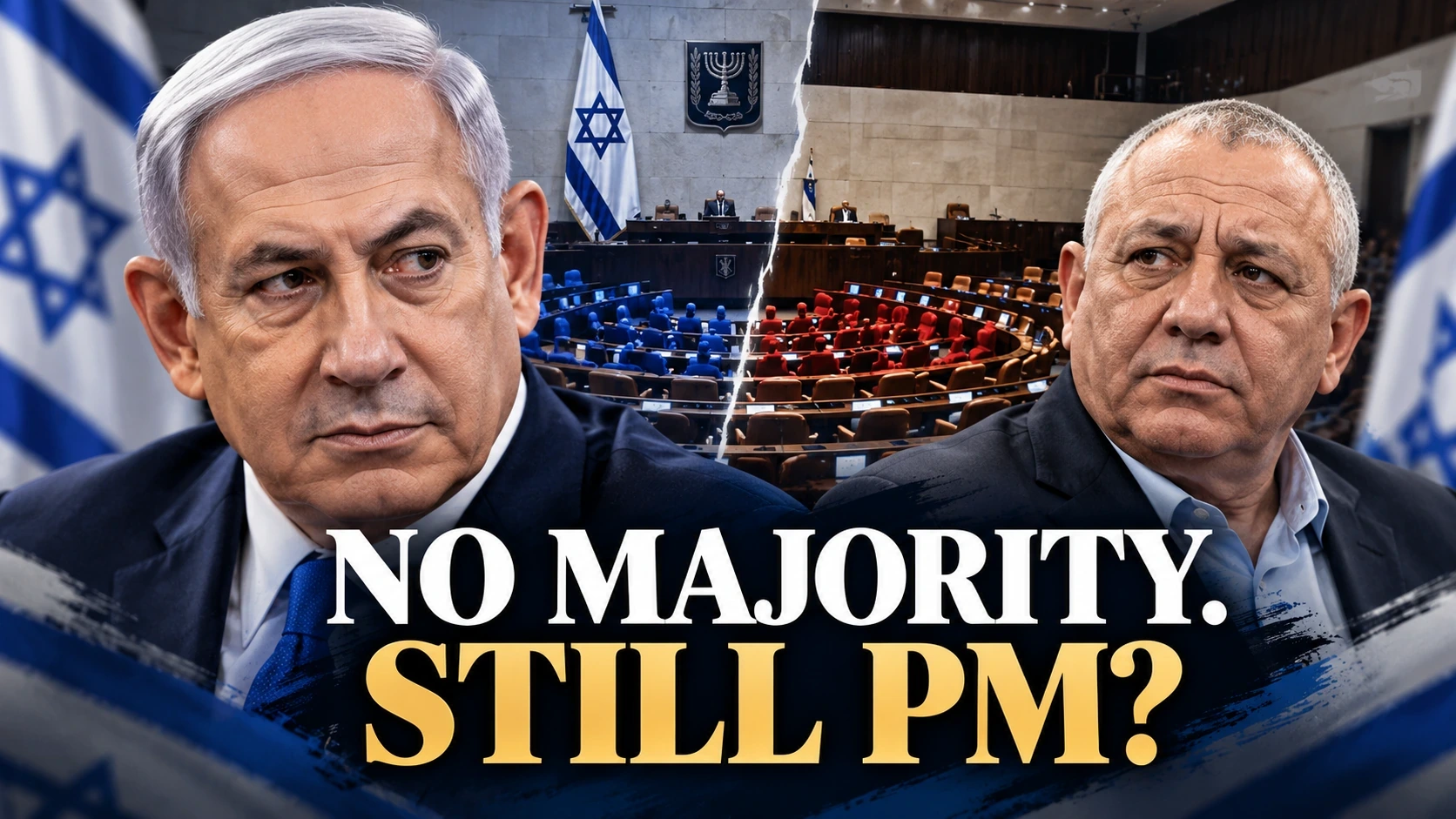
※ Images in this article are AI-generated illustrations created to help explain the story. They are not actual photographs, and depictions of people, places, or events may differ slightly from reality.
That distinction could allow Netanyahu to remain in office while political leaders spend weeks negotiating over Israel’s next government.
Understanding why requires looking at the election results and how Israel’s parliamentary system actually works.
What Did Israel’s Election Actually Decide?
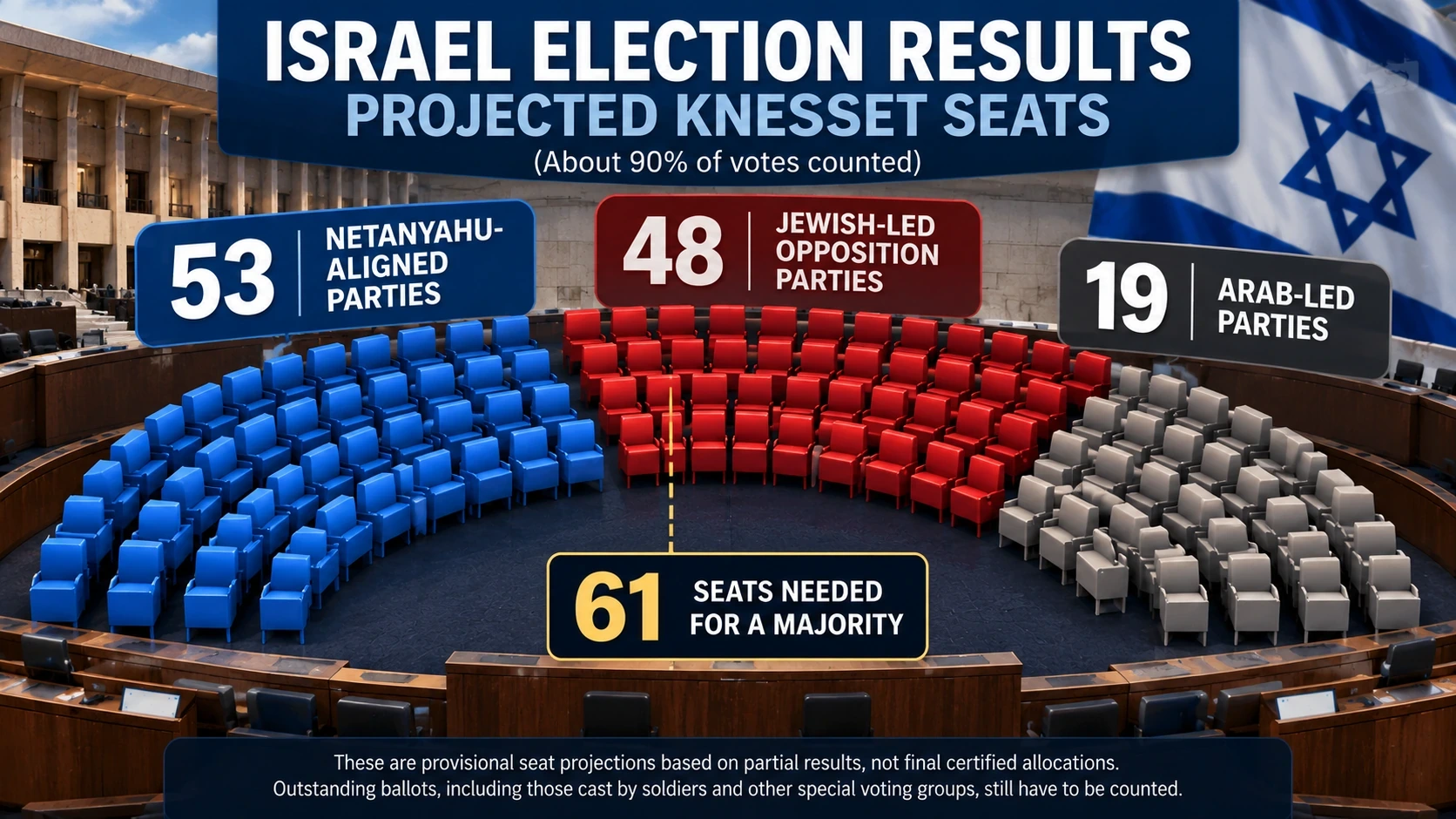
Israel’s October 27 election determined the distribution of seats in the Knesset, the country’s 120-member parliament. It did not directly elect a prime minister.
By the evening of October 28, with approximately 90% of ballots counted, the projected distribution was:
| Political grouping | Projected seats |
|---|---|
| Netanyahu-aligned parties | 53 |
| Jewish-led opposition parties | 48 |
| Arab-led parties | 19 |
| Total | 120 |
These were provisional seat projections based on partial results, not final certified allocations. Outstanding ballots, including those cast by soldiers and other special voting groups, still had to be counted. (The Times of Israel · CBS News)
The numbers reveal the dilemma.
Netanyahu’s bloc was eight seats short of the 61 seats needed for an outright parliamentary majority.
Meanwhile, the Jewish-led opposition parties and the Arab-led parties together were projected to control 67 seats.
On paper, that looks like enough to replace him.
But 67 lawmakers opposing the same prime minister do not necessarily constitute a coalition capable of governing together.
That is where Israel’s election becomes more complicated than a simple contest between two candidates.
Why Doesn’t the Biggest Party Automatically Get the Prime Minister’s Office?
Israel does not use the American presidential election system.
Instead, voters choose lists of parliamentary candidates representing political parties. Seats are distributed proportionally, subject to a nationwide electoral threshold of 3.25% of valid votes.
A party receiving roughly 20% of the national vote can expect approximately one-fifth of the 120 parliamentary seats, rather than control of the government. (Knesset)
That means the biggest party may have only 20 or 30 seats.
To govern with a dependable majority, its leader generally needs agreements with enough other parties to reach at least 61.
Those agreements form a coalition.
For example, imagine an election produces these results:
- Party A wins 35 seats.
- Party B wins 30 seats.
- Party C wins 20 seats.
- Several smaller parties divide the remaining seats.
Party A has more seats than any other individual party.
But if Party B persuades Party C and other lawmakers to cooperate, Party B’s leader could potentially form the next government instead.
The decisive question is not simply which party finishes first. It is who can assemble enough parliamentary support to govern.
That is also why Netanyahu’s Likud party being the largest does not, by itself, settle the 2026 election.
Why Can’t Netanyahu’s Opponents Simply Join Forces?
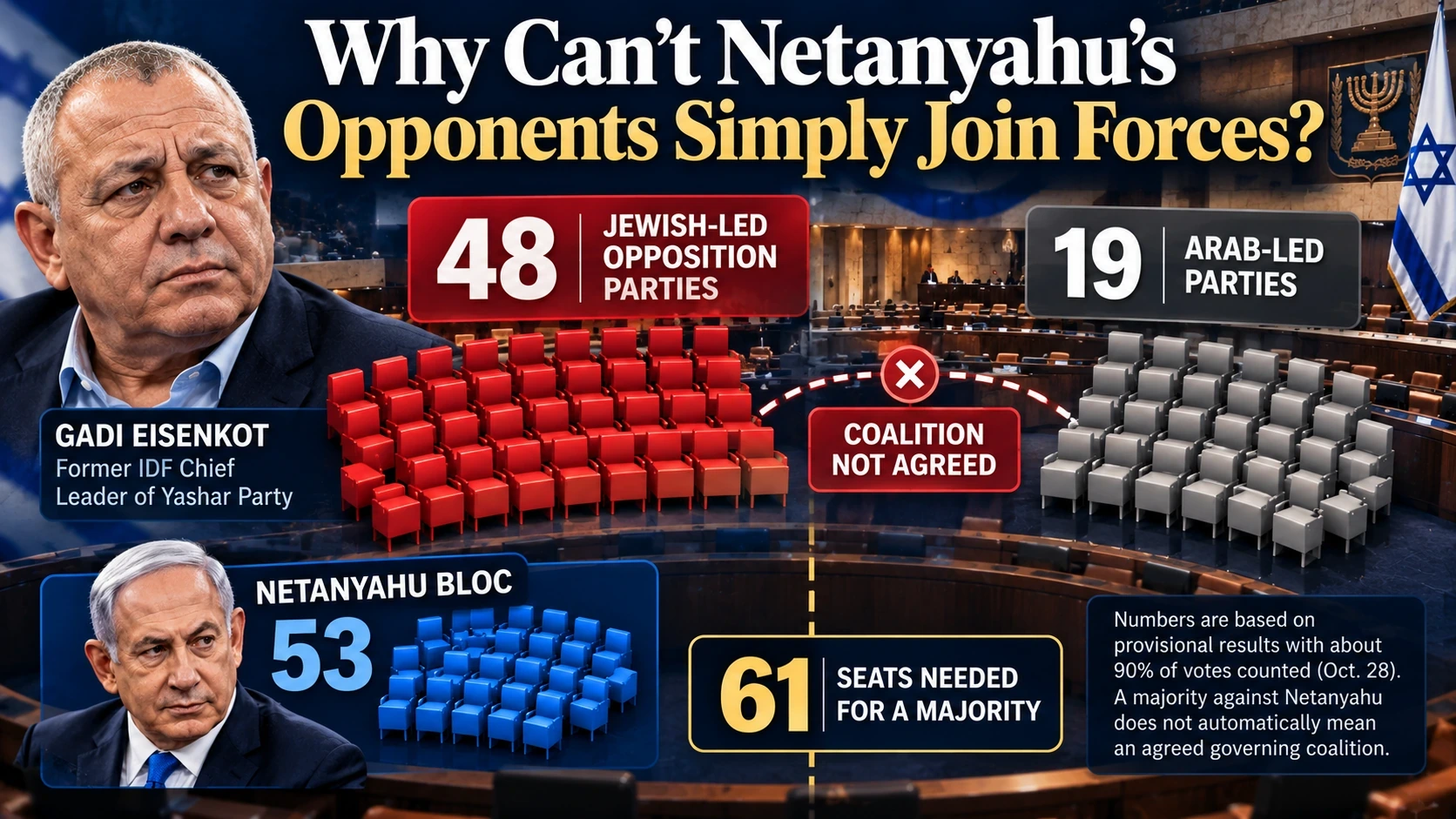
The principal obstacle is political compatibility.
Netanyahu’s leading challenger, Gadi Eisenkot, is a former Israeli military chief who heads the centrist Yashar party.
Other parties opposed to Netanyahu range from the secular right to the center and left. They disagree on national security, religion, the Palestinian question, and the role of Arab-led parties in government.
The Arab-led Joint List and Ra’am also oppose Netanyahu, but several Jewish-led opposition parties have resisted governing in partnership with them.
That makes the apparent 67-seat anti-Netanyahu majority much less straightforward than the arithmetic suggests. (AP)
Why are the Arab-led parties so important?
Their projected 19 seats could determine whether Netanyahu’s opponents can build a parliamentary majority.
Arab citizens of Israel constitute roughly one-fifth of the country’s population. The two Arab-led lists represent different political approaches and are not interchangeable.
Their participation in, or outside support for, a governing arrangement would be a major political decision.
Some opposition figures have considered forms of cooperation. Others have rejected coalition arrangements involving Arab-led parties.
These disagreements matter because being united against Netanyahu is different from agreeing on who should govern and how.
The opposition might secure broader support for individual parliamentary votes without being able to sustain a cabinet.
Netanyahu faces a different difficulty. His existing allies do not appear to have enough seats on their own, so he would need support from outside his established bloc to form a majority government.
Both sides therefore confront a similar problem: they need political partners whose interests may conflict with their own.
How Can Netanyahu Remain Prime Minister Without 61 Seats?
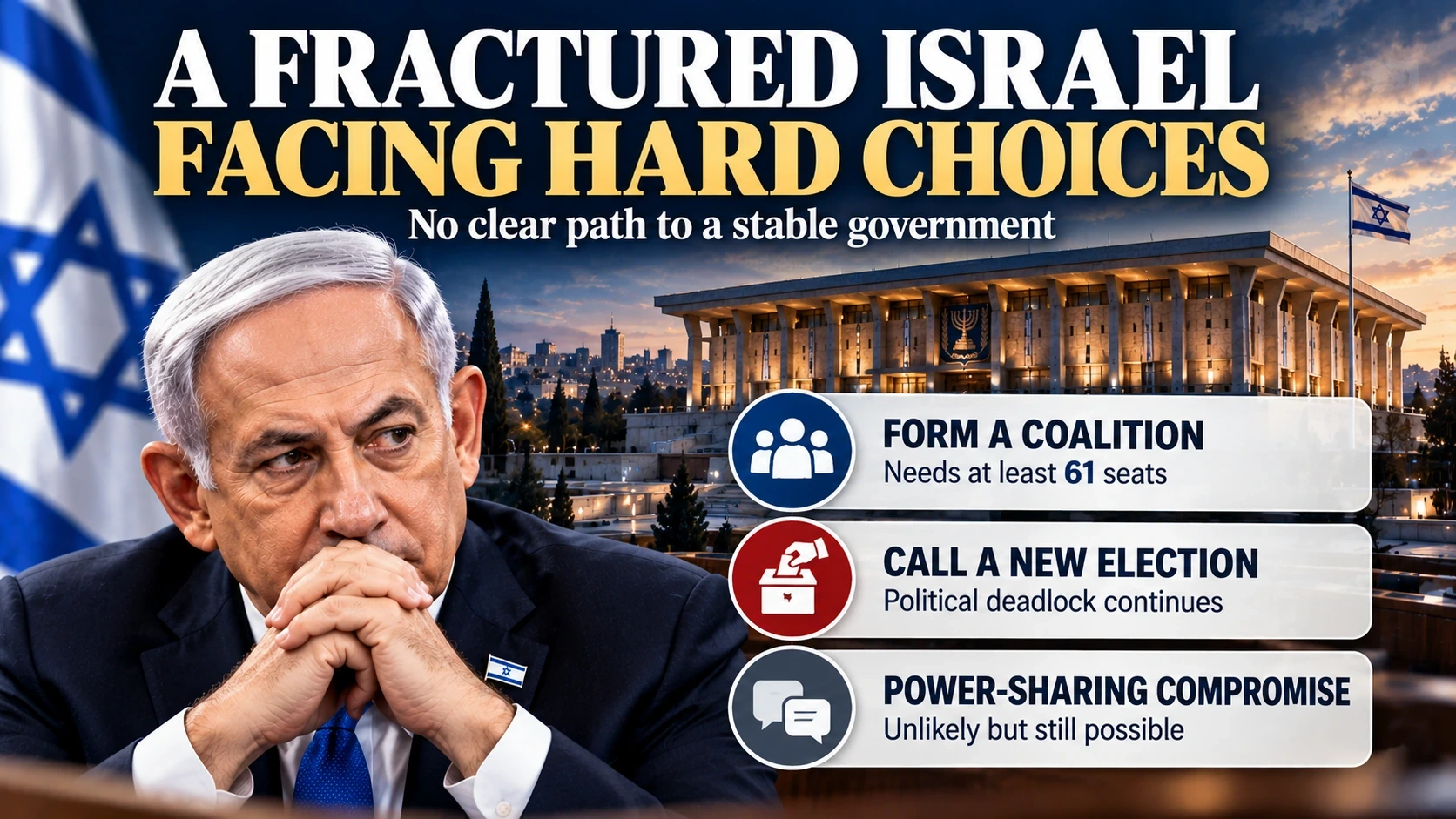
Netanyahu can remain prime minister because Israel’s outgoing government continues to perform its duties until a new government is established.
A deadlocked election does not automatically create a vacancy in the prime minister’s office. (Office of the President of Israel)
The next stage involves President Isaac Herzog, whose role differs from that of the U.S. president.
Israel’s president is the head of state, but the prime minister leads the government.
After consulting parliamentary parties, Herzog must assign a member of the Knesset the task of trying to form a government. The person selected does not automatically have to lead the largest party.
The process generally works as follows:
| Stage | What happens |
|---|---|
| Final election results | Parties receive their parliamentary seats |
| Presidential consultations | Party representatives make recommendations |
| Government formation | A designated lawmaker has 28 days to build a coalition |
| Possible extension | The president may grant up to 14 additional days |
| Parliamentary approval | A proposed government seeks the Knesset’s confidence |
If the first candidate fails, additional procedures allow another lawmaker to attempt to form a government. If those efforts fail, another election can eventually become necessary. (Office of the President of Israel)
A coalition controlling 61 seats has the clearest path to a stable majority, although parliamentary support arrangements can also involve parties that do not formally join the cabinet.
Until a replacement government is established, Netanyahu can continue serving in a caretaker capacity.
That is continuity in office, not proof that he has won another governing mandate.
Why Was the October 27 Election So Divisive?
The election was Israel’s first national vote since the Hamas-led attacks of October 7, 2023, and the devastating wars and regional confrontations that followed.
The campaign was shaped by competing arguments over Netanyahu’s leadership, national security, government accountability, and Israel’s future direction.
Some voters continued to support Netanyahu’s approach to military security and regional threats.
Others wanted political change after the security failures surrounding the October 7 attacks and the prolonged consequences of war.
Domestic issues also mattered, including the cost of living and disputes over exemptions from military service for ultra-Orthodox Jewish men.
These were not simply disagreements about one politician. They reflected competing ideas about the country’s security, democratic institutions, and the responsibilities of its citizens. (AP)
Israel held five national elections between 2019 and 2022 amid repeated political deadlock. That history helps explain why voters and party leaders are now confronting the possibility of yet another round of coalition bargaining. (CBS News)
What Could Happen Next—and Why Should Americans Care?
Three broad outcomes remain possible.
A Netanyahu-led coalition: Netanyahu could negotiate an agreement with parties outside his existing political bloc, potentially creating a broader government.
An opposition-led government: Eisenkot or another opposition lawmaker could seek an agreement involving enough parties or outside parliamentary support to replace Netanyahu.
Prolonged deadlock: If neither side secures an arrangement that can govern, Netanyahu could remain caretaker prime minister while negotiations continue, and another election could eventually follow.
These are possible scenarios, not confirmed agreements or predictions of who will prevail. (AP · CBS News)
For Americans, the election matters because Israel is a major U.S. security partner and a central player in Middle East diplomacy.
Whoever forms Israel’s next government will face decisions involving Gaza, Iran, regional security, relations with Palestinians, and cooperation with Washington.
A different prime minister would not necessarily produce an immediate reversal of Israeli security policy. The policies of any new government would depend partly on the parties needed to keep its coalition together.
The immediate developments worth following are the final vote count, the recommendations parties make to President Herzog, and any concrete coalition agreements.
Until those pieces come together, Israel’s election remains a story about who can actually build a government—not merely who received the most votes.
Bottom Line: What This Story Really Means
Israel’s October 27 election did not produce an immediate answer to who would govern the country next.
Netanyahu’s political bloc fell short of a clear parliamentary majority, but his opponents were divided over how to replace him.
A parliamentary majority opposed to a leader is not necessarily a majority prepared to support the same replacement government.
That explains why Netanyahu can remain prime minister even after an election in which his existing coalition appears to have lost its majority.
The eventual outcome will depend on the final distribution of seats, coalition negotiations, and whether someone can assemble sufficient support in the Knesset.
Israeli Election: Key Questions Explained
Q. Who won Israel’s October 27, 2026, election?
No governing coalition had been confirmed as the winner by early October 29. Netanyahu’s Likud was the largest individual party in preliminary results, but neither major political bloc had secured a majority.
Q. How many seats does a party need to control Israel’s parliament?
An outright majority of the 120-member Knesset requires 61 seats. Governments can include multiple parties, and parliamentary support can sometimes come from outside the cabinet.
Q. Why is Netanyahu still prime minister?
Israel’s outgoing government continues serving until a new government is established. Netanyahu can therefore remain caretaker prime minister during coalition negotiations.
Q. Who is Gadi Eisenkot?
Gadi Eisenkot is a former chief of the Israel Defense Forces and leader of the centrist Yashar party. He was Netanyahu’s principal challenger in the 2026 election.
Q. Why do Arab-led parties matter in this election?
They were projected to win 19 seats in the partial count, giving them potentially decisive parliamentary influence. Whether other opposition parties will cooperate with them remains a major obstacle.
Q. Does Israel’s president choose the next prime minister?
President Isaac Herzog assigns a member of parliament the task of forming a government after consulting parliamentary groups. The prospective government must then secure parliamentary confidence.
Q. Could Israel hold another election?
Yes. If the government formation process fails, another election can eventually be required. It is not automatic immediately after an inconclusive vote.
Q. Could a new Israeli prime minister change U.S.–Israel relations?
A new government could adjust diplomatic and security priorities, but a leadership change would not automatically transform the relationship. Coalition agreements and subsequent policy decisions would determine the practical effects.
Did this help make the story clearer? 🙂
WIN keeps unpacking the “why” behind the news—clearly and simply!
Sources
Election Results and Political Deadlock
The Times of Israel — With 90% Counted, Netanyahu Bloc at 53 Seats
CBS News — No Clear Winner in Israeli Election
Associated Press — The Latest on Israel’s Election
Electoral System and Government Formation
The Knesset — Elections for the Knesset
Office of the President of Israel — Government Formation Timetable
Political Background and International Implications
Associated Press — What to Know About the Israeli Election
Keep Reading
Why Is the October 7 Investigation Part of Israel’s Election Debate?
The coalition negotiations could also determine how Israel investigates the security failures surrounding October 7, 2023. That earlier debate helps explain why the choice of government matters beyond parliamentary arithmetic.