
Why Did Berlin Vote Left While Germany’s Northeast Backed the AfD?
Germany seemed to move in two political directions at once.
In Berlin, the left-wing Die Linke finished first. In the northeastern state of Mecklenburg-Western Pomerania, the Alternative for Germany, or AfD, won the largest share of the vote.
So did one part of Germany suddenly swing left while another swung sharply right?
Not quite. The elections were held on the same day, but voters were choosing two different state governments and responding to different local pressures. What connects the results is less a single ideological shift than the weakening of parties that had long occupied Germany’s political center. The official results also show just how dramatic those shifts were. (Berlin Election Authority)

To understand why the results looked so contradictory, start with what voters in each place were actually voting about.
What Actually Happened in the Two Elections?
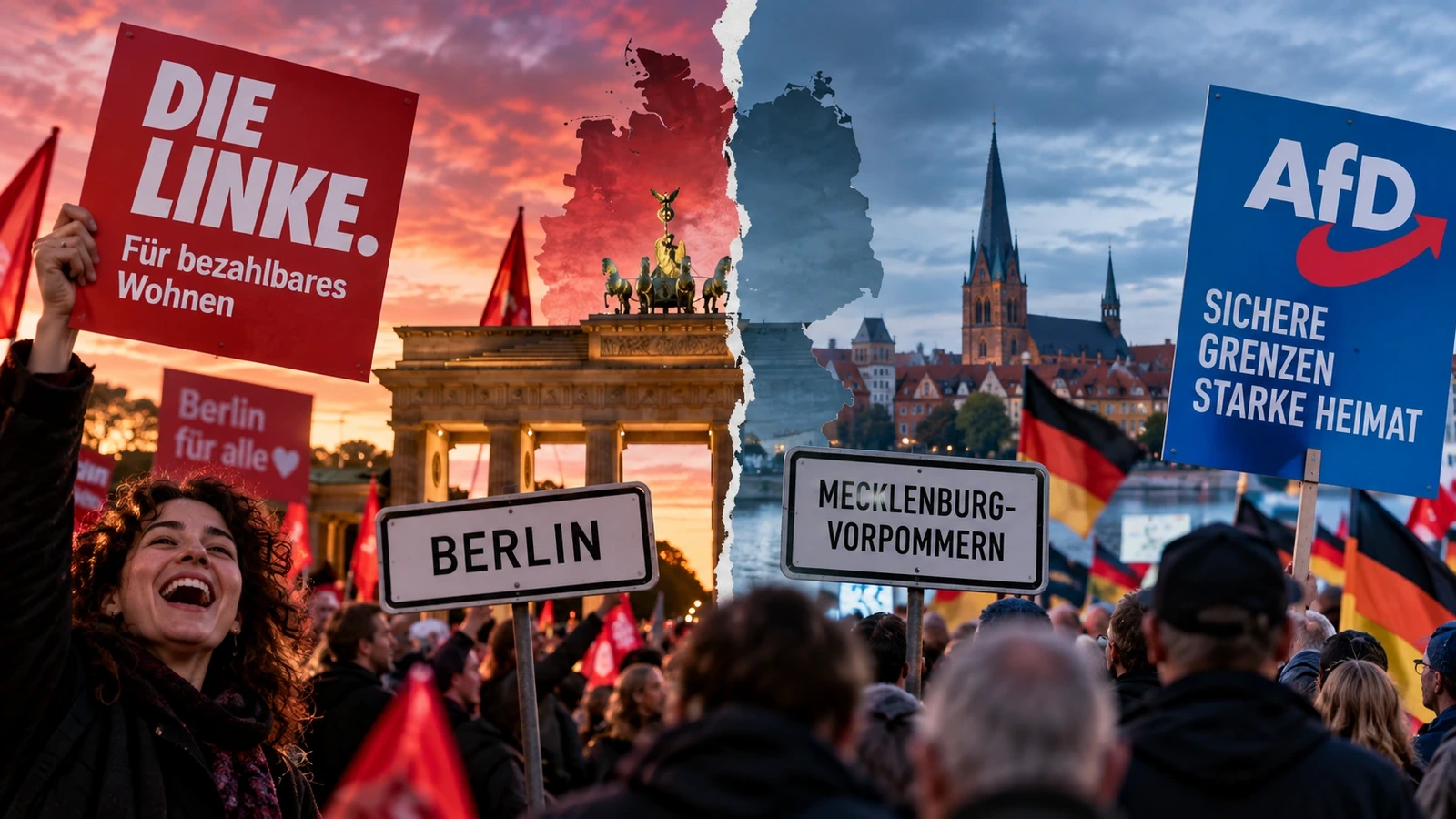
Berlin is both Germany’s capital and one of its 16 federal states. On September 20, voters elected a new state parliament, the House of Representatives.
Berlin’s preliminary official result gave Die Linke 25.7% of the second vote, which determines the overall distribution of seats. The CDU, the center-right party of Chancellor Friedrich Merz, fell to 18.8%. The AfD received 16.3%, the Greens 14.3% and the center-left SPD 12.1%. (Berlin Election Authority)
Compared with Berlin’s 2023 election, Die Linke gained 13.4 percentage points while the CDU lost 9.5 points and the SPD lost 6.3. The AfD gained 7.2 points. Those figures come directly from Berlin’s election authority. (Berlin Election Authority)
The result in Mecklenburg-Western Pomerania was very different.
The AfD finished first there with 38.2% and 32 of the state parliament’s 71 seats. The SPD followed with 35.5% and 29 seats. Die Linke and the Greens received five seats each, while the CDU fell to 4.9% and failed to clear the 5% threshold for representation. (Mecklenburg-Western Pomerania State Parliament)
| State | First-place party | Vote share | Other major result |
|---|---|---|---|
| Berlin | Die Linke | 25.7% | CDU 18.8%, AfD 16.3% |
| Mecklenburg-Western Pomerania | AfD | 38.2% | SPD 35.5%, CDU 4.9% |
That does not mean Berlin voters and northeastern voters were answering the same political question differently.
They were, in important ways, answering different questions.
Why Did Berlin Move Toward Die Linke?
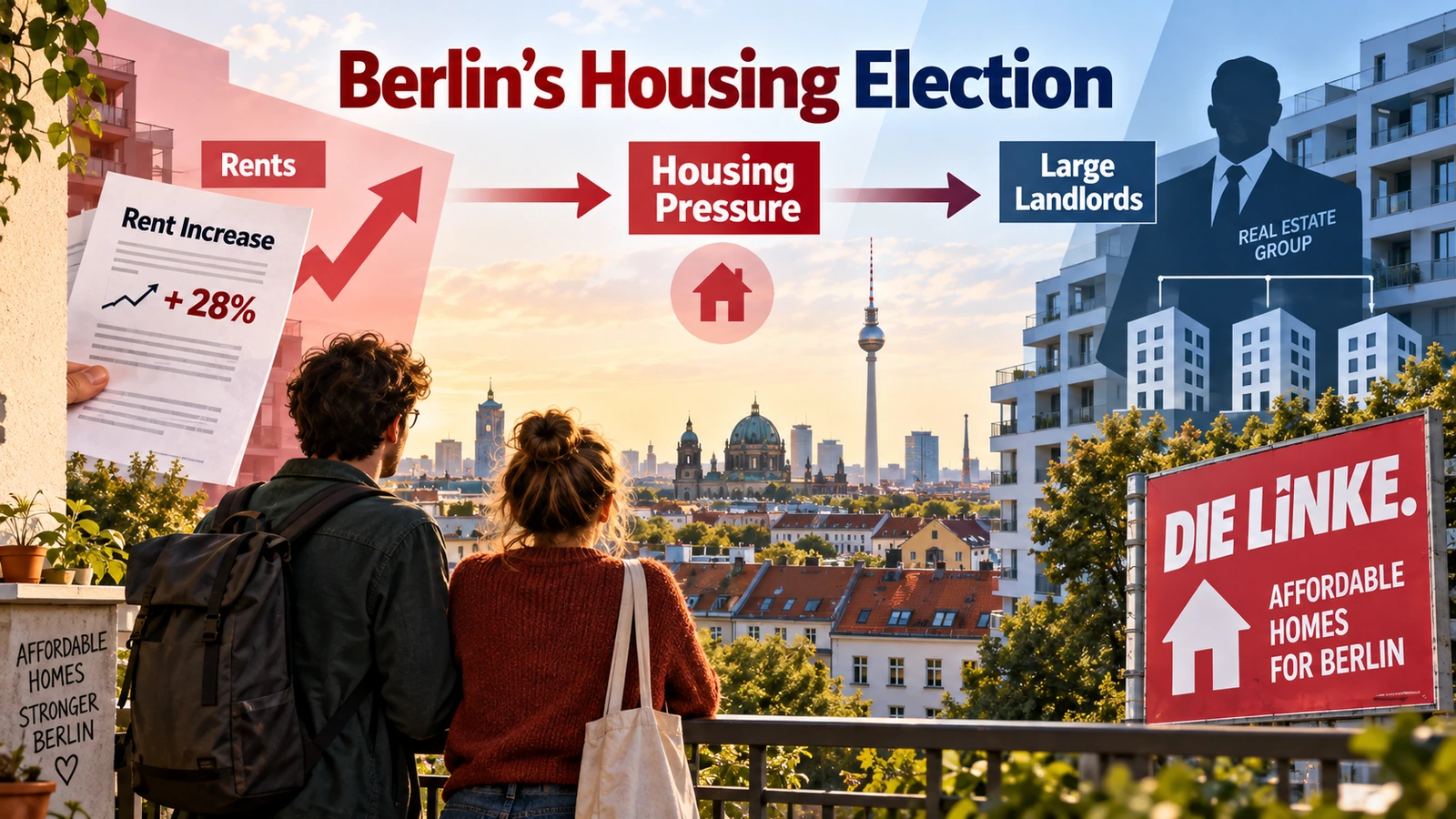
Housing was one of the central issues in Berlin.
Die Linke’s lead candidate, Elif Eralp, made rising rents and the power of large corporate landlords a defining part of her campaign. Reuters reported that she described housing as the capital’s biggest social problem and renewed a pledge to move large privately owned housing portfolios into public ownership. (Reuters)
That message landed in a city where housing pressure is already visible in public policy. Berlin officially classifies its rental market as tight enough for Germany’s rent-brake rules to apply, limiting many new leases to no more than 10% above the local reference rent, subject to exceptions. In July 2026, the city said it had begun automatically scanning thousands of rental listings for possible violations. (Berlin)
So Berlin’s result cannot be understood simply as voters becoming more ideologically left-wing overnight.
For many voters, housing was a concrete city problem: What can local government do about rent? How much power should large landlords have? And why did a housing proposal already endorsed by voters in 2021 still remain unresolved?
That last question mattered because Berlin had already held a citywide referendum on the issue.
What Does “Nationalizing Housing” Actually Mean in Berlin?
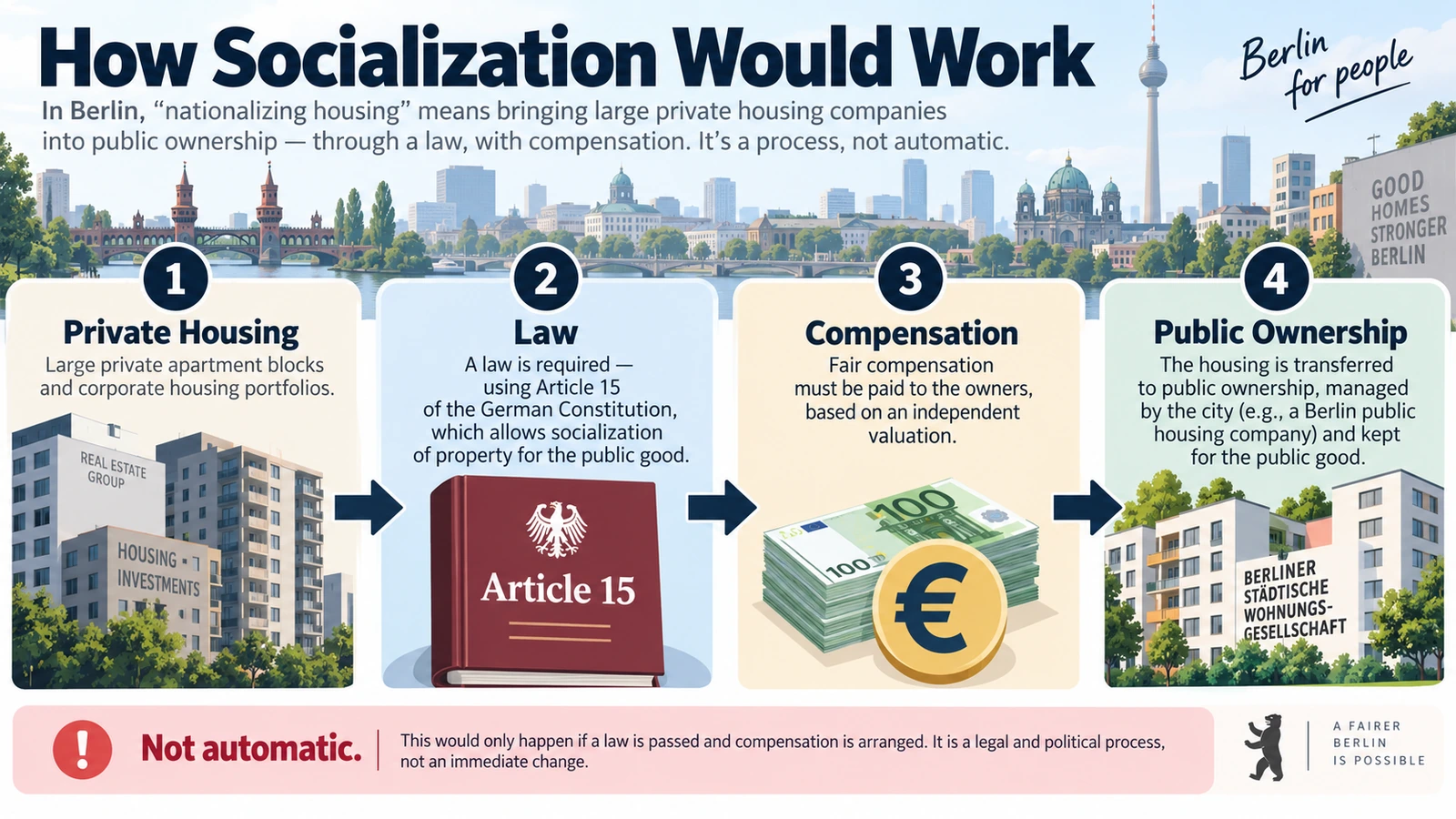
“Nationalization” is useful shorthand, but it can create the wrong picture for an American reader.
Berlin’s debate centers on a German constitutional concept called Vergesellschaftung, usually translated as “socialization.” Article 15 of Germany’s Basic Law says that land, natural resources and means of production may be transferred into public ownership or other forms of public enterprise through legislation that also determines compensation. (German Federal Ministry of Justice)
In other words, the proposal is not simply: government takes apartments and pays nothing.
A law would have to define what property is covered, how the transfer works and how compensation is calculated. Legal and financial disputes could follow.
The political pressure dates back to September 2021, when Berlin voters approved a referendum calling for action on the housing holdings of large private companies. The official final result showed 57.6% of participants voting in favor. (Berlin)
But the referendum itself did not instantly transfer hundreds of thousands of apartments to the government. It called on Berlin authorities to pursue legislation.
That distinction explains why the same issue can return years later as an election promise.
Reuters reported that Eralp’s plan could affect more than 200,000 housing units. The SPD has argued that compensation could cost roughly €20 billion, while supporters of socialization dispute how the financial burden should be calculated. (Reuters)
So the next fight is not simply “for or against nationalization.”
It is also over the legal design, compensation, financing and whether a future Berlin coalition would agree to pass such a law at all.
Why Did the AfD Finish First in Mecklenburg-Western Pomerania?
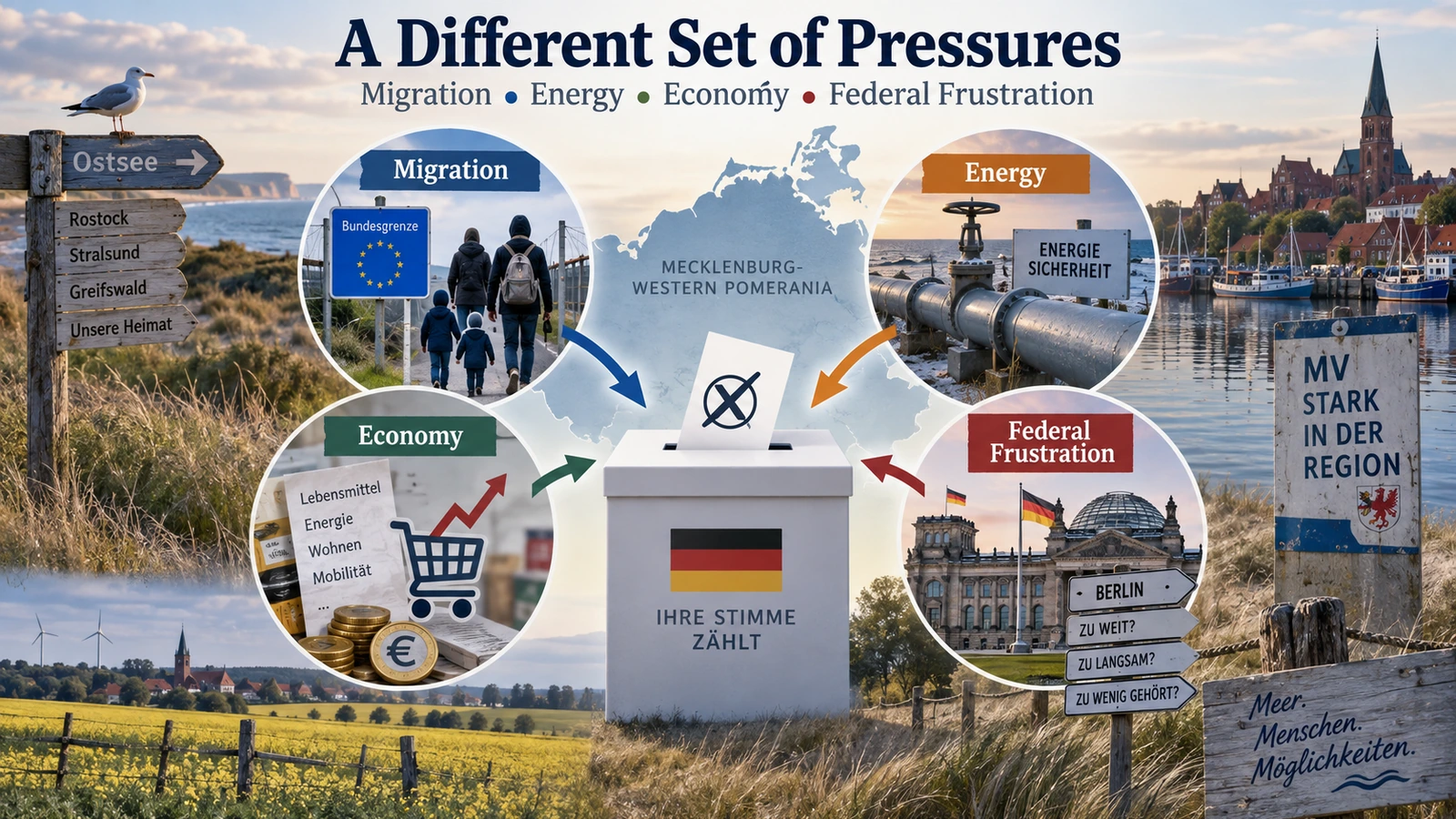
The northeastern result came from a very different political setting.
Mecklenburg-Western Pomerania is a largely rural and small-city state on the Baltic Sea in what was formerly East Germany. The AfD ran strongly there on immigration, opposition to parts of the federal government’s agenda and a different approach to Germany’s relations with Russia and energy policy.
Reuters reported that SPD state premier Manuela Schwesig said opposition to financial and military support for Ukraine was significant among voters in her state and that some voters wanted Russian gas flows through Nord Stream restored. That was Schwesig’s assessment of the political mood, not proof that every AfD voter shared the same motivation. (Reuters)
AP likewise described the AfD as campaigning on strong anti-migration positions while the state election unfolded against dissatisfaction with the national government and Germany’s weak economic performance. (AP)
The scale of the result is important: the AfD received 38.2%, while the CDU of Chancellor Merz received only 4.9% and lost representation in the state parliament. (Mecklenburg-Western Pomerania State Parliament)
But first place does not automatically mean control of the state government.
Germany’s parliamentary system works through legislative majorities. The SPD state leadership has ruled out talks with the AfD and instead approved exploratory talks with Die Linke and the Greens. (SPD Mecklenburg-Western Pomerania)
That creates one of the most confusing parts of the result for American readers:
The party with the most votes can still remain outside government if other parties can assemble a majority without it.
Are Berlin and Mecklenburg-Western Pomerania Really Political Opposites?
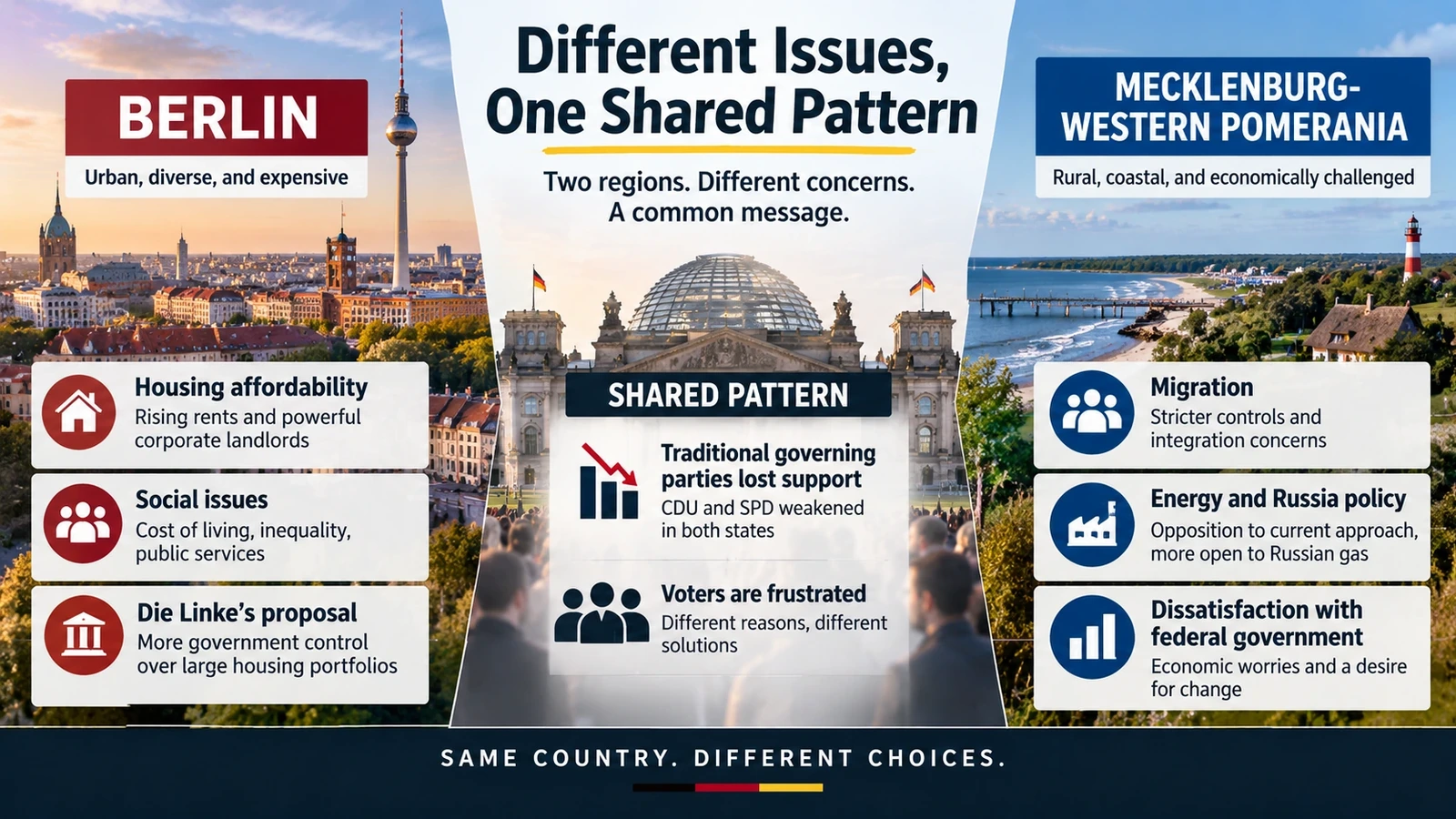
They are different, but the most revealing part may be what the elections shared.
In Berlin, the governing CDU-SPD coalition lost heavily. Die Linke more than doubled its 2023 vote share, while the AfD also gained substantially. (Berlin Election Authority)
In Mecklenburg-Western Pomerania, the AfD finished first while the CDU fell below the threshold for parliament. The SPD remained much stronger there than in Berlin but still finished second. (Mecklenburg-Western Pomerania State Parliament)
So a useful way to read the two elections is not:
“Germany moved left in one place and right in another.”
It is:
“Different groups of voters dissatisfied with established governing parties chose different alternatives based on the issues and political choices available in their state.”
| Berlin | Mecklenburg-Western Pomerania |
|---|---|
| Housing and rent were central campaign issues | Immigration, energy, Russia policy and the federal government were major campaign themes |
| Die Linke offered a more aggressive housing intervention | AfD offered a sharper break with national policy |
| CDU and SPD both lost substantial support | CDU fell below the 5% threshold |
| AfD also gained | SPD remained close behind AfD |
That is an important distinction because German state elections are not one national referendum conducted in pieces.
Regional political cultures matter. Candidates matter. Coalition options matter. And state-level problems can dominate even when national dissatisfaction is also shaping the vote.
Does Winning the Most Votes Mean You Get to Govern?
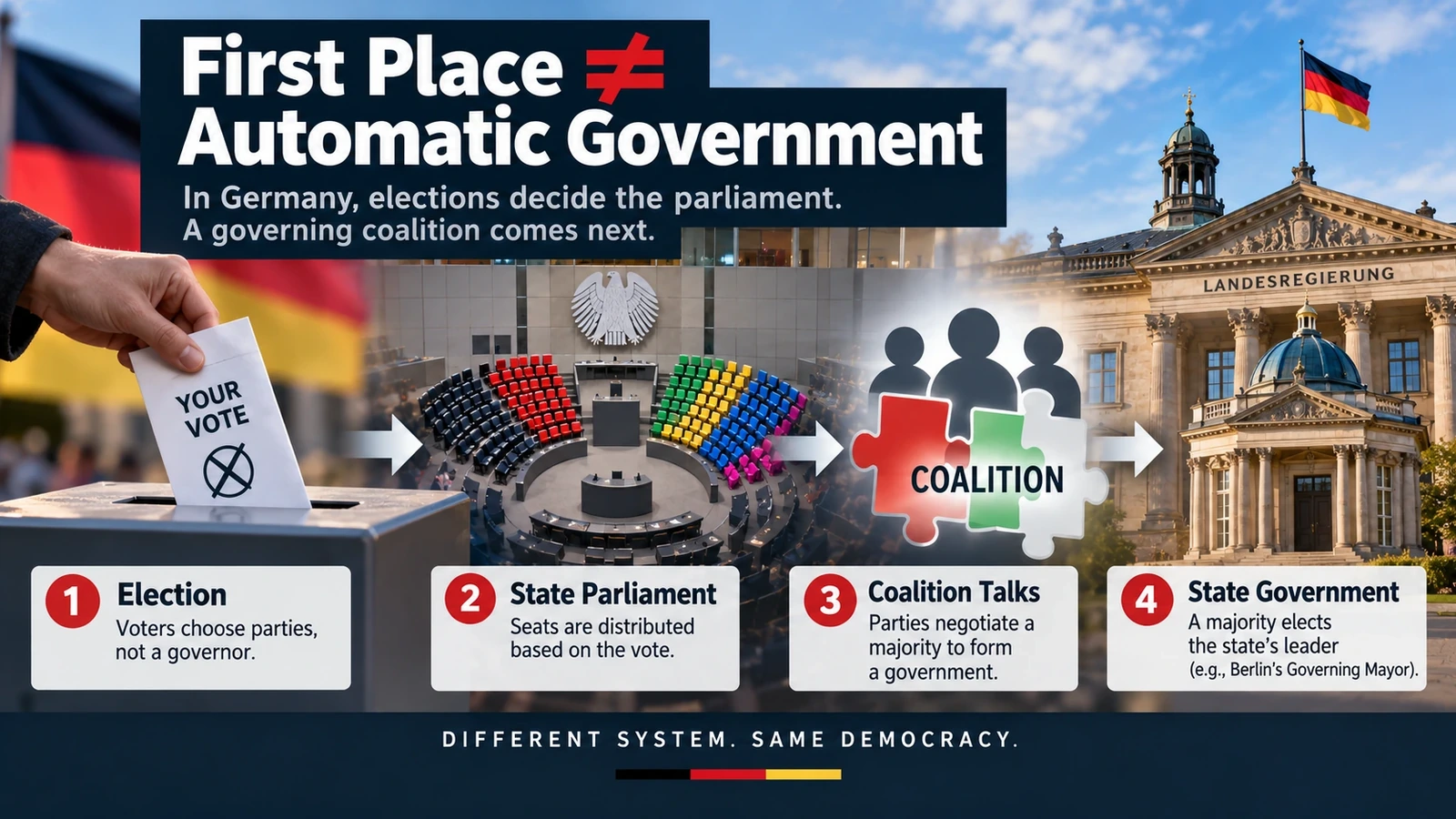
No.
That is one of the biggest differences from a U.S. governor’s race.
German voters elect state parliaments. Those lawmakers and the parties behind them then determine which coalition can command enough support to form a government.
In Berlin, Die Linke has said it wants talks with the Greens and SPD. But another combination involving the CDU, Greens and SPD is also mathematically possible, according to post-election reporting. No final coalition had been formed as of September 21. (Deutschlandfunk)
Even the mayor is not elected directly by Berlin voters.
Berlin’s constitution says the Governing Mayor is elected by the House of Representatives. An absolute majority is required in the first two rounds; if neither succeeds, the third round is decided by who receives the most votes. (Berlin)
That means Elif Eralp’s party finishing first does not by itself make her mayor.
She needs a governing arrangement capable of getting her through the parliamentary process.
The same principle explains the apparently stranger situation in Mecklenburg-Western Pomerania, where the AfD won the most votes but the SPD has begun talks with Die Linke and the Greens. Those three parties together hold 39 of the 71 seats in the new parliament, based on the official provisional result. (Mecklenburg-Western Pomerania State Parliament)
Winning an election and forming a government are therefore related—but they are not the same thing.
What Does This Mean for Chancellor Friedrich Merz?
Friedrich Merz was not personally running for office in either state.
These elections do not remove Germany’s federal government, and they do not directly change who serves as chancellor.
They do, however, matter politically because Merz leads the CDU, and his party suffered large losses in both states. AP reported that Merz called the Mecklenburg-Western Pomerania result a “disaster” while saying he intended to remain chancellor and CDU leader and continue pursuing his government’s reform agenda. (AP)
The results also matter institutionally.
Germany’s state governments send representatives to the Bundesrat, the federal chamber through which the states participate in national legislation. The Bundesrat says its members come from state governments, not state parliamentary opposition parties, and that every federal law is considered there in some form. (German Bundesrat)
So the composition of state governments can affect federal politics even though state elections do not directly choose the chancellor.
The more immediate question for Merz is political rather than constitutional: whether his national coalition changes any part of its economic, pension or social-policy agenda in response to the state results.
AP reported on September 21 that SPD leaders inside the federal coalition were already calling for parts of the reform program to receive a new “fairness” and “reality” check, while Merz said he would not yet speculate publicly about corrections. (AP)
What Should You Watch Next?
The first thing to watch is coalition negotiations.
In Berlin, the central questions are whether Die Linke can reach an agreement with the Greens and SPD and what happens to the housing-socialization proposal during those talks.
Housing may be the issue that helped Die Linke win the election, but it could also become one of the hardest issues to settle inside a coalition. Reuters reported that the SPD has opposed the proposed large-scale housing transfer, while Die Linke has continued to make it a priority. (Reuters)
In Mecklenburg-Western Pomerania, the question is whether the SPD, Die Linke and Greens can turn their exploratory talks into a governing coalition. The SPD state leadership formally authorized those talks on September 21. (SPD Mecklenburg-Western Pomerania)
The larger question is whether the pattern seen in these elections continues elsewhere: established governing parties losing support, while voters move toward very different challengers depending on local conditions.
That is something future elections can measure.
These two elections alone cannot tell us how all Germans would vote in a federal election.
Why It Matters in One Sentence
Germany did not suddenly choose one new political direction on September 20: Berlin voters focused heavily on housing and lifted Die Linke to first place, while voters in Mecklenburg-Western Pomerania gave the AfD the largest share amid a different mix of economic, migration, energy and foreign-policy concerns—and in both states the traditional governing parties lost ground. (Berlin Election Authority)
Germany State Elections: Key Questions Explained
Q. Who won the 2026 Berlin state election?
Die Linke finished first with 25.7% of the second vote in the preliminary official result, ahead of the CDU at 18.8%, the AfD at 16.3%, the Greens at 14.3% and the SPD at 12.1%. (Berlin Election Authority)
Q. Who won in Mecklenburg-Western Pomerania?
The AfD received the largest share at 38.2%, followed by the SPD at 35.5%. The official provisional result gave the AfD 32 seats and the SPD 29 in the 71-seat parliament. (Mecklenburg-Western Pomerania State Parliament)
Q. Why did Die Linke do so well in Berlin?
Housing affordability was one of its strongest campaign themes. Elif Eralp pushed for stronger intervention in Berlin’s rental market and renewed the debate over transferring large corporate housing portfolios into public ownership. (Reuters)
Q. Did Berlin already vote to nationalize housing?
Berlin voters approved a 2021 referendum calling for action to socialize large housing companies, with 57.6% of participants voting yes. But the referendum did not itself transfer the properties; implementation requires legislation. (Berlin)
Q. Can Germany legally transfer private housing into public ownership?
Germany’s Basic Law contains Article 15, which allows land and certain other assets to be transferred into public ownership for socialization through legislation that also determines compensation. Whether a specific Berlin law would satisfy constitutional requirements would depend on its design and could face legal review. (German Federal Ministry of Justice)
Q. Does AfD’s first-place finish mean it will govern Mecklenburg-Western Pomerania?
Not automatically. State governments depend on parliamentary majorities, and the SPD has begun exploratory talks with Die Linke and the Greens instead of the AfD. (SPD Mecklenburg-Western Pomerania)
Q. Does winning Berlin automatically make Elif Eralp mayor?
No. Berlin’s Governing Mayor is elected by the state House of Representatives, so Eralp would need sufficient parliamentary support after coalition negotiations. (Berlin)
Q. Can these state elections remove Chancellor Friedrich Merz?
No. They do not directly determine the federal chancellor. They can, however, create political pressure on the parties in the federal government and alter the composition of state governments represented in the Bundesrat. (AP)
Did this help make the story clearer? 🙂
WIN keeps unpacking the “why” behind the news—clearly and simply!
Sources
Official Election Results
Berlin Election Authority — 2026 House of Representatives Preliminary Result
Mecklenburg-Western Pomerania State Parliament — 2026 Preliminary Official Final Result
Housing Policy and Legal Framework
Berlin Election Authority — 2021 Deutsche Wohnen & Co. Referendum
German Federal Ministry of Justice — Basic Law, Article 15
Berlin — Rent Enforcement and Housing Market Rules
Election Context and Government Formation
Reuters — Far-left party wins Berlin election, pledging to nationalise housing
Reuters — AfD leads as Merz rues “disaster” in German state election
AP — Merz vows to press ahead after German state election defeats
SPD Mecklenburg-Western Pomerania — Exploratory Talks With Die Linke and Greens
Political System and Federal Impact
Berlin Constitution — Election of the Governing Mayor
German Bundesrat — How Germany’s State Governments Participate in Federal Lawmaking