Is Polymarket a Financial Market or a Gambling App—and Who Gets to Regulate It?

If you can put money on whether something will happen, isn’t that basically gambling?
Then why is Polymarket US registered with a federal financial regulator rather than a state gaming commission?
That apparent contradiction is now at the center of a major regulatory fight.
On September 24, New York Attorney General Letitia James and Governor Kathy Hochul announced a lawsuit against QCX LLC, doing business as Polymarket US. New York alleges that Polymarket is operating an illegal, unlicensed gambling business in the state and wants a court to stop the company from doing so without a New York gaming license. (ag.ny.gov)
Polymarket sees the situation very differently. Its U.S. exchange operates through a designated contract market, or DCM, registered with the Commodity Futures Trading Commission. The CFTC itself lists QCX LLC d/b/a Polymarket US as a designated contract market. (CFTC)
So both statements can exist at the same time:
Polymarket US is federally regulated. New York also says some of what it offers is illegal gambling under state law.
And the dispute escalated again Thursday evening. Hours after New York filed its case, Polymarket filed its own lawsuit in Manhattan federal court seeking to block Attorney General Letitia James and other state officials from regulating its prediction market. (Bloomberg Law)
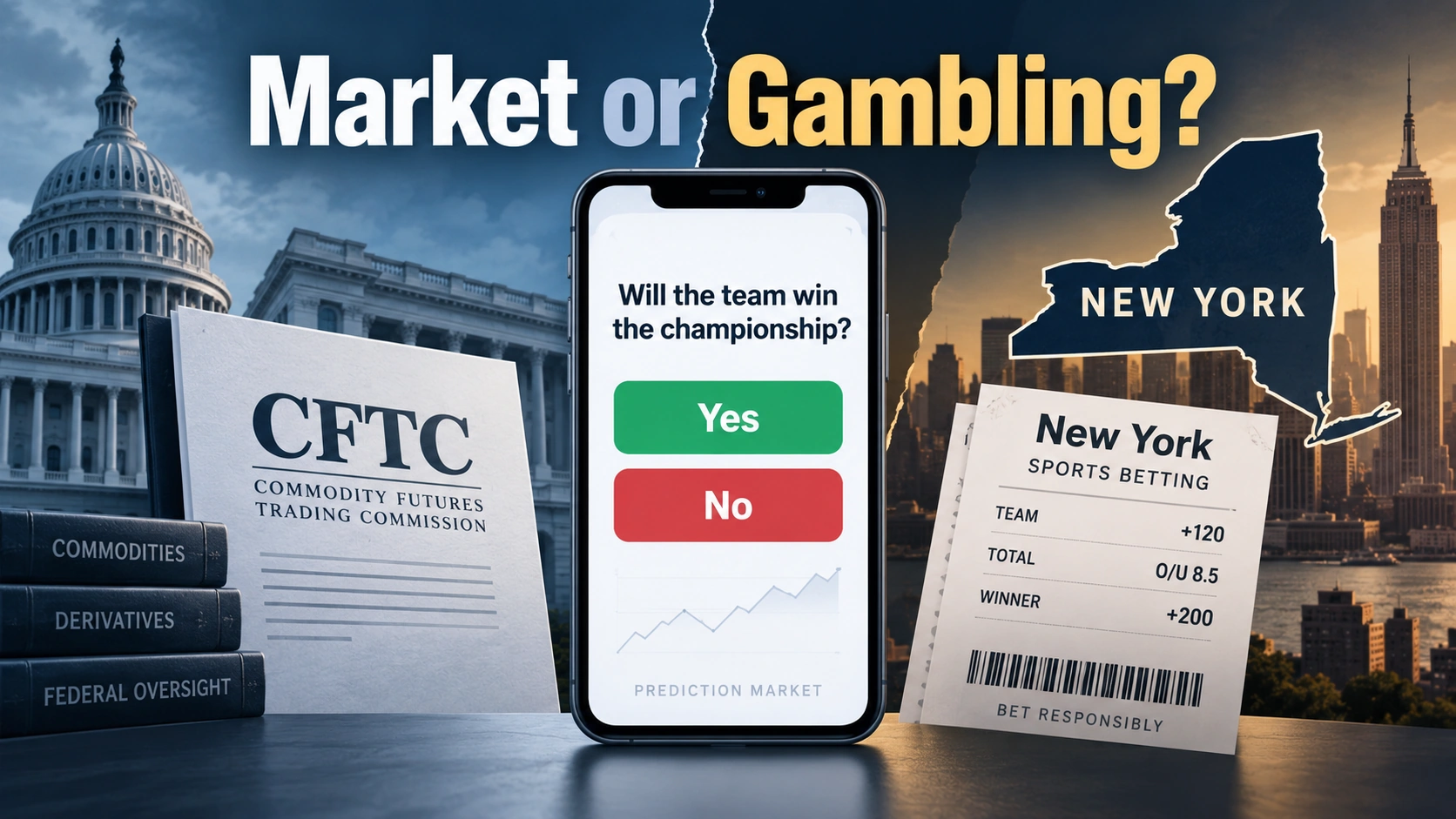
※ Images in this article are AI-generated illustrations created to help explain the story. They are not actual photographs, and depictions of people, places, or events may differ slightly from reality.
The lawsuit is really about the unresolved question sitting between those two statements:
When a federally regulated exchange lets people trade contracts on sports or other real-world events, does federal commodities law control the entire market—or can states still enforce their gambling laws?
What Did New York Actually Sue Polymarket Over?
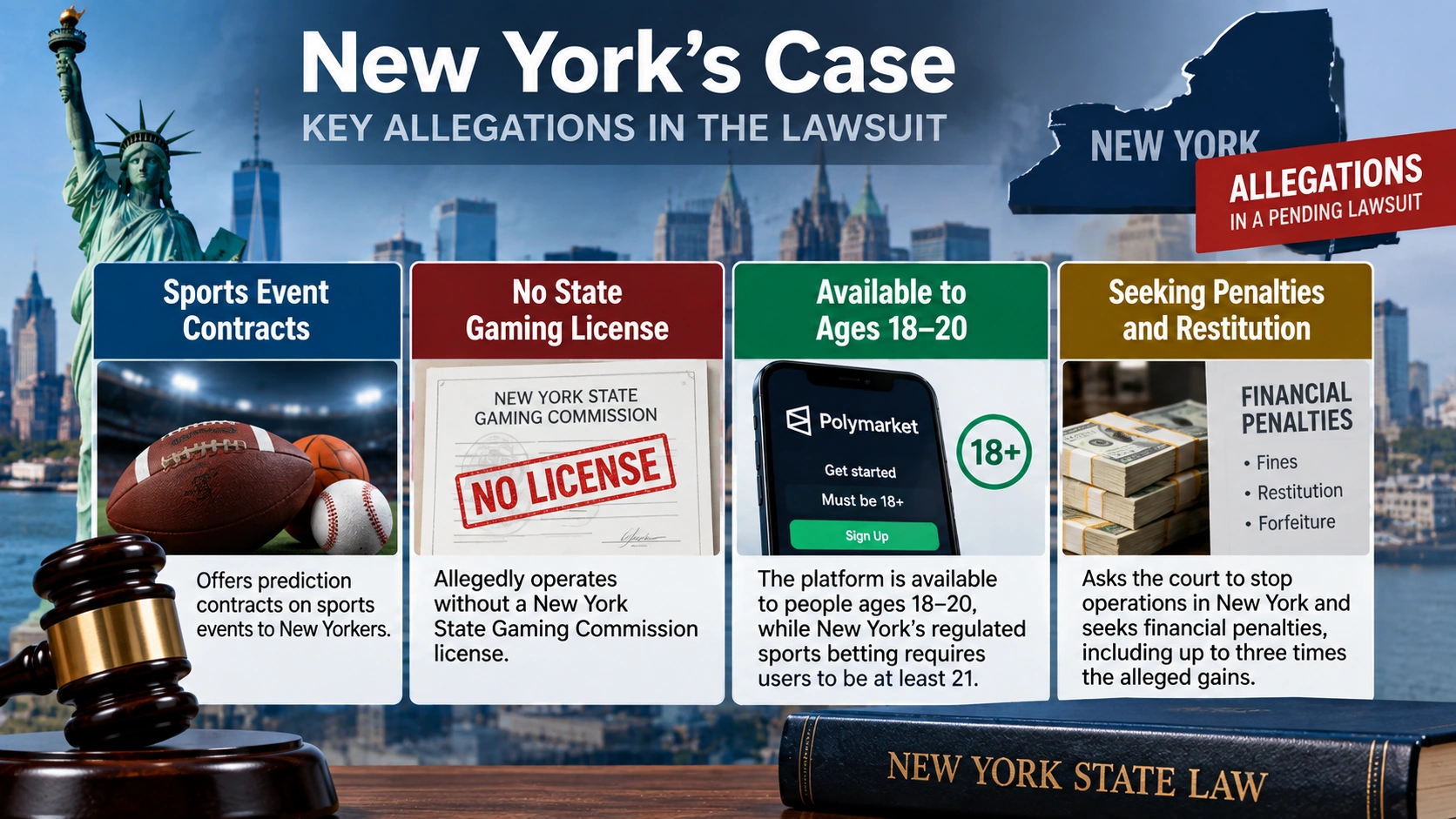
New York’s case is straightforward on the surface: if people risk money on uncertain sports outcomes, the state says that activity falls within gambling laws regardless of what the product is called.
The attorney general says Polymarket offers prediction contracts to New Yorkers without a license from the New York State Gaming Commission. The state also says the platform is available to people ages 18 through 20 even though New York’s regulated mobile sports betting system requires bettors to be at least 21. (ag.ny.gov)
New York is asking the court to stop Polymarket from operating as an unlicensed gambling business in the state and to order financial remedies including fines, restitution and forfeiture of allegedly illegal gains. The attorney general’s announcement says the state is seeking penalties tied to three times the gains generated by the alleged violations. (ag.ny.gov)
Polymarket disputes the state’s characterization.
Its chief legal officer, Neal Kumar, said the company would fight the lawsuit, remain in New York, and had tried to engage state officials directly about their concerns. (ABC News)
That means the phrase “illegal gambling operation” is New York’s legal allegation—not a final court judgment.
Why Does Polymarket Look Like a Financial Market in the First Place?
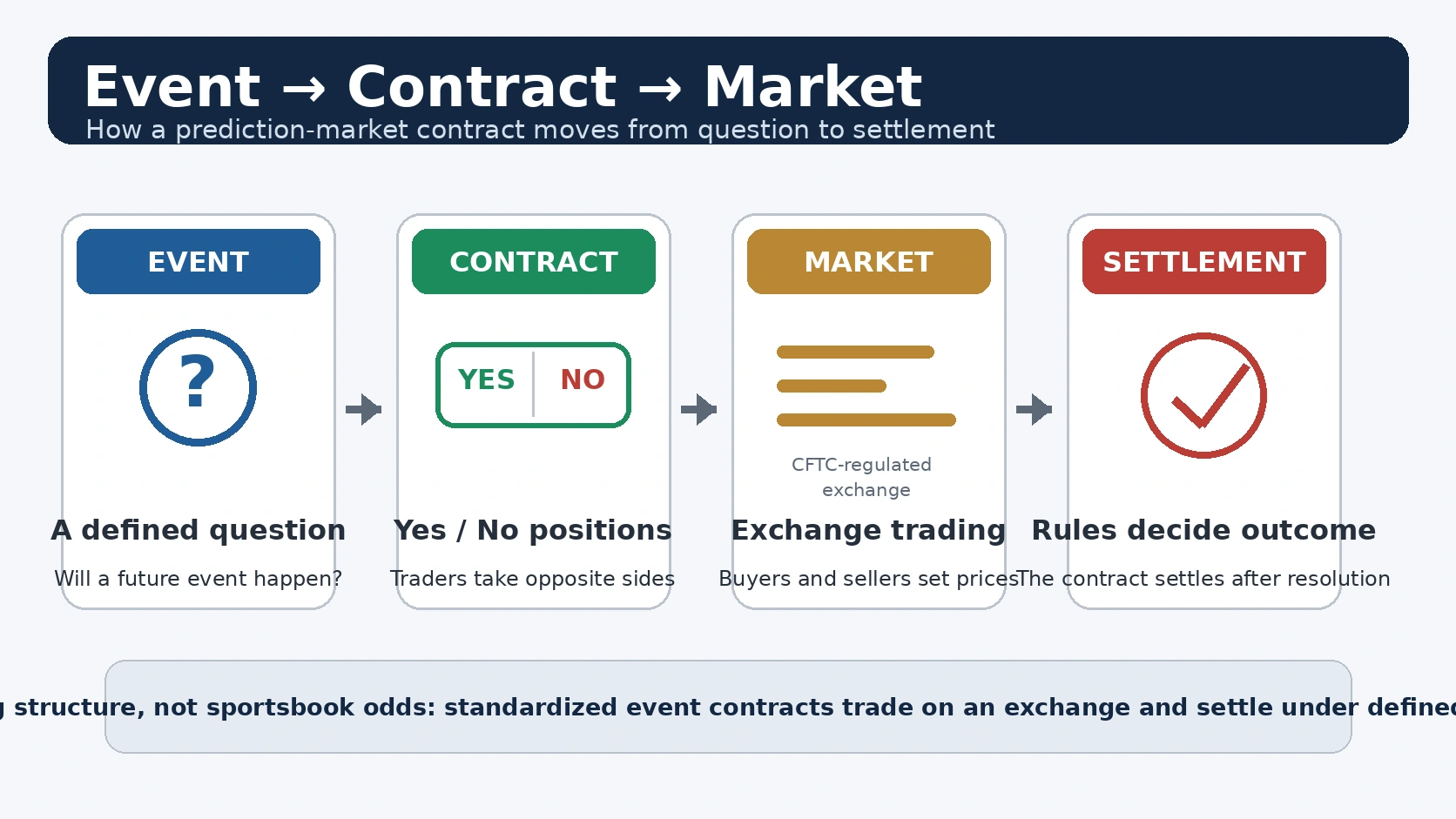
Because prediction markets are structured as event contracts traded on an exchange.
Instead of a traditional sportsbook simply posting a bet such as “Team A -3.5,” a prediction exchange can create contracts tied to whether a defined event will happen.
Participants take opposite sides of the contract, and prices move as buyers and sellers react to new information. When the event is resolved, the contract settles according to its rules. The CFTC explains that event contracts are typically structured as derivatives whose value depends on an event outcome. (CFTC)
That structure resembles other derivatives markets—and U.S. commodities law already regulates many derivatives through the CFTC.
Polymarket US is not merely describing itself as regulated. The CFTC’s own registry shows that QCX LLC, now operating as Polymarket US, is a designated contract market. (CFTC)
A DCM is a federally regulated exchange authorized to list contracts subject to Commodity Exchange Act requirements and CFTC oversight.
That is Polymarket’s strongest structural argument:
These are not ordinary sportsbook wagers being disguised with financial language. They are federally regulated contracts traded on a federally registered exchange.
But that still does not answer the entire legal question.
Why Does New York Say the Same Activity Is Gambling?
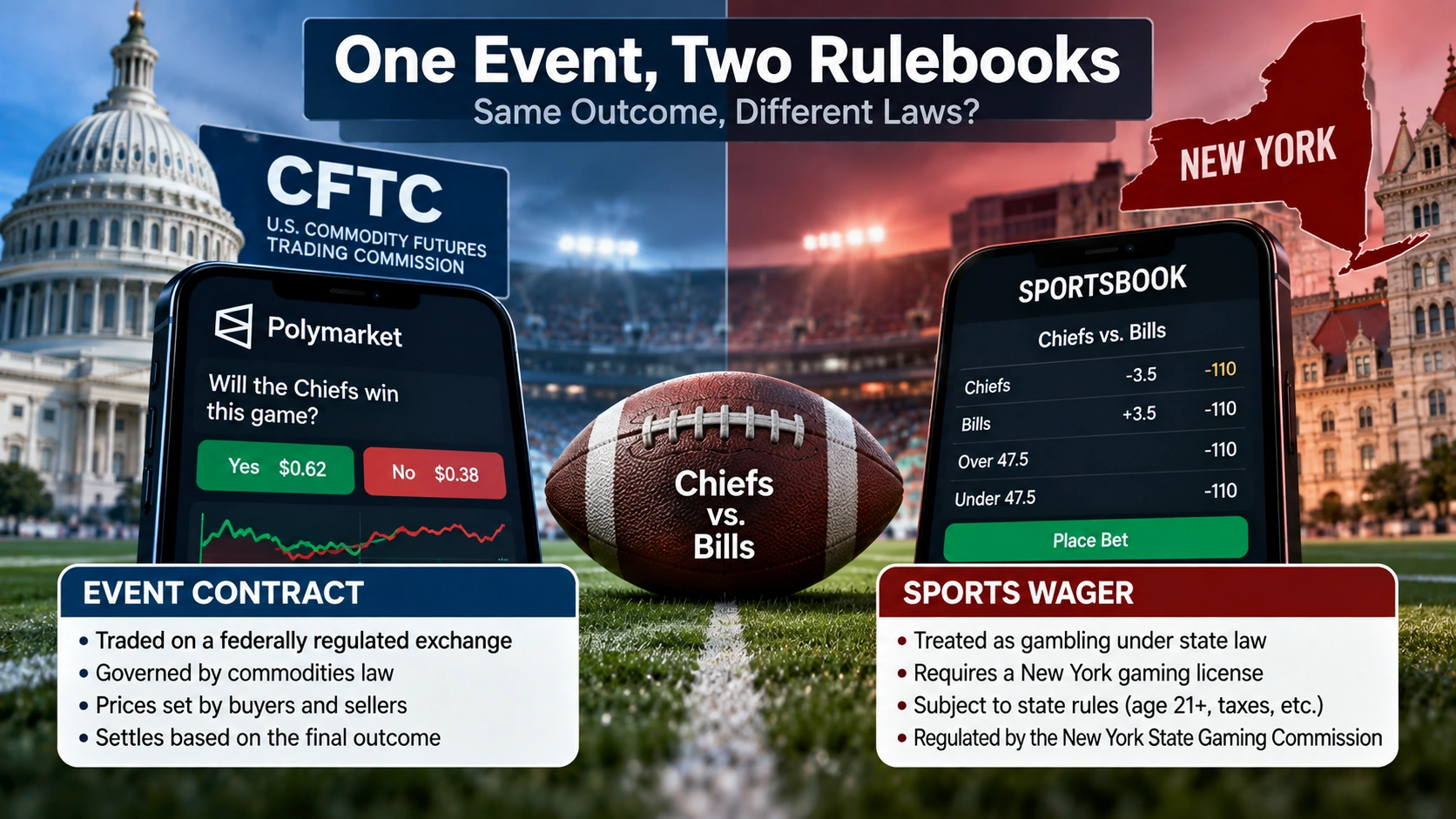
Because New York starts with a different question.
The state is not primarily asking, “What type of exchange is operating this platform?”
It is asking, “What are customers actually putting money on?”
If the answer is that customers risk money on the uncertain outcome of a football game, basketball game or another sporting event, New York argues that the economic substance looks like sports wagering.
The state’s licensed mobile sportsbooks operate under a detailed framework governing age verification, account controls, advertising, problem-gambling protections and taxation. New York regulations require an authorized sports bettor to confirm that the bettor is at least 21 years old. (gaming.ny.gov)
New York says Polymarket is available to users ages 18 through 20, and state officials have identified that difference as a consumer-protection concern. A September report from the state comptroller also highlighted prediction-market access beginning at 18 compared with New York’s 21-year minimum for mobile sports wagering. (New York Attorney General · New York State Comptroller)
To New York, calling the transaction an “event contract” does not automatically answer whether it is also gambling under state law.
That is where the jurisdiction problem begins.
Can Something Be Both a Financial Contract and Gambling?
Yes—and that is one reason this dispute is so difficult.
Legal categories do not always match everyday language neatly.
A contract can have the mechanics of a financial derivative while also involving an activity that governments traditionally regulate as gambling.
Congress anticipated some version of this problem.
Section 5c(c)(5)(C) of the Commodity Exchange Act gives the CFTC special authority to examine event contracts involving subjects including gaming, war, terrorism, assassination and conduct that is unlawful under federal or state law.
The CFTC proposed a new framework in June 2026 for deciding when those event contracts should receive special review and whether particular contracts are contrary to the public interest. (cftc.gov)
That point is important.
The fact that an exchange is federally registered does not mean every conceivable event contract automatically receives unrestricted approval.
Even the federal regulatory structure recognizes that certain subjects—including gaming—raise special legal questions.
The disagreement is over who gets the final word.
Doesn’t the CFTC Have “Exclusive Jurisdiction”?
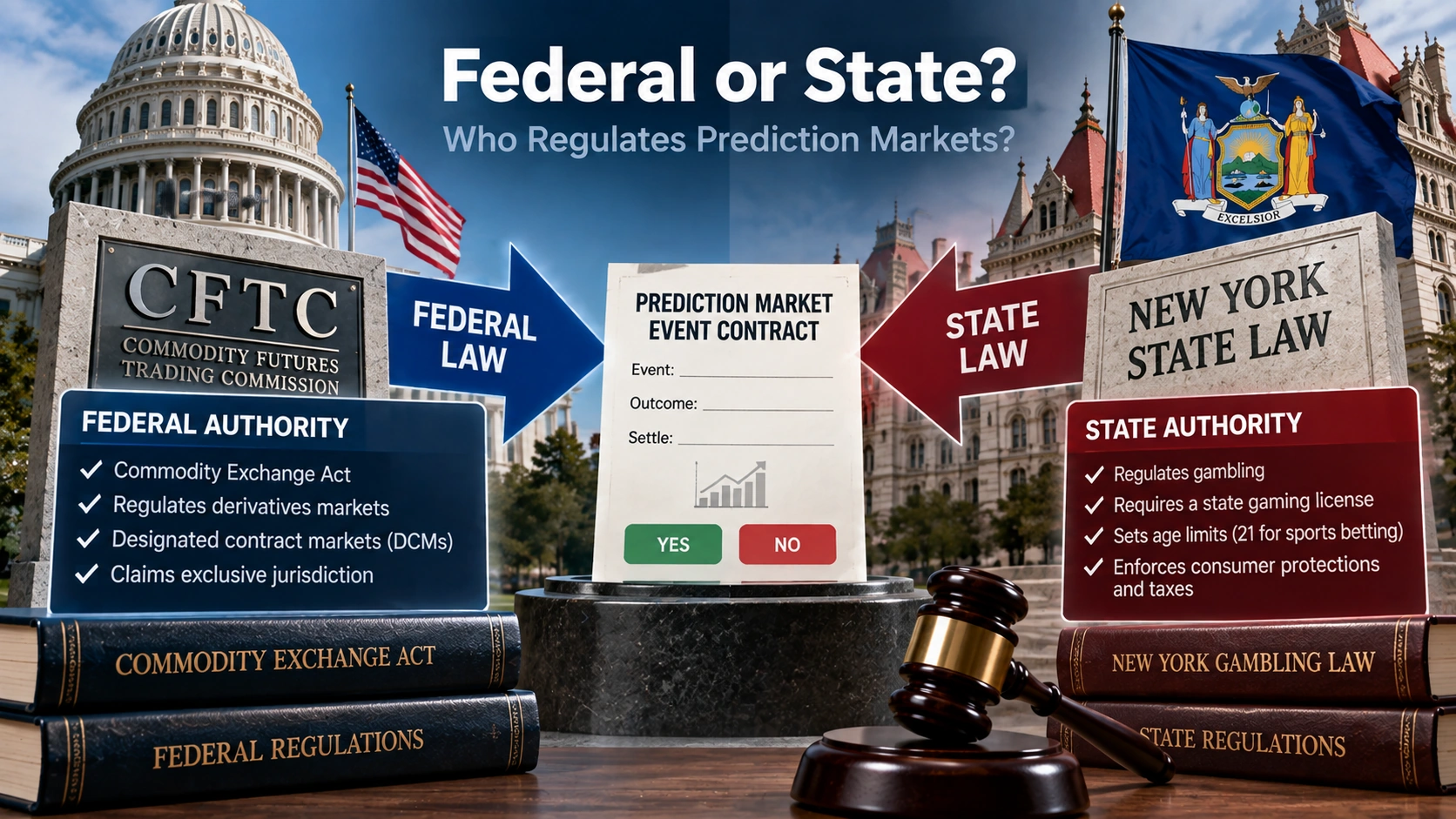
The CFTC says it does.
The agency has repeatedly taken the position that Congress gave it exclusive jurisdiction over federally regulated derivatives markets, including event contracts traded on DCMs.
In 2026, the CFTC went beyond regulatory statements and sued several states that were trying to apply state gambling laws to federally regulated prediction markets. In an April action involving Wisconsin, the CFTC said states could not circumvent what it viewed as Congress’s decision to establish one national derivatives framework. (cftc.gov)
The CFTC has made similar arguments in other state disputes and appellate filings. (cftc.gov)
That sounds decisive.
But there is an important legal word here: preemption.
Federal preemption means federal law displaces a state law that would otherwise apply.
Polymarket and other prediction exchanges therefore need more than the argument that the CFTC regulates them. The bigger question is whether the Commodity Exchange Act prevents New York from applying its own gambling rules to the same contracts.
And courts have not uniformly accepted the industry’s answer.
What Did the Kalshi Case Already Tell Us?
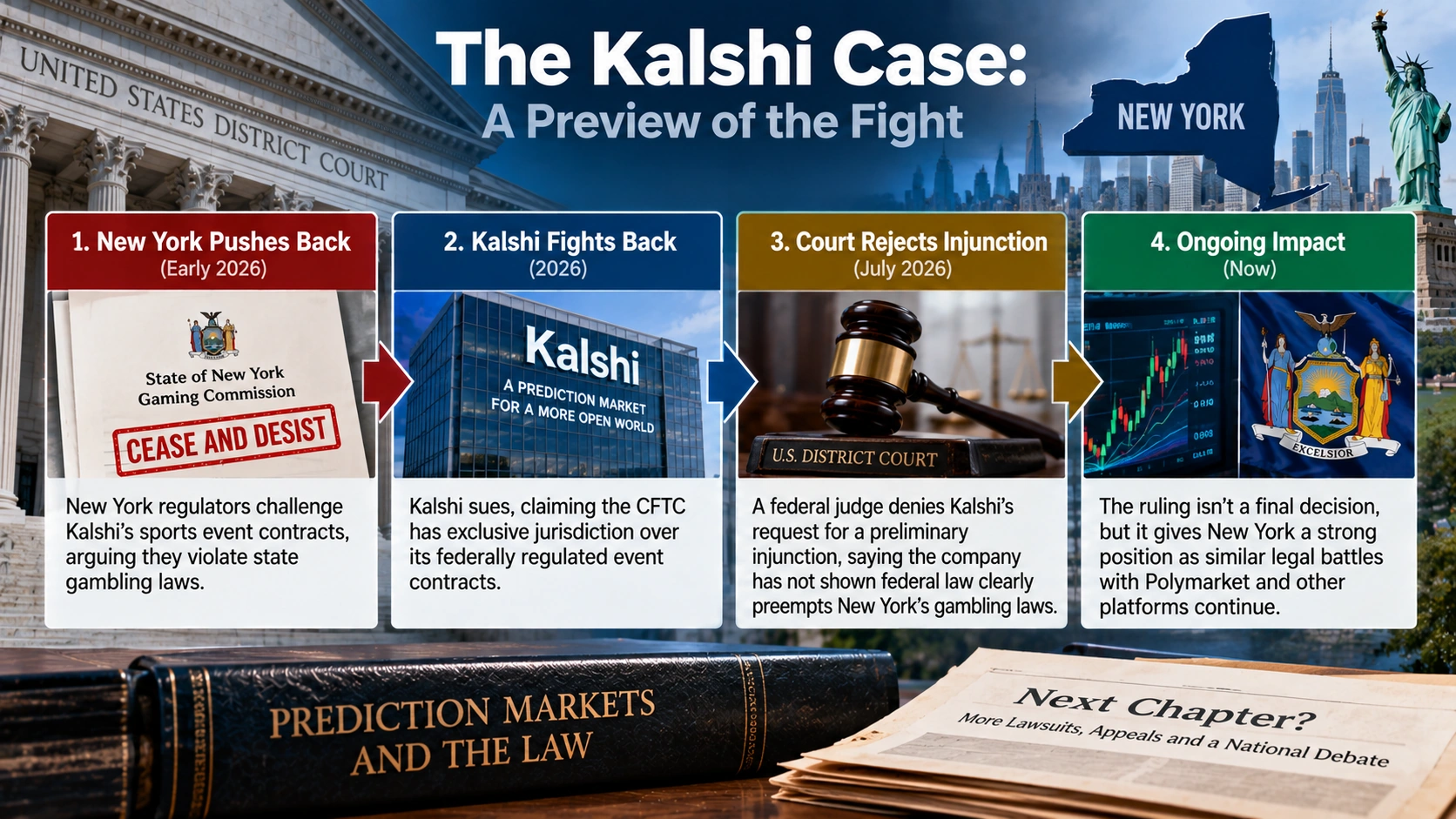
Kalshi provides the clearest preview because it has already fought New York over nearly the same basic jurisdictional question.
Kalshi is also a CFTC-designated prediction exchange. After New York regulators challenged its sports contracts, Kalshi argued that the Commodity Exchange Act gave the CFTC exclusive jurisdiction and therefore blocked New York from applying its gambling laws.
In July, U.S. District Judge Analisa Torres rejected Kalshi’s request for a preliminary injunction against New York enforcement.
The court found at that stage of the case that Kalshi had not shown a sufficient likelihood that federal law preempted New York’s gambling laws as applied to its sports-event contracts. (law.justia.com)
That ruling did not finally decide every legal issue in the case.
It decided whether Kalshi had made the showing necessary for preliminary relief while the broader litigation continued.
But the reasoning matters enormously for Polymarket.
The court emphasized the long history of states regulating gambling and rejected, at least at the preliminary-injunction stage, the idea that the CFTC’s federal role automatically removed New York from the field. (law.justia.com)
So the Polymarket lawsuit is not starting on an empty legal map.
New York now has a recent federal-court decision pointing in its direction.
The prediction-market industry still has the CFTC itself arguing strongly in the opposite direction.
Why Isn’t This Just the Same as DraftKings or FanDuel?
Because the regulatory structure is different.
A conventional New York mobile sportsbook operates under New York gaming law and a state licensing system.
A prediction exchange such as Polymarket US operates through the federal derivatives framework.
That difference affects far more than what the app calls a bet.
| Issue | New York Mobile Sportsbook | CFTC-Regulated Prediction Exchange |
|---|---|---|
| Primary regulator | New York State Gaming Commission | Commodity Futures Trading Commission |
| Legal framework | State gambling law | Federal commodities law |
| Minimum age relevant here | 21 for New York mobile sports wagering | Polymarket is available to users ages 18–20, according to New York |
| Product structure | Sports wagers | Tradable event contracts |
| Central legal question | Is the wager licensed under state law? | Does federal market regulation displace state gambling rules? |
The dispute is therefore not merely about whether Polymarket “looks like” DraftKings.
It is about whether the legal structure underneath the transaction changes which government has authority over it.
That is much harder to answer.
Why Does the 18-versus-21 Age Difference Matter So Much?
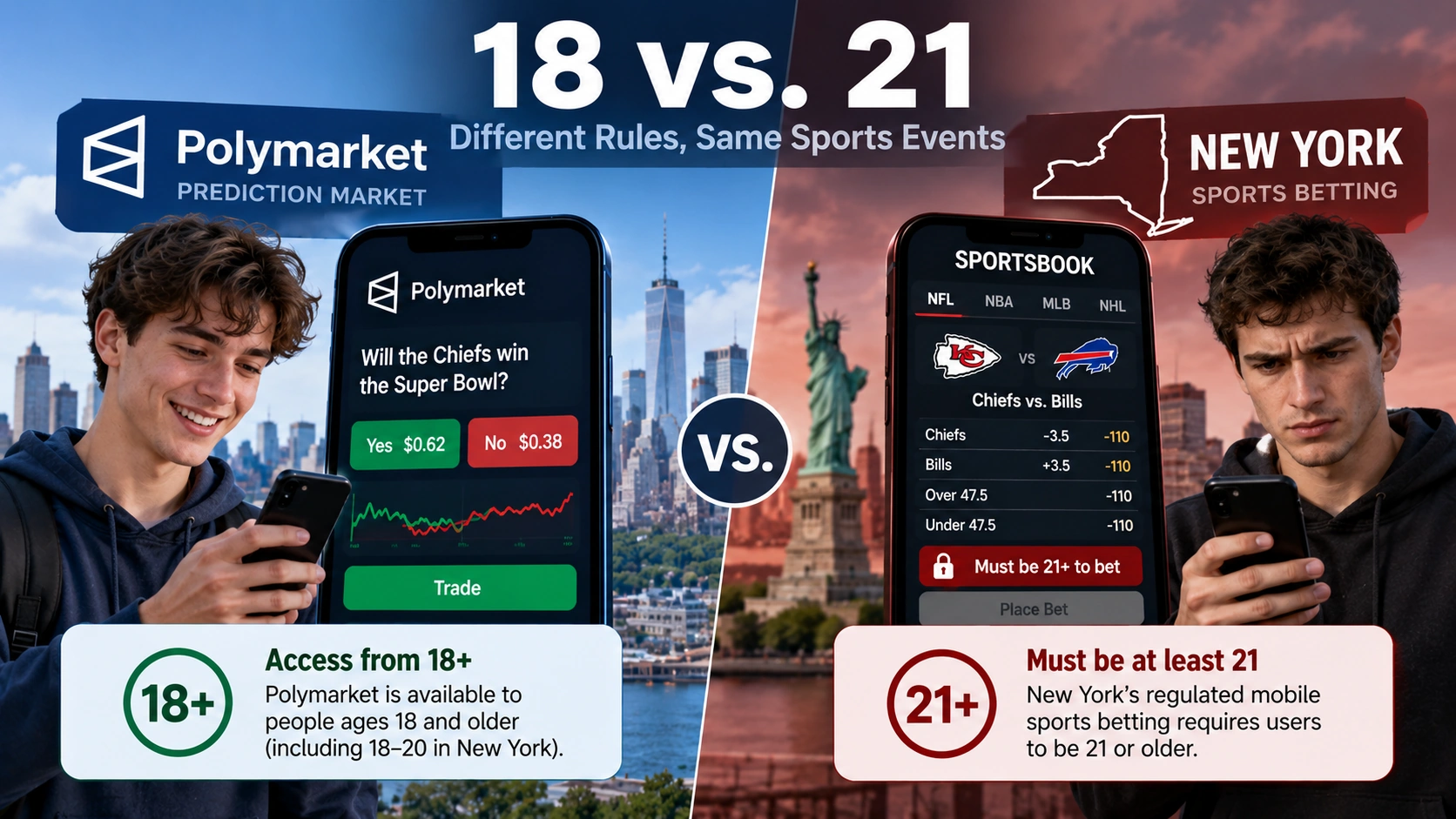
Because it shows why this fight is more than a technical argument between regulators.
New York’s mobile sports wagering framework requires customers to be at least 21. (New York State Gaming Commission)
The state says Polymarket’s structure allows younger adults to participate in transactions that, in New York’s view, function like sports bets.
That creates a strange real-world result.
An 18-year-old New Yorker could be too young to place a regulated mobile sports bet under state law, while potentially being old enough to access a federally regulated prediction contract tied to a similar sporting outcome.
New York officials say that gap undermines the state’s consumer-protection framework.
The prediction-market side sees the same difference as evidence that the products belong to a different federal regulatory category.
Again, the underlying disagreement is not really about arithmetic.
It is about classification.
Why Are States So Worried About Prediction Markets Now?
Scale.
Prediction markets are no longer a niche academic experiment.
Trading has expanded rapidly, particularly around sports and major public events. Reuters noted in September that the industry has been growing quickly as Polymarket, Kalshi and other platforms move closer to mainstream financial and consumer markets. (reuters.com)
New York’s comptroller reported that through July 2026, combined trading volume on Kalshi and Polymarket had reached $208.6 billion, with sports accounting for a large share of activity on both platforms. (osc.ny.gov)
That changes the stakes for state regulators.
If prediction exchanges handle only a tiny number of specialist contracts, the boundary between commodities law and gambling law can remain an obscure legal debate.
If billions of dollars begin flowing through contracts tied to NFL games, elections, awards, weather and other public events, the question becomes much harder for governments to ignore.
There are also tax, advertising, age-verification and problem-gambling consequences.
A state-regulated sportsbook operates inside one set of requirements.
A federally regulated prediction market may operate under another.
Whichever regulatory system ultimately controls could determine not only who regulates the companies, but which consumer protections apply.
Could New York Ban Polymarket While It Operates Elsewhere?
Potentially, yes.
That is one possible result if courts conclude that state gambling laws are not preempted.
A federally registered exchange could remain legal under federal commodities law while facing restrictions in particular states.
From the platform’s perspective, that creates a serious problem.
Financial exchanges are designed around national markets and common pools of liquidity. A patchwork in which residents of some states can trade certain contracts and residents of other states cannot could make national prediction exchanges more complicated to operate.
That is one reason the CFTC has pushed back so aggressively against state enforcement.
The federal agency argues that Congress deliberately created a national regulatory framework for derivatives markets and that allowing individual states to impose conflicting rules threatens that structure. (cftc.gov)
States answer that gambling regulation has historically been one of their core responsibilities.
Both arguments have significant legal history behind them.
That is why one lawsuit will not necessarily settle the issue nationwide.
Does This Mean Every Polymarket Contract Is Being Challenged?
No.
The clearest regulatory conflict centers on contracts that look most like traditional gambling—especially sports-related event contracts.
The Commodity Exchange Act itself recognizes that “gaming” contracts can require special treatment, and the CFTC’s June proposal focuses on how to evaluate event contracts involving gaming and several other specially listed activities. (cftc.gov)
A prediction contract tied to an economic indicator, for example, may present a different regulatory question from a contract asking which team will win tonight’s game.
That distinction is likely to become increasingly important.
The phrase “prediction market” covers a very broad category.
Sports outcomes, elections, economic data, weather events, entertainment awards and scientific developments can all be turned into event contracts, but they do not necessarily raise identical legal concerns.
The harder regulators push on sports contracts, the more important those distinctions become.
What Happens Next?
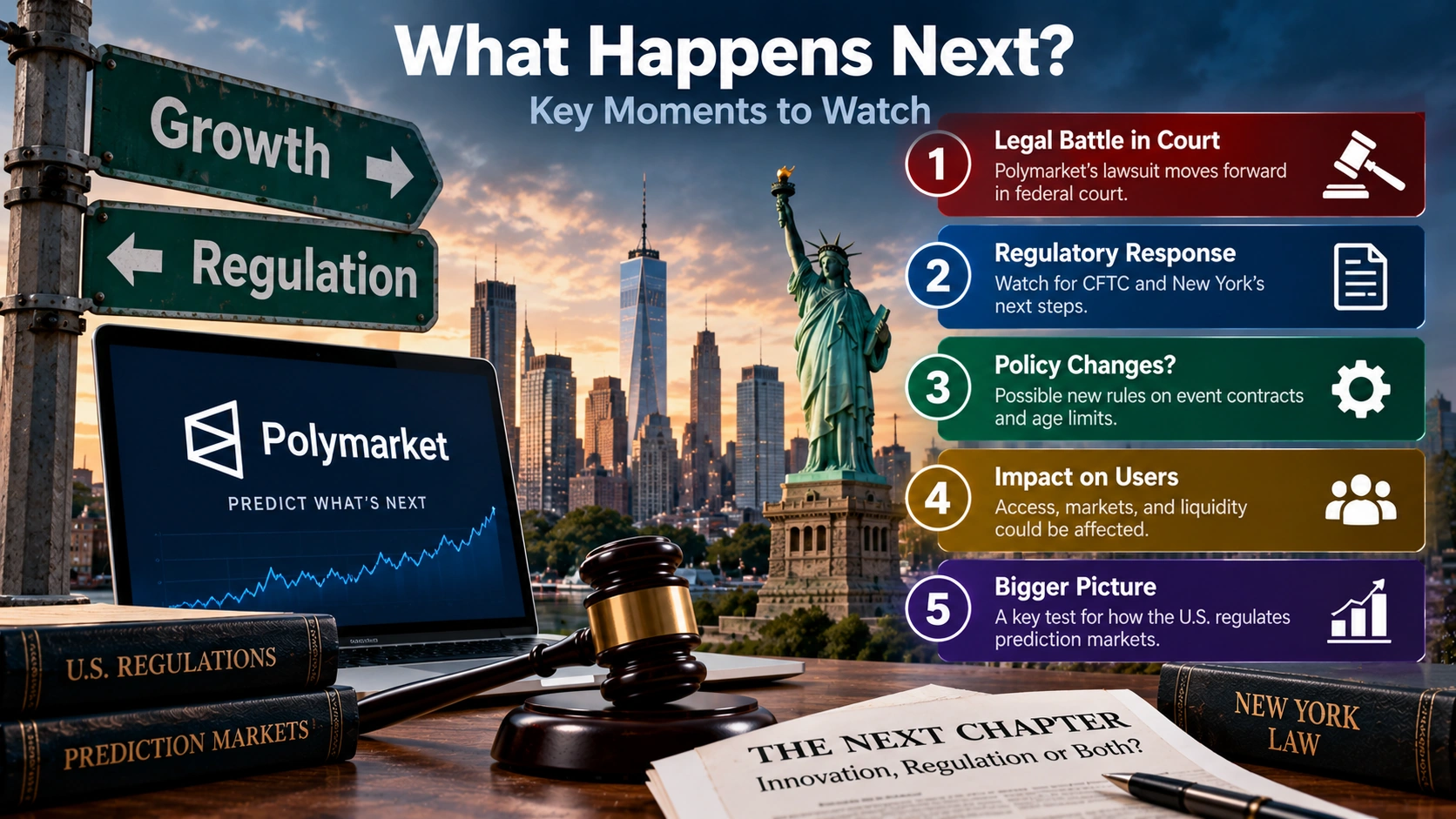
Several things are now happening at the same time.
First, New York’s state case against Polymarket can proceed as the state seeks to apply its gambling laws to the platform.
Second, Polymarket has opened a separate federal front. On Thursday evening, it sued Attorney General Letitia James and other New York officials in Manhattan federal court, seeking to block them from regulating its prediction market. (Bloomberg Law · Reuters)
Third, the broader federal-state fight is already moving through multiple courts. Kalshi appealed the July New York ruling, and other state disputes have produced different results, which means the national jurisdiction question is still unsettled. (Reuters)
Fourth, the CFTC is still developing its regulatory approach to event contracts. Its June proposal would create a process for examining contracts involving gaming and other specially listed activities. (CFTC)
That means the rules can evolve through both litigation and regulation.
The question to watch is not simply whether Polymarket survives one New York lawsuit.
It is whether courts ultimately draw a durable line between:
a federally regulated event contract
and
a state-regulated bet.
Until that line becomes clearer, prediction markets can continue occupying an unusual legal space where the same transaction may be described as a financial product by one regulator and gambling by another.
Why It Matters in One Sentence
The Polymarket lawsuit matters because it could help determine whether rapidly growing prediction markets operate primarily under one national CFTC framework or must also follow state gambling rules whenever their event contracts resemble traditional betting.
Polymarket Lawsuit: Key Questions Explained
Q. Why is New York suing Polymarket?
New York alleges that Polymarket US is offering unlicensed gambling, particularly sports-related event contracts, without a New York State Gaming Commission license. Polymarket disputes that characterization. (ag.ny.gov)
Q. Is Polymarket regulated by the federal government?
Yes. QCX LLC d/b/a Polymarket US is listed by the CFTC as a designated contract market. (CFTC)
Q. If Polymarket is CFTC-regulated, why can New York still sue it?
Because the unresolved legal question is whether federal commodities law preempts state gambling law. Federal regulation by itself does not automatically settle the scope of state authority.
Q. What is an event contract?
An event contract is a derivative tied to the outcome of a defined event. The CFTC says these contracts are often yes-or-no products and can be used for speculation or hedging. (CFTC)
Q. Are prediction markets the same as sportsbooks?
Not structurally. Sportsbooks operate under state gambling systems, while federally registered prediction exchanges use event contracts under commodities regulation. The lawsuit asks whether some sports event contracts nevertheless remain subject to state gambling laws.
Q. What did the New York court decide in the Kalshi case?
At the preliminary-injunction stage, a federal judge ruled that Kalshi had not shown a sufficient likelihood that federal law preempted New York gambling laws as applied to its sports-event contracts. The broader litigation was not finally resolved by that preliminary decision. (law.justia.com)
Q. Why is the legal gambling age part of the dispute?
New York requires mobile sports bettors to be at least 21, while the state says Polymarket is available to users ages 18 through 20. New York argues that this creates a consumer-protection gap when similar sports outcomes can be traded through prediction contracts. (New York State Gaming Commission · New York Attorney General)
Q. Does the CFTC believe states can regulate these markets?
The CFTC has repeatedly argued that federal law gives it exclusive jurisdiction over federally regulated prediction markets and has challenged several states’ attempts to apply gambling laws to registered exchanges. (cftc.gov)
Q. Does CFTC registration mean every prediction contract is automatically allowed?
No. Federal law gives the CFTC special authority to review event contracts involving categories such as gaming, war, terrorism, assassination and conduct that is unlawful under federal or state law. (cftc.gov)
Q. What should prediction-market users watch next?
The most important developments are the New York Polymarket litigation, appeals and related state cases involving other prediction exchanges, and the CFTC’s continuing rulemaking on event contracts.
Did this help make the story clearer? 🙂
WIN keeps unpacking the “why” behind the news—clearly and simply!
Sources
New York’s Lawsuit and Polymarket’s Federal Response
New York Attorney General — Lawsuit Against Polymarket for Running Illegal Gambling Operation
ABC News — New York Attorney General Files Suit Against Polymarket
Bloomberg Law — New York Sues Polymarket; Polymarket Files Federal Challenge
Reuters — Polymarket Sues New York Attorney General to Block Regulation
Federal Prediction-Market Regulation
CFTC — QCX LLC d/b/a Polymarket US Designated Contract Market Filing
CFTC — Understanding Prediction Markets and Event Contracts
CFTC — Proposed Framework for Event Contracts Involving Gaming and Other Enumerated Activities
CFTC — Exclusive Jurisdiction Dispute With States
New York Gambling Rules and the Kalshi Precedent
New York State Gaming Commission — Mobile Sports Wagering Rules and Age Requirements
Federal Court — KalshiEX LLC v. Williams Preliminary Injunction Decision
Reuters — Judge Rejects Kalshi Bid to Block New York Gambling Enforcement
New York State Comptroller — Sports Wagering and Prediction-Market Report