Congress Voted on Trump’s Iran War Powers Again—What Can a War Powers Resolution Actually Do?

Didn’t Congress already vote on this?
And if Congress tells a president to stop using U.S. forces in a war, doesn’t that mean the fighting has to stop?
Those questions became harder to answer after September 24, when the Senate rejected H.Con.Res. 89 by just one vote, 49–50. The measure had already passed the House in July, 214–208. Four Republican senators joined most Democrats in supporting it, while Democratic Sen. John Fetterman voted against it and Sen. Angela Alsobrooks did not vote. (U.S. Senate)
But the surprising part is that Congress had already gone through a similar exercise earlier in the year. In June, both the House and Senate approved H.Con.Res. 86, another Iran war-powers measure. The administration disputed that resolution’s legal force, and the constitutional argument did not disappear. (U.S. House Clerk)
So this is not simply a story about one close Senate vote.
It is a story about a much older question: When the United States is already using military force, who ultimately gets to decide whether it continues—Congress or the president?
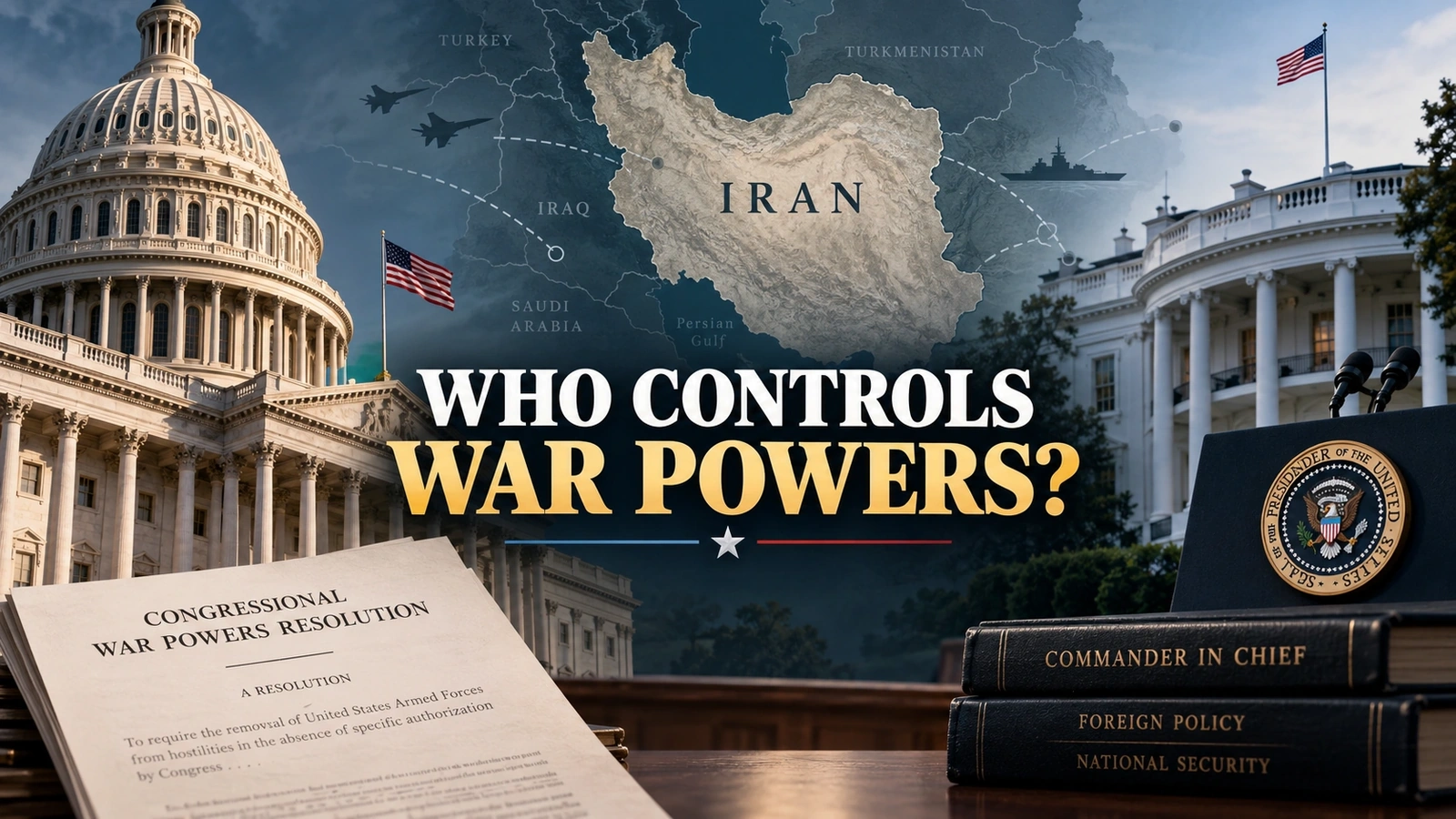
※ Images in this article are AI-generated illustrations created to help explain the story. They are not actual photographs, and depictions of people, places, or events may differ slightly from reality.
The answer is more complicated than either “Congress decides” or “the president is commander in chief.”
What Did the Senate Actually Vote On?
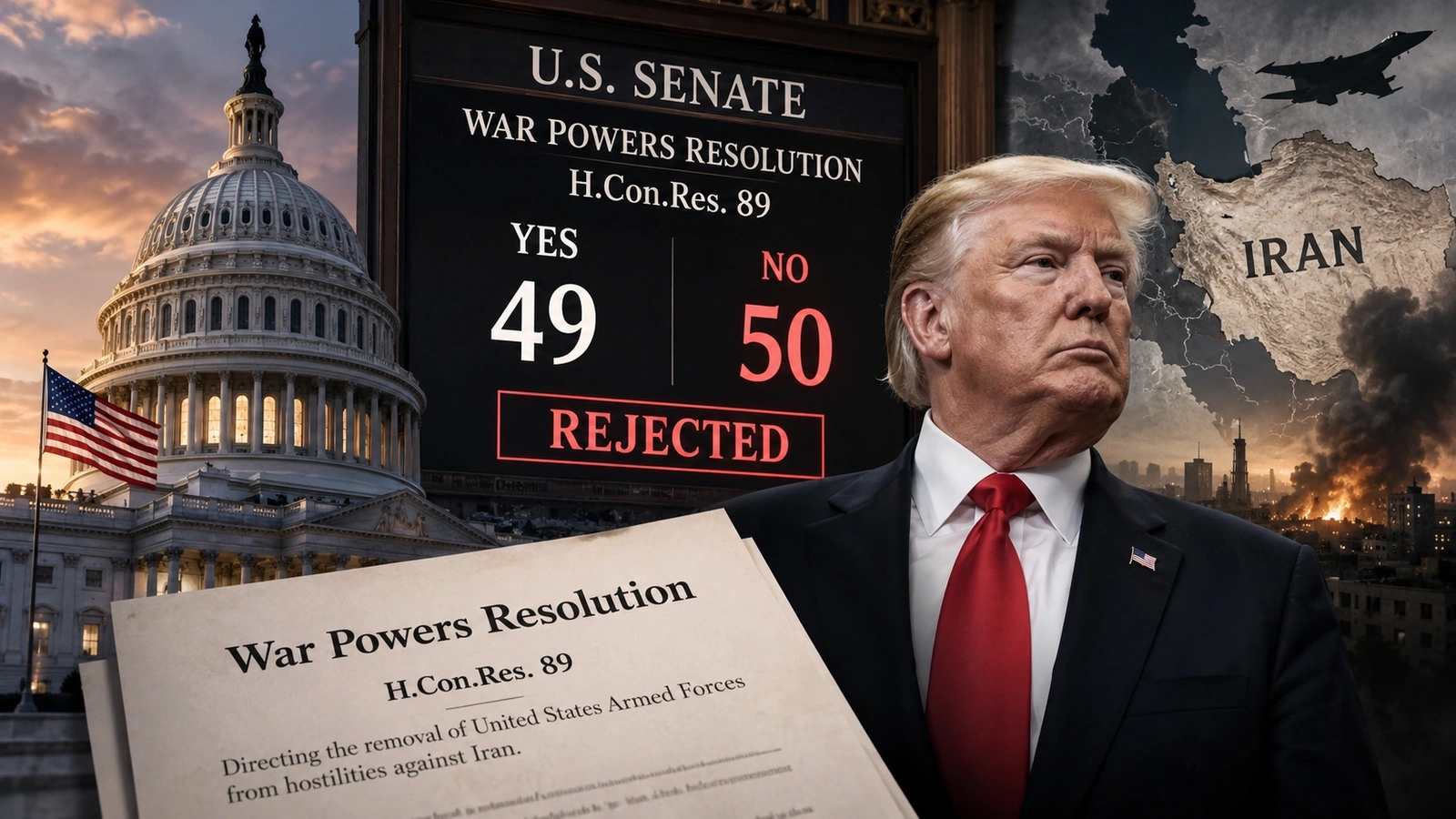
H.Con.Res. 89 was a concurrent resolution invoking Section 5(c) of the War Powers Resolution.
Its central instruction was that the president should remove U.S. forces from hostilities against Iran unless Congress had expressly authorized those hostilities through a declaration of war or a specific authorization for military force. (GovInfo)
The resolution was not written to require every U.S. service member to leave the Middle East.
It expressly preserved the ability to defend the United States, U.S. forces, diplomatic facilities and allies from imminent attack. It also allowed defensive troop deployments in the region and did not require troops who were not participating in hostilities against Iran to leave. Intelligence, counterintelligence and certain intelligence-sharing activities were also protected. (GovInfo)
That distinction matters.
The proposal was aimed at unauthorized hostilities with Iran, not at eliminating every American military activity in the region.
Didn’t Congress Already Pass an Iran War Powers Resolution?
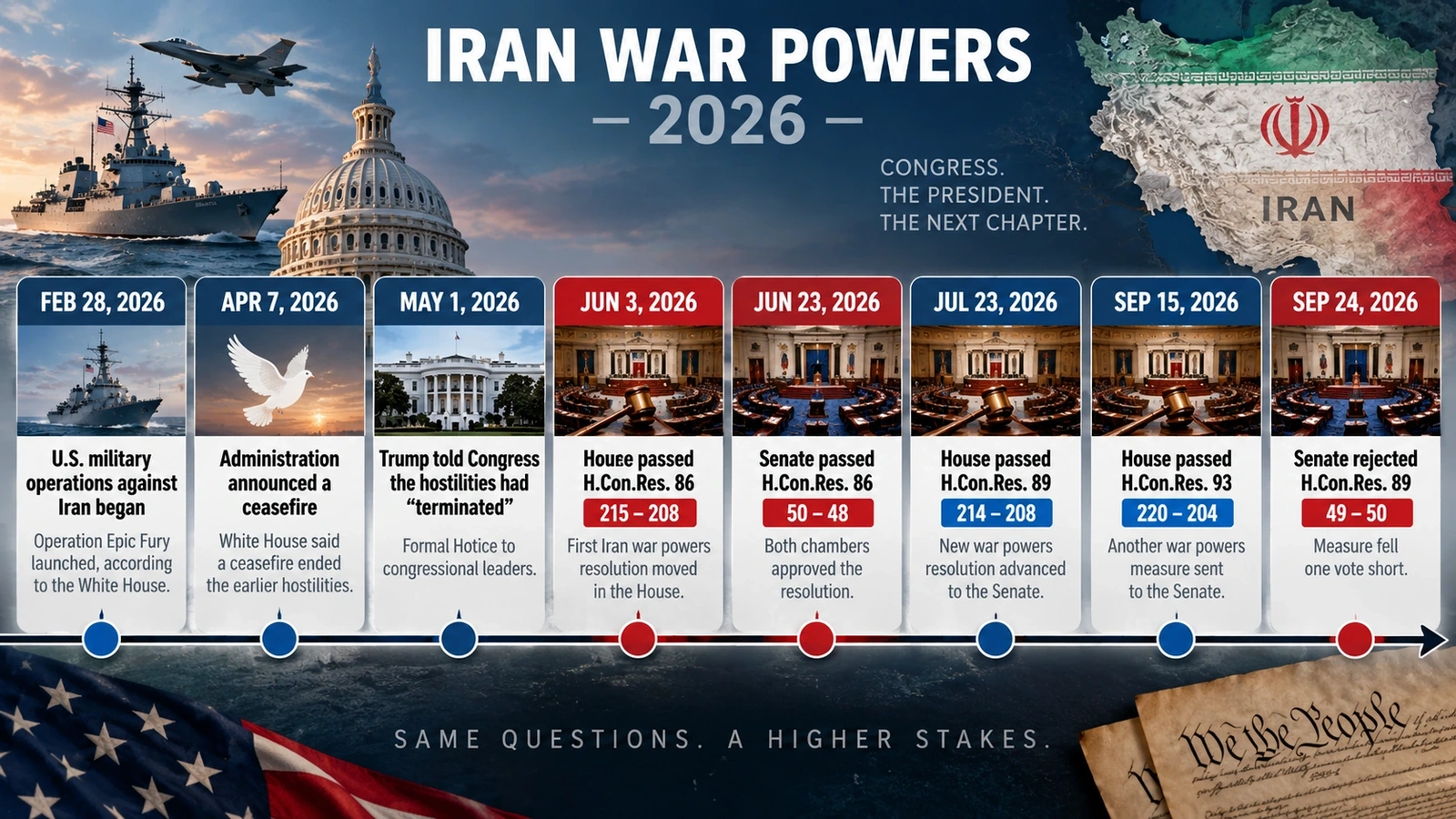
Yes.
That is one reason the September vote can seem confusing.
| Date | What happened | Why it mattered |
|---|---|---|
| February 28 | U.S. military operations against Iran began | Triggered the modern war-powers dispute |
| April 7 | The administration said a ceasefire ended the earlier hostilities | Became central to the administration’s argument about the 60-day clock |
| May 1 | Trump told Congress the earlier hostilities had “terminated” | The administration said the War Powers deadline no longer required withdrawal |
| June 3 | House passed H.Con.Res. 86, 215–208 | Congress moved to invoke Section 5(c) |
| June 23 | Senate passed H.Con.Res. 86, 50–48 | Both chambers had approved the concurrent resolution |
| July 23 | House passed H.Con.Res. 89, 214–208 | Congress began another round of the war-powers process |
| September 15 | House passed H.Con.Res. 93, 220–204 | A newer House war-powers measure was also sent to the Senate |
| September 24 | Senate rejected H.Con.Res. 89, 49–50 | The Senate voted on the earlier House-passed measure under a previously scheduled agreement |
The White House said Operation Epic Fury began February 28. It later argued that a ceasefire beginning April 7 ended the hostilities for purposes of the War Powers Resolution. On May 1, Trump formally told congressional leaders that those hostilities had terminated. Critics in Congress disputed whether continuing military activity could be treated that way. (White House · AP)
Then came H.Con.Res. 86.
The House approved it 215–208 on June 3, and the Senate approved it 50–48 on June 23. The Trump administration maintained that a concurrent resolution did not have binding legal force and cited the Supreme Court’s 1983 decision in INS v. Chadha as part of its argument. (U.S. House Clerk · White House OMB)
There was yet another House vote shortly before the September Senate action. On September 15, the House passed H.Con.Res. 93 by 220–204, and the measure was referred to the Senate Foreign Relations Committee the next day. The Senate nevertheless took up H.Con.Res. 89 on September 24 because senators had already reached an agreement to discharge and vote on H.Con.Res. 89 no later than October 2. (U.S. House Clerk · GovInfo · Congressional Record Daily Digest)
That sequence is the key to understanding why Congress could keep voting on similar Iran war-powers measures.
A congressional vote and a legally uncontested order to end military operations are not necessarily the same thing.
Who Actually Controls U.S. War Powers?
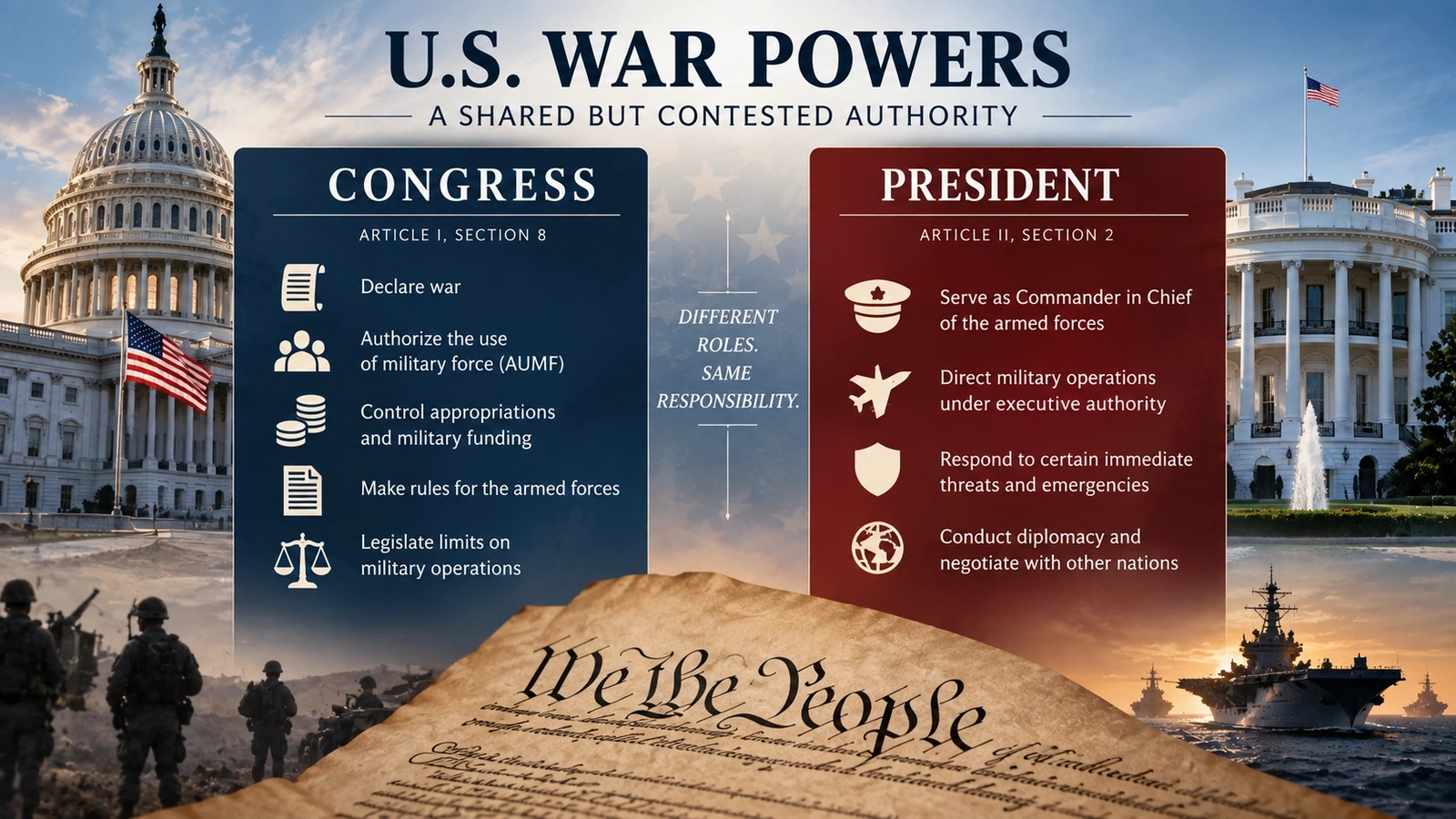
The Constitution divides war authority rather than putting every military decision in one place.
Congress has the power to declare war, raise and support armies, maintain a navy, make rules governing the armed forces and control federal appropriations. The president, meanwhile, is Commander in Chief of the armed forces. (Constitution Annotated)
| Congress | President |
|---|---|
| Declares war | Serves as Commander in Chief |
| Can enact an Authorization for Use of Military Force, or AUMF | Directs military operations under executive authority |
| Controls appropriations and military funding through legislation | Can respond to certain immediate threats and emergencies under claimed constitutional authority |
| Can legislate limits on military operations | Has historically asserted varying degrees of independent Article II authority |
The difficult part is the boundary between those powers.
The Supreme Court has recognized that only Congress has the constitutional power to declare war, but the full relationship between that power and presidential authority to use military force without a formal declaration remains heavily disputed. The legislative and executive branches have disagreed over that boundary for generations. (Constitution Annotated)
That is why the phrase “the president is Commander in Chief” does not by itself resolve every war-powers dispute.
And neither does the phrase “Congress has the power to declare war.”
What Does the War Powers Resolution Actually Require?
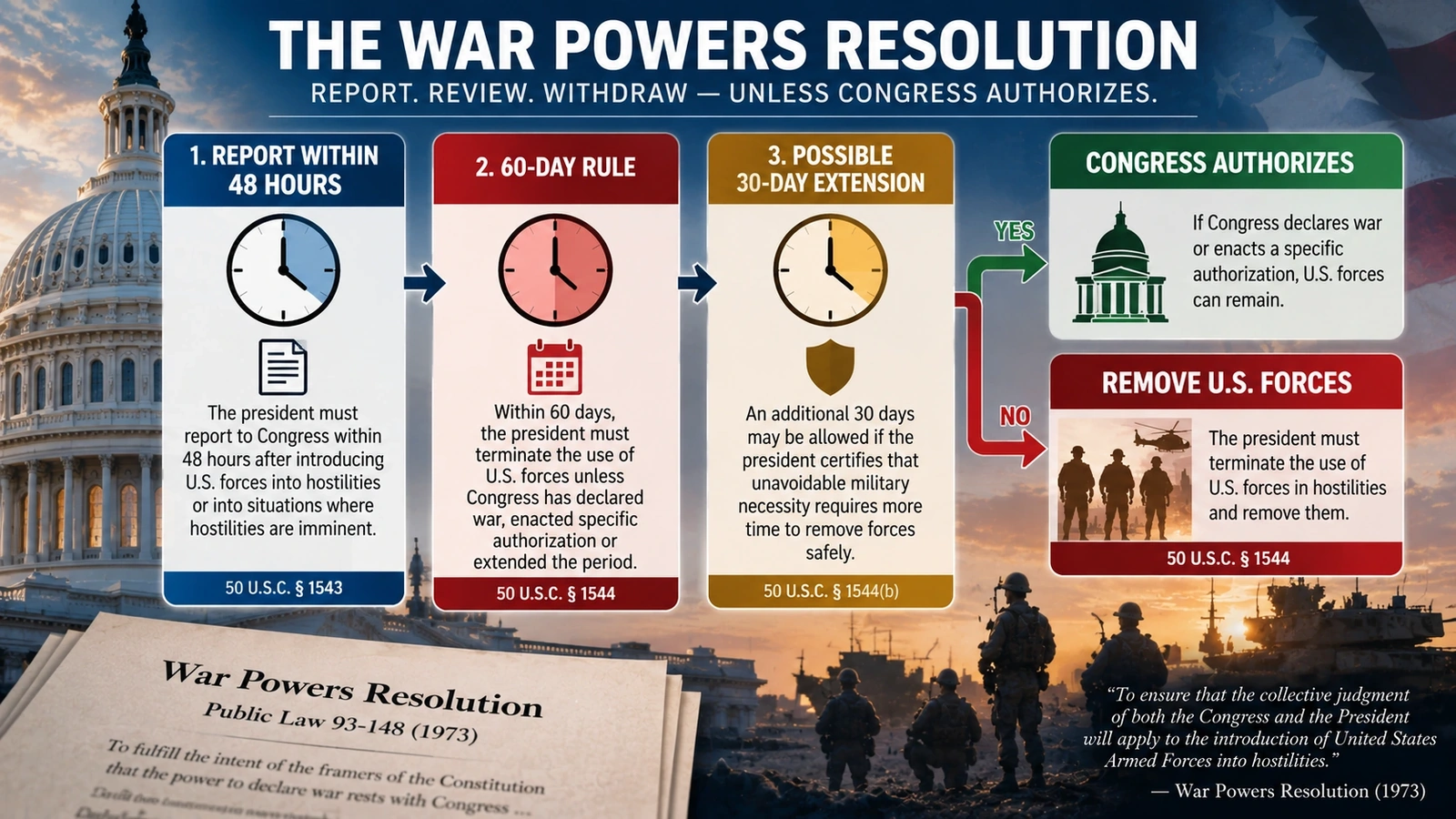
Congress enacted the War Powers Resolution in 1973 over President Richard Nixon’s veto, after years of conflict over presidential military action during the Vietnam era. (Constitution Annotated)
Its basic structure is easier to understand as a clock.
A president who introduces U.S. forces into hostilities without a declaration of war generally must report that action to Congress within 48 hours. (50 U.S.C. § 1543)
Once the relevant reporting requirement is triggered, Section 5(b) says the president must terminate the use of those forces within 60 days unless Congress has declared war, enacted specific authorization or extended the period by law. A further period of up to 30 days can be used when the president certifies that unavoidable military necessity requires more time to remove forces safely. (50 U.S.C. § 1544)
But there is a common misunderstanding here.
The War Powers Resolution does not say that every president automatically receives a free 60-day authorization to fight any war.
The statute itself says it should not be interpreted as granting the president military authority the president would not otherwise possess. It also says ordinary appropriations should not automatically be treated as authorization for hostilities unless Congress expressly says so. (50 U.S.C. § 1547)
So the 60-day mechanism is a restriction and procedure built around a larger constitutional dispute—not a simple blank check.
Why Is the Phrase “Concurrent Resolution” So Important?
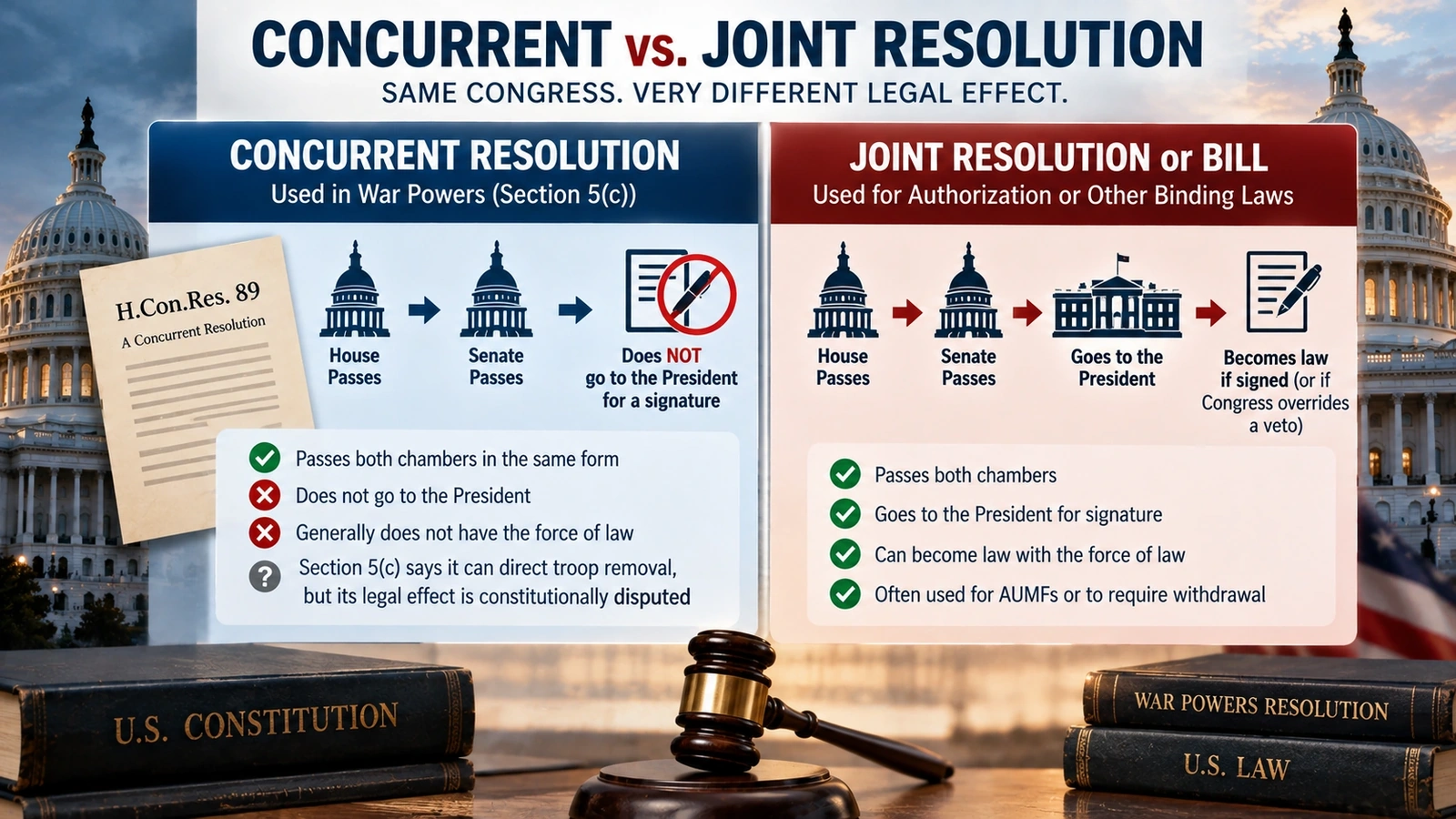
This is the part that turns an apparently simple vote into a constitutional puzzle.
The Senate’s own legislative guide says a concurrent resolution must pass both chambers in the same form, does not go to the president for a signature and ordinarily does not have the force of law. (U.S. Senate)
Yet Section 5(c) of the War Powers Resolution says that when U.S. forces are engaged in unauthorized hostilities abroad, the president shall remove them if Congress directs removal by concurrent resolution. (50 U.S.C. § 1544)
Those two ideas sit awkwardly together today.
Why? Because in 1983, the Supreme Court decided INS v. Chadha, a major separation-of-powers case involving a congressional “legislative veto.” The case was not an Iran war-powers case, but it raised serious constitutional questions about congressional mechanisms designed to produce legal effects without going through presidential presentment.
Congress’s own Constitution Annotated notes that after Chadha, Congress created expedited procedures for joint resolutions or bills that would require the removal of U.S. forces. (Constitution Annotated)
| Legislative vehicle | Goes to president? | General legal effect |
|---|---|---|
| Concurrent resolution | No | Generally does not have force of law |
| Joint resolution or bill | Yes | Can become law if signed, or if Congress overrides a veto |
| War Powers Section 5(c) concurrent resolution | No | Statutory text says it can direct removal, but its enforceability is constitutionally disputed |
The Trump administration has taken one side of that dispute. In its July statement opposing H.Con.Res. 89, the White House Office of Management and Budget argued that concurrent resolutions of this kind lack the force of law and should be treated as unconstitutional legislative vetoes under INS v. Chadha. Supporters of the resolutions have argued that Section 5(c) remains part of federal statute and directs presidential compliance. (White House OMB)
WIN’s useful distinction is therefore:
The statute still contains Section 5(c). The legal effect of using that mechanism after Chadha is the contested part.
If H.Con.Res. 89 Had Passed, Would the War Have Ended Automatically?
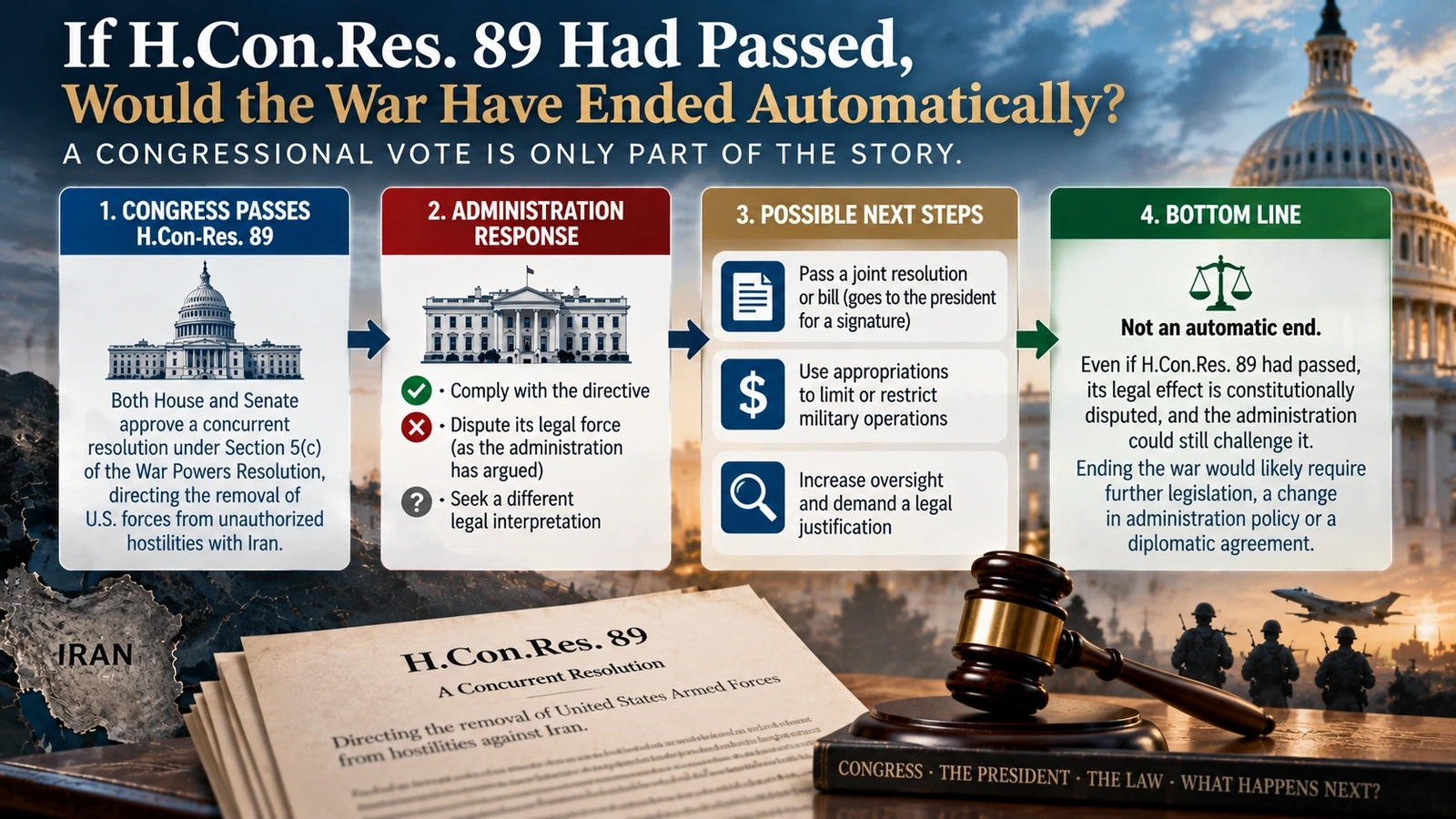
Not automatically in the straightforward sense many readers might expect.
If the Senate had approved H.Con.Res. 89, both chambers would have approved a Section 5(c) directive telling the president to remove U.S. forces from unauthorized hostilities with Iran.
But the administration had already made clear in June that it rejects the argument that this kind of concurrent resolution is legally binding. The earlier H.Con.Res. 86 passed both chambers, yet the administration maintained that such measures lack legal force. (Reuters)
That does not mean Congress has no war powers.
It means this particular mechanism has a disputed enforcement problem.
A binding bill or joint resolution presents a different structure because it goes through the normal lawmaking process: passage by both chambers, presidential signature or a congressional override of a veto.
H.Con.Res. 89 never reached that next constitutional dispute on September 24 because the Senate rejected it 49–50. (U.S. Senate)
What Else Can Congress Do About a War?
A War Powers concurrent resolution is only one congressional tool.
Congress can also consider an Authorization for Use of Military Force, usually called an AUMF. That can authorize military action while defining its targets, geographic limits, duration or other conditions.
Congress can pass legislation directing the termination or limitation of military operations. Unlike a concurrent resolution, a bill or joint resolution intended to have the force of law normally must go to the president; a veto can be overridden only with the constitutionally required supermajorities.
Congress also controls appropriations. In practical terms, lawmakers can attempt to restrict which military activities federal money may support—but those restrictions themselves have to become law.
And Congress can conduct oversight, demand reports, hold hearings and require the executive branch to explain the claimed legal basis for military action.
That broader structure helps explain why war-powers fights rarely end with a single roll-call vote.
Why Does Congress Keep Voting If the Legal Dispute Is Still Unresolved?
Because votes can matter in more than one way.
One purpose is legal: lawmakers supporting these resolutions argue that Congress is exercising authority provided by the War Powers Resolution.
Another is institutional: repeated votes establish where Congress stands on whether military operations should continue without explicit legislative authorization.
And a third is practical. A close vote can affect what legislation comes next—an AUMF, a funding restriction, a bill requiring withdrawal, or another attempt at a War Powers measure.
The September 24 vote was especially close. The official Senate tally was 49 in favor, 50 against and one senator not voting, so H.Con.Res. 89 was rejected. (U.S. Senate)
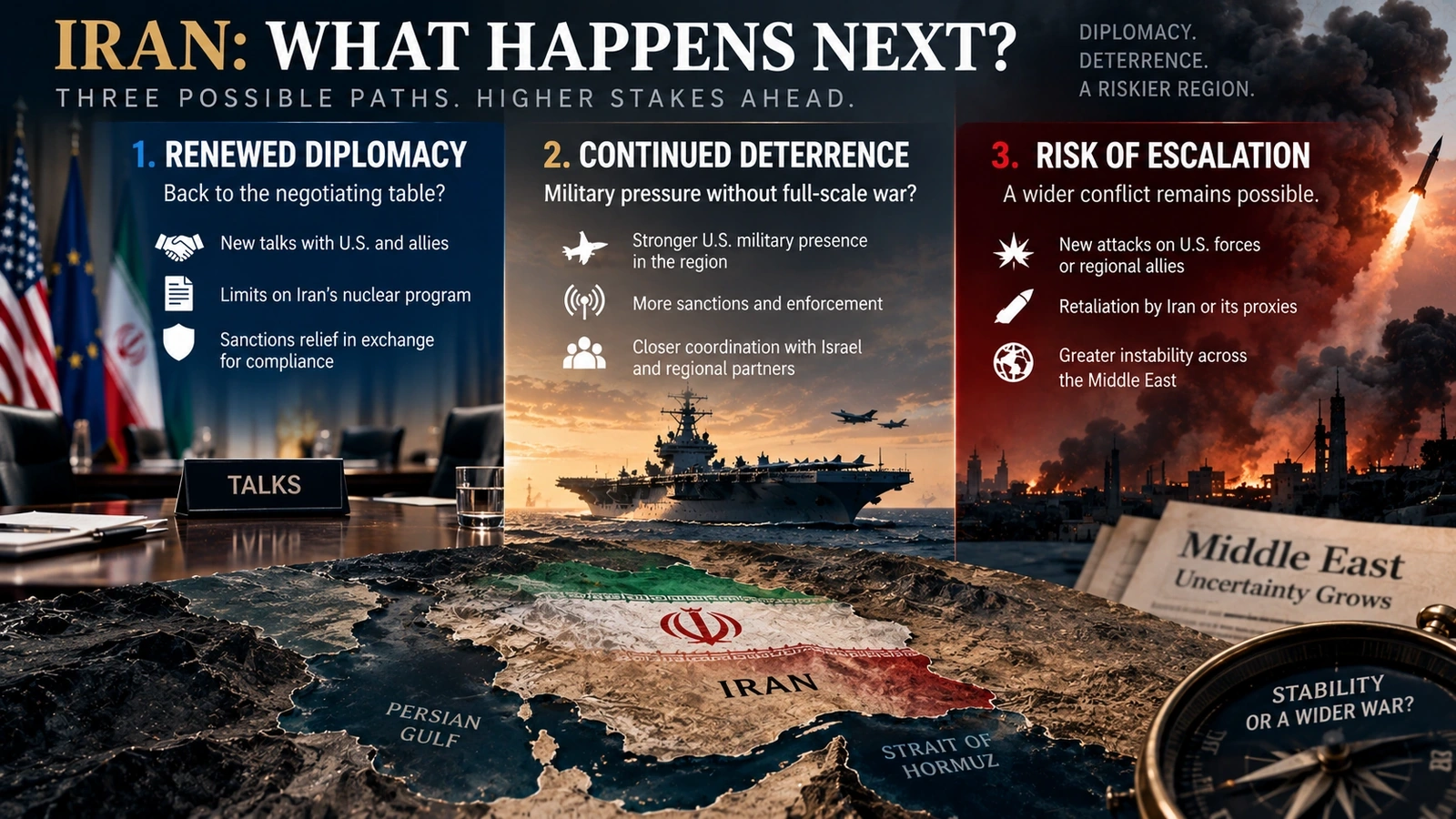
Meanwhile, the underlying Iran conflict remained active nearly seven months after it began. Iran said in September that it could reopen the Strait of Hormuz if the United States eased military pressure and lifted its blockade, while Secretary of State Marco Rubio said Washington remained open to talks that could lead to a positive outcome. (Reuters)
So Congress is debating war powers at the same time diplomacy and military pressure are still evolving.
What Should You Watch Next?
The next important development may not be another concurrent resolution.
Watch for whether lawmakers introduce a binding bill or joint resolution, whether Congress debates a specific Iran AUMF, or whether appropriations legislation contains restrictions on military operations.
Also watch the administration’s legal explanations. The central questions are whether it continues to rely primarily on Article II commander-in-chief authority, how it describes the current state of “hostilities,” and whether it seeks explicit congressional authorization.
Finally, diplomacy matters.
If the United States and Iran reach a durable agreement that actually ends the relevant hostilities, the immediate War Powers dispute could change substantially. If major combat operations expand again, congressional pressure over authorization could intensify.
The important distinction is that Congress’s constitutional war powers, the president’s commander-in-chief role and the 1973 War Powers Resolution are overlapping parts of the same system—not interchangeable terms.
Why It Matters in One Sentence
The Senate’s 49–50 vote matters because the Iran debate is not only about whether Congress wants the fighting to continue—it exposes a decades-old constitutional dispute over how Congress can legally force a president to end military operations that lawmakers have not specifically authorized.
War Powers: Key Questions Explained
Q. What was H.Con.Res. 89?
H.Con.Res. 89 was a concurrent resolution invoking Section 5(c) of the War Powers Resolution and directing the president to remove U.S. forces from unauthorized hostilities against Iran, while preserving specified defensive and intelligence activities. (GovInfo)
Q. What happened in the Senate on September 24?
The Senate rejected H.Con.Res. 89 by 49 votes to 50, with one senator not voting. The House had previously approved the resolution 214–208. (U.S. Senate)
Q. Had Congress already passed another Iran war powers resolution?
Yes. H.Con.Res. 86 passed the House 215–208 on June 3 and the Senate 50–48 on June 23. The administration disputed its legal force. (U.S. House Clerk)
Q. Does the War Powers Resolution give a president 60 days of automatic authority to fight?
No. The statute establishes a 60-day withdrawal rule under specified circumstances, but it also says the War Powers Resolution itself does not grant the president military authority that the president would not otherwise possess. (50 U.S.C. § 1544)
Q. What is the difference between a concurrent resolution and a joint resolution?
A concurrent resolution passes both chambers but does not go to the president and ordinarily does not have the force of law. A joint resolution intended to become law generally goes through presidential presentment just like a bill. (U.S. Senate)
Q. Why is Section 5(c) controversial?
Section 5(c) expressly says Congress can direct troop removal through a concurrent resolution. But after the Supreme Court’s 1983 INS v. Chadha decision, the constitutional enforceability of legislative-veto-style mechanisms became disputed, and Congress created expedited procedures for joint resolutions or bills as well. (Constitution Annotated)
Q. Who has the constitutional power to declare war?
Congress has the constitutional power to declare war. The president is Commander in Chief, and the scope of presidential authority to initiate or continue military operations without explicit congressional authorization has long been disputed between the branches. (Constitution Annotated)
Q. What is an AUMF?
An Authorization for Use of Military Force is a law in which Congress specifically authorizes military action. It can define who may be targeted, where force may be used and what limits apply.
Q. Can Congress use funding to limit a war?
Congress controls federal appropriations and can enact restrictions on how military funds are used. But those restrictions must themselves complete the constitutional legislative process to become binding law.
Did this help make the story clearer? 🙂
WIN keeps unpacking the “why” behind the news—clearly and simply!
Sources
September 24 Vote and H.Con.Res. 89
U.S. Senate — Roll Call Vote No. 244, September 24, 2026
U.S. House Clerk — H.Con.Res. 89 Roll Call 282, July 23, 2026
CBS News — Iran war powers measure falls short in Senate
War Powers Law and Constitutional Authority
50 U.S.C. § 1543 — War Powers Reporting Requirement
50 U.S.C. § 1544 — Congressional Action and the 60-Day Rule
50 U.S.C. § 1547 — Interpretation of the War Powers Resolution
Congressional Constitution Annotated — War Powers and Presidential Authority
U.S. Senate — Types of Legislation and Concurrent Resolutions
2026 Iran War Powers Dispute
U.S. House Clerk — H.Con.Res. 86 Vote, June 3, 2026
U.S. Senate — H.Con.Res. 86 Vote, June 23, 2026
U.S. House Clerk — H.Con.Res. 93 Vote, September 15, 2026
GovInfo — H.Con.Res. 93 Referred in Senate
Reuters — Senate and House approval of H.Con.Res. 86 and the constitutional dispute
White House OMB — Statement of Administration Policy on H.Con.Res. 89
Keep Reading
Why Does the Iran Conflict Matter Beyond the War Powers Fight?
The congressional dispute is about who can authorize military force. The wider Iran conflict also reaches shipping routes, energy markets and the prices Americans can ultimately feel at the pump.
Saudi Arabia Built a Pipeline to Bypass Hormuz—So Why Is Its Oil Route Still at Risk?
How Is Trump Describing the Use of American Power More Broadly?
The Iran debate fits into a wider argument over military power, sovereignty and international rules that was also visible in Trump’s September U.N. address.
Did Trump Threaten Macron and Lula? What Their U.N. Speeches Actually Said